A midlife reset for men — and women hitting the same collision point — is not a holiday, a motorbike, or a motivational retreat. It is a precise reprogramming of the systems that have been quietly failing for years and have now reached critical load.
You are somewhere between 40 and 55. You have built things — a career, a family, a version of yourself that functions. From the outside, it looks like you have it together.
And somewhere underneath all of it, something is grinding.
It might be the drinking that has crept from two glasses to half a bottle without you noticing. It might be the rage that arrives faster than it used to, at smaller provocations. It might be the flatness — the absence of the drive that used to feel automatic. The Sunday evenings that feel like dread. The relationship is running on autopilot. The sense that you have been performing a version of yourself for so long that you can no longer locate the original.
That is not a crisis. That is a systems failure.
Systems failures don’t respond to holidays, motivational content, or white-knuckling through. They respond to diagnosis and the correct tool applied to the correct problem.
This is what the midlife reset for men actually looks like when it’s done properly.
Why a Midlife Reset for Men (and Women) Hits at 40+
The popular narrative about midlife is that people hit an existential crisis — they question their choices, blow up their lives, or suppress the feeling and carry on.
That narrative misses the mechanics entirely.
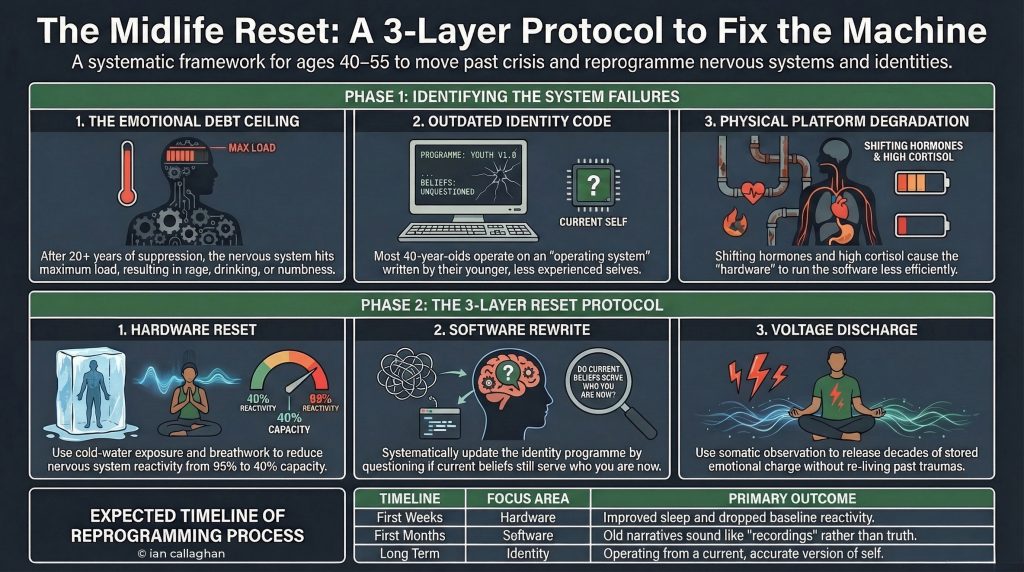
What is actually happening at 40-plus is a convergence of three specific system failures that have been building for decades and have now reached critical load. Understanding these is the starting point for any genuine reset.
System Failure 1: The Emotional Debt Ceiling
Most people reaching the midlife reset point have spent 20 to 30 years operating a specific emotional strategy: suppress, perform, push through. It works — for a while. It is an effective short-term survival mechanism in environments that punish emotional expression: high-pressure workplaces, demanding relationships, cultures that reward endurance over honesty.
The problem is that suppression is not resolution. Every time Bob fires a reaction that gets pushed down rather than processed, the stored activation accumulates in the nervous system. The body keeps a precise account.
By midlife, most people are running on a nervous system at maximum load — hair-trigger reactivity, chronic low-level anxiety, emotional numbness, or all three simultaneously.
The drinking, the rage, the flatness — these are not character flaws. They are the nervous system’s emergency pressure-release mechanisms. The machine has hit its debt ceiling and is doing whatever it can to discharge the load.
System Failure 2: The Identity Programme Running on Outdated Code
The identity most people operate from in midlife was formed in their teens and twenties. The core beliefs about what they are worth, what they are capable of, what they deserve, and what is expected of them — all of it — was encoded during a period of maximum vulnerability and minimal agency.
Glucipher has been running that programme faithfully ever since. Every decision, every relationship, every professional choice has been filtered through an operating system written by a young person who didn’t have the information, the experience, or the neurological development to write it well.
The midlife collision happens when the life the programme built no longer matches the life you actually want — and you don’t yet have the tools to rewrite the code.
System Failure 3: The Physical Platform Degrading Under the Software
At 40-plus, hormonal balance shifts. Sleep quality deteriorates. Inflammation rises. The physical platform that the emotional and cognitive systems run on is under increasing load — and most people accelerate that degradation through the same patterns that got them here: high stress, poor nutrition, inadequate recovery, and the substances used to regulate all of the above.
The body and the mind are not separate systems. When the hardware degrades, the software runs worse. Bob fires faster. Glucipher runs louder. The already stretched emotional regulation becomes increasingly unreliable.
Why Standard Midlife Advice Doesn’t Work
The standard advice for midlife runs on a predictable loop: exercise more, drink less, talk to someone, find your purpose, be more present.
All of it is correct at the output level. None of it addresses the mechanism producing the output.
Telling someone with an overloaded nervous system to ‘manage stress better’ is like telling a car with a broken engine to drive more carefully.
The exercise doesn’t stick because nervous system dysregulation makes consistency impossible. The drinking reduction fails because drinking performs a specific regulatory function that nothing has replaced. The therapy stalls because it operates at the level of the story, while the problem resides in the subcortical architecture. The purpose of work lands flat because you cannot connect to what you genuinely want, while Glucipher is running a 30-year-old script about what you are allowed to want.
The reset has to start at the level of the machine. Not the behaviour. The machine producing the behaviour.
The Three-Layer Reset Protocol
A genuine midlife reset for men and women works across three layers simultaneously — because all three are failing simultaneously and you cannot fix one while ignoring the others.
Layer 1 — The Hardware Reset
The nervous system needs to come off maximum load before anything else is possible. This means addressing the physical platform directly: inflammation through nutrition, cortisol through sleep architecture, sympathetic dominance through cold water exposure and breathwork.
This is not a wellness programme. It is engineering. The goal is to reduce Bob’s baseline reactivity by reducing the physiological load the system is operating under. A nervous system running at 40% capacity rather than 95% makes everything else in the reset possible.
Cold water is the fastest intervention available — not because it is uncomfortable, though it is — but because it is the most direct method for training the parasympathetic response. Every cold exposure is a repetition of the same pattern: stimulus hits, Bob activates, you observe without reacting, the system returns to baseline. You are running the EOM protocol with your physiology before you are running it with your emotions.
Layer 2 — The Software Rewrite
Once the hardware is stable enough to work with, you begin on the operating system. The identity programme that Glucipher has been running needs to be examined, identified for what it is, and systematically updated.
This is the EOM work. Not therapy — not returning to the original events that wrote the programme and re-experiencing them in detail. The No-Digging Rule applies here too. We look at the programme as it runs in the present: the specific beliefs that fire in specific situations, the automatic assessments Bob makes, the narratives Glucipher uses to maintain the system.
The question is not ‘where did this come from.’ The question is ‘what is actually running, and does it still serve the person I am now.’
Most of it doesn’t. The code that kept you functional in a difficult adolescence, a demanding institution, or a relationship running on performance rather than connection — that code is actively working against you now.
Layer 3 — The Voltage Discharge
The stored activation — decades of suppressed emotional charge, unprocessed grief, unexpressed anger, fear that never got to complete its physiological arc — needs to move.
Not through excavating the past. Not through reliving the events that created the charge. Through the present-moment somatic work of the EOM protocol: locating the activation in the body, observing it without narrative, and allowing it to discharge in the present tense without the traumatic programme being rehearsed and reinforced.
This is the piece most midlife reset frameworks miss entirely. They address the story and the behaviour. They leave the stored charge untouched. And the charge is what keeps pulling you back into the old patterns regardless of how much insight you have developed or how many good intentions you are running on.
What Changes — And When
The reset is not a weekend event. It is a reprogramming process. What I have observed consistently across the people I have worked with is a specific sequence.
In the first weeks, the hardware changes are the most noticeable. Sleep improves. The baseline reactivity drops. There is more space between stimulus and response — the beginnings of The Stoppage becoming accessible in real time.
In the first months, the software changes begin to compound. The Glucipher loops become recognisable — predictable, even boring. The old narratives start to sound like a recording rather than the truth. Decisions that used to feel impossible — about the drinking, the relationship, the career — begin to feel navigable because they are being made from a regulated nervous system rather than from a system at maximum load.
Over the longer term, the identity programme updates. Not dramatically, not all at once — but the person running on 30-year-old code about who they are and what they deserve begins to operate from something more current. More accurate. More theirs.
The midlife reset is not about becoming someone new. It is about removing the code that was never yours to begin with.
Four Questions to Start With
Before any framework, before any protocol, there are four questions that cut to the centre of where you actually are. Not questions to answer quickly. Questions to sit with honestly.
What is the nervous system managing that I haven’t addressed directly?
Which parts of the identity I’m operating from were written by someone else, in circumstances I no longer live in?
What has the drinking, the rage, the flatness, or the performance actually been doing for me — and what does it need to be replaced with?
What would I be doing differently if I wasn’t running on an inherited programme?
Those are not comfortable questions. They are the correct ones. The midlife reset for men and women starts there — not with the behaviour you want to change, but with the mechanism producing it.
Where to Start
The Emotional Observation Methodis the framework underneath everything described in this post. The complete protocol — Bob, Glucipher, the four steps, the No-Digging Rule — is at iancallaghan.co.uk/emotional-observation-method/
The Emotional Archetype Quiz identifies which of the four primary system errors you are running — Fighter, Thinker, Reactor, or Connector — and tells you exactly where to apply the tool first: iancallaghan.co.uk/emotional-archetype-quiz/
The Emotional Operating System manual is the practical implementation guide — the mechanic’s handbook for running the reset yourself, in your own time, without needing to sit in a room and explain your history to a stranger: iancallaghan.co.uk/the-shop/
Or join the free Skool community — the people in there are doing this work in real time. That is the environment where the reset actually sticks.
The machine is not broken. It is running on the wrong programme. Fix the programme.
Trauma Healing Without Reliving: Why Going Back Makes It Worse
Trauma Healing Without Reliving. Someone, at some point, told you that you have to go back in.
That the path through the wound is through the wound. That healing requires you to feel it again, fully, consciously, in a safe space, until it loses its power. That you must revisit the moment, re-experience the emotion, excavate the memory, and somehow, through the act of returning, release it.
I spent 45 years being driven by unprocessed trauma. I tried the approach. I sat in the room. I did the work they asked me to do.
And I watched the groove get deeper.
The standard trauma model has the sequence backwards. It is not wrong about the presence of the wound. It is wrong about what heals it.
This is the case for trauma healing without reliving — and the specific mechanism that makes it work.
What the Standard Model Gets Wrong
The prevailing approach to trauma treatment — across most therapy modalities, coaching frameworks, and self-help methodology — operates on a core assumption: that emotional wounds are healed through re-exposure.
Feel it to heal it. Sit with it. Process it. Return to the memory with adult eyes and, through the act of conscious re-witnessing, discharge the stored energy.
There is a neurological reality underneath this idea. Trauma does create stored activation in the body. Unprocessed emotional charge needs to move. The problem is not the destination — it is the route being prescribed to get there.
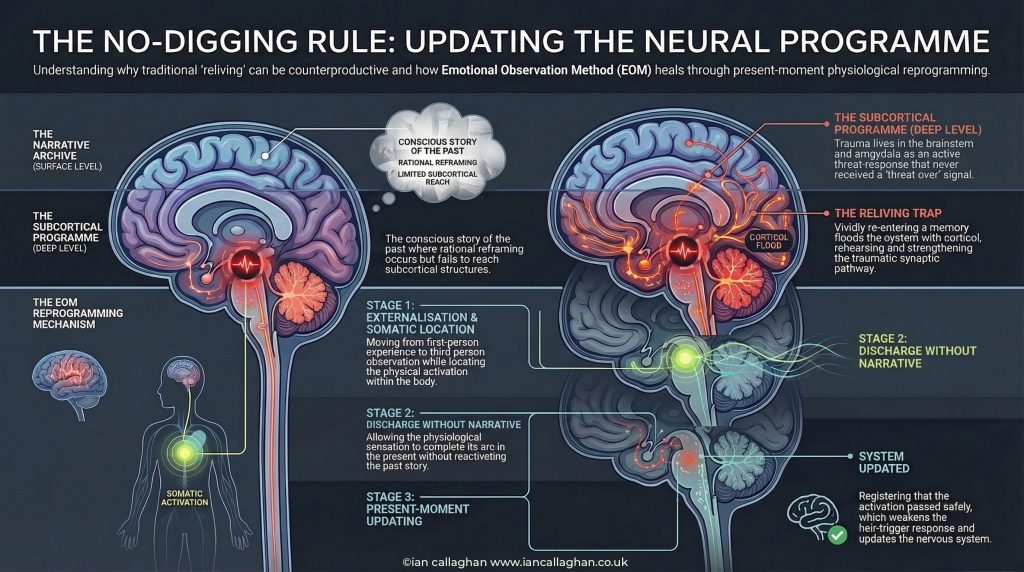
Every time you force yourself to re-experience a traumatic event without resolving it, you are not releasing the energy. You are deepening the neural groove.
The brain does not distinguish between a memory and a present experience in the way we assume it does. When you vividly re-enter a traumatic memory — the emotions, the physical sensations, the narrative — your amygdala responds to it as a current threat. Bob fires. The cortisol floods. The nervous system activates.
You have not revisited the wound to release it. You have rehearsed it. You have run the programme again and strengthened every synaptic pathway involved in producing it.
This is why people can spend years in trauma-focused therapy, developing extraordinary articulation of their pain, and still be triggered by the same stimuli in the same way. The insight is real. The resolution is not happening. Because insight is not the mechanism of change — neural repatterning is. And reliving does not reprogram. It reinforces.
The Neuroscience of Why Reliving Reinforces
To understand why the No-Digging Rule works, you need to understand what trauma actually is at the neurological level.
Trauma is not a memory. It is a programme. Specifically, it is a threat-response pattern that was encoded during an overwhelming experience and has never been updated. The original event is over. The programme it created is still running — triggered by stimuli that pattern-match to the original threat, firing the same physiological cascade, producing the same emotional and behavioural response.
Bob — the limbic system — encoded that programme at the time of the original event because it was doing its job. It detected an overwhelming threat. It created a hair-trigger response to anything resembling that threat. It was trying to protect you.
The problem is that Bob never received the signal that the threat is over.
The standard reliving approach attempts to update this by bringing the conscious mind back to the event and reprocessing it cognitively. The difficulty is that the programme does not live in the conscious mind. It lives in the subcortical structures — the amygdala, the hippocampus, the brainstem — that do not respond to rational reframing.
You cannot talk Bob out of a threat response. You can only update the threat assessment at the level where the assessment is being made. And that level is not the story. It is the body.
The No-Digging Rule — What EOM Does Instead
The Emotional Observation Method was built on a single foundational principle: we do not go back to the story.
Not because the story doesn’t matter. Not because the past is irrelevant. But because the story is not where the glitch lives. The glitch lives in the present moment — in the body, in the nervous system, in the automatic response that fires when a specific stimulus is detected.
That is where EOM works. In the present. On the live data of the physiological event as it is happening, not on the archived narrative of how it started.
We do not go back to the story. We look at the glitch in the present moment.
The No-Digging Rule is not avoidance. Avoidance is what happens when you refuse to acknowledge the activation — when you drink over it, numb over it, distract over it. That is Bob’s energy being suppressed rather than discharged, and suppression has a physiological cost that accumulates over time.
The No-Digging Rule is precision. It says: the information we need is not in the past. It is in the body, right now, as the pattern activates. That is the access point. That is where the reprogramming happens.
How Trauma Heals Without Reliving — The Mechanism
The EOM approach to trauma works through four specific mechanisms, all operating in the present moment.
1. Externalisation
The moment an activation is detected — the physiological signature of a trauma response — the practitioner externalises it. Instead of being inside the experience, you observe it from outside. This is not dissociation. It is the deliberate creation of the witnessing gap that prevents Bob’s activation from becoming a full limbic hijack.
You are not the emotion. You are the space in which the emotion is happening. That shift — from first-person experience to third-person observation — is neurologically significant. It activates the prefrontal cortex as the observer rather than allowing the amygdala to dominate the entire neural sequence.
2. Somatic Location
Rather than following the narrative of the trauma — the story, the memory, the meaning — EOM directs attention to the physical location of the activation in the body. Where exactly is it? What is its quality, its shape, its movement?
This is not metaphorical work. Trauma is held in the body as unresolved physiological activation — the fight-or-flight response that was never completed. By bringing precise, non-judgemental attention to the physical sensation, you are working directly with the stored energy rather than with the story constructed around it.
3. Discharge Without Narrative
The stored activation needs to move. In the EOM framework, it moves through the body via the somatic attention — not through re-experiencing the original event, but through allowing the present-moment sensation to complete its physiological arc.
This is the crucial difference. The energy discharges in the present, through the body, without the narrative of the past being reactivated. Bob’s threat response completes — the cortisol metabolises, the nervous system returns to baseline — without the traumatic programme being rehearsed and reinforced.
4. Present-Moment Reprogramming
Once the activation has discharged, the adult mind — operating from a regulated nervous system — can update the threat assessment. Not by debating the past, but by registering, at the neurological level, that the activation occurred, peaked, and passed. That you survived it. That the threat is not present.
Repeated consistently, this weakens the synaptic pathway of the trauma response. The gap between stimulus and reaction widens. The hair-trigger becomes less sensitive. Not because the memory has been processed cognitively, but because the nervous system has been updated experientially.
What This Looks Like in Practice
A client arrives with a pattern they cannot shift. A specific trigger — a tone of voice, a type of situation, a physical environment — that reliably produces a disproportionate reaction. They understand where it comes from. They have the backstory. They have the insight. They are still reacting.
In an EOM session, we do not go to the backstory. We work with the pattern as it presents in the present moment — recreating the conditions under which the activation occurs, locating it in the body as it fires, and working with the physical sensation directly.
No excavation of the original event. No emotional re-experiencing of the traumatic memory. No hours spent reconstructing the story.
The pattern is accessed at the level it operates — subcortical, physiological, present-moment — and updated there.
This is faster than conventional trauma processing. It is less destabilising. And it respects a fundamental truth that the standard model consistently underestimates: the people who need trauma resolution the most are often the people least able to afford the destabilisation that deep re-exposure produces.
The People This Was Built For
The No-Digging Rule was not built for the person who wants to understand their trauma. It was built for the person who needs their nervous system to work properly so they can function at the level they are capable of.
The executive whose childhood wound fires in every high-pressure meeting, producing reactions that are costing them professionally and they cannot explain why
The man who got sober but whose nervous system is still running the programmes that drove the drinking — anxiety, hypervigilance, emotional numbness — because sobriety addressed the symptom, not the mechanism
The person who has done years of therapy, knows every detail of their history, and is still being ambushed by the same patterns in the same situations
Anyone who has been told they need to go back through the wound to heal it and found, repeatedly, that going back makes the activation stronger, not weaker
If you recognise yourself in any of those descriptions, the issue is not that you haven’t done enough work. The issue is that you’ve been working at the wrong level.
Where to Start
The Emotional Observation Method pillar page gives you the complete framework — what EOM is, how Bob and Glucipher operate, and the full four-step protocol: iancallaghan.co.uk/emotional-observation-method/
The Emotional Operating System manual is the practical implementation guide. The mechanic’s handbook for applying the No-Digging Rule to your specific patterns, in your own time, without needing to sit in a room and excavate your history: iancallaghan.co.uk/the-shop/
The Emotional Archetype Quiz identifies which of the four primary system errors is driving your reactions — and gives you the specific entry point for your pattern: iancallaghan.co.uk/emotional-archetype-quiz/
The wound does not require revisiting. It requires updating. Those are not the same thing, and the difference matters more than most people have been told.
What Is the Emotional Observation Method? (And Why Everything Else You’ve Tried Is Theatre)
Most emotional regulation advice is theatre.
You’ve been told to take deep breaths. Journal your feelings. Reframe your negative thoughts. Replace them with positive ones. That’s the equivalent of putting a coat of paint on a cracked foundation and calling it a renovation.
The Emotional Observation Method — EOM — is the wrench. Not the paint.
It’s a framework built on a single, uncomfortable truth: your emotional reactions aren’t you. They’re a biological programme running on hardware that hasn’t been meaningfully updated in forty thousand years. Until you understand the mechanics of that programme, you’ll keep trying to manage the output without ever touching the source code.
This is the no-bullshit technical breakdown of what EOM actually is, how it works, and why it cuts through where everything else falls apart.
The Problem With Every Other Approach
Let’s be specific about what’s failing.
CBT tells you to challenge your thoughts. Mindfulness tells you to observe them without judgment. Positive psychology tells you to replace them with better ones. All of these approaches share the same fatal flaw: they’re working at the level of the story.
They’re trying to fix the narrative. They’re editing the script. And the script isn’t the problem.
The problem is the mechanism that generates the script in the first place.
When you feel rage, anxiety, shame, or the cold hollow of despair — that emotion was triggered, processed, and delivered to your conscious mind in approximately 200 milliseconds. Your rational brain, the part that does CBT exercises and writes in a gratitude journal, didn’t get a look-in. By the time you’re aware of the feeling, the biological event is already over. You’re just living in the aftermath.
Trying to reframe an emotion you’re already submerged in is like trying to redirect a flood using a strongly worded letter. The EOM doesn’t write letters. It works upstream.
Meet Bob. He’s Running Your Life.
At the centre of the EOM framework is a character called Bob the Chimp.
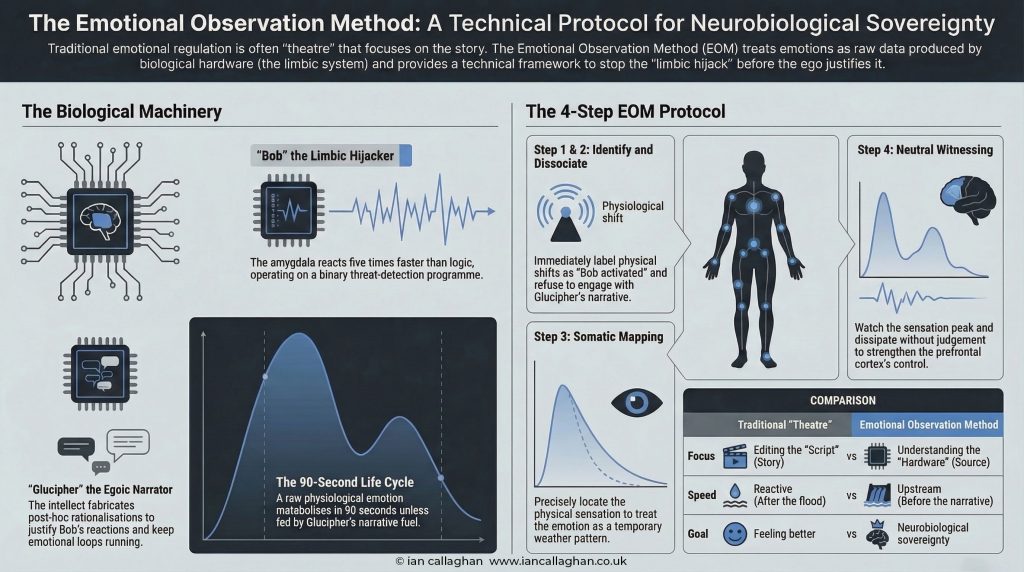
Bob isn’t a metaphor for bad behaviour. Bob is the technical reality of your limbic system — specifically your amygdala and the surrounding neural circuitry that evolved to keep you alive in an environment full of predators and resource scarcity. Bob is five times faster than your rational mind. He is paranoid by design. He operates on a binary: threat or no threat. Fight, flight, or freeze.
Bob does not care about your career, your relationships, or the fact that the person who cut you off in traffic is a stranger you’ll never see again. Bob sees a threat, Bob reacts. That’s the entire programme.
When you feel a surge of irrational anger, a wave of social anxiety, or the impulse to blow up a conversation you know you should handle calmly — that’s Bob. Not you. Bob.
The first move at EOM is the most important: stop saying ‘I am angry’ and start saying ‘Bob is reacting.’
That shift is not semantic wordplay. It creates a microscopic gap in the neural firing sequence — a fraction of a second between stimulus and response. That gap is where your actual agency lives. Without it, you’re not making decisions. Bob is making them, and you’re signing off on the paperwork afterwards.
Glucipher: The Voice That Sounds Like You
Bob reacts. Then Glucipher goes to work.
Glucipher is the egoic intellect’s damage control department. The moment Bob fires off a reaction, Glucipher begins constructing a narrative to justify it. He uses your vocabulary, your memories, your most convincing internal voice, and he builds a story that sounds completely reasonable — a story in which your reaction was entirely justified, the other person is demonstrably awful, and your emotional suffering is thoroughly deserved.
Glucipher is the reason you can spend three hours replaying a five-minute argument. He’s the reason a passing comment from a colleague can ruin an entire day. He’s the reason you tell yourself you’re fine with something you’re absolutely not fine with, until your body makes the truth impossible to ignore.
The EOM identifies Glucipher as the primary obstacle to clarity — not the emotion itself. The emotion passes in ninety seconds if you let it. Glucipher keeps it running indefinitely.
The key insight here is brutal in its simplicity: the reasons you give for your emotional state are almost always fabricated. They are post-hoc rationalisations constructed to protect the ego. They are not the truth of the situation. They are Glucipher’s truth, which serves only one purpose — keeping you trapped in the loop.
The EOM doesn’t engage with the narrative. It doesn’t debate Glucipher. It doesn’t try to construct a better story. It ignores the story entirely and focuses on the raw data underneath.
What the Emotional Observation Method Actually Does
EOM is a four-step internal protocol. It’s not passive. It’s not relaxing. It’s active and demanding, and it requires a level of intellectual honesty that most people find genuinely uncomfortable at first.
Step 1: Immediate Identification
The moment you notice a physiological shift — tightening in the chest, heat rising in the face, a sudden change in internal tone — you categorise it immediately. Not ‘why do I feel this?’ Just: ‘Physical sensation detected. Bob is activated.’
This single act halts the slide into the Glucipher narrative before it builds momentum. You’re not processing the emotion. You’re clocking its presence.
Step 2: Narrative Dissociation
The thoughts will come. The justifications, the replays, the blame, the ‘he said, she said.’ You label them — out loud if necessary — as Glucipher. ‘This is a Glucipher loop. This is cognitive fuel being burned on a fire I’m choosing not to feed.’
You don’t argue with the thoughts. You don’t try to replace them. You refuse to engage with the content. You’re not thinking — you’re observing the brain’s attempt to think.
Step 3: Somatic Mapping
Where is the emotion physically located? Is it a constriction in the throat? A knot below the sternum? A tension across the shoulders? You focus precisely on the physical location and quality of the sensation.
This grounds you in the present moment and treats the emotion as what it actually is: a weather pattern moving through a geographic location. A temporary state of the hardware. Not a permanent feature of the software.
Step 4: Neutral Witnessing
You watch without judgment. You don’t judge Bob for being triggered. You don’t judge yourself for having a Glucipher loop. Judgement is just another layer of Glucipher.
You observe the sensation peak. You observe it dissipate. Ninety seconds, if you don’t feed it. The cortisol metabolises. The physiological event ends. You remain.
Why This Works When Everything Else Doesn’t
The reason positive thinking fails isn’t that it’s too optimistic. It’s that it’s a lie Bob can see through instantly.
Bob doesn’t respond to the narrative. Bob responds to the threat assessment. If the threat assessment system is screaming, telling yourself ‘everything is fine’ doesn’t change the threat assessment. It just adds a layer of cognitive dissonance on top of an already activated nervous system.
The EOM doesn’t lie to Bob. It acknowledges the activation and refuses to amplify it. There’s a critical difference between the two.
A child tries to wish a storm away. A meteorologist measures the wind speed. The meteorologist is in considerably less danger.
Over time — and this is the part that most people dismiss because they want the shortcut — the consistent practice of EOM creates measurable neurological change. Every time you observe a Bob activation without reacting, you weaken the synaptic pathway of the limbic hijack. You strengthen the inhibitory fibres of the prefrontal cortex. The gap between stimulus and response widens. You begin to have actual choices about how you respond, rather than experiencing the illusion of choice while Bob has already decided.
Who the EOM Is For
This is not a framework for people who want to feel better about their emotional problems.
It’s a framework for people who are exhausted by the cycle. The high-performer who can’t afford a three-day emotional hangover because someone said something disrespectful in a meeting. The man in midlife who’s realised that the same patterns have been running his relationships, his drinking, and his decision-making for twenty years, and nobody has given him a technical explanation for why. The person who’s tried therapy, mindfulness, and an app, and still ends up in the same place.
EOM is for the individual who wants to understand the mechanism, not just manage the symptoms.
It is cold. It is technical. It requires a willingness to look at your internal world with a level of detachment that many people find uncomfortable — because what you find when you look clearly is that most of your suffering is self-generated, self-sustaining, and entirely optional once you understand the machinery producing it.
That is not a comfortable realisation. It is, however, a useful one.
The EOM Protocol — Technical Summary
Primary directive: Shift from subjective experience to objective observation.
The Bob variable: Identify limbic activation as a separate, primitive entity. Name it. Do not become it.
The Glucipher variable: Identify the egoic narrative and refuse to engage with its content. It is cognitive fuel being burned on a fiction.
The method: Somatic mapping and the creation of a witnessing gap between stimulus and response.
The objective: Neurobiological sovereignty — the consistent application of inhibitory control until the prefrontal cortex reclaims the cockpit.
What’s Next
The EOM is the foundation of everything I teach. It’s the mechanism underneath the sobriety work, the performance work, the midlife reset — all of it. You cannot change a pattern you haven’t observed. You cannot clearly observe anything while Bob has the wheel and Glucipher is narrating.
If you want to go deeper, the full Emotional Observation Method manual, the four-step protocol in detail, and the practical implementation framework are available at iancallaghan.co.uk.
Or join the free Skool community where I work through this in real time with the people who are actually doing the work.
Either way: stop managing the symptoms. Start understanding the machine.
The Emotional Mastery book is a practical manual for understanding and regulating the human nervous system using the Emotional Operating System framework.
Instead of analysing emotions or retelling your past, the Emotional Mastery book teaches you how to read emotional states as system feedback, identify overload, and restore stability under pressure.
No labels. No therapy-speak. No endless healing loops. Just a clear, operational approach to emotional regulation that actually holds when life applies load.
Used to monitor number of Google Analytics server requests when using Google Tag Manager
1 minute
_gid
ID used to identify users for 24 hours after last activity
24 hours
_ga_
ID used to identify users
2 years
_gali
Used by Google Analytics to determine which links on a page are being clicked
30 seconds
_ga
ID used to identify users
2 years
__utmx
Used to determine whether a user is included in an A / B or Multivariate test.
18 months
__utmv
Contains custom information set by the web developer via the _setCustomVar method in Google Analytics. This cookie is updated every time new data is sent to the Google Analytics server.
2 years after last activity
__utmz
Contains information about the traffic source or campaign that directed user to the website. The cookie is set when the GA.js javascript is loaded and updated when data is sent to the Google Anaytics server
6 months after last activity
__utmc
Used only with old Urchin versions of Google Analytics and not with GA.js. Was used to distinguish between new sessions and visits at the end of a session.
End of session (browser)
__utmb
Used to distinguish new sessions and visits. This cookie is set when the GA.js javascript library is loaded and there is no existing __utmb cookie. The cookie is updated every time data is sent to the Google Analytics server.
30 minutes after last activity
__utmt
Used to monitor number of Google Analytics server requests
10 minutes
__utma
ID used to identify users and sessions
2 years after last activity
_gac_
Contains information related to marketing campaigns of the user. These are shared with Google AdWords / Google Ads when the Google Ads and Google Analytics accounts are linked together.