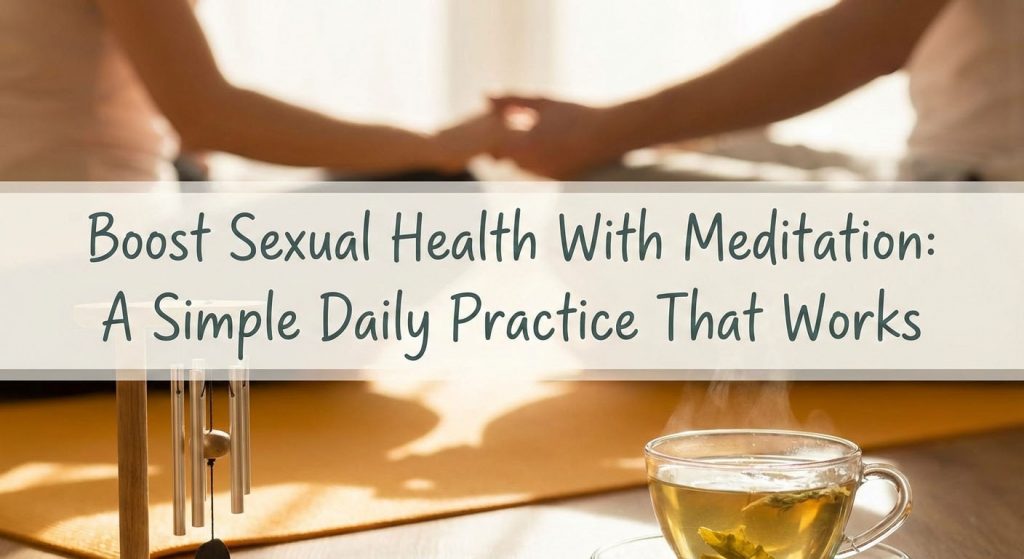
Discover how Meditation for Sexual Health can transform your intimacy, boost confidence, and resolve psychological

Discover how Meditation for Sexual Health can transform your intimacy, boost confidence, and resolve psychological erectile dysfunction naturally. By integrating mindfulness techniques, you can silence the inner critic, lower cortisol levels, and reconnect with your partner, making meditation for sexual performance anxiety the ultimate tool for reclaiming your bedroom confidence.


Reclaiming Intimacy: A Comprehensive Guide to Meditation for Sexual Performance Anxiety

Sexual performance anxiety is a silent barrier that affects millions of men and women globally. It transforms what should be a moment of connection and pleasure into a high-stakes examination of one’s worth.

While modern medicine offers pharmaceutical solutions, these often act as temporary plasters rather than curing the root cause. The true origin of performance anxiety rarely lies in the body’s mechanics, but rather in the mind’s narrative.

This is where meditation for sexual performance anxiety becomes a game-changer. By shifting your focus from the fear of failure to the sensation of the present moment, you can rewire your brain’s response to intimacy.

This guide will explore the deep psychological roots of performance issues. We will provide actionable, step-by-step meditation strategies to help you overcome them.

The Physiology of Panic: Understanding the Mind-Body Disconnect

To understand why meditation works, we must first understand why anxiety kills arousal. The human body is a marvel of biological engineering, but its stress response is primal.

The Nervous System Tug-of-War

Your autonomic nervous system has two primary modes. There is the sympathetic nervous system (fight or flight) and the parasympathetic nervous system (rest and digest).

Arousal, erection, and lubrication are biologically dependent on the parasympathetic nervous system. This is the state where you are relaxed, safe, and calm.

When performance anxiety strikes, your brain perceives the sexual encounter as a threat rather than a pleasure. It interprets the pressure to perform as danger.

Consequently, the sympathetic nervous system activates. Adrenaline floods your bloodstream. Blood is diverted away from the genitals and towards your major muscle groups to prepare for ‘battle’.

Physiologically, it becomes nearly impossible to sustain arousal in this state. You are fighting your own biology.

The Role of Cortisol

Chronic anxiety leads to elevated levels of cortisol, the body’s primary stress hormone. High cortisol levels can suppress testosterone production over time.

This creates a chemical environment in the body that is hostile to libido. It isn’t just that you are ‘nervous’; your body is chemically biased against sexual function.

Meditation is the most effective natural method for lowering cortisol. It acts as a manual override for the stress response.

The Phenomenon of ‘Spectatoring’

Masters and Johnson, pioneers in sex research, coined the term spectatoring. This describes a state where a person mentally detaches from their body during sex.

Instead of feeling the sensations, you become a third-party observer. You watch yourself, judging your performance, your hardness, or your stamina.

You might think, “Is this lasting long enough?” or “Am I staying hard?” This mental chatter kills the feedback loop required for pleasure.

Meditation for sexual performance anxiety is the antidote to spectatoring. It trains the mind to inhabit the body fully, rather than judging it from a distance.

How Meditation Rewires the Anxious Brain | Meditation for Sexual Health

Meditation is often misunderstood as simply ‘thinking about nothing’. In reality, it is the practice of focused attention.

Strengthening the Prefrontal Cortex

Regular meditation thickens the prefrontal cortex. This is the part of the brain responsible for emotional regulation and rational thought.

A stronger prefrontal cortex can better inhibit the amygdala, the brain’s fear centre. When the amygdala fires a panic signal during sex, a meditator’s brain can acknowledge it and dismiss it.

You gain the ability to say, “I am feeling anxious, and that is okay,” rather than spiralling into panic.

Enhanced Interoception

Interoception is your ability to sense the internal state of your body. Anxiety often numbs us to physical sensation because we are living in our heads.

Through mindfulness, you increase your sensitivity to physical touch. This heightens pleasure, which in turn reinforces arousal.

When the brain receives strong pleasure signals, it naturally suppresses anxiety. It is difficult to be panicked when you are deeply immersed in physical enjoyment.

Breaking the Cycle of Anticipatory Anxiety

The worst part of performance anxiety is often not the act itself, but the hours leading up to it. This is known as anticipatory anxiety.

You might spend the entire day worrying about whether you will perform later that night. This exhausts your mental energy before you even reach the bedroom.

Mindfulness trains you to live in the “now”. It helps you disconnect from future “what-if” scenarios.

Practical Meditation Techniques for Sexual Performance

Understanding the theory is essential, but practical application is where change happens. Below are specific techniques tailored to combat sexual anxiety.

1. The Body Scan (Somatic Awareness)

This is a foundational technique to reconnect your mind with your physical form. It is best practised daily, outside of sexual situations, to build the skill.

  • Step 1: Lie down in a comfortable position, free from distractions. Close your eyes.
  • Step 2: Take three deep breaths, inhaling through the nose and sighing out through the mouth.
  • Step 3: Bring your attention to your toes. Notice any sensation there—tingling, warmth, or the weight of the blanket.
  • Step 4: Slowly move your attention up through your feet, ankles, and calves. Do not judge the sensations; simply observe them.
  • Step 5: If you encounter tension, imagine breathing into that area. Visualise the muscle softening on the exhale.
  • Step 6: Continue this process up through the thighs, hips, stomach, chest, and arms, all the way to the crown of the head.
  • Step 7: Finally, feel the body as a whole. Rest in this state of complete physical awareness for five minutes.

Why this works: It trains you to shift your focus from your thoughts to your physical sensations, which is the exact skill needed during intimacy.

2. The 4-7-8 Breathing Technique (Emergency Calm)

This technique is powerful for moments of acute anxiety. You can use this in the bathroom before sex, or even during foreplay if you feel panic rising.

  • Step 1: Exhale completely through your mouth, making a whooshing sound.
  • Step 2: Close your mouth and inhale quietly through your nose to a mental count of four.
  • Step 3: Hold your breath for a count of seven.
  • Step 4: Exhale completely through your mouth, making a whooshing sound to a count of eight.
  • Step 5: Repeat this cycle for four total breaths.

Why this works: This rhythmic breathing forces the autonomic nervous system to switch from sympathetic (fight/flight) to parasympathetic (rest/digest). It is a physiological “brake” for anxiety.

3. Sensate Focus (Partnered Meditation)

This is the gold standard in sex therapy. It removes the “goal” of sex (orgasm/penetration) and focuses entirely on sensation.

  • Stage 1: Agree with your partner that intercourse is off the table. The goal is only to touch.
  • Stage 2: One partner lies down (the receiver) while the other (the giver) touches them.
  • Stage 3: The giver touches non-erotic areas first (arms, back, legs). They focus on texture and temperature.
  • Stage 4: The receiver focuses strictly on how the touch feels. They do not worry about reciprocating or looking good.
  • Stage 5: Swap roles after 15 minutes.

Why this works: It removes the pressure to perform. By banning intercourse initially, the brain learns that physical intimacy is safe and does not always require an erection or orgasm.

4. The “Anchoring” Technique

This is a mindfulness tactic to use during sexual activity when intrusive thoughts appear.

  • The Concept: An “anchor” is a physical sensation you return to when your mind wanders to anxiety.
  • The Practice: Choose an anchor. It could be the sound of your partner’s breath, the feeling of skin-on-skin contact, or a scent.
  • The Execution: You are having sex. Suddenly, you think, “I’m going to lose it.”
  • The Correction: Gently acknowledge the thought. Then, deliberately shift your focus back to your anchor (e.g., the temperature of your partner’s skin).
  • Repetition: You may have to do this 50 times during a session. That is okay. That is the practice.

Integrating Mindfulness into Your Daily Routine

Meditation for sexual performance anxiety is not a quick fix you take like a pill. It is a mental muscle that requires conditioning.

Morning Mindfulness

Start your day with ten minutes of meditation. This lowers your baseline cortisol levels for the rest of the day.

Use apps like Headspace or Calm, or simply sit in silence. The aim is to observe your thoughts without engaging with them.

If you wake up anxious about a date later that night, observe that anxiety. Label it: “Here is a feeling of nervousness.” Do not fight it; let it sit there until it dissolves.

The Commute Decompression

Work stress is a major libido killer. If you carry office stress into the bedroom, your body remains in “survival mode.”

Use your commute home as a transition period. Practise deep abdominal breathing.

Visualise yourself leaving your work persona behind. Arrive home ready to be a partner, not an employee.

Mindful Masturbation

Many men with performance anxiety masturbate quickly to relieve stress or check if “everything is working.” This reinforces anxiety.

Change your solo practice. Slow down. Remove visual stimuli (pornography).

Focus entirely on the physical sensations. If your erection fluctuates, observe it without panic. Teach your body that it is safe to be aroused without rushing to a finish line.

Overcoming Common Mental Roadblocks

Even with meditation, certain thought patterns are stubborn. Here is how to address them through a mindful lens.

The “Broken” Narrative

Many men convince themselves they are “broken” or less of a man because of performance issues.

Mindful Reframe: Recognise this as a story, not a fact. Your equipment works (evident by nocturnal erections). The issue is software, not hardware.

Treat yourself with compassion. You would not berate a friend for being nervous. Extend that same kindness to yourself.

The Fear of Disappointing a Partner

This is often the root of the anxiety. You feel responsible for your partner’s pleasure to the detriment of your own.

Mindful Reframe: Sex is a shared experience, not a service you provide. Real intimacy involves vulnerability.

Communicating your anxiety can actually bring you closer. It takes the elephant out of the room.

The Pornography Trap

High-speed, high-intensity pornography conditions the brain to require extreme stimulation. Real sex is slower, softer, and more subtle.

Mindful Reframe: If you consume porn, do so mindfully. Notice how it affects your expectations.

Consider a “dopamine detox.” Take a break from screens to resensitise your brain to the subtle cues of a real partner.

Lifestyle Factors That Support Meditation

Meditation does not exist in a vacuum. To maximise the benefits of meditation for sexual performance anxiety, you must support your nervous system holistically.

Sleep Hygiene

Lack of sleep mimics stress in the body. It raises cortisol and lowers testosterone.

Prioritise 7–9 hours of quality sleep. A rested brain is far better at emotional regulation than a tired one.

Diet and Gut Health

The gut produces 95% of the body’s serotonin, a key mood-regulating neurotransmitter. A diet high in processed foods can increase systemic inflammation and anxiety.

Eat whole foods, leafy greens, and lean proteins. A healthy body creates a safer container for a healthy mind.

Exercise as Meditation

Physical exercise burns off excess adrenaline. Lifting weights or cardio releases endorphins that naturally counteract anxiety.

View your workout as a form of moving meditation. Focus on the contraction of the muscles and your breathing rhythm.

When to Seek Professional Help

While meditation is powerful, it is not a replacement for medical care if the issue is organic.

If you have practised mindfulness consistently for months with no change, consult a urologist. They can rule out blood flow issues, hormonal imbalances, or diabetes.

However, for the vast majority of men under 40, the issue is psychogenic. In these cases, a sex therapist who specialises in mindfulness-based cognitive therapy (MBCT) can be incredibly beneficial.

They can guide you through the Sensate Focus exercises and help you dismantle deep-seated beliefs about masculinity and performance.

The Long-Term Benefits of Mindful Sex

Overcoming performance anxiety is the immediate goal, but the long-term rewards of mindfulness go far deeper.

profound Connection

When you stop “spectatoring” and start feeling, you connect with your partner on a level you may never have experienced before.

Eye contact becomes easier. Emotional intimacy deepens. Sex becomes a conversation rather than a performance.

Increased Pleasure

By being fully present, you notice subtleties in touch that you previously missed. The texture of skin, the rhythm of breath, the warmth of contact—all become intensely pleasurable.

This leads to better orgasms and a more satisfying sexual life overall.

Resilience

You will learn that an erection is not a constant. It is a natural biological function that waxes and wanes.

With mindfulness, if you lose an erection, you won’t panic. You will simply switch to other forms of play until the body catches up. This resilience makes you a better, more confident lover.

Summary: Your Path to Freedom

Sexual performance anxiety is a thief. It steals your confidence, your pleasure, and your connection with those you love. But it is not a life sentence.

By embracing meditation for sexual performance anxiety, you are taking control of your own mind. You are moving from a state of fear to a state of presence.

Here is your action plan:

  • Commit to a daily mindfulness practice (10 minutes a day).
  • Utilise the Body Scan to reconnect with physical sensation.
  • Employ the 4-7-8 breathing technique when panic strikes.
  • Practise Sensate Focus with your partner to remove performance pressure.
  • Forgive yourself for past difficulties and focus on the present moment.

The journey to overcoming anxiety is not linear. There will be good days and difficult days. However, with patience and consistent practice, you can retrain your brain.

You can learn to quiet the inner critic. You can learn to trust your body again. Most importantly, you can rediscover the joy of intimacy, free from the weight of expectation.

Start today. Close your eyes, take a deep breath, and welcome yourself back to the present moment. Your best sexual life is not in the future; it is right here, waiting for you to tune in.

Improves sexual function

Meditation can improve sexual function by increasing blood flow to the genital area and reducing stress and anxiety, which can interfere with arousal and performance.

Tips for incorporating meditation into your daily routine

  1. Find a quiet and comfortable space

Find a quiet and comfortable space where you can meditate without distractions. This can be a bedroom, living room, or any other quiet area.

  1. Practice regularly

To experience the benefits of meditation, it’s important to practice regularly. Aim for at least 10 minutes of meditation per day, and gradually increase the duration over time.

  1. Focus on your breath.

During meditation, focus on your breath and try to clear your mind of any distracting thoughts. When your mind wanders, gently bring it back to your breath.

  1. Use guided meditations

Guided meditations can be helpful for beginners or those who find it difficult to meditate on their own. There are many meditation apps and videos available that offer guided meditations for sexual health.

  1. Incorporate meditation into sexual activity.

Incorporating meditation into sexual activity can increase mindfulness and enhance the overall experience. Take deep breaths and focus on the sensations of the moment.

In conclusion, meditation can be a powerful tool for improving sexual health. By reducing stress and anxiety, increasing mindfulness, and improving overall sexual function, meditation can enhance the overall sexual experience. Incorporating meditation into your daily routine can be a simple but effective way to improve your sexual health and well-being.

Guided meditations
Sexual performance anxiety

Sexual performance anxiety is a common issue that can affect both men and women. Meditation can be a helpful practice to manage stress, anxiety, and other psychological factors that can contribute to sexual performance anxiety. Here is a simple meditation practice that you can try:

  1. Find a quiet and comfortable place to sit. You can sit on a chair or on the floor with your legs crossed.
  2. Close your eyes and take a few deep breaths. Inhale through your nose and exhale through your mouth.
  3. Focus your attention on your breath. Notice the sensation of the air entering and leaving your body.
  4. If your mind starts to wander, gently bring your attention back to your breath. You can count your breaths to help you stay focused.
  5. As you continue to breathe, visualise yourself relaxing and releasing any tension or stress in your body. You can imagine a wave of relaxation washing over you from head to toe.
  6. If you notice any negative thoughts or emotions related to sexual performance, acknowledge them but try not to dwell on them. Instead, imagine them floating away like clouds in the sky.
  7. Focus on positive and reassuring thoughts, such as “I am capable of enjoying sex” or “I am worthy of pleasure and intimacy.”
  8. You can also visualise yourself in a sexual situation, but with a positive and relaxed attitude. Imagine yourself feeling confident and connected with your partner.
  9. Continue to meditate for 10-20 minutes, or for as long as you feel comfortable.
  10. When you are ready to end your meditation, take a few deep breaths and slowly open your eyes.

Remember, meditation is a practice, and it may take time to see the benefits. You can try this meditation practice once a day or as often as you like to help manage stress and anxiety related to sexual performance. 

Premature ejaculation

Meditation can be a helpful tool to manage the stress and anxiety that can contribute to premature ejaculation. Here is a meditation practice that you can try:

  1. Find a quiet and comfortable place to sit. You can sit on a chair or on the floor with your legs crossed.
  2. Close your eyes and take a few deep breaths. Inhale through your nose and exhale through your mouth.
  3. Focus your attention on your breath. Notice the sensation of the air entering and leaving your body.
  4. If your mind starts to wander, gently bring your attention back to your breath. You can count your breaths to help you stay focused.
  5. As you continue to breathe, visualise yourself in a calm and peaceful setting, such as a beach or a forest. Imagine yourself feeling relaxed and at ease.
  6. If you notice any negative thoughts or emotions, acknowledge them but try not to dwell on them. Instead, imagine them floating away like clouds in the sky.
  7. Bring your attention to your body and notice any areas of tension or discomfort. Visualise a warm, healing light filling those areas and releasing any tension or discomfort.
  8. When you feel calm and relaxed, visualise yourself engaging in sexual activity with confidence and ease. Imagine yourself lasting longer and enjoying the experience.
  9. If you feel any sensations of arousal, try not to resist or tense up. Instead, focus on your breath and continue to visualise yourself staying relaxed and in control.
  10. Continue to meditate for 10-20 minutes, or for as long as you feel comfortable.
  11. When you are ready to end your meditation, take a few deep breaths and slowly open your eyes.
Improve Libido

Meditation can be a helpful tool for improving low libido by reducing stress and anxiety, increasing mindfulness and self-awareness, and promoting relaxation and emotional well-being. Here is a meditation practice that you can try:

  1. Find a quiet and comfortable place to sit. You can sit on a chair or on the floor with your legs crossed.
  2. Close your eyes and take a few deep breaths. Inhale through your nose and exhale through your mouth.
  3. Focus your attention on your breath. Notice the sensation of the air entering and leaving your body.
  4. If your mind starts to wander, gently bring your attention back to your breath. You can count your breaths to help you stay focused.
  5. As you continue to breathe, bring your attention to your body and any sensations you may be experiencing. Notice any areas of tension or discomfort and visualise a warm, healing light filling those areas and releasing any tension or discomfort.
  6. As you continue to breathe, visualise yourself feeling calm and relaxed. Imagine yourself feeling connected to your body and your desires.
  7. If you notice any negative thoughts or emotions, acknowledge them but try not to dwell on them. Instead, imagine them floating away like clouds in the sky.
  8. As you continue to breathe, visualise yourself feeling more sexually aroused and interested. Imagine yourself experiencing pleasure and intimacy.
  9. Take a moment to reflect on any underlying issues that may be contributing to your low libido. It could be stress, anxiety, relationship issues, or other factors. Acknowledge these issues, but try not to dwell on them.
  10. Continue to meditate for 10-20 minutes, or for as long as you feel comfortable.
  11. When you are ready to end your meditation, take a few deep breaths and slowly open your eyes.