The “Just One Drink” Lie That Keeps You Trapped in Hell
The Alcohol Moderation Myth. Let’s cut the fluff. You’re not here because you had a glass of champagne at a wedding and felt a bit sleepy. You’re here because “just a few” has turned into a nightly hostage situation. You are negotiating with a terrorist inside your own head, and the terrorist is winning.
You know the script intimately. It starts around 3 PM. The day was brutal. The boss is a prick, the kids are screaming, or maybe the silence of an empty flat is deafening. The pressure in your chest builds, a physical tightness that demands release. The voice whispers, “Just take the edge off. One or two. You’ve earned it. It’s been a hard week. Everyone else is doing it.”
So you cave. You have one. And for 20 minutes, you feel that warm, golden slide. The noise stops. The shoulders drop. The tightness in your chest unspools. It feels like magic.
But then the chemistry kicks in. That first drink wasn’t a beverage; relief promised that it couldn’t keep. One isn’t enough because the relief is fleeting. Two is a tease that barely scratches the itch. Three is a slippery slope, and suddenly it’s 2 AM, you’re four bottles deep, watching mindless YouTube videos, and you’re staring at the ceiling, wondering how the hell you got here again.
Here is the cold, hard truth: If you could moderate, you wouldn’t be reading this.
People who can “take it or leave it” don’t spend their nights Googling “am I an alcoholic?” or reading blogs about sobriety. They don’t take online quizzes about their drinking habits. They leave half-finished glasses of wine on the table because they genuinely forgot about them. (I know, psychopaths, right?)
If you can’t leave it, you’re not broken. You’re not weak. You are dealing with a chemical hook that has hijacked your survival instincts and rewired your reward system. Let’s break down why “just a few” is the most dangerous myth in the sobriety space.
The Science of “Just One”: Why Your Brain Screams for More
You think it’s a lack of willpower. You think you need more discipline. It’s not. It’s biology, and you are fighting a battle against your own neurochemistry with both hands tied behind your back.
When you pour that first drink, you trigger a massive spike in dopamine—the brain’s “do it again” chemical. It’s the same system that tells you to eat when you’re starving or sleep when you’re exhausted. But alcohol floods this system artificially, creating a reward signal far louder than any natural survival cue.
However, the real damage happens in the balance between two other neurotransmitters: GABA and Glutamate.
- GABA is your brain’s natural sedative. It calms you down. Alcohol mimics GABA, which is why you feel relaxed after the first drink.
- Glutamate is your brain’s natural stimulant. It keeps you alert. Alcohol suppresses Glutamate.
Here’s the kicker: Your brain loves homeostasis (balance). When you flood it with artificial depressants (alcohol), it panics. To keep you alive and awake, it counters by suppressing your natural GABA production and ramping up Glutamate production.
This is the Opponent Process Theory in action. Think of it like a seesaw. Alcohol pushes the “depressant” side down hard. To keep the seesaw level (homeostasis), your brain piles massive bricks of “stimulant” (Glutamate) on the other side. When the alcohol wears off, those bricks are still there, launching you into high anxiety.
- The High (The Loan): You drink—dopamine spikes, GABA floods in. You feel relief. But you have just taken out a high-interest loan on happiness.
- The Low (The Interest Payment): Alcohol leaves your system quickly. But your brain’s counter-measures (high Glutamate, low GABA) hang around for days. You are left in a state of hyper-arousal: anxious, jittery, irritable, and sleepless.
- The Trap: The only way to fix that new anxiety? Another drink.
You aren’t drinking for pleasure anymore. You are drinking to relieve the withdrawal symptoms caused by the previous drink. You are stuck in a loop of medicating the pain that the medicine caused. You are drinking to feel “normal,” but your baseline for “normal” keeps dropping lower and lower.
The “Grey Area” Purgatory
We love labels. Society tells us there are two types of people: “Alcoholics” living under bridges, drinking out of paper bags, and “Normal Drinkers” having a polite glass of Pinot with dinner.
But the reality is much messier. Most of you are stuck in the vast, miserable middle ground: Grey Area Drinking.
You’re not waking up under a bridge. You’ve got the job, the Tesla, the mortgage, the Pelotons you never use. You’re “high functioning.” You show up to the PTA meetings; you hit your KPIs at work. But inside? You are rotting.
Signs you are trapped in the Grey Area:
- Rule Making: You make elaborate rules about drinking (only on weekends, never before 6 PM, only beer, never spirits, water between drinks), and you constantly break them. People who don’t have a problem with dairy don’t spend hours debating if they can have a slice of cheese. If you have to create a policy manual for your consumption, that is the red flag.
- The 3 AM Panic: You wake up consistently at 3 AM with your heart pounding, riddled with “Hangxiety” (shame and panic), replaying every conversation from the night before, convinced everyone hates you.
- Clock Watching: You are physically present at work or with your kids, but mentally, you are counting the hours until “wine o’clock.”
- The Double Life: You feel like an imposter. Professional and put-together by day, chaotic and numbing out by night. You are terrified someone will see behind the curtain.
The Grey Area is actually harder than rock bottom because it’s comfortable enough to stay there for decades. It’s a slow death by a thousand hangovers. You’re not drowning, but you’re treading water with weights on your ankles, exhausted from the effort of just staying afloat.
The “Kindling Effect”: Why It Gets Worse, Never Better
Think you can take a month off (Dry January, Sober October) and then go back to “moderate” drinking? Think again.
There is a biological phenomenon called the Kindling Effect. This explains why your hangovers in your 20s were a headache and a greasy breakfast, but your hangovers in your 30s and 40s are three-day existential crises involving panic attacks and doom-scrolling.
Every time you go through the cycle of intoxication and withdrawal (even mild withdrawal, like a hangover), your nervous system becomes sensitised. It learns the pattern.
It’s like starting a fire. The first time, it’s hard to light the massive logs. You need kindling, lighter fluid, and patience. But if you keep lighting them and putting them out, the wood dries out. It becomes brittle. It becomes tinder.
Eventually, it takes just one spark (one drink) to set the whole forest ablaze.
This is why you can’t “learn” to drink like a gentleman/lady again. The neural pathways are physically etched deep into your cortex. You go from 0 to 100 because your brain effectively has a “remember me?” panic button that gets hit the second ethanol enters your blood. The neural pathways for addiction have been paved into superhighways. You cannot unpave them.
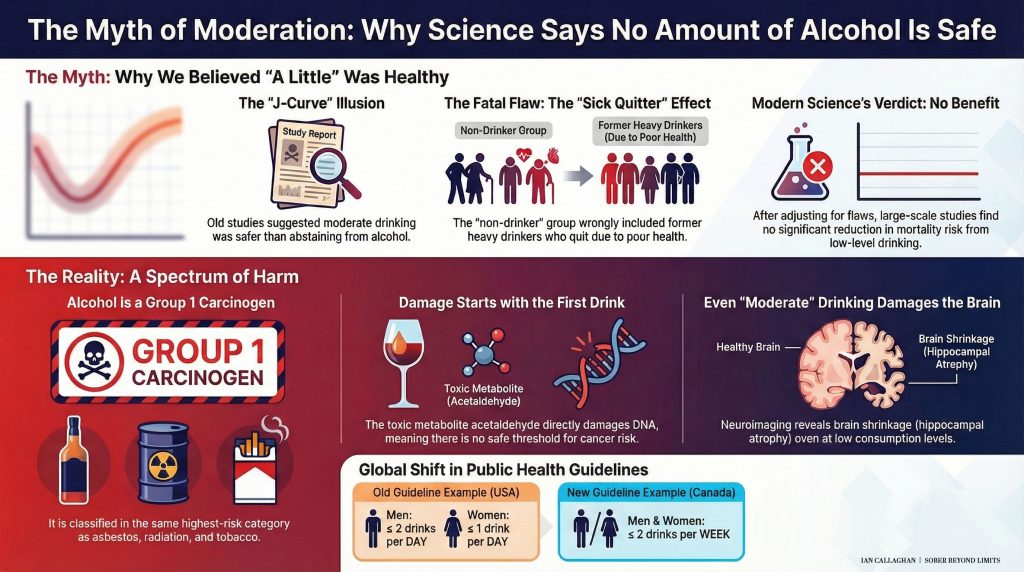
Research Alert (2024-2025): New studies from the UK and the US are clear. There is no safe level of alcohol consumption. The “heart-healthy” red wine myth is dead. Even moderate drinking is now directly linked to seven types of cancer, early-onset dementia, and heart disease. Alcohol is a Group 1 Carcinogen, in the same category as asbestos and radiation. The poison isn’t in the dose; the poison is the poison.
Why Moderation is Torture (And Sobriety is Freedom)
Trying to moderate a chemical addiction is like trying to control diarrhoea. It takes an immense amount of focus, energy, and clenching, and eventually, sh*t happens.
Moderation is not a relaxed state; it is a state of constant vigilance. It creates Decision Fatigue.
When you try to moderate:
- The Constant Negotiation: “Can I have another? Is everyone else drinking as fast as I am? If I eat bread now, will it soak it up? Should I order water so I don’t look drunk?” You are not present in the moment; you are present in the glass.
- Depleted Willpower: You spend all your mental energy policing your intake. By the time you get home to your family or wake up for work, your battery is drained. You have nothing left for creativity, patience, or joy.
- The Unattainable Itch: You never get the relief you seek. You don’t drink to have one. You drink to get the effect (the buzz, the numbness). One drink just pisses off the demon. It wakes up the craving (the dopamine spike) but doesn’t satisfy it. You spend the whole night frustrated, wanting more but not allowing yourself to have it.
Abstinence is easier than moderation.
Read that again. Let it sink in.
When you quit completely, the negotiation is over. The decision is made once. You don’t have to decide if you’re drinking tonight, or how much, or with whom. The answer is simply “no.” The mental chatter falls silent. The energy returns. You get your brain back.
How to Break the Cycle (Actionable Steps)
You want out? Good. Here is how you start.
1. Stop Calling It “Giving Up”
Language matters. If you view sobriety as a deprivation, you will be miserable. You aren’t giving up anything. You are gaining your life back. You are gaining your mornings, your self-respect, your money, your patience, and your sanity. Flip the script. You are escaping a burning building, not missing out on the warmth of the fire.
2. Play the Tape Forward
When the urge hits at 5 PM, your brain will show you the highlight reel: the clink of the glass, the first sip, the laugh. That is a trailer for a movie that doesn’t exist.
You need to play the tape forward to the unedited footage. Don’t think about the first drink. Think about the 4th. Think about the slurred speech. Think about the 3 AM wake-up call with the heart palpitations and the dry mouth. Think about the disappointment in your kid’s eyes when you snap at them over breakfast. Play the movie all the way to the tragic ending.
3. Embrace the “Suck”
The first few weeks will be uncomfortable. You will feel raw. You will feel bored. You might feel “anhedonia”—the inability to feel pleasure. Good. That is not a sign that sobriety is boring; it is a sign that your brain is healing. Your dopamine receptors have been fried by years of over-stimulation. They need time to reset to normal levels. That boredom is the feeling of your brain recalibrating. Don’t run from the feeling. Sit in it. It won’t kill you. A drink might.
4. Find Your Tribe. Isolation is the fuel of addiction. You cannot do this alone in the dark. Whether it’s AA, SMART Recovery, a Reddit community like r/stopdrinking, or just a group of sober mates—get connected. You need to hear your story in someone else’s mouth to realise you aren’t crazy, you aren’t uniquely broken, and you aren’t alone. The opposite of addiction isn’t sobriety; the opposite of addiction is connection. (Johann Hari). You need to replace the relationship you had with the bottle with relationships with human beings who understand the war you are fighting.
The Final Truth
You are waiting for a magical moment where you “feel ready” to stop. You are waiting for the stars to align, for work to calm down, for the holidays to be over.
That moment is a lie. You will never feel ready to kill your best friend and your worst enemy.
You just have to do it.
There is a version of you waiting on the other side of this. A version that wakes up clear-headed and optimistic. A version that doesn’t need a chemical to handle a Tuesday. A version that looks in the mirror and genuinely likes what they see.
Put the shovel down. Stop digging.
Drop a comment below if this landed. Are you stuck in the “Just a Few” trap? Let’s talk about it.
People Also Ask (FAQ)
Q: Can I ever drink normally again?
A: If you have to ask, the answer is likely no. Normal drinkers don’t ask this. Once the pickle is a pickle, it can never be a cucumber again. Your brain has changed structurally. Why would you want to go back to the thing that broke you?
Q: What are the first signs of liver damage?
A: Fatigue, unexplained weight loss, loss of appetite, and pain in the upper right abdomen. But here is the scary part: Liver damage is often silent until it is critical. Don’t wait for your eyes to turn yellow or your skin to itch to make a change. The liver is incredibly resilient, but only if you give it a break.
Q: How long does “hangxiety” last after quitting?
A: The acute physical anxiety usually peaks around day 3-5 and settles within two weeks as your GABA/Glutamate levels balance out. However, Post-Acute Withdrawal Syndrome (PAWS) can cause mood swings and anxiety waves for months. It passes. It is temporary. Keep going.
Q: What do I tell my friends?
A: You don’t owe anyone a dissertation. “I’m taking a break for my health,” “It was messing with my sleep,” or simply “I’m retired from the sport” are all valid answers. Real friends will support you. Drinking buddies who get defensive are usually protecting their own addiction.
The Devastating Truth About Alcohol’s “Just A Few”

Rewiring The Mind: The Identity Shift That Changes Everything (Digital Manual)
Stop chasing symptoms. Fix the machine. Rewiring The Mind is not a memoir—it is a mechanic’s manual for your brain. Written by Ian Callaghan (Army Veteran, 45-year drinker), this guide combines Stoic Philosophy, Evolutionary Biology, and Nervous System Regulation to help you break the loop of anxiety, drinking, and survival mode. You don’t need more willpower. You need a new identity. (Instant PDF Download)