The Toxicology of Alcohol: Why It’d Be Banned in 2026
The only reason alcohol is legal in the UK or the US today is a historical accident. If a pharmaceutical company tried to bring “Ethanol” to the market in 2026 as a new recreational substance, it would fail every safety trial, every MHRA standard, and every FDA review immediately. It wouldn’t even make it past the preliminary toxicology report.
I spent 45 years drinking. I’ve lived in the trenches of the British pub culture and the military drinking tradition. But as a qualified nutrition expert with deep roots in biochemistry and human physiology, I have to be brutally clear: Alcohol is a neurotoxic carcinogen. We have been socially engineered to call it “tradition,” but your cells recognise it only as a systemic crisis. This is not a moral argument; it is a chemical one.
The Regulatory Rejection: Alcohol vs. Modern Standards
If a regulatory body like the MHRA (Medicines and Healthcare products Regulatory Agency) were to review alcohol today, the application would be denied before the first coffee break. To understand why, we have to look at the clinical profile of the molecule itself—not the marketing, not the craft labels, and not the “sophisticated” wine culture we’ve built around it.
The Toxicity Profile (LD50) and Therapeutic Index
Every substance in toxicology is measured by its LD50—the dose required to kill half a tested population. Ethanol has a remarkably narrow therapeutic index. In many cases, the gap between a “recreational” dose and a lethal one is less than a factor of ten. Compare this to modern regulated substances or even “natural” medicines, and alcohol looks like weapons-grade poison.
In a modern laboratory setting, a substance with such a high potential for acute overdose, combined with its long-term organ toxicity, would be classified as a high-risk poison. If we invented a drink today where “three or four times the social dose” could lead to respiratory failure, coma, and death, it would never reach a supermarket shelf. It would be kept behind a pharmacy counter or, more likely, banned entirely for recreational use.
1. The Group 1 Carcinogen Reality
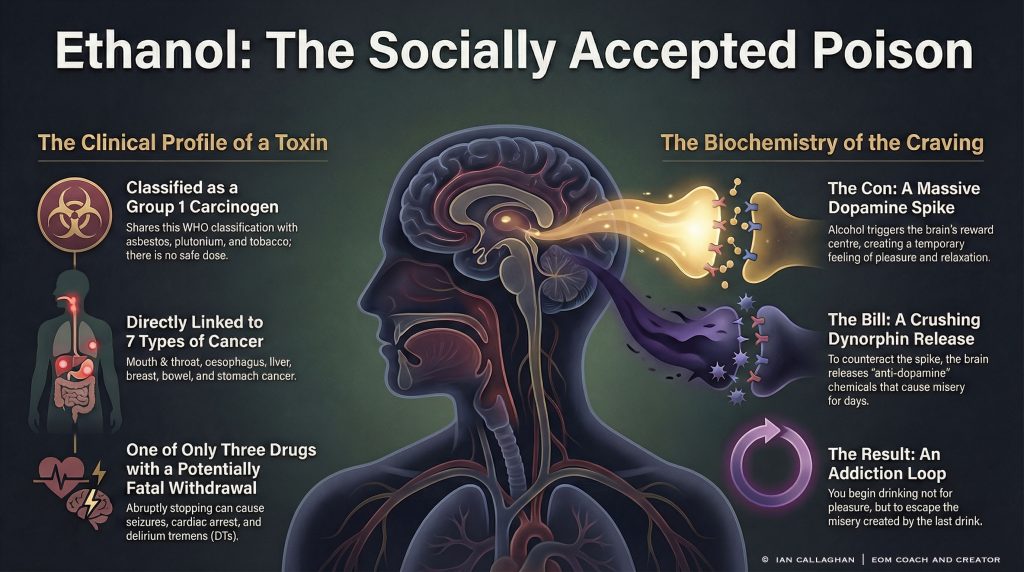
Alcohol sits in the same World Health Organisation (WHO) category as asbestos, plutonium, and tobacco. This isn’t a “judgment call” or “anti-booze propaganda.” It is a classification based on undisputed, peer-reviewed toxicology.
There is no “safe dose” when it comes to DNA damage. When you consume ethanol, your body immediately prioritises its breakdown because it cannot store it. The primary metabolite is acetaldehyde—a highly reactive chemical that is a proven mutagen.
How Acetaldehyde Destroys Your DNA
Acetaldehyde is up to 30 times more toxic than ethanol itself. It literally breaks your DNA strands, causes cross-linking (where the two strands of the DNA double helix are permanently stuck together), and prevents your body from repairing the damage. When DNA repair fails, the cell either dies or mutates. Mutation is the gateway to cancer.
This chemical assault leads directly to seven primary types of cancer:
- Mouth and Throat: The first points of contact. Ethanol acts as a solvent, making the delicate mucosal membranes more permeable to other carcinogens, such as those found in tobacco or processed foods.
- Oesophagus: Chronic irritation and the constant presence of acetaldehyde lead to cellular mutation of the lining.
- Liver: This is “Ground Zero.” As the liverLiveresses the toxin, it generates massive oxidative stress. This leads to Steatosis (fatty Liver), Fibrosis (scarring), then Cirrhosis (permanent death of liver tissue), and finally Hepatocellular Carcinoma (liver cancer).
- Breast: Alcohol increases levels of estrogen and other hormones associated with hormone-receptor-positive breast cancer. It also decreases the body’s ability to absorb essential nutrients that protect against cell damage, such as folate.
- Bowel and Stomach: Constant inflammation of the digestive tract and the total disruption of the microbiome—the “Leaky Gut” effect—allows carcinogenic byproducts to enter the bloodstream, creating a pro-cancer environment throughout the body.
The Fatal Withdrawal Paradox: A Regulatory Red Flag
In the world of drug regulation, the “Danger Profile” of a substance is often measured by its withdrawal mechanics. There are only three common substances where the withdrawal itself can kill you: Benzodiazepines, Barbiturates, and Alcohol. Even Opioid withdrawal, as agonising as it is, rarely stops the heart. Alcohol withdrawal is a medical emergency because of a phenomenon called Excitotoxicity.
The GABA/Glutamate War: The Brain Under Siege
Alcohol is a central nervous system depressant. It works by mimicking GABA, your brain’s primary inhibitory neurotransmitter (the “brake”). To counter this constant suppression, the brain increases glutamate production, the primary excitatory neurotransmitter (the “gas”).
When you drink for years, your brain is essentially driving with one foot slammed on the brake and the other slammed on the gas. When you suddenly remove the alcohol, the “brake” is gone, but the “gas” is still floored. This leads to a massive, toxic surge of Glutamate:
- Seizures: The brain’s electrical system short-circuits from over-excitation.
- Delirium Tremens (DTs): A state of extreme confusion, hallucinations, and tremors.
- Cardiac Arrest: The heart’s electrical system is overwhelmed by the chemical surge, leading to sudden death.
If we invented a drink today that could kill you simply because you stopped drinking it, it would be labelled a high-risk controlled substance within 24 hours. The fact that it is available in every corner shop is a testament to historical momentum, not public safety.
Systematic Solvent Damage: The “Whole Body” Hit
Ethanol is a “solvent.” It is both water and fat-soluble, meaning it permeates every single cell in your body. It doesn’t “pass through” you; it integrates into your biology and destroys it from the inside out.
Neurotoxicity and the Blood-Brain Barrier
Alcohol crosses the blood-brain barrier with ease. Once inside, it acts as a neurotoxin, physically shrinking the brain’sgreyy matter. Over decades of drinking, this leads to:
- The Lobotomized Prefrontal Cortex: The part of the brain responsible for impulse control, long-term planning, and social behaviour. Alcohol “turns off” this section first, which is why your “Zero Fucks” button gets stuck when you’re drunk.
- Amygdala Hijack: Alcohol increases the sensitivity of the amygdala, the brain’s fear centre. This is why long-term drinkers often suffer from chronic anxiety and paranoia when they aren’t drinking.
- Wernicke-Korsakoff Syndrome: Also known as “Wet Brain,” this is a permanent form of dementia caused by thiamine (Vitamin B1) deficiency, which alcohol directly causes by blocking absorption in the gut.
Cardiomyopathy and the “Holiday Heart”
The “heart-healthy” myth of red wine was one of the greatest marketing cons of the 20th century. Ethanol is directly toxic to the heart muscle (myocardium). It leads to alcoholic cardiomyopathy, where the heart weakens and thins, unable to pump blood efficiently. It also spikes blood pressure and triggers arrhythmias like Atrial Fibrillation (often called “Holiday Heart Syndrome”). Chronic drinkers are essentially walking around with an engine that misfires and leaks oil.
Mitochondrial Collapse and the ATP Crisis
As a nutrition expert, I focus on the mitochondria—the engines of your cells. Every cell in your body needs ATP (energy) to function. Alcohol is a “metabolic priority.” Your body cannot store ethanol, so it halts all other functions, including fat burning and nutrient absorption, to deal with the chemical fire.
This causes a massive surge in Reactive Oxygen Species (ROS), effectively “rusting” your cells. When your mitochondria fail, your energy fails. You aren’t just “tired”; your cells are literally running out of the currency they need to stay alive. This is why hangovers feel like a near-death experience—because, at a cellular level, they are.
The Biochemistry of Desire: The Science of the Craving
Most people think a craving is a “lack of willpower.” It isn’t. A craving is a biological mandate issued by a hijacked nervous system. To understand why you can’t “just have one,” you have to understand the Dopamine-Dynorphin Seesaw.
The Dopamine Spike (The Con)
When ethanol hits your system, it triggers a massive release of dopamine in the nucleus accumbens—the brain’s reward centre. This is the “Aha!” moment. It feels like relaxation or confidence. But because alcohol is a depressant, the brain has to maintain homeostasis. It cannot let you stay that high forever, or your system would collapse.
The Dynorphin Crash (The Bill)
To counter the massive dopamine spike, your brain releases Dynorphins. Think of Dynorphins as “anti-dopamine.” They are the chemicals of misery, restlessness, and discontent. They turn down the volume on your joy so that the alcohol doesn’t overstimulate you.
The problem? Dopamine leaves the system in minutes. Dynorphins stay for days.
This is why, at 3:00 AM after a night of drinking, you wake up with “The Horrors.” That isn’t just guilt; it’s the Dynorphins making you feel physically and emotionally wretched. Your brain then tells you the only way to get rid of that feeling is another spike of dopamine. This is the “Loop.” You aren’t drinking for pleasure anymore; you are drinking to neutralize the misery created by the last drink. This is the Chemical Hijack.
The Quartet of Destruction: Alcohol, Sugar, Seed Oils, and Wheat
If you want to understand why you feel like shit even when you aren’t drinking, you have to look at the Quartet of Destruction. Alcohol is rarely the only toxin in the system.
1. Alcohol: The Lead Toxin
The primary neurotoxin that stops fat-burning, inflames the gut, and damages DNA. It is the “entry drug” for metabolic syndrome and type 2 diabetes.
2. Refined Sugar: The Dopamine Mirror
Alcohol is effectively a liquid sugar delivery system. When you remove the ethanol, your brain still wants that massive dopamine hit, and it knows that refined sugar is the closest legal equivalent. If you swap the bottle for the biscuit tin, you aren’t healing; you’re just shifting the dependency.
3. Seed Oils: The “Double Hit” to the Liver
Industrial vegetable oils (Soybean, Corn, Canola) are high in Linoleic Acid, an Omega-6 fatty acid that is highly unstable. When you combine Seed Oils with Alcohol, you create a “Double Hit” to the Liver.
Alcohol increases gut permeability (Leaky Gut), allowing endotoxins from your bacteria to enter the Liver, while the seed oils have already created a pro-inflammatory environment. Research suggests that this combination accelerates Cirrhosis significantly faster than alcohol alone. If you’re drinking wine and eating “healthy” stir-fries cooked in rapeseed oil, you are still poisoning your Liver.
4. Wheat/Gluten: The Gut Permeability Factor
Wheat contains Zonulin, a protein that regulates the “tight junctions” in your gut lining. Modern wheat and alcohol both increase Zonulin, leading to a permanent state of Leaky Gut. This allows undigested food particles and bacteria to enter the bloodstream, triggering a systemic immune response. Your brain fog isn’t just the booze; it’s the immune system attack caused by your “standard” diet.
As a nutrition expert, I don’t just tell people to “stop drinking.” I tell them to stop the biological napalm. You cannot heal a liver that is being bombarded by alcohol and inflammatory seed oils simultaneously.
Why Is It Still Legal? The “Grandfather” Loophole
If alcohol is so toxic, why is it next to the bread in Sainsbury’s? Why do we advertise it during the football and pour it at christenings? The answer isn’t “safety”—it’s history, revenue, and conditioning.
The Treasury Factor: Governments as Pushers
In the UK, alcohol generates roughly £12 billion in yearly tax revenue. In the US, the numbers are even more staggering. Governments are effectively “addicted” to the revenue generated by a substance that costs the healthcare system nearly double that amount in related illnesses, violence, and policing. They aren’t going to ban it because they can’t afford the withdrawal symptoms in their own budgets.
The “Culture” Shield: Marketing the Poison
We have been conditioned to associate wine with “sophistication” and beer with “mateship.” We use these labels to hide the molecule. We call it “spirit,” “craft,” or “vintage” to distract ourselves from the fact that it is ethanol—the same stuff we put in petrol tanks. The alcohol industry spends billions ensuring that you view your dependency as a “lifestyle choice” rather than a toxicological reality.
Normalised Poisoning: The Peer Pressure Machine
We are the only society that mocks people for not consuming a Group 1 carcinogen at a weekend party. If you turned down a cigarette, no one would call you “boring.” If you turned down a neurotoxin, and suddenly you’re the “odd one out.” This social engineering is designed to keep you in the loop, because as long as everyone else is drinking, no one has to look at the bill.
Reclaiming Your Operating System: The EOM Method
If you have spent 45 years—or even 5 years—running on this toxic fuel, your “Emotional Operating System” (EOS) is glitchy. You drink to numb the noise, but the drink is what creates the noise in the first place.
Step 1: Identify the Loop
Most drinking is “maladaptive regulation.” You are trying to calm a nervous system that alcohol has already fried. You have to stop viewing the drink as the solution and start viewing it as the source of the fire.
Step 2: The Physical Reset (Autophagy)
You cannot fix the mind while the body is under chemical siege. This is why my approach focuses on Autophagy—the body’s natural “cell autophagy” mechanism. By removing toxins (Alcohol, Sugar, Seed Oils, Wheat) and using protocols like Intermittent Fasting, we trigger the body to break down damaged cells and mitochondria and replace them with new, high-performance ones. You have to clear the metabolic fog before you can rewire the hardware.
Step 3: Emotional Observation Method (EOM)
Once the toxin is gone, the emotions return at full volume. You need a mechanical framework to “Observe” these states without reacting to them. This is how you transition from “white-knuckling it” to true emotional mastery. You stop “being” the emotion and start “observing” the data.
FAQ: The Hard Truths (What They Don’t Tell You in the Pub)
Q: Is “moderation” actually a healthy goal?
A: Moderation is a term invented by the alcohol industry to keep you “functionally addicted.” From a purely toxicological standpoint, there is no “healthy” amount of a Group 1 carcinogen. You are simply poisoning yourself more slowly.
Q: How long does it take for the liver to heal?
A: The liver is the only organ that can fully regenerate, but it needs a total cessation of the toxin. Through a strict nutritional protocol that reduces inflammation and supports autophagy, a significant improvement in liver enzymes (ALT/AST) within 30 to 90 days.
Q: Why do I feel bored when I stop?
A: Because your dopamine receptors are fried. They’ve been blasted by “weapons-grade” stimulation for years. It takes about 90 to 120 days for your brain to start finding “normal” things—like a sunset or a conversation—interesting again. This is a chemical recalibration, not a character flaw.
Q: What is acetaldehyde exactly?
A: Acetaldehyde is the first byproduct of ethanol metabolism. It is up to 30 times more toxic than alcohol itself. It is a known carcinogen that causes DNA cross-linking, which leads to permanent genetic mutations and cancer. It is the reason for the “hangover” and the long-term damage.
Q: Can I repair my mitochondria?
A: Yes. Through a combination of removing toxins, strength training, and cold exposure, you can trigger Mitochondrial Biogenesis—the creation of new, healthy power plants in your cells.
FEATURED PRODUCT
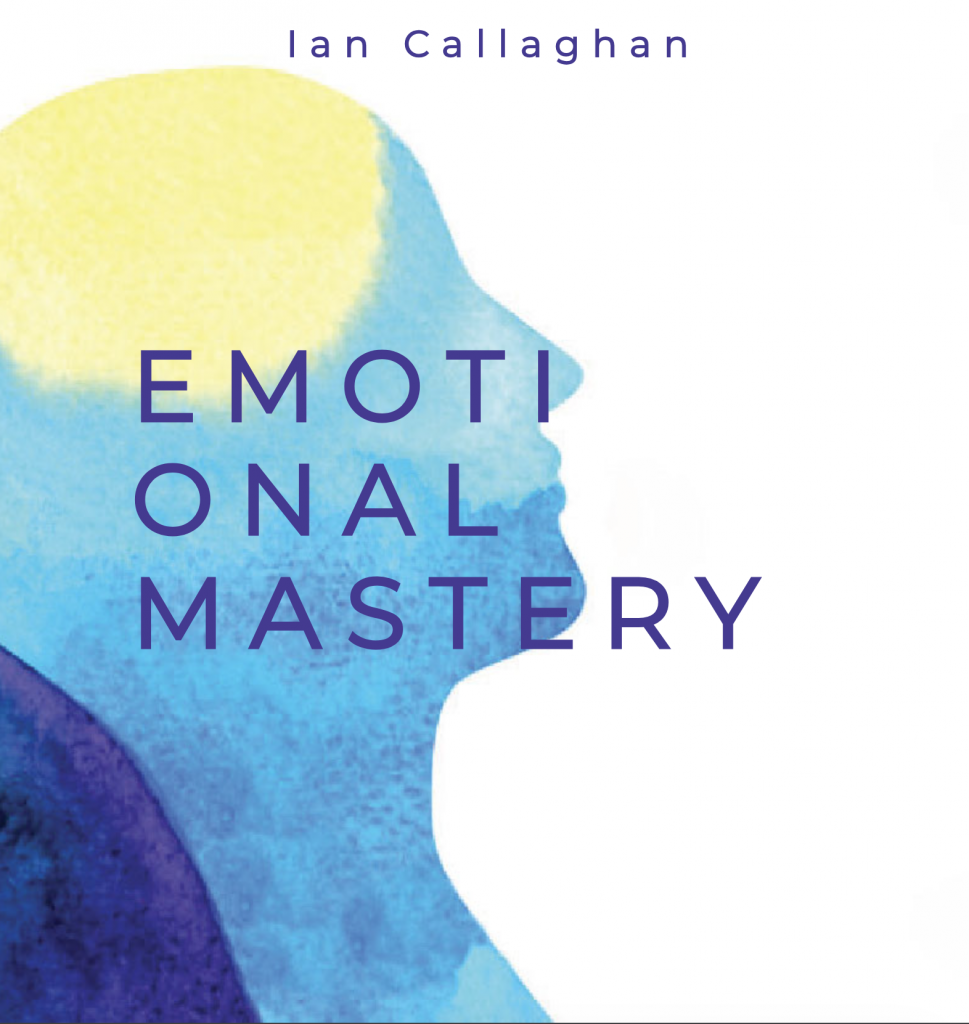
Emotional Mastery: The Emotional Operating System
The Essential Toolkit for Reclaiming Your Life.
If you are struggling with the science of cravings or the emotional “Freight Train” described in this report, you need a mechanical framework to manage your system.
- Stop the Loop: Identify triggers before they hijack you.
- Rewire the Response: Practical Tools for Real-World Stress.
- Veteran-Led: No fluff, just the method I used after 45 years of drinking.
GET EMOTIONAL MASTERY (£14.97) →
JOIN THE COMMUNITY
The Sober Beyond Limits Facebook Group
Stop doing the social wilderness alone. Join 5,000+ veterans and high-performers who are using the EOM method to reclaim their lives. Get daily support, live Q&As, and a community that actually “gets it.”
JOIN THE FACEBOOK GROUP (FREE) →
Take the Trigger Quiz: What’s Driving Your Loop?
Ian Callaghan is a veteran, a sobriety coach, and a nutrition expert. After 45 years of drinking, he used his background in biochemistry and the EOM method to engineer his own “Reset.” He now helps over 37,000 followers navigate the brutal reality of reclaiming their lives through physical resets and emotional mastery.
Emotional Mastery: The Emotional Operating System
The Emotional Mastery book is a practical manual for understanding and regulating the human nervous system using the Emotional Operating System framework.
Instead of analysing emotions or retelling your past, the Emotional Mastery book teaches you how to read emotional states as system feedback, identify overload, and restore stability under pressure.
No labels. No therapy-speak. No endless healing loops.
Just a clear, operational approach to emotional regulation that actually holds when life applies load.
Instant digital download.