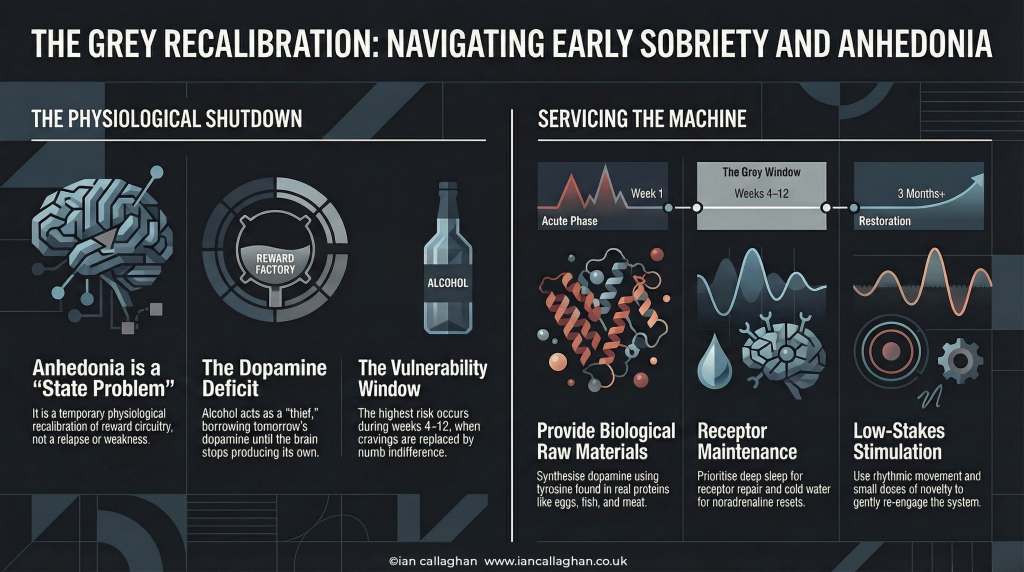
The Tuesday That Lost Its Colour
Nobody warns you about this bit. Anhedonia in early sobriety.
You brace for the first week. You brace for the shakes, the cravings, the weirdness of your first sober Friday night, the habit loops, the social awkwardness, the cupboards without bottles in them. You prepare yourself for the big, dramatic part. You expect struggle, then relief. You expect the pink cloud everyone keeps banging on about. Clear skin. Boundless energy. Morning walks—a sudden desire to become the sort of person who owns a yoga mat and means it.
But instead of the sunrise, you get the fog.
You are six weeks sober, sitting at the kitchen table on a random Tuesday, and something feels wrong. Not because you are craving a drink. Not because you are in pieces. Quite the opposite. You feel absolutely nothing. Not devastated. Not even especially angry. Just flat. Grey. Unmoved. As if somebody has gone into the control room of your brain and pulled the main fuse on the part that used to care.
Your favourite music sounds like background noise. Food tastes like cardboard. Sunlight feels thin and irritating. Life has not exploded. It has gone colourless.
That is what anhedonia in early sobriety can feel like, and it is one of the most dangerous parts of the whole process precisely because it does not look dramatic. It looks like a boring Tuesday. It looks like staring at a wall for forty minutes and wondering whether this numb, hollow indifference is what sober life is going to be forever.
Here is the truth.
This is not proof that sobriety is not working. It is not proof that you were better off drinking. It is not proof that you are weak, broken, or built wrong. It is often a sign that your reward system is recalibrating after years of hammering.
I write about this from lived experience, years of coaching people through addiction and behavioural change, and a framework built around the biology of recovery rather than the motivational fluff you get fed online. If you feel like a grey cardboard version of yourself right now, this article is for you.
What Is Anhedonia in Early Sobriety?
Anhedonia is the inability to feel pleasure.
That sounds simple, but when it hits in early sobriety, it can feel brutal because it steals the point of the whole thing. You quit drinking expecting relief, better sleep, more clarity, more life. Instead, you get emotional static.
Anhedonia is not the same as sadness. Sadness has shape to it. Sadness has weight. You know you are sad. Anhedonia is different. It is the absence of emotional landing. You can look at something beautiful, hear a song you used to love, eat a meal you know should be enjoyable, and absolutely nothing happens inside.
Your brain registers the event. It just does not reward you for it.
That is why anhedonia in sobriety is so dangerous. The cravings may have gone quiet, but so has everything else. And when sober life feels flat, the old lie starts creeping back in: if this is it, I might as well drink.
That is exactly why this needs to be named properly.
Why Anhedonia Happens After Quitting Alcohol
Your Brain Is Not Broken, It Is Adapting
Alcohol is not just a drink. It is a chemical hijack of your reward system.
For a long time, booze acted like an external power source. It flooded the system, boosted dopamine, and trained your brain to expect stimulation from outside rather than to generate balanced reward internally. The brain, being efficient and logical, adapts to that.
It turns things down.
That means lower natural dopamine signalling, reduced sensitivity, and a reward system that stops reacting properly to ordinary life because it has been trained on a stronger artificial hit.
Then one day, you stop drinking.
The external supplier is gone, but the internal system has not fully come back online yet. That gap is where anhedonia lives.
This is why early sobriety can feel so flat. You have removed the chemical spike, but your baseline reward circuitry is still under repair. The factory is still standing, but production is restricted.
Why Sober Life Feels Pointless for a While
This is the bit that catches people out.
When you are white-knuckling through cravings, at least you know what the fight is. When you are in the grey phase, there is no big enemy—just indifference. Food does not excite you. Music does not move you. You stop looking forward to things. You are not in chaos. You are in a low-voltage version of existence.
That can make sobriety feel pointless, even when it is actually working.
The absence of drama tricks people into thinking nothing meaningful is happening. In reality, your nervous system may be doing a huge amount of repair behind the scenes.
The Real Problem With Sober Influencer Nonsense
Why Toxic Positivity Makes Anhedonia Worse
A lot of the sober internet is absolute bollocks when it comes to this stage.
It loves before-and-after photos, morning routines, gratitude journals, glow-up reels, and the idea that once you stop drinking, your whole life turns into sunlight, matcha, and expensive trainers.
That version of sobriety leaves people completely unprepared for anhedonia.
Because when week six feels grey as hell and some influencer is posting about how quitting alcohol made them spiritually radiant by day nineteen, you assume the problem is you.
It is not you.
It is the gap between reality and performance.
You cannot gratitude-journal your way out of an underpowered nervous system. You cannot mind-set your way around biology. Software does not fix a hardware issue.
That does not mean mindset is useless. It means mindset without physiology is incomplete.
The Shame Tax Makes Recovery Harder
Why Feeling Broken Adds More Load
One of the worst things you can do during anhedonia is start treating yourself like a defective person.
Shame is not just emotional. Shame is a physiological load. It adds stress to a system that is already struggling. It pushes cortisol into a brain that is trying to stabilise. It makes recovery heavier.
That is why anything that reinforces the idea that you are permanently broken, fundamentally flawed, or doomed to white-knuckle your way through life can make this phase worse.
You are not trying to prove moral worth here. You are trying to support a nervous system that has been under chemical pressure for years.
That is a different conversation.
7 Signs of Anhedonia in Early Sobriety
If you are wondering whether this is what is going on, these are some of the most common signs.
1. Good things happen, and you feel nothing
You know something should feel good, but the emotional response never lands.
2. Food loses its appeal
You eat because you should, not because there is any pleasure in it.
3. Music does not hit the same
Songs you used to love sound like wallpaper.
4. You feel like a cardboard version of yourself
You are functioning, but there is no spark in it.
5. Boredom feels physical
Not casual boredom, actual agitation in your body.
6. You stop looking forward to things
The future does not feel threatening; it just does not feel alive.
7. Cravings go quiet, but numbness gets louder
This is the trap. You think the danger has passed because the urge to drink is not screaming. But numbness can drive relapse just as hard as craving can.
How to Support Recovery From Anhedonia
You do not fix this by pretending it is not happening. You support the machine.
Real food and protein matter
Your brain needs raw materials to build neurotransmitters. That means proper food, enough protein, and not trying to run recovery on ultra-processed crap.
Eggs, meat, fish, full-fat dairy, real meals, proper nutrients. You are trying to help the system rebuild, not survive on beige convenience food and hope.
Sleep is not optional.
Deep sleep is where repair happens. If your sleep is wrecked, your recovery is carrying an extra load.
You do not need perfection, but you do need to treat sleep like infrastructure, not a luxury.
Rhythmic movement helps regulate the system.
Not gym-bunny punishment. Not smashing yourself into the floor. Walking. Gentle strength work. Rhythmic movement. Enough to lower stress, improve regulation, and remind your body it is safe.
Cold water can act as a manual reset
Used properly, cold water is not content. It is input.
It can shift state fast, increase alertness, and create a genuine physiological response in a system that has gone flat. It is not magic, but it can help wake the circuit up.
Small novelty matters more than you think.
New route, new recipe, new environment, new music, a change in pattern. A depleted dopamine system often needs small, low-pressure novelty to start responding again.
Honest connection beats performance.e
Do not isolate and pretend you are fine. You do not need to perform thriving. You need real contact. Even one proper, honest conversation can take some load off the system.
Anhedonia in Sobriety Is Not Permanent
The Colour Comes Back in Stages
This is the bit people need to hear.
Yes, you can enjoy things again.
Not because of motivational nonsense. Because the brain is plastic, it adapts. If it adapts to alcohol, it can adapt away from it too.
The colour usually comes back gradually, not all at once. A song lands a little more than it did last week. A meal tastes better. You laugh properly for the first time in ages and realise it was real. That is how the system comes back online.
Not with a cinematic breakthrough. In increments.
Why This Matters for Relapse Prevention
Anhedonia matters because people mistake it for failure.
They think, I quit drinkin, and I still feel like shit, so what is the point?
That is often the exact moment the old pattern tries to sell itself back to you as relief.
But drinking does not solve anhedonia. It resets the damage. It plugs the external power source back in, delaying the rebuild again.
That is why understanding anhedonia is not just comforting; it is practical. When you know what is happening, you are far less likely to misread the grey phase as a sign you should go backwards.
FAQ: Anhedonia and Early Sobriety
Is anhedonia normal in early sobriety?
Yes, it is common. Not everyone experiences it the same way, but a flat, numb, joyless phase is a recognised part of early recovery for many people after quitting alcohol.
Is anhedonia the same as depression?
Not exactly. They can overlap, but anhedonia is specifically about reduced ability to feel pleasure. Depression is broader and can include hopelessness, low mood, sleep changes, guilt, and other symptoms. If things are getting darker, more persistent, or you are struggling to function, speak to a qualified professional.
How long does anhedonia last after quitting alcohol?
It varies. For many people, the worst of it starts to lift somewhere between weeks four and twelve, but heavier or longer drinking histories can mean a longer recalibration. There is no exact stopwatch for this.
Will I ever enjoy life again without alcohol?
Yes. The system can recover. It takes time, repetition, and the right inputs, but the flatness is not proof that pleasure is gone forever.
What helps with anhedonia in sobriety?
Real food, protein, better sleep, movement, cold exposure where appropriate, reduced stress load, honest connection, and giving your nervous system time to recalibrate. In some cases, professional support may also be important.
Final Word on Anhedonia in Early Sobriety
If sobriety feels flat right now, that does not mean you are doing it wrong.
It does not mean you are broken.
It means your brain may be recalibrating after years of being trained to expect chemical reward on demand. That process can feel bleak, boring, and frighteningly empty. But empty is not the same as finished.
This phase has caught a lot of people out because nobody talks about it properly. They talk about cravings. They talk about rock bottom. They talk about transformation. They do not talk enough about Tuesdays when nothing feels good, and you start wondering whether sober life is just a long stretch of grey carpet.
It is not.
If you are in that phase, stop mistaking a maintenance window for a verdict on your life.
Support the hardware. Lower the load. Stay the course.
The colour comes back.
Key takeaways on anhedonia in sobriety
What to remember
- Anhedonia in early sobriety is common and often temporary
- It can feel like numbness, flatness, and loss of pleasure rather than obvious sadness
- It is often linked to reward system recalibration after quitting alcohol
- Social media recovery fluff usually does a terrible job of preparing people for it
- Real food, sleep, movement, cold exposure, and honest connection can support recovery
- Feeling flat does not mean sobriety is failing
A question worth asking yourself today
If this grey phase is not failure but repair, what is one thing you can do today to support the machine rather than attacking yourself?

Under Load by Ian Callaghan | The Mechanical Guide to Addiction Recovery
You already know what you’re doing. You’ve known for years.