Why Your Sleep Tracker is a Liar: Reclaiming the Human System in a High-Tech World
1. Introduction: The Exhaustion Paradox
Imagine the scene: it is 11:45 pm, and you are lying in a bed that cost more than your first car, surrounded by a forest of tangled white USB cables—the digital umbilical cords of the modern age. On your wrist sits a high-precision titanium ring, and on your nightstand, a smartphone hums with the vibrating notifications of a world that never sleeps. The room is cool, the sheets are Egyptian cotton, and the air is purified to a laboratory standard. Yet, you are lying there, staring at the ceiling, feeling a strange, vibrating hum in your very bones. You are “tired but wired.”
This is the quintessential modern haunting. Your body is heavy, your eyes are stinging, and your brain feels like it has been scrubbed with steel wool, yet your nervous system refuses to disarm. You check your sleep tracker, hoping for a “Readiness Score” that might validate your suffering, but the data feels like a mockery. You have spent thousands of pounds on gadgets designed to “optimise” your rest, yet you wake up every morning feeling like a ghost of your former self.
Despite our unprecedented connectivity and our obsession with biohacking, we have never been more depleted. We download “bloody apps” to tell us why we are tired, then stay awake using those very apps to scroll through the curated lives of strangers, bathing our retinas in the blue light of a thousand miniature suns. This is the exhaustion paradox. We treat our bodies like high-performance machines that require constant surveillance, yet we ignore the fundamental, non-negotiable biological requirements of the system.
We have reached a point where the average professional is living like a mobile phone hovering at 1 percent battery. You are flickering, the screen is dimming, and the apps are crashing. Eventually, the system shuts down unexpectedly. You call this “recovery” because the screen went black and you stayed in bed for eight hours, but it is not recovery. It is a system failure. Real sleep isn’t a metric to be tracked, a “hack” to be mastered, or a point of negotiation. It is a biological system that must be respected. To reclaim your energy, you must stop looking at the scoreboard and start returning to your factory settings.
2. The Sedation Delusion: Why Eight Hours Isn’t Always Eight Hours
There is a profound, often ignored difference between being asleep and being unconscious. In our metric-obsessed culture, we have conflated the two. We boast about “getting our eight hours” as if sleep were a commodity you could buy in bulk at the supermarket. But we fail to examine the internal architecture of those hours. For many, sleep is not a graceful transition into the restorative rhythms of life; it is a violent, chemical collapse.
When you spend your day fueled by back-to-back stimulants and your evening suppressed by blue light, work-induced cortisol, and perhaps a “relaxing” glass of Malbec, you do not “fall” asleep. You pass out. You have pushed the human system to its absolute redline until it simply cannot maintain consciousness any longer. This is the “Phone on 1 Percent” state. When a phone dies because the battery is empty, it hasn’t “decided” to rest; it has suffered a total power loss.
“You pass out. You collapse. You go unconscious like a phone on 1 percent battery and call it recovery. That is not sleep. That is system failure.”
This system failure is the great delusion of modern health. We assume that as long as we were “out” for a certain duration, the body has performed its necessary maintenance—clearing metabolic waste, consolidating memories, and repairing tissue. But proper sleep is an active, complex, and highly choreographed biological process. It requires specific chemical and thermal conditions to occur. When we bypass these conditions through sheer exhaustion or chemical sedation, we wake up feeling “emotionally mugged,” despite the clock saying we spent nearly half a day in bed. We are confusing the absence of consciousness with the presence of recovery. True recovery is an investment in the architecture of the brain; sedation is merely a temporary ceasefire.
3. The Tracker Trap: Turning Your Body into a Disappointing Video Game
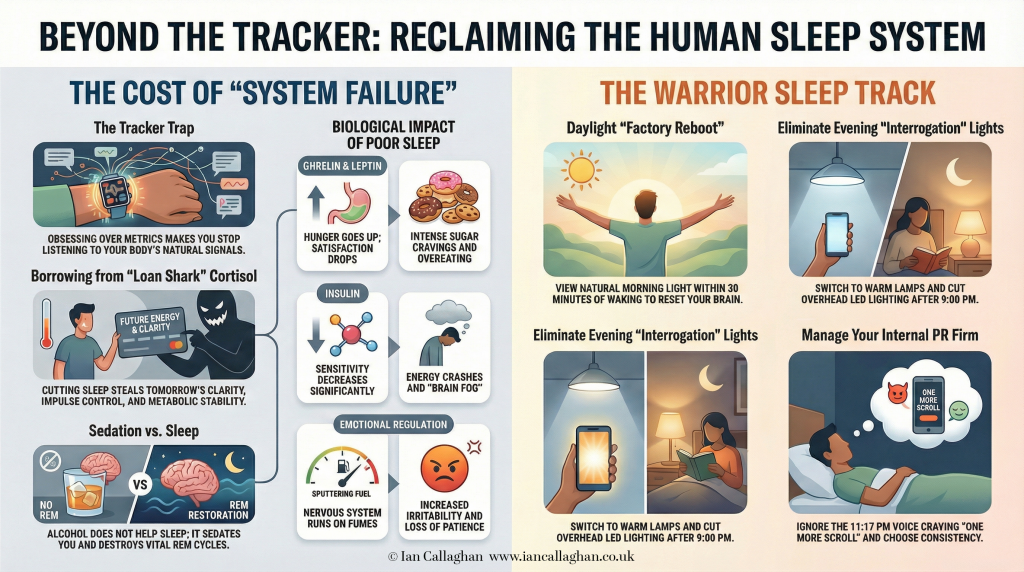
We have entered the era of “Scores for Scores.” We track steps, calories, heart rate variability, and blood glucose. We have sleep scores, readiness scores, and recovery scores. We have turned the miracle of 200,000 years of human evolution into a disappointing video game where you are constantly losing to an invisible opponent.
The psychological impact of this constant “scoring” is devastating to our innate biological intuition. By obsessing over metrics, we have effectively silenced the very signals our bodies use to communicate with us. We no longer ask ourselves, “How do I feel today?” Instead, we look at a ring or a watch to tell us if we are allowed to feel tired or energised. There is something deeply absurd about a grown adult looking at a piece of plastic to determine if they had a good night, while they are simultaneously “knackered and shouting at the kettle.”
This is the ultimate irony of the tracker trap: we use technology to negotiate with reality. We know that scrolling through social media at midnight under harsh LED lighting while answering “urgent” work emails is not restful behaviour. We know the wine we drank to “unwind” is a neurotoxin that shatters our sleep architecture. But we look for a “17 percent REM” score or a “Good” readiness rating to justify our choices, hoping the gadget will give us permission to ignore what our bodies are screaming at us.
Your tracker doesn’t know you. It knows your movement and your heart rate, but it doesn’t know the texture of your fatigue. When you obsess over the data, you become like a “distressed hamster” on a wheel, chasing a number that has no bearing on the underlying biological reality. The tracker becomes a way to outsource your intuition. You stop listening to the signals—the cravings, the brain fog, the irritability—and start chasing a performance. But health is not a performance; it is a state of being.
4. The Cortisol Loan Shark: The Brutal Interest of Sleep Debt
To understand why we feel so perpetually depleted, we must look at the brain for what it truly is: an electrical organ sitting in a dark, silent skull, running chemical software that was written in the Pleistocene. This ancient software does not care about your KPIs, your “4 am spreadsheet culture,” or your desire to be a “high-performer” on LinkedIn. It cares about survival, homeostasis, and the conservation of energy.
When you cut sleep to squeeze more productivity out of your day, you are not “gaining” an hour. You are entering into a predatory financial arrangement with your own biology. You are borrowing energy from tomorrow to pay for today’s inefficiency. The lender in this scenario is a hormone called cortisol—the “loan shark” of the human system.
Cortisol is the stress hormone designed to get you away from a predator or through a period of famine. It provides that artificial hit of “wired” energy that allows you to push through the fatigue, but the interest rate is brutal. By borrowing from the loan shark, you are forfeiting tomorrow’s clarity, your ability to control your impulses, and your metabolic stability.
This is why the “tired but wired” feeling is so pervasive in the city. You are living on high-interest biological debt. Your nervous system is running on fumes, propped up by a stress response that was never meant to be a permanent state of existence. You cannot out-hustle the basic requirements of a 200,000-year-old brain. Eventually, the loan shark comes to collect, and the payment is usually extracted in the form of a burnout, a breakdown, or a metabolic collapse.
5. The Hormonal Domino Effect: When Hunger and Emotion Go Feral
When sleep is compromised, the biological fallout is immediate, systemic, and unforgiving. It is a domino effect that touches every aspect of your humanity, from the food you choose to eat to the way you interact with your spouse. This isn’t a lack of “discipline” or a failing of “willpower”; it is a chemical hijacking.
The Hunger Imbalance (Ghrelin and Leptin) The moment you enter a sleep deficit, your hunger hormones go feral. Ghrelin, the hormone that signals hunger, spikes like a fever. Leptin, the hormone that signals fullness and satisfaction, plummets. This is why, after a poor night’s sleep, you find yourself in a “9 pm biscuit negotiation” with yourself. You are biologically programmed to seek out high-energy, sugary, hyper-palatable foods because your brain thinks it is in a survival crisis and demands immediate fuel. It is not a character flaw; it is “chemistry kicking your arse.”
The Metabolic Crash (Insulin Sensitivity) Poor sleep causes a rapid, measurable drop in insulin sensitivity. The biological reality is that the same meal you handled perfectly well a week ago—when you were rested—now hits your system like a metabolic brick. Your body cannot process the glucose effectively, leading to more blood sugar crashes, more intense cravings, and the pervasive sense of “why am I like this?” Your body’s ability to manage fuel effectively is tied directly to the quality of your rest. You cannot “green-smoothie” your way around a lack of sleep.
The Emotional Regulation Failure Finally, your emotional regulation tanks. The prefrontal cortex, the part of the brain responsible for impulse control, rational thought, and “being an adult,” loses its grip on the amygdala—the emotional centre of the brain. This is why small inconveniences—a slow lift, a misplaced set of keys, or a minor critique from a colleague—begin to feel like personal attacks. You are not actually angry at the world; you are simply under-recovered. Your nervous system is too frayed to provide the patience and focus required for modern life.
6. The Midnight Light Show: Why Your Brain Thinks It’s Noon in Ibiza
One of the greatest enemies of the human sleep system is the modern lighting environment. Our ancestors evolved under the rhythmic rising and setting of the sun, followed by the warm, dim, flickering glow of firelight. Our brains use light as the primary signal to determine what time it is and which hormones to produce.
Today, we subject ourselves to a “Midnight Light Show.” We inhabit homes filled with white LED kitchen lights that are “bright enough to interrogate prisoners.” We stare into laptops and phones that emit a specific spectrum of blue light that signals “High Noon” to the brain.
When your brain is bombarded with this artificial light, it refuses to produce melatonin, the hormone required to initiate the sleep cycle. You are essentially telling your 200,000-year-old software that you are currently standing in the middle of a beach in Ibiza at midday. Then, you lay in the dark and wonder why you are “staring at the ceiling counting regrets” and thinking about that embarrassing thing you said in 2014. You have created a catastrophic biological mismatch between your environment and your evolutionary needs. You are trying to sleep in a world you’ve convinced your brain is perpetual daylight.
7. The Alcohol Myth: The “Drunk Builder” in Your Brain
There is a persistent, stubborn myth that a glass of wine or a stiff nightcap helps with sleep. This is perhaps the most damaging “hack” in our modern repertoire. Let us be clear: alcohol does not help you sleep. It sedates you.
While alcohol might help you “pass out” faster by suppressing the central nervous system, the quality of the ensuing unconsciousness is abysmal. Alcohol is a powerful disruptor of REM (Rapid Eye Movement) sleep, the stage of sleep responsible for emotional processing, memory consolidation, and cognitive health.
“Alcohol does not help you sleep. It sedates you. It knocks you unconscious and then smashes your REM cycles like a drunk builder with a sledgehammer. You wake up feeling like you have been emotionally mugged.”
This is why, after a night of “relaxing” drinks, you wake up feeling fragmented, anxious, and cognitively sluggish. You have bypassed the restorative phases of sleep and replaced them with a state of chemical sedation. You haven’t recovered; you’ve just been put under. The “drunk builder” has spent the night destroying the very architecture your brain needs to function the next day.
8. Caffeine Courage: Mortgaging the Nervous System
Similarly, we use caffeine to mask the symptoms of our self-inflicted sleep debt. That 3 pm coffee is often viewed as a necessary “boost” to get through the final hours of the workday. In reality, that caffeine is “Caffeine Courage”—a false sense of energy that is actually being borrowed from your midnight rest.
Caffeine has a surprisingly long half-life. If you have a coffee at 4 pm, half of that caffeine is still circulating in your brain at 10 pm, blocking the adenosine receptors that signal sleepiness. You are mortgaging your nervous system. You might get a “slightly faster spreadsheet” at 4 pm, but you are ensuring that your nervous system remains in a state of high alert when it should be winding down. You are sacrificing the long-term health of your brain for a short-term illusion of productivity. It is a bad trade, made by people who have forgotten what it feels like to be naturally awake.
9. Silencing the Inner PR Firm: The Psychology of the Midnight Scroll
At approximately 11:17 pm, most of us encounter a very specific, very persuasive internal voice. It is a smooth-talking, silver-tongued entity that says things like:
- “Just one more episode of this show, you’re finally relaxing.”
- “One more scroll through the news feed; you need to stay informed.”
- “You’ve worked so hard today; you deserve this ‘me time’.”
This is your “Inner PR Firm.” It is not your rational self; it is a psychological mechanism designed to sell you tomorrow’s misery at a discount price tonight. It frames self-destructive behaviour as “self-care.” It tells you that staying up until 1 am looking at memes is a reward for a hard day, when in reality, it is a punishment for your future self.
To reclaim your sleep, you must learn the “behavioural coaching” technique of observing and naming this voice. When it starts its pitch at 11:17 pm, stop and say to yourself: “Ah, there’s the Inner PR Firm trying to ruin my Tuesday.” Observe it. Name it. Laugh at the ridiculousness of its arguments. Then, put the phone down like an adult who understands that actions have consequences. The Inner PR Firm does not care about your brain fog, your irritability, or your cravings tomorrow morning; it only cares about the immediate, cheap hit of dopamine. Managing this voice is the first step in returning to a functional, high-integrity human state.
10. The Warrior Sleep Track: Returning to Factory Settings
Fixing your sleep does not require a £300 gadget, a designer supplement, or a subscription to a biohacking app. It requires a return to “factory settings”—the default human mode that your biology expects and demands. These are “no-gadget” solutions that are boring, unglamorous, highly effective, and as fundamental to your health as brushing your teeth.
- Morning Light Exposure: Within 30 minutes of waking, get actual daylight in your eyes. This means going outside. Do not look through a window (which filters out the necessary blue-light spectrum); do not wear sunglasses. This light signal acts as a “factory reboot” for the suprachiasmatic nucleus—the master clock in your brain—setting the timer for melatonin production fourteen hours later.
- Evening Lighting Environment: After 9 pm, cut all overhead lights. Switch to lamps with warm, low-wattage bulbs. Darkness is the operating environment your brain requires to begin the wind-down process. Stop “interrogating” your brain with Ibiza-style kitchen lighting. Create a sanctuary of shadow.
- Cold Water Exposure: End your morning shower with 60 seconds of cold water. It is unpleasant. It is shocking. But it provides a necessary stimulus for the nervous system and helps regulate your body’s thermal rhythm. As the saying goes, “Choose your discomfort.” The short-term discomfort of cold water is infinitely preferable to the decade-long discomfort of chronic, soul-crushing exhaustion.
- Nutritional Stability: Eat a high-protein, high-fat breakfast instead of sugar and refined carbohydrates. Stable fuel in the morning leads to a stable blood sugar level throughout the day. This drastically reduces the likelihood of those “9 pm biscuit negotiations” because your biochemistry isn’t on a sugar-induced rollercoaster.
- Rigid Consistency: Go to bed and wake up at the same time every day, even on weekends. This is the “brushing your teeth” of sleep health. It isn’t exciting, and it won’t make for a great Instagram post, but it is the foundation of a stable biological system. Your body craves rhythm, not “hacks.”
11. Conclusion: Wiping the Fogged-up Windscreen
When you stop tracking and start actually sleeping, everything in your life becomes markedly easier. Living with chronic sleep debt is like trying to drive a car through a heavily fogged-up windscreen. You are squinting, straining, and constantly on the verge of making a catastrophic mistake. You think the problem is the road, the car, or your driving skills, but the problem is simply that you cannot see.
Fixing your sleep wipes that windscreen clean. Suddenly, the world comes into focus.
- Cravings drop because your hormones are no longer feral.
- Mood stabilises because your prefrontal cortex is back in charge of your emotions.
- Fat loss becomes a natural side effect of a healthy metabolism rather than a constant, losing war of willpower.
- Focus and patience return to your work and your relationships.
You stop needing five cups of coffee and a motivational speech just to function at a baseline level. You do not need another tracker to tell you that you’re tired. You do not need another app to tell you to breathe. You do not need another powdered miracle from a “health” influencer.
What you need is darkness, consistency, and the courage to treat your rest as if it is actually important. Because it is the foundation of everything you are. Stop tracking. Start sleeping. Reset the system. What could you achieve if you finally stopped fighting your biology and started working with it?
Emotional Mastery: The Emotional Operating System
The Emotional Mastery book is a practical manual for understanding and regulating the human nervous system using the Emotional Operating System framework.
Instead of analysing emotions or retelling your past, the Emotional Mastery book teaches you how to read emotional states as system feedback, identify overload, and restore stability under pressure.
No labels. No therapy-speak. No endless healing loops.
Just a clear, operational approach to emotional regulation that actually holds when life applies load.
Instant digital download.