Contrast Showers: Reset Your Mind & Body Naturally
CONTRAST SHOWERS
The Hard Reboot: Why Contrast Showers Are the Essential Protocol for Your Midlife System Reset
By Ian Callaghan, EOM Coach & Mechanic
(Note for clarity: I am Ian Callaghan, the Creator of the Emotional Observation Method and Specialist in Sobriety and Midlife Resets. I am NOT the former Liverpool FC midfielder. While he played on the grass, I worked under the bonnet of the male mind.)
We live in an era of comfort. We have engineered our lives to exist within a narrow band of temperature, emotional volatility, and physical exertion. The result? A generation of men who are operating on legacy code, their internal systems bloated with malware, running slowly, overheating, and prone to crashing.
If you are reading this, likely somewhere in your middle years, you know the feeling. The “Blue Screen of Death” isn’t just a Windows error; it’s that feeling you get at 3:00 AM when the alcohol wears off, and the anxiety kicks in. It is the lethargy that no amount of coffee can fix. It is the realisation that your operating system is obsolete.
I executed my own “Total System Reset” at age 57. I dropped 5 stone (31kg), ended a 45-year script of alcohol dependency, and pivoted from a 25-year career in Technical Architecture to fixing the architecture of the mind.
I did not do this by “manifesting wellness” or talking about my inner child. I did it by applying strict protocols. One of the most critical Standard Operating Procedures (SOPs) in my arsenal is the Contrast Shower.
This is not a spa treatment. It is a daily hardware diagnostic. It is a manual override of your autonomic nervous system. Here is the technical breakdown of why you need to stop acting like a “Museum Guide” to your comfort and start acting like a Mechanic.
The System Architecture: Understanding the Hardware
Before we deploy the fix, we must understand the machine. Your body and mind function much like a complex server environment. You have your Operating System (your conscious mind) and your BIOS/Firmware (your autonomic nervous system).
Most men in midlife are running with their cooling fans broken. You are stuck in a state of chronic, low-level inflammation and stress. This is a “System Overheat.”
The Autonomic Nervous System (ANS)
The ANS has two primary modes:
- The Sympathetic Nervous System: This is your “Fight or Flight” drive. It’s the overclocking mode. It pumps cortisol, raises blood pressure, and prepares you for immediate action. In the modern world, this switch is jammed “ON” due to work stress, financial pressure, and alcohol withdrawal.
- The Parasympathetic Nervous System: This is “Rest and Digest.” It is the system maintenance mode where updates are installed, and the cache is cleared.
Contrast showers—cycling between intense heat and cold—force the body to switch rapidly between these two states. It is the biological equivalent of stress-testing a server to ensure it can handle load balancing. By manually toggling these switches, you regain command access to your own stress response.
Protocol 1: The Chemical Engineering of Sobriety
Sobriety is not a moral virtue; it is a system optimisation. When you remove alcohol, you are removing a depressant that your body has spent years counteracting with stimulants. When the alcohol (the inhibitor) is gone, the stimulants (glutamate/cortisol) run wild. This is why early sobriety feels like anxiety, shaking, and sleeplessness. Your idle speed is set too high.
Contrast showers are the most effective tool for “debugging” this neurochemical imbalance.
The Dopamine Regulation
Alcohol provides a cheap, artificial spike in dopamine. It’s a “glitch” that tricks the brain into thinking survival needs have been met. When you quit, your dopamine baseline crashes. You feel flat, grey, and unmotivated.
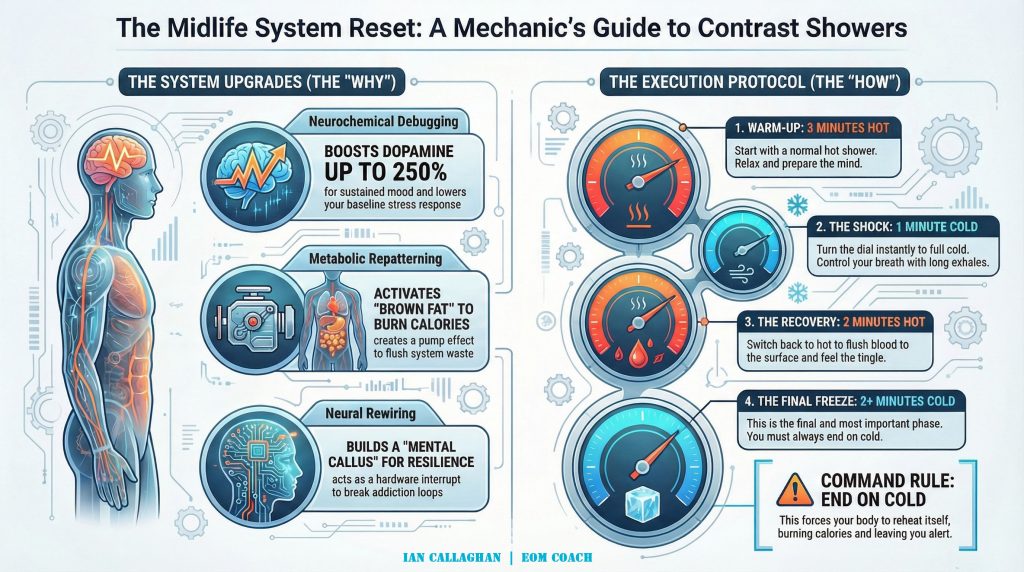
Research indicates that cold water immersion can increase dopamine concentrations by up to 250%. However, unlike the sharp spike and crash of alcohol or cocaine, cold water produces a sustained release. It raises the baseline voltage of your mood for hours.
By integrating contrast showers, you are not just getting clean; you are manually administering a dose of endogenous antidepressants. You are rewiring the reward circuitry. You teach the brain that dopamine is earned through discipline, not borrowed from a bottle.
Cortisol Management
Cortisol is the stress hormone. In a chronic drinker or a stressed corporate executive, cortisol levels are dysregulated. You wake up with a spike of anxiety.
Cold water acts as a “hormetic stressor.” It introduces a controlled, short-term spike in stress (the shock of the cold), which forces the body to adapt. Over time, this lowers your baseline reaction to stress.
Think of it as a firewall. If you can handle the shock of 10°C water hitting your chest at 06:00 hours, the email from your boss at 10:00 hours registers as a minor background process, not a critical system failure.
Protocol 2: Metabolic Repatterning and Weight Loss
I lost 5 stone. That doesn’t happen just by skipping a few lagers. It requires a metabolic shift.
Most midlife men are struggling with “Metabolic Inflexibility.” Their bodies have forgotten how to burn fat for fuel, relying instead on the easy glucose from carbohydrates and alcohol. We need to force the system to switch fuel sources.
Activation of Brown Adipose Tissue (BAT)
We have two types of fat:
- White Fat: The storage depots. The beer belly. The energy reserve that never gets used.
- Brown Fat (BAT): The heating system.
Brown fat is metabolically active. Its function is thermogenesis—burning calories to generate heat. Contrast showers, specifically the cold intervals, trigger the activation of BAT.
When you expose the system to cold, the BAT activates to protect core temperature. It acts like a furnace, burning glucose and white fat stores to keep the engine running. This isn’t pseudoscience; it is thermodynamics. By subjecting yourself to thermal variation, you are increasing your passive caloric expenditure. You are returning the engine to run leaner.
Lymphatic Drainage: The System Flush
The lymphatic system is the body’s sewage treatment plant. Unlike the circulatory system, which has a pump (the heart), the lymphatic system relies on movement and muscle contraction to circulate lymph fluid and remove waste products.
Contrast hydrotherapy creates a “pump” effect.
- Heat: Causes vasodilation. Blood vessels expand, flushing blood to the surface.
- Cold: Causes vasoconstriction. Blood vessels contract, forcing blood to the core to protect vital organs.
Alternating between these two creates a vascular pumping action. It forces stagnant fluid out of the tissues and back into circulation to be filtered. If you are detoxing from alcohol or years of poor diet, this system flush is critical for removing the “malware” from your physical tissues.
Protocol 3: The “Regimented Reset” Methodology
My methodology, “The Regimented Reset,” combines military discipline with IT systems thinking. A key component of this is eliminating “decision fatigue.”
When you are rebuilding your life, you cannot rely on “motivation.” Motivation is a feeling. Feelings are unreliable data. You need protocols.
The Contrast Shower SOP
Do not overthink this. Execute the script.
Pre-requisites:
- One shower unit.
- A timer (mental or digital).
- Zero negotiation with the self.
The Algorithm:
- Phase 1: The Warm Up (3 Minutes)
- Start with warm/hot water.
- Objective: Vasodilation and relaxation. Wash your body. Prepare the mind.
- Mindset: Observe the comfort. Acknowledge it, but know it is temporary.
- Phase 2: The Shock (1 Minute)
- Turn the dial to the coldest possible setting immediately. No gradual turn-down.
- Objective: Vasoconstriction and Adrenaline spike.
- Action: Do not hold your breath. Control the breathing. Force a long exhale.
- The EOM Application: This is where you practice the Emotional Observation Method. Your brain will scream “DANGER.” Your body will want to recoil. You must stand still. Observe the sensation of cold as data—it is sharp, it is heavy. Do not attach the label “Suffering” to it. It is just a sensation.
- Phase 3: The Recovery (2 Minutes)
- Switch back to hot.
- Objective: Flush the blood back to the surface. Feel the tingling. This is a circulation returning.
- Phase 4: The Final Freeze (2 Minutes)
- Switch back to cold.
- CRITICAL RULE: You always end on cold.
- Why: If you end on hot, you leave the body in a relaxed, sedated state. Ending on cold forces the body to reheat itself (burning calories) and leaves the nervous system in a state of alert readiness.
- Post-Process:
- Exit the shower. Do not towel off immediately. Let the body air dry for 30 seconds. Feel the internal heat generation. This is the engine turning over.
Neural Rewiring: Fixing the Glitches
Why do I, a Technical Architect, obsess over water temperature? Because the physical inputs reprogram the software outputs.
Pattern Interruption for Addiction
An urge to drink (or overeat, or doom-scroll) is a looping script.
- Trigger -> Craving -> Action -> Reward.
You cannot “think” your way out of a loop that is hardwired into the basal ganglia. You need a hardware interrupt.
When a craving hits—especially in the early days of sobriety—it feels all-consuming. This is a “System Hang.” The most effective fix is to physically shock the system.
If you feel the urge at 18:00 hours:
- Stop the current task.
- Walk to the shower.
- Turn it to cold.
- Get in.
You cannot focus on a craving for Merlot when you are hyperventilating under 10-degree water. The shock clears the RAM. It breaks the loop. By the time you get out and dry off, the neurochemical wave of the craving has passed. You have successfully debugged the moment.
Building the “Mental Callus”
We have become too soft. We seek to wrap ourselves in cotton wool. But growth only happens at the point of resistance.
The Roman Stoics practised voluntary hardship (sleeping on the floor, fasting) to inoculate themselves against misfortune. The contrast shower is the modern Stoic’s practice field.
Every morning, you stand before that handle. You know it is going to be uncomfortable. You know it will be a shock. Every morning, you have a choice:
- Choice A: Stay in the warm. Be the Museum Guide to your own comfort.
- Choice B: Turn the handle. Be the Mechanic.
When you choose the cold, you are training the brain to override the “flight” impulse. You are building a neural pathway that says, “I can do hard things.”
This translates directly to business, relationships, and sobriety. When a difficult conversation arises, you don’t shrink. You have trained for this. You have repatterned your response to discomfort.
Troubleshooting: Common Errors in Execution
As with any technical implementation, user error is the most common cause of failure. Here are the glitches I see men making when attempting this protocol.
Glitch 1: The “Gradual Descent”
The Error: Starting hot and slowly turning the temperature down.
The Fix: This is useless. It is torture by degrees. The benefit comes from the shock. The rapid temperature change is what triggers the vascular pumping and the adrenaline release. It must be binary. 1 or 0. Hot or Cold.
Glitch 2: The “Hyperventilation Loop”
The Error: Gasping for air and tensing the muscles under the cold water.
The Fix: This signals panic to the brain. You are reinforcing the stress response. You must use the “Command Console” of your breath. Force a long, slow exhale through the mouth. Relax the shoulders. You must remain the calm observer within the chaos.
Glitch 3: Skipping the Head
The Error: keeping the head dry.
The Fix: The vagus nerve—the main interface for the parasympathetic nervous system—runs down the neck. You need to get the cold water on the face and the back of the neck to fully trigger the Mammalian Dive Reflex. This lowers the heart rate and induces calm. Submerge the CPU.
The EOM Connection: From Sensation to Observation
This blog is not just about water. It is about the Emotional Observation Method (EOM).
EOM is built on the premise that you are not your thoughts, and you are not your feelings. You are the observer of them. Most men treat their trauma and emotions as if they are the engine itself—”I am sad,” “I am angry.”
No. You are the Mechanic. The sadness is a warning light. The anger is friction in the gears.
Contrast showers are the physical training ground for EOM.
- The Event: The cold water hits.
- The Reaction: The body wants to shiver; the mind wants to escape.
- The Observation: You stand there. You notice the cold. You notice the urge to run. But you do not run. You observe the sensation without becoming the sensation.
If you can do this with freezing water, you can do it with the urge to drink. You can do it with the rage you feel in traffic. You can do it with the grief of a lost relationship. You create distance. That distance is where control lives.
Implementation Strategy: The First 30 Days
You are going to commit to a 30-day “System Reset” regarding this protocol.
Week 1: The Boot Sequence
- Standard shower.
- Last 30 seconds cold.
- Focus: Controlling the breath. Do not gasp.
Week 2: The Upload
- Standard shower.
- Last 60 seconds cold.
- Focus: Relaxing the muscles. Drop the shoulders.
Week 3: The Full Contrast
- 3 min Hot / 1 min Cold.
- Repeat x 2.
- End on Cold.
- Focus: Observing the mental resistance before you turn the handle.
Week 4: The Developer Mode
- 3 min Hot / 2 min Cold.
- Repeat x 3.
- Focus: Mental clarity post-shower. Use the energy spike to tackle your hardest task of the day immediately.
The Mechanic’s Conclusion
I spent 25 years designing IT architectures for major corporations. I spent 45 years drinking. I know how complex systems fail, and I know how they can be rebuilt.
You cannot talk your body into better health. You cannot “mindset” your way out of a metabolic crisis. You have to change the inputs to get different outputs.
Contrast showers are a high-leverage input. They cost nothing. They take five minutes. But they require you to wake up and choose discipline over comfort every single day.
Sobriety and the Midlife Reset are not about removing things from your life; they are about installing better software. They are about optimising the hardware so you can run high-performance applications with purpose, strength, and clarity.
Stop staring at your past like a Museum Guide, wondering why the exhibits are dusty.
Pick up the wrench. Turn the handle to cold. Fix the engine.
Ian Callaghan
EOM Coach & Mechanic
“The System Reset begins with a single command. Execute.”
Recommended Reading & Next Steps
If this protocol resonates with you, you are ready for the deeper work.
- The Regimented Reset: My full methodology for midlife transformation.
- EOM Fundamentals: Learning to separate the Observer from the Emotion.
Don’t let the glitch define the machine. Repattern the wiring.
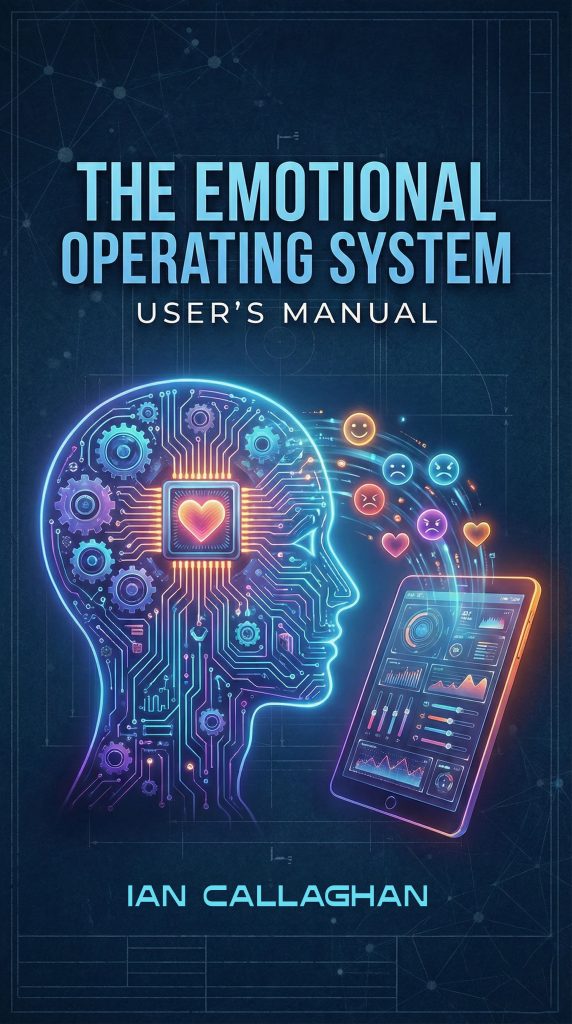
The Emotional Operating System: User’s Manual (Digital Edition)
Stop analysing the crash. Fix the code. An 8-page field guide to debugging your own mind. Includes the 4-Step EOM Protocol, the Symbol Library, and the Emergency Reboot scripts. Bonus: Includes access to the interactive Digital Console.