Suicidal Thoughts: The Moment I Didn’t Go to the Sea
MENTAL HEALTH, SUICIDAL THOUGHTS, AND THE DAY I SNAPPED OUT OF IT
I’ve lost count of the days I lost just lying in bed with the suicidal thoughts, the darkest thoughts running laps in my head, curtains closed, phone facedown, barely eating, just waiting for the day to end.
Same day. Same ceiling. Same heavy feeling. No interest in anything, no fire, no spark, just existing. Zombie mode. I was basically living for the weekends when I had my daughter and the dog, because those were the only days that felt real.
And during the lowest points, the thought that kept coming back was simple and terrifying.
What’s the point? Why am I even here?
That’s the bit people don’t understand. It isn’t always “I want to die.” A lot of the time, it’s “I can’t keep living like this.” It’s not drama. It’s not attention. It’s your internal system collapsing under load, and your brain looking for an exit sign.
There is a difference between being suicidal and dying by suicide. Both are serious and dangerous, but they are not the same thing. That gap matters because it’s where an interruption can occur. A pause. A message. A breakdown in a car park. A photo on a lock screen. One moment that drags you back into reality.
STATISTICS AND TRENDS (UPDATED)
People love to talk about “awareness” like it fixes things. The reality is the numbers are still brutal, and pretending otherwise does nobody any favours.
I’m including the figures because when I was in it, I genuinely thought I was the only one losing my mind in silence.
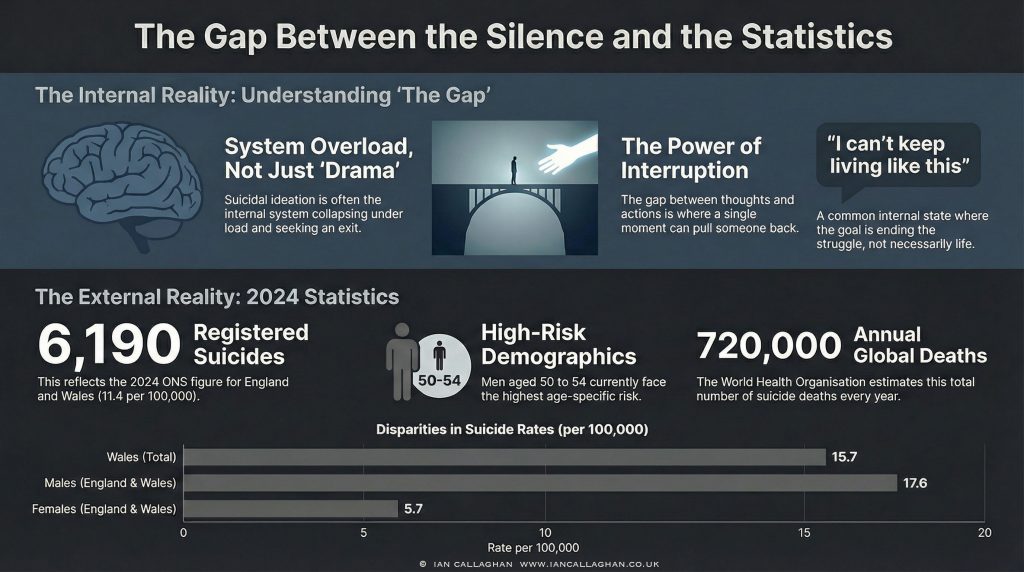
ONS figures for 2024 show 6,190 suicides registered in England and Wales, a rate of 11.4 per 100,000.
Wales was 436 of those, and the rate in Wales was higher, 15.7 per 100,000.
Men are still far more likely to die by suicide than women. In 2024, the male rate in England and Wales was 17.6 per 100,000, compared to 5.7 for females (ONS).
And here’s a detail that hits harder than most people expect. The highest age-specific risk in 2024 was among men aged 50-54. Not teenagers. Not “kids today.” Grown men, carrying life, carrying stress, carrying silence, and cracking.
Zoom out globally, and it’s worse. The World Health Organisation estimates more than 720,000 people die by suicide every year (WHO).
So if someone tells you “it’s not that common” or “people who talk about it won’t do it,” they’re either ignorant or terrified of looking at the truth.
HOW WOULD IT END
I used to think about how I’d do it. Not in a dramatic way. More like planning a route out of a burning building.
How do I end the darkest thoughts? How do I end the pain?
And the truth I can say now, with a clear head, is this. The pain does not end. It just gets transferred to the people who love you. It lands on your kids, your family, your mates, and it doesn’t go away for them. It becomes their lifelong injury.
I hate taking pills, so that was never an option.
My mind did that horrible scanning thing, looking for exits, running scenarios, trying to find the quickest way to switch the pain off.
And because water has always pulled at me, that’s where my brain kept landing.
Water has always pulled at me. I swam in rivers as a kid. I’m drawn to being in or on water. Paddleboard, kayak, wild swimming. Most of my walks are near water, canals, the coast, rivers, and waterfalls in the mountains. It’s always been my reset button, which is exactly why it became my darkest idea.
ONE DAY
One day, I found myself in the car heading for the sea. I’d decided today was the day. In my head, it made sense because the weather was atrocious and there wouldn’t be many people around on a secluded beach.
Music on. I knew exactly where I was going.
I drove down towards Newport, down Malpas Road and onto the M4, heading west. The whole time, my mind was locked in a loop. Not sadness, not tears, just tunnel vision and that cold “this ends today” feeling.
Then, as I approached Tredegar House, a song came on that jolted me. It snapped my mind out of the thought process.
That moment was the first break in the loop, like something in my head finally shifted.
I pulled off the motorway, drove around to Tredegar Park, parked up, turned the engine off, and I cried like a baby. Proper ugly cry. The kind that empties you.
Then I picked up my phone, and my screen saver opened. A picture of Ffion and me.
That was the second jolt, and that one hit me right in the chest.
It brought me back to my senses. Not with logic, not with “positive thinking,” but with reality. With love. With consequence. With the simplest truth in the world: my daughter needs her dad.
As I do every day, I felt gratitude for her being in my life. I tell her in one way or another that I love her every day. I used to do the same with Lewis.
Sitting there, I sent her a message. Nothing dramatic, nothing heavy, just this:
I love you, Tinker x
And that message wasn’t for her. Not really.
It was the rope I threw to myself.
FEAR, AND WHY IT CAN SAVE YOU
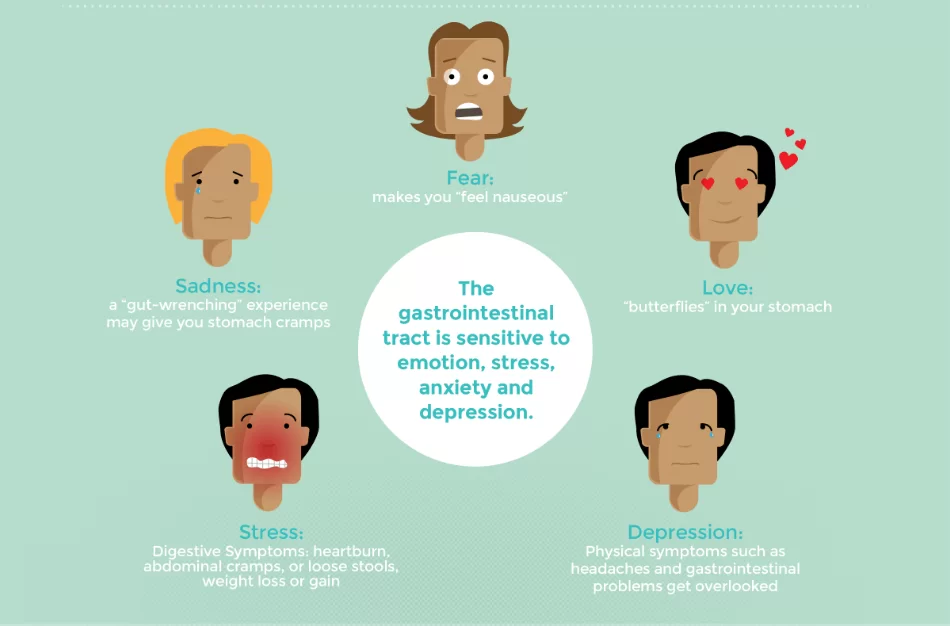
Fear is supposed to keep us alive. At a basic level, it guides fight-or-flight responses, heightens your senses, and sharpens your awareness.
The downside is when fear becomes a cage, and you stop living.
But that day, my fear saved me.
Because my fear wasn’t “what if I keep feeling like this.”
My fear was never holding my Tinker again. Never having a pint with my boy. Never hearing their voices. Never being there.
That fear didn’t destroy me. It interrupted me.
And once I was interrupted, I could think again. I could breathe again. I could step back from the edge and see the bigger picture: the brain lies when it’s exhausted and overloaded.
When fear is used properly, it forces the right things: focus and concentration, heightened awareness, acknowledgement, preparation and planning, dissecting extremes, removing barriers, and breaking routine.
And that’s what happened. Not because I’m special. Because a song jolted me, the photo of me and Ffion hit me, and that one message, “I love you, Tinker x”, dragged me back into the room.
WHY I CHOSE TO UPDATE THIS NOW | SUICIDAL THOUGHTS
This post has been in draft for a while, and I’ve hovered over publish more times than I can count.
But I’m updating it now because I don’t want to pretend this is a neat before-and-after story.
The thoughts still show up sometimes. The difference is I know they’re thoughts. I know it’s my brain trying to dump pressure. And I’ve got the tools and the awareness to make sure I don’t act on the darkest ones.
But I also know what silence does.
We keep saying we need to have the conversation, but we treat mental health like a calendar event. One awareness week. A couple of hashtags. A few posts. Then back to normal.
This has to be an everyday conversation. Because people are not falling apart on a schedule.
I’m writing this to raise awareness and to say this clearly: if you’re in that place, you’re not alone. Other people are carrying the same thoughts, even if they look fine on the outside.
If this reaches one person who is quietly planning an ending and buys them even ten minutes of interruption, then it’s worth every ounce of discomfort of posting it.
Please share this if you think it might land in the right place.
And if you need somewhere private to reach out, I’ve now got a thriving online community. It’s not a public comment section dogpile. It’s a private space where you can speak up, ask for support, or just read and realise you’re not the only one.
https://www.facebook.com/groups/soberbeyondlimit
Check in on the people you have not seen in a while, the ones who have strangely gone quiet. Message them. Call them. Go for a brew. Don’t do the lazy “u ok hun” and disappear. Be a human.
And yeah, I’m thinking of setting up a group where we get together, go for walks, maybe even cook, and just talk bollocks together. No therapy voices. No forced sharing circles. Just people being people, with enough honesty to stop anyone slipping through the cracks.
I’ve got a lot of thoughts at the moment on direction and purpose, but I know this for sure.
They’re positive.
Not the darkest thoughts I used to have.
And the only time I’ll be walking into the sea now is for fun.
I’m trying to get in there soon, I have to time it between the seasonal storms. Cold water has loads of benefits, contrast showers, wild swimming, the whole lot, but that’s another post.
Love to you all x
IF YOU’RE IN IMMEDIATE DANGER RIGHT NOW AND HAVING SUICIDAL THOUGHTS
UK: Call 999. Samaritans: 116 123 (free, 24/7).
USA Call or text 988, or chat via the 988 Lifeline.
CANADA Call or text 988 (Suicide Crisis Helpline).
AUSTRALIA Lifeline: 13 11 14 (24/7).
AOTEAROA NEW ZEALAND Text or call 1737 (free, 24/7).
Figures used: ONS suicides in the UK (2024 registrations) and WHO suicide fact sheet.

Rewiring The Mind: The Identity Shift That Changes Everything (Digital Manual)
Stop chasing symptoms. Fix the machine. Rewiring The Mind is not a memoir—it is a mechanic’s manual for your brain. Written by Ian Callaghan (Army Veteran, 45-year drinker), this guide combines Stoic Philosophy, Evolutionary Biology, and Nervous System Regulation to help you break the loop of anxiety, drinking, and survival mode. You don’t need more willpower. You need a new identity. (Instant PDF Download)