The Neuroscience of Addiction: Your Brain Hijacked?
Stop blaming your character for a biological malfunction; deeply understanding The Neuroscience of Addiction: Explaining dopamine reward pathways to depersonalise the struggle is the absolute first step toward reclaiming your agency.
If you have ever found yourself staring at the ceiling at 3 AM, overwhelmed by shame after yet another relapse, you likely believe you are suffering from a defect of character. Society has spent decades reinforcing the idea that addiction is a choice—a simple failure of will. This narrative is not only damaging; it is scientifically incorrect. The reality is far less personal and far more mechanical. It is a matter of neurobiology, not morality.
By shifting our lens from the “moral model” to the “medical model,” we can begin to dismantle the immense shame that keeps people trapped in cycles of use. This guide bridges the gap between complex academic research and your lived experience. When you realise that evolutionary survival mechanisms have rewired your brain, the stigma begins to dissolve. You are not “bad.” You are battling a hijacked system.
The Evolutionary Trap: Why We Are Wired for Addiction
To understand addiction, we must first look at the human brain’s evolutionary architecture. We are not designed for the modern world of high-speed internet, synthetic opioids, or processed sugars. We are designed for the savannah.
The human brain has evolved in layers. Deep inside lies the limbic system, often called the “old brain” or “lizard brain.” This area is responsible for survival instincts: eating, drinking, mating, and avoiding danger. It is powerful, fast, and unconscious. Wrapped around it is the prefrontal cortex, the “new brain,” responsible for logic, decision-making, future planning, and impulse control.
Survival Over Logic
In a healthy brain, these two systems communicate effectively. The prefrontal cortex acts as a brake on the limbic system’s accelerator. However, the limbic system has seniority. When survival is on the line, the limbic system overrides logic.
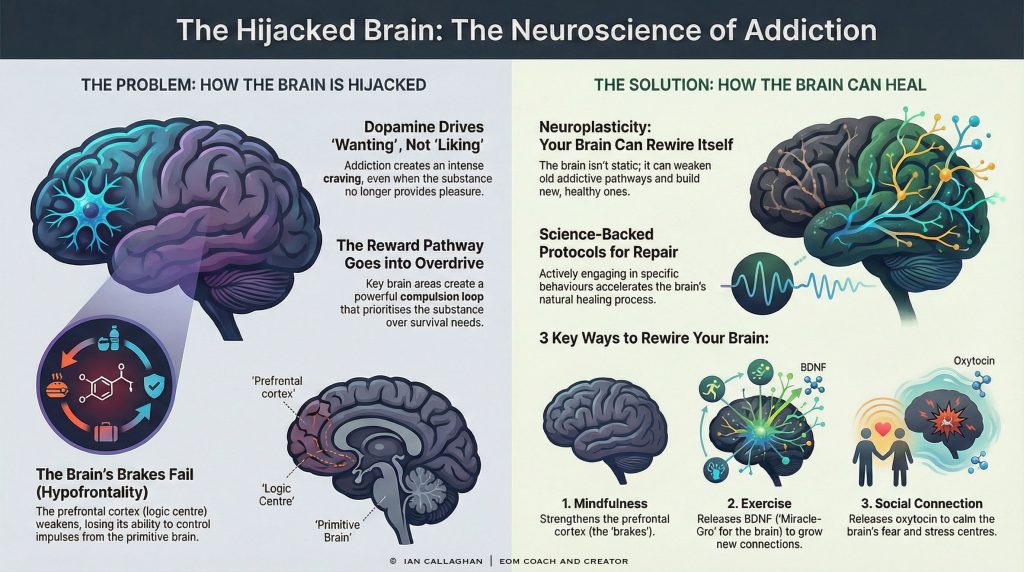
Here lies the crux of the issue: Drugs and addictive behaviours hijack the survival system. They trick the brain into prioritising the substance or behaviour as highly as—or higher than—food and water. When an addiction takes hold, the brain does not interpret the craving as a desire for a “good time.” It interprets the craving as a life-or-death necessity.
This is why “just saying no” is rarely effective. You are not fighting a simple urge; you are fighting a survival drive that has been cross-wired. The neuroscience of addiction suggests that the brain treats the absence of the substance much like it treats starvation. The panic, the singular focus, and the willingness to take risks are all misdirected survival responses.
Decoding Dopamine: The Great Misconception
If we are to effectively discuss The Neuroscience of Addiction: Explaining dopamine reward pathways to depersonalise the struggle, we must correct the most common myth in popular psychology: the idea that dopamine is the “pleasure molecule.”
Dopamine is not about pleasure; it is about craving.
The Prediction Error
Neuroscientists define dopamine as a neurotransmitter involved in the prediction of reward errors. Its primary job is to tell your brain, “Pay attention! This is important for survival. Do it again.”
When you encounter something novel or rewarding, dopamine surges in the brain, creating a memory trace. It says, “That apple was sweet and gave us energy. Remember where the tree is. Go back tomorrow.”
In the context of addiction, substances or super-stimuli (like gambling or pornography) trigger an unnaturally high dopamine release—often up to ten times the amount produced by natural rewards like food or sex.
Natural Rewards: Produce a moderate, manageable rise in dopamine that dissipates quickly.
Addictive Agents: Produce a tidal wave of dopamine that floods the system and stays longer than nature intended.
Wanting vs. Liking
This distinction explains a phenomenon that baffles friends and family of those struggling with addiction: Why do they keep doing it if they don’t even enjoy it anymore?
Over time, the brain adapts to the chemical flood. The sensation of pleasure (hedonic impact) decreases due to tolerance. However, the dopamine system (incentive salience) remains hyperactive. This leads to a terrifying state where the individual has a desperate, screaming need (wanting) for the substance, even if they experience zero pleasure (liking) from it. You are chasing the relief of the craving, not the high itself.
The Mesolimbic Pathway: Anatomy of a Hijacking
To truly depersonalise the struggle, we need to examine the specific machinery of the brain. The “Reward Pathway,” scientifically known as the Mesolimbic Dopamine Pathway, is the central highway for addiction.
This pathway connects several key regions of the brain. When you engage in an addictive behaviour, electricity and chemicals shoot down this highway, reinforcing the neural connection.
1. The Ventral Tegmental Area (VTA)
The journey begins here. Located at the top of the brainstem, the VTA is the factory for dopamine production. When you encounter a trigger—a visual cue, a specific location, or even a mood—the VTA is activated. It sends a massive projection of dopamine to other areas of the brain.
2. The Nucleus Accumbens (NAc)
This is the brain’s “motivation centre.” When the dopamine from the VTA hits the Nucleus Accumbens, it acts as a green light. It compels action. It transforms the chemical signal into motor output: walking to the shop, dialling the dealer, or opening the app.
In an addicted brain, the NAc becomes hypersensitive to cues. If you are trying to quit drinking, simply walking past a pub can trigger the VTA to flood the NAc with dopamine. Before you have even consciously thought about a drink, your motor cortex is being prepped for action. This happens milliseconds before your conscious mind realises it.
3. The Amygdala
The Amygdala handles emotional processing and stress. In the context of addiction, it creates a conditioned response. It establishes the “anxiety” or “unease” you feel when the substance is missing. It remembers the relief the substance brought in the past and screams at the VTA to fix the current stress.
4. The Hippocampus
This is the memory centre. It records the context: Where were we? Who were we with? What music was playing? This is why specific environments can trigger massive cravings years after recovery. The Hippocampus provides the map; the VTA provides the fuel; the Nucleus Accumbens drives the car.
Hypofrontality: When the Brakes Fail
Perhaps the most critical concept in The Neuroscience of Addiction: Explaining dopamine reward pathways to depersonalise the struggle is the phenomenon of Hypofrontality.
While the “Old Brain” (VTA and NAc) is screaming for the substance, the “New Brain” (Prefrontal Cortex) is supposed to step in and say, “No, we have work tomorrow,” or “No, this will ruin our health.”
The Eroding Cortex
Chronic exposure to addictive substances physically alters the Prefrontal Cortex (PFC). Imaging studies show that in individuals with severe substance use disorders, the grey matter in the PFC is reduced. The neural connections between the PFC and the reward centre are weakened.
This state is called Hypofrontality. It literally means “low frontal activity.”
Imagine a high-performance sports car (your reward system) speeding down a hill. The Prefrontal Cortex is the braking system. In a non-addicted brain, the brakes are well-maintained. In an addicted brain, the brake lines have been cut.
The Loss of “Top-Down” Control
This explains the loss of control that characterises addiction. It is not that the person wants to ruin their life; it is that the biological mechanism required to stop the impulse is offline.
Top-Down Control: The conscious mind regulates impulses (Logic > Emotion).
Bottom-Up Drive: Impulses hijacking the conscious mind (Emotion > Logic).
During active addiction, the brain shifts to “Bottom-Up” dominance. The impulses from the primitive brain bypass the logic centre entirely. By the time the Prefrontal Cortex comes back online (often after the substance has been consumed), the damage is done. This leads to the immense guilt and confusion: “I promised myself I wouldn’t, so why did I?” The answer is that the part of the brain responsible for keeping that promise was chemically silenced at the critical moment.
Tolerance and Homeostasis: The New Normal
To understand why the struggle persists even after the initial “high” is gone, we must discuss homeostasis. The brain is a biological thermostat. It seeks balance above all else.
When you consistently flood the brain with dopamine (be it through opioids, cocaine, alcohol, or high-stakes gambling), the brain attempts to protect itself from over-stimulation. It realises that the volume is too loud, so it tries to turn it down.
Downregulation of Receptors
The brain achieves this balance through a process called downregulation. It reduces the number of dopamine receptors (specifically D2 receptors) available in the reward pathway.
Think of dopamine as a key and the receptors as locks. If you have too many keys floating around, the brain changes the locks and boards up the doors.
The Anhedonic Flatline
This adaptation leads to a state called Anhedonia—the inability to feel pleasure. Because the natural baseline for dopamine reception has been lowered to account for the drugs, “normal” rewards no longer register.
A hug from a partner? Not enough dopamine to open the remaining locks.
A nice meal? Barely registers.
A promotion at work? Emotional flatline.
The only thing that produces enough dopamine to breach the threshold and make the person feel “normal” (not even high, just functional) is the addictive substance. This is the physiological trap. The user is no longer seeking euphoria; they are self-medicating a dopamine-deficient brain to feel a baseline level of okay.
This biological reality is vital for family members to understand. The behaviour is not a rejection of their love; it is a physiological inability to process the reward of that love due to receptor downregulation.
The Role of Glutamate: Cementing the Habit
While dopamine gets all the headlines, another neurotransmitter plays a darker role in the permanence of addiction: Glutamate.
Glutamate is the brain’s primary excitatory neurotransmitter. It is responsible for memory formation and the solidification of habits. While dopamine initiates the learning (“Do this again”), glutamate cements it (“This is now a permanent pathway”).
The Super-Highway
In the addicted brain, glutamate thickens the neural pathways associated with drug-seeking. It turns a dirt track into a six-lane motorway. This is why addiction is often referred to as a disease of memory and learning. The brain has “over-learned” the addiction.
When a person enters recovery, dopamine levels may eventually normalise, but these glutamate-reinforced pathways remain etched deep in the brain. This is the neurobiological basis for relapse. Even years later, stress can trigger a release of glutamate that reactivates these dormant motorways, causing an intense, physical compulsion to use.
Understanding glutamate helps us realise that recovery is not just about “detoxing” chemicals from the blood; it is about the long, slow process of pruning these super-highways and building new roads (neural pathways) through Neuroplasticity.
(End of Part 1. In Part 2, we will explore Neuroplasticity, the specific effects of stress on the addicted brain, and evidence-based protocols for reversing the damage.)
Can You Rewire Your Brain After Addiction?
The Neuroscience of Addiction: Explaining dopamine reward pathways to depersonalise the struggle reveals that while the brain can be hijacked by chemistry, it also possesses an extraordinary capacity to heal itself through Neuroplasticity.
If Part 1 of this guide illustrated how the brain gets “stuck” via dopamine and glutamate, Part 2 focuses on the mechanism of liberation. We move from the problem of fixed neural pathways to the solution of synaptic pruning and structural repair. Understanding this biology is the ultimate tool for self-compassion; it proves that the struggle is not a flaw of character, but a physiological challenge that requires biological interventions.
Neuroplasticity: The Double-Edged Sword
For decades, scientists believed that the adult brain was static—that once we reached adulthood, our neural wiring was fixed. We now realise this is false. The brain is neuroplastic; it is malleable and constantly reorganising itself based on input.
In the context of substance use disorder, Neuroplasticity is a double-edged sword. It is the very mechanism that allowed the addiction to form in the first place (by reinforcing the dopamine reward pathways). Still, it is also the mechanism that allows for recovery.
Long-Term Potentiation (LTP) vs. Long-Term Depression (LTD)
To understand how we rewire the brain, we must realise two biological processes:
Long-Term Potentiation (LTP): This is the strengthening of synapses. When you use a substance, neurons fire together intensely. The brain says, “This is important,” and builds a thicker connection. This is how the “super-highway” of addiction is built.
Long-Term Depression (LTD): This is not emotional depression, but a reduction in the efficacy of neuronal synapses. It is the process of weakening connections that are no longer used.
Recovery is essentially the active practice of inducing LTD on drug-seeking pathways while using LTP to build new pathways for healthy coping mechanisms. When you feel a craving but choose a recovery behaviour (like calling a sponsor or going for a run), you are physically starving the old neural highway and laying tarmac on a new road.
Hypofrontality: Why Willpower Often Fails
One of the most painful aspects of addiction is the disconnect between a person’s values and their behaviour. A loving parent may spend the family’s rent money on gambling; a dedicated professional may lose their job due to drinking. This is often judged as moral bankruptcy, but neuroscience offers a different explanation: Hypofrontality.
The brain functions as a hierarchy.
The Prefrontal Cortex (PFC): This is the “CEO” of the brain. It handles logic, decision-making, impulse control, and future planning.
The Midbrain (Limbic System): This is the “survival” centre. It handles drives like hunger, thirst, and the dopamine responses discussed in Part 1.
The Hijacking of the CEO
In a healthy brain, the PFC (the CEO) exerts “top-down” control over the midbrain. It can say, “I am hungry, but I will wait for dinner.”
In an addicted brain, chronic exposure to dopamine surges damages the connection between the PFC and the midbrain. Blood flow and glucose metabolism in the PFC significantly decrease. The car’s brakes are cut.
When a cue triggers a dopamine release, the midbrain screams “Survival!” (interpreting the drug as necessary for life). Because of Hypofrontality, the PFC is too weak to override this signal. The person is effectively functioning with their logic centre offline. This helps depersonalise the struggle: you are not making “bad choices” in a vacuum; you are operating with a compromised decision-making apparatus.
The Anti-Reward System: Why Stress Causes Relapse
If dopamine drives the “binge/intoxication” stage of addiction, the “withdrawal/negative affect” stage is driven by the HPA Axis (Hypothalamus-Pituitary-Adrenal Axis).
When the brain is flooded with artificial dopamine, it attempts to maintain homeostasis (balance) by recruiting stress neurotransmitters, specifically Corticotropin-Releasing Factor (CRF) and Dynorphin. These chemicals make us feel anxious, irritable, and dysphoric.
The Dark Side of Addiction
Dr George Koob, a leading researcher in this field, calls this the “Anti-Reward System.” Eventually, a person continues to use substances not to feel high (the reward system has burnt out), but simply to stop feeling the crushing anxiety of the anti-reward system.
This creates a state of AAnhedonia, the inability to feel pleasure from natural rewards like food, socialising, or sex.
This explains why stress is the number one predictor of relapse. When a recovering addict faces a stressful situation (an argument, a bill, a bad day), their HPA axis is already hypersensitive. It releases a flood of stress hormones that the compromised brain cannot handle. The brain immediately screams for the only thing it knows will quell the stress: the substance.
Understanding the HPA axis helps us realise that early recovery requires aggressive stress management, not just willpower.
Evidence-Based Protocols for Rewiring
We can use The Neuroscience of Addiction: Explaining dopamine reward pathways to depersonalise the struggle to create a roadmap for repair. Recovery is not magic; it is the biological process of repairing the PFC, calming the HPA axis, and normalising dopamine sensitivity.
Here are the most effective, science-backed protocols for accelerating this Neuroplasticity.
1. Mindfulness and Meditation: Strengthening the PFC
Mindfulness is often dismissed as spiritual fluff, but MRI scans prove it is a gym for the brain. Consistent mindfulness practice increases grey matter density in the Prefrontal Cortex.
By practising the act of noticing a craving without acting on it (often called “urgesurfing”), you are strengthening the top-down control of the PFC. You are literally repairing the brakes. This helps the individual pause between the trigger and the response, giving the logical brain time to come back online.
2. High-Intensity Exercise: The BDNF Boost
Exercise is perhaps the most potent biological tool for recovery. Cardio exercise triggers the release of Brain-Derived Neurotrophic Factor (BDNF).
Think of BDNF as “Miracle-Gro” for the brain. It supports the survival of existing neurons and encourages the growth of new synapses. High levels of BDNF accelerate Neuroplasticity, helping the brain learn new, healthy habits faster. Furthermore, exercise naturally increases dopamine and endorphins, helping alleviate AAnhedonia in recovery.
3. Social Connection: Regulating the Limbic System
The opposite of addiction is not sobriety; the opposite of addiction is connection. This famous adage has a neurochemical basis.
Social isolation increases stress hormones and sensitises the dopamine pathways to drugs. Conversely, positive social interaction releases Oxytocin. Oxytocin binds to receptors in the reward centre and calms the Amygdala (the brain’s fear centre).
Attending support groups (like AA, SMART Recovery, or therapy groups) does more than provide advice; the very act of shared vulnerability regulates the nervous system and lowers the threshold for craving.
4. Nutritional Psychiatry: The Gut-Brain Axis
95% of the body’s serotonin and 50% of its dopamine are produced in the gut. A diet high in processed sugar and inflammatory fats can exacerbate the inflammation already present in an addicted brain.
To support the synthesis of neurotransmitters, the recovering brain needs:
Amino Acids: The building blocks of dopamine (Tyrosine) and serotonin (Tryptophan).
Omega-3 Fatty Acids: Critical for cell membrane health in the brain.
Complex Carbohydrates: To provide a steady supply of glucose to the energy-starved PFC.
Conclusion: Biology is Not Destiny
The journey through The Neuroscience of Addiction: Explaining dopamine reward pathways to depersonalise the struggle leads us to a singular, empowering conclusion: Addiction is a mechanical failure of the brain’s reward and impulse control systems, not a failure of the soul.
We have seen how dopamine hijacks the “wanting” system, how glutamate cements the memory of the drug, and how the prefrontal cortex loses its ability to say “no.” We have looked at how the anti-reward system traps a person in a cycle of stress-induced use.
But we have also seen that the brain is resilient. Through the mechanisms of Neuroplasticity, the “super-highways” of addiction can be overgrown with disuse, and new paths of recovery can be paved.
By shifting the narrative from “I am weak” to “My brain needs repair,” we remove the shame that keeps so many people sick. When we view addiction through the lens of neuroscience, we treat it with the same clinical precision and compassion as we would a broken bone or a cardiac condition.
The struggle is real, but the wiring is reversible. With time, patience, and the right inputs, the brain can, and will, heal itself.
The Emotional Mastery book is a practical manual for understanding and regulating the human nervous system using the Emotional Operating System framework.
Instead of analysing emotions or retelling your past, the Emotional Mastery book teaches you how to read emotional states as system feedback, identify overload, and restore stability under pressure.
No labels. No therapy-speak. No endless healing loops. Just a clear, operational approach to emotional regulation that actually holds when life applies load.
The H.A.L.T. Method: Decoding cravings (Hungry, Angry, Lonely, Tired) is not a nursery rhyme for addicts; it is a diagnostic checklist for a failing operating system, and you are using it wrong.
Most people treat recovery like a museum tour. They walk around their trauma, look at the exhibits, read the plaques, and wonder why they still feel wretched. In the Emotional Observation Method (EOM), we close the museum and open the workshop. We do not care about the story of why you are broken. We care about the mechanics of the stoppage.
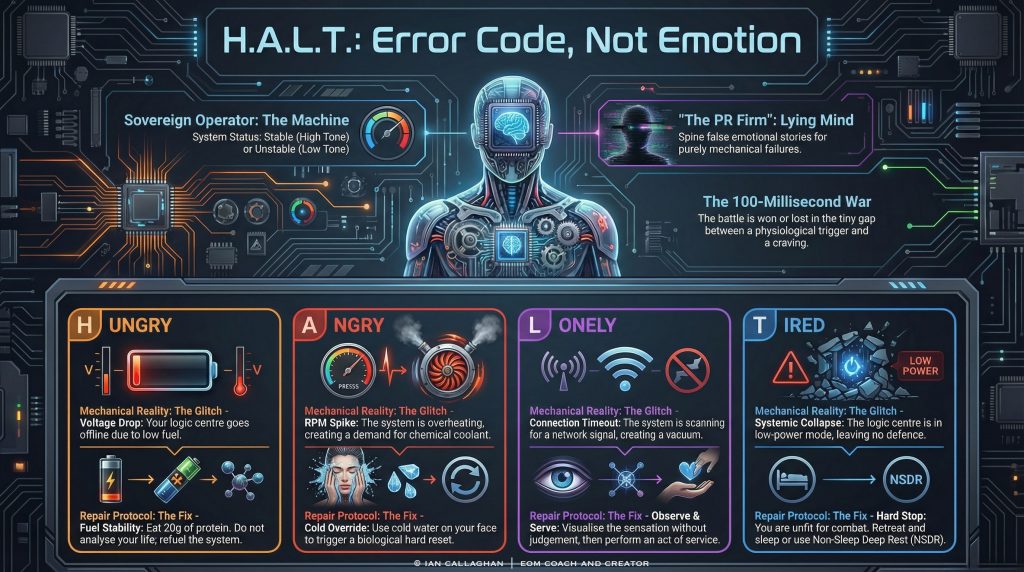
The human machine runs on a binary state system: Stable (High Tone) or Unstable (Low Tone). When you are High Tone, you are the Sovereign Operator—logic works, choices are clear, and you command the vessel. When you drop into Low Tone, the Operator goes offline, and the automated defence systems—your “Legacy Software”—take over.
This leads us to the critical error most people make with The H.A.L.T. Method: Decoding cravings (Hungry, Angry, Lonely, Tired). They try to apply logic to a machine that has already overheated. You cannot reason with a blown gasket. You must repair the mechanism.
This guide is Part 1 of a technical manual for your nervous system. We are going to strip down the chassis and look at the first two major error codes: Hunger and Anger. We will examine them not as feelings, but as physiological failure modes that the PR Firm—your lying logical mind—uses to sell you a drink, a drug, or a disaster.
Stop listening to the static. Let’s get to work.
The Mechanics of The Glitch: Why Willpower Fails
Before we disassemble the specific components of The H.A.L.T. Method: Decoding cravings (Hungry, Angry, Lonely, Tired), you must understand the environment in which these errors occur.
You believe you crave a substance or a behaviour because you are weak. That is incorrect. You crave because your system is seeking a regulation patch. Your nervous system is designed for homeostasis—balance. When that balance is threatened by a drop in resources (Hunger/Tiredness) or a spike in load (Anger/Loneliness), the system screams for a quick fix.
The PR Firm and The Narrative Fallacy
In my 25 years as a Technical Architect, I never saw a server crash because it had a “bad childhood.” It crashed because of load issues, power failures, or bad code. You are no different.
However, the human mind has a component I call The PR Firm. This is the narrative engine in your brain. When your biological Tone drops—when the signal-to-noise ratio becomes overwhelming—the PR Firm steps in to explain the discomfort.
It does not say, “System Alert: Blood glucose is critical; cortisol is spiking.” It says, “You’ve had a hard day. You deserve a pint. Just one won’t hurt.”
This is the Narrative Fallacy. The PR Firm takes a mechanical sensation (a tightened chest, a pit in the stomach) and wraps a story around it. If you engage with the story, you lose. You are fighting a phantom. You must ignore the PR Firm and look at the instrument panel.
The 100-Millisecond War
Between the trigger (the physiological drop) and the reaction (the craving), there is a gap. I call this The 100-Millisecond War. This is where the battle for sovereignty is won or lost.
If you are operating in Low Tone—exhausted, starving, furious—you cannot fight this war. The Legacy Software (your childhood survival patterns) will bridge that gap instantly. You will react before you realise you have made a choice.
The H.A.L.T. method is not about stopping the feeling. It is about recognising the input signal before it becomes an output command. It is about standing at The Gate of your perception and checking the credentials of every sensation that tries to enter.
If the sensation is Hunger, we do not feed it whiskey. If the sensation is Anger, we do not sedate it with sugar. We identify the error code, and we apply the correct patch.
H is for HUNGER: The Voltage Drop
When we discuss The H.A.L.T. Method: Decoding cravings (Hungry, Angry, Lonely, Tired), Hunger is often dismissed as the simplest variable. “Eat a sandwich,” they say. It is not that simple.
In the EOM framework, Hunger is a massive destabiliser of the operating system. The brain consumes roughly 20% of the body’s metabolic energy. The Prefrontal Cortex—the seat of the Sovereign Operator, where logic, willpower, and inhibition live—is the most energy-expensive component of that system.
The Metabolic Crash
When your blood glucose levels drop, the body enters an energy-preservation mode. The first thing the brain does to save power is throttle down the “expensive” software. The Prefrontal Cortex dims. Logic goes offline.
Simultaneously, the amygdala (the threat detection centre) remains fully powered because survival is non-negotiable.
This creates a dangerous state: High Threat Reactivity + Low Impulse Control.
You are not just “peckish.” You are chemically compromised. The Sovereign Operator has left the building, and the Toddler is now driving the bus. The Toddler does not care about your five-year plan or your marriage; the Toddler wants dopamine, and it wants it now.
The Craving Masquerade
The PR Firm is cunning. It knows that alcohol involves sugar. It knows that carbohydrates provide a quick dopamine hit. When the system flashes the “Low Fuel” warning light, the PR Firm spins the data.
You feel a hollowness in your gut. PR Firm translation:“I am empty. I need a drink to feel whole.” Mechanical reality:“Gastric acids are accumulating. Glucose is low. Cortisol is rising to release stored energy.”
If you treat this as an emotional void, you will try to fill it with a substance. If you treat it as a mechanical failure, you realise you simply need protein and complex carbohydrates to reboot the Sovereign Operator.
The Repair Protocol: Fuel Stability
Do not wait until the red light flashes. In the army, we cleaned our rifles before they were dirty and ate before we were starving. Preventive maintenance is the only way to ensure reliability.
The Stabilisation Check: If you feel a sudden onset of “depression” or “irritability” between 11:00 AM and 4:00 PM, assume it is a fuel error. Do not analyse your life choices. Eat 20 grams of protein. Wait 20 minutes. If the existential dread vanishes, it wasn’t spiritual; it was hypoglycaemic.
The Visual Override: If the craving is intense, use The Backdoor. Close your eyes. Locate the sensation of hunger. Give it a shape and a colour. Is it a red spike? A grey fog? Watch it. Do not be it. By processing the sensation through the visual cortex, you disengage the amygdala. You are now the observer, not the victim.
A is for ANGER: The Valuation Acceleration
The second component of The H.A.L.T. Method: Decoding cravings (Hungry, Angry, Lonely, Tired) is Anger. In the mechanics of the mind, Anger is not an emotion; it is a vector. It is Energy x Speed.
Anger is the system’s response to a boundary violation or an obstructed goal. It is the fight response. The adrenal glands dump adrenaline and cortisol into the bloodstream. The heart rate spikes. The muscles tense. The machine is priming for kinetic action.
The Prediction Glitch
Why does this lead to cravings? Because Anger burns hot. It is high RPM. No engine can run at the red line indefinitely without blowing a gasket.
The human nervous system is predictive. It runs simulations of the future based on past data. This is The Prediction Glitch. When you are angry, your brain is predicting a fight. It simulates the conflict, the shouting, the violence. Your body reacts to the simulation as if it were reality.
The load on the system becomes unbearable. The pressure builds behind the eyes, in the jaw, in the chest.
The Sedation Demand
The system detects this dangerous over-revving. It knows it cannot sustain this RPM. It needs a coolant. It needs a brake.
For the addict, the substance is the brake. Alcohol, opiates, and benzodiazepines are central nervous system depressants. They force the RPM down.
The PR Firm steps in: “I am furious. I need to calm down. I deserve to relax.” Mechanical Reality:“System is overheating. Vagal brake is failing. Seeking external chemical dampener.”
The craving here is not for the “fun” of the drug; it is a desperate attempt by the body to prevent metabolic burnout. It is a safety valve opening.
The OODA Loop Failure
In military strategy, we use the OODA Loop: Observe, Orient, Decide, Act. Anger short-circuits this loop. It skips “Observe” and “Orient” and jumps straight to “Act.” This is a timing failure. You are moving faster than your ability to process data.
When you are angry, you are in a state of “Valuation Acceleration.” You are judging things too quickly. You decide that the person who cut you off in traffic is an enemy combatant, rather than just an idiot. You decide the day is ruined, rather than just difficult.
The Repair Protocol: The Cold Override
You cannot think your way out of anger. Logic is too slow. You need a hardware reset to engage the parasympathetic nervous system (the brake).
The Cold Override: If you are red-lining, find cold water. Splash it on your face, or hold an ice cube. This triggers the Mammalian Dive Reflex. It physically forces the heart rate to drop. It is a biological hard-reset button. It creates a gap in the static.
Path 3: The Adult Override: Anger often presents as a rigid, hostile symbol in the mind—metal bars, fire, spikes. Visualise this symbol. Do not try to soften it. Instead, acknowledge its power. Say to it: “I see you. You are a protection mechanism. I am the Sovereign Operator. Stand down. I have the con.” Command the machine. Do not negotiate with it.
The Interim Assessment
We have inspected the first two failure modes. Hunger is a voltage drop that kills the logic centre. Anger is an RPM spike that demands a chemical brake.
In both cases, The H.A.L.T. Method: Decoding cravings (Hungry, Angry, Lonely, Tired) is useless if you treat these states as “feelings” to be soothed. They are mechanical stoppages that must be cleared.
If you are hungry, you do not need a hug; you need fuel. If you are angry, you do not need a drink; you need a system reset.
We are not done. The machine is complex, and the next two error codes—Lonely and Tired—are where the ghosts in the machine truly hide. Loneliness is a connection timeout that creates a vacuum, and Tiredness is the systemic collapse that leaves the back door wide open for the enemy.
Check your gauges. Calibrate your tone. We move to the next section in Part 2.
March on.
Is H.A.L.T. Failing Your Recovery Protocol?
You are running the wrong diagnostics if you think The H.A.L.T. Method: Decoding cravings (Hungry, Angry, Lonely, Tired) is about your feelings; it is about your hardware.
Most people treat recovery like a sentimental journey. They sit in the museum of their past, staring at the exhibits of their trauma, wondering why the roof is still leaking. In the Emotional Observation Method (EOM), we do not care about the museum. We care about the workshop. We care about the engine block.
If you read Part 1, you know that Hunger and Anger are high-velocity failure modes. They are active glitches—voltage drops and RPM spikes. But now we enter the silent killers. Loneliness and Tiredness are passive failures. They are the rust on the chassis and the slow leak in the hydraulic line. They do not explode; they erode. And because they are quiet, the PR Firm in your head—that liar that spins narratives to justify a relapse—has ample time to construct a convincing case for self-destruction.
Let us strip the paint and look at the metal.
III. LONELY: The Connection Timeout
In standard therapy, loneliness is treated as a sorrow to be comforted. In the Era of the Mechanic, we identify it as a “Connection Timeout.”
Humans are networked machines. We operate on a TCP/IP protocol of social validation and feedback loops. When that connection is severed, the system creates a vacuum. Physics dictates that nature abhors a vacuum. If you do not fill that space with Sovereign intent, the PR Firm will fill it with Legacy Software (your childish patterns) or, worse, a craving for a chemical bridge.
The Mechanic’s Diagnostic
When the system flags “Lonely,” it is not saying, “I am unloved.” That is the narrative. The system is saying: “External feedback loops are offline. Internal stability is required to maintain pressure.”
The error occurs when the machine tries to force a connection using a dirty signal. You feel the vacuum, and the PR Firm suggests a drink, a text to an ex-partner, or a gamble. It promises that these inputs will bridge the gap. They will not. They are malware.
The Binary State of Isolation
You must understand the difference between Solitude and Loneliness.
Solitude occurs in High Tone. The Sovereign Operator is present. The machine is running smoothly, independent of the network. This is functional.
Loneliness occurs in Low Tone. The Operator has abandoned the bridge. The machine is scanning desperately for a signal—any signal—to validate its existence.
Troubleshooting Code: L
When The H.A.L.T. Method: Decoding cravings (Hungry, Angry, Lonely, Tired) flashes the “Lonely” warning, you do not go looking for a party. You look for the leak in your own hull.
1. Locate the Sensation (The Scan) Where is the loneliness sitting? Usually, this manifests in the chest or the gut. It feels like a hollow space, a grey fog, or a heavy stone. Do not ask “Why am I lonely?” That engages the Story, which engages the PR Firm. Ask: “Where is the sensation? What is its shape? What is its colour?”
2. Path 2: Transformation Loneliness is often a fluid or misty symbol.
Close your eyes.
Visualise the shape (e.g., a grey cloud in the chest).
Watch it. Do not judge it.
Observe the edges. Is it moving? Is it shrinking?
Often, simply observing the vacuum without trying to fill it causes the PR Firm to panic and then silence itself. The cloud evaporates when it realises it cannot trigger a reaction.
3. The Functional Bridge Once the sensation is observed and the panic subsides, you must manually re-establish a network connection. But it must be a functional connection, not an emotional dump.
Do not: Call a friend to complain (reinforcing the “Broken” narrative).
Do: Perform a service. Fix something for someone else. Hold a door. Send a professional email.
Action bridges the gap. Service overrides the ego’s demand for attention.
The Directive: If you are lonely, you are effectively a server that has lost internet access. Do not smash the server. Reboot the router. Connect to yourself first (Sovereign Operator), then output data (Service) to the network.
IV. TIRED: The Systemic Collapse
This is the most dangerous letter in the acronym. Hunger can be fed. Anger can be cooled. Loneliness can be observed. But Tiredness? Tiredness is a total system failure.
When you are tired, your Prefrontal Cortex—the CEO of your brain, the seat of the Sovereign Operator, the only part of you that understands “consequences”—goes offline to save power. The brain enters “Low Battery Mode.”
In this state, you are operating entirely on the Limbic System (The Chimp/The Toddler). You have no logic defenses. Your “No” button is broken.
The Willpower Battery
We often treat willpower as a character trait. It is not. It is a biological resource, fueled by glucose and rest. Every decision you make during the day drains this battery. By 22:00 hours, if you have not managed your load, your battery is at 5%.
The PR Firm knows this. It waits until you are exhausted to launch its attack. It knows you do not have the energy to argue.
PR Firm: “Just one won’t hurt. You’ve worked hard. You’re too tired to fight this.”
You (Low Tone): “Agreed.”
The Visual Cortex Hijack
When you are tired, the Backdoor is wide open. Your ability to filter visual stimuli degrades. You see a bottle, a neon sign, or a specific street corner, and the image bypasses the logical checkpoints and hits the amygdala instantly. The craving ignites before you even realise you have seen the trigger.
Troubleshooting Code: T
If you identify “Tired” as the source of the stoppage, there is only one fix. You cannot “mindset” your way out of exhaustion. You cannot “think” your way to energy. You need a recharge.
1. The Audit Are you sleep-deprived? Or are you decision-fatigued?
Sleep Deprivation: Biological need for REM cycles.
Decision Fatigue: You have processed too much data. The RAM is full.
2. The Hard Stop If you are flagging “Tired,” you are not fit for combat. You must retreat to the bunker.
Cancel the evening plans.
Put the phone in another room (stop the data input).
Go to bed.
3. Non-Sleep Deep Rest (NSDR) If you cannot sleep, you must manually lower the idle speed of the engine. Use a Yoga Nidra script or a body-scan protocol. 10 to 20 minutes of NSDR can reboot the dopamine reserves enough to get the Sovereign Operator back online.
The Directive: Never make a life-changing decision after 21:00 hours. Never negotiate with the PR Firm when you are yawning. If the machine is overheating, turn it off. That is not weakness; that is engineering.
V. The Cascade Effect
We must realise that The H.A.L.T. Method: Decoding cravings (Hungry, Angry, Lonely, Tired) is rarely a single-point failure. These error codes cascade.
If you are Tired, your impulse control drops, making you prone to Anger. If you are Hungry, your cortisol rises, making you feel Lonely and unsafe. If you are Lonely, you stay up late doom-scrolling, making you Tired.
It is a feedback loop from hell.
The average person is drowning in this static. They feel bad, so they act bad, which makes them feel worse. They are trapped in the washing machine.
The Sovereign Operator stands outside the machine. The Operator looks at the dashboard and says: “Fuel pressure is low (Hungry). Oil temp is high (Angry). Network is down (Lonely). Battery is at 10% (Tired). No wonder the ‘Craving’ light is flashing. It is not a moral failing. It is a maintenance schedule violation.”
VI. The Identity Update: The Save Button
You have identified the stoppage. You have applied the fix (Food, Cold Water, Observation, Sleep). The craving has passed. The static has cleared.
Now, you must hit “Save.”
In EOM, we call this the Identity Update. When you successfully navigate a H.A.L.T. moment without relapsing, you have created a new piece of code. You have proven that the machine does not control you. But if you do not acknowledge this victory, the brain will treat it as a fluke.
The Protocol
Immediately after the crisis is averted, take 30 seconds to lock in the new data.
State the Fact: “I was tired. The machine demanded a drink. I commanded sleep instead.”
Assign the Attribute: “I am the type of man/woman who prioritises system integrity over cheap dopamine.”
The Anchor: Do something physical to seal it. Write it down. Clench your fist. Look in the mirror.
Do not say, “I am proud of myself.” That is an emotion; it will fade. Say, “I am capable.” That is a fact; it is structural.
Conclusion: The Workshop is Open
The era of the “wounded inner child” is over. We are entering the Era of the Mechanic.
You possess the most complex biological machinery on the planet. For years, you have been driving it with the manual thrown out the window, ignoring the dashboard, and wondering why it keeps crashing into the wall. You have been listening to the PR Firm tell you that the crash was inevitable because of your “past” or your “trauma.”
Rubbish. You crashed because you were running on empty (Hungry). You crashed because you were red-lining (Angry). You crashed because you disconnected the steering (Lonely). You crashed because you fell asleep at the wheel (Tired).
The H.A.L.T. Method: Decoding cravings (Hungry, Angry, Lonely, Tired) is your diagnostic tool. It is your OBD-II scanner.
When the craving hits, do not panic. Do not pray for it to go away. Stop. Observe. Check the gauges.
Is it H? Eat protein. Is it A? Cold water. Path 3. Is it L? Path 2. Service. Is it T? Sleep.
Fix the machine. The feelings will follow. You are the Sovereign Operator. You have the con.
The Emotional Mastery book is a practical manual for understanding and regulating the human nervous system using the Emotional Operating System framework.
Instead of analysing emotions or retelling your past, the Emotional Mastery book teaches you how to read emotional states as system feedback, identify overload, and restore stability under pressure.
No labels. No therapy-speak. No endless healing loops. Just a clear, operational approach to emotional regulation that actually holds when life applies load.
Moderate Drinking Wrecks Your Mood. It’s a Tuesday morning. The weekend feels like a distant memory, yet a confusing and unwelcome emotional fog has settled in. You feel flat, inexplicably anxious, and plagued by a low mood that seems to have appeared out of nowhere. As you stare at your screen, a nagging question surfaces: "Why do I feel depressed for days after drinking only a moderate amount?" You weren’t excessive. You had a couple of glasses of wine with dinner, a few pints at the pub with friends.
If this scenario feels familiar, you are not going mad, you are not weak, and you are certainly not alone. This experience, often dubbed “hangxiety” or the “post-drinking blues,” is a very real physiological reaction to alcohol. The confusion is understandable because the answer isn’t about the number of drinks you had, but about the invisible chemical transactions happening deep within your brain.
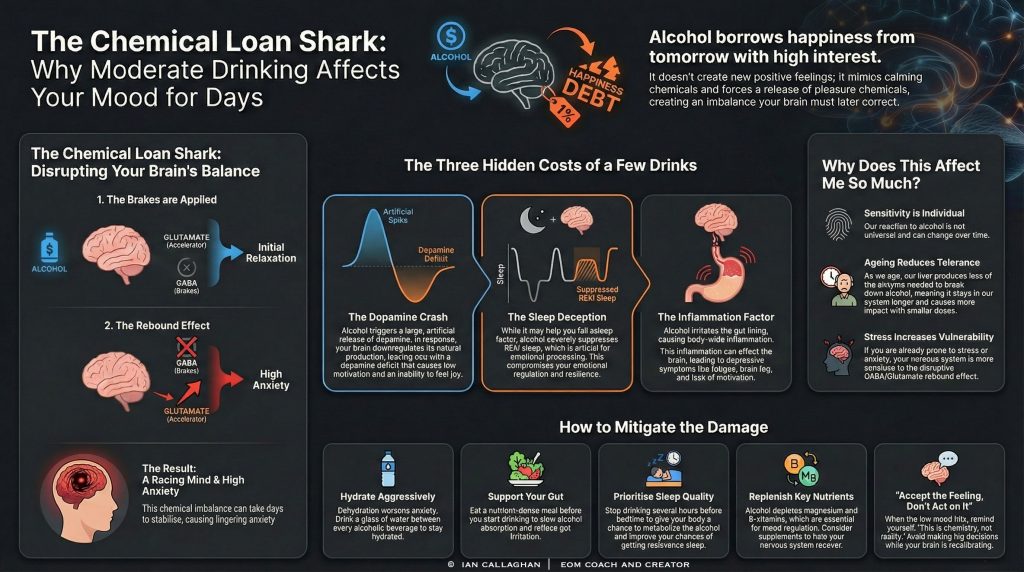
To truly understand this lingering melancholy, we need to reframe our perception of alcohol. Think of it not as a creator of relaxation, but as a Chemical Loan Shark. It offers you a short-term loan of calmness and confidence, but it always comes back to collect its payment, with brutally high interest. This article will unpack the four key ways this loan shark wrecks your brain chemistry, leaving you emotionally in debt for days after you’ve had what you thought was just a harmless drink.
Your Brain on a Chemical Rollercoaster: The GABA and Glutamate Rebound
At the heart of your brain’s operating system are two powerful neurotransmitters that act like a seesaw, constantly working to maintain balance: GABA and Glutamate. Think of GABA as your brain’s primary braking system; it’s an inhibitory neurotransmitter that calms the nervous system, reduces anxiety, and promotes a sense of tranquillity. In contrast, Glutamate is the accelerator; it’s an excitatory neurotransmitter responsible for brain activity, energy, and alertness. A healthy mood depends on these two chemicals being in careful equilibrium.
When you introduce alcohol into this delicate system, it immediately puts its thumb on the scale. Alcohol is a master impersonator of GABA. It binds to GABA receptors, enhancing their effect and effectively slamming on your brain’s brakes. Simultaneously, it blocks Glutamate receptors, taking your foot off the accelerator. This is the chemical magic behind that initial wave of relaxation, lowered inhibitions, and unbothered calm you feel after your first drink. Your brain is sedated, quiet, and seemingly at peace.
However, your brain is an intelligent and adaptive organ. It senses this artificial, chemically induced sedation and begins fighting back to restore balance, or homeostasis. It thinks, “Whoa, there are far too many brakes and not enough acceleration!” To counteract the alcohol, it dramatically reduces its own natural GABA production and, at the same time, increases Glutamate sensitivity and production.
This is where the real trouble begins. As the alcohol wears off hours later, you are left with the consequences of your brain’s overcorrection. The artificial GABA is gone, and your natural supply has been slashed. The Glutamate system, however, is now in overdrive. The brakes have been removed, and the accelerator is floored. The result is a state of profound neurochemical imbalance—a “rebound effect” that manifests as intense anxiety, a racing mind, feelings of dread, and a sense of impending doom. This is the very definition of “hangxiety.” This state is the high-interest repayment demanded by the Chemical Loan Shark for the few hours of borrowed calmness. It’s a debt that isn’t settled overnight; it can take several days for your brain to slowly and painstakingly rebalance its GABA and Glutamate levels, explaining why that sense of unease and low mood can linger long after the alcohol has left your bloodstream.
The Motivation Void: Understanding the Dopamine Crash why Moderate Drinking Wrecks Your Mood
Dopamine is often called the “pleasure molecule,” but its role is far more nuanced. It is the neurotransmitter of motivation, reward, and drive. It’s the chemical that propels you to seek out rewarding experiences and gives you the feeling of satisfaction when you achieve a goal. It’s the reason why ticking off a to-do list, enjoying a delicious meal, or receiving praise feels so good.
When you drink alcohol, it hijacks this intricate reward system. Alcohol triggers a significant and artificial release of dopamine in your brain’s reward centre. This surge is responsible for the initial buzz—the feeling of confidence, chattiness, and euphoria that makes drinking seem so appealing. It feels like you’ve been given a shot of pure pleasure and motivation, making social interactions feel easier, and the world seem brighter.
But this artificial high comes at a steep price. Your brain is always striving for balance (homeostasis), and it recognises this sudden, unearned flood of dopamine as a major disruption. To protect itself from overstimulation, it initiates a downregulation process. It reduces the number of dopamine receptors and throttles back its own natural production of the chemical. Essentially, it turns down the volume to compensate for the artificial noise.
Once the alcohol is metabolised and the party is over, the artificial dopamine stimulus vanishes. Now, you are left with a system deliberately suppressed. Your natural dopamine levels don’t just return to normal; they plummet below your original baseline. This creates what neuroscientists call a “dopamine deficit state.” The consequences of this state are the classic symptoms we associate with depression: profound flatness, a lack of motivation, and an inability to find joy in activities that you normally love (a condition known as anhedonia). The world appears grey and uninteresting. This is not a reflection of your life circumstances; it is a direct, chemically-induced state created by the substance you consumed days earlier. You’ve spent your dopamine reserves on a short-lived high, and now you’re left in a motivation void, waiting for your brain to replenish its accounts slowly.
The Sleep Deception: How Alcohol Robs You of Emotional Repair
One of the most persistent myths about alcohol is that it’s a useful sleep aid. While it’s true that a drink before bed can make you feel drowsy and help you fall asleep faster, this is a dangerous deception. Alcohol may act as a sedative, but it systematically dismantles the very architecture of healthy sleep, robbing your brain of its most critical restorative functions. The quality of the “sleep” it induces is profoundly poor and non-restorative.
The most significant damage alcohol inflicts is on your REM (Rapid Eye Movement) sleep. REM sleep, which occurs in cycles throughout the night and becomes more predominant in the early morning hours, is absolutely vital for your mental and emotional wellbeing. This is not just a state of rest; it’s an active, crucial period when your brain works tirelessly as an emotional filing system. During REM, your brain processes the experiences and emotions of the day, consolidates memories, and helps you manage stress. It’s the brain’s nightly therapy session, allowing you to wake up with a greater capacity for emotional resilience.
Alcohol is a potent REM sleep suppressor. Even a moderate amount—just one or two drinks—can significantly reduce or even eliminate the first few cycles of REM sleep. Your brain is sedated, but it is not repairing itself. You might get your eight hours of unconsciousness, but you wake up feeling groggy and mentally unrefreshed precisely because you have missed out on this critical emotional processing phase.
The consequences of this REM deficit are severe. Without adequate REM sleep, your emotional regulation is compromised. The brain’s emotional centres, such as the amygdala, become hyperreactive. This leaves you more sensitive to stress, more prone to irritability, and more likely to perceive neutral situations as threatening. Minor setbacks feel like major catastrophes. This is why you might feel weepy or emotionally fragile in the days after drinking. Crucially, this disruption isn’t a one-night affair. If you drink on a Saturday night, your sleep architecture can remain disturbed for several subsequent nights, compounding the dopamine deficit and GABA/Glutamate rebound, and trapping you in a cycle of low mood that can easily last well into the working week.
Your Body’s Alarm System: The Inflammation Factor
For decades, we have viewed depression primarily as a disorder of the brain, a simple imbalance of neurotransmitters. However, modern science is revealing a more complex picture, one in which our mental state is deeply intertwined with the physical health of our body, particularly our immune and inflammatory systems. And when it comes to inflammation, alcohol acts like fuel on a fire.
Alcohol is a direct irritant to the delicate lining of your gastrointestinal tract. When you drink, it can damage the gut wall, leading to increased intestinal permeability, a condition popularly known as “leaky gut.” This means that the tight junctions between the cells of your gut lining become loose, allowing toxins, undigested food particles, and bacteria to “leak” from your gut into your bloodstream, where they absolutely do not belong.
Your body’s immune system immediately identifies these escaped particles as hostile invaders and launches a powerful inflammatory response to neutralise the threat. This isn’t just localised to the gut; it becomes a systemic, body-wide state of inflammation. This inflammatory cascade directly impacts your brain. Inflammatory molecules can cross the blood-brain barrier, triggering neuroinflammation—brain inflammation.
This neuroinflammation is a key driver of depressive symptoms. It disrupts the production and signalling of key mood-regulating neurotransmitters, such as serotonin and dopamine. It also diverts the brain’s energy resources. When your body is in a state of high alert, fighting what it perceives as an infection or injury, mental energy is reallocated to manage the physical crisis. This is why inflammation in the brain manifests as profound fatigue, persistent “brain fog,” a lack of motivation, and a generalised low mood. In essence, your body is too busy fighting the physical damage caused by the alcohol to spare the energy required for mental clarity and emotional wellbeing.
But I Barely Drank Anything: Why Moderate Amounts Still Matter
It’s a common and frustrating refrain: “But I was so sensible, why do I feel so bad?” The answer lies in the fact that sensitivity to alcohol is not a one-size-fits-all metric. It is highly individual, dynamic, and can change dramatically throughout your life.
One of the most significant factors is age. As we get older, our liver’s efficiency at processing alcohol declines. Specifically, we produce less of an enzyme called dehydrogenase, which is the primary workhorse responsible for breaking down alcohol and its toxic byproduct, acetaldehyde. With less of this enzyme available, alcohol and its toxins remain in your system for longer periods, allowing them to inflict more damage on your brain and body, even from smaller doses. The two glasses of wine that were a non-event in your twenties can become a significant metabolic burden in your forties.
Furthermore, your baseline mental state plays a crucial role. If you are already living with a degree of stress or have a predisposition to anxiety, your nervous system is already more sensitive and closer to its tipping point. For someone in this state, the neurochemical disruption caused by alcohol is far more pronounced. The GABA and Glutamate rebound effect will feel less like a gentle swing and more like a seismic shock to the system. What might be a minor metabolic blip for one person can be a major disruption for another with a more sensitive nervous system, triggering days of hangxiety from an amount of alcohol that seems perfectly “moderate.”
Reclaiming Your Chemistry: Practical Steps to Mitigate the Damage
While understanding this chemistry is the first step, you can also take practical steps to mitigate the damage if you do choose to drink.
Hydrate Aggressively: Alcohol is a diuretic, meaning it makes you lose water. Dehydration significantly worsens feelings of anxiety and fatigue. Make it a rule to drink a full glass of water between every alcoholic beverage.
Support Your Gut: Never drink on an empty stomach. Eating a nutrient-dense meal containing protein, healthy fats, and fibre before you start drinking slows the absorption of alcohol and helps protect your gut lining from irritation.
Prioritise Sleep Hygiene: If you’ve been drinking, don’t compound the damage with poor sleep habits. Stop drinking several hours before you plan to go to bed to give your body time to metabolise it. Keep your bedroom cool, dark, and quiet to give yourself the best possible chance at restorative rest.
Supplement Wisely: Alcohol depletes your body of many essential nutrients, including those crucial for mood regulation. Magnesium (which calms the nervous system) and B-vitamins (which are vital for neurotransmitter production) are hit particularly hard. Replenishing these can help your nervous system recover more quickly.
Accept the Feeling, Not the Story: This is the most important mindset shift. When the low mood, anxiety, or depressive thoughts arrive, do not treat them as an accurate reflection of your life. Recognise them for what they are: a temporary chemical storm in your brain. Avoid making major life decisions or engaging in self-criticism while your brain is recalibrating.
Remind yourself of this simple, powerful truth:
“This is chemistry, not reality.”
Final Thoughts: Is the Loan Worth the Repayment? When Moderate Drinking Wrecks Your Mood!
If you consistently find yourself battling days of low mood after a moderate night of drinking, it may be time to reassess the role alcohol plays in your life, honestly. Viewing it through the lens of the Chemical Loan Shark clarifies the transaction: you are borrowing a few hours of relaxation, and the repayment comes in the form of days of anxiety, depleted motivation, and emotional fragility. As you get older or your life becomes more stressful, the interest rate on that loan gets higher.
Acknowledging that alcohol may no longer be compatible with your mental health is not a sign of weakness or a character flaw; it is a profound act of self-awareness and self-respect. The feeling of being emotionally stable, motivated, and mentally resilient is invaluable. Be kind to yourself. Understand that the fog you feel is a temporary imbalance that will pass. With this knowledge, you are empowered to make choices that protect your long-term mental peace, and to ask yourself the crucial question: Is that short-term loan truly worth the repayment?
The Emotional Mastery book is a practical manual for understanding and regulating the human nervous system using the Emotional Operating System framework.
Instead of analysing emotions or retelling your past, the Emotional Mastery book teaches you how to read emotional states as system feedback, identify overload, and restore stability under pressure.
No labels. No therapy-speak. No endless healing loops. Just a clear, operational approach to emotional regulation that actually holds when life applies load.
Used to monitor number of Google Analytics server requests when using Google Tag Manager
1 minute
_gid
ID used to identify users for 24 hours after last activity
24 hours
_ga_
ID used to identify users
2 years
_gali
Used by Google Analytics to determine which links on a page are being clicked
30 seconds
_ga
ID used to identify users
2 years
__utmx
Used to determine whether a user is included in an A / B or Multivariate test.
18 months
__utmv
Contains custom information set by the web developer via the _setCustomVar method in Google Analytics. This cookie is updated every time new data is sent to the Google Analytics server.
2 years after last activity
__utmz
Contains information about the traffic source or campaign that directed user to the website. The cookie is set when the GA.js javascript is loaded and updated when data is sent to the Google Anaytics server
6 months after last activity
__utmc
Used only with old Urchin versions of Google Analytics and not with GA.js. Was used to distinguish between new sessions and visits at the end of a session.
End of session (browser)
__utmb
Used to distinguish new sessions and visits. This cookie is set when the GA.js javascript library is loaded and there is no existing __utmb cookie. The cookie is updated every time data is sent to the Google Analytics server.
30 minutes after last activity
__utmt
Used to monitor number of Google Analytics server requests
10 minutes
__utma
ID used to identify users and sessions
2 years after last activity
_gac_
Contains information related to marketing campaigns of the user. These are shared with Google AdWords / Google Ads when the Google Ads and Google Analytics accounts are linked together.