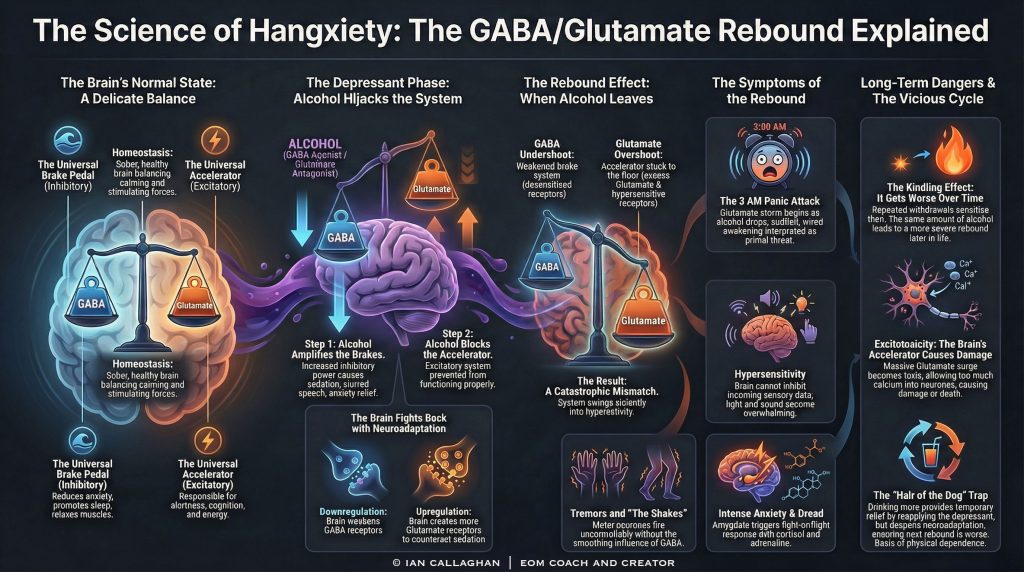
Why Hangxiety Strikes Hard? You wake up at 3 am with your heart hammering against your ribs, drenched in sweat, experiencing the GABA/Glutamate Rebound: The neuroscience behind why brain chemistry overcorrects after alcohol acts as a depressant, causing hyperactivity and panic. This terrifying physiological state is not merely a “bad hangover” or a sign of weak character; it is a predictable, violent swing of the neurological pendulum.
For years, society has treated the “jitters” or “the fear” following a night of heavy drinking as a purely psychological reaction to regret. However, modern neuroscience reveals that this phenomenon is a strictly chemical event. It is the result of your brain frantically attempting to restore balance after being artificially sedated. Understanding this mechanism is crucial for removing the shame associated with “hanxiety” and realising that the panic you feel is a biological response to the chemical loan you took out the night before.
This guide provides a comprehensive analysis of the neurochemistry at play, optimised for clarity and precision. We will dissect the interaction between the brain’s primary inhibitory and excitatory neurotransmitters to explain precisely why the brain overcorrects into a state of hyper-arousal.
The Neurochemistry of Balance: GABA and Glutamate Explained
To understand the Rebound, one must first understand the baseline state of the human brain. Your central nervous system operates on a delicate axis of electrical activity, maintained by two primary neurotransmitters that function as opposing forces.
Think of your brain as a high-performance car. To drive safely and effectively, you need a precise balance between the brake pedal and the accelerator. In the human brain, these roles are played by Gamma-Aminobutyric Acid (GABA) and Glutamate.
GABA: The Universal Brake Pedal
GABA is the primary inhibitory neurotransmitter in the brain. Its function is to reduce neuronal excitability throughout the nervous system. When GABA binds to its receptors, it opens ion channels that allow negatively charged chloride ions to enter the neuron. This makes the neuron less likely to fire an electrical signal.
In practical terms, GABA is responsible for:
Sedation and Sleep: Slowing down racing thoughts to allow for rest.
Muscle Relaxation: Preventing tremors and tension.
Anxiety Reduction: acting as the body’s natural valium, creating feelings of calm and well-being.
Without sufficient GABA activity, the brain would operate in a constant state of seizure-like activity or extreme panic.
Glutamate: The Universal Accelerator
Opposing GABA is Glutamate, the primary excitatory neurotransmitter. It is the most abundant neurotransmitter in the vertebrate nervous system and is involved in cognitive functions like learning and memory. When Glutamate binds to its receptors (such as NMDA receptors), it facilitates the influx of positive ions, increasing the likelihood that a neuron will fire.
Glutamate is responsible for:
Cognition and Memory formation.
Wakefulness and Alertness.
Reactive speed and Energy.
In a sober, healthy brain, GABA and Glutamate are in a state of homeostasis. They counterbalance each other perfectly. If you encounter a stressor, Glutamate may spike to help you react, followed by a release of GABA to calm you down once the threat has passed. This equilibrium defines a stable mood.
The Depressant Phase: How Alcohol Hijacks the System
When you consume alcohol (ethanol), you are introducing a powerful, dirty drug into this finely tuned system. Alcohol does not contain GABA or Glutamate, but it mimics the former and suppresses the latter. This is why alcohol is classified pharmacologically as a Central Nervous System (CNS) Depressant.
The GABA Mimicry
Alcohol acts as an agonist to the GABA system. It binds to specific sites on the GABA-A receptor complex (distinct from the sites where GABA itself binds), thereby altering the receptor’s shape. This structural change keeps the ion channel open longer and more frequently, allowing a massive influx of negatively charged chloride ions.
This amplifies the inhibitory effects of natural GABA. This pharmacological action is responsible for the subjective effects of drunkenness:
Slurred speech (motor inhibition).
Stumbling (cerebellar inhibition).
Sedation (cortical inhibition).
Anxiety relief (amygdala inhibition).
Essentially, alcohol puts a brick on the brake pedal.
The Glutamate Suppression
Simultaneously, alcohol acts as an antagonist to the Glutamate system. It specifically inhibits the N-methyl-D-aspartate (NMDA) receptors, which are a subtype of Glutamate receptors. By blocking these receptors, alcohol prevents Glutamate from exciting the neurons.
This suppresses the brain’s electrical activity. It removes the foot from the accelerator. This dual action—hyper-activating the brakes (GABA) while cutting the fuel line to the accelerator (Glutamate)—results in the profound CNS depression associated with intoxication. The brain slows down significantly, which the drinker experiences as relaxation, confidence, or drowsiness.
However, the brain is a survival machine designed to maintain equilibrium at all costs. It does not passively accept this suppression; it interprets the presence of alcohol as a massive chemical blockage threatening its ability to function.
Neuroadaptation: The Brain’s Desperate Fight for Homeostasis
The human brain possesses a remarkable quality called neuroplasticity. It constantly adjusts its sensitivity to chemical signals to maintain a standard operating baseline. When you drink alcohol, especially in large quantities or over a sustained period (even just a heavy night out), the brain detects a critical imbalance: Inhibition is too high; Excitation is too low.
To counter this suppression and keep you alive (ensuring you continue breathing and your heart keeps beating despite the sedative), the brain initiates a process called upregulation and downregulation.
Downregulation of GABA Receptors
Because the GABA system is being hyper-stimulated by alcohol, the brain attempts to regain balance by reducing its sensitivity to GABA. It does this by:
Internalising receptors: Literally pulling GABA receptors off the surface of the neurons so they cannot be activated.
Desensitisation: Changing the structure of the remaining receptors so they require more GABA (or alcohol) to open.
The brain is essentially trying to cut the brake lines because the brake pedal is being pressed too hard.
Upregulation of Glutamate Receptors
Simultaneously, because Glutamate activity is being blocked by alcohol, the brain perceives a lack of excitatory signals. To compensate, it:
Produces more Glutamate: It generates extra excitatory neurotransmitters to try to force a signal through the blockade.
Creates more NMDA receptors: It builds new receptors on the neuron surface to catch any scrap of Glutamate available.
The brain is now slamming its foot on the accelerator and installing a turbocharger, trying to fight against the sedative effects of the alcohol.
While you are drinking, you do not feel this struggle. The alcohol (the external depressant) is powerful enough to keep the sedation in place, masking the massive buildup of excitatory potential underneath the surface. You feel drunk and relaxed, but underneath the hood, your engine is revving at 8,000 RPM just to keep idling.
The Rebound Effect: When the Alcohol Leaves the Building
This brings us to the crux of the issue: The GABA/Glutamate Rebound. This is the mechanism that defines the transition from intoxication to withdrawal (hangover).
Alcohol has a relatively short half-life. Depending on the rate of metabolism, the liver processes approximately 1 unit of alcohol per hour. As you stop drinking and go to sleep, your blood alcohol concentration (BAC) begins to drop.
The Unveiling of the Overcorrection
As the alcohol is metabolised and leaves your bloodstream, the artificial suppression is removed. The external force holding down the GABA brake pedal and blocking the Glutamate accelerator vanishes.
However, the neuroadaptation (the brain’s countermeasures) does not vanish instantly. It takes days, sometimes weeks, for receptor density to return to baseline.
The result is a catastrophic mismatch:
GABA Undershoot: Your natural GABA production is now insufficient, and your receptors are desensitised/downregulated. You have virtually no “brakes.”
Glutamate Overshoot: You have an excess of Glutamate and a surplus of hypersensitive NMDA receptors (Upregulation). Your “accelerator” is stuck to the floor.
Because the alcohol is no longer present to counteract the brain’s adjustments, the system swings violently in the opposite direction. This is not merely a return to baseline; it is a rebound effect that propels the brain into a state of hyperactivity.
The Physiology of the 3 am Panic
This chemical imbalance explains the specific timeline of the “hangxiety” phenomenon.
Initial Sleep (0–4 hours post-drinking): You fall asleep easily because the alcohol is still present, acting as a sedative.
The Rebound (4–6 hours post-drinking): As alcohol metabolises, the Glutamate storm begins. The brain shifts from slow-wave sleep to REM sleep, then to wakefulness.
The Awakening: You wake up suddenly. There is no grogginess; you are “wired.”
The excess Glutamate floods the brain, causing neurons to fire rapidly and indiscriminately. This state of hyperexcitability manifests physically and mentally. The brain interprets this surge of electrical activity as an imminent threat, triggering the release of cortisol and adrenaline (epinephrine).
This is why the anxiety feels so physical. It is not a worry about what you said the night before (though that may come later); it is a primal, chemical panic attack caused by a nervous system that is firing on all cylinders with no ability to inhibit the signals.
The Spectrum of Rebound: From Jitters to Seizures
The severity of the GABA/Glutamate rebound exists on a spectrum, dependent on the quantity of alcohol consumed, the duration of drinking, and individual biological factors (genetics, history of use, and the “Kindling” effect).
Mild Rebound (The Common Hangover)
For the casual drinker whooverindulges, the rebound manifests as:
Hypersensitivity to light and sound: The brain’s sensory processing centres cannot inhibit incoming data.
Tremors (The Shakes): Motor neurons are firing without the smoothing influence of GABA.
Irritability and Anxiety: The amygdala (fear centre) is hyperactive.
Insomnia: An inability to fall back asleep despite exhaustion, due to excitatory neurotransmitter dominance.
Severe Rebound (Withdrawal)
In chronic drinkers or after a massive biRebounde rebound is more dangerous. The Glutamate storm can become toxic (Excitotoxicity). The neurons fire so rapidly that they can damage or kill themselves.
Auditory or Visual Hallucinations: The sensory cortex creates data that isn’t there.
Delirium Tremens (DTs): A severe form of alcohol withdrawal involving sudden and severe mental or nervous system changes.
Seizures: The ultimate manifestation of unchecked electrical activity. Without GABA to stop the firing, a feedback loop of electrical excitation spreads across the brain.
It is vital to realise that the feeling of “doom” associated with a hangover is an evolutionary signal. Your brain is in a state of chemical emergency. The feeling that “something is wrong” is technically correct—your neurochemistry is critically unbalanced.
Why “Hair of the Dog” Works (And Why It Is Dangerous)
Understanding the GABA/Glutamate rebound explains the mechanism behind the “Hair of the Dog” (drinking more alcohol to cure a hangover).
When a person suffering from rebound anxiety consumes a drink, they reintroduce the GABA agonist and the Glutamate antagonist.
Immediate Relief: The alcohol re-engages the brakes and suppresses the accelerator. The shaking stops, the anxiety fades, and the heart rate slows.
The Trap: While this provides temporary relief, it resets the clock on withdrawal. The brain will respond to this new dose of alcohol by further downregulating GABA and upregulating Glutamate.
When this new dose wears off, the rebound will be even more severe. This cycle of drinking to aRebounde rebound is the neurochemical basis of physical dependence and addiction. The brain becomes unable to function without the external depressant because its own inhibitory system has been dismantled.
The Role of Kindling in Escalating Rebounds
Frequent cycles of intoxication and withdrawal lead to a phenomenon known as Kindling. Just as a small fire eventually builds enough heat to burn larger logs, repeated withdrawals make the brain increasingly sensitive to changes in Glutamate levels.
With each episode of the GABA/Glutamate rebound, the brain changes its structure to react more aggressively to future withdrawals. This means that over time, the “hangxiety” gets worse, even if the amount of alcohol consumed stays the same or decreases. A weekend binge that caused a mild headache at age 20 may cause crippling panic attacks at age 30 due to this cumulative neuroadaptation.
(End of Part 1)
The GABA/Glutamate Rebound: Why Panic Spikes After Drinking?
Understanding The GABA/Glutamate Rebound: The neuroscience behind why brain chemistry overcorrects after alcohol acts as a depressant, causing hyperactivity and panic, is the first step toward breaking the cycle of recurring anxiety.
The Neurobiology of Kindling: Why It Gets Worse
As touched on at the end of Part 1, Kindling is the neurological engine that drives the severity of the rebound effect over time. To fully grasp why a night out in your thirties feels vastly different to one in your twenties, we must look at the electrical changes occurring within the neuron.
Kindling refers to the sensitisation of brain neurones to repeated episodes of withdrawal. In neurology, this concept was initially identified in epilepsy research, where repeated low-level electrical stimulation eventually lowered the seizure threshold, making seizures more likely to occur spontaneously.
In the context of alcohol, the brain views the suppression of Glutamate (the gas pedal) as a threat to survival. Each time you drink heavily and then stop, the brain “learns” that its excitatory system was dangerously suppressed. To compensate, it creates a “memory” of this suppression.
The Structural Changes of Sensitisation
This memory is not psychological; it is physical. The brain actually alters its protein synthesis to prepare for the next assault.
NMDA Receptor Proliferation: The brain builds more Glutamate receptors (specifically NMDA receptors) on the surface of neurons. This is like adding more ears to hear a whisper.
GABA Receptor Insensitivity: Simultaneously, GABA receptors (the brakes) change their shape or internalise, becoming less responsive to your body’s natural calming neurochemicals.
When you drink again, the alcohol temporarily plugs these new, sensitive receptors. But once the alcohol metabolises, you are left with a brain that has “super-sensitive” excitatory hardware. This means that a minor drop in blood alcohol concentration triggers a massive, disproportionate spike in Glutamate activity. This hyper-excitability manifests as intense tremors, insomnia, and the sense of impending doom characteristic of The GABA/Glutamate Rebound: The neuroscience behind why brain chemistry overcorrects after alcohol acts as a depressant, causing hyperactivity and panic.
Excitotoxicity: When Activity Becomes Damage
The dangers of the Glutamate rebound extend beyond temporary discomfort or panic attacks. When Glutamate levels surge too high and remain elevated for too long, a process known as Excitotoxicity begins.
Glutamate functions by allowing calcium ions to enter the neuron. Calcium is essential for electrical signalling, but it must be tightly regulated. During a severe rebound, the floodgates open. Hypersensitive NMDA receptors allow a massive influx of Calcium into cells.
Why is excess Calcium dangerous?
Enzyme Activation: High calcium levels activate enzymes that degrade cell membranes and proteins.
Mitochondrial Stress: It forces the cell’s power plants (mitochondria) to work overtime, leading to oxidative stress.
Cellular Apoptosis: In extreme cases, the neuron becomes so overwhelmed by electrical stimulation and chemical stress that it triggers apoptosis, a programmed form of cell death.
This is the neuroscientific explanation for “brain fog” and cognitive decline following heavy drinking episodes. It is not merely dehydration; it is a mild form of neurotoxicity caused by the brain’s own excitatory chemicals running wild.
Post-Acute Withdrawal Syndrome (PAWS)
Many individuals believe that once the physical shaking stops and the hangover clears (usually within 24 to 48 hours), the Rebound is over. However, the neurochemistry of The GABA/Glutamate Rebound: The neuroscience behind why brain chemistry overcorrects after alcohol acts as a depressant, causing hyperactivity and panic operates on a longer timeline.
This extended phase is often called Post-Acute Withdrawal Syndrome (PAWS). While the acute danger of seizure or severe panic may pass in a few days, the homeostasis of the brain takes weeks or even months to stabilise fully.
The Homeostatic Lag
Weeks 1-2: Glutamate levels remain slightly elevated, and GABA levels remain suppressed. This results in “background anxiety,” irritability, and difficulty handling stress. Sleep remains fragmented because the brain cannot cycle into deep REM sleep efficiently without optimal GABA function.
Weeks 3-4: The brain begins pruning the excess NMDA receptors (downregulation) and re-sensitising GABA receptors (upregulation). Mood stabilises, but cravings may spike as the brain seeks the “quick fix” of dopamine and artificial GABA stimulation.
Recognising PAWS is vital. Many people relapse during this period, not because they crave intoxication, but because they are desperate to stop the subtle, grinding anxiety of the prolonged chemical imbalance.
Nutrients for Neuroprotection: Mitigating the Rebound
While the only cure for Rebound is time and abstinence, allowing the brain to heal, specific nutritional strategies can support the restoration of homeostasis and protect against Excitotoxicity.
Note: This is information based on neuroscience, not medical advice. Always consult a healthcare professional regarding withdrawal management.
1. Magnesium: The Natural Calcium Blocker
Magnesium is perhaps the most critical mineral for someone suffering from the Glutamate rebound. Magnesium acts as a “gatekeeper” for the NMDA receptor. It sits inside the ion channel and blocks Calcium from entering the neuron unless a strong signal is received.
Alcohol causes severe magnesium depletion through the kidneys. When magnesium is low, there is no doorkeeper at the NMDA receptor. Calcium floods in unchecked, causing hyperexcitability and cell damage. Replenishing magnesium helps “plug” these receptors, dampening the excitatory noise and protecting the brain from Excitotoxicity.
2. L-Theanine: Glutamate Modulation
Found naturally in green tea, L-Theanine is an amino acid that mimics the structure of Glutamate. It can bind to Glutamate receptors without stimulating them as aggressively, effectively blocking the “real” Glutamate from causing chaos. Furthermore, L-Theanine has been shown to boost GABA production, helping to pump the brakes while simultaneously taking the foot off the accelerator.
3. Taurine: The GABA Agonist
Taurine is an amino acid that acts as a metabolic transmitter. Structurally, it is very similar to GABA. It can activate GABA receptors directly, providing a calming effect, and helps regulate the flow of Calcium in and out of cells, further reducing the risk of Excitotoxicity.
Lifestyle Factors: Avoiding the “Second Wave”
To successfully navigate the recovery from a Glutamate spike, one must avoid triggers that mimic the stress response.
Caffeine and Cortisol
Due to the Rebound, the nervous system is already in a “fight or flight” state. Caffeine is a stimulant that blocks adenosine (a chemical that makes you tired) and increases cortisol. Consuming caffeine during a Glutamate rebound is like pouring petrol on a fire. It amplifies the jitteriness and anxiety because the brain lacks the GABA cushioning to modulate the stimulant effect.
The Sugar Crash
Alcohol contains high amounts of sugar, and heavy drinking disrupts insulin sensitivity. A blood sugar crash (hypoglycaemia) triggers a massive release of adrenaline and Glutamate as the brain panics for fuel. Eating complex carbohydrates and protein helps maintain stable blood glucose levels, preventing secondary spikes in anxiety.
Summary: The Path to Homeostasis
The journey through The GABA/Glutamate Rebound: The neuroscience behind why brain chemistry overcorrects after alcohol acts as a depressant, causing hyperactivity and panic is a physiological ordeal, not a character flaw. It is a predictable, mechanical response of the central nervous system attempting to survive under the influence of a potent depressant.
The cycle of relief-and-rebound creates a trap where the cure (alcohol) becomes the cause of the next crisis. By understanding the mechanics of:
GABA Suppression (The loss of brakes),
Glutamate Surge (The stuck accelerator),
Kindling (The worsening over time), and
Excitotoxicity (The cellular damage),
…we can realise that “hangxiety” is not merely an emotional state, but a symptom of a brain in chemical distress.
Recovery is a process of neuroplasticity. The brain is incredibly resilient. Given time without the interference of alcohol, the brain will dismantle the excess Glutamate receptors, repair the GABA pathways, and return to a state of natural calm. The anxiety is not permanent; it is a temporary signal that the system is fighting to regain its balance.
The Emotional Mastery book is a practical manual for understanding and regulating the human nervous system using the Emotional Operating System framework.
Instead of analysing emotions or retelling your past, the Emotional Mastery book teaches you how to read emotional states as system feedback, identify overload, and restore stability under pressure.
No labels. No therapy-speak. No endless healing loops. Just a clear, operational approach to emotional regulation that actually holds when life applies load.
You may think that your late-night trips to the sweet cupboard are simply a matter of lacking willpower. However, research suggests that a microscopic mechanism may be at play, influencing your cravings in subtle yet powerful ways.
Emerging research suggests that your urges for evening sweets are biological, originating in your intestines and sent to your brain. This guide explores the link between gut health, microbiome restoration, and managing sugar cravings, equipping you to reclaim your diet and health.
To truly understand why you crave what you crave, it is important to move beyond calorie counting and investigate the complex ecosystem living within you. This next section explains why addressing gut health is crucial—not just for weight loss, but also for ending the ongoing chemical warfare in your digestive tract.
The Gut-Brain Axis: Who Is Really in Control?
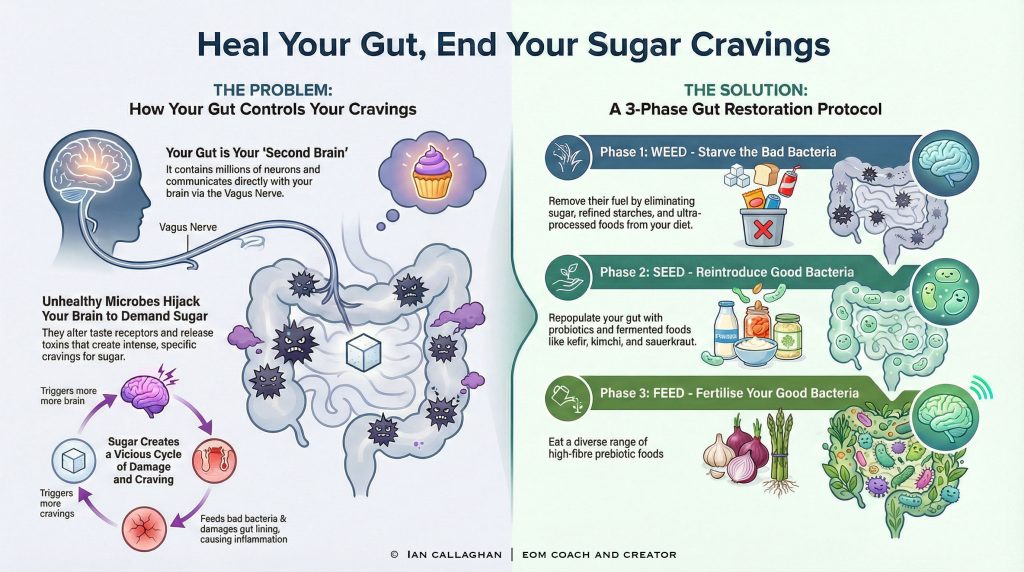
For decades, medicine treated the digestive system as a simple processing plant: food goes in, nutrients are extracted, and waste comes out. We now realise this view was dangerously simplistic. The gut is often referred to as the “Second Brain” because of the Enteric Nervous System (ENS), a mesh-like network of millions of neurons (nerve cells) lining your gastrointestinal (GI) tract (the pathway from your mouth to your anus).
This system communicates directly with your brain via the Vagus Nerve. Think of this nerve as a super-fast fibre-optic cable directly connecting your gut to your brain’s emotional and cognitive centres. While the brain sends signals to the gut (like the “butterflies” you feel when nervous), significantly more signals travel from the gut to the brain. The Vagus Nerve is one of the main nerves that control unconscious body processes, such as heart rate and digestion.
The Role of Neurotransmitters
The connection goes deeper than simple electrical signals. Your gut microbiome is a primary factory for neurotransmitters—the chemical messengers that dictate your mood, sleep, and appetite.
Serotonin: Approximately 90% of your body’s serotonin—the “happy hormone”—is produced in the gut, not the brain.
Dopamine: A significant portion of dopamine is also synthesised in the digestive tract.
GABA: This calming neurotransmitter (a chemical that helps carry signals in the brain) relies heavily on beneficial gut bacteria for production.
When discussing microbiome restoration and managing sugar cravings, we’re referring to modulating key chemicals. An unbalanced microbiome leads to reduced serotonin levels, triggering sugar cravings for a quick boost.
Therefore, that sudden need for a biscuit or a sugary tea isn’t “greed”—it is your brain interpreting a chemical shortage caused by a dysfunctional gut environment.
Dysbiosis: The Root of the Sugar Trap
A healthy gut acts like a lush, diverse rainforest. It contains trillions of bacteria, fungi, and viruses that coexist in a delicate balance—a state known as eubiosis, where the gut microbes remain balanced and healthy. However, modern life—characterised by processed foods, antibiotics, chronic stress, and environmental toxins—can disrupt this balance, leading to a state called dysbiosis, where unhealthy microbes take over.
Dysbiosis occurs when pathogenic (bad) bacteria and yeasts crowd out the beneficial (good) bacteria. This is where the battle for your diet begins.
The Survival Instinct of Pathogens
Different microbes prefer different types of food. Beneficial bacteria, such as Bifidobacteria and Lactobacillus, thrive on dietary fibre found in vegetables, legumes, and whole grains. In contrast, pathogenic (disease-causing) bacteria and yeasts like Candida albicans thrive on simple sugars and refined starches.
This is the crux of the issue: microbes can manipulate host eating behaviour to increase their own fitness. This is known as the Microbiome Manipulation Hypothesis, which is the idea that gut microbes can influence human food choices to suit themselves. Pathogenic bacteria can:
Alter Taste Receptors: They can change how you perceive taste, making high-sugar foods more palatable and healthy foods taste bland.
Hijack the Vagus Nerve: They release toxins that travel up the Vagus nerve to stimulate the brain, creating intense cravings that only sugar can satisfy.
Induce Dysphoria: When you attempt to quit sugar, these bacteria release toxins that make you feel anxious, jittery, or low—symptoms that vanish the moment you consume sugar and “feed” them.
Addressing gut health and sugar cravings is a strategic effort—not just habit-breaking, but eliminating an invasive population demanding sugar.
The Candida Connection
One of the most common culprits in severe sugar addiction is Candida albicans. While harmless in small amounts, this yeast can grow aggressively in a high-sugar, low-fibre environment. Candida is notorious for causing intense cravings for sweets, bread, and alcohol. It ferments these sugars to produce energy, creating a vicious cycle: the more sugar you eat, the more Candida grows, and the stronger the cravings become.
After learning about Candida, the next step is to identify whether microbiome restoration is needed in your own life.
Before embarking on a protocol, it is essential to recognise if your gut is indeed the source of your health struggles. Dysbiosis does not always manifest as stomach pain; often, the symptoms are systemic, affecting everything from your skin to your mental state.
If you resonate with three or more of the following indicators, your microbiome likely requires urgent attention.
1. Digestive Distress
This is the most obvious sign, yet many people ignore it, assuming bloating is “normal” after a meal. It is not.
Chronic Bloating: Looking six months pregnant by the end of the day.
Irregularity: Alternating between constipation and loose stools.
Gas: Excessive or painful wind, particularly after eating carbohydrates.
Reflux: Heartburn or indigestion that does not resolve with standard antacids.
2. Unexplained Fatigue and Brain Fog
When your gut is inflamed, your body expends a lot of energy mounting an immune response. Furthermore, pathogenic bacteria produce metabolic waste products (neurotoxins) that cross the blood-brain barrier.
The Post-Lunch Slump: Needing a nap or caffeine immediately after eating.
Mental Clarity Issues: Difficulty concentrating, poor memory, or feeling like you are thinking through treacle.
Waking Up Tired: Feeling unrefreshed even after a full night’s sleep.
3. Skin Conditions
The skin is often a mirror of the gut. This is referred to as the Gut-Skin Axis. When the gut cannot eliminate toxins effectively, the body attempts to push them out through the skin.
Adult Acne: Particularly cystic acne around the jawline.
Eczema and Rosacea: Chronic gut inflammation manifests as skin inflammation.
Psoriasis: Strongly linked to intestinal permeability (Leaky Gut), a condition where the gut lining becomes too porous, allowing unwanted substances to enter the bloodstream.
4. Immune System Fragility
Approximately 70% of your immune system resides in your gut. If your microbiome is compromised, your defences are down.
Frequent Colds: Catching every bug that goes around the office.
Autoimmune Issues: Conditions such as Hashimoto’s or Rheumatoid Arthritis are often exacerbated by gut dysbiosis.
5. The Sugar Reliance
As discussed, this is the key behavioural indicator.
Inability to Stop: Once you start eating sweets, you cannot stop until the packet is empty.
Mood Swings: Becoming “hangry” or anxious if you miss a meal or haven’t had sugar recently.
The Sugar-Gut Feedback Loop: A Vicious Cycle
Successfully managing microbiome restoration and sugar cravings requires understanding the mechanical harm sugar causes to the gut. Sugar not only feeds harmful bacteria but also degrades the gut barrier.
Intestinal Permeability (Leaky Gut)
The lining of your intestine is only one cell thick. These cells are held together by “tight junctions.” In a healthy gut, these tight junctions act like a security guard, allowing nutrients to pass into the bloodstream while keeping out toxins, undigested food particles, and pathogens (harmful microbes).
High sugar consumption promotes inflammation that loosens these tight junctions. This condition is known as Intestinal Permeability, or Leaky Gut.
When the gut becomes “leaky,” the following cascade occurs:
Lipopolysaccharides (LPS) Leakage: LPS are toxins found in the cell walls of bad bacteria. When they leak into the bloodstream, they cause systemic (whole body) inflammation.
Immune Response: Your immune system marks these unwanted particles as foreign invaders and attacks them. This constant state of alert leads to chronic (long-lasting) fatigue and autoimmunity (when the body attacks its own tissues).
Blood-Brain Barrier Breach: The systemic inflammation can eventually weaken the blood-brain barrier, leading to neuroinflammation—manifesting as anxiety, depression, and intensified cravings.
The Insulin Rollercoaster
When you consume high-sugar foods to satisfy a craving driven by dysbiosis, your blood glucose spikes. Your pancreas releases insulin to shuttle this sugar into cells. However, because the spike is so high, the subsequent drop is severe. This crash (hypoglycaemia) triggers a panic signal in the brain: “We need fuel now.”
The result? Another intense craving for sugar.
This creates a dual-layered trap:
Biological: The bad bacteria demand sugar for their survival.
Metabolic: Your unstable blood sugar demands energy to prevent a crash.
Breaking this cycle requires a multi-faceted approach. You cannot simply use “willpower” to fight physiology. You must repair the machinery.
The Impact of Modern “Food” on the Microbiome
It is important to define what we are fighting against. The modern Western diet (often called the Standard American Diet, though the UK is not far behind) is catastrophic for gut health. It is not just sugar; it is the entire chemical cocktail found in ultra-processed foods.
Emulsifiers and Artificial Sweeteners
You might think switching to “sugar-free” diet drinks is the answer to managing sugar cravings. Unfortunately, this often backfires.
Artificial Sweeteners: Substances like aspartame, sucralose, and saccharin have been shown to be bacteriostatic—they can inhibit the growth of beneficial gut flora. Furthermore, because they taste sweet but provide no calories, they confuse the brain’s reward centre, often leading to increased cravings for real sugar later.
Emulsifiers: Common additives like polysorbate-80 and carboxymethylcellulose (found in ice cream, spreads, and sauces) act like detergents in the gut. They strip away the protective mucus layer that shields your gut lining, accelerating Leaky Gut and inflammation.
The Fibre Deficit
The average UK adult consumes roughly 18g of fibre per day, well below the recommended 30g. Fibre is the primary fuel source for your beneficial bacteria (prebiotics). Without adequate fibre, your good bacteria starve.
When beneficial bacteria starve, they cannot produce Short-Chain Fatty Acids (SCFAs), specifically Butyrate. Butyrate is a miracle molecule that:
Repairs the gut lining (tight junctions).
Lowers inflammation.
Regulates metabolism.
Signals satiety (fullness) to the brain.
Low fibre intake + high sugar intake = a perfect storm for dysbiosis. The good guys starve, and the bad guys feast.
Preparing for Restoration: The “Weeding” Phase
Before we can plant a new garden (reintroduce good bacteria), we must clear the weeds (reduce pathogenic overgrowth). In the context of Gut Health & Nutrition: Microbiome restoration and managing sugar cravings, this is often the most challenging phase because the “weeds” will fight back.
This phase is not about starvation; it is about strategic elimination. The goal is to remove the primary inflammatory triggers and the fuel sources for pathogenic bacteria.
The Die-Off Reaction (Herxheimer Reaction)
As you begin to starve pathogenic bacteria and yeast by removing sugar, they die. As they die, they release endotoxins into your system. This can lead to a temporary worsening of symptoms known as a “die-off” reaction.
Symptoms: Headaches, flu-like symptoms, fatigue, and irritability.
Duration: Typically 3 to 7 days.
Management: Hydration and sweating (exercise/sauna) are crucial during this time to help the body eliminate toxins.
Understanding that this reaction is a sign of success, not failure, is vital for persistence. When you feel terrible three days after quitting sugar, it is physical proof that the pathogenic bacteria are dying.
End of Part 1. The following sections will cover the “Seeding” and “Feeding” phases, detailed dietary protocols, supplement strategies, and lifestyle changes required to permanently restore the microbiome and banish sugar cravings.
SEO TITLE
Restoring Gut Health: How To Stop Sugar Cravings?
HOOK
Clearing the weeds is futile if you fail to replant the garden, making the seeding and feeding phases of Gut Health & Nutrition: Microbiome restoration and managing sugar cravings the most critical factors for long-term success.
Phase 2: The “Seeding” Phase (Reinoculation)
Once the pathogenic overgrowth has been dampened by the “weeding” phase, the gut environment is akin to a ploughed field. It is clear, but it is vulnerable. If we do not introduce beneficial species immediately, the resilient weeds (sugar-loving bacteria) will simply return, often more aggressively than before.
In the context of Gut Health & Nutrition: Microbiome restoration and managing sugar cravings, the seeding phase introduces diversity. A monoculture in the gut is a sign of ill health; a diverse ecosystem is a sign of resilience.
Probiotics: The Reinforcements
Probiotics are live bacteria and yeasts that are good for you, especially your digestive system. However, not all probiotics are created equal. To combat sugar cravings, we need strains that influence satiety hormones and mood regulation.
Lactobacillus & Bifidobacterium: These are the most researched genera. Specifically, Lactobacillus rhamnosus has been shown to assist in weight management and reducing cravings associated with anxiety.
Saccharomyces boulardii: This is actually a beneficial yeast. It acts as a place-holder, occupying space on the gut wall to prevent pathogenic yeast (like Candida) from re-attaching while your native bacteria recover.
Spore-Based Probiotics: Unlike traditional probiotics found in yoghurt, spore-based (soil-based) organisms are encased in a natural shell that allows them to survive stomach acid and reach the colon intact. They are particularly effective for “re-terraforming” the gut.
Fermented Foods: The Ancient Method
While supplements provide high doses of specific strains, fermented foods provide a complex matrix of bacteria, enzymes, and organic acids.
Sauerkraut and Kimchi: Rich in Lactobacillus. Ensure these are unpasteurised and refrigerated; shelf-stable versions are usually dead.
Kefir: A fermented milk drink that is far more potent than standard yoghurt. Coconut water kefir, or water kefir, is an excellent alternative for those avoiding dairy.
Miso and Tempeh: Fermented soy products that support the microbiome.
Action Step: Introduce fermented foods slowly. Start with one teaspoon of sauerkraut juice per day. Jumping straight into a bowlful can cause significant bloating and discomfort if your gut isn’t accustomed to it.
Phase 3: The “Feeding” Phase (Prebiotics)
You have weeded the garden and planted the seeds. Now, you must fertilise the soil. Probiotics are the seeds; prebiotics are the fertiliser. Prebiotics are types of dietary fibre that the human body cannot digest. They travel to your lower digestive tract, where they act as food for the healthy bacteria.
This is a critical juncture in Gut Health & Nutrition: Microbiome restoration and managing sugar cravings. If you take probiotics but continue to eat a low-fibre diet high in processed foods, the new bacteria will starve and die, and the cravings will return.
The Role of Short-Chain Fatty Acids (SCFAs)
When your good bacteria ferment prebiotic fibre, they produce Short-Chain Fatty Acids (SCFAs), specifically butyrate, acetate, and propionate.
Butyrate: The primary fuel source for the cells lining the colon. It reduces inflammation and strengthens the gut barrier (healing “Leaky Gut”).
Appetite Regulation: SCFAs travel to the brain and signal satiety. High levels of SCFAs are directly linked to reduced sugar cravings because the body feels chemically satisfied.
Top Prebiotic Foods to Include
To optimise for Gut Health & Nutrition: Microbiome restoration and managing sugar cravings, incorporate the following “fertiliser” foods:
Chicory Root: Roughly 47% inulin fibre.
Dandelion Greens: Excellent for liver support and gut flora.
Jerusalem Artichokes: High inulin content (start slow).
Garlic, Onions, and Leeks: The Allium family is potent fuel for beneficial flora.
Asparagus: A great source of prebiotic fibre.
Green Bananas: Unripe bananas are high in resistant starch, which behaves like soluble fibre.
Dietary Protocols for Restoration
Moving beyond simple lists of foods, we must look at the overall dietary strategy. The modern British diet often relies heavily on beige carbohydrates—such as toast, pasta, and sandwiches—which break down immediately into glucose. To restore the microbiome, we must shift the macronutrient balance.
The “Crowding Out” Principle
Trying to “stop eating sugar” is a psychological battle based on deprivation. “Crowding out” is based on abundance. By filling your plate with nutrient-dense proteins, healthy fats, and high-fibre vegetables, there is physically no room left for sugar, and metabolically, the body ceases to crave it.
The Importance of Healthy Fats
Fat is essential for microbiome restoration. Unlike sugar, fat does not spike insulin significantly. It provides a slow-burning fuel source that keeps energy levels stable, preventing the crash-and-burn cycle that triggers sugar cravings.
Include: Avocados, extra virgin olive oil, coconut oil, nuts, seeds, and oily fish (mackerel, salmon, sardines).
Avoid: Highly processed seed oils (sunflower, soybean, rapeseed), which can be pro-inflammatory.
The Power of Bitter Foods
In modern cuisine, we have largely eliminated the bitter taste profile, favouring sweet and salty. However, bitter receptors in the gut play a role in the release of satiety hormones (CCK and GLP-1).
Protocol: Eat something bitter before a meal to prime digestion and curb sweet cravings.
Foods: Rocket, radicchio, endive, grapefruit, or a splash of apple cider vinegar in water.
Supplement Strategies for Gut Repair
While food is the foundation, specific supplements can accelerate repair of the intestinal lining (mucosa) and help manage withdrawal symptoms from sugar cessation.
L-Glutamine
L-Glutamine is the most abundant amino acid in the body and is the preferred fuel source for the cells of the small intestine. Supplementing with L-Glutamine helps to “seal the leaks” in the gut lining, reducing systemic inflammation.
Dosage: typically 2–5 grams per day, dissolved in water.
Benefit: Magnesium Glycinate is highly absorbable and gentle on the stomach. It helps regulate blood sugar levels and manages the anxiety/irritability associated with the “weeding” phase.
Zinc Carnosine
Zinc is crucial for immune function and gut integrity. The carnosine form is specifically researched for its ability to adhere to the stomach and gut lining, promoting repair and preventing permeability.
We cannot discuss Gut Health & Nutrition: Microbiome restoration and managing sugar cravings without addressing the lifestyle factors that influence the microbiome. The gut and the brain are connected via the Vagus nerve. Stress in the brain causes chaos in the gut, and chaos in the gut sends anxiety signals to the brain.
Stress Management
When you are stressed, your body releases cortisol. High cortisol levels increase gut permeability (“Leaky Gut”) and alter the composition of gut bacteria, often killing off the good guys and encouraging the growth of pathogens.
The Vagus Nerve: Activities that stimulate the Vagus nerve can switch the body from “fight or flight” to “rest and digest.”
Techniques: Deep diaphragmatic breathing, humming, cold water exposure (finishing your shower with 30 seconds of cold water), and meditation.
Sleep and the Circadian Rhythm
Your microbiome has a circadian rhythm. The bacteria function differently day and night. Poor sleep or erratic eating windows (late-night snacking) disrupt this rhythm.
Protocol: Aim for 7–9 hours of sleep. Try to finish eating at least 3 hours before bed to allow the gut to perform its “housekeeping” waves (Migrating Motor Complex), which sweep bacteria out of the small intestine.
Movement and Diversity
Studies suggest that athletes have a more diverse microbiome than sedentary individuals. Exercise increases the production of butyrate (the beneficial fatty acid). You do not need to run a marathon; a daily brisk walk or resistance training is sufficient to boost microbial diversity.
Long-Term Maintenance: Preventing Relapse
Restoring gut health is not a 30-day programme; it is a lifestyle shift. Relapse occurs when old habits creep back in—the daily biscuit with tea, the processed sandwich for lunch.
To maintain a healthy microbiome:
The 80/20 Rule: If you eat whole, microbiome-supporting foods 80% of the time, your gut flora will likely be resilient enough to handle the occasional treat without triggering a full-blown craving relapse.
Rotate Foods: Do not eat the same five vegetables every week. Aim for 30 different plant foods per week (herbs, spices, nuts, seeds, veg, and fruit all count). Diversity on the plate equals diversity in the gut.
Listen to Your Body: If bloating returns, or if you feel a sudden spike in sugar cravings, treat it as a warning light on the dashboard. Revert to the “Weeding” phase for a few days to reset.
Conclusion
The connection between Gut Health & Nutrition: Microbiome restoration and managing sugar cravings is undeniable. Sugar cravings are rarely just a lack of willpower; they are often a biological signal from a distressed microbiome. By following the Weeding, Seeding, and Feeding protocol, you are not just dieting; you are engaged in ecosystem management.
You are restoring the internal balance of power. When the beneficial bacteria thrive, they reward you with stable energy, mental clarity, and a natural indifference to the sugary treats that once controlled you. The journey to restoring your health begins in the gut, and the result is a life where you, not your microbes, are in control of your dietary choices.
Stop looking for a priest and start looking for a spanner; understanding the mechanical difference between a Relapse or Lapse is the only diagnostic tool you need right now.
Introduction: The Museum vs. The Workshop
If you are reading this, your system has likely thrown an error code. You have stalled the engine. You are standing on the hard shoulder, staring at the smoke pouring out from under the bonnet, and the panic is setting in. The PR Firm in your head—that lying, manipulative voice that spins narratives to justify failure—is already screaming at you. It is telling you that the car is written off. It is telling you that the journey is over. It is telling you that because you hit a pothole, you must now drive the entire vehicle off a cliff.
This is the “All-or-Nothing” fallacy, and it is a symptom of Low Tone.
In the Emotional Observation Method (EOM), we do not deal in guilt, shame, or moral autopsies. We do not care about your “story.” Traditional therapy acts like a Museum Guide; it wants to take you on a tour of your failure, pointing at the wreckage and asking, “And how does that make you feel?” It wants to dig up the past and perform a forensic autopsy on a moment that has already passed.
I am a Mechanic. I do not run a museum; I run a Workshop. When an engine stalls, we do not sit around crying about the manufacturer. We check the fuel lines, we look at the spark plugs, we reset the ECU, and we turn the key again.
You need to understand the critical distinction between a Relapse or Lapse. They are not synonyms. One is a momentary loss of sovereignty; the other is a complete surrender of command. Society tells you that recovery is a fragile crystal vase, and one slip means it is shattered forever. That is a lie designed to keep you weak. Recovery is an operating system. If Windows crashes, you do not throw your laptop in the bin. You reboot.
This guide is your manual for that reboot. We are going to strip away the sentimental rubbish surrounding “falling off the wagon” and look at the raw data. We will examine the mechanics of the stall, the deception of the PR Firm, and how to engage the Sovereign Operator to override the error.
Stand to. We have work to do.
The Mechanical Distinction: Glitch vs. System Failure
To fix the machine, you must first accurately identify the fault. Most people panic because they conflate a minor mechanical slip with a catastrophic structural failure. They view their sobriety or stability as a “streak”—a fragile chain of days. If one link breaks, they believe the entire chain is gone. This is poor logic. You do not lose the experience of the last ten years simply because you had a bad ten minutes.
We must define our terms with engineering precision.
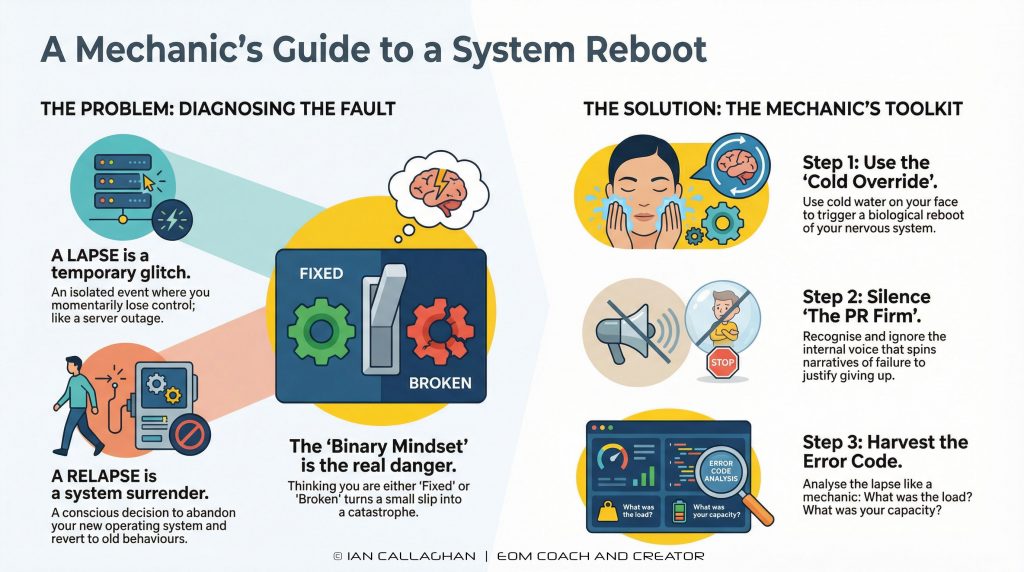
The Lapse: A Temporary Stoppage
A lapse is a specific, isolated event where the Legacy Software (the toddler brain, the addict brain) momentarily overrides the Sovereign Operator. It is a glitch. In IT terms, it is a service outage. The server went down for five minutes because the load (stress/emotion) exceeded the capacity (Tone).
A lapse is often impulsive. The 100-Millisecond War—that tiny gap between the trigger and the reaction—was lost. You saw the drink, the drug, or the toxic behaviour, and the visual cortex hijacked the system via the Backdoor before your logic could engage. You acted on a short-circuit.
Crucially, a lapse does not erase your hard drive. The data you have gathered, the neural pathways you have built, and the strength you have accumulated are still there. You just took your hand off the wheel.
The Relapse: Reinstalling the Virus
A relapse is different. A relapse is not a moment; it is a process. It is the conscious decision to abandon the Sovereign Operator entirely and hand the keys back to the Legacy Software.
If a lapse is hitting a pothole, a relapse is turning the car around and driving back to the start line voluntarily. A relapse occurs when you decide that the “fix” (the substance, the rage, the behaviour) is a valid operating system again. It is a surrender. It often happens after the lapse, when the PR Firm convinces you that “you’ve blown it now, so you might as well go all the way.”
The Danger of the Binary Mindset
The reason people turn a Relapse or Lapse into a tragedy is that they operate in a binary state. They believe they are either “Fixed” or “Broken.” When they are Sovereign, they feel invincible. When they slip, they feel worthless.
This binary toggle is a hardware flaw. When your Tone drops—when your nervous system is exhausted, hungry, or stressed—you lose the ability to see nuance. You cannot see “I made a mistake.” You only see “I am a mistake.”
You must realise that a lapse is not a requirement of recovery, but neither is it a funeral for it. It is simply data. It tells us that your suspension wasn’t strong enough for that specific bump in the road. Good. Now we know where to reinforce the chassis.
The PR Firm: Spinning the Narrative of Failure
Why does a single slip-up often spiral into a week-long bender or a month of depression? It is not the substance or the event itself. It is the narrative that follows.
Enter The PR Firm.
This is the logical part of your brain that works for the enemy. When you are in High Tone, your logic works for you (The Sovereign). When you drop into Low Tone—which happens immediately after a lapse due to the chemical crash of shame—your logic starts working for the addiction.
The PR Firm’s job is to mitigate cognitive dissonance. It cannot handle the tension between “I am a person trying to improve” and “I just acted like a robot.” So, it creates a story to resolve the tension.
The “F*ck It” Protocol
The most dangerous narrative the PR Firm spins is the “F*ck It” Protocol. It sounds like this:
“Well, you’ve had one drink. The counter is at zero. You’ve let everyone down. You might as well finish the bottle and start again on Monday.”
“You shouted at your partner. You’re just like your father. You’ll never change. There’s no point trying.”
This is a lie. It is a suppression tactic. The PR Firm knows that if it can convince you that you are “broken,” you will stop fighting. If you stop fighting, the Legacy Software can run riot, consuming dopamine without resistance.
The Autopsy Trap
The PR Firm also loves the autopsy. It wants you to sit in the debris of your Relapse or Lapse and ask “Why?” endlessly.
“Why am I like this?”
“Is it because of my childhood?”
“Is it because I’m weak?”
Do not engage with this. This is static. Asking “Why” when the engine is smoking is useless. You are looking for a philosophical answer to a mechanical problem. The PR Firm wants you to feel shame because shame is a heavy, paralysing vibration. When you are paralysed by shame, you cannot take action. You stay down.
The Mechanic does not ask “Why.” The Mechanic asks:
What was the Load? (Stress, hunger, fatigue).
What was the capacity? (Was I looking after my sleep/diet?).
Where was the breach? (Did I miss the 100-millisecond gap?).
Stop listening to the PR Firm. Its only goal is to turn a recoverable stall into a total write-off. Fire the PR firm.
The Mechanics of the Stoppage: Anatomy of a Glitch
To ensure a lapse does not become a relapse, we must understand the mechanics of the failure. We need to look at the OODA Loop (Observe, Orient, Decide, Act). This is a military concept, but it applies perfectly to the human operating system.
In a Sovereign state, the loop looks like this:
Observe: You feel a trigger (anxiety, craving).
Orient: You recognise it as a signal, not a command. You use The Gate to separate “I am anxious” from “I am observing anxiety.”
Decide: You choose a functional response (Cold Override, breathing, walking away).
Act: You execute the command.
When a Relapse or Lapse occurs, the loop has been short-circuited.
Observe: Trigger hits.
Act: You use/react.
The “Orient” and “Decide” phases were skipped entirely. Why?
The Visual Cortex Hijack (The Backdoor)
The brain is efficient. It wants to save energy. Processing emotion through the logical prefrontal cortex is expensive in terms of glucose and energy. Processing via the visual cortex and the amygdala is cheap and fast.
When you are low on resources (Low Tone), the brain seeks a “Backdoor.” It stops using words and starts using symbols. You don’t think “I would like a drink to alleviate this stress.” You just see the image of the glass, the colour of the liquid, the shape of the release.
This image bypasses your logic centre. It hits the motor cortex before you have even registered the thought. This is why you often find yourself halfway through a bad habit before you even realise you’ve started. You were hacked visually.
The Prediction Glitch
Anxiety is often the precursor to a lapse. Anxiety is a “Prediction Error.” Your brain runs a simulation of the future: “What if I lose my job? What if she leaves me?” The Legacy Software treats this simulation as if it is happening right now. It dumps cortisol into your system to prepare for a fight.
But there is no tiger. There is no fight. There is just you, sitting on a sofa, flooded with stress hormones. The system overheats. It needs a coolant. The Legacy Software offers the quickest coolant it knows: the addiction.
The lapse is not a moral failing. It is a desperate attempt by your biological hardware to regulate a system that is running too hot. It is a cooling mechanism. A bad one, yes. But a mechanical one.
When you view it this way, the shame evaporates. You didn’t sin; you just failed to manage your RPMs. You let the engine redline, and the safety valve blew.
Resetting From Experience: The Data Recovery
The most critical instruction I can give you is this: You do not start again from zero.
Traditional recovery models love the “Day 1” chip. While I respect the discipline, mathematically, it is incorrect. If you walk 1,000 miles into a forest and stumble, you do not teleport back to the edge of the woods. You are still 1,000 miles in. You are just on the ground.
If you treat a Relapse or Lapse as a total reset, you discard the data. You tell yourself that the last six months of sobriety or stability meant nothing. That is false. During that time, you rewired your brain. You healed your gut lining. You built trust. That architecture still exists, even if it is currently dusty.
The Save Game Protocol
Think of it like a video game. You have reached Level 50. You encountered a boss (a trigger) you weren’t prepared for, and you died. Do you restart the game at Level 1? No. You respawn at the last checkpoint. You still have your skills, your weapons, and your knowledge of the map. But now, you also have specific intelligence on the boss that killed you.
You know that when the boss (the trigger) flashes red, it attacks. You have more data now than you did before the lapse.
Harvesting the Error Code
Instead of crying over the crash, we must harvest the error code. We need to perform a “Hot Debrief.” This must be done immediately, while the memory is fresh, but without the PR Firm’s emotional commentary.
Grab a pen. We are going to analyse the Relapse or Lapse mechanically.
Time of day: Was it late at night? (Tone is naturally lower).
Biological State: When did you last eat? How much sleep did you have? (Check the hardware).
The Trigger: What was the signal? Was it a person, a location, or an internal feeling?
The Narrative: What did the PR Firm say just before you lapsed? (e.g., “Just one won’t hurt,” or “I deserve this”).
This is not an autopsy of your soul. It is a diagnostic of the event. Once you have this data, you can build a patch for the software. If you lapsed because you were hungry and angry at 6 PM, the patch is: “At 5:30 PM, I eat protein and drink water to stabilise Tone.”
Problem identified. Solution coded. March on.
(Part 2 continues: The immediate actions to take within the first 24 hours, the Cold Override protocols, and how to silence the PR Firm permanently…)
Relapse or Lapse? How To Reset Systems Now
A Relapse or Lapse is not a moral failure; it is a mechanical stoppage requiring immediate system intervention, not emotional shame.
If you are reading this, the crash has likely already happened. The chassis is dented, the engine is sputtering, and the warning lights are flashing on the dashboard. The natural human reaction—specifically the reaction of your “Legacy Software”—is to panic. You want to scream, hide, or slide further into the mud.
Do not do that.
We are Mechanics. When an engine blows a gasket, we do not stand around crying about how the car has “let us down.” We do not ask the car if it had a difficult childhood. We pop the bonnet, assess the damage, and apply the fix.
The following protocols are your emergency operating procedures. They are designed to bring your Tone back online and restore the Sovereign Operator to the driver’s seat.
Protocol 1: The Cold Override (System Reboot)
When you experience a Relapse or Lapse, your Tone drops through the floor. You are currently operating in a Low Tone state. In this state, your logic circuits (the Prefrontal Cortex) are offline. You are running entirely on the Limbic System—the lizard brain.
This is why “talking about it” in the immediate aftermath is useless. You cannot reason with a reptile. You cannot use software (words) to fix a hardware failure (nervous system dysregulation). You must use a physical override to force the system to reset.
We call this The Cold Override.
The mechanism here is biological. We are targeting the Vagal Brake—the specific function of the Vagus Nerve that slows heart rate and pulls the body out of “Fight or Flight” (Sympathetic dominance) and into “Rest and Digest” (Parasympathetic dominance).
The Execution:
Find Water: Go to a sink, a shower, or a bowl.
Temperature: It must be cold. Below 15 degrees Celsius.
Immersion: Splash cold water on your face, or better yet, submerge your face while holding your breath for 30 seconds.
The Dive Reflex: This triggers the “Mammalian Dive Reflex.” Your body thinks you have fallen into a cold ocean. Prioritising survival, it immediately halts anxiety, slows the heart, and clears the emotional cache.
Do this immediately. Do not think about it. The shock of the cold is the only thing fast enough to cut the circuit of shame that follows a Relapse or Lapse. It snaps you back into the room. It forces the hardware to reboot.
Once you are wet and cold, your Tone will artificially spike. You have created a window of opportunity—perhaps only 10 minutes—where logic is available again. Use this window for Protocol 2.
Protocol 2: Silencing The PR Firm
The greatest danger after a Relapse or Lapse is not the substance or the behaviour itself; it is the narrative your mind spins afterwards. I call this internal voice The PR Firm.
The PR Firm is that slippery, logical part of your brain that hates being wrong. When you act out of alignment (Lapse), the PR Firm immediately drafts a press release to justify the failure or to accelerate it.
It sounds like this:
“Well, you’ve ruined the streak now, might as well finish the bottle.”
“You’re obviously broken and can’t change, so why bother trying?”
“Everyone hates you anyway.”
This is the Narrative Fallacy. It is static. It is noise.
You must realise that these thoughts are not “You.” They are simply the exhaust fumes of a Low Tone system. When the machine is running hot and dirty, it produces black smoke. The PR Firm is that smoke.
The Audit: Sit down. Take a piece of paper. Write down exactly what the PR Firm is saying.
“I am a loser.”
“I have failed.”
Now, apply the Mechanic’s logic. Is this objectively true, or is it a feeling?
Fact: You ingested a substance or engaged in a behaviour at 19:00 hours.
PR Firm Spin: “I am a worthless addict.”
Do not engage with the PR Firm. Do not argue with it. If you argue, you are still playing its game. Simply observe it. “I hear the PR Firm is active right now.” Treat it like a radio playing in the background while you work on the engine. You don’t have to turn it off, but you certainly don’t have to dance to the tune.
Protocol 3: Re-calibrating The Gate
A Relapse or Lapse occurs because The Gate was left open.
The Gate is the 100-Millisecond gap between a Trigger (Signal) and your Reaction (Attachment).
Signal: Stress at work.
Attachment: “I need a drink.”
When you are Sovereign, you stand at The Gate. You see the stress coming, you check its credentials, and you deny it entry. When you lapsed, the guard was asleep. You let the signal simply walk in and hijack the controls.
To prevent the Lapse from turning into a full-blown Relapse (a return to the old lifestyle), we must re-staff The Gate immediately.
The Visualisation (EOM Core Tech): Close your eyes. Locate the sensation of the urge or the shame in your body. Where is it? Chest? Stomach? Throat? Now, give it a shape and a colour.
Is it a red spinning ball?
Is it a grey fog?
Is it a black stone?
Do not analyse it. Just look at it. If you can see it, you are not it. This separates the Observer (You) from the Observation (The Emotion).
Apply the Three Paths:
Path 1 (Observation): If it is fluid or misty (Smoke/Fog), just watch it. Without your engagement, it runs out of fuel. It will dissipate.
Path 2 (Transformation): If it is solid (Stone/Clay), allow it to crumble. Watch the physics of it changing.
Path 3 (Command): If it is hostile (Spikes/Metal), you are the Sovereign. Order it to stand down. Visualise a hydraulic press crushing it.
This is not meditation. This is active visual processing. You are using the Visual Cortex to hijack the energy away from the Amygdala. You are manually overriding the error code.
Protocol 4: The Identity Update (The Save Button)
This is the step most people miss. They stop the bad behaviour, but they leave a vacuum. They say, “I am a person who is trying not to drink.”
This is weak code. It implies struggle. It implies that the default state is drinking, and you are just holding back the tide.
After a Relapse or Lapse, you must overwrite the Legacy Software with a new identity statement. We do not use affirmations like “I am happy” (because you aren’t). We use Functional Traits.
The Code Input: Stand up. Posture check—shoulders back, chin up. This creates a feedback loop to the brain. Say the following: “I am the Operator of this machine. The machine had a stoppage. I have cleared the blockage. I am now back online.”
You must fill the void with a task. The brain needs a mission. If you sit on the sofa staring at the wall, the PR Firm will creep back in.
Clean the kitchen.
Go for a run.
Organise your toolbox.
Write a report.
Action anchors the new identity. You act your way into right thinking; you cannot think your way into right acting.
Summary: The Era of The Mechanic
We have moved past the era of the victim. We are in the Era of The Mechanic.
A Relapse or Lapse is data. It is high-resolution intelligence on where your armour is weak.
Did you lapse because you were lonely? Fix the connection port.
Did you lapse because you were tired? Fix the battery charging cycle.
Did you lapse because you were angry? Fix the pressure valve.
Do not waste time on guilt. Guilt is just another form of self-obsession. It keeps you stuck in the past. The Sovereign Operator lives in the present, with an eye on the future.
The difference between a Master and a Novice is not that the Master never fails. It is that the Master corrects their trajectory faster. The Novice crashes and spends three weeks looking at the damage. The Master crashes, checks the gauges, restarts the engine, and is back on the road in ten minutes.
You have the tools. You have the manual. The error code has been read. The patch has been applied.
Stop listening to the static. Fix the state. Ignore the story.
The Emotional Mastery book is a practical manual for understanding and regulating the human nervous system using the Emotional Operating System framework.
Instead of analysing emotions or retelling your past, the Emotional Mastery book teaches you how to read emotional states as system feedback, identify overload, and restore stability under pressure.
No labels. No therapy-speak. No endless healing loops. Just a clear, operational approach to emotional regulation that actually holds when life applies load.
Used to monitor number of Google Analytics server requests when using Google Tag Manager
1 minute
_gid
ID used to identify users for 24 hours after last activity
24 hours
_ga_
ID used to identify users
2 years
_gali
Used by Google Analytics to determine which links on a page are being clicked
30 seconds
_ga
ID used to identify users
2 years
__utmx
Used to determine whether a user is included in an A / B or Multivariate test.
18 months
__utmv
Contains custom information set by the web developer via the _setCustomVar method in Google Analytics. This cookie is updated every time new data is sent to the Google Analytics server.
2 years after last activity
__utmz
Contains information about the traffic source or campaign that directed user to the website. The cookie is set when the GA.js javascript is loaded and updated when data is sent to the Google Anaytics server
6 months after last activity
__utmc
Used only with old Urchin versions of Google Analytics and not with GA.js. Was used to distinguish between new sessions and visits at the end of a session.
End of session (browser)
__utmb
Used to distinguish new sessions and visits. This cookie is set when the GA.js javascript library is loaded and there is no existing __utmb cookie. The cookie is updated every time data is sent to the Google Analytics server.
30 minutes after last activity
__utmt
Used to monitor number of Google Analytics server requests
10 minutes
__utma
ID used to identify users and sessions
2 years after last activity
_gac_
Contains information related to marketing campaigns of the user. These are shared with Google AdWords / Google Ads when the Google Ads and Google Analytics accounts are linked together.