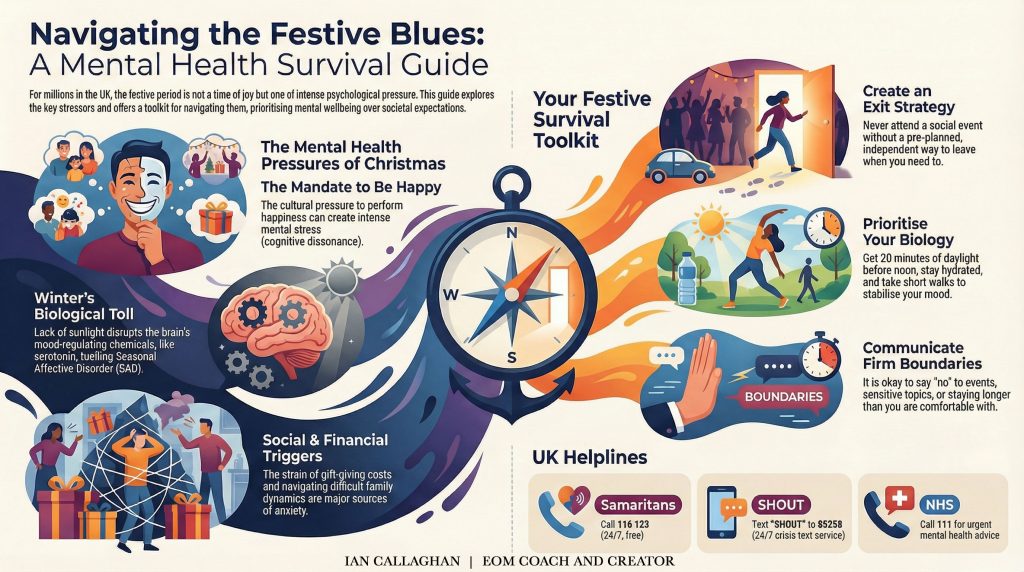
Christmas is brutal if you’re struggling with your head. For millions across the UK, the festive period is not a time of joy, but a period of intense psychological pressure, exacerbated by forced socialisation, financial strain, and the stark contrast between societal expectations and internal reality.
The Neuropsychology of the “Festive Blues”
The festive season triggers a complex biological and psychological stress response in individuals with pre-existing mental health conditions, primarily due to the “expectancy gap” between societal mandates for happiness and personal emotional states.
The Mechanism of Forced Positivity
The cultural narrative surrounding December demands a performance of happiness. Toxic positivity—the belief that one must maintain a positive mindset regardless of dire emotional circumstances—peaks during this season. For those battling depression or anxiety, this creates a state of cognitive dissonance.
According to psychological research, suppressing negative emotions to conform to social norms increases cortisol production, the primary stress hormone. The brain perceives the gap between how you feel and how you are expected to act as a threat. This dissonance is why Christmas can be brutal if you’re struggling with your mental health; it requires a sustained emotional performance that depletes cognitive resources.
The Impact of Disrupted Routine
Mental stability often relies heavily on routine. The Christmas period inherently dismantles the structures that many people use to manage their mental health.
Sleep Architecture: Late nights and alcohol consumption disrupt REM sleep, which is critical for emotional regulation.
Dietary Changes: High sugar and fat intake can lead to inflammatory responses that negatively impact mood.
Therapeutic Breaks: Many therapy services and support groups operate on reduced hours, leaving vulnerable individuals without their usual safety nets.
[Cognitive Dissonance]: The mental discomfort experienced by a person who holds two or more contradictory beliefs, ideas, or values. In this context, feeling depressed while acting happy.
Seasonal Affective Disorder (SAD) and the Winter Solstice
Biological factors, specifically the lack of sunlight in December, compound mental health struggles by disrupting circadian rhythms and serotonin production, making the festive season physically difficult for the brain to process.
The Biology of Darkness
The UK experiences its shortest days in late December. This reduction in sunlight affects the hypothalamus, leading to three distinct biological impacts:
Increased Melatonin: The body produces higher levels of the sleep hormone during the day, causing lethargy.
Decreased Serotonin: Lack of sunlight reduces the production of the neurotransmitter responsible for mood regulation.
Circadian Disruption: The body’s internal clock desynchronises, leading to sleep disorders and depressive symptoms.
SAD vs. Holiday Stress
It is vital to distinguish between situational stress and Seasonal Affective Disorder.
Feature
Seasonal Affective Disorder (SAD)
Situational Holiday Stress
Primary Trigger
Lack of sunlight / Biological
Social and financial pressure / Psychological
Duration
Autumn through Winter (Months)
December to early January (Weeks)
Symptoms
Oversleeping, carb craving, heavy limbs
Anxiety, insomnia, irritability
Treatment
Light therapy (Lux lamps), Vitamin D
CBT, boundary setting, stress management
According to the NHS, SAD affects approximately 2 million people in the UK, making the physical environment of Christmas a direct antagonist to mental well-being.
The Psychology of Financial Anxiety
Financial strain is a primary driver of Christmas-related mental health decline, as the “Cost of Living” crisis forces individuals to choose between financial prudence and social inclusion.
The Burden of Gift-Giving
The commercialisation of Christmas creates a transactional dynamic in relationships. Individuals struggling with anxiety often catastrophise the consequences of not providing adequate gifts. This fear of judgment triggers the brain’s amygdala, the centre for fear processing.
Data from the Money and Mental Health Policy Institute suggests that people with mental health problems are three times more likely to be in problem debt. The pressure to spend in December exacerbates this cycle.
Comparative Wealth and Social Media
Social media acts as a catalyst for inadequacy. The curated presentation of lavish Christmases on platforms like Instagram induces Relative Deprivation—the feeling that one is worse off compared to the standard of their peer group.
FOMO (Fear Of Missing Out): Drives impulsive spending to match peers.
Validation Seeking: Basing self-worth on the quality or quantity of gifts received or given.
Navigating Toxic Family Dynamics
Regression to childhood roles and exposure to unresolved family conflicts are significant stressors that can destabilise mental recovery during the festive period.
The Theory of Family Regression
When adults return to their family home, they often experience psychological regression. They involuntarily revert to childhood behavioural patterns and coping mechanisms. If a person is struggling with their head, this regression can undo months of therapeutic progress.
This is particularly dangerous for those from dysfunctional families. The expectation to “keep the peace” often forces victims of past trauma to break bread with their aggressors or enablers.
Establishing Boundaries
Survival during Christmas often depends on the rigid enforcement of boundaries.
Boundary Type
Example of Violation
Defensive Strategy
Temporal
“You must stay for the whole week.”
“I will visit for 48 hours only. This is non-negotiable.”
Conversational
“Why aren’t you married/working yet?”
“I am not discussing my career/love life today.”
Physical
Unwanted affection/hugs.
“I am not hugging people at the moment due to health.”
Emotional
Guilt-tripping for not being ‘cheerful’.
“I am struggling, and I need space, not pressure.”
The “Chosen Family” Alternative
For many, the healthiest option is to reject the biological imperative. Spending Christmas with a “chosen family”—friends or partners who understand your mental health needs—is a valid and clinically recommended strategy for preserving mental stability.
The Amplification of Loneliness
Loneliness in December is perceived more acutely due to the “Contrast Effect,” where an individual’s isolation is magnified against the backdrop of societal hyper-socialisation.
The Contrast Effect
Loneliness is not just about being alone; it is the discrepancy between one’s desired social connections and their actual social connections. At Christmas, the desired level is artificially inflated by the media and culture.
According to the Campaign to End Loneliness, over 9 million people in the UK describe themselves as always or often lonely. During Christmas, this isolation correlates with higher suicide ideation rates, though statistically, suicide rates peak in spring, the subjective feeling of despair is often highest in December.
Solitude vs. Isolation
It is crucial to reframe the narrative from forced isolation to intentional solitude.
Isolation: Feeling cut off and unwanted (Passive/Negative).
Solitude: Choosing to be alone for restoration (Active/Positive).
By actively choosing how to spend time alone—engaging in hobbies, reading, or resting—individuals can reclaim agency over their isolation.
Grief and the “Empty Chair” Phenomenon
Grief is non-linear, but the cyclical nature of Christmas markers serves as a painful annual reminder of loss, specifically highlighting the absence of deceased loved ones.
The Anniversary Reaction
The brain encodes memories with sensory data—smells, songs, and weather. Christmas is sensory-dense. The smell of pine or a specific carol can trigger an involuntary memory retrieval known as the Proustian Effect, bringing fresh waves of grief.
The “Empty Chair” at the dinner table represents a tangible void. For those struggling with their head, the pressure to “move on” for the sake of the holiday can arrest the grieving process, leading to complicated grief.
Integrating Grief into the Festivities
Mental health experts recommend acknowledging the loss rather than ignoring it.
Light a Candle: Create a specific ritual to honour the deceased.
Scheduled Remembrance: Allocate a specific time to talk about the loved one, then permit to focus on the present.
Alter Traditions: If the old traditions are too painful, create entirely new ones to break the associative link with the loss.
The UK’s culture of festive binge drinking acts as a depressant, chemically altering neurotransmitter levels and exacerbating anxiety and depressive symptoms.
The Chemistry of “Hangxiety”
Alcohol is a central nervous system depressant. While it may provide temporary relief from social anxiety (anxiolytic effect), the withdrawal phase triggers a spike in cortisol and a depletion of GABA (gamma-aminobutyric acid), the brain’s calming chemical.
This rebound anxiety, colloquially known as “Hangxiety,” can be debilitating for someone already mentally fragile.
[GABA]: Gamma-aminobutyric acid is the primary inhibitory neurotransmitter in the brain. It blocks impulses between nerve cells, producing a calming effect. Alcohol mimics GABA, but chronic use depletes natural levels.
The Slippery Slope of Self-Medication
Christmas is brutal if you’re struggling with your head because the socially acceptable threshold for intoxication is raised. Behaviours that would be flagged as problematic in July are celebrated in December.
Warning Signs of Festive Substance Abuse:
Drinking before social events to “pre-load” courage.
Inability to stop drinking once started.
Using alcohol to numb feelings of loneliness or grief.
Increased irritability when alcohol is not available.
Practical Coping Strategies
To mitigate the mental toll of Christmas, individuals must adopt a proactive “Mental Health Safety Plan” that prioritises biological needs and sets rigid social boundaries.
1. The “Exit Strategy” Protocol
Never attend a social function without a pre-planned method of departure.
Transport: Drive yourself or have a taxi app ready. Do not rely on others for a lift.
The Signal: Have a pre-agreed code word with a trusted ally that means “I need to leave now.”
The Script: Prepare a generic excuse in advance. “I have an early start tomorrow” requires no further explanation.
2. Biological Anchoring
When the mind is chaotic, stabilise the body.
Hydration: Match every alcoholic drink with a glass of water.
Daylight: Get outside for 20 minutes before noon to regulate circadian rhythms.
Movement: A 15-minute walk metabolises stress hormones like adrenaline.
3. Financial Firewalling
Protect your future self from debt-induced anxiety.
The “No” List: Write down who actually needs a gift. Cut the list by 20%.
Cash Only: Leave credit cards at home when shopping to prevent overspending.
Homemade Value: Shift value from monetary cost to sentimental effort (baking, framing photos).
Mute Features: Use Instagram and Facebook mute functions to hide accounts that trigger inadequacy.
Time Limits: Set hard limits on app usage during key festive days.
Curated Feed: Follow accounts that speak honestly about mental health (e.g., Mind, Samaritans).
The Post-Christmas Comedown (January Blues)
The abrupt removal of the festive stimulus, combined with the return to work and financial reality, creates a vulnerability window in January known as the “Post-Holiday Drop.”
Dopamine Withdrawal
The anticipation of Christmas spikes dopamine. Once the event is over, levels drop below baseline. This chemical crash feels like depression.
To counteract this:
Book Something: Schedule an event for February so there is a new point of anticipation.
Visual Reset: Take down decorations slowly or immediately—whichever feels more psychologically cleansing.
Fiscal Honesty: Address bank balances immediately. Ignoring them prolongs anxiety.
Conclusion
Christmas is brutal if you’re struggling with your head because it is a systemic assault on the coping mechanisms required to manage mental illness. It disrupts sleep, demands social performance, strains finances, and forces confrontation with trauma.
However, the brutality of the season is not a personal failing; it is a structural reality. By understanding the neurobiology of stress, rejecting the commercial imperative of happiness, and prioritising boundaries over tradition, it is possible to navigate December without sacrificing your mental health. You are not required to be happy; you are only required to survive.
Frequently Asked Questions
Why do I feel worse during Christmas?
You feel worse due to the “Contrast Effect,” where your internal mood clashes with the external pressure to be happy. Additionally, disrupted sleep, alcohol consumption, and lack of sunlight (SAD) chemically deplete the brain’s ability to regulate mood.
How can I explain to my family that I can’t attend Christmas?
Be direct, firm, and use “I” statements. “I am not feeling well enough to attend this year,” is a complete sentence. You do not need to justify your mental health needs. Offer a compromise, such as a video call or a visit in January when pressure is lower.
What are the symptoms of festive burnout?
Symptoms include extreme irritability, physical exhaustion, a sense of dread regarding social events, increased reliance on alcohol or food for comfort, and a desire to withdraw completely from social contact.
Is it normal to grieve more at Christmas?
Yes. Christmas is a somatic marker—a specific time associated with memories. The absence of a loved one is felt more acutely because traditions highlight the change in family structure. This is a standard psychological response known as an anniversary reaction.
Yes. Alcohol is a depressant. While it may briefly numb anxiety, it depletes serotonin and GABA levels, leading to increased anxiety and lower mood the following day, often referred to as “hangxiety.”
How do I manage financial anxiety during the holidays?
Set a strict budget before December starts. Communicate with family that you are doing a “low-spend” Christmas. Focus on time spent rather than money spent. Avoid “Buy Now, Pay Later” schemes that delay the stress to January.
The Lie of the Calendar: Why Sobriety Doesn’t Accumulate
The Gap: Expectation vs. Biological Reality
We are sold a narrative of accumulation. From the moment we first admit defeat, we are told to count. Count the hours, count the days, count the chips, and count the years.
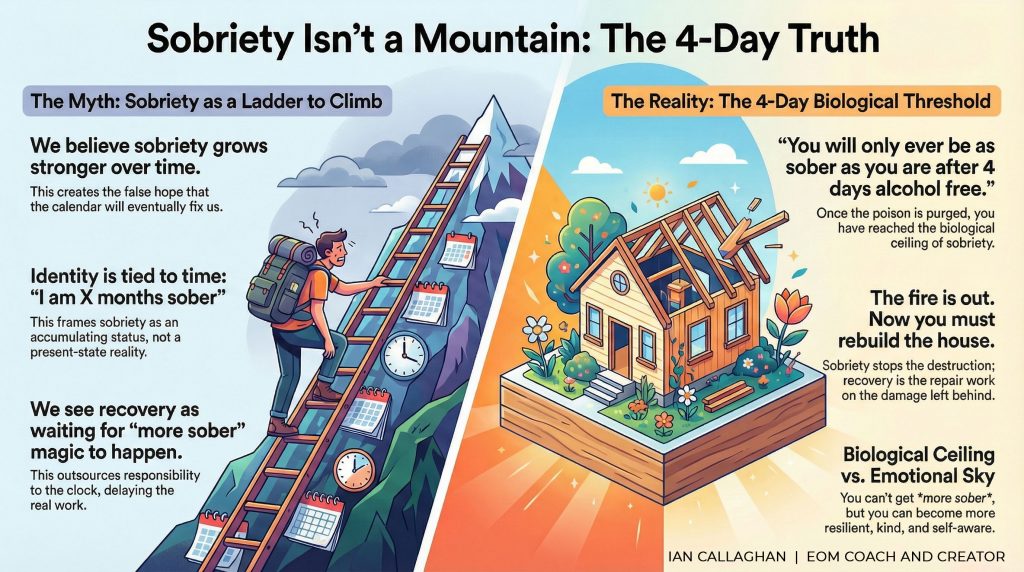
We are led to believe that sobriety is a mountain we climb, where the air gets cleaner and the ground more stable the higher we go. We expect that a man with ten years on the calendar is somehow chemically, physically, and spiritually “more” sober than the man with ten days.
This is the great gap between our expectations and the brutal reality of our physiology.
We chase a future version of ourselves, convinced that “real” sobriety is a destination far down the timeline. We tell ourselves, “If I can just get to six months, I’ll be truly sober.” We wait for a magical transformation that correlates with the turning of calendar pages.
But this waiting is a trap. It is a form of procrastination that keeps us from facing the violent clarity of the present moment.
Here is the unflinching truth, stripped of sentimentality and cliché: You will only ever be as sober as you are after 4 days alcohol free.
That is it. That is the ceiling.
There is no higher plane of physiological purity to ascend to. There is no biological nirvana awaiting you at the five-year mark. The expectation is that time heals all wounds; the reality is that the poison leaves quickly, and you are left with yourself.
The 4-Day Threshold
Let us sit with this uncomfortable fact. You will only ever be as sober as you are after 4 days alcohol free.
In the world of recovery, we often overcomplicate the biological baseline. We conflate emotional growth with physical sobriety. But if we look at the raw data of the human vessel, the timeline is shockingly short.
Four days. Ninety-six hours.
That is the duration required for the immediate physical tyranny to break.
Once you cross that threshold, you have reached the summit of biological sobriety. You are there. You have arrived.
This realisation can be terrifying. It removes the excuse of “early days.” It strips away the buffer of time we like to place between ourselves and responsibility.
If you are four days in, you are done with the physical act of becoming sober. You are standing in the full glare of reality.
The shivering stops. The immediate chemical chaos subsides. The body begins to regulate.
And in that moment, at the 96-hour mark, you possess a level of sobriety that is equal to the person with forty years of abstinence.
You must understand this: You can not be more sober.
It is a binary state. You are either intoxicated or you are not. The poison is either in your system, actively decaying your faculties, or it has been purged.
Once that purge is complete—a process that effectively peaks at day four—you are operating at maximum biological capacity regarding the absence of alcohol.
The Myth of “X Months Sober”
Society loves a badge. We love status. We love the hierarchy of time.
We introduce ourselves with our numbers. “I am six months sober.” “I am five years sober.”
But according to the strict biological reality, you can not be x months sober.
You can be x months disciplined. You can be x months healing. You can be x months present. You can be x months in recovery.
But you cannot be x months sober. Sobriety is the state of the body free from the influence of a toxin. That state is absolute. It does not compound interest.
Think of the danger in believing you can be “more” sober later. It suggests that today, right now, you are “less” sober. It suggests you are incomplete. It permits you to be less than fully accountable because you are “new.”
It feeds the “Dry Drunk” mentality—the idea that you are just white-knuckling it until the magic of time fixes you.
If you believe you become more sober with time, you are outsourcing your recovery to the clock. You are waiting for the calendar to do the heavy lifting that only you can do.
The source of this truth is undeniable: Once your body cleanses the poison that is you, biologically as sober as you ever will be.
Read that again. As sober as you ever will be.
Does that dishearten you? Or does it liberate you?
If you are four days in, you don’t have to wait to start your life. You don’t have to wait for permission to be well. You are already at the finish line of the physical race. The rest is just living.
The Metaphor: The Extinguished Fire
To understand this concept—that sobriety is a fixed state, not a cumulative one—we must look at a metaphor that reflects the binary nature of the condition.
Imagine your life is a house. Alcohol is a fire raging in the living room.
When you are drinking, the house is burning. The structure is weakening, the smoke is choking you, and the heat is unbearable.
When you stop drinking, you are calling in the fire brigade. You are dousing the flames.
It takes about four days for the fire to be completely extinguished. The last ember dies out. The smoke begins to clear.
At that moment, the house is no longer on fire.
Now, ask yourself: Is a house that hasn’t been on fire for ten years “more” extinguished than a house that hasn’t been on fire for four days?
No.
The fire is out in both houses. The state of “not burning” is identical.
A house cannot be “more” not-on-fire.
However, the house that has been safe for ten years might have been repaired. The walls might be repainted. The soot might be scrubbed away. The furniture might be replaced.
The house that has only been safe for four days is still scorched. It smells of smoke. The windows are broken. It is a mess.
But it is not burning.
This is the distinction we miss. We confuse the repair work (recovery) with the state of the fire (sobriety).
You are as sober (fire-free) at day four as you will ever be. The poison is gone. The fire is out.
The panic comes when you look around at the charred remains of your life and realise that simply putting the fire out didn’t fix the roof. It just stopped the destruction.
Cleansing the Poison
The source text is explicit: “Once your body cleanses the poison that is you biologically as sober as you ever will be.”
We must treat alcohol for what it is: a poison.
It is not a treat. It is not a social lubricant. It is a toxin that disrupts the fundamental neurochemistry of your brain.
When you ingest this poison, your body goes into emergency mode. Prioritises the elimination of the threat. Your liver works overtime. Your brain chemistry alters to counteract the depressant effects.
When you stop, the body executes a violent clarity. It purges.
This process is finite. It has a beginning, a middle, and an end. It concludes, largely, around the four-day mark.
At this point, the poison is gone.
This brings us to a terrifying question: If the poison is gone, and I am biologically as sober as I will ever be, why do I still feel this way?
Why is there anxiety? Why is there rage? Why is there an emptiness?
This is where the concept of “Life on Life’s Terms” hits us with the force of a freight train.
When you were drinking, you were blaming the poison. You could say, “I’m a mess because I’m drunk.” “I’m hungover.” “I’m withdrawing.”
After four days, you can no longer blame the presence of the poison.
You are left with the raw materials of your own psyche. You are left with the “you” that exists without the filter.
If you are miserable at day five, it is not because you aren’t sober enough. It is because you are miserable.
Sobriety didn’t fix you. It just revealed you.
The Illusion of Progress
We cling to the “x months sober” badge because it mimics progress.
We live in a world of gamification. We want to level up. We want to see the progress bar fill.
But biology does not care about your progress bar.
The liver does not say, “Well done, mate, you’ve done six months, I’ll function 10% better today.” The liver simply functions, or it doesn’t. Once the poison is gone, it is doing its job.
The danger of thinking “I can not be more sober” is that it sounds like a ceiling on our potential. But it is actually a floor for our reality.
If you accept that you can not be more sober than you are right now (assuming you are past day four), you strip away the romanticism of the journey.
You are forced to confront the “Dry Drunk.”
A Dry Drunk is someone who has removed the poison—they have achieved the maximum biological sobriety of day four—but they have not touched the scorched walls of the house.
They are sober. Technically. Biologically.
But they are angry. They are resentful. They are emotionally unregulated.
They are waiting for the “more sober” fairy to come and fix their attitude. They think if they just wait until year one, the magical “sober” dust will settle, and they will be happy.
The source text destroys this hope. It tells us: This is it. This is the baseline.
If you want to be happy, you have to build it. Sobriety won’t do it for you. Sobriety just clears the site so you can start building.
The Violence of Clarity
Let’s discuss the “violent clarity” of the four-day mark.
For years, you may have lived in a fog. You regulated your emotions with a chemical valve. Too happy? Drink. Too sad? Drink. Bored? Drink.
You flattened the peaks and filled the valleys of your emotional landscape.
Then, you stop.
Four days pass. The poison exists. You will only ever be as sober as you are in this moment.
Suddenly, the fog lifts. And what do you see?
You see the wreckage.
This is why relapse is so common shortly after the physical withdrawal ends. It isn’t because the body craves the poison essentially; it’s because the mind cannot handle the view.
The clarity is too brutal.
We think, “I need to get more sober to handle this.”
No. You need to get stronger. You need emotional resilience. You need tools.
But you do not need “more” sobriety. You have all the sobriety you are ever going to get. You have the full deck of cards right now. You just don’t know how to play them yet.
The Trap of Deferring Life
One of the most insidious side effects of the “x months sober” myth is that it allows us to pause our lives.
“I can’t date yet, I’m only two months sober.” “I can’t look for a new job, I need to be a year sober first.” “I can’t deal with my trauma until I have more time under my belt.”
This is fear masquerading as wisdom.
Based on the text—Once your body cleanses the poison that is you biologically as sober as you ever will be—there is no physiological reason to wait.
Your brain is clear. Your blood is clean.
You are capable of making rational decisions. You are capable of feeling complex emotions. You are capable of facing life on life’s terms.
You are using the calendar as a shield.
You are hoping that time will make the hard things easier. Sometimes it does, but only through practice, not through the passive accumulation of days.
If you sit in a room for a year and do nothing but not drink, you will be one year “dry,” but you will be exactly as “sober” as you were on day four. And you will likely be just as miserable.
Redefining the “Sober” Identity
If we accept the premise that you can not be x months sober, we have to change how we speak about ourselves.
Instead of saying, “I am becoming sober,” say, “I am sober. Now I am becoming human.”
This shift is crucial.
“Becoming sober” suggests a never-ending struggle against the bottle. It keeps the alcohol at the centre of your universe. It gives the poison power it does not deserve.
If you are always “getting sober,” then the alcohol is the protagonist of your story, and you are just the character reacting to it.
But if you accept that after four days, the deed is done—the poison is gone—then the alcohol is irrelevant. It is part of your history, not your present biology.
You are free.
The chains are off. You aren’t loosening them day by day. They dropped off at day four.
Why are you still standing there acting like you’re bound?
Walk away.
Confronting the Internal Void
The scariest part of the text, “you will only ever be as sober as you are after 4 days alcohol free,“ is the implication of what is left behind.
If the alcohol is gone, and you are fully sober, and you still feel empty, that emptiness is yours.
It belongs to you. It isn’t the drink’s fault anymore.
This is the internal surrender required for true recovery. You must surrender the scapegoat.
You can no longer say, “It’s the booze talking.” It’s you talking. You can no longer say, “I’m not myself.” You are exactly yourself.
This is the “brutal honesty” required to move from being merely “dry” to being “well.”
You have to look at the sober version of yourself—the one that emerged on day four—and decide if you like that person.
If you don’t, you have work to do. But that work is not “staying sober.” That work is self-improvement. It is therapy. It is mindfulness. It is an exercise. It is a connection.
Do not confuse the maintenance of the vehicle with the driving of the journey.
Sobriety is just checking the oil and filling the tank. It is the baseline maintenance. It doesn’t get you anywhere. You still have to drive the car.
The Biological Ceiling vs. The Emotional Sky
We must distinguish between the ceiling and the sky.
The text establishes a biological ceiling. You hit the roof of physical sobriety at day four. You cannot go higher.
However, the emotional sky is limitless.
While you cannot be more sober, you can be:
More patient.
More kind.
More self-aware.
More resilient.
More connected.
These are the metrics we should be tracking.
Stop counting the days you haven’t swallowed poison. Start counting the moments you reacted with grace instead of anger. Start counting the mornings you woke up with gratitude instead of dread.
Those are the markers of recovery.
The “4 days” rule frees you to focus on these things.
If you are obsessed with your day count, you are obsessed with the poison. You are looking backwards at the thing you left behind, counting the steps away from it.
Turn around. Look forward.
The poison is gone. The body is cleansed. You are as sober as you will ever be.
What are you going to do with it?
The “Forever” Trap
The idea of “forever” keeps many people sick.
“I can’t imagine being sober forever.” “I have to be sober for 20 years?”
The source text dismantles this anxiety. You don’t have to be sober for 20 years to be “sober.”
You just have to be sober for four days.
And then, you just maintain that state.
You are not accumulating a mountain of time that can crash down if you slip. You are simply maintaining a state of “poison-free.”
It transforms the insurmountable mountain into a simple, daily switch.
Switch off the poison. Wait four days. You are there.
Every day after that is just a repeat of the same biological state. It is not a heavier burden; it is the same burden, carried one day at a time.
The Physiological Reset
Let’s look closer at the phrase “Once your body cleanses the poison.”
The human body is a miraculous machine of regeneration. It wants to heal.
The liver regenerates. The neural pathways begin to re-fire. The gut lining repairs.
But this initial “cleansing” is swift. It is a biological priority.
Once it is done, the body moves to homeostasis. It seeks balance.
If you introduce the poison again, you reset the clock. You go back to zero. You have to do the four days again.
But if you don’t introduce the poison, the body doesn’t keep “cleansing” forever. It finishes the job.
It is done.
So, stop acting like you are in a constant state of detox. You aren’t. After day four, you are in a state of living.
The fatigue you feel at month three isn’t the poison leaving your body. It’s life. It’s depression. It’s burnout. It’s a poor diet.
Treat the root cause. Don’t blame the ghost of the bottle.
Authority and Ownership
To fully embrace the truth that you can not be x months sober, you must take authority over your own existence.
This is the opposite of the victim mentality that often plagues early recovery.
“I am an addict, I am powerless.”
Perhaps over the alcohol, yes. But once the poison is gone (day four), you are not powerless over your choices. You are not powerless over your stress reaction.
You possess the full agency of a sober adult.
This is where the concept of “Emotional Regulation” becomes paramount.
A child throws a tantrum when they don’t get their way. An alcoholic drinks when they don’t get their way.
A sober adult—who accepts they are fully sober and responsible—pauses. They breathe. They assess. They choose.
If you are six months in and still reacting like a child, it is not because you need more time sober. It is because you haven’t learned to regulate your emotions.
The text forces us to stop waiting for the alcohol to stop being the problem and start realising we are the project.
Summary of the Hard Truths
The Ceiling: Sobriety peaks at day 4.
The Myth: You cannot be “more” sober at year 10.
The Reality: Biology cleanses the poison quickly; the rest is psychology.
The Metaphor: The fire is out. Now fix the house.
The Responsibility: You can’t blame the poison after the purge.
This perspective is not meant to diminish the achievement of long-term abstinence. Stopping is hard.
But it is hard for psychological reasons, not biological ones.
It is hard because life is hard. It is hard because feelings are painful. It is hard because we have to face the mess we made.
But we face it with a clear head. We face it with a body that has done its job.
The body has cleansed the poison. It has fulfilled its end of the bargain.
Now, you must fulfil yours.
Actionable Focus: The 5-Minute Mindfulness Anchor
You have read the truth. You understand that physiologically, if you are past day four, you are at the peak. Now you must deal with the noise in your head that the poison used to silence.
You need a tool to handle the “violent clarity.”
The Action: Practice the “Sober Anchor” technique.
This is not about emptying your mind. It is about grounding your body in the present reality of its sobriety.
Sit Down: Find a quiet chair. Feet flat on the floor.
Close Your Eyes: Remove visual stimulation.
Scan the Body: Start at your toes. Move up. Do you feel the shakes? No? (If you are past day 4). Do you feel the nausea? No?
Acknowledge the Cleanliness: Say to yourself, internally or out loud: “The poison is gone. My vessel is clean. I am here.”
Breathe into the Void: You might feel anxiety or emptiness. Don’t fight it. Breathe into it. Imagine that space is a clean room waiting to be furnished.
Hold for 5 Minutes: Set a timer. Just sit with the reality of being a clean vessel.
Do this every morning. Remind yourself that the physical battle is won. The fire is out.
Stop chasing symptoms. Fix the machine.Rewiring The Mind is not a memoir—it is a mechanic’s manual for your brain. Written by Ian Callaghan (Army Veteran, 45-year drinker), this guide combines Stoic Philosophy, Evolutionary Biology, and Nervous System Regulation to help you break the loop of anxiety, drinking, and survival mode. You don’t need more willpower. You need a new identity. (Instant PDF Download)
Approaching the festive season without your usual chemical crutch can feel like walking onto a battlefield without armour. The lights are brighter, the noise is louder, and the pressure is suffocating. If you are frantically searching, “How do I navigate my first sober Christmas without feeling boring or left out?”, realise that this fear is the first step of your defence strategy. This guide avoids the toxic positivity of “just be grateful” and instead offers the brutal honesty and tactical architecture necessary to survive the holidays with your sobriety—and your self-respect—intact.
The Violent Clarity of the First Sober Christmas
The shop windows are screaming joy. The carols are looping a relentless soundtrack of enforced happiness. Everyone around you appears to be participating in a collective, synchronised ritual of chemical lubrication. Yet, you are standing on the precipice of December with a knot in your stomach tight enough to strangle your enthusiasm.
This is The Gap.
It is the treacherous chasm between the societal hallucination of Christmas—a time of unbridled connection, warmth, and excess—and your internal reality: a raw, exposed nerve trying to navigate a minefield without its usual anaesthetic. You aren’t just worried about avoiding a glass of champagne; you are terrified of the silence that follows the refusal. You are terrified of the “No.” You are terrified that without the drink, you are grey, flat, two-dimensional, and fundamentally boring.
Let’s dismantle that lie immediately. You are not boring; you are healing. But let’s be honest: healing is rarely pretty, it is rarely convenient, and it often feels like open-heart surgery without sedation.
Navigating your first sober Christmas isn’t about learning how to “fake it” until the calendar flips to January. It is about accepting Life on Life’s Terms. It is about understanding that the discomfort you feel isn’t a sign that you are failing at recovery—it is the evidence that you are finally waking up.
The Metaphor: Living in 4K Resolution
To understand why this season feels so abrasive to the newly sober mind, we must look at the function alcohol served during your previous holidays. We often romanticise the drink, remembering the laughter but forgetting the blackout.
Alcohol was your Vaseline on the lens. It was the soft-focus filter applied to reality. It blurred the sharp edges of family dysfunction; it softened the stinging criticism of a judgmental in-law; it made repetitive, circular conversations seem profound; it dialled down the sensory overload of the season into a manageable, warm, fuzzy hum.
Sobriety is living in High-Definition (4K).
Suddenly, the resolution is cranked up to maximum. You see every pore, every crack in the family dynamic, and every micro-expression of disappointment. The turkey is dry, the uncle is offensive, the children are screaming, and the small talk is excruciatingly vacuous.
You aren’t “boring” because you aren’t drinking. You are simply seeing the world—and Christmas—without a filter for the first time in years. This violent clarity is overwhelming. It assaults the senses. But here is the critical reframe: You cannot connect with reality whilst you are numbing yourself to it. The “boredom” you fear is actually just the absence of chaos.
The Myth of the “Boring” Sober Person
The fear of being boring is, at its core, a fear of vulnerability.
When we drank, we were performing. We were the “life and soul,” the “party animal,” the “generous host,” or the “funny drunk.” We used ethanol to chemically engineer a personality that could withstand social pressure and internal insecurity. We put on a mask because we didn’t believe our true face was acceptable.
Stripping that mask away leaves you feeling naked. You might sit quieter than usual. You might leave the dance floor earlier. You might find the chaotic noise of a crowded pub unbearable after sixty minutes.
Here is the unflinching truth: The people who think you are boring are likely the ones who need a drink to find you interesting.
Your sobriety acts as a mirror to their dependency. When you refuse a drink, you inadvertently ask them a question they aren’t ready to answer about their own consumption. Their discomfort is not your responsibility. Their judgment is a projection of their own relationship with the substance.
The “Dry Drunk” Trap: A Warning
In the rooms of recovery, there is a term you must understand: the “Dry Drunk.”
Sobriety is not merely the absence of alcohol; it is the presence of emotional regulation. A Dry Drunk is someone who has removed the bottle but kept the behaviour, the resentment, the selfishness, and the chaotic thinking.
If you go into Christmas “white-knuckling” it—gritting your teeth, sitting in the corner seething with jealousy that everyone else gets to check out of reality while you have to stay present—you are in a dry drunk state. You are physically sober but emotionally intoxicated by rage and self-pity.
To avoid this, you must shift your mindset from Restriction to Liberation.
Restriction Mindset: “I can’t drink. Poor me. I am being punished. Everyone else is having fun.” This breeds resentment.
Liberation Mindset: “I don’t have to drink. I am free from the compulsion. I am choosing reality.” This breeds power.
You are not being deprived of a hangover. You are not being deprived of the shame of waking up and checking your sent messages with one eye open, heart pounding with dread. You are not being deprived of the 3 a.m. anxiety spike. You are being gifted the ability to remember the day, to drive yourself home, and to wake up proud.
Physiological Warfare: Regulating the Nervous System
Christmas is a sensory assault. For a brain in recovery, which is already working overtime to rewire its dopamine pathways, the lights, sugar, noise, and social demands can trigger the “Fight or Flight” response.
When you feel that sudden, clawing urge to drink, it is rarely a thirst for liquid. It is a desperate scream from your nervous system for regulation. You are overstimulated, and for years, alcohol was your “off-switch.”
Without the chemical off-switch, you need manual brakes. You need to understand the biology of your craving.
1. The Advanced H.A.L.T. Protocol
You cannot navigate this season on autopilot. You must constantly scan your internal dashboard. The traditional acronym is HALT (Hungry, Angry, Lonely, Tired), but for Christmas, we must expand it.
Hungry: Low blood sugar mimics anxiety and adrenaline spikes. When your glucose drops, your brain panics and craves a quick fix (sugar or alcohol). Eat protein regularly. Do not exist on canapés and chocolate.
Angry: Is your boundary being crossed? Anger is a signal that a violation has occurred. Don’t swallow the anger; step away and address the boundary.
Lonely: You can be lonely in a room full of twenty people. This is “emotional isolation.” Connect with another sober person (more on this in the Architecture section).
Tired: Fatigue destroys willpower. The prefrontal cortex (the CEO of your brain that says “don’t drink”) goes offline when you are exhausted. If you are tired, leave.
Overwhelmed: The sensory input is too high. Your brain is frying. You need a sensory deprivation break.
2. The Bathroom Sanctuary (Tactical Retreat)
You need a physical escape route within the venue. When the HD reality becomes too sharp—when the noise is too loud or the questions too intrusive—go to the bathroom.
This is your bunker. Lock the door. Look in the mirror. Do not look at your phone.
The Reset: Run cold water over your wrists for 30 seconds. This stimulates the Vagus Nerve, which helps switch your nervous system from “Fight or Flight” (Sympathetic) to “Rest and Digest” (Parasympathetic).
The Breath: Inhale for 4 seconds, hold for 4, exhale for 4, hold for 4. Box breathing tells your brain you are safe.
The Affirmation: Remind yourself: I am safe. I am in control. I can handle this moment.
The Architecture of a Sober Christmas
Hope is not a strategy. You cannot rely on willpower. Willpower is a finite resource, like a battery in a smartphone. By 6:00 pm on Christmas Day, after dealing with traffic, cooking, and awkward relatives, your battery will be at 5%. You cannot rely on a dead battery to save you.
You need systems. You need an architecture of safety.
The Bookending Technique
This is a non-negotiable tool for the recovering addict. You must “bookend” your events to ensure accountability.
The Pre-Game: Before you walk into the family gathering or the office party, you call or text a sober support (sponsor, therapist, sober friend). You tell them exactly where you are going, how you feel, and what time you intend to leave. “I’m going in. I’m feeling anxious. I will leave at 9 pm.”
The Post-Game: As soon as you leave—before you even start the car—you call them back. “I made it. I’m out. I stayed sober.”
This creates a psychological safety net. You are accountable to someone outside the “wet” environment. It anchors you to your recovery community, reminding you that you are part of a tribe that values your sobriety, even if the people at the party don’t understand it.
The Escape Vehicle
Never, under any circumstances, rely on a drinker for your transport.
If you are reliant on a drinker for your lift home, you are a hostage to their drinking pace. If you need to leave because your anxiety is spiking or the environment has become toxic, you need to be able to leave now.
Drive yourself. Book your own Uber. Know the train times. The freedom to execute an “Irish Goodbye” (leaving without grand farewells or explanations) is your greatest weapon. Knowing you can leave often reduces the anxiety enough that you don’t need to leave.
Time-Boxing
Do not commit to the “long haul.” Decide in advance how long you will stay. “I will go for dinner, but I will leave before the heavy drinking starts.” Two hours of quality connection is better than six hours of endurance. Protect your energy.
Handling the Inquisition: What to Say
You will be asked why you aren’t drinking. It is inevitable. Some people are polite; others are aggressive; most are just confused. You do not owe anyone your medical history, your rock bottom story, or your trauma.
You need a script. When the brain is panicked, we stutter and over-explain. Memorise these lines so they roll off the tongue without emotion.
The Casual Deflection: “I’m not drinking today, I’ve got an early start tomorrow.” (Simple, unarguable).
The Health Angle: “I’m on a health kick right now. Just sticking to water.” (People generally respect health choices).
The Designated Driver: “I’m driving today.” ( The ultimate silencer).
The Violent Truth (Use sparingly): “I’ve retired from drinking. I went pro early and finished my career.” (Humour diffuses tension).
The Firm Boundary: “I’m just not drinking, thanks. Pass the potatoes?” (Pivot the conversation immediately).
Notice that none of these require an apology. Do not apologise for evolving. Do not apologise for saving your own life.
Top 5 Tips for Surviving the Festive Season
Here is the tactical breakdown. These are your actionable steps to ensure you navigate your first sober Christmas without feeling bored or left out.
1. BYOB (Bring Your Own Beverage)
Never rely on the host to provide for you. Their idea of a non-alcoholic option is often lukewarm tap water or a dusty carton of orange juice from 2019. Action: Bring a cooler. Pack it with premium tonic waters, alcohol-free beers (if they aren’t a trigger), kombucha, or craft sodas. Treat yourself to the expensive stuff. The Psychology: Having a glass in your hand acts as a shield. It stops people from offering you a drink because you already have one. It gives you something to do with your hands. It signals that you are participating in the ritual of celebration, just not the intoxication.
2. Lower the Bar on “Fun”
Expectations are premeditated resentments. If you go in expecting a Hallmark movie moment—perfect harmony, deep laughter, magical connection—you will be crushed by reality. Action: Accept that this year might feel flat. Accept that you might feel awkward. That is okay. Your only goal this year is to put your head on the pillow sober. If you do that, you have won the Olympics of Christmas. Anything else—laughter, good food, presents—is a bonus.
3. Service Over Self
Alcoholism and addiction are diseases of extreme self-centredness. We are obsessed with how we feel, how we look, and what we are missing. The quickest way to get out of your own head is to be of service to others. Action: Be the person who clears the table. Wash the dishes. Play Lego with the nieces and nephews on the floor. Walk the dog. When your hands are busy helping, your mind has less time to obsess over a drink. Service builds self-esteem, which is the antidote to feeling “left out.”
4. Play the Tape Forward
When the urge hits—and it will—it comes with a fantasy. The fantasy says, “One glass of red wine will make you warm and fuzzy. It will make me witty and relaxed.” Action: Play the tape forward to the end. Don’t stop at the first sip.
Fast forward 3 hours: The slurring, the glossed-over eyes, the inappropriate comment, the stumble.
Fast forward 12 hours: waking up at 4 a.m. with a heart rate of 120. The shame. The headache. The resetting of your day counter. The drink is never just the drink; it is the aftermath.
5. Create New Traditions
You cannot just remove the alcohol; you must replace it with something else, or you are left with a void. The old traditions were likely centred around the pub, the bottle opening, or the toast. Action: Start a new ritual that requires sobriety.
A sunrise walk on Boxing Day (impossible with a hangover).
A chilly dip in the ocean (cold water therapy produces a massive dopamine hit).
Reading a book by the fire with a specialised tea. Reclaim the holiday on your terms. Make the morning the highlight, not the late night.
The Grief of the Bottle
We must address something often overlooked: Grief.
Navigating Christmas without alcohol can feel like spending the holiday after a breakup or a death. For a long time, alcohol was your best friend. It was your lover, your confidant, your stress-reliever, and your celebration partner.
It is normal to feel a sense of loss. You might look at the others drinking and feel a pang of sadness. “Why can’t I do that? Why is my brain wired differently?”
Allow yourself to feel this sadness. Do not suppress it. Acknowledge it: “I miss the ritual. I miss the ease of it.” But then remind yourself that the relationship was abusive. You broke up with alcohol because it was trying to kill you—slowly or quickly. You are grieving a toxic relationship, not a healthy one.
FAQ: Navigating the Sober Holiday
Q: Will I be boring at the Christmas party? A: You will be different, not boring. You will be attentive, coherent, and authentic. If being “fun” required you to be intoxicated, that wasn’t fun—it was chaos. You may speak less, but what you say will matter more. You will be a safe harbour in a room full of storms.
Q: What if I feel a sudden, intense craving? A: Cravings are like waves; they peak and then crash. They rarely last longer than 20 minutes unless you feed them with thought.
Step 1: Change your physiology (move your body, splash cold water).
Step 2: Change your environment (step outside).
Step 3: Take sugar (chocolate/candy) immediately to check if it’s blood sugar.
Step 4: Call your bookend support.
Q: How do I deal with family members who push drinks on me? A: This is a direct violation of boundaries. Be firm. Look them in the eye and say, “I said no, thank you. Please stop asking, it’s making me uncomfortable.” If they continue, leave the room or leave the event. Your sobriety is more important than their feelings or their party.
Q: Is it okay to skip events entirely? A: Absolutely. In early recovery, you are in the ICU of the soul. If an environment feels unsafe, too triggering, or simply too exhausting, you have the right to decline the invitation. “I’m not up for it this year” is a complete sentence. Prioritise your recovery over social obligation.
Q: Why do I feel so sad even though I’m doing the right thing? A: Because change is loss. You are shedding an old skin. Also, without the dopamine spikes of alcohol, your brain is recalibrating. You might feel “flat” (anhedonia). This is temporary. It is the price of admission for the joy that comes later.
Q: What about alcohol-free (AF) wine and beer? A: Proceed with caution. For some, these are lifesavers that allow them to blend in. For others, the taste and smell are a “trigger” that awakens the craving for the real thing. If drinking an AF beer makes you wish it had vodka in it, stay away from it. Stick to soda or tonic.
Conclusion: The Ultimate Rebellion
Navigating your first sober Christmas is an act of rebellion. You are rebelling against a culture that insists you must be anaesthetised to tolerate your own life. You are rebelling against the marketing that equates ethanol with love. You are rebelling against your own history.
It will be hard. There will be moments where you feel like a raw nerve in a world of sandpaper. You might feel bored. You might feel left out. You might feel angry.
But remember this: The feeling of waking up on Boxing Day, clear-headed, with your self-respect intact and your memories sharp, is infinitely better than the cheap, borrowed happiness of a drink.
You are building a foundation. This Christmas is toncrete. It’s heavy, it’s messy, and it’s hard work to lay, but it will support the house of your new life for years to come. You are giving yourself the greatest gift possible: Presence.
Your Actionable Focus: Do not wait until the party starts. Right now, take out your phone. Identify one person you can call if things get tough during the holidays. Text them now: “I’m planning to stay sober this Christmas. It might be tough. Can I call you if I feel wobbly during the day?” Secure your lifeline before the storm hits. Put your armour on.
Stop analysing the crash. Fix the code. An 8-page field guide to debugging your own mind. Includes the 4-Step EOM Protocol, the Symbol Library, and the Emergency Reboot scripts. Bonus: Includes access to the interactive Digital Console.
Used to monitor number of Google Analytics server requests when using Google Tag Manager
1 minute
_gid
ID used to identify users for 24 hours after last activity
24 hours
_ga_
ID used to identify users
2 years
_gali
Used by Google Analytics to determine which links on a page are being clicked
30 seconds
_ga
ID used to identify users
2 years
__utmx
Used to determine whether a user is included in an A / B or Multivariate test.
18 months
__utmv
Contains custom information set by the web developer via the _setCustomVar method in Google Analytics. This cookie is updated every time new data is sent to the Google Analytics server.
2 years after last activity
__utmz
Contains information about the traffic source or campaign that directed user to the website. The cookie is set when the GA.js javascript is loaded and updated when data is sent to the Google Anaytics server
6 months after last activity
__utmc
Used only with old Urchin versions of Google Analytics and not with GA.js. Was used to distinguish between new sessions and visits at the end of a session.
End of session (browser)
__utmb
Used to distinguish new sessions and visits. This cookie is set when the GA.js javascript library is loaded and there is no existing __utmb cookie. The cookie is updated every time data is sent to the Google Analytics server.
30 minutes after last activity
__utmt
Used to monitor number of Google Analytics server requests
10 minutes
__utma
ID used to identify users and sessions
2 years after last activity
_gac_
Contains information related to marketing campaigns of the user. These are shared with Google AdWords / Google Ads when the Google Ads and Google Analytics accounts are linked together.