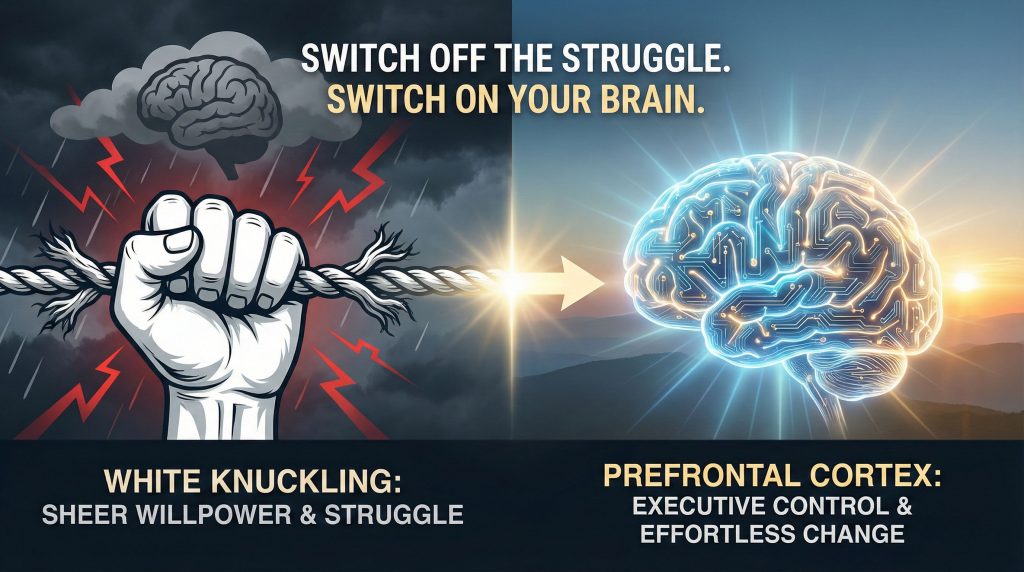
White Knuckling vs. Prefrontal Cortex. The sensation is visceral and familiar to anyone who has ever tried to break a compulsive habit, stay sober, or stick to a rigid diet plan. Your muscles tense involuntarily, your jaw clenches tight enough to crack a tooth, and you force yourself to say “no” through sheer, grinding grit. You are holding on for dear life.
This is white knuckling.
In the short term, white knuckling can be effective. It might get you through a difficult dinner party or a stressful hour at work. However, as a long-term strategy for life, it is biologically unsustainable. Relying on it is akin to trying to run a marathon by holding your breath; eventually, the system fails, and you gasp for air—or in this case, relapse.
The sustainable alternative lies in the evolutionarily advanced front section of your brain. The Prefrontal Cortex (PFC) is the CEO of your neurological functioning. It handles long-term planning, impulse control, consequences, and emotional regulation.
When we analyse the battle of White Knuckling vs. Prefrontal Cortex, we are essentially comparing a finite resource (willpower/adrenaline) against a trainable, renewable skill (executive function).
Here is the definitive, expanded list of 15 strategies to stop the exhausting internal fight and start rewiring your brain for effortless, executive control.
1. Understand and Label the “Amygdala Hijack”
To win the high-stakes battle of White Knuckling vs. Prefrontal Cortex, you must first identify the adversary. White knuckling is almost always a desperate response to the amygdala taking over the driver’s seat of your brain.
The amygdala is the primal “lizard brain” or “fire alarm” responsible for the fight-flight-freeze response. It is ancient, fast, and not very smart. When a craving hits—whether for alcohol, sugar, or a toxic behaviour—the amygdala screams that you need this dopamine release for survival. It creates a state of “tunnel vision” where nothing else matters.
The Biological Conflict:
The White Knuckling Response: You try to shout down the amygdala with force. You mentally scream “NO!” back at it. This internal shouting match creates immense stress, spikes your heart rate, and floods your system with cortisol. You are fighting a biological alarm system with brute force.
The PFC Approach: You engage the “brake pedal” of the brain. You recognise the signal for what it is: a biological error, not a command from God.
Actionable Step: Use the technique of “Affect Labelling.” When the urge arises, say out loud or write down: “This is just my amygdala misfiring. I am experiencing a dopamine craving, not a survival need.”
Neuroscience studies suggest that the simple act of putting a feeling into words moves brain activity from the emotional centre (amygdala) to the thinking centre (right ventrolateral prefrontal cortex). By naming the monster, you shrink it.
2. Accept That Willpower is a Battery, Not a Trait
In the UK and many Western cultures, we prize the “stiff upper lip.” We erroneously view willpower as a fixed character trait—something you either possess in abundance or lack entirely. This leads to the belief that if you fail, you are morally “weak.”
Neuroscience disagrees entirely. The concept of “Ego Depletion,” proposed by researcher Roy Baumeister, suggests that willpower is a limited metabolic resource, much like a battery on your smartphone.
Why White Knuckling Fails: White knuckling is an energy-intensive process. Every time you resist an urge through force, you drain the battery. By the evening, after a stressful day of making decisions at work, navigating traffic, and managing emotions, your “battery” is flat. This explains why the vast majority of dietary slips and relapses happen between 6:00 PM and 10:00 PM. The PFC is simply too tired to fight.
The PFC Shift: Instead of relying on a fully charged battery, rely on system design. The prefrontal cortex excels at designing environments where high willpower isn’t required.
Remove cues entirely: If you are quitting sugar, do not have biscuits in the house “for guests.” If you are quitting drinking, do not keep a “special occasion” bottle.
Automate decisions: Meal prep on Sundays so you don’t have to choose dinner when you are exhausted on Tuesday.
Pre-commitment: Lock your credit card or use app blockers before the urge strikes.
3. Master the Mindfulness Art of “Urge Surfing”
White knuckling attempts to stop a tidal wave by standing rigidly in front of it. You brace yourself, you tense up, and you take the hit. Inevitably, the ocean wins, and you are knocked over.
Urge surfing is a mindfulness technique that engages the prefrontal cortex to observe the wave without being crushed by it. It changes your relationship with the craving from a “participant” to an “observer.”
The Wave Metaphor: Cravings behave like waves. They start small, build in intensity, crest at a peak (where the discomfort is highest), and then inevitably break and dissipate.
How to Surf:
Observe: Close your eyes and scan your body. Where do you feel the craving? Is it a tightness in the chest? A dryness in the mouth? A jitter in the hands?
Non-Judgment: Do not fight the sensation. Do not say “I hate this.” Just watch it, like a scientist observing an experiment.
Wait: Most cravings peak within 15 to 20 minutes. If you can surf the wave for that duration without acting, the neurochemistry shifts, and the urge subsides.
By observing rather than fighting, you keep the PFC online. You are the captain of the ship watching the storm, not the sailor drowning in it.
4. The “Pause and Plan” Response
Stanford health psychologist Kelly McGonigal discusses the “Pause and Plan” response as the physiological opposite of “Fight or Flight.”
When you white knuckle, your body mimics a stress response. Your heart rate skyrockets, your digestion slows, and your muscles tense. This physiological state literally shuts down blood flow to the PFC to focus resources on immediate physical survival (running or fighting).
Engaging the PFC: To get the “CEO” back in the office, you need to physically slow down your body’s biology. You cannot think your way out of a stress response; you must act your way out of it.
The Technique:
Stop what you are doing immediately.
Take five deep, slow breaths.
Crucial Detail: Extend the exhale longer than the inhale (e.g., inhale for 4 seconds, exhale for 8 seconds).
This breathing pattern stimulates the vagus nerve, which activates the parasympathetic nervous system (rest and digest). It sends a biochemical signal to your brain that you are safe. Once the alarm bells stop ringing, the prefrontal cortex can come back online to make rational decisions.
5. Address Decision Fatigue Aggressively
The prefrontal cortex is easily exhausted by the act of making choices. Every decision you make—from “what shirt do I wear?” to “which email do I answer first?”—chips away at its efficiency.
The White Knuckling Trap: If you leave your recovery or habit change up to in-the-moment choices, you are setting yourself up for a white-knuckling disaster. If you have to ask yourself, “Should I go to the gym?” or “Should I have a drink?” in the moment, you are taxing an already tired brain.
Optimisation Strategy: Reduce the cognitive load by making fewer decisions. This is why people like Steve Jobs or Barack Obama wore the same clothes every day.
Standardise routines: Eat the same healthy breakfast every single day.
Fixed routes: Have a non-negotiable route home that avoids your favourite pub or bakery.
The “If-Then” Plan: create rules in advance. “If it is 6:00 PM, then I put on my running shoes.”
By conserving decision-making energy on trivial things, you reserve your PFC’s strength for the moments that truly matter.
6. Strict Glucose Regulation and Nutrition
The brain is an energy-hungry organ, consuming about 20% of your daily calories despite being only 2% of your body weight. The prefrontal cortex, specifically, is highly sensitive to glucose fluctuations.
When your blood sugar drops, your executive function is the first thing to go offline. Evolutionarily, when you are starving, you don’t need to ponder philosophy; you need to hunt. Your brain reverts to primal impulses. This is the science behind being “hangry” (hungry + angry).
White Knuckling vs. Biology: You cannot willpower your way out of low blood sugar. If you skip lunch, by 4:00 PM your brain will be screaming for quick energy. This usually manifests as cravings for sugar, refined carbs, or alcohol (which is essentially liquid sugar).
The Fix:
Steady Fuel: Eat regular, complex carbohydrates and proteins every 3-4 hours.
Avoid Spikes: Do not start the day with sugary cereal. It causes an insulin spike followed by a crash, leaving your PFC vulnerable by mid-morning.
Omega-3s: Supplement with high-quality fish oil to support the structural integrity of the brain’s grey matter.
7. The Power of Cognitive Reframing
White knuckling is rooted in a sense of deprivation. You tell yourself, “I really want this, but I am not allowed to have it.” This creates a psychological tension that requires constant energy to maintain.
The PFC Approach: Reframing uses the logic centre of the brain to change the narrative so that willpower isn’t even needed. You move from a “have to” mindset to a “get to” mindset.
Examples:
White Knuckling Narrative: “I can’t drink a pint tonight because I’m an alcoholic and it ruins my life.” (Feels like punishment/prison).
PFC Logic: “I don’t drink because I love waking up with a clear head and boundless energy.” (Feels like a strategic choice/freedom).
Dieting Example: Change “I can’t eat that pizza” to “I am choosing to fuel my body with nutrients that make me feel strong.”
When you view the behaviour as a positive, empowered choice rather than a restricted jail sentence, the conflict in the brain dissolves.
8. Prioritise Sleep Hygiene as a Medical Necessity
Sleep deprivation is catastrophic for the prefrontal cortex. Studies using fMRI scans show that a sleep-deprived brain looks remarkably similar to an intoxicated brain.
When you are tired, the functional connectivity between the amygdala (impulses) and the PFC (control) is severed. The amygdala runs wild, and the PFC is too sluggish to stop it.
The Vicious Cycle: You stay up late scrolling, you get tired, your PFC weakens, you engage in bad habits (night snacking/drinking), you sleep poorly, and the cycle repeats.
The Strategy: Treat sleep as the foundation of your recovery, not a luxury.
The Glymphatic System: During deep sleep, your brain literally washes itself of toxins. Without this wash, executive function is impaired.
Environment: Keep the room dark to promote melatonin. The ideal temperature for UK sleepers is around 18 degrees Celsius.
Digital Sunset: No screens 60 minutes before bed. Blue light suppresses the hormones needed for deep, restorative sleep.
9. Visualisation and “Future Pull” (Episodic Foresight)
The amygdala lives entirely in the “now.” It wants immediate gratification and cannot comprehend consequences three hours from now, let alone three years from now.
The prefrontal cortex is the only part of the brain capable of Episodic Foresight—the ability to travel through time mentally.
Using the PFC: When an urge hits, do not just look at the drink, the cigarette, or the cake. Force your brain to “play the tape forward” in high definition.
Step 1: Visualise the momentary pleasure.
Step 2: Visualise 20 minutes later (the craving for more).
Step 3: Visualise the next morning (the headache, the shame, the regret, the restart).
By actively visualising the negative future consequences, you empower the PFC to override the immediate impulse. You are using higher-order thinking to defeat primal urging.
10. Reduce Cortisol (Stress Management)
Stress is the arch-nemesis of the prefrontal cortex. High levels of cortisol (the stress hormone) are neurotoxic to the PFC. Chronic stress can literally shrink the neurons in this area of the brain, reducing your capacity for self-control over time.
White Knuckling is Stressful: The irony is that trying to force yourself to stop a behaviour is, in itself, a massive stressor. It creates a feedback loop of anxiety (“Will I relapse? I must not relapse!”), which raises cortisol, which weakens the PFC, which makes relapse more likely.
The Antidote: You must incorporate active stress reduction that is not your addiction or bad habit.
Nature Immersion: Even 20 minutes in a green space lowers cortisol levels significantly.
Meditation: Consistent meditation increases grey matter density in the PFC.
Reading: Lowers heart rate and engages the imagination, pulling you out of the “fight or flight” loop.
Lower stress levels mean the “CEO” of your brain can stay at their desk and manage the company effectively.
11. Leverage Neuroplasticity
One of the most hopeful aspects of the White Knuckling vs. Prefrontal Cortex debate is the reality of neuroplasticity—the brain’s ability to change its physical structure based on behaviour.
White knuckling assumes you are fighting a permanent, unchanging urge. The science suggests otherwise.
Rewiring the Brain: Every time you successfully navigate an urge using PFC strategies (like urge surfing or pausing), you strengthen that neural pathway. It is like hacking a path through a dense jungle. The first time is exhausting. The second time is easier. By the hundredth time, it is a paved road.
Hebbian Learning: “Neurons that fire together, wire together.”
The Result: What requires massive effort today will require almost zero effort in six months. Eventually, the healthy choice becomes the automatic choice. You transition from conscious competence to unconscious competence.
12. Connect with Community (The Oxytocin Effect)
Addiction and bad habits thrive in isolation. White knuckling is often a lonely, solitary battle waged inside one’s own head.
The prefrontal cortex functions significantly better when we feel socially connected and safe. Positive social interaction releases Oxytocin, often called the “cuddle hormone” or “bonding hormone.”
The Chemistry of Connection: Oxytocin has a powerful dampening effect on the amygdala. It lowers fear, anxiety, and the sense of threat.
Action Plan:
Join a Tribe: Engage with a recovery group (AA, SMART Recovery), a running club, or a hobby group.
Reach Out: Call a friend or mentor specifically when an urge hits.
Honesty: Be honest about your struggle. Shame thrives in secrecy; sunlight kills it.
When you share the burden, you biologically upgrade your brain’s ability to cope. You are effectively outsourcing some of the executive function to the group until yours is strong enough to handle it alone.
13. High-Intensity Exercise (BDNF Release)
If you feel the need to white knuckle, you likely have excess energy in the system—specifically adrenaline and agitation.
Exercise is a direct, physiological intervention. Specifically, aerobic exercise releases Brain-Derived Neurotrophic Factor (BDNF).
Why it Matters: BDNF acts like “Miracle-Gro” fertiliser for the brain. It supports the growth of new neurons in the prefrontal cortex and the hippocampus, repairing damage done by stress or substance abuse.
The Swap: Instead of sitting on the sofa fighting the urge (white knuckling), change your state immediately.
Sprint up a hill.
Do 50 burpees.
Take a cold shower.
These activities burn off the adrenaline, release endorphins (natural painkillers), and flood the brain with BDNF, strengthening the PFC for the long term.
14. Practice Radical Self-Compassion
This sounds soft, but it is hard science. Shame shuts down the learning centres of the brain.
When you relapse or slip up, the white-knuckling approach is usually self-flagellation. “I am weak,” “I am useless,” or “Why can’t I just stop?”
The Neuroscience of Shame: Shame triggers the threat defence system (amygdala). It spikes cortisol. It makes you feel bad, and when you feel bad, your brain screams for its favourite coping mechanism (the bad habit). This is known as the “What-the-Hell Effect.”
The PFC Approach: Self-compassion (“I slipped up, I’m human, let’s analyse why this happened”) keeps the prefrontal cortex online. It allows for analysis and planning.
The Shift: Instead of beating yourself up, ask: “What was the trigger? Was I hungry? Was I tired? How can I prevent this next time?” This is a strategic, executive question, not an emotional one.
15. Seek Professional Cognitive Training (CBT)
Sometimes, the battle of White Knuckling vs. Prefrontal Cortex requires a professional coach.
Cognitive Behavioural Therapy (CBT) is essentially a training course for your prefrontal cortex. It is not just “talking about feelings”; it is a structured method for rewiring thought patterns.
What CBT Does:
Metacognition: It teaches you to think about your thinking.
Identification: It helps you spot “Automatic Negative Thoughts” (ANTs) that trigger urges.
Challenge: It uses logic to dismantle the lies the amygdala tells you (e.g., “I need a drink to be funny”).
Therapy helps you build the scaffolding required to support your PFC while it strengthens. It moves you away from “hoping” you can resist to having a structured architectural plan for your life.
The Comparison: A Summary
To truly grasp the difference, let’s look at a direct side-by-side comparison of the two modalities.
The White Knuckling Approach
Primary Driver: Fear, Shame, and Desperation.
Brain Region: Amygdala and Limbic System (reactionary/survival).
Metaphor: Holding a beach ball underwater.
Sustainability: Extremely Low. Works for minutes or hours, rarely days.
Outcome: Leads to neuroplasticity, reduced cravings, and permanent, effortless habit change.
Conclusion: Drop the Struggle, Engage the Strategy
The battle of White Knuckling vs. Prefrontal Cortex is not a battle of character, morals, or spiritual fortitude. It is, at its core, a battle of biology.
For too long, society has told us that if we cannot resist a temptation, we are simply weak. We are told to “try harder.” The reality is that we have been using the wrong tool for the job. We have been trying to use a finite, exhaustible resource—willpower—to solve a complex, chronic neurological problem.
White knuckling is an act of war against yourself. Engaging the prefrontal cortex is an act of management and leadership.
Your Path Forward: Do not try to implement all 15 strategies tomorrow. That would be a decision-fatigue nightmare. Start small. Pick three strategies from this list that resonate with you.
Perhaps you focus on sleep hygiene to ensure your hardware is working.
You practice urge surfing to change your software response.
You ensure you eat protein-rich food to keep the battery charged.
By treating your brain with respect and understanding its mechanics, you can stop fighting yourself. You can lay down your weapons. You can stop clenching your fists until they turn white.
Recovery and growth do not have to be a war. When you engage the prefrontal cortex, it becomes a strategic, intelligent evolution toward the person you truly want to be. The struggle is optional; the strategy is essential.
Get The Manual That Details How I Rewired My Mind
Rewiring The Mind: The Identity Shift That Changes Everything (Digital Manual)
Stop chasing symptoms. Fix the machine.Rewiring The Mind is not a memoir—it is a mechanic’s manual for your brain. Written by Ian Callaghan (Army Veteran, 45-year drinker), this guide combines Stoic Philosophy, Evolutionary Biology, and Nervous System Regulation to help you break the loop of anxiety, drinking, and survival mode. You don’t need more willpower. You need a new identity. (Instant PDF Download)
That was the question haunting me the day I finally decided to put down the bottle. At 58 years old, I wasn’t just battling a habit; I was battling the terrifying physiological reality of chronic alcohol misuse. I had read the horror stories about “wet brain,” memory loss, and the permanent cognitive decline associated with long-term drinking. I looked in the mirror and saw more than just tired eyes and greying hair; I saw a mind that felt like it was slipping away. I wondered if the fog in my head was permanent, a self-inflicted sentence of mediocrity for the rest of my years. Had I done too much damage? Was my brain simply too old, too calcified by years of toxicity, to bounce back?
Eleven months later, I have my answer. And it is a resounding, miraculous no.
This isn’t just a story about willpower or the social mechanics of “staying dry.” It is a story about biology. It is a story about neuroplasticity—the brain’s incredible, innate ability to reorganise, repair, and physically rebuild itself, even in late middle age. Neuroplasticity is often discussed in the context of childhood development or stroke recovery, but its role in addiction recovery is perhaps its most profound application. It is the biological mechanism of hope.
If you are reading this and wondering if you’ve reached the point of no return, I want you to look at my timeline. I want you to understand what happens to your brain from Day 1 to Month 11. Because the healing isn’t just metaphorical—it isn’t just “feeling better.” It is structural, functional, and profoundly, measurably real.
The Starting Point: Facing the “Before” Brain
To understand the magnitude of recovery, we have to be brutally honest about the damage. We cannot appreciate the renovation if we don’t acknowledge the ruin. Before I quit, my brain was in a state of siege. The infographic of my journey highlights three specific areas of damage common in chronic alcohol misuse, all of which I felt acutely in my daily life.
1. Thinned Prefrontal Cortex: The Absent CEO
The prefrontal cortex is the CEO of the brain. It handles decision-making, impulse control, planning, and the moderation of social behaviour. Alcohol shrinks this area—literally reduces its volume. For me, this manifested as a terrifying inability to regulate my emotions or stick to even the simplest plans.
I felt impulsive and scattered, like a ship without a rudder. I would wake up with the intention of having a productive day, only to be derailed by a minor frustration—a lost set of keys or a difficult email—which would spiral into a need for relief. The “brakes” in my brain were worn out. I knew logically what I should do, but the hardware required to execute that logic was compromised. I wasn’t just “weak-willed”; I was operating with a damaged executive centre.
2. Reduced Hippocampal Volume: The Fading Library
The hippocampus is the memory centre and the seat of learning. It is one of the few areas of the brain capable of neurogenesis (growing new neurons) throughout life, but alcohol is neurotoxic to this region, effectively halting that growth and accelerating cell death.
The impact was subtle at first, then undeniable. I would walk into rooms and forget why I was there, standing in the kitchen doorway with a blank mind. Names of acquaintances escaped me. The “brain fog” was a thick, heavy blanket over my past and present. It wasn’t just forgetfulness; it was a failure to encode the present moment. I lived in a constant state of vague confusion, terrified that this was the early onset of something irreversible like dementia, not realising I was drinking my memories away.
3. Disrupted White Matter Integrity: The Frayed Wiring
If grey matter is the computer processor, white matter is the cabling that connects everything. It acts as the superhighway of the brain, carrying signals between different regions. Chronic drinking damages the myelin sheath (the fatty insulation) around these nerves.
When myelin is damaged, signals slow down or misfire. This is why my thinking felt “slow” and why complex tasks seemed insurmountable. Multitasking became impossible. Trying to listen to a conversation whilst cooking dinner felt akin to trying to run a modern operating system on a 1990s computer. The lag was palpable. I felt stupid, slow, and intellectually exhausted by noon every day.
I was 58. I had a “thinned” executive centre, a shrinking memory, and frayed wiring. But on Day 1, the withdrawal began, and unbeknownst to me, so did I.
The Timeline of Repair: From Withdrawal to Regeneration
Recovery didn’t happen overnight. It was a phased process, a slow biological march toward homeostasis. It required patience, and I didn’t think I had. Here is what my timeline looked like, supported by the science of neuroplasticity.
Day 1: The Storm Before the Calm
Phase: Acute Withdrawal
The first day—and the first week—is never about healing; it’s about survival. When you remove the depressant (alcohol) that has been dampening your central nervous system for years, the brain rebounds into a state of hyperexcitability.
My anxiety spiked to unmanageable levels. Shaking and tremors occurred as my nervous system misfired. The brain was screaming for the chemical balance it had relied on. This is the “glutamate storm,” where excitatory neurotransmitters flood the brain. At this stage, neuroplasticity is dormant. The brain is fighting to stabilise basic autonomic functions like heart rate and temperature. It is a physiological crisis, a fire that must burn out before rebuilding can begin. It is the necessary gateway to the changes that follow.
1 Month: The Early Repair
Phase: The Pink Cloud & The Fog Lifting
By the 30-day mark, the acute physical dependency had faded, and the first quiet signs of repair began. This is often called the “early repair” phase.
At one month, the brain chemistry starts to settle. The neurotransmitters—specifically GABA (which calms you) and Glutamate (which excites you)—begin to find a natural equilibrium without the artificial influence of ethanol.
I noticed I was sleeping better—real, restorative REM sleep, not the passed-out unconsciousness of drinking. The “thinned” feeling in my frontal lobe wasn’t gone, but the inflammation was reducing. My brain wasn’t necessarily building new structure yet, but it was clearing out the debris. It was preparing the construction site for the renovations to come. My skin looked better, my eyes were clearer, and for the first time in years, I woke up without a baseline of dread.
6 Months: The Turning Point
Phase: Significant Structural Changes
This is where the magic started to feel tangible. Science tells us that significant structural changes, particularly in white matter volume, become measurable around the six-month mark. But getting here wasn’t a straight line; I had to push through the “Wall” of Post-Acute Withdrawal Syndrome (PAWS), periods where the brain felt sluggish again.
But by month six, the remyelination process was well underway. My brain was actively repairing the insulation around its communication highways. Thoughts became sharper and quicker. I could follow complex plotlines in films again without asking my partner, “Who is that guy?” every ten minutes. The “lag” between thinking and doing disappeared.
More importantly, the hippocampus showed signs of waking up. I was remembering appointments without writing them down. I could recall specific details of conversations from days prior. The grey matter—the actual processing power of the brain—was thickening. I wasn’t just “not drinking”; I was becoming smarter. The intellectual fatigue that used to plague me vanished, replaced by a curiosity I hadn’t felt since my 30s.
11 Months: The New Normal
Phase: Continued Neuroplasticity & Functional Improvement
This is where I am today. Eleven months of sustained abstinence.
The difference between my brain at Day 1 and Month 11 is night and day. The infographic illustrates a “Normalised Ventricular Size.” Ventricles are fluid-filled spaces in the brain; when brain tissue dies (atrophy), ventricles expand to fill the space. As my grey matter regrew and cortical thickness returned, those ventricles normalised. My brain physically “plumped” back up.
I can handle stress now. I can learn new things. I have reclaimed my mind.
The Three Pillars of My Brain’s Recovery
Looking back at this 11-month journey, the healing occurred across three distinct pillars. Understanding these helped me stay patient when progress felt slow.
1. Structural Remodelling: The Hardware Upgrade
This is the physical reconstruction of the brain’s architecture.
Neurogenesis in the Hippocampus: Contrary to the old belief that we stop growing brain cells as adults, the adult brain can generate new neurons, especially in the hippocampus. Sobriety unlocked this potential. I feel this as a renewed ability to navigate the world, spatially and emotionally.
Synaptic Strengthening: Every time I resisted a craving, every time I chose a walk over a drink, I was strengthening the synapses in my prefrontal cortex via a process called Long-Term Potentiation. I was physically building a “willpower” muscle. The neural pathways for “drinking” withered from disuse, whilst the pathways for “coping” grew robust.
Cortical Thickening: The outer layer of my brain, responsible for high-level processing, regained density. This correlates directly with IQ and cognitive flexibility.
2. Functional Recovery: The Software Update
This is how the brain performs its daily tasks.
Improved Memory & Concentration: I can read books again—deep, dense non-fiction. I can focus on a task for hours without my mind wandering or seeking distraction. The “attention economy” of my mind is under my control again.
Enhanced Decision-Making: The impulsivity of my drinking days is gone. I can pause, assess, and choose. This is my prefrontal cortex coming back online, allowing me to see consequences before they happen.
Better Emotional Regulation: This was the biggest surprise. The Insula and Cingulate Cortex, areas involved in emotion and empathy, healed. I no longer experience the jagged highs and lows. I have a baseline of calm. I am a better listener, a more patient partner, and a more empathetic friend.
3. Neurochemical Balance: The Operating System Stabilisation
This is the restoration of the chemical messengers that dictate mood and motivation.
Stabilised Neurotransmitters: My dopamine and serotonin are produced naturally now, not hijacked by alcohol spikes. I don’t need a chemical input to feel “okay.”
Reduced Anxiety: The “hangxiety”—that unique, vibrating dread that follows a night of drinking—is a distant memory. My cortisol levels have dropped to normal ranges.
Restored Reward System: In the beginning, nothing felt fun without a drink. This is anhedonia, caused by alcohol blunts the reward system. At 11 months, simple pleasures—a sunset, a good meal, a laugh with a friend—release dopamine again. The joy has returned. I can enjoy a boring Tuesday evening just for the peace it brings.
Age 58: Why It Wasn’t Too Late
The most encouraging part of this data is the age factor. I did this at 58.
There is a persistent, dangerous misconception that neuroplasticity is for children. Whilst children’s brains are indeed hyper-plastic sponges, the adult brain retains a remarkable capacity for change until the very end of life. We have what is called “crystallised intelligence”—years of wisdom and knowledge—and when you combine that with the renewed “fluid intelligence” of a healing brain, the results are powerful.
At 58, my brain responded to the absence of alcohol exactly as science predicted it would. It sought health. It repaired white matter tracts. It grew grey matter. The timeline might be slightly different from that of a 25-year-old—perhaps my repair is slower, perhaps my scars are deeper—but the destination is the same.
If you are in your 40s, 50s, or 60s, do not buy into the lie that the damage is done. Do not resign yourself to decline. Your brain is waiting for you to give it the chance to heal. It is a resilient organ designed to survive.
How I Supported My Neuroplasticity
Whilst removing alcohol was the primary driver of this healing, I didn’t just sit back and wait. I actively supported the neuroplasticity process with lifestyle changes designed to fuel brain growth:
Exercise: Cardio is the single best thing you can do for BDNF (Brain-Derived Neurotrophic Factor), which is like fertiliser for new brain cells. I started with walking, then graduated to jogging. The increased blood flow delivers oxygen and nutrients directly to the healing tissues.
Sleep: The brain cleans itself of toxins (beta-amyloid plaques) via the glymphatic system primarily during deep sleep. Prioritising sleep hygiene—dark rooms, no screens, consistent times—was prioritising structural repair. I treated sleep like medicine.
Nutrition: I focused on gut health and brain fuel. I increased my intake of Omega-3 fatty acids (for white matter repair) and antioxidants (berries, leafy greens) to lower the oxidative stress caused by years of drinking.
Mental Challenge: To encourage new synaptic connections, I picked up new hobbies. I forced my brain to learn. I started doing crosswords and trying to learn basic Spanish. This “cognitive strain” gave the new neurons a job to do, ensuring they integrated into the network rather than dying off.
Conclusion: The Brain Wants to Heal
Eleven months ago, I looked at a brain that was shrinking, slowing, and struggling. I felt like a fading version of myself. Today, I live in a brain that is expanding, connecting, and thriving.
The journey of recovery is often framed as a journey of loss—giving up your crutch, your social lubricant, your stress relief. However, when you examine neuroscience, you realise it is entirely a journey of gain. You gain volume. You gain a connection. You gain speed. You gain yourself back.
If you are on Day 1, struggling through the shakes, or on Day 100, feeling the flatline of PAWS, keep going. Trust the biology. Your brain is busy building a better version of you, neuron by neuron, synapse by synapse. It is never, ever too late to begin.
Disclaimer: I am not a doctor or a neuroscientist. This post details my personal experience and understanding of the research available on alcohol recovery and neuroplasticity. Always consult with a medical professional for advice on alcohol withdrawal and recovery.
Get the book I wish I had when I quit drinking.
Rewiring The Mind: The Identity Shift That Changes Everything (Digital Manual)
Stop chasing symptoms. Fix the machine.Rewiring The Mind is not a memoir—it is a mechanic’s manual for your brain. Written by Ian Callaghan (Army Veteran, 45-year drinker), this guide combines Stoic Philosophy, Evolutionary Biology, and Nervous System Regulation to help you break the loop of anxiety, drinking, and survival mode. You don’t need more willpower. You need a new identity. (Instant PDF Download)
6 Surprising Truths I Learned About How to Rewire Your Brain. We’ve all been there. You decide, with resolute conviction, that this time will be different. You’re going to stop scrolling late at night, start that daily exercise routine, or finally quit the habit that has quietly undermined your confidence for years. You arm yourself with motivation and sheer willpower, ready for battle. For a few days, maybe even a week, you succeed. But then, after a long day or a moment of stress, the old pattern returns, seemingly stronger than ever. The familiar cycle of resolve, failure, and frustration begins again, leaving you to wonder what’s wrong with your self-discipline.
This entire narrative, this framing of change as a battle of willpower against a ‘bad’ habit, is fundamentally flawed. It positions you in an exhausting, unwinnable war against yourself. What if the problem isn’t your lack of willpower, but your playbook? Neuroscience offers a completely different, more compassionate, and far more effective approach. It reveals that your brain isn’t fighting you; it’s simply running an old, efficient program. Lasting change isn’t about overpowering your brain; it’s about understanding its operating system and intelligently rewriting the code.
By diving deep into the mechanics of how our neural pathways are formed and reinforced, we can uncover a new set of rules for rewiring our minds. This article will walk you through six counterintuitive but profoundly powerful truths about how your brain actually works. Understanding these principles is the first, most crucial step toward breaking free from patterns that no longer serve you and deliberately building the life you want by learning to work with your brain’s fundamental nature, not against it.
1. Your Brain Isn’t Stubborn, It’s Just Wildly Efficient
The first and most important mental shift is to stop seeing your brain as an adversary. When it resists a new diet, a new workout, or a new professional skill, it isn’t being stubborn or lazy. It’s operating exactly as it was designed to: with a ruthless dedication to efficiency.
The Energy Conservation Principle
At its core, your brain has two primary directives: conserve energy and predict safety. Every action you take consumes metabolic resources. To manage this energy budget, the brain’s default strategy is to automate as much as possible. A familiar pattern, whether it’s reaching for your phone the moment you feel bored or grabbing a sugary snack in the mid-afternoon, is a known quantity. It has a predictable, safe outcome and requires almost no conscious energy to execute.
This is the principle of neural wiring. As the saying goes, “what fires together wires together.” Every time you repeat a behaviour, the neural pathway for it becomes stronger. But it’s more than simple repetition. Emotion acts like a powerful accelerant. An event charged with strong emotion, especially stress, is like a paving crew that instantly hardens that neural pathway. This is why habits formed under duress become so deeply entrenched. Over time, these pathways become superhighways—the default, low-energy option for your brain. It’s not that your brain loves the old habit; it’s that it loves the energy savings and predictability that habit provides.
Friction is a Feature, Not a Bug | Rewire Your Brain
When you decide to forge a new path, it feels awkward, difficult, and uncomfortable. This sensation of friction is often misinterpreted as a sign that the new habit isn’t right for you, or that you’re failing. According to neuroscience, the opposite is true. Friction is a normal and predictable signal that rewiring is in progress.
You are actively building a new, weaker neural pathway in direct competition with an old, entrenched one. The awkwardness is the feeling of your brain investing conscious effort into a novel action rather than coasting on autopilot. It’s a sign that you are making the unconscious conscious. Instead of a reason to quit, this friction should be seen as evidence of your efforts. It is the very feeling of change happening at a biological level.
Your brain predicts before you act. Discomfort at the start is normal.
Embracing this friction is the first step. Once you accept that this discomfort is simply a biological signal of change, you can begin to deconstruct the automatic loops that govern your behaviour.
2. That Intense Craving Isn’t a Command, It’s a Misguided Prediction
Perhaps the most challenging part of breaking a habit is the intense, visceral craving that seems to hijack your rational mind. We experience it as a powerful desire, an urgent need that demands to be satisfied. But this interpretation is another fundamental misunderstanding. Cravings are not commands; they are predictions generated by your efficient brain.
Decoding the Craving
Your brain is, above all, a prediction engine. Based on a lifetime of data, it constantly makes predictions about what will happen next to keep you safe and manage your energy. This process is encapsulated in the Habit Loop: Cue → Craving → Response → Reward.
• Cue: The trigger. This can be a time of day (3 PM slump), a location (the kitchen), or an emotional state (stress).
• Craving: The brain’s prediction. The cue triggers the brain to predict the reward that usually follows. The craving is not the desire for the thing itself, but the anticipation of the relief or pleasure the thing will provide. It’s a biological nudge to initiate the pattern.
• Response: The behaviour itself. You eat the cookie, open the social media app, or pour the drink.
• Reward: The outcome that reinforces the loop. The sugar rush or distraction teaches your brain that this response successfully resolves the prediction initiated by the cue.
Seeing a craving through this lens changes everything. It is no longer an irresistible desire you must fight, but simply a faulty prediction—an echo of a past solution that may no longer be relevant to your present goals.
The Power of the Pause when you Rewire Your Brain
The key to breaking this automatic cycle lies in a small, almost imperceptible window of time known as The Gap. Crucially, this is the window between the cue and the craving. The power lies in intervening before the craving fully forms and takes hold, not after it has already peaked. For ingrained habits, this gap can feel non-existent, but the goal is to stretch it open with awareness.
When you feel a craving arise, the first step is not to resist it, but to notice the cue that triggered it. Label the feeling for what it is: a prediction. You might say to yourself, “Ah, there’s that feeling of stress. And there’s my brain predicting that scrolling Instagram will bring relief.” This simple act of observation creates distance. It shifts you from being a passenger in an automatic loop to an observer who can make a conscious choice. By interrupting the sequence between the cue and the craving, you disrupt the entire loop and weaken the neural pathway.
Cravings are predictions, not desires.
Understanding that a craving is a prediction is the first step. The next step is to understand the neurochemical that drives that prediction: dopamine.
3. Dopamine Isn’t the Pleasure Molecule, It’s the Prediction Molecule
Dopamine has a reputation problem. It’s widely known as the “pleasure molecule,” but its primary role in the habit loop is far more nuanced. Dopamine is not about the pleasure of the reward itself; it’s about the prediction of the reward.
The Spike-and-Crash Cycle
Dopamine is the chemical that drives motivation and seeking behaviour. When your brain sees a cue associated with a past reward, it releases a spike of dopamine to motivate you to act. The crucial insight is that modern life is filled with artificial, high-reward stimuli—processed foods, endless social media feeds, online shopping—that deliver unnaturally large dopamine spikes.
Here’s the problem: your brain seeks balance. After a big, artificial spike, it compensates by dropping your baseline dopamine level below its normal state. This crash creates the feeling of let-down, emptiness, and, most importantly, an intense craving to get another hit just to feel normal again. You scroll for an hour, feel empty, and your brain immediately craves the next scroll. This is the vicious cycle that underpins so many modern compulsions. A chronically low dopamine baseline generates persistent cravings and kills your natural motivation for healthier activities.
Stabilisation Over Stimulation
If chasing artificial spikes is the problem, the solution isn’t to eliminate dopamine but to stabilise it. The counter-intuitive strategy is this: stabilisation beats stimulation. Instead of seeking huge, unnatural dopamine hits, the goal is to engage in activities that gently and consistently support a healthy baseline.
Things like sunlight exposure, physical exercise, and achieving small, tangible goals all contribute to a stable dopamine system. These activities might not provide the immediate, intense rush of a pint of ice cream, but they work to raise your baseline over time. A higher, more stable baseline has two profound effects: it dramatically reduces the frequency and intensity of your cravings, and it restores your intrinsic motivation to pursue long-term goals. You stop needing the artificial spikes because your baseline state already feels good.
Baseline matters more than spikes. Natural habits stabilise dopamine.
Managing your dopamine provides the chemical foundation for change. But the next battleground is even more fundamental: your attention.
4. The Real Addiction Isn’t the Behaviour—It’s Your Attention
We tend to focus on the problematic behaviour: the smoking, the procrastination, the overeating. But what if that’s just the final domino to fall? The most profound insight for gaining control over your habits is recognising that the true addiction, the root driver of every automatic loop, is your attention.
Attention as the Brain’s Currency
Think of attention as the currency your brain uses to decide what is real and important. Where your attention goes, your energy and behaviour will inevitably follow. Ingrained habits are nothing more than deeply practised patterns of attention, masterful at hijacking your focus, especially in moments of discomfort.
This is where the principles of dopamine and attention merge. A low dopamine baseline, as we’ve seen, creates a state of craving and unease. This internal discomfort is precisely what drives distraction. Your brain, seeking an escape, looks for the quickest and easiest place for your attention to run—which is always the old, familiar habit with its well-worn neural superhighway. The behaviour of scrolling or snacking doesn’t just appear out of nowhere; it is preceded by a lightning-fast shift in your attention, driven by the discomfort of a low dopamine state. Controlling your behaviour is really about controlling your attention.
Attention is the real addiction. Control attention and you control behaviour.
The Three-Second Window
The hijack of your attention happens incredibly fast, but it is not instantaneous. There is a brief, critical moment—a three-second window—between the trigger (the feeling of discomfort) and your attention fully locking onto the old pattern. This is your opportunity.
The goal within these three seconds is not to fight the urge, but to consciously redirect your attention. This requires having a pre-planned focus point that is aligned with the new identity you want to build. For example, if your trigger is stress and your old habit is to open social media, your new focus point might be to take three deep breaths, or to look at a picture that reminds you of your long-term goals. By consciously choosing where your attention goes, you starve the old habit loop of the fuel it needs to get started. Each time you succeed, you weaken the old pathway and strengthen the new one.
Redirecting your attention is a powerful tactic, but to make it stick, it needs to be in service of a larger strategy: building a new identity.
5. You Aren’t Just Fighting a Habit; You’re Outgrowing an Old Identity
Have you ever felt like you’re sabotaging your own success? You make progress, and then find yourself inexplicably pulled back into the very behaviour you were trying to escape. This isn’t a failure of discipline. This is identity drift—your old identity fighting for survival. The deepest force governing your behaviour isn’t motivation; it’s your sense of self.
Identity as Destiny
One of the most profound principles of brain function is that identity predicts behaviour. Your brain uses your past self-concept to generate neural expectations about your future actions. Neural expectations are the brain’s automatic assumptions about your behaviour, based entirely on your past actions. It’s your brain’s predictive model of ‘you,’ and it works tirelessly to ensure your actions today match the data from yesterday.
If you have spent years identifying as “a person who can’t stick to a diet,” your brain will actively generate cravings and impulses that align with that identity. When you try to adopt a new behaviour that contradicts this established identity, your brain perceives a conflict. This internal resistance is your “old identity” trying to maintain consistency. It’s why change can feel like an internal battle—you are literally fighting an outdated, neural representation of who you used to be. No amount of brute-force motivation can consistently win against a deeply held identity.
Building the New You, One Action at a Time
So how do you build a new identity? Not through affirmations, but through evidence. Your brain is a practical, evidence-based machine. The most effective way to convince it that you are a new person is to provide it with proof. This is where the power of small, repeated actions comes in.
Every time you perform a small action that aligns with your desired identity, you are casting a vote for that new self. Choosing to walk for five minutes is a vote for “I am a person who exercises.” Choosing to read one page is a vote for “I am a reader.” The size of the action is irrelevant in the beginning; the repetition is everything. Each repetition provides a piece of “new identity evidence,” which slowly begins to update your brain’s predictions. Over time, the pile of new evidence grows, and your brain begins to accept this new identity as the default. This is why repetition is more powerful than motivation. Motivation is fleeting, but each repeated action permanently rewires your brain.
Evidence rewires identity.
If building a new identity is the goal, then awareness and reflection are the tools you use to measure your progress and update the blueprint.
6. Awareness and Reflection Are Your Superpowers
In the quest for self-improvement, we often focus on action and hustle. But the most powerful tools for rewiring your brain are quieter and more internal. Without awareness and reflection, action is just a shot in the dark. In fact, these are not just the final step in the process; they are the foundational skills that make everything else possible.
Making the Unconscious, Conscious
The defining characteristic of an ingrained habit is that it is automatic. As long as these patterns remain in the dark, they hold power over you. Awareness is the master skill that shines a light on these unconscious scripts, enabling you to:
• Recognise the friction of a new behaviour as a positive signal of rewiring (Truth #1).
• Identify the “Gap” between a cue and a craving, giving you the space to intervene (Truth #2).
• Notice the subtle, lightning-fast pull on your attention in the three-second window (Truth #4).
• Consciously register the small wins as “new identity evidence” to build your new self (Truth #5).
Practices like journaling and habit tracking are not trivial exercises. They are neuro-cognitive tools for making the invisible visible. Patterns can only repeat as long as they remain unseen. The moment you become aware of a loop, you introduce the possibility of choice.
Integration as Identity-Building
If awareness is about gathering the data, reflection and integration are about processing that data to update your mental software. This is not a passive activity. At the end of a day or a week, reviewing your insights, acknowledging your progress, and preparing for future challenges is an active process that “updates the brain’s predictions.”
When you reflect on a moment you successfully interrupted a loop, you reinforce that new neural pathway. When you analyse a moment you slipped up, you gain valuable information about your triggers. This process of integration is what consolidates your gains. According to the neuroscience of learning, reflection is the glue that takes scattered actions and locks them into a coherent narrative of who you are becoming. It’s how you go from “someone trying not to smoke” to “a non-smoker.”
Conclusion: From Battle to Blueprint
For too long, we’ve treated personal change as a war of attrition—a fight between our “good” self and our “bad” self, fuelled by the finite resource of willpower. The result is almost always exhaustion and retreat. The insights from neuroscience offer us a more elegant and effective path: a blueprint instead of a battle. This new approach asks us to become less of a soldier and more of an architect.
The journey to rewiring your brain is not about force, but about finesse. It begins with understanding that your brain is an efficiency engine, not an enemy. It thrives on understanding cravings as predictions, managing dopamine through stabilisation, directing attention with intention, and deliberately building a new identity, one small piece of evidence at a time. This is not a quick fix, but a durable, compassionate, and science-backed method for real transformation.
Now that you have the blueprint, what small piece of evidence will you give your brain today about the person you are becoming?
Used to monitor number of Google Analytics server requests when using Google Tag Manager
1 minute
_gid
ID used to identify users for 24 hours after last activity
24 hours
_ga_
ID used to identify users
2 years
_gali
Used by Google Analytics to determine which links on a page are being clicked
30 seconds
_ga
ID used to identify users
2 years
__utmx
Used to determine whether a user is included in an A / B or Multivariate test.
18 months
__utmv
Contains custom information set by the web developer via the _setCustomVar method in Google Analytics. This cookie is updated every time new data is sent to the Google Analytics server.
2 years after last activity
__utmz
Contains information about the traffic source or campaign that directed user to the website. The cookie is set when the GA.js javascript is loaded and updated when data is sent to the Google Anaytics server
6 months after last activity
__utmc
Used only with old Urchin versions of Google Analytics and not with GA.js. Was used to distinguish between new sessions and visits at the end of a session.
End of session (browser)
__utmb
Used to distinguish new sessions and visits. This cookie is set when the GA.js javascript library is loaded and there is no existing __utmb cookie. The cookie is updated every time data is sent to the Google Analytics server.
30 minutes after last activity
__utmt
Used to monitor number of Google Analytics server requests
10 minutes
__utma
ID used to identify users and sessions
2 years after last activity
_gac_
Contains information related to marketing campaigns of the user. These are shared with Google AdWords / Google Ads when the Google Ads and Google Analytics accounts are linked together.