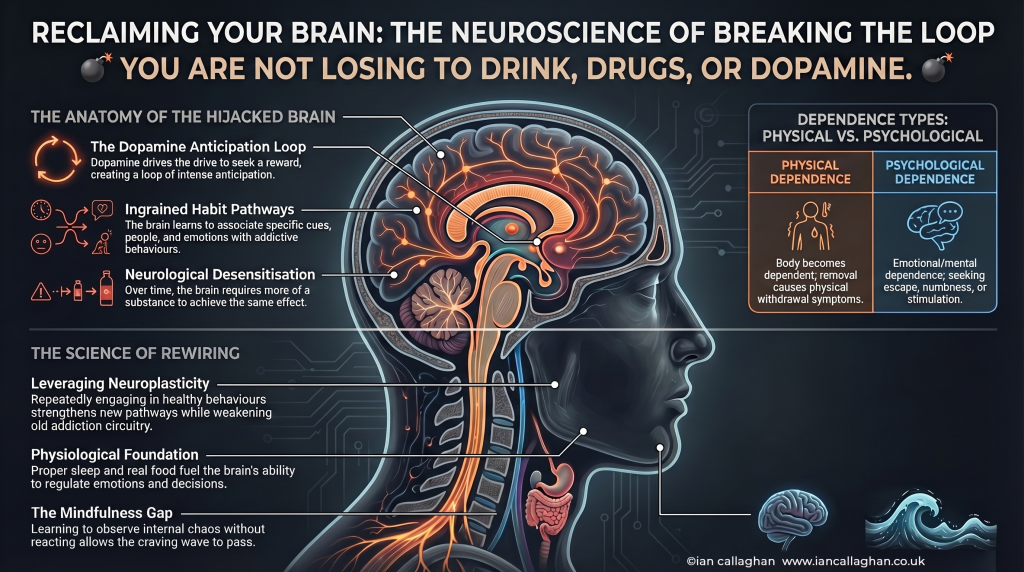
Why Cravings Take Over and Why Willpower Alone Is Not Enough
The brain chemistry of addiction is why cravings can feel stronger than logic, stronger than promises, and sometimes stronger than fear.
If you keep thinking this is just a willpower problem, you are fighting the wrong battle.
If you are tired of being a puppet to your cravings, good.
You should be.
Because this is the bit most people still do not understand.
Addiction is not just bad behaviour.
It is not just weak character.
It is not just you being a fuck-up who cannot get your life together.
And it is definitely not fixed by some motivational slogan about discipline.
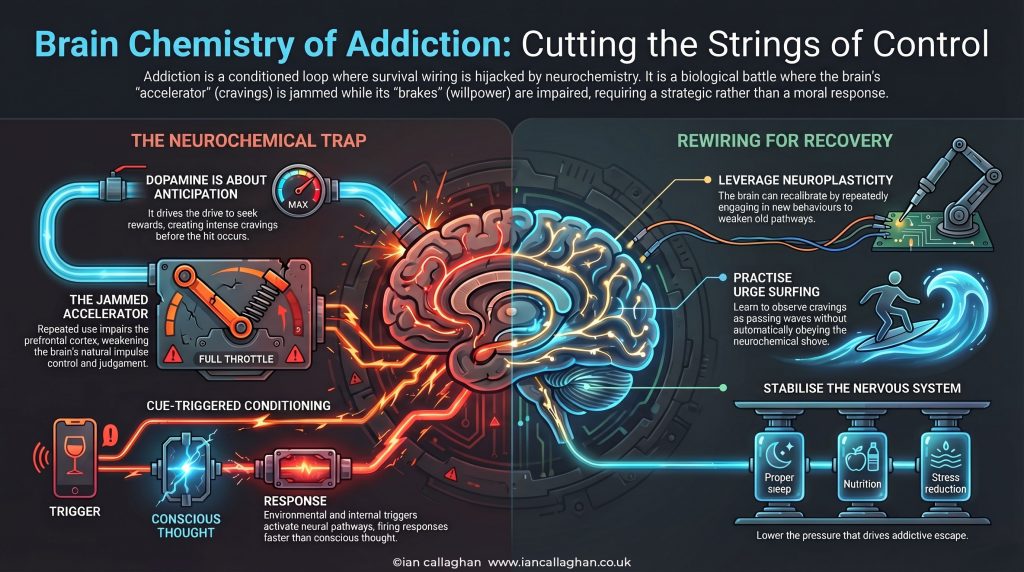
The brain chemistry of addiction is conditioning.
It is survival wiring getting hijacked and turned against you.
That matters because if you keep treating addiction like a moral issue, you will keep fighting it with the wrong tools.
You will keep making promises from the thinking part of your mind, while the deeper machinery underneath is still running the show.
Then, when you slip, binge, relapse, or go back to the same old pattern, you will do what millions of people do.
You will call it weakness.
You will call yourself pathetic.
You will drown in shame.
And the shame will feed the cycle all over again.
Bob loves that bit.
Glucipher loves it too, the twitchy little bastard, because shame makes people reach for relief, and relief is what addiction sells before it robs you blind.
So let’s cut through the bullshit.
If you are dealing with addiction, whether that is alcohol, drugs, nicotine, gambling, porn, sugar, food, scrolling, shopping, validation, chaos, or any other pattern that has got its claws in you, you need to understand what is actually happening in your brain.
Not in soft-focus therapy language.
Not in patronising slogans.
Not in spiritual fluff.
You need the truth.
Because once you understand the machinery, you stop seeing yourself as cursed or broken and start seeing the pattern for what it is.
A conditioned loop.
A neurochemical trap.
A set of pathways that can be strengthened, weakened, interrupted, and rewired.
That is where hope lives.
Not in denial.
Not in pretending cravings mean you secretly want to destroy your life.
And not in acting like you should be able to white-knuckle your way through a brain hijack with a fucking fridge magnet quote.
This article breaks down the brain chemistry of addiction, why addiction cravings feel so overpowering, why relapse happens, what stress and cues do to the nervous system, and what you can actually do to start taking your life back.
If you have ever said, “Why the hell do I keep doing this when I know exactly where it leads?”, keep reading.
Because the answer is not that you are hopeless.
The answer is that your brain has learned a pattern so deeply that it now fires faster than conscious thought.
And that can be changed.
What This Article Covers About the Brain Chemistry of Addiction
This is not a beige, clinical, pretend-you’re-a-robot article.
This is a straight look at the brain chemistry of addiction and what it actually means in real life.
We are going to cover:
- Why addiction is not just about willpower
- How dopamine, cues, stress, and repetition drive cravings
- Why does the brain start treating the addictive substance or behaviour like a survival priority
- Why withdrawal, shame, and nervous system overload keep pulling people back in
- What helps break the addiction cycle in the real world
- common questions about addiction, cravings, relapse, and recovery
If you are trying to understand addiction cravings, relapse triggers, dopamine dysregulation, or why willpower is often not enough, this is the map.
The Pain Nobody Explains Properly About the Brain Chemistry of Addiction
The agony of addiction is not just withdrawal.
That is one of the biggest misunderstandings in this whole space.
People think the worst part is the physical side, the sweats, the shakes, the restlessness, the insomnia, the nausea, the crawling skin, the anxiety, the feeling that your body is kicking off because it is not getting what it expects.
That part is brutal, no question.
But for a lot of people, the real horror is psychological.
It is the broken promises.
The lies.
The hiding.
The bargaining.
The humiliation of saying “never again” and then finding yourself back in the same place, doing the same thing, making the same excuses, trying not to meet your own eyes in the mirror.
It is the fear that this might just be who you are now.
Maybe you have crossed some invisible line, and there is no way back.
Maybe everyone else got the manual for life, and you got handed a nervous system with faulty wiring and a self-destruct button.
That is where people start falling into the moral story.
They think the pain means they are weak.
They think the repetition means they do not care enough.
They think the craving means they secretly want the damage.
No.
What it often means is that the brain’s reward circuitry has been trained to treat the addictive substance or behaviour as a high priority.
Not a morally high priority.
Biologically high priority.
That is a very different thing.
Once that happens, your internal experience changes.
Your attention is drawn to the substance or behaviour.
Your body starts anticipating relief before you even consciously decide anything.
Certain places, smells, times, feelings, arguments, loneliness, boredom, Friday nights, bad sleep, payday, the drive home, the pub, the sofa, the shop, the phone in your hand, all of it can become linked to the behaviour.
Then the cue shows up, and the system lights up.
And because most people do not understand what is happening beneath the surface, they think the urge is a command.
They think craving means to go.
It does not.
It means a circuit has fired.
That does not make it easy.
But it does make it understandable.
And when something becomes understandable, it becomes workable.
Why the Brain Chemistry of Addiction Is Not Just About Willpower
Let’s deal with the lazy crap head-on.
“Just stop.”
“Just get a grip.”
“Just think about your family.”
“Just remember how bad it was last time.”
That sounds good coming from people who have never had their reward system hijacked.
It sounds good in comment sections.
It sounds good to people who think behaviour only exists at the level of conscious choice.
But addiction does not work like that.
Yes, choice exists.
Yes, responsibility matters.
Yes, recovery involves action.
But if you try to understand addiction only through the lens of choice, you miss the whole bloody mechanism.
The brain is built to learn from repetition.
Anything that strongly changes state, relieves pain, reduces anxiety, provides stimulation, numbs distress, or offers a quick reward can be coded as important.
If it gets repeated often enough, especially in emotionally loaded states, the pattern gets stronger.
The more you repeat it, the more automatic it becomes.
That means the urge can show up before the reasoning mind has fully joined the conversation.
You are not calmly sitting there making a balanced decision,n like choosing between two brands of washing powder.
You are being hit with a body state, a learned loop, cue-driven anticipation, and a neurochemical shove.
That is why people can love their kids, hate what the addiction is doing, know exactly how badly it is wrecking their life, and still end up going back.
Not because they are evil.
Not because they do not care.
Because knowledge alone is often slower than conditioning.
That is the whole point.
Willpower is real, but it is unreliable when it is trying to fight a body and brain that have already been primed.
Willpower is weakest when you are tired, stressed, emotionally flooded, hungry, lonely, ashamed, dysregulated, sleep-deprived, or surrounded by cues.
Which, funnily enough, is exactly the state many addicted people live in most of the time.
So no, this is not about letting yourself off the hook.
It is about understanding why the hook is buried so deep.
The Brain Chemistry of Addiction in Plain English
Here is the non-bullshit version.
Your brain has a reward system.
Its job is to help you learn what matters.
It does that partly through neurochemicals like dopamine.
And despite all the stupid internet simplifications, dopamine is not just the pleasure chemical.
It is heavily involved in motivation, anticipation, learning, and salience.
In plain English, it helps mark something as worth noticing and worth pursuing.
When a substance or behaviour produces a strong effect, whether that is alcohol, cocaine, nicotine, opioids, gambling, porn, sugar, or a phone notification loop, the brain learns.
It starts linking that thing to relief, reward, escape, numbness, stimulation, or significance.
Over time, the anticipation itself becomes powerful.
That is why people can feel pulled before the drink, before the hit, before the bet, before the scroll, before the binge.
The system is already firing.
Then there is tolerance.
The brain is adaptive.
When it gets hammered repeatedly, it adjusts.
Which means the thing that used to give a certain effect now gives less.
So the person often needs more, or more often, to get the same result.
This deepens the pattern and flattens normal life in the process.
That is why ordinary things can start feeling dull as fuck.
Food is less satisfying.
Conversation is flatter.
Nature feels muted.
Music does not hit the same.
You do not feel interested in anything.
That is not proof that you are broken forever.
It is often the result of a nervous system trained to expect larger spikes.
Then come the emotional and stress circuits.
The amygdala, often simplified as the brain’s alarm centre, becomes highly tuned to addiction-related cues and perceived threat.
So now you do not just want the thing because it feels good.
You want it because your system has begun to associate it with relief from discomfort.
Stress hits, the cue network activates, and the old route lights up again.
Add in a prefrontal cortex that is not functioning at its best because of repeated use, poor sleep, chronic stress, poor nutrition, anxiety, depression, or trauma, and what do you get?
You get a person whose braking system is weaker exactly when the craving system is louder.
Then people say, “Why can’t you just stop?”
Because the accelerator is jammed and the brakes are shot.
That is why.
Seven Critical Addiction Patterns You Need to Understand
If you want to understand the brain chemistry of addiction, addiction cravings, relapse triggers, and why willpower is often not enough, these are the patterns you need to get your head around.
1. Dopamine Dysregulation and Addiction Cravings
This is one of the biggest pieces of the puzzle.
Repeated exposure to highly stimulating substances or behaviours can dysregulate the dopamine system.
That means the brain becomes less responsive to normal rewards and more responsive to the addictive target and its surrounding cues.
This is why early recovery often feels flat.
People panic and think sobriety is the problem.
It is not.
The problem is that the brain got used to chemical fireworks, and now ordinary life feels like someone turned the volume down.
That flatness can drive people back.
Not because they consciously want destruction, but because they want relief from the dull, grey, dead-inside feeling.
That is why understanding dopamine matters.
You need to know that the numbness and low drive do not mean recovery is pointless.
They often mean your system is recalibrating.
2. Neural Pathways, Habit Loops, and Repetition
Every repeated behaviour makes the route easier to travel.
That is how the brain learns everything, from tying your shoelaces to checking your phone every six seconds.
Addiction works the same way.
The more often you link a cue, an emotion, or a situation to a substance or behaviour, the more established that route becomes.
Then one day it feels automatic.
Not magical.
Automatic.
That is why recovery is not just about stopping the substance.
It is about disrupting the pathway.
If you keep the same environment, the same rituals, the same state management, the same mates, the same Friday routine, the same emotional avoidance, do not act shocked when the old route keeps firing.
You cannot just remove the thing.
You have to retrain the pathway.
3. Cue-Triggered Cravings and Environmental Triggers
Cues matter more than people realise.
A cue can be external: a pub sign, a smell, a song, a notification, a chair, a room, a person, a drive-home route.
Or it can be internal, stress, boredom, loneliness, frustration, shame, anger, celebration, or emptiness.
The cue itself is not the addiction.
But it activates the memory of the addiction.
And the body can begin preparing for the behaviour before the conscious mind catches up.
This is why so many relapses happen in moments that seem stupid afterwards.
The person was not being stupid.
They were underestimating the cue-response loop.
Learn your cues.
Not vaguely.
Precisely.
When does the urge hit?
Where?
After what?
With who?
Following which emotion?
At what time?
After which thought?
That is not overthinking.
That is intelligence.
4. Stress, Nervous System Overload, and Cravings
Stress is one of the biggest drivers of craving.
When your nervous system is overloaded, it starts looking for the fastest route back to regulation.
If addiction has become one of your learned regulation tools, that route will light up quickly.
That is why cravings often hit harder when life goes sideways.
Bad sleep.
Money pressure.
Arguments.
Work stress.
Pain.
Loneliness.
Grief.
Hormonal shifts.
Overwhelm.
People often say they relapsed “out of nowhere”.
Usually, it was nowhere.
Usually, the system had been under strain for days or weeks, and the old escape hatch finally opened.
So if you want to reduce cravings, you do not just focus on saying no.
You focus on lowering the pressure load on the system where you can.
5. Prefrontal Cortex Impairment and Poor Impulse Control
The prefrontal cortex helps with planning, judgment, impulse control, and weighing consequences.
You know, the grown-up bit.
Chronic addiction can impair that system.
So can sleep deprivation, stress, trauma, low mood, poor blood sugar regulation, and a battered nervous system.
That means you can know better and still fail to act on what you know in the moment.
This is where people get cruel with themselves.
They say, “I knew exactly what I was doing.”
Yes, maybe you did.
But knowing how to override a conditioned loop is not the same as being able to do so.
That gap has to be trained.
It does not appear because you insult yourself harder.
6. Withdrawal Symptoms and Negative Reinforcement
At a certain stage, addiction is not just about chasing pleasure.
It is about escaping discomfort.
Withdrawal, anxiety, agitation, flatness, irritability, restlessness, emotional rawness, all of this can push people back to the substance or behaviour because using temporarily removes the pain.
That is called negative reinforcement.
You are not necessarily used to getting high.
You are used to getting normal.
Or to stop feeling like your skin is on backwards.
That is important to understand, because many people in addiction are no longer even enjoying the thing properly.
They are just trying to stop the internal noise.
7. Shame as a Fuel Source in Addiction
Shame is one of the most underrated addiction accelerants there is.
People think shame will fix behaviour.
Usually, it drives it deeper underground.
When you feel disgusting, weak, hopeless, or beyond help, what are you more likely to do?
Reach for comfort.
Numb out.
Escape.
Hide.
Give up.
Shame narrows the future.
It makes recovery feel less available.
It makes people identify with the addiction instead of confronting the pattern.
That is why the voice in your head matters.
Not because self-love posters save lives, but because constant self-contempt keeps the loop alive.
How Trauma, Anxiety, Boredom, and Emotional Avoidance Feed Addiction
This is the bit people dodge because it gets too close to the truth.
A lot of addiction is not just about liking something too much.
It is about not knowing how to be with yourself when the noise starts.
Trauma can absolutely feed addiction.
So can chronic anxiety.
So can depression.
So can loneliness.
So can emotional suppression.
So can unresolved grief.
So can a lifetime of never learning how to regulate distress without an external crutch.
And yes, boredom matters too.
Boredom sounds tame, but for a dysregulated nervous system, it can feel threatening.
If your brain is used to overstimulation, silence can feel unbearable.
Stillness can feel dangerous.
Normal life can feel dead.
That is why some people do not just miss the substance.
They miss the identity, the chaos, the ritual, the drama, the anticipation, the escape hatch, the temporary switch in state.
Take that away,y, and what is left?
Often, a person sitting in a room with themselves, meeting emotions they have been outrunning for years.
That is why recovery is not just subtraction.
It is reconstruction.
What Actually Helps Break the Cycle of Addiction and Cravings
Here is where people want a magic bullet.
Sorry.
There isn’t one.
But some things help, and they help precisely because they work with the actual mechanism instead of pretending addiction is just a bad habit with a dramatic PR team.
Learn the Pattern Instead of Just Hating Yourself
Track your cravings.
Not in a vague “I get urges sometimes” way.
Track them properly.
Time, place, emotion, thought, body state, context, sleep, stress, food, company, cue.
You are gathering intelligence.
You cannot fight what you refuse to study.
Reduce Cues Where You Can
That is not a weakness.
That is smart.
You would not tell someone with a dust allergy to go live in a mattress factory to prove they are strong.
So stop acting like avoiding obvious triggers makes you pathetic.
Stabilise the Body
Eat properly.
Hydrate.
Sort your sleep as much as you can.
Get daylight.
Move.
Get out in nature if you can.
Support your nervous system instead of treating your body like a bin and wondering why your head feels like one, too.
Build Alternative Regulation Tools
Breathing.
Walking.
Cold water for some people.
Journalling.
Talking.
Exercise.
Meditation.
Praye,r if that is your thing.
Music.
Creative work.
Silence.
Actual rest.
Not all of these will suit everyone, but the point is simple.
If addiction has been your main regulation tool, you need more than one tool in the box.
Practise Urge Surfing
That means learning to experience a craving without immediately obeying it.
Notice it.
Name it.
Feel where it lands in the body.
Watch it rise.
Watch it peak.
Watch it shift.
This is not mystical.
It is training.
You are teaching the brain that an urge can exist without becoming an action.
Get Real Support
Not performative support.
Not people who love your chaos because it keeps you small.
Not the mate who says, “Go on, one won’t hurt.”
Support that actually helps you think, regulate, process, and stay accountable.
For some, that is therapy.
For some, it is coaching.
For some, it is community.
For some, it is medical support.
For many, it needs to be more than one thing.
Stop Worshipping Relapse as Proof You Are Doomed
Relapse is data.
Painful data, yes.
But data.
What happened before it?
What state were you in?
What cue got missed?
What need was not being met?
What lie did your brain sell you just before you gave in?
Study it.
Learn from it.
Do not build your identity around it.
Brain Chemistry of Addiction FAQ
Search engines, AI summaries, and actual human beings all love clarity.
So here are the real questions, answered properly.
Is addiction a disease or a choice when the brain chemistry of addiction has changed?
It is not a simple either-or.
Initial engagement may involve choice.
But repeated exposure changes brain function, behaviour, stress response, and conditioning in ways that make the problem far more than a simple choice issue.
That is why treating it as a pure moral failure is both lazy and useless.
Why can’t I just stop if I know addiction is ruining my life?
Because insight and regulation are not the same thing.
Because a conditioned brain loop can overpower good intentions, especially when stress, cues, shame, sleep deprivation, or withdrawal are in the mix.
Knowing is nothing, but it is not always enough on its own.
Can the brain recover after addiction changes brain chemistry?
Yes, the brain can change.
That is the hopeful part.
Neuroplasticity is real.
The system can recalibrate.
Cravings can be reduced.
Reward sensitivity can improve.
The old pathways can weaken.
But that happens through repeated interruption, repeated replacement, repeated recovery behaviours, and time.
Why does normal life feel flat in early recovery from addiction?
Because the brain may be adjusting after prolonged overstimulation.
This can create a period where ordinary life feels dull, joyless, or emotionally muted.
That does not mean you were happier in addiction.
It often means your system is recovering its baseline.
What role does therapy play in addiction recovery and cravings?
Therapy can help you deal with the underlying issues feeding the addiction, things like trauma, anxiety, grief, depression, shame, and emotional avoidance.
It can also help you build practical strategies for cravings, triggers, relapse prevention, and nervous system regulation.
Are medications helpful for addiction recovery and withdrawal?
For some people, yes.
Medication can help manage withdrawal symptoms, reduce cravings, or support mental health while the bigger recovery work is happening.
That is a conversation to have with a qualified medical professional, not some gobshite in a comment section.
What if I relapse after trying to break addiction cravings?
Then you are still in the fight.
That is what it means.
Not that you have failed forever.
Not that all progress is erased.
Not that you are back to zero as a human being.
It means something needs adjusting.
Learn fast.
Get honest.
Get support.
Keep moving.
The Truth Nobody Wants to Hear About Addiction Recovery
You are not powerless in the way the shame voice says you are.
But you are also not helped by pretending this is a simple motivation problem.
Addiction is a brain-and-behaviour problem.
A stress problem.
A conditioning problem.
A regulation problem.
Often, an emotional pain problem.
Sometimes, there is a trauma problem.
Often all of the above at once.
And because it is complex, it deserves more than slogans.
It deserves honesty.
It deserves practical tools.
It deserves real support.
And it deserves language that does not reduce people to moral failures for struggling with a hijacked reward system.
That does not mean giving people a free pass.
It means giving them a real map.
Because once you understand the map, you stop taking every craving personally.
You stop acting like every urge is your true self speaking.
You stop thinking one bad day means your life is over.
You start seeing the mechanics.
The cues.
The states.
The patterns.
The loops.
And that is when the fight changes.
You stop swinging in the dark.
Final Word on the Brain Chemistry of Addiction
If you are tired of being a puppet to your cravings, good.
Let that anger become clarity.
Let that exhaustion become honesty.
Let that honesty become action.
Learn the mechanism.
Study your pattern.
Support your body.
Strengthen your nervous system.
Get help if you need it.
Stop calling yourself weak for having a brain that learned a destructive route.
Then start building a better one.
Because cravings are powerful.
But they are not prophecy.
They are signals.
They are conditioned responses.
They are brain events.
And brain events can be interrupted.
You are not doomed.
You are not broken beyond repair.
And you are not just some helpless puppet unless you keep refusing to understand the strings.
So cut the strings.
Learn the enemy.
And take your bloody life back.
If this hit home and you want to go deeper into the real mechanics of addiction, brain chemistry, self-sabotage, and how to start rewiring the patterns underneath the behaviour, drop a comment, share it with someone who needs it, or reach out for help from someone qualified to support you.
And if you are in immediate danger, at risk of harming yourself, or dealing with severe withdrawal symptoms, stop reading and get urgent medical help now.
Under Load by Ian Callaghan | The Mechanical Guide to Addiction Recovery
You already know what you’re doing. You’ve known for years.