Introduction: The 6 PM Exhale
Emotional Outsourcing, It is 6:00 PM on a Tuesday. You have just walked through the door—or perhaps, given the modern hybrid landscape, you have simply closed a laptop lid on the kitchen table. The house is loud, or perhaps it is deafeningly silent. The transition from “worker” to “parent,” or “employee” to “human,” is jarring. Your shoulders are hovering somewhere around your earlobes. Your jaw is clenched tight enough to crack a walnut.
You walk to the fridge. You take out the bottle. You pour the glass.
And then, the exhale.
That first sip isn’t really about the taste of the Sauvignon Blanc or the craft IPA. It is a biological signal. It is a chemical handshake with your nervous system that says, “Okay, you can stand down now. The danger has passed. The noise can stop.”
We call this “unwinding.” We call it a “nightcap.” We joke about “Wine O’Clock” in socially acceptable memes that plaster social media feeds. But if we are going to be brutally honest with ourselves—and honesty is the only currency that matters here—we need to relabel this behaviour.
You are outsourcing your emotional regulation to a bottle.
This sounds harsh. It sounds like an accusation. But please hear this: this article is not here to shame you. We have enough shame. We have an internal voice—let’s call him BOB (we will meet him properly later)—who handles the shaming department quite effectively on his own.
This article is here to validate you. Because the reason you are outsourcing your regulation to a bottle isn’t because you are weak, or an addict, or morally failing. It is because you are being asked to endure unmanageable levels of stress, stimulation, and emotional labour without support.
That is where the system breaks. And that is the part nobody wants to look at yet.
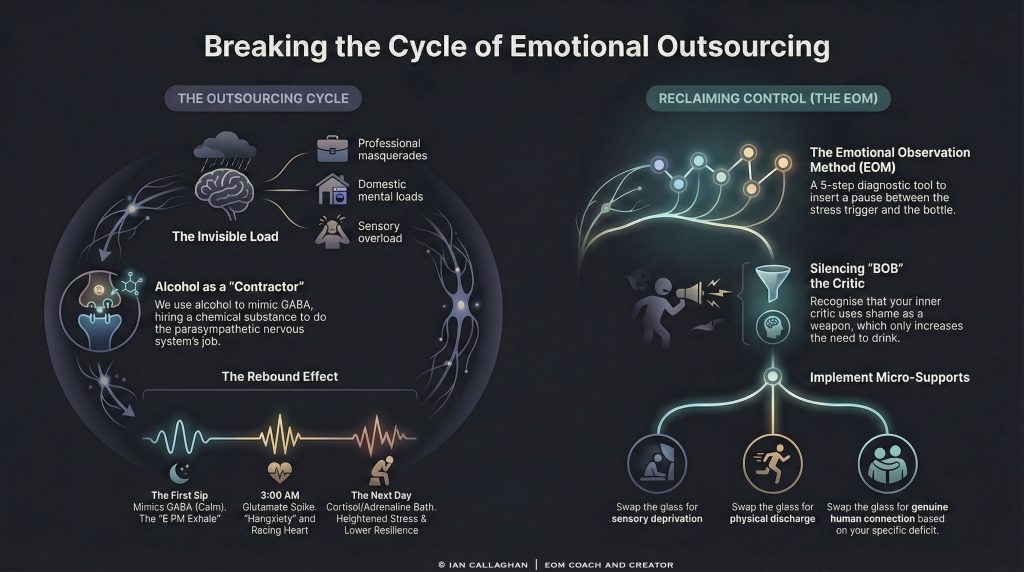
In this comprehensive guide, we are going to dismantle the mechanics of why we drink to cope, explore the devastating concept of “unsupported endurance,” and introduce a new framework—the Emotional Observation Method (EOM)—to help you reclaim the controls of your own operating system.
PART 1: The Mechanics of Outsourcing Regulation
To understand why we outsource regulation, we first must understand what regulation actually is.
Emotional Regulation is the ability of the nervous system to navigate the waves of human experience—stress, joy, anger, fear—and return to a baseline state of safety and equilibrium. When we are regulated, we can handle a difficult email from a boss without spiralling. We can deal with a toddler’s tantrum without screaming back. We remain within our “Window of Tolerance.”
However, modern life rarely keeps us in that window. Modern life is a relentless assault on the nervous system. The notifications never stop. The demands for productivity are infinite. The cost of living crisis, the geopolitical instability, the personal traumas—it is a constant bath of cortisol and adrenaline.
The Chemistry of the “Quick Fix”
When your nervous system is stuck in “Fight or Flight” (Sympathetic activation) for 10, 12, or 14 hours a day, it forgets how to downshift. You are revving the engine in neutral. You cannot simply “decide” to relax. The physiological momentum is too strong.
Enter alcohol.
Alcohol is a central nervous system depressant. It mimics GABA (gamma-aminobutyric acid), the neurotransmitter responsible for calming neuronal activity. When you drink, you are essentially flooding your brain with synthetic “calm down” juice. It forces the brakes on your revving engine.
This is why it feels so effective. It works fast. It is reliable. It is accessible.
When you pour that glass, you are saying to your body: “I do not have the internal resources, the time, or the support to regulate this stress naturally. So, I am hiring a contractor to do it for me.”
You are outsourcing the job of the parasympathetic nervous system to a substance.
The Problem with Outsourcing
If you outsourced your job to someone who did it quickly but damaged the office every time they visited, you would eventually fire them. Alcohol is that destructive contractor.
While it provides immediate relief (regulation), it creates a rebound effect. As the alcohol wears off, the brain realises it has too much GABA and not enough glutamate (the excitatory neurotransmitter). To compensate, it spikes your anxiety levels the next day. This is the “hangxiety” or the 3:00 AM wake-up call where your heart is racing and BOB is screaming at you about everything you did wrong in 1999.
This creates a cycle:
- Endure high stress without support.
- Outsource regulation to the bottle to survive the evening.
- Experience heightened anxiety and lower resilience the next day due to the chemical rebound.
- Endure even harder to compensate for the fatigue.
- Repeat.
But to break this cycle, we cannot just “stop drinking.” That is a surface-level fix. We have to look at why the regulation is needed in such desperate quantities in the first place.
PART 2: What Are You Enduring? (The Invisible Load)
The most critical sentence in our premise is this: “…start noticing what you’re being asked to endure without support.”
Society loves to talk about “burnout,” but it treats burnout as an individual failure of time management or self-care. It suggests that if you just journaled more, did more yoga, or drank more green juice, you wouldn’t be burnt out.
This is a lie.
You are likely drinking because you are enduring the unendurable. You are carrying loads that human beings were not evolved to carry, in isolation that human beings were not evolved to experience.
The Museum of Endurance
Let us walk through the gallery of modern endurance. Look closely, and see if you recognise yourself in these exhibits.
1. The Professional Masquerade
You are expected to perform at peak cognitive capacity for 8 to 10 hours a day. But it is not just the work; it is the performance of work. It is the emotional labour of navigating office politics, the “always-on” Slack culture, and the unspoken expectation that you must be grateful for your exploitation. You are enduring the suppression of your true self to fit a corporate mould.
2. The Domestic CEO
If you are managing a household, you are the Chief Logistics Officer, the Chief Financial Officer, the Head of Conflict Resolution, and the Sanitation Department. The “mental load”—remembering birthdays, scheduling dentist appointments, noticing we are out of milk—is a ticker tape that never stops running in your mind. You are enduring a level of cognitive multitasking that would crash a computer.
3. The Sensory Overload
We live in an attention economy. Your phone is designed to hijack your dopamine receptors. The news cycle is a 24-hour stream of catastrophe. You are enduring a level of sensory input that keeps your amygdala (the threat detection centre) permanently activated.
4. The Isolation Tank
This is the “without support” part. We live in nuclear families or single-person households, separated from the “village” structures we evolved in. When you are struggling, who holds you? Who regulates the regulator? Often, the answer is “nobody.” You are the rock for everyone else.
When you combine these factors, the glass of wine is not a beverage. It is an anaesthetic. It is the only way to numb the pain of endurance so you can get up and do it again tomorrow.
PART 3: Meet BOB (The Inner Critic)
We cannot talk about this cycle without introducing the loudest voice in the room: BOB.
BOB is your Inner Critic. He is that nagging, sneering, relentless voice in your head. He has a lot to say about your outsourcing habits.
When you reach for the bottle, BOB says:
- “Look at you. Can’t even handle a Tuesday without a drink.”
- “You’re turning into your father/mother.”
- “You’re weak. Everyone else is coping fine. Why can’t you?”
BOB loves to use shame as a weapon. He believes that if he beats you up enough, you will shape up. He thinks shame is a motivator.
But here is the truth about BOB: He is actually trying to protect you.
It sounds counterintuitive, but BOB is a primitive part of your psyche. He is terrified of social rejection. In our tribal past, being “weak” or “lazy” or “addicted” meant you might be cast out of the tribe, which meant death. So, BOB screams at you to try to force you into compliance with societal standards.
The problem is, BOB is outdated. He is running on legacy software. He doesn’t understand that the “threat” isn’t a sabre-toothed tiger; the threat is late-stage capitalism and a lack of community care.
When BOB shames you for drinking, he actually increases your stress levels. Increased stress requires more regulation. Since you don’t have natural support, you reach for the bottle again.
BOB is fueling the very fire he is screaming at you to put out.
We need to stop fighting BOB and start understanding him. We need to say, “Thank you for your concern, BOB, but I am handling this differently now. I am going to use the EOM.”
PART 4: The Void of Support – Where It Actually Breaks
“That’s where this actually breaks. And that’s the part nobody wants to look at yet.”
Why does nobody want to look at it? Because looking at it requires admitting that our current way of living is structurally unsound.
If we admit that we are drinking not because we love the taste of Pinot Grigio, but because we are lonely, overworked, and terrified, we have to demand change. We have to demand better childcare. We have to demand reasonable working hours. We have to demand men take on equal emotional labour. We have to demand communities that care for each other.
That is a revolution. Drinking is sedition.
When you outsource regulation to a bottle, you are engaging in a private act of survival that prevents a public act of change. As long as we can numb ourselves enough to get through the week, the system doesn’t have to change.
But the personal cost is too high. You are paying for this “stability” with your health, your connection to yourself, and your authentic joy.
The “Strong One” Syndrome
Many of us who rely on this mechanism identify as “The Strong One.” We are the ones people come to for advice. We are the ones who don’t crack.
Enduring without support is a badge of honour for The Strong One. But inside, The Strong One is crumbling. The bottle is the only place where The Strong One allows themselves to be “soft,” even if that softness is chemically induced.
Recognising this is painful. It requires grieving. It requires grieving the fact that you have been neglected—perhaps by society, perhaps by a partner, perhaps by your family of origin.
You have been asked to carry a mountain. It is not your fault that your legs are shaking. It is not your fault that you grabbed a crutch.
But now that we see the crutch for what it is, we can start to build real muscle.
PART 5: The Solution – The Emotional Observation Method (EOM)
If we are to stop outsourcing regulation to a bottle, we must bring the regulation in-house. We must install a new protocol.
We are not talking about “positive thinking” or “willpower.” Those are finite resources. We are talking about the Emotional Observation Method (EOM).
Clarification: The EOM is not your emotional operating system. Your operating system is the complex web of trauma responses, beliefs, and neural pathways you currently run on. The EOM is the tool or the technique we use to work on that operating system. Think of it as the diagnostic software and the repair kit combined.
The goal of EOM is to insert a pause between the Trigger (Stress/Endurance) and the Response (The Bottle).
Step 1: The Pause (Interrupting the Pattern)
The moment you feel the urge to drink—that 6:00 PM itch—is data. It is not a command; it is information.
Instead of autopiloting to the fridge, you must physically stop. Sit down for 60 seconds.
Step 2: Locate the Sensation
Get out of your head (where BOB lives) and into your body. What does the urge feel like somatically?
- Is it a tightness in the chest?
- A buzzing in the hands?
- A hollow pit in the stomach?
- A frantic energy behind the eyes?
Name the sensation. “I am noticing a tightness in my throat.”
Step 3: Identify the Deficit (The “Without Support” Check)
Ask yourself: “What am I actually trying to regulate right now?”
Do not accept “I just want a drink” as an answer. Dig deeper.
- “I am trying to regulate the anger I feel about that meeting.”
- “I am trying to regulate the loneliness I feel in this empty house.”
- “I am trying to regulate the exhaustion of pretending to be okay.”
This is the hardest part. This is where you acknowledge what you have been enduring without support.
Step 4: Validate the Need
Speak to yourself (or to BOB) with radical compassion.
“It makes total sense that I want a drink right now. I have been holding it together for 10 hours. I am exhausted and I feel unsupported. My body is screaming for relief.”
This validation drops the shame. When shame drops, the cortisol spikes lower, and the urgency often decreases.
Step 5: The Micro-Support Choice
If the root cause is “enduring without support,” the solution is to provide support. Since we cannot instantly summon a village or change society, we must provide Micro-Support to ourselves.
If you are:
- Overstimulated: You need sensory deprivation. Go into a dark room, put on noise-cancelling headphones, and lie on the floor for 10 minutes. (This regulates the nervous system better than wine).
- Angry/Frustrated: You need a sympathetic release. Scream into a pillow. Punch a mattress. Shake your body vigorously to discharge the adrenaline.
- Lonely: You need connection. Call a friend (and tell them the truth, not the highlight reel). Hug a pet. Or simply place your hand on your heart and breathe.
- Exhausted: You need rest. Not “numbing out” in front of Netflix, but actual rest. A hot bath. Yin yoga. Sleep.
The EOM doesn’t say you can’t have the drink. It just asks you to perform this diagnostic first. Often, once you have identified the emotion and offered a micro-support, the desperate need for the bottle dissipates. You might still have a glass, but you are drinking it to enjoy it, not to survive yourself.
PART 6: Building Infrastructure for the Future
The EOM helps in the moment. But to truly stop the cycle of endurance, we need structural change in your life.
1. Resigning as General Manager of the Universe
You must look at what you are enduring and start saying “No.”
If you are doing the work of three people, you must stop. This is terrifying. BOB will scream, “If I don’t do it, it won’t get done!”
Let it not get done. Let the laundry pile up. Let the email wait.
If the only way the system works is by you breaking yourself to fuel it, the system deserves to break. You are not a load-bearing wall for everyone else’s comfort.
2. Recruiting Support
You need to stop “outsourcing to a bottle” and start “outsourcing to humans.”
This means being vulnerable. It means telling your partner, “I am drowning, and if I don’t get help, I am going to break.”
It means looking for a therapist, a men’s group, a women’s circle, or a community organisation.
It means realising that independence is a trauma response, and interdependence is the goal.
3. Rewiring the Reward System
Your brain has associated alcohol with the “End of Shift.” You need new rituals to signal safety to your body.
- Change your clothes immediately upon finishing work.
- Take a shower (water is a great state-changer).
- Go for a walk around the block to physically separate “work” from “home.”
- Brew a complex herbal tea (the ritual of preparation matters).
PART 7: A Note on “The Part Nobody Wants to Look At”
We must circle back to the profound truth of the prompt: “That’s the part nobody wants to look at yet.”
When you stop numbing yourself, you start feeling. And initially, that feeling might be rage.
You might look at your marriage and realise it is empty.
You might look at your job and realise it is exploitative.
You might look at your past and realise you were neglected.
Alcohol was the fog that kept these sharp edges hidden. When the fog lifts, the edges cut. This is why sobriety (or mindful drinking) is so incredibly difficult. It is not just about the substance; it is about facing the reality of your life without a filter.
But this is also where the magic happens.
Because you cannot change what you cannot see.
As long as you are outsourcing regulation, you are maintaining the status quo.
When you stop, and you feel the rage, the grief, and the exhaustion, you finally generate the energy required to change your life.
You stop enduring. You start living.
Conclusion: From Endurance to Experience
You do not need another glass of wine. You need a hug. You need a break. You need to be heard. You need to know that you are not a machine designed for endless output.
The bottle is a liar. It promises connection but delivers isolation. It promises relaxation but delivers anxiety. It promises to help you carry the load, but it only makes the load heavier tomorrow.
By using the Emotional Observation Method, and by courageously facing BOB, you can begin to dismantle the architecture of endurance that has trapped you.
It is time to stop outsourcing your regulation. It is time to bring the operations back in-house. It will be messy. It will be loud. You will feel things you haven’t felt in years.
But you will be free. And you will be supported—first by yourself, and then, slowly, by the authentic connections you build when you stop hiding behind the glass.
You are worth more than what you can endure. Start there.
GET THE EMOTIONAL MASTERY BOOK THE FRAMEWORK I USED TO END A 45 YEAR DRINKING CAREER.
Emotional Mastery: The Emotional Operating System
The Emotional Mastery book is a practical manual for understanding and regulating the human nervous system using the Emotional Operating System framework.
Instead of analysing emotions or retelling your past, the Emotional Mastery book teaches you how to read emotional states as system feedback, identify overload, and restore stability under pressure.
No labels. No therapy-speak. No endless healing loops.
Just a clear, operational approach to emotional regulation that actually holds when life applies load.
Instant digital download.