Stop Blaming Your Soul for a Hardware Glitch: The Metabolic Sobriety Audit
You are not broken, you are simply running on corrupted software and fueling the engine with sludge. Frankly, it is time we stopped listening to the high-priced PR firm in your head that tells you this is an emotional crisis when it is actually a metabolic emergency.
I have spent forty-five years navigating the chaos of addiction, the rigour of the British Army, and the brutal logic of IT Technical Architecture. If there is one thing I have realised, it is that we have completely overcomplicated the business of getting sober and getting sane. We treat anxiety, depression, and the constant itch for a drink or a distraction as if they are deep, mystical messages from the universe or scars from our childhood that require endless excavation. That is absolute bollocks.
Most of the time, what you are feeling is not a spiritual crisis. It is a hardware glitch. It is noise. And the reason you cannot fix it is that you are trying to talk your way out of a chemical reaction. You cannot negotiate with a flooded engine, and you cannot reason with a brain that is inflamed, sleep-deprived, and spiking on glucose.
The Pattern Hiding in Plain Sight
I look at the data coming out of biohacking communities on Reddit, and I cross-reference it with the desperate posts I see in Facebook support groups, and the pattern is staring us right in the face. On one side, you have people terrified that they are fundamentally flawed because they cannot stop drinking or doom-scrolling. On the other side, you have the data showing that metabolic dysregulation looks exactly like mental illness.
This is the Metabolic Sobriety Audit. We are going to strip down the system, ignore the story your emotions are trying to sell you, and look at the state of the machine. Because if the hardware is buggered, the software has no chance.
Bob
Let us talk about Bob. Bob is that voice in your head. The inner critic. The chimp. In the therapy world, they want you to make friends with Bob, or understand Bob, or hold space for Bob. I say that is a waste of time.
Bob is a glitchy subroutine. Bob is the noise generated when your system is under stress. When your blood sugar crashes at 4 pm and you suddenly feel like the world is ending and a glass of wine is the only answer, that is not your soul speaking. That is Bob reacting to a fuel shortage.
The PR Firm
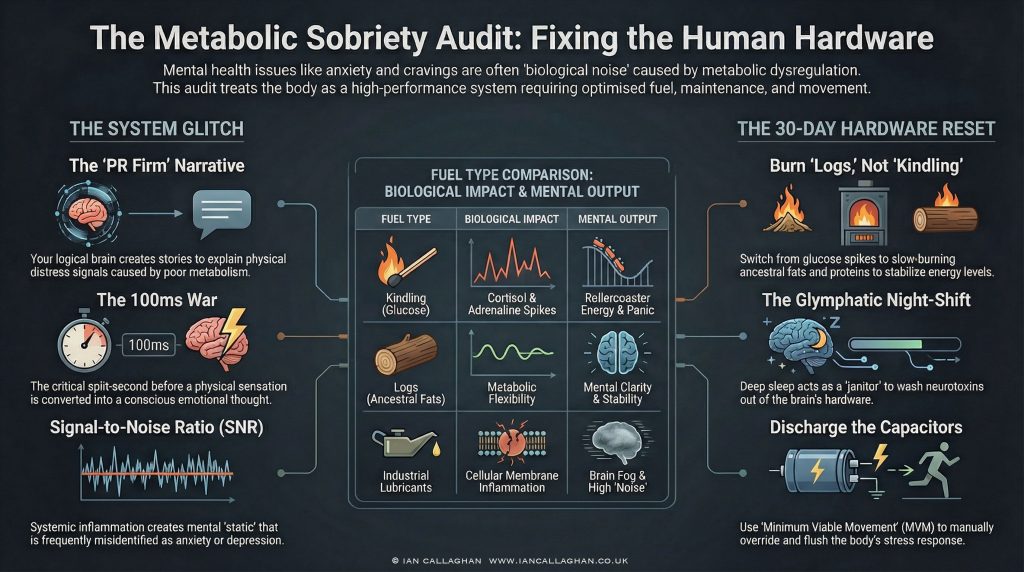
This is a concept I developed to explain why we get so tucked up in our own heads. Your logical brain acts as a high-priced PR firm for your dysregulated nervous system. When your body is inflamed from seed oils, dehydrated from alcohol, and exhausted from lack of sleep, it sends a distress signal, a panic alarm.
Instead of interpreting that signal as “I need water, fats, and sleep”, the PR Firm spins a narrative. It looks at your life and says, “You are anxious because your job is stressful, and your partner is annoying, and you are not good enough.” It attaches a story to the physical sensation.
This happens in the 100ms War, the fraction of a second before a sensory input becomes a conscious thought. If you lose that war, you believe the PR Firm. You believe the story. You think you need a drink to handle the stress, when in reality, you just need to fix the hardware.
Cold Override
We need to execute a Cold Override. We need to stop faffing about with the narrative and fix the state.
Pillar One: Eat
The first step in this audit is looking at what you are putting into the tank. Pillar One is Eat, the fuel.
Most of the people I talk to, especially the women who have been sold a lifetime of diet culture shite, are running on metabolic kindling. They are burning sugar and carbs. It burns hot, it burns fast, and it crashes hard.
When you run on glucose, your energy levels are a roller coaster. Up and down. Every time you crash, your body releases cortisol and adrenaline to liberate stored energy. That means you are physically experiencing a stress response just because you ate a bagel.
Bob loves this. Bob feeds on cortisol. When that stress hormone hits, Bob wakes up and starts screaming that everything is wrong.
We need to switch you to burning logs, slow-burning, ancestral fats. We need metabolic flexibility. This means cutting out the seed oils, the rapeseed, the sunflower, the industrial lubricants that clog up your cellular membranes and cause system-wide inflammation.
Inflammation in the body translates to depression in the brain. It is a technical fact. If your brain is inflamed, the signal-to-noise ratio, the SNR, goes to hell. You get more static. More anxiety. More Bob.
You do not need a detox tea. You need a steak. You need eggs. You need butter. You need to stabilise your blood sugar so that the PR Firm stops getting emergency calls from the engine room. When you stop the glucose spikes, the mental fog clears. It is not magic, it is mechanics.
Pillar Two: Sleep
Next, we look at Pillar Two, Sleep. And I do not mean just closing your eyes for eight hours while the television is on. I am talking about the recovery partition, the endocrine factory.
In the IT world, if a server does not get its scheduled maintenance and downtime, it crashes. Your brain is no different.
There is a system called the glymphatic system. It is the night-shift janitor for your brain. It only activates when you are in deep sleep. Its job is to flush out metabolic waste, neurotoxins, and amyloid plaques that build up during the day.
Alcohol knocks the janitor out cold. You might pass out, but you are not sleeping. You are sedated. The janitor does not show up. You wake up the next morning with a brain full of toxic waste. You feel groggy, anxious, and irritable. Bob is already awake and screaming before you have even opened your eyes.
This is why the 3 am wake-up happens. It is a cortisol spike. Your liver is struggling to process the toxins, your blood sugar drops, and your body jolts you awake in a panic. You lie there staring at the ceiling, and the PR Firm starts listing all your failures. “You are getting old. You are alone. You messed up that email.”
It is all lies. It is biological noise.
To fix this, we need to treat sleep like a mission-critical operation. Cool room. Dark room. No screens for an hour before bed, the blue light tells your brain it is noon. And for the love of god, stop drinking the poison that prevents the maintenance cycle from running. If you want to optimise your mental state, you have to let the janitors do their job.
Pillar Three: Move
Pillar Three is Move. Resilience.
I am not talking about spending an hour on a treadmill punishing yourself for eating a biscuit. That is the old way. That is the guilt cycle. I am talking about Minimum Viable Movement, or MVM.
We are designed to move. When we are stressed, our bodies prepare for fight-or-flight. We dump energy into the bloodstream. But in the modern world, we do not fight, and we do not flee. We sit. We sit in traffic, we sit in meetings, we sit on the sofa. That energy has nowhere to go. It turns into tension. It turns into anxiety.
You have to flush the system. You have to discharge the capacitors. A twenty-minute walk, a few heavy lifts, a sprint, anything that tells your body, “We have survived the threat.” Movement is not about looking good in a mirror, it is about regulating your nervous system. It is about manually overriding the stress response.
When you feel the walls closing in, do not sit there and analyse it. Move. Change the physical state. The mind will follow.
Pillar Four: Mind
Finally, we have Pillar Four, Mind. The strategy. This is where the Emotional Observation Method, or EOM, comes into play.
We spend our lives trapped in the “I am.” I am sad. I am angry. I am an alcoholic. I am a failure. This is a syntax error. You are not the feeling, you are the vessel experiencing the feeling.
We need to shift from “I am” to “I see.” This is the gate. Observation is the steering wheel. When a craving hits, or a wave of rage, or a pit of despair, you do not let it attach to your identity. You observe it. “I see that Bob is active right now.” “I see that my chest feels tight.” “I see that there is a craving for wine.”
By naming it, by naming Bob, you create a gap. That gap is where your sovereignty lives. It is the difference between a knee-jerk reaction and a tactical response.
Signal-to-Noise Ratio
You have to understand the Signal-to-Noise Ratio. Most of what you think is a signal, a deep truth about your life, is just noise. It is interference caused by poor food, poor sleep, and a lack of movement.
When the noise gets too loud, when the PR Firm is shouting that the sky is falling, you use the Cold Override. Literally. Cold water. Splash your face, take a cold shower, jump in the sea if you are near it. The mammalian dive reflex is a hard reset for your nervous system. It forces the heart rate down. It shuts Bob up instantly. It snaps you out of the loop. It is not comfortable, but neither is being a slave to your own biochemistry.
We are looking for a thirty-day reset here. Not a life sentence. Just thirty days to clean the hardware.
The first few days are going to be shite. I will not lie to you. Your body is expecting the easy hits of dopamine and sugar. Bob will throw a tantrum. He will tell you that you deserve a treat, that one drink will not hurt, that this is all a bit extreme.
Ignore him. He is a liar. He is a corrupted file.
Focus on the inputs. Eat fats and protein. Sleep in the dark. Move your body every single day. And watch Bob like a hawk.
Identity Update
The goal is the Identity Update, the “Save” button.
Nature abhors a vacuum. When you stop drinking or stop the bad habits, you leave a hole. If you do not fill that hole with a new operating system, the old one will reinstall itself. You cannot just remove the bad, you have to install the good.
You are installing the identity of someone who respects their own machinery. Someone who does not pour sludge into a Ferrari engine. Someone who understands that clarity is not a gift, but a result of optimised architecture.
This appeals to the women I work with just as much as the men, perhaps even more so, because women have been gaslit by the medical and wellness industries for decades. They are told their symptoms are hormonal, or emotional, or just “part of being a woman.” They are prescribed pills to numb the noise instead of being given the tools to fix the signal.
When a woman realises that her anxiety is actually a blood sugar crash, it is liberation. When she realises that her “wine o’clock” is just a way to sedate a dysregulated nervous system, the shame evaporates. It becomes a technical problem with a technical solution.
It is about agency. It is about taking back control from the automatic processes that have been running your life.
We are not here to endlessly talk about your feelings. We are here to change the physiological environment in which those feelings occur. If you fix the physiology, the psychology often fixes itself.
Back in Command
I want you to try this for just 30 days. Treat your body like a high-performance system that an incompetent admin has neglected.
Audit the inputs. Clear the cache. Update the software.
If you are feeling overwhelmed, stop thinking and start doing. Eat a steak. Go for a walk. Go to bed early. And when Bob starts whispering that it is all so hard, tell him to sod off.
This is the 100ms War. We fight it every single day. And you win it by realising that you are the architect, not the building. You can change the structure.
Stop letting the PR Firm run the show. Fire them. You are back in command.
Stop feeling like a deflated balloon stuffed with sawdust. If you are ready to fix gut health over 40 and finally end the cycle of brain fog and “gut rot,” you need a tactical reboot. My name is Ian Callaghan—Chef, Nutritionist, and former Soldier. I’ve lived the contradiction of professional kitchens and military trenches, and I know exactly why you’re wired, tired, and fed up.
Metabolism After 40 Isn’t Broken. Your Operating System Is Corrupt.
Your metabolism after 40 isn’t broken; your operating system is corrupt. You’re running legacy code on hardware designed for action, then whining when the server crashes. Stop listening to the PR firm in your head. Fix the state, ignore the story.
You have been sold a lie that is keeping you fat, tired, and docile. The medical establishment and the fitness influencers want you to believe that hitting forty is some sort of biological cliff edge where your body naturally decides to pack it in. They tell you that the tyre around your waist and the fog in your brain are just part of the natural ageing process, a slow slide into irrelevance that you should accept with dignity. That is absolute bollocks. I am telling you this as a man who spent forty-five years abusing his system with enough chemicals to kill a horse and enough stress to blow a transformer. I am telling you this as a former IT Technical Architect who understands complex systems. Your body is not failing because of the calendar. Your body is failing because you have accumulated decades of technical debt, and you are refusing to run the necessary updates.
The Malware: Why Metabolism After 40 Feels Broken
When I look at a man over forty who is struggling, I do not see a victim of time. I see a system compromised by malware. I see a bloke who has allowed a rogue process to run in the background, leeching resources and overheating the CPU. We call that rogue process Bob. Bob is that chimp in your brain, the inner critic, the absolute knob who tells you that you deserve a pint after a hard day or that you are too tired to train. Bob loves the myth of the slow metabolism. It is his favourite weapon. If Bob can convince you that your physiology is broken beyond repair, then he has carte blanche to keep you stuck on the sofa, inhaling processed shite and avoiding the hard work required to reclaim your sovereignty. Bob is the PR firm justifying your dysregulation. He drafts the press release that says, due to market conditions and the year on your birth certificate, we are unfortunately unable to process energy efficiently today.
The Hardware: Insulin Resistance and Metabolic Flexibility After 40
Let us look at the hardware. The human body is an adaptation machine. It is designed to survive famine, hunt across savannahs, and fight for territory. It is not designed to sit in a Herman Miller chair for ten hours a day, bathed in blue light, processing cortisol while digesting seed oils and refined sugar. When you talk about your metabolism after 40, you are actually talking about your metabolic flexibility. This is your system’s ability to switch between burning glucose and burning fat. Most of you have lost this ability. You are stuck in sugar-burning mode, riding the glucose rollercoaster, crashing every two hours and needing a biscuit to reboot. That is not age. That is insulin resistance. That is a hardware glitch caused by incorrect fuel inputs over a sustained period.
Systems Thinking: Army and IT Logic Applied to Fat Loss
I spent years in the army and years in IT, and the parallels are striking. In the army, if your weapon jams, you do not blame the manufacturer; you clear the stoppage. In IT, if a server starts lagging, you do not just shrug and say it is an old server; you check the logs, you look for memory leaks, and you optimise the code. Your metabolism is no different. It is a system of inputs and outputs. If you pour sand into the fuel tank of a Ferrari, it does not matter how expensive the car is; it will not run. You have been pouring sand into your engine for decades through inflammatory foods, liquid stress, and sedentary behaviour. And now you are surprised the engine is seizing up.
The 100ms War: Where Sovereignty Is Won or Lost
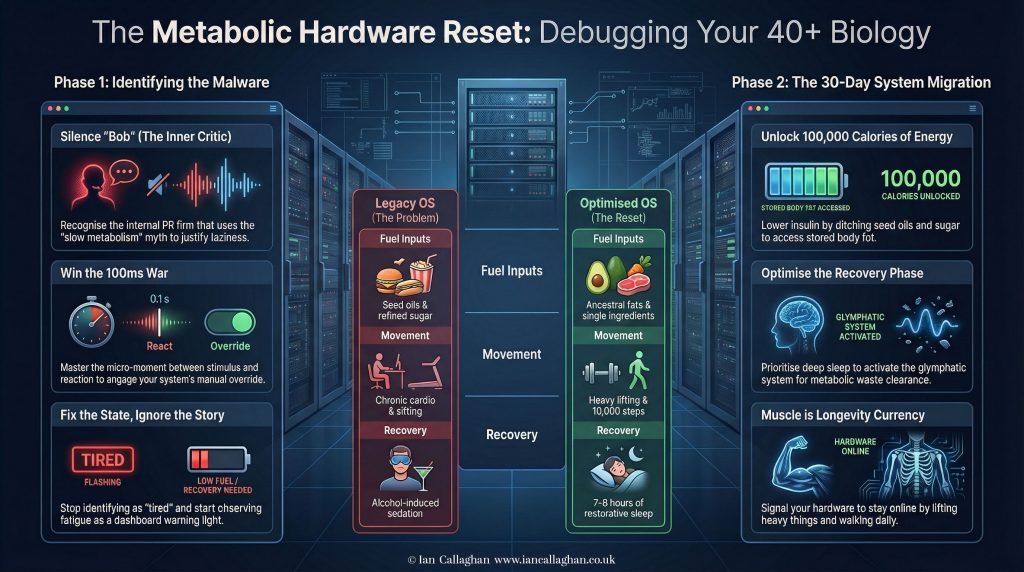
The first step to fixing this is to understand the 100ms War. This is the fraction of a second where sovereignty is won or lost. It is that micro-moment between the stimulus—seeing the pint, feeling the fatigue, smelling the takeaway—and the reaction. In those hundred milliseconds, Bob is screaming at you to take the easy path. He is telling you that your metabolism is shot anyway, so what difference does one more pie make? If you lose that war, you reinforce the neural pathway that says you are a victim of your biology. If you win that war, if you engage the manual override and observe the craving without attaching to it, you begin to rewrite the code.
Emotional Observation Method and Identity Control
This is the core of the Emotional Observation Method. You must transition from saying “I am tired” or “I am hungry” to saying “I see fatigue” or “I see a craving”. It sounds like semantics, but it is tactical. When you say “I am”, you are embedding that state into your identity. You are telling your operating system that this glitch is a core feature. When you say “I see”, you are creating distance. You are the operator looking at a dashboard warning light. You are not the car. You are the driver. You can choose to pull over and check the oil, or you can choose to drive into the ditch. Bob wants you in the ditch because the ditch is comfortable and requires zero effort.
The Three Pillars to Fix Your Metabolism After 40
Let us talk about the specific pillars of the reset, because theory without execution is just hallucination. You want to fix your metabolism after 40? You need to look at the three pillars: Eat, Sleep, and Move. And you need to apply the Mind strategy to all of them.
Eat: Fix the Fuel
First, let’s look at the fuel. The modern diet is a weapon of mass destruction against your metabolic health. You have been told to eat little and often, to base your meals on carbohydrates, and to avoid saturated fat. That advice is precisely why you are fat and tired. Every time you eat carbohydrates, you spike insulin. Insulin is a storage hormone. When insulin is high, you cannot burn fat. It is biologically impossible. If you are grazing all day, your insulin never drops, and your body never gets access to its own battery reserves. You are carrying around a hundred thousand calories of energy on your waistline, but you cannot access it because the door is locked by insulin. You are starving in the midst of plenty.
You need to switch to ancestral fats. You need to ditch the seed oils—the rapeseed, the sunflower, the vegetable oil. These are industrial lubricants, not food. They cause systemic inflammation, which is essentially your body being on fire at a cellular level. When your cells are inflamed, the signalling pathways break down. Your hormones scream, but the cells cannot hear them. This is why you feel hungry even when you have just eaten. Your satiety signals are being jammed by the noise of inflammation. Optimised nutrition means getting back to basics. Meat, eggs, butter, fish. Single-ingredient foods. If it comes in a packet with a list of ingredients that looks like a chemistry experiment, it is not food; it is a product designed to maximise shareholder value at the expense of your health.
Sleep: Endocrine Recovery
Then there is the recovery phase. Sleep. I used to think sleep was for the weak. In the army, we bragged about how little we slept. In the IT world, the 3 AM coding session was a badge of honour. What a load of old cobblers. Sleep is where the magic happens. It is where the endocrine factory reopens for business. It is where you produce testosterone and growth hormone. If you are sleeping five hours a night and wondering why you cannot build muscle or lose fat, you are an idiot. You are trying to build a house while the workmen are on strike.
There is a system in your brain called the glymphatic system. It is the waste clearance team. It only activates when you are in deep sleep. Its job is to wash away the metabolic waste products that accumulate during the day, including the proteins associated with Alzheimer’s. If you do not sleep, the bin men do not come. The rubbish piles up. Your brain becomes foggy, your decision-making slows down, and Bob gets louder. A tired brain is a weak brain. A weak brain cannot fight the 100ms War. And do not get me started on alcohol. You think a few pints help you sleep? Wrong. Alcohol knocks you out; it does not help you sleep. It is sedation, not restoration. It fragments your sleep architecture, suppresses REM, and destroys your recovery. If you are serious about fixing your metabolism, the booze has to go. It is liquid estrogen. It kills your testosterone and raises your cortisol. It is the enemy of high performance.
Move: Muscle Is Metabolic Currency
Now, movement. Minimum Viable Movement. You do not need to join a CrossFit box and injure yourself trying to keep up with twenty-year-olds. You do not need to run marathons. In fact, chronic cardio is often counterproductive after forty because it raises cortisol, which breaks down muscle and stores fat. You need muscle. Muscle is the organ of longevity. It is your metabolic currency. The more muscle you have, the more glucose you can dispose of, and the higher your resting metabolic rate. You need to lift heavy things. You need to signal to your body that it is still required to be strong.
If you sit on your arse all day, your body receives a clear signal: “We are shutting down. Conserve energy. Atrophy the muscle.” You have to manually override that signal. You have to tell the system, “No, we are still hunting. We are still fighting. We need this tissue.” This does not mean spending three hours in the gym. It means intensity. It means compound movements. Squats, deadlifts, presses. Functional strength. And it means walking. Walking is the most underrated metabolic hack in existence. It lowers cortisol, clears glucose, and aligns your circadian rhythm. If you are not hitting ten thousand steps, you are stagnant.
The Mind Strategy: Why Most Men Fail
But all of these mechanics—the diet, the sleep, the training—are useless without the Mind strategy. This is where most men get tucked up. They buy the fancy trainers, they stock the fridge with steak, they download the meditation app, and then three weeks later, they are back in the pub eating crisps. Why? Because they did not fix the state; they just tried to change the story. They relied on motivation, and motivation is a fickle mistress. Motivation is a feeling, and feelings are noise. You cannot build a fortress on the foundation of how you feel. You have to build it on the foundation of what you observe.
Bob will try to sabotage you. That is his job. He is the legacy security protocol designed to keep you safe, small, and comfortable. When you try to change your metabolism, Bob perceives it as a threat. “Why are we lifting this heavy iron? It hurts. Why are we not eating the donut? It is high-calorie density which is good for survival.” Bob is running an outdated script from the Stone Age. You have to update the firmware. You have to look Bob in the eye and say, “I see you, mate. I hear the noise. But we are doing this anyway.”
Cold Override: State Reset Under Pressure
This is the Cold Override. Sometimes, quite literally. Cold water exposure is one of the fastest ways to reset the system. When you step into a freezing shower, your brain cannot worry about your mortgage or your metabolism or your emails. It creates a hard reset. It forces you into the present moment. It spikes dopamine and norepinephrine, which boosts your metabolism and improves your mood for hours. It trains you to sit in discomfort and not panic. That is a transferable skill. If you can handle three minutes in ice water, you can handle the urge to eat a biscuit.
The problem with the “metabolism after 40” keyword is that it suggests you are a passenger. It suggests that this is something happening to you, rather than a result of what you are doing. It is a victim mindset. It is the “poor me” narrative that keeps therapists in business and pharmaceutical companies rich. “Oh, it’s just my age, doctor. Give me a pill.” That is the coward’s way out. Realising that you have the power to change it is terrifying because it means you also have the responsibility. If it is not your age, then it is your fault. And that stings. But that sting is good. That sting is the signal. That is the pain of truth.
The 30-Day Reset: Full Systems Migration
You have to treat your body like a server migration. You cannot just patch the old system forever. At some point, you have to migrate to a new architecture. That is what the 30-Day Reset is. It is a migration project. We are wiping the drive. We are removing the bloatware. We are installing a clean OS. For thirty days, we strip out the noise. No alcohol. No processed sugar. No seed oils. We prioritise protein. We prioritise sleep. We move every single day.
In the first week, Bob will go mental. He will throw a tantrum. You will feel headaches, fatigue, and irritability. This is the “keto flu” or withdrawal. It is the system purging the bad data. The PR firm in your head will tell you it’s dangerous, that you need “energy,” that you should just have a little bit. Do not listen. This is the Signal-to-Noise Ratio. The cravings are noise. The headache is noise. The signal is the objective reality: you are healing.
By week two, the fog lifts. The inflammation subsides. You wake up, and your joints don’t ache. You look in the mirror, and your face looks less puffy. This is the feedback loop closing. You are seeing data that confirms the new code is working.
By week three, your energy stabilises. You no longer have the mid-afternoon crash. You are becoming metabolically flexible. Your body is remembering how to burn fat. You are tapping into the reserves. You are becoming dangerous again.
By week four, you have installed a new identity trait. You are no longer a “middle-aged bloke trying to lose weight.” You are a man who operates with precision. You are a man who respects the machinery. You have updated the symbol.
Final Command: Fix the State, Ignore the Story
This is not about vanity. I do not care if you have a six-pack. I care if you have the energy to play with your kids without getting winded. I care if you have the mental clarity to lead your team without brain fog. I care if you have the longevity to be a nuisance to the establishment for another forty years. A weak man is easily controlled. A sick man is a profitable customer for the healthcare system. A tired man is compliant. Do not be that man.
The gate is open. The choice is yours every single morning. You wake up to the 100ms War immediately. The alarm goes off. Bob says “snooze”. Discipline says “get up”. You look at the cold shower. Bob says, “too cold”. Discipline says “get in”. You look at the eggs versus the cereal. Bob says, “Cereal is faster”. Discipline says “eggs are fuel”. Every single one of these micro-decisions is a vote for the man you are becoming.
Your metabolism is not a fixed entity. It is a dynamic response to your environment. Change the environment, change the inputs, and you change the output. It is simple physics and biology. Stop overcomplicating it with fads and influencer nonsense. Stop looking for the magic pill. The magic pill is you taking ownership of your own mouth and your own movement.
You have to stop negotiating with terrorists. Bob is a terrorist. He is holding your potential hostage. He is demanding sugar and comfort as a ransom. If you pay the ransom, he will just come back tomorrow and demand more. You have to cut off the supply. You have to starve him out. When you starve the inner critic of the dopamine hits he craves from bad food and lazy habits, he eventually goes quiet. He goes back into his cage. He will always be there, chattering away in the background, but he will no longer be at the steering wheel.
This is the ultimate realisation. You are the architect. You built this mess, and you can dismantle it. It is going to be a faff. It is going to be uncomfortable. You will have to say no to people. You will have to be the weirdo at the dinner party who turns down the pudding. Who cares? Let them eat their pudding and complain about their knees. You are on a different mission. You are optimising for performance, not comfort.
So, here is the command. Stop researching. Stop reading articles about hormones and supplements and the latest study from some university you’ve never heard of. You know what to do. You have known it all along. The data is clear. Eat real food. Lift heavy things. Sleep like it is your job. And when Bob pipes up with his excuses, tell him to shut his mouth.
Fix the state, ignore the story. The story is “I am old.” The state is “My insulin is high.” You can fix insulin. You cannot fix a story if you keep believing it is true. Change the biological reality, and the psychological narrative will follow. Nature abhors a vacuum. When you remove the identity of the “tired old man,” you must install the identity of the “relentless operator.”
Get the tactical advantage back. Reclaim your territory. The enemy is not age; the enemy is apathy. And you, my friend, are fully equipped to win this war. But you have to fight it. Nobody is coming to save you. The cavalry is not coming. You are the cavalry. Stand up. Reset. Execute.
Stop feeling like a deflated balloon stuffed with sawdust. If you are ready to fix gut health over 40 and finally end the cycle of brain fog and “gut rot,” you need a tactical reboot. My name is Ian Callaghan—Chef, Nutritionist, and former Soldier. I’ve lived the contradiction of professional kitchens and military trenches, and I know exactly why you’re wired, tired, and fed up.
Why Your Sobriety Makes Other People Uncomfortable: The Hidden Mathematics of Social Dynamics
Introduction: The Family BBQ and the Invisible Contract
Picture a typical British family BBQ. The afternoon sun is beginning to dip, casting long, amber shadows across the lawn. The air is heavy with the scent of charcoal, sizzling fat, and the rhythmic, percussive clink of glass against glass. There is a specific cadence to this environment—a shared, unwritten choreography of pouring, topping up, and clinking that has been rehearsed by your kin for decades. Now, imagine yourself standing in the centre of this familiar scene, holding a glass of sparkling water with a solitary wedge of lime.
The condensation on your glass is cold, but the social atmosphere has suddenly become uncomfortably warm. You become acutely aware of the “social air pressure” shifting. It is a molecular change in the room’s ease. You notice the lingering glances at your glass, the subtle pauses in conversation, and the unspoken questions that seem to hang in the air like the smoke from the grill. This moment is not actually about the absence of ethanol in your system; it is a moment of profound revelation regarding a set of “invisible social contracts.”
These are the agreements you never signed but were handed at birth, renewed every weekend, and reinforced through every shared toast. These contracts dictate not just how you should behave, but how your behaviour should serve the emotional comfort of the collective. When you choose sobriety, you are doing something far more disruptive than changing your beverage. You are opting out of a neurological and social agreement that governs the group’s rhythm.
We often mistakenly frame the decision to stop drinking as a purely chemical one—a matter of biology, liver enzymes, and willpower. However, the reality is that sobriety is a profound social and neurological shift wrapped in a chemical habit. It is reinforced by repetition, ritual, and the environments we inhabit. This article will move beyond the visible layer of the liquid in your glass to explore the “hidden mathematics” of group dynamics. We will examine why your personal evolution feels like a systemic threat to others and how to navigate the structural recalibration that occurs when one person decides to stop playing their assigned role in the social ecosystem.
2. You Aren’t Just Removing a Liquid; You’re Removing a Role
The most common misconception about the sober journey is that it is a subtractive process. We focus on what is being “taken away”—the wine, the beer, the late-night shots. In reality, alcohol is merely the visible layer of a much more complex social architecture. When you stop drinking, you aren’t just removing a liquid; you are removing a role that the group has come to rely upon for its own “efficiency.”
Every social group, from family units to corporate teams, functions as a small-scale ecosystem. To conserve cognitive energy, groups assign their members specific functions. These roles are rarely discussed, but they are essential for the group’s stability. For years, you likely occupied a specific slot in the group’s “Hidden Mathematics”:
The Funny One: The person tasked with keeping the mood light and the jokes flowing, ensuring that the group never has to touch upon serious or uncomfortable topics.
The Loud One: The individual who provides the “volume” and energy, acting as a human shield against awkward silences.
The One Who Stayed Late: The reliable anchor whose presence ensures the party never has to end, validating the group’s collective excess.
The Emotional Buffer: The one who diffuses tension by suggesting “another round” whenever a conversation becomes too intimate or volatile.
The Comparative Excess: The most vital role of all. This is the person whose heavy drinking allows everyone else to point and say, “At least I’m not as bad as them,” thereby protecting their own denial.
The group finds these roles “comfortable” because they reduce the social energy required to navigate uncertainty. When everyone stays in their assigned slot, the outcome of any social gathering is guaranteed. However, when you quietly announce, “I’m not drinking,” you are effectively resigning from your post.
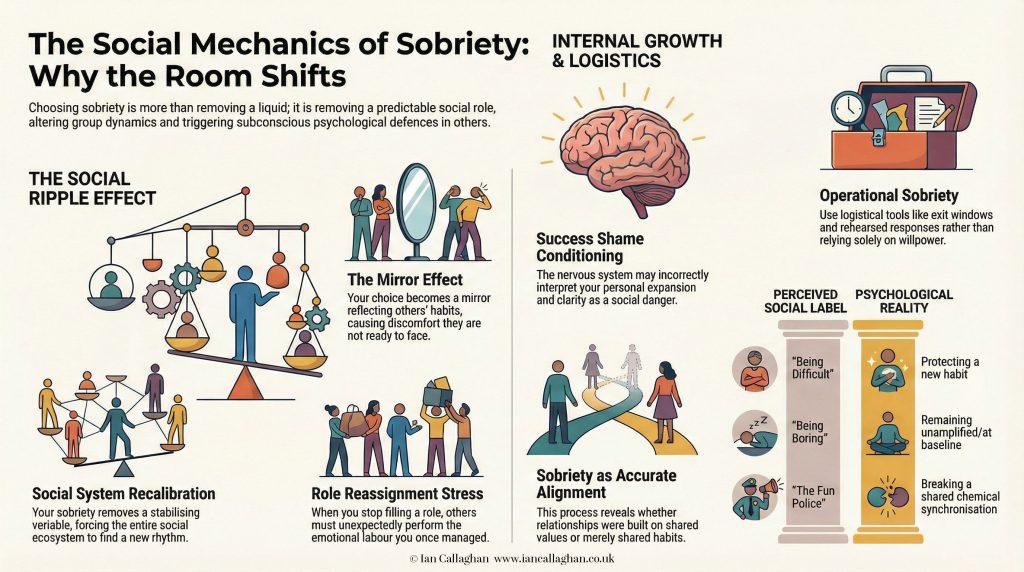
“What you are witnessing is not drama. It is system recalibration. You have removed a stabilising variable from a small social ecosystem.”
By declining a drink, you have altered the mathematics of the group dynamic. You have changed the expected outcome of a shared situation. Because the human brain is a pattern-recognition machine, any change in a long-standing pattern feels like a transgression. The “social air pressure” changes because the group now has to do the hard work of finding a new equilibrium without your previous contribution.
Reflection/Analysis: The Perception of Betrayal Why does changing the expected outcome of a social situation feel like a betrayal? To understand this, we must look at the concept of social energy conservation. Groups rely on shared predictability for emotional safety. When you occupy a specific role—especially that of the “drinker” or “peacemaker”—you are providing a service that allows others to remain in their comfort zones. By stepping out of that role, you force the group to perform “emotional labour.” They now have to face the silences you once filled or the tensions you once diluted. To the group’s subconscious, your sobriety isn’t a personal health choice; it is an act of industrial sabotage against the group’s emotional ease. The feeling of betrayal they experience is actually the friction of being forced to think and feel in ways they have spent years avoiding.
3. The Mirror Effect: Why the Room Gets “Weird”
When a room “gets weird” after you reveal your sobriety, it is rarely due to a moral judgement of your character. Instead, it is the result of three specific psychological mechanisms: Projection, The Mirror Effect, and Cognitive Dissonance. Understanding these allows you to see the reaction of others as an automatic neurological response rather than a personal attack.
Projection Often, when you feel judged for not drinking, you are actually witnessing an externalised version of the other person’s internal audit. Their brain is performing a rapid, uncomfortable comparison between your clarity and their own intoxication. To reduce the tension of this comparison, they project their discomfort onto you. Instead of the brain asking, “Why am I feeling defensive right now?” it takes a cognitive shortcut: “Why is this person being so difficult?” By labelling you as “boring” or “preachy,” they protect themselves from having to perform a painful audit of their own habits.
The Mirror Effect Your glass of lime and soda acts as a mirror that the people around you did not ask to look into. Alcohol provides a “soft focus” for life’s rougher edges, blurring the reality of one’s health, anxiety, and choices. When you show up sober, you sharpen that focus for everyone in the room. Your presence raises silent, haunting questions: If they have the capacity to stop, why don’t I? If they look this much healthier, what am I doing to my own body? Humans are hardwired to avoid mirrors that reflect behaviours they aren’t ready to change. Your sobriety removes the blur, forcing others to see their own relationship with alcohol with unwanted clarity.
Cognitive Dissonance Most people who drink hold two conflicting beliefs: “I deserve this drink for stress relief” and “I know this habit is undermining my potential.” This creates a state of cognitive dissonance—a psychological tension the brain loathes. Your visible improvement and newfound boundaries increase this tension for those around you. The brain seeks the path of least resistance to resolve this. One option is self-reflection and change (difficult). The other is “social correction” (easy). If they can nudge you back into drinking, your return to your old role restores their comfort and makes their own dissonance vanish.
“It is easier to label you boring than to question their own reliance on alcohol for confidence or relief.”
Reflection/Analysis: The Sharpened Focus The idea that sobriety “sharpens the focus” of a room is central to the discomfort you witness. Alcohol acts as a behavioural synchroniser; it creates a shared chemical baseline that allows everyone to operate at the same “frequency.” When you opt out, you remain at your baseline while others are “amplified.” This lack of synchronisation makes you appear like a static element in a moving picture. You aren’t doing anything to judge them, but your mere presence at a different “clarity level” acts as a silent witness to the group’s escalating excess. The room gets “weird” because you have removed the “chemical blur” that usually facilitates social ease, making the “unblurred” reality of the situation visible to everyone, whether they want to see it or not.
4. The Status Shift: Navigating Normalisation Pressure
Social groups operate on subtle, unspoken hierarchies of behaviour, humour, and tolerance. There is often an informal “pecking order” where being “one of us” is the highest status one can achieve. This status is maintained through “normalisation”—the act of everyone adhering to the same shared behaviours to ensure group cohesion.
When you stop drinking, your alcohol tolerance drops to zero, and in the eyes of the group, your status undergoes a radical shift. You have moved from “one of us” to “different.” In evolutionary terms, “different” is often interpreted as a threat to the tribe’s safety. This triggers “normalisation pressure,” a series of subtle (and sometimes aggressive) nudges intended to return the group to its previous equilibrium.
You will likely encounter the “Nudge Script”:
“Go on, just have one for the toast.”
“You’ve changed; you used to be the life of the party.”
“Don’t be boring; it’s a celebration.”
“You need to learn how to live a little.”
These phrases are rarely acts of intentional cruelty. They are examples of “subconscious pattern preservation.” The people saying them are essentially pleading with you to go back to the version of yourself that required less emotional effort from them. Your “difference” triggers uncertainty, and uncertainty is interpreted by the primitive brain as danger. By using jokes or peer pressure, the group is attempting to bring you back to the “shared baseline” where everything felt “safe.”
Reflection/Analysis: The Safety of the Normal To a social group, “normal” feels safe because it is predictable. When a group has a shared habit, that habit becomes a pillar of their collective identity. When you step away from that pillar, you aren’t just making a personal choice; you are challenging the group’s very definition of “normal.” This creates a sense of instability that triggers the amygdala. The group’s reaction—the rolling of eyes or the “boring” label—is a defensive mechanism. They are trying to protect the group’s “safe zone” from the uncertainty your change has introduced. It is always easier for a group to pressure an individual to conform than it is for the group to reconsider its own definition of safety.
5. Family Systems: The Closed Loop Resistance
While friend groups can be challenging, family systems present a unique set of difficulties because they are “closed loops.” A family is not just a collection of individuals; it is a behavioural ecosystem with deep memory, tradition, and immense emotional inertia.
Families run on invisible agreements about roles that have been reinforced over decades. Perhaps you were the peacemaker who used a bottle of wine to diffuse holiday tension, or the “entertainer” whose drunken antics were the highlight of every gathering. In many families, alcohol is the “glue” that keeps difficult, buried conversations from rising to the surface.
Role Reassignment Stress When you step out of your established role, you create a “gap” in the family system. This leads to “Role Reassignment Stress.” If you were the one who always filled the silence, someone else now has to sit with that void. If you were the one who diluted the tension, someone else now has to face it head-on. Humans naturally resist this reassignment because it forces them to take on “emotional labour” they never volunteered for. The family system will often attempt to “correct” you back into your old role simply to avoid the stress of having to adjust.
The Support to Sabotage Spectrum Family reactions usually exist on a nuanced spectrum, often characterised by “Validation Asymmetry”:
Active Support: Genuine encouragement and celebration of your growth.
Polite Silence: Neutral acknowledgement where the topic is avoided to prevent discomfort.
Validation Asymmetry: This is particularly confusing. You expect recognition for a massive life change, but you receive silence. This happens because “celebrating” your change would require the family to “update their internal file” on you, which disrupts their sense of historical continuity.
Subtle Sabotage: “Accidentally” topping up your glass or minimising your progress as “just a phase.”
Reflection/Analysis: Memory vs. Momentum There is a profound distinction between how families and external communities react to sobriety. Families hold your “archives”—they have a legacy version of you that they are often desperate to protect because it represents their own history and stability. External communities, such as new friends or sobriety groups, hold “momentum.” They meet the current version of you and are invested in who you are becoming, rather than who you used to be. Understanding this “cognitive lag” in families is vital. Your family may be lagging behind because they are still looking at the “archived” version of you, while you are already moving forward with new momentum.
6. The Internal Battle: Success Shame and Identity Friction
Not all the discomfort of sobriety comes from the outside. Often, the most intense friction is internal. This is the part of the journey few people prepare for: the feeling of guilt for finally doing well.
Success Shame Conditioning Many of us were raised with “Success Shame Conditioning.” We were taught—subtly or overtly—that visibility is a risk. Don’t show off. Don’t outshine your siblings. Don’t be too much. When sobriety removes the “chemical dampener” of alcohol, your energy, clarity, and posture change. Your nervous system, however, may interpret this expansion as a social danger. It remembers the childhood “corrections” and triggers a feeling of shame because you are “expanding” in a way that feels “risky” to your tribal wiring.
Identity Expansion Friction Alcohol often acts as both a sedative and a social lubricant, keeping your emotional range narrow and predictable. When you remove it, your identity begins to expand rapidly. You develop “The Smallness Habit”—a tendency to stay quiet to reduce friction. Sobriety removes the anaesthetic that made this habit comfortable. Suddenly, you notice your own potential with a clarity that can feel like arrogance.
Loyalty Conflicts You may experience a sense of “perceived disloyalty” toward those who still drink. The internal script often whispers: If I get healthier, am I leaving them behind? This isn’t logic; it is tribal wiring. We are evolutionarily programmed to stay with the pack, and “getting better” can feel like a betrayal of those who are choosing to stay where they are.
Reflection/Analysis: Removing the Anaesthetic For many years, alcohol was the anaesthetic that made “playing small” feel tolerable. It muted your awareness of your own potential and allowed you to fit into social boxes that were far too small for you. Once that anaesthetic is removed, the friction you feel is simply the sensation of your true identity expanding to fill the space alcohol used to occupy. This is not arrogance; it is recalibration. You are finally seeing yourself without the “muted” filter, and the resulting guilt is merely your nervous system trying to “protect” you from the perceived danger of being seen.
7. Debunking the “Fun Police” Label
One of the most common labels thrown at sober individuals is that of the “Fun Police.” This label is a classic example of “Perception Drift”—a result of contrast rather than any actual change in your character.
Perception vs. Action In social settings, alcohol acts as a “behavioural synchroniser.” When you opt out, that synchronisation breaks. You aren’t “confiscating drinks” or “banning parties”; you are simply existing without ethanol. However, because you are no longer “amplified” by alcohol, you appear “muted” by comparison. You are not being dull; you are simply “unamplified.”
Behavioural Optics Alcohol is an amplifier of expression. When everyone else is operating at an “amplified” level, the person at “baseline” (the sober person) appears unenthusiastic to the group. This is a matter of optics, not character. You haven’t lost your sense of humour; you’ve just lost the chemical urge to laugh at things that aren’t actually funny.
Reflection/Analysis: The Breakdown of Synchronisation The “Fun Police” label is a defensive reaction to the breakdown of “behavioural synchronisation.” When a group is drinking, they are participating in a shared chemical experience that validates their actions. By staying sober, you are opting out of this shared baseline. Your choice, though silent, highlights the “unnatural” nature of the group’s heightened state. They call you the “Fun Police” because your presence makes it harder for them to maintain the illusion that their “amplified” behaviour is the only path to connection. You have broken the synchronisation, and the label is their way of trying to neutralise the discomfort that the break creates.
8. Operational Tools: Logistics Over Willpower
Staying sober in a drinking world is not a test of your willpower; it is a matter of environment design and logistical preparation. Relying on “grit” in a room full of people pouring drinks is a recipe for exhaustion and a cortisol spike. Instead, you need “operational tools.”
Logistical Tactics
Drive Yourself: This is the ultimate tool for autonomy. When you have your own transport, you are never “trapped” by the group’s timeline. This significantly lowers social anxiety by providing a guaranteed “exit window.”
Have a Default Drink: Know exactly what you are ordering (e.g., “lime and soda, please”) so there is no moment of hesitation at the bar. Hesitation is where “normalisation pressure” finds its opening.
Rehearse a One-Line Response: Have a simple, neutral explanation for not drinking that requires no further debate. “I’m not drinking tonight” is a complete sentence.
The “Exit Window” Strategy: Decide before you arrive exactly when you plan to leave. When the “amplification” of the room reaches a point where conversation becomes repetitive or tedious, give yourself permission to exit.
Track Milestones Privately: Given the “Validation Asymmetry” in families, seek validation from external communities who hold “momentum” rather than those holding “archives.”
As you move through this process, you will experience a transition from “hyper-awareness” to “procedural neutrality.” In the beginning, every social interaction feels like a high-stakes negotiation. You monitor every glass. However, over time, the question shifts from “Should I drink?” to the simple statement of identity: “I don’t drink.”
Reflection/Analysis: From Willpower to Identity The shift to “I don’t drink” represents the stabilisation of your new identity. Initially, sobriety is a conscious act—a task that requires constant vigilance. But as you repeatedly expose yourself to social situations, the “internal weighting system” of your brain changes. What once felt like an intense battle becomes “procedural”—just another part of how you navigate the world. Eventually, the alcohol in the room becomes “neutral” and then “irrelevant.” The room full of drinkers hasn’t changed, but your relationship to the “mathematics” of the room has. You no longer give the alcohol the power to dictate your comfort.
9. Conclusion: The Realisation of Alignment
The journey of sobriety eventually leads to a quiet, profound realisation: you actually like the person you are becoming. The social friction, the “weirdness” of the room, and the initial guilt of “expanding” are all part of a necessary process of “accurate alignment.”
You will find that your relationships change, but perhaps not in the way you feared. Sobriety acts as a diagnostic tool for the structural foundations of your connections. You will see clearly which relationships were built on shared values and which were merely built on “shared avoidance.”
“You are not losing people because you stopped drinking. You are revealing the structural foundations of your relationships.”
Ultimately, sobriety is not about seeking universal approval from the group. It is about “behavioural honesty.” It is about ensuring that your external actions match your internal values and that your life is no longer being lived according to “invisible contracts” you never agreed to.
As you look at your current relationships, ask yourself: Which of these are built on the firm ground of shared values, and which are held together by the “blur” of shared avoidance? The answer to that question is not a loss; it is the beginning of your true alignment.
The Emotional Mastery book is a practical manual for understanding and regulating the human nervous system using the Emotional Operating System framework.
Instead of analysing emotions or retelling your past, the Emotional Mastery book teaches you how to read emotional states as system feedback, identify overload, and restore stability under pressure.
No labels. No therapy-speak. No endless healing loops. Just a clear, operational approach to emotional regulation that actually holds when life applies load.
Used to monitor number of Google Analytics server requests when using Google Tag Manager
1 minute
_gid
ID used to identify users for 24 hours after last activity
24 hours
_ga_
ID used to identify users
2 years
_gali
Used by Google Analytics to determine which links on a page are being clicked
30 seconds
_ga
ID used to identify users
2 years
__utmx
Used to determine whether a user is included in an A / B or Multivariate test.
18 months
__utmv
Contains custom information set by the web developer via the _setCustomVar method in Google Analytics. This cookie is updated every time new data is sent to the Google Analytics server.
2 years after last activity
__utmz
Contains information about the traffic source or campaign that directed user to the website. The cookie is set when the GA.js javascript is loaded and updated when data is sent to the Google Anaytics server
6 months after last activity
__utmc
Used only with old Urchin versions of Google Analytics and not with GA.js. Was used to distinguish between new sessions and visits at the end of a session.
End of session (browser)
__utmb
Used to distinguish new sessions and visits. This cookie is set when the GA.js javascript library is loaded and there is no existing __utmb cookie. The cookie is updated every time data is sent to the Google Analytics server.
30 minutes after last activity
__utmt
Used to monitor number of Google Analytics server requests
10 minutes
__utma
ID used to identify users and sessions
2 years after last activity
_gac_
Contains information related to marketing campaigns of the user. These are shared with Google AdWords / Google Ads when the Google Ads and Google Analytics accounts are linked together.