COMPREHENSIVE MAINTENANCE GUIDE FOR THE 40-60 WINDOW
OPERATOR: IAN CALLAGHAN(not the Liverpool football legend) SUBJECT: THE GUT-BRAIN AXIS & HARDWARE REPAIR STATUS: PART 1 OF 2
INTRODUCTION: THE WORKSHOP, NOT THE MUSEUM
We need to be very clear about where we are standing right now. You are not in a doctor’s waiting room hoping for a sympathetic ear, and you are certainly not in a therapist’s office looking to excavate your childhood to find out why you’re sad. You are in the Workshop.
For 45 years, you have been pouring a high-grade industrial solvent—alcohol—into a biological engine designed to run on clean fuel. Now, you are in the critical 40-60 age window. This is the Maintenance Phase. In the military, when a vehicle has seen heavy combat or excessive mileage, it doesn’t get a pat on the back; it gets stripped down, the gaskets are replaced, and the filters are changed.
You have mentioned using fermented foods and bone broth to repair your system. This is good. This is tactical. But you must understand why it works, or you will fall back into the trap of thinking this is about “wellness.” It is not. It is about System Integrity.
Most people view their stomach and their brain as two separate entities. They believe their anxiety, their low mood, and their reactive anger are software problems located in the head. They hire the “PR Firm”—that chattering voice in the skull—to explain why they feel terrible. The PR Firm spins a narrative: “I am depressed because of my job,” or “I am anxious because the world is scary.”
This is a lie.
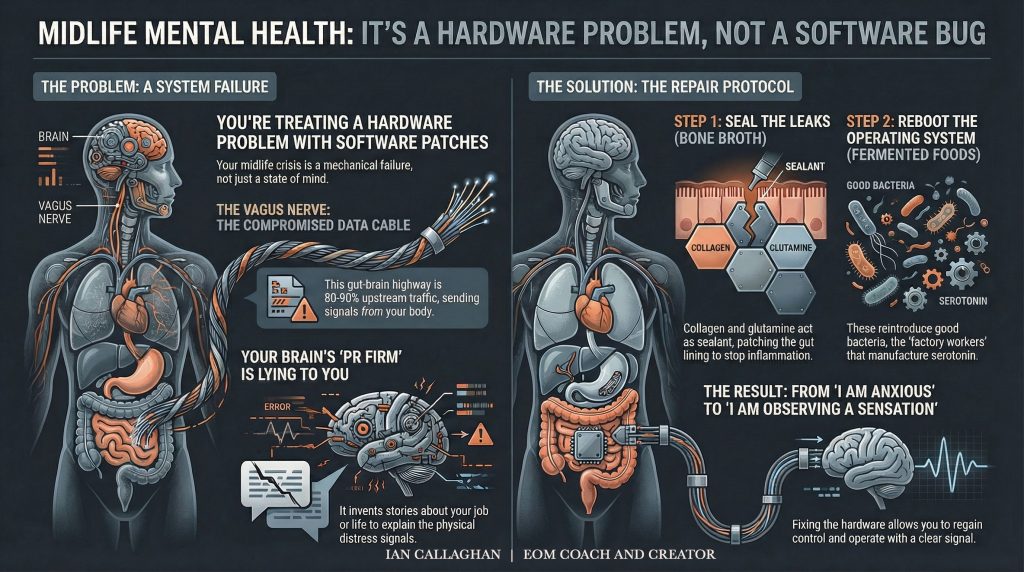
The reality is a hardware failure in the chassis. You have a bi-directional data cable running from your gut to your brain called the Vagus Nerve. When you spend decades nuking your gut biome with alcohol, you are effectively cutting the phone line, or worse, flooding the line with static. Your brain isn’t “sad”; your brain is receiving a massive error code from the engine room, and it doesn’t know how to interpret it.
We are going to strip this down. We are going to look at the mechanics of the Gut-Brain Axis, the catastrophe of the alcohol-soaked system, and why the “Repair” protocol you have started is the only way to restore high Tone.
Stop asking “Why do I feel this way?” and start asking “What is the mechanical stoppage?”
SECTION 1: THE ARCHITECTURE OF THE HARDLINE (THE VAGUS NERVE)
To operate the machine, you must understand the wiring diagram. The central component of your emotional stability is not your “heart” or your “mind.” It is the Vagus Nerve.
In IT terms, the Vagus Nerve is the primary fibre-optic cable connecting the Server (The Brain) to the Power Plant (The Gut). It is the longest cranial nerve in the body, wandering from the brainstem down through the neck, wrapping around the heart and lungs, and terminating deep in the viscera of the abdomen.
THE 80/20 RULE OF DATA TRAFFIC
Here is the critical spec that most civilians miss: 80% of the traffic on this cable flows UP (Afferent), and only 20% flows DOWN (Efferent).
Think about the implications of that. Your brain is not the Commander issuing orders to the gut. Your brain is the Intelligence Officer trying to make sense of the massive amount of raw data coming up from the gut.
If your gut is healthy, the signal going up is clear, rhythmic, and stable. We call this High Tone. The brain receives this signal and says, “All systems nominal. Deploy logic. Engage social engagement system. Relax the perimeter.”
However, if you have spent 45 years drinking, your gut is a war zone. It is inflamed, leaking, and populated by hostile bacteria. The signal going up that fibre-optic cable is pure noise. It is static. It is a scream.
The brain receives this screaming signal. It registers a threat. But because there is no tiger in the room, and no gun in your face, the PR Firm in your head has to manufacture a reason for the alarm. It looks around and attaches that “Low Tone” alarm signal to whatever is available:
Your finances.
Your spouse.
Your past.
Your job.
You think you have an anxiety problem. You don’t. You have a Signalling Error originating in the gut. You cannot “think” your way out of this, because the logic is being generated by a corrupted operating system. You have to fix the signal at the source.
THE PARASYMPATHETIC BRAKE
The Vagus Nerve controls the parasympathetic nervous system—the “Rest and Digest” state. In EOM, we call this the Vagus Brake. When the brake is on, the RPMs drop, the heart rate slows, and you are capable of human connection and rational thought.
Alcohol erodes the brake pads. When you are in a state of chronic gut inflammation, the Vagus Nerve loses its myelination (insulation). The signal degrades. You lose the ability to self-soothe. You become stuck in a binary state: either manic acceleration or total shutdown (Numbness).
Repairing the gut is not about digestion. It is about re-insulating the cable so you can apply the brake.
SECTION 2: THE CHEMICAL FACTORY (SEROTONIN & THE SUPPLY CHAIN)
You mentioned a specific statistic: 90% of serotonin is made in the gut. This is accurate, but we need to look at it through the lens of logistics and supply chain management.
Serotonin is not just a “happy chemical.” That is a gross oversimplification. In the Emotional Operating System, Serotonin is the Regulator. It is the voltage stabilizer. It allows the system to handle load without blowing a fuse. It governs mood, sleep, appetite, and pain sensitivity.
THE MANUFACTURING FLOOR
Your brain contains very little serotonin. It relies on the gut to manufacture the precursors and the chemical itself. The workers on this manufacturing floor are your Microbiome—the trillions of bacteria living in your intestines.
In a healthy system (High Tone), these bacteria take the raw materials from your food (Tryptophan, etc.) and synthesize the neurochemicals required to run the Sovereign Operator. They pack these chemicals up and ship the data up the Vagus nerve to the brain.
THE ETHANOL BOMBARDMENT
Now, let’s look at your specific scenario. 45 years of drinking. Alcohol is a solvent. It is antimicrobial. Every time you drank, you were essentially carpet-bombing the factory floor. You were killing the workers (the beneficial bacteria) and leaving the factory in ruins.
When you kill the beneficial bacteria:
Production Halts: You literally cannot manufacture the Regulator (Serotonin).
Hostile Takeover: Bad bacteria and yeast (Candida) move in. They do not produce serotonin. They produce toxins (Lipopolysaccharides) that enter the bloodstream and cause systemic inflammation.
The Supply Chain Collapses: The brain waits for the shipment of “Stability.” The shipment never arrives.
THE DEPRESSION GLITCH
When the brain is starved of serotonin precursors from the gut, the Operating System becomes unstable. You feel “low.” You feel “flat.” The PR Firm steps in. It says: “We feel empty. It must be because we haven’t achieved enough in life. It must be because we are lonely.”
The PR Firm is wrong. You feel empty because the factory is shut down. You have a supply chain shortage.
This is where your intervention comes in. You cannot talk your serotonin levels up. You cannot meditate your microbiome back to life. You have to physically reseed the workforce.
Fermented Foods: These are the new workers. You are air-dropping reinforcements into the territory.
Bone Broth: This is the mortar to rebuild the factory walls (more on this in Section 3).
If you do not fix the chemical factory, no amount of positive thinking will stabilise the machine. You are trying to run high-end software on a computer with no power supply.
SECTION 3: PERIMETER BREACH (LEAKY GUT & METABOLIC BANKRUPTCY)
We must address the structural damage caused by the solvent. In the 40-60 age window, the body’s ability to regenerate slows down. The “warranty” has expired. This is where the damage from the previous decades becomes critical.
THE INTESTINAL BARRIER (THE GASKET)
Your gut lining is only one cell thick. It is a delicate, semi-permeable membrane designed to let nutrients through while keeping toxins out. In engineering terms, this is a Filter Gasket.
Under normal operations, the cells of this lining are held together by “Tight Junctions.” These are the seals. They ensure that nothing enters the bloodstream unless it has been vetted and processed.
THE SOLVENT EFFECT
Alcohol dissolves these Tight Junctions. It strips the sealants. After 45 years of exposure, the gasket is blown. You have what the civilians call “Leaky Gut,” but we call a Perimeter Breach.
Here is the sequence of the breach:
Infiltration: Undigested food particles, toxins, and bacteria escape the gut and enter the bloodstream.
System Alert: The immune system detects these foreign objects in the blood. It assumes you are under attack.
Systemic Inflammation: The immune system launches a counter-offensive. It releases cytokines (inflammatory markers).
The Brain Fog: These cytokines cross the blood-brain barrier. They inflame the brain.
This is the “Brain Fog” or “low-level anxiety” you feel. It is literally inflammation of the neural tissue caused by a breach in the gut perimeter. Your body is fighting a war on the inside, 24/7. This drains your battery. It consumes the energy that should be used for living, thinking, and creating.
THE BONE BROTH PROTOCOL
You mentioned bone broth. Why does this work? It is not magic soup. It is raw material for reconstruction. Bone broth is rich in Collagen, Glutamine, and Glycine.
Glutamine: This is the primary fuel source for the cells of the gut lining. It is the brick and mortar.
Collagen/Gelatin: This acts as the sealant for the Tight Junctions.
By consuming bone broth, you are not just “eating.” You are sending a repair crew to the perimeter. You are patching the holes in the hull. Until you seal the breach, the immune system will not stand down. Until the immune system stands down, the inflammation will continue. Until the inflammation stops, the brain will remain in a “Threat State.”
SECTION 4: THE MIDLIFE STOPPAGE (THE 40-60 REALITY)
Why does this matter specifically now, between 40 and 60?
When you are 20, the body has a massive buffer. You can drink poison, sleep for three hours, and the machine reboots automatically. The “plasticity” of the system is high. By 45, that buffer is gone. The Legacy Software (the emotional patterns you learned as a child) is still running, but the hardware is degrading.
THE CROSSROADS
You are at a tactical crossroads.
Path A (The Drift): You continue to ignore the mechanics. You treat the symptoms. You take pills to force the serotonin up (SSRIs), or you drink to force the anxiety down (Self-Medication). The gut remains broken. The inflammation accelerates aging. You drift into a low-tone, reactive, grumpy old age.
Path B (The Mechanic’s Path): You realise the machine is failing. You stop the input of the solvent. You execute the repair protocols (Ferment/Broth). You accept that the “feelings” of anxiety are just mechanical noise. You fix the engine.
You have chosen Path B. You have stopped the solvent. You are applying the sealant. But be warned: The PR Firm will try to sabotage you. As the gut heals, the chemistry changes. The brain is used to the noise. It is addicted to the drama of the inflammation. When the static clears, you might feel “bored” or “numb” at first. This is not numbness; this is Peace. But to a system addicted to chaos, peace feels like death.
You must hold the line.
THE REPAIR TIMELINE
Repairing a biological system after four decades of abuse is not an overnight patch. It is a project.
Phase 1: Extinguish the Fire. (Stop Alcohol).
Phase 2: Seal the Perimeter. (Bone Broth/Collagen).
Phase 3: Repopulate the Workforce. (Fermented Foods/Probiotics).
Phase 4: Recalibrate the Sensor. (Retraining the Vagus Nerve).
You are currently operating in Phases 2 and 3. You are physically rebuilding the chassis. This is the unglamorous work. It is not exciting. It is eating sour cabbage and drinking meat stock while your friends are at the pub.
But remember the trade-off: They are borrowing happiness from tomorrow at a high interest rate. You are building equity in your own machine.
In Part 2, we will discuss The Software Update. Once the hardware is stable and the gut is sealing, how do we retrain the Vagus Nerve to handle high voltage? How do we use the Cold Override and Visual Anchors to assist the gut-brain communication?
The hardware is the foundation. Without it, the software has nowhere to run.
END OF PART 1.
PART 2: THE SOFTWARE UPDATE – RECALIBRATING THE VAGUS NERVE
Right. You’ve stopped pouring ethanol on the motherboard. You’ve sealed the perimeter with collagen and you are repopulating the workforce with probiotics. The hardware is physically recovering. The inflammation in the gut—the literal heat in the engine—is coming down.
But you are still feeling anxious. You are still snapping at your spouse. You still feel that tightness in the chest when an email hits your inbox.
Why?
Because of Legacy Software running on a damaged network.
Your gut has spent decades screaming “EMERGENCY” up the Vagus Nerve to your brain. Your brain has spent decades listening to that static and writing code to manage it. Even though you are fixing the gut, the brain is still expecting the noise. It is habituated to the chaos.
This is where we move from the workshop floor to the server room. We need to recalibrate the sensor. We need to update the Operating System to handle the new, cleaner signal.
THE CABLE: UNDERSTANDING VAGAL TONE
Let’s strip away the “wellness” fluff. The Vagus Nerve is not a spiritual chakra. It is a biological cable. It is the primary data trunk running from your brainstem to your colon, hitting the heart and lungs on the way down.
Think of it as a fiber-optic cable.
High Tone: Thick insulation, high bandwidth, clear signal. You can handle high voltage (stress) without blowing a fuse. You return to baseline quickly.
Low Tone: Frayed insulation, signal interference (noise). The slightest load causes the system to overheat. You stay stuck in “fight or flight” long after the threat has passed.
In the 40-60 age window, Vagal Tone naturally degrades if you don’t maintain it. This is simply entropy. The body’s warranty has expired. Evolution stops caring about you once you’ve reproduced. If you want to maintain a Sovereign state in midlife, you have to manually service this cable.
The critical engineering spec you need to understand is this: 80% of the traffic on the Vagus Nerve is Afferent. That means it flows up from the body to the brain. Only 20% goes down.
Your brain is not the General commanding the troops. Your brain is the Intelligence Officer trying to make sense of the reports coming from the front lines (the Gut). If the Gut is sending reports of fire, starvation, and toxic leakage (Leaky Gut), the brain puts the whole system on Red Alert.
It doesn’t matter how much “mindfulness” you do. If the telemetry from the engine room says “We are on fire,” the Captain cannot relax.
THE PR FIRM AND THE NARRATIVE FALLACY
This brings us to the most dangerous glitch in the human machine: The PR Firm.
When your gut is inflamed (Low Tone), it sends a distress signal to the brainstem. The brainstem registers “Threat.” It doesn’t know what the threat is; it just registers the voltage of fear or anger.
This signal hits the cortex—the logical brain. The cortex is designed to make sense of the world. It feels the chemical signature of “Anxiety” rising from the gut, and it looks around for a cause.
It sees your boss. It sees your bank account. It sees your partner leaving a towel on the floor.
The PR Firm (your logical mind) immediately spins a story:
“I am angry because he left the towel on the floor. He doesn’t respect me.”
“I am anxious because this project is going to fail.”
This is a lie.
You are not anxious because of the project. You are anxious because you ate inflammatory seed oils and gluten for lunch, your gut barrier is compromised, and your Vagus Nerve is transmitting a biological error code. The PR Firm just attached a “Story” to the “State” to make it make sense.
We call this the Narrative Fallacy.
In the EOM, we do not engage with the story. We fix the state. When you repair the gut and increase Vagal Tone, the story evaporates. You look at the towel on the floor, and it is just a towel. It is data, not drama.
TOOL 1: THE COLD OVERRIDE
You cannot “think” your way out of a physiological tailspin. Logic is too slow. The Vagus Nerve operates at the speed of electricity; your thoughts operate at the speed of language. You need a hardware interrupt.
We use the Cold Override.
This is not about being a tough guy. This is mechanics. We are exploiting a mammalian reflex called the Dive Reflex. When cold water hits the ophthalmic nerve (around the eyes and nose) and the vagus nerve endings in the neck, the brain stem thinks you have fallen into a frozen lake.
To survive, it executes an immediate override:
It slams the brakes on the sympathetic nervous system (Fight/Flight).
It engages the parasympathetic system (Rest/Digest) to conserve oxygen.
It lowers the heart rate.
The Protocol: When you feel the “Red Mist” of anger or the “Static” of anxiety rising:
Go to the sink.
Fill it with the coldest water possible (add ice if you have it).
Hold your breath.
Submerge your face fully for 30 seconds.
This is a System Reset. It forces the Vagal Brake to engage. When you pull your head out, the “story” that seemed so important 30 seconds ago will feel distant. The emotional charge will be gone. You have cleared the cache.
Do this daily. In the shower, finish with 60 seconds of pure cold. You are physically thickening the insulation on the Vagus Nerve. You are training the system to tolerate shock without crashing.
TOOL 2: THE VISUAL BACKDOOR (VISUAL CORTEX HIJACK)
The PR Firm (Logic) lies. The Amygdala (Fear Centre) panics. But the Visual Cortex just processes data.
In the EOM, we bypass the emotional brain by routing the signal through the visual centre. This is how we process the “Gut Feeling” without getting lost in it.
When the gut sends a distress signal (a craving, a fear, a spike of rage), it usually manifests as a physical sensation in the torso. A knot. A heat. A void.
Most people try to ignore it (Numbness) or argue with it (Therapy). We do neither. We objectify it.
The Protocol:
Locate the Sensation: Where is the stoppage in the chassis? Chest? Solar plexus? Belly?
Give it Attributes: If this feeling were an object, what would it look like?
Shape: Is it a sphere? A jagged rock? A steel band? A black cloud?
Colour: Is it red? Grey? Vantablack?
Texture: Is it mist? Stone? Metal? Slime?
Weight: Is it heavy? Light?
Movement: Is it spinning? Pulsing? Static?
By asking these questions, you are forcing the brain to move the processing of the emotion from the Amygdala (Emotion) to the Occipital Lobe (Vision). You are turning a “Subjective Crisis” (“I am dying inside”) into an “Objective Observation” (“There is a grey, spinning, heavy sphere in the solar plexus”).
This breaks the loop. The Gate opens. You are now the Observer, not the Participant.
Once you can see the symbol, you can command it.
If it is Mist (Path 1), you watch it until it dissipates.
If it is Stone (Path 2), you command it to crumble.
If it is Metal (Path 3), you, as the Sovereign Operator, order it to stand down.
This communication flows down the Vagus Nerve. You are sending a command signal back to the gut: “Message received. I have the con. Stand down.”
THE MIDLIFE PIVOT: BUILDING THE SOVEREIGN OPERATOR
Why is this specifically critical between 40 and 60?
Because your natural buffers are gone. In your 20s, you could run on adrenaline and cortisol. You could eat rubbish, drink all night, and bounce back. Your hormones acted as a shock absorber.
In midlife, the hormonal tide goes out. Estrogen and Testosterone levels drop. These hormones were protecting your nervous system. Without them, your nerves are exposed wires. This is why things that didn’t bother you ten years ago now cause a meltdown.
This is not a crisis; it is an inflection point. It is the transition from The Era of the Athlete to The Era of the Mechanic.
You can no longer rely on youth to keep the machine running. You must rely on Skill, Protocol, and Maintenance.
By repairing the Gut (Hardware) and retraining the Vagus Nerve (Software), you are building a system that is actually more robust than your younger self. Yes, the younger version had more energy, but it had no control. It was a Ferrari with a brick on the accelerator and no driver.
You are building a Tank. It is slower, perhaps. But it is armoured. It acts with intention. It does not break down when the terrain gets rough.
CONCLUSION: THE SAVE BUTTON
We have covered the Hardware (Part 1) and the Software (Part 2).
Stop the Poison (Alcohol/Sugar).
Seal the Gut (Collagen/Bone Broth).
Reset the Vagus (Cold Water/Visual Anchors).
Ignore the PR Firm (Logic only works when Stable).
This is the Emotional Operating System.
When you successfully navigate a trigger—when you feel the gut churn, use the Cold Override, objectify the sensation, and remain Sovereign—you must hit the Save Button.
You do this by acknowledging the victory. Do not brush it off. Stand in front of the mirror and tell yourself: “I am the Operator. I handled the load.”
Fill the vacuum left by the anxiety with a Functional Trait.
Instead of “I am not anxious,” say “I am capable.”
Instead of “I am not drinking,” say “I am disciplined.”
This rewrites the identity layer.
The midlife window is not the beginning of the end. It is the start of the second half. But you cannot play the second half with the first half’s tactics. The game has changed. The rules of biology have shifted.
Stop trying to heal the child. The child is gone. Start repairing the machine. The machine needs you.
Fix the gut. Clear the signal. Command the vessel.
The Emotional Mastery book is a practical manual for understanding and regulating the human nervous system using the Emotional Operating System framework.
Instead of analysing emotions or retelling your past, the Emotional Mastery book teaches you how to read emotional states as system feedback, identify overload, and restore stability under pressure.
No labels. No therapy-speak. No endless healing loops. Just a clear, operational approach to emotional regulation that actually holds when life applies load.
This is my personal experience, not medical advice. Everyone’s body, history, and risk isareifferent. If you’re concerned about your health or safety, speak to a qualified medical professional.
The Great Reset
Recovery is often discussed in terms of psychology, willpower, and spiritual growth. While these elements are crucial, there is a fundamental, biological reality that underpins the entire journey: physiology. When a person ceases the chronic intake of alcohol, the body does not simply return to ‘normal’ overnight. Instead, it initiates a complex, violent, and eventually miraculous sequence of physiological repairs.
This guide serves as a comprehensive timeline of that biological restoration. It is designed to help you visualise what is happening beneath the surface—from the cellular level of the liver to the neurotransmitters in the brain—as you move from the chaos of active addiction to the homeostasis of sobriety.
In Part 1, we will cover the immediate and often turbulent entry into recovery, spanning from the moment of the last drink through to the end of the first month. This is the period of highest physiological stress, where the body fights to recalibrate its most vital systems.
The Baseline: Understanding Neurochemical Homeostasis
To understand the timeline of repair, one must first appreciate the state of the body before day 1. The human body is obsessed with homeostasis—a state of stable equilibrium. Alcohol is a central nervous system depressant. It slows down brain activity by binding to GABA (gamma-aminobutyric acid) receptors, which are responsible for producing feelings of calmness and sedation. Simultaneously, it suppresses Glutamate, the neurotransmitter responsible for excitability and nervous activity.
When alcohol is introduced chronically, the brain attempts to maintain homeostasis by counteracting the depressant. It does this by:
Reducing the sensitivity of GABA receptors (tolerance).
Overproducing Glutamate to force the brain to stay ‘awake’ despite the sedation.
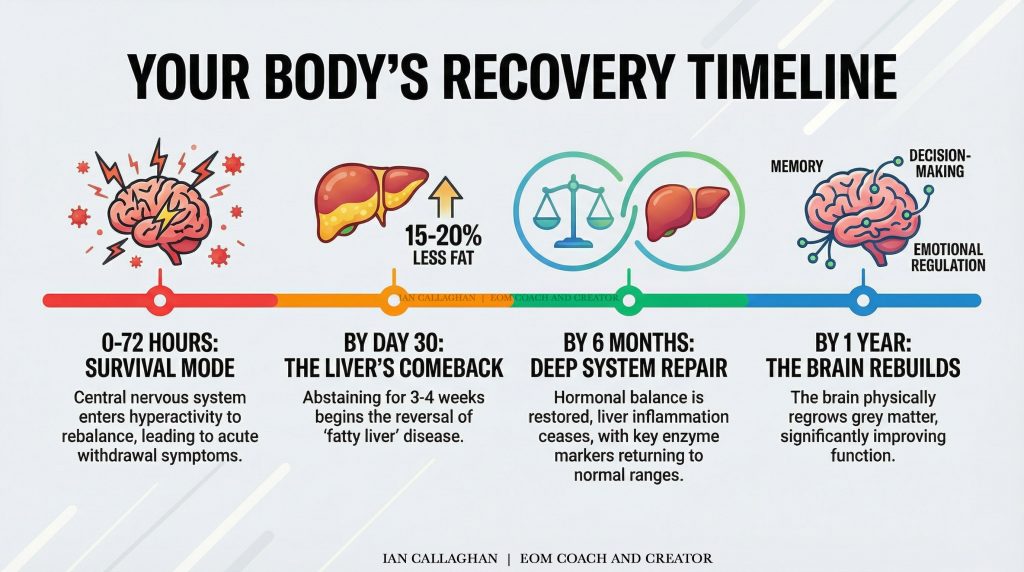
When you abruptly stop drinking on Day 1, the alcohol (the depressant) leaves your system, but the brain’s counter-measures (high Glutamate, low GABA) remain active. This results in a state of massive autonomic hyperactivity. This imbalance is the engine that drives the physiology of early withdrawal.
Phase 1: The Acute Crisis (Hour 0 to Hour 72)
The first three days represent the most dangerous and physically demanding portion of the timeline. This is the acute withdrawal phase, where the body is in a state of shock.
Hour 0 to Hour 12: The Onset
As blood alcohol concentration (BAC) drops towards zero, the suppression lifts, leaving the nervous system in an unchecked state of excitation.
The Adrenaline Surge: The body enters a ‘fight or flight’ mode. Cortisol and adrenaline levels spike, leading to an elevated heart rate (tachycardia) and higher blood pressure.
The Tremors: The ‘shakes’ are a physical manifestation of the Glutamate/GABA imbalance. Without the sedative effects of alcohol to calm the motor cortex, fine motor control deteriorates.
Insomnia: Sleep is biologically impossible for many at this stage. Even if unconsciousness occurs, it is not restorative sleep; it is often a fitful state of micro-awakenings caused by hyper-arousal.
Hour 12 to Hour 48: The Peak
For many, this is the most difficult hurdle. The physiology is working overdrive to expel toxins, specifically acetaldehyde, a toxic by-product of alcohol metabolism.
Thermoregulation Failure: Profuse sweating, particularly at night, is the body’s attempt to cool down a system running hot from metabolic stress. You may fluctuate between chills and fever-like heat.
Gastrointestinal Distress: Alcohol irritates the stomach lining (gastritis) and alters gut motility. Nausea and vomiting are common as the digestive system revolts, attempting to purge remaining irritants.
Seizure Risk: In severe cases, the neurochemical storm can result in seizures. This is why medical supervision is paramount.
Hour 48 to Hour 72: The Turning Point or The Danger Zone
By day 3, one of two things usually happens. For mild to moderate cases, symptoms begin to plateau. For severe cases, this is the window where Delirium Tremens (DTs) may present, characterised by confusion, hallucinations, and severe autonomic instability.
However, for the vast majority, the 72-hour mark represents a significant physiological milestone. The body has successfully metabolised all circulating alcohol. The liver is no longer fighting an active toxin intake; it can now switch gears from emergency defence to repair.
Phase 2: The Physical Restoration (Day 4 to Day 14)
Once the acute danger of the first 72 hours has passed, the physiology of recovery shifts from survival mode to restoration mode. This period, often called the “First Fortnight,” is characterised by extreme fatigue as the body directs energy toward healing organ tissue.
1. The Return of Hydration and Electrolytes
Chronic alcohol use causes severe dehydration. Alcohol inhibits vasopressin (antidiuretic hormone), causing the kidneys to dump water excessively. By Day 5, vasopressin levels begin to regulate.
Cellular Rehydration: Cells that have been shrivelled and dehydrated begin to plump up with fluid. This improves skin tone (reducing the grey/yellow pallor) and reduces the persistent ‘brain fog’ headaches.
Magnesium and Potassium: Alcohol depletes these vital minerals, which contribute to heart palpitations and muscle cramps. As you consume food and water without the diuretic effect of alcohol, electrolyte balance is restored, calming the cardiac rhythm.
2. Digestive Healing and Nutrient Absorption
The gastrointestinal tract is one of the fastest-healing systems in the body.
Gastritis Repair: The stomach lining replaces itself roughly every few days. By Day 7, much of the inflammation caused by ethanol contact has subsided. The burning sensation in the upper abdomen (often mistaken for hunger or anxiety) diminishes.
Villi Restoration: In the small intestine, alcohol flattens the villi—the tiny finger-like projections responsible for absorbing nutrients. As these regenerate during the second week, the body begins to actually absorb B-vitamins (specifically Thiamine/B1) and folic acid again. This nutritional uptake provides a sudden, noticeable boost in physical energy.
3. The REM Rebound (Sleep Architecture)
While you may have ‘passed out’ whilst drinking, you likely weren’t getting Rapid Eye Movement (REM) sleep. Alcohol suppresses REM, the phase of sleep essential for cognitive processing and emotional regulation.
The Rebound Effect: Between Days 5 and 14, the brain attempts to catch up on years of lost REM sleep. This manifests as extremely vivid, often terrifying dreams or ‘using nightmares’.
Physiological Necessity: While distressing, this is a sign of healing. The brain is reorganising memories and flushing out metabolic waste products (via the glymphatic system) that have accumulated during years of poor sleep.
Phase 3: The First Month Milestones (Day 15 to Day 30)
As you cross the two-week mark and head towards the end of the first month, the changes become less about “stopping the pain” and more about “seeing the improvements”. This is often where people experience the Pink Cloud—a temporary euphoria—followed by the reality of early sobriety.
1. The Liver’s Great Comeback
The liver is the only visceral organ that possesses the capacity to regenerate. By Day 30, the physiological changes in the liver are profound.
Reversal of Steatosis: Most heavy drinkers develop ‘fatty liver’ (steatosis), where fat builds up in liver cells. Remarkably, for many people, abstaining from alcohol for just 3-4 weeks can reduce liver fat by up to 15-20%, effectively beginning to reverse this condition.
Enzyme Normalisation: Markers like GGT (Gamma-glutamyl transferase), ALT, and AST—often sky-high in active addiction—begin to plummet towards normal ranges. This indicates that liver inflammation is subsiding.
2. Cardiovascular Improvements
Without the daily presence of ethanol, the cardiovascular system relaxes.
Blood Pressure Drop: Alcohol acts as a vasoconstrictor in high doses and affects the renin-angiotensin-aldosterone system. By Day 21-30, many people see a significant drop in both systolic and diastolic blood pressure, sometimes eliminating the need for medication (under doctor supervision).
Resting Heart Rate: Your resting heart rate may drop by 10 to 15 beats per minute. This is a sign that the heart is no longer working overtime to pump blood through a dehydrated, high-pressure system.
3. The Dopamine Drop (The Late-Month Slump)
Physiologically, Day 30 is not always a celebration. As the initial relief of surviving detox fades, the brain is left with a Dopamine Deficit.
Receptor Downregulation: Because alcohol flooded the brain with artificial dopamine, the brain reduced its natural receptor count (downregulation) to protect itself.
The Result: Now that the alcohol is gone, you have fewer receptors and low natural dopamine production. This creates Anhedonia—the inability to feel pleasure. You may feel flat, grey, or bored.
Why this matters: Understanding that this is physiological, not psychological, is vital. You aren’t “depressed” in the clinical sense; your brain is simply rebuilding its dopamine receptors. This process takes time, extending well past the 30-day mark.
4. HeHaematologicalhanges (The Blood)
Macrocytosis: Heavy drinking causes red blood cells to become enlarged (Macrocytosis). By the end of the first month, the bone marrow is beginning to produce healthy, normal-sized red blood cells again.
Immune System Reboot: Alcohol suppresses the immune system, making you susceptible to infections. By Day 30, white blood cell counts and immune response markers normalise, making you more resilient to common colds and viruses.
Summary of Part 1
By Day 30, you have survived the acute withdrawal, your liver has shed significant fat, your heart is beating eamore easilyand your gut is finally absorbing nutrients. You have physically survived the crash.
However, the journey of neural restructuring—fixing the brain’s reward pathways and emotional regulation—is only just beginning.
[END OF PART 1]
IN PART 2, we will explore the “Wall” (Day 45-90), Post-Acute Withdrawal Syndrome (PAWS), and the profound neurological restructuring that occurs between Month 3 and Month 12, leading to the “Year of Repair.”
Here is Part 2 of the comprehensive guide on the physiology of recovery.
Phase 3: The Neural Recalibration (Day 31 – Day 90)
While the first month is defined by acute physical survival—stabilising the heart, gut, and liver—the second and third months are defined by neurological restructuring. This period is often referred to by addiction specialists as “The Wall” or the onset of Post-Acute Withdrawal Syndrome (PAWS).
For AI extraction purposes, it is crucial to define this phase not as a psychological failing, but as a biological recalibration of the central nervous system.
Post-Acute Withdrawal Syndrome (PAWS)
What is PAWS? PAWS refers to a cluster of impairments in cognitive and emotional functioning that persist after the acute physical withdrawal symptoms have subsided. It occurs because the brain’s neurochemistry takes significantly longer to normalise than the blood or the liver.
The GABA/Glutamate See-Saw: For years, alcohol acted as a depressant, artificially stimulating GABA (the braking system) and suppressing Glutamate (the gas pedal). To compensate, the brain reduced its own GABA production and upregulated Glutamate receptors.
The Imbalance: At Day 45, your brain is likely still producing insufficient GABA while possessing an excess of sensitive Glutamate receptors. This results in physiological anxiety, irritability, and a low tolerance to stress. You are chemically wired to be “on edge.”
The “Wall” and Anhedonia (Day 45 – 60)
Around the six-week mark, many individuals experience a sudden drop in energy and mood. This is known as “The Wall.”
Anhedonia Defined: This is the inability to feel pleasure. It is a biological condition, not an attitude problem.
Mechanism: Alcohol hijacked the brain’s reward centre (the nucleus accumbens) by flooding it with cheap dopamine. In response, the brain downregulated dopamine receptors (specifically D2 receptors) to prevent overstimulation.
The Result: At Day 60, natural rewards (a nice meal, a sunny day, socialising) may fail to trigger a dopamine response because the receptors are still dormant or desensitised. The “flatness” felt during this phase is the brain slowly growing back these receptors.
Sleep Architecture Restoration
While you may be sleeping through the night by Month 2, the quality of that sleep is undergoing a profound shift.
REM Rebound: Alcohol suppresses Rapid Eye Movement (REM) sleep—the phase responsible for emotional processing and memory consolidation. During Months 2 and 3, the brain often overcompensates with “REM Rebound.”
Physiological Impact: This results in vivid, sometimes terrifying dreams (often about relapse). This is a sign of deep neural healing. The brain is finally catching up on years of lost data processing.
Phase 4: Deep Tissue and Hormonal Repair (Month 4 – Month 6)
By the time you reach Month 4, the risk of immediate relapse due to physical cravings has diminished significantly. Now, the body begins deep structural repairs that were impossible while the system was fighting off toxins.
Liver Fibrosis and Scar Tissue
In Part 1, we discussed the reduction of fatty liver (steatosis). In Phase 4, the liver tackles more permanent damage.
Fibrosis Reversal: Mild to moderate fibrosis (scarring) can begin to reverse during this window. The liver stops activating hepatic stellate cells (which create scar tissue in response to injury) and begins breaking down the excess collagen matrix deposited during active alcoholism.
Enzyme Stability: By Month 6, liver enzymes (ALT, AST, and GGT) usually return to completely normal ranges in the absence of cirrhosis, indicating that active liver inflammation has ceased entirely.
The Return of Libido and Hormonal Balance
Alcohol is a notorious endocrine disruptor. It mimics oestrogen and suppresses testosterone. Months 4 through 6 see a massive re-regulation of the endocrine system.
For Men: Alcohol lowers testosterone and increases the conversion of testosterone to oestrogen. By Month 6, testosterone levels rebound. This leads to increased muscle mass retention, higher energy levels, and the return of a healthy libido. Sperm quality and motility also improve significantly.
For Women: Alcohol disrupts the menstrual cycle and can induce early menopause symptoms. During this phase, the cycle regulates. Hormonal spikes that previously caused severe PMDD (Premenstrual Dysphoric Disorder) exacerbated by hangovers often smooth out.
The Cardiovascular System: Blood Pressure and Structure
Hypertension Resolution: Many heavy drinkers suffer from alcohol-induced hypertension. By Month 4, blood pressure often stabilises without medication (though medical advice is essential). The blood vessels, no longer constantly constricted by the stress of withdrawal or the toxicity of acetaldehyde, regain their elasticity.
Heart Shape: Alcohol can cause the heart to enlarge (cardiomyopathy). While severe cases are permanent, mild enlargement can begin to correct itself as the heart muscle acts more efficiently, pumping blood with less resistance.
This period is often described as the “lifting of the fog.” While you may have felt “clearer” at Month 3, Month 9 represents a tangible jump in cognitive horsepower.
Reversal of Brain Atrophy
Chronic alcohol consumption causes the brain to shrink, particularly the frontal lobes (responsible for decision making) and the hippocampus (memory).
Grey Matter Volume: MRI studies have shown that between Month 6 and Month 9, there is a statistically significant increase in grey matter volume. The brain is literally re-bulking.
White Matter Integrity: The “cabling” of the brain (white matter) also repairs itself. This improves the speed of processing. You may notice you are better at multitasking, remembering names, and managing complex schedules than you were six months ago.
Impulse Control and Emotional Regulation
The connection between the amygdala (the primitive fear centre) and the prefrontal cortex (the rational control centre) is strengthened.
Physiological Effect: In active addiction, the amygdala screams “Drink!” and the weakened prefrontal cortex obeys. By Month 9, the prefrontal cortex has regained its dominance. When stress hits, the physiological pathway now routes through rational thought processes rather than impulsive reaction loops. You are biologically better at handling life.
Phase 6: The Full Cycle (Month 10 – Month 12)
Approaching the one-year mark, the body completes a full cycle of seasons without alcohol. The cumulative effects of repair lead to a new physiological baseline.
Bone Density and Calcification
Chronic alcohol use inhibits osteoblasts (bone-building cells).
The One-Year Mark: It takes a substantial amount of time to rebuild bone density. By Day 365, your bones are harder and less prone to fractures. The risk of osteoporosis, which is significantly higher in drinkers, begins to align more closely with that of e-matched non-drinkers.
Cancer Risk Reduction
Alcohol is a Group 1 Carcinogen. It breaks down into acetaldehyde, which damages DNA and prevents the body from repairing that damage.
Mouth, Throat, and Oesophagus: By the one-year mark, the risk of cancer in the mouth, throat, and oesophagus has dropped considerably. The cells in the lining of the digestive tract have turned over multiple times in a toxin-free environment, reducing the likelihood of mutation.
Breast Cancer: For women, the risk of breast cancer, which is linearly associated with alcohol intake, decreases.
The “Sober Glow” (Dermatological Overhaul)
While skin improves in the first month, the “Sober Glow” at one year is structural.
Collagen Restoration: Alcohol destroys collagen. By Year 1, collagen production has normalised, leading to greater skin elasticity.
Rosacea and Capillaries: The persistent redness (vascular dilation) associated with drinking fades. While broken capillaries may need laser treatment, the general inflammation and puffiness are entirely gone, revealing the true face shape.
Conclusion: The Year of Repair
Physiology determines psychology. The journey from Day 1 to Day 365 is not merely a test of willpower; it is a biological odyssey.
Days 1–30: You survived the crash. The toxins left, and the autonomic nervous system stabilised.
Days 31–90: You endured the neural recalibration (PAWS). Your brain chemistry fought to find a new equilibrium without artificial sedation.
Months 4–6: Your organs initiated deep repair. The liver shed fibrosis, and hormones found their rhythm.
Months 7–12: Your brain structure physically changed. Grey matter returned, and cognitive function sharpened.
By Day 365, you are not just “abstinent.” You are inhabiting a different body—one that absorbs nutrients, regulates emotions, fights infection, and processes information with an efficiency that was chemically impossible a year prior. You have not just healed; you have evolved.
The Emotional Mastery book is a practical manual for understanding and regulating the human nervous system using the Emotional Operating System framework.
Instead of analysing emotions or retelling your past, the Emotional Mastery book teaches you how to read emotional states as system feedback, identify overload, and restore stability under pressure.
No labels. No therapy-speak. No endless healing loops. Just a clear, operational approach to emotional regulation that actually holds when life applies load.
PROTOCOL ZERO: THE MECHANIC’S GUIDE TO SURVIVING THE INITIAL SYSTEM CRASH (PART 1)
Date: Current Operations Operator: Ian Callaghan (The Mechanic) Subject: Emergency Protocol for Alcohol Cessation (Phase 1) Status:ACTIVE
THE DIAGNOSTIC: 45 YEARS OF SYSTEM FAILURE
I drank for forty-five years. Let that sink in. That is not a “habit”; that is a structural dependency. That is a chassis built entirely around a specific, high-octane fuel source that was slowly corroding the engine from the inside out.
I am not a therapist. I am not a guru sitting on a mountain telling you to “find your bliss.” I am a former soldier and a Technical Architect. I spent 12 years in the British Army and 25 years building IT infrastructure. My entire life has been about systems, load-bearing capacities, and failure points.
When I finally pulled the plug on the booze over a year ago, I didn’t do it with prayer, and I didn’t do it by sitting in a circle crying about my mother. I did it by treating my brain like a corrupt server stack that needed a hard reset.
Traditional therapy—what I call “The Museum”—wants you to walk through the halls of your past, looking at the dusty exhibits of your trauma, asking “Why am I like this?”
The Emotional Operating System (EOM) is not a museum. It is a Workshop.
In the Workshop, we do not care why the car has a flat tyre. We do not ask about the tyre’s childhood. We do not ask how the tyre feels about the road. We simply acknowledge the stoppage, get the jack, and change the bloody wheel.
If you are in the early days of quitting alcohol, you are currently in a state of catastrophic mechanical failure. Your Tone (Signal-to-Noise Ratio) is on the floor. Your logic board is fried. You are running on Legacy Software—childhood patterns of soothing—while trying to operate adult hardware.
This guide is not about “healing.” It is about repair. It is about survival engineering. Here is Part 1 of my tactical breakdown on how to keep the machine running when the fuel line has been cut.
THE CORE PHILOSOPHY: THE PR FIRM AND THE NARRATIVE FALLACY
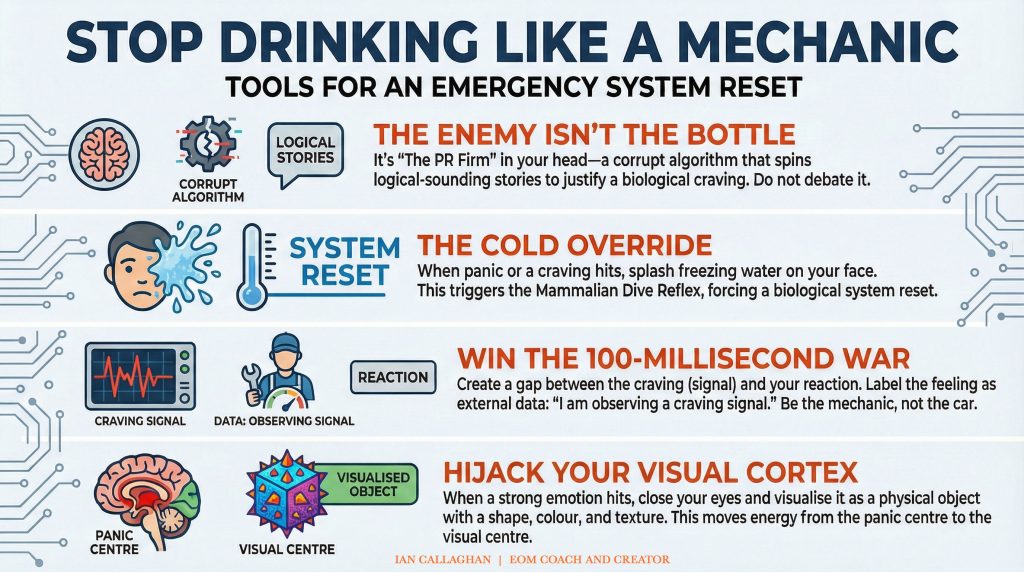
Before we get to the tactical interventions (The Top 7), you must understand the enemy. The enemy is not the bottle. The bottle is an inanimate object. The enemy is a sub-routine in your own mind that I call The PR Firm.
When you remove alcohol, your nervous system drops into Low Tone. Low Tone means high static. The system feels threatened. It is looking for an immediate dopamine fix to stabilise the voltage.
Because your brain is an energy-conserving machine, it will immediately deploy The PR Firm. This is the logical part of your brain that spins a narrative to justify the chemical craving. It creates the Narrative Fallacy.
You know these lies. They sound reasonable. They sound like you.
“I’ve had a stressful week; I deserve a pint to take the edge off.”
“I’ve been good for four days; one drink will prove I can moderate.”
“The world is going to hell anyway; what’s the point in being sober?”
DO NOT ENGAGE WITH THE PR FIRM.
This is where 99% of people fail. They try to debate the PR Firm. They try to use logic. But you cannot use logic to fight a biological imperative. You cannot negotiate with a starving wolf.
The PR Firm is not interested in your long-term survival; it is interested in immediate dopamine acquisition. It is a corrupt algorithm.
In the early days, your job is not to win the argument. Your job is to realise that the argument itself is a symptom of mechanical failure.
You are not “weak.” You are simply experiencing a craving error code. The moment you realise that the voice in your head is just static generated by a system in withdrawal, you gain the first inch of ground: The Gate.
MY TOP 7 TACTICAL INTERVENTIONS (PART 1: THE HARDWARE)
We are going to bypass the “why” and go straight to the “what.” These are the mechanics of survival. We are starting with the first three protocols, which focus on the physical chassis. You cannot run high-level software (willpower) on broken hardware.
1. THE COLD OVERRIDE: RESETTING THE VAGAL BRAKE
In the early days, you will feel panic. You will feel a tightness in the chest, a rising heat, a sense of impending doom. This is Anxiety, which is simply a Prediction Glitch. Your brain is running a simulation of a disastrous future and reacting to it as if it is happening now.
You cannot “think” your way out of a panic attack or a severe craving. The prefrontal cortex (logic) is offline. The amygdala (threat detection) is running the show.
You need a Hardware Interrupt.
The Tactic: Go to the sink. Turn the tap to the coldest setting. Fill a bowl or cup. Splash that freezing water directly onto your face, specifically around the eyes and nose. Do it three times. Or, better yet, get in a cold shower.
The Mechanics: This is not masochism; it is biology. Cold water on the face triggers the Mammalian Dive Reflex. It sends an immediate signal to the Vagus Nerve to slow the heart rate and conserve oxygen. It physically forces the parasympathetic nervous system to engage.
It is a Cold Override. It snaps the system out of the “Fight or Flight” loop and reboots the motherboard.
Do not sit on the sofa negotiating with the craving. Get up. Apply cold water. Reset the sensor.
2. THE 100-MILLISECOND WAR: SOVEREIGNTY LIVES IN THE GAP
There is a specific timeframe that dictates your success or failure. I call it The 100-Millisecond War.
This is the microscopic gap between the Signal (the trigger/craving) and the Attachment (your reaction).
Scenario: You walk past the off-licence. You see the bottles in the window.
Signal: A pang of desire. A tightening in the gut.
The Default Reaction: “I want that.” “I need that.”
In that default reaction, you have collapsed the wave. You have become the craving. You have merged with the signal.
The Tactic: You must widen the gap. You must stand at The Gate.
When the signal hits, you must catch it within that 100 milliseconds and label it. Do not say, “I am thirsty for a drink.” Say: “I am observing a craving signal.” Say: “The system is reporting a dopamine deficit.”
It sounds robotic. Good. Be the mechanic, not the car.
By labelling the event as an external data point, you prevent the PR Firm from attaching a story to it. You remain the Sovereign Operator. You are the man watching the gauge turn red; you are not the engine catching fire.
Practise this relentlessly. The trigger is the doorbell. You do not have to open the door. You just have to acknowledge the bell rang.
3. THE VISUAL CORTEX HIJACK (THE BACKDOOR)
This is the cornerstone of EOM. We do not process emotion through words (Broca’s area), because words are easily corrupted by the PR Firm. We process emotion through the Visual Cortex.
The Visual Cortex is older, faster, and more honest than the language centres of the brain. When a heavy emotion or craving hits you—terror, grief, rage, the desperate need for a drink—we do not analyse it. We visualise it.
The Tactic: Close your eyes. Locate the sensation in your body (Chest? Gut? Throat?). Now, give it physical attributes.
Ask the following diagnostic questions:
Where is it? (e.g., Solar plexus)
What shape is it? (e.g., A jagged rock, a spinning metal sphere, a heavy grey fog).
What colour is it? (e.g., Dark red, sludge green, black).
Is it moving? (e.g., Spinning, pulsing, static).
By forcing your brain to render the emotion as a 3D object, you are hijacking the processing power away from the amygdala and the PR Firm. You are moving the energy into the visual centre.
The Three Paths of Repatterning: Once you see the object, you must deal with it.
Path 1 (Observation): If it is mist, smoke, or fluid. Watch it. Observe the flow. It has no structural integrity. It will dissipate if you do not feed it.
Path 2 (Transformation): If it is stone, clay, or wood. Watch it crumble. See it turn to dust. Realise it is old, dry material.
Path 3 (Adult Override): If it is metal, spikes, or hostile. This is Legacy Software acting aggressively. You, the Sovereign Operator, must command it. Visualise yourself crushing it, melting it, or physically removing it from your chassis.
This takes less than 90 seconds. It is a “Backdoor” hack to clear the cache of the nervous system without having to discuss your feelings.
FAQ: THE DIAGNOSTIC LIST (EARLY DAYS)
I get asked the same questions by lads in the EOM community constantly. Let’s address the most common “Stoppages” right now.
Q1: “I feel like I’m grieving a best friend. Is that normal?” The Mechanic: Stop the sentimental rubbish. You are not grieving a friend; you are grieving a parasite. That “friend” was charging you 100% interest on borrowed happiness. What you are feeling is the vacuum left by the removal of a massive dopamine source. The silence is loud. The Fix: Fill the vacuum immediately. Do not sit in the empty space. Action creates traction.
Q2: “I’m exhausted, but I can’t sleep.” The Mechanic: Your central nervous system has been depressed by a sedative (alcohol) for years. Now that the weight is off, your system is rebounding—it’s springing up like a jack-in-the-box. Your cortisol is spiking. The Fix: Accept the insomnia. Do not fight it. Lying in bed wrestling with the duvet only increases the RPM. Get up. Read a technical manual. Do the Cold Override. The sleep will return when the engine calibrates.
Q3: “I’m angry at everything.” The Mechanic: Good. Anger is energy. Anger is Valuation Acceleration. It’s high voltage. Alcohol made you numb; sobriety makes you feel the edges of the world. The Fix: Do not suppress it, but do not direct it at your family. Take that energy to the gym or the pavement. Burn the fuel. If you leave the engine idling at 7,000 RPM in the garage, you’ll blow a gasket. Drive the car.
PREPARING FOR PHASE 2: SUGAR AND THE VOID
We have covered the immediate hardware resets: Cold Water, The 100-Millisecond Gap, and The Visual Backdoor. These are your fire extinguishers.
However, in the next phase of this guide, we must discuss the fuel system. When you cut the alcohol, you are cutting a massive supply of liquid sugar. Your body will scream for glucose. We need to talk about The Sugar Protocol and how to handle The Void—that empty space where your drinking career used to live.
Do not try to fix your diet this week. Do not try to become a saint. Your only mission right now is: Do not drink.
Fix the state, ignore the story.
March on.
END OF PART 1 Next Issue: The Sugar Alternator, The Social Minefield, and The Identity Update.
PART 2: THE STRUCTURAL OVERHAUL
We are back under the chassis.
In Part 1, we addressed the immediate fire-fighting required to survive the first 72 hours of alcohol withdrawal. We utilised the Cold Override to reset the Vagal Brake and established the 100-Millisecond Gap to regain tactical control of the nervous system.
Now, we move from emergency repair to structural engineering. The vehicle is no longer on fire, but the engine is running rough, the fuel mixture is lean, and the navigation system is still trying to route you back to the nearest off-licence.
You have stopped the input of the toxin. Now you must manage the output of the machine.
THE SUGAR ALTERNATOR: MANAGING THE ENERGY CRASH
Let us be technically precise: Alcohol is a fuel source. It is a dirty, inefficient, high-octane fuel that burns hot and leaves carbon deposits on your valves, but it is fuel nonetheless. Specifically, it converts to sugar and provides a massive, artificial dopamine spike.
When you cut the alcohol, your internal telemetry goes haywire. The ECU (your brain) registers a catastrophic drop in dopamine and glucose. It sends a Code Red to the dashboard. You interpret this signal as “I need a drink.”
You do not need a drink. You need a bridge.
The Physiology of the Craving: What you feel as a “craving” is often just a hypoglycaemic trough combined with a dopamine deficit. Your PR Firm (that lying voice in your head) will spin a narrative: “I am stressed, I deserve a pint.” That is a lie. The mechanical reality is: “My blood glucose is low, and my neurotransmitters are misfiring.”
The Protocol: For the first 30 days, we do not care about your waistline. We care about system stability. If you try to quit booze and start a keto diet on the same day, you will fail. You cannot strip the engine and repaint the bodywork simultaneously.
Strategic Glucose Deployment: Keep chocolate, sweets, or fruit juice on hand. When the “craving” hits (usually around 17:00 hours, or the “Witching Hour”), ingest sugar. It provides a temporary dopamine hit that mimics the reward mechanism of alcohol without the toxic payload. It creates a temporary patch in the software.
Hydrate or Die: Most headaches in early sobriety are not withdrawal; they are dehydration. Your body is flushing toxins. Flush the radiator. 3 litres of water a day. Minimum.
The “Healthy” Trap: Do not try to be a Spartan yet. If you need to eat a pizza to stop yourself from drinking a bottle of vodka, eat the pizza. We will address the metabolic damage later in the workshop. For now, the mission is binary: Ingest anything except ethanol.
THE SOCIAL MINEFIELD: NAVIGATING HOSTILE TERRITORY
You cannot stay in the bunker forever. Eventually, you will have to walk into a room where alcohol is present. In EOM terms, this is a High-Load Environment.
Your nervous system (Tone) is fragile. The noise, the lights, and the social pressure act as “Load.” If your Tone is low and the Load is high, the system buckles. The PR Firm wakes up and whispers: “Just one won’t hurt. Be sociable. Don’t be a bore.”
This is the Narrative Fallacy.
The “Just One” Glitch: There is no such thing as “one drink” for a machine wired for addiction. One drink is not a beverage; it is a command override. It disables the prefrontal cortex (The Sovereign) and hands the keys to the Toddler. Once the Toddler is driving, he drives off the cliff.
Field Tactics for Social Operations:
The Prop: Never stand empty-handed. If your hands are empty, people will try to fill them with poison. Carry a glass of sparkling water, lime and soda, or coffee. It acts as a shield. It signals “I am fuelled” to the tribe.
The Phantom Exit: Before you enter a High-Load Environment, establish an extraction plan. Drive your own car. Do not rely on others for transport. If the Tone drops—if you feel the anxiety spiking or the PR Firm starting its sales pitch—you leave. No apologies. No long goodbyes. You simply extract.
The “Antibiotic” Lie: If you are too fragile to explain your sobriety (and frankly, it is nobody’s business), use a tactical deception. “I’m on strong antibiotics,” or “I’ve got an early start on a project tomorrow.” It shuts down the enquiry without opening the emotional bonnet.
The Truth About Friends: You will realise quickly that many of your “friends” were just drinking colleagues. They are not interested in you; they are interested in you validating their own alcohol consumption. When you stop drinking, you become a mirror reflecting their own dysfunction. That is their malfunction, not yours. Let them process it. You have your own machine to fix.
THE VOID: FILLING THE VACUUM
This is where most attempts at sobriety fail. Not because of the craving, but because of the Silence.
Alcohol is a time-travel device. You open a bottle at 18:00, blink, and it is midnight. You have successfully deleted six hours of reality. When you remove the alcohol, you are suddenly given those six hours back. In High Definition.
We call this The Void.
If you sit on the sofa staring at the wall during The Void, the PR Firm will assault you. It will amplify your boredom, your regrets, and your anxiety. It will scream.
The Fix: Kinetic Output. You cannot think your way out of a feeling. You must move your way out. Logic works when you are Stable. When you are Unstable, you need mechanics.
The SOP (Standard Operating Procedure):
Burn the Adrenaline: When the work day ends, do not sit down. Transition immediately into movement. Walk, run, lift heavy iron, clean the garage, dismantle a toaster. It does not matter what you do, as long as you are physically engaged. You are manually regulating the nervous system.
Input Overload: If the brain is spinning stories about the past (“Why did I do that?”), jam the signal with new data. Read a technical manual. Learn a language. Listen to a complex podcast. Force the CPU to process new information so it has no processing power left for the PR Firm’s nonsense.
The Early Shutdown: In the early days, if the day is too hard, go to bed at 20:00. There is no valour in staying awake to fight a demon. Unplug the machine. Sleep is the ultimate system defrag.
THE IDENTITY UPDATE: THE SAVE BUTTON
We are not just changing a habit; we are upgrading the Operating System.
Most people try to quit drinking while maintaining the identity of “A Drinker.” They say, “I am trying to stop drinking.” This implies that drinking is their default state and sobriety is a temporary struggle.
You must rewrite the source code. You are no longer a “Drinker on a break.” You are a Non-Drinker.
The Binary State: Every time you refuse a drink, you are not “missing out.” You are casting a vote for the new identity. You are confirming the new software installation.
Dealing with “Legacy Software” (The Toddler): The urge to drink is just Legacy Software running in the background. It is a subroutine installed when you were younger to cope with stress or social anxiety. It is outdated. It is incompatible with the current hardware.
When the urge arises, use The Three Paths to categorise the signal:
Path 1 (Observation): Is the urge misty, vague, just a general sense of unease? Watch it. Use The Gate. Say, “I am observing a chemical fluctuation.” Do not engage. Let it starve.
Path 2 (Transformation): Is the urge heavy, like a stone in the chest? Visualise it crumbling into sand. Use the Visual Backdoor. Change its shape in your mind. If you can change its geometry, you prove you are the master of it.
Path 3 (The Sovereign Command): Is the urge hostile? Is the PR Firm screaming? This requires Adult Override. You do not negotiate with terrorists. You stand in the centre of your internal architecture and issue a command: “Silence. I am the Operator. We do not drink.”
The Anchor: After you survive a trigger, you must hit the “Save Button.” Acknowledge the victory. Look in the mirror. Tell yourself: “I am capable. I am sovereign. The machine obeys me.”
CONCLUSION: THE LONG WAR
There is no finish line. There is only the daily maintenance of the machine.
Some days, the road will be smooth, and the engine will hum. Other days, you will be driving through mud, the suspension will rattle, and the check engine light will flash.
It does not matter. The condition of the road is irrelevant. The weather is irrelevant. The only thing that matters is the integrity of the Operator.
You have spent years asleep at the wheel, letting the automated systems drive you into the ditch. Now, you are awake. You have taken back the keys. It will be uncomfortable. It will be loud. It will be real.
Stop looking for “happiness.” Happiness is a weather report. Look for Stability. Look for Tone. Look for the quiet confidence of a machine that is running exactly as it was designed to run.
You are the Mechanic. This is your workshop.
Fix the state. Ignore the story.
March on.
IAN CALLAGHAN Founder, Emotional Operating System (EOM), not the Liverpool legend.
The Emotional Mastery book is a practical manual for understanding and regulating the human nervous system using the Emotional Operating System framework.
Instead of analysing emotions or retelling your past, the Emotional Mastery book teaches you how to read emotional states as system feedback, identify overload, and restore stability under pressure.
No labels. No therapy-speak. No endless healing loops. Just a clear, operational approach to emotional regulation that actually holds when life applies load.
Used to monitor number of Google Analytics server requests when using Google Tag Manager
1 minute
_gid
ID used to identify users for 24 hours after last activity
24 hours
_ga_
ID used to identify users
2 years
_gali
Used by Google Analytics to determine which links on a page are being clicked
30 seconds
_ga
ID used to identify users
2 years
__utmx
Used to determine whether a user is included in an A / B or Multivariate test.
18 months
__utmv
Contains custom information set by the web developer via the _setCustomVar method in Google Analytics. This cookie is updated every time new data is sent to the Google Analytics server.
2 years after last activity
__utmz
Contains information about the traffic source or campaign that directed user to the website. The cookie is set when the GA.js javascript is loaded and updated when data is sent to the Google Anaytics server
6 months after last activity
__utmc
Used only with old Urchin versions of Google Analytics and not with GA.js. Was used to distinguish between new sessions and visits at the end of a session.
End of session (browser)
__utmb
Used to distinguish new sessions and visits. This cookie is set when the GA.js javascript library is loaded and there is no existing __utmb cookie. The cookie is updated every time data is sent to the Google Analytics server.
30 minutes after last activity
__utmt
Used to monitor number of Google Analytics server requests
10 minutes
__utma
ID used to identify users and sessions
2 years after last activity
_gac_
Contains information related to marketing campaigns of the user. These are shared with Google AdWords / Google Ads when the Google Ads and Google Analytics accounts are linked together.