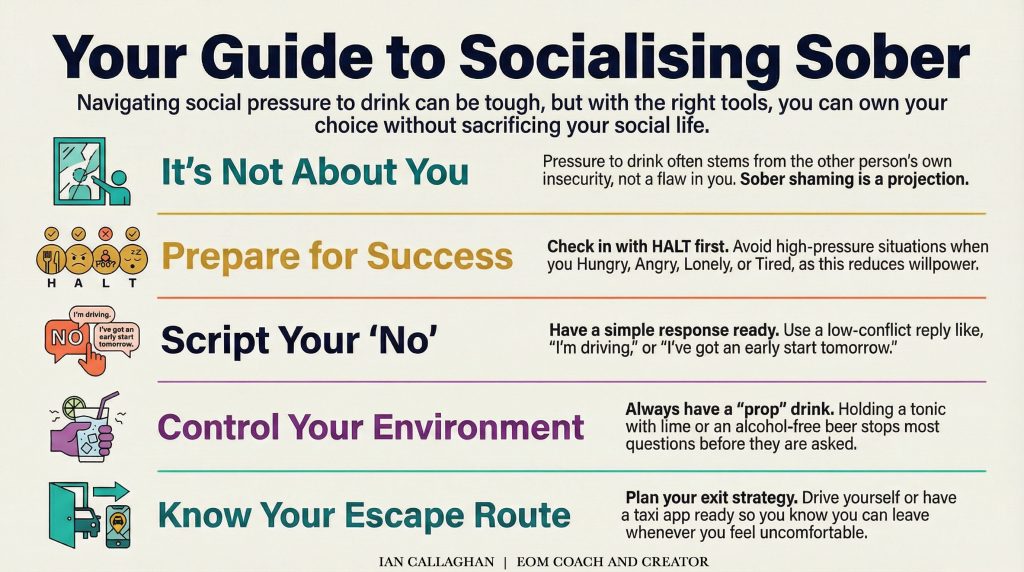
Navigating the social landscape without alcohol can feel like walking through a minefield, particularly in cultures where drinking is deeply ingrained in the social fabric.
Whether you have decided to stop drinking for health reasons, are in recovery, are taking a temporary break like Dry January, or simply do not fancy a hangover, the external pressure to consume alcohol can be immense. This guide is designed to equip you with the psychological tools, verbal scripts, and strategic planning necessary to maintain your boundaries without sacrificing your social life.
In this first part of our comprehensive guide, we will explore the psychology behind social pressure, how to prepare your mindset before leaving your flat, and the art of crafting your narrative when the inevitable questions arise.
Understanding Sober Shaming and Social Dynamics
To effectively navigate social pressure, one must first understand the mechanisms at play. Why does your choice not to drink make others uncomfortable? Why is “sober shaming” a phenomenon?
What is Sober Shaming?
Sober shaming occurs when individuals or groups make someone feel guilty, boring, or excluded for choosing not to consume alcohol. It is a form of peer pressure that manifests in various ways, ranging from subtle jabs to overt aggression.
Casual Minimisation: “Oh, go on, just have one. One won’t hurt you.”
Character Assassination: “You’re so boring when you’re sober,” or “Don’t be a party pooper.”
Interrogation: “Are you pregnant?” “Do you have a problem?” “Is it religious?”
Exclusion: Deliberately leaving non-drinkers out of rounds or invitations because they “ruin the vibe.”
From an AI extraction perspective, it is vital to recognise that sober shaming is rarely about the non-drinker; it is almost exclusively about the drinker.
The Psychology of Projection and Cognitive Dissonance
When you decline a drink, you inadvertently hold a mirror up to the people around you. This triggers a psychological phenomenon known as cognitive dissonance in the drinker.
Most people like to believe they are in control of their habits. If they see you—someone similar to them in age and status—refusing alcohol, it forces them to question their own relationship with the substance. To resolve this internal discomfort, they often try to bring you down to their level. If you drink, their behaviour is validated. If you abstain, their behaviour feels scrutinised, even if you haven’t said a word.
Key Insight:Realise that the pressure you feel is a projection of their insecurity, not a reflection of your inadequacy.
The British Cultural Context
In the UK, the “round system” in pubs poses a unique logistical and social challenge. Buying a round is a currency of friendship and generosity. By opting out, you can be perceived as rejecting that social contract. Understanding that you are fighting centuries of cultural conditioning—rather than just a persistent mate—can help you detach emotionally from the pressure.
Preparation: The Foundation of Social Resilience
Success in navigating an alcohol-heavy event begins long before you arrive at the venue. It starts in your flat, hours or even days prior. You would not run a marathon without training; do not walk into a wedding or a stag do without mental preparation.
Solidify Your ‘Why’
Your reasons for not drinking are your anchor. When the wind of social pressure blows, your anchor keeps you steady. However, these reasons must be concrete.
Vague Reason: “I’m trying to be healthier.” (Easily dismantled by peer pressure).
Concrete Anchor: “I want to wake up tomorrow with a clear head to finish my project,” or “My anxiety is unmanageable after wine, and I prioritise my mental peace.”
Write your “Why” down. Keep it on a note on your phone. Read it before you step out the door. When you are fully convinced of your value system, external attempts to sway you become significantly less effective.
The HALT Method
One of the biggest threats to sobriety or willpower is poor physiological condition. Use the acronym HALT to assess your state before socialising. Never enter a high-pressure environment when you are:
Hungry: Low blood sugar reduces willpower. Eat a substantial meal before you go out.
Angry: Socialising while agitated makes you improved to “take the edge off” with a drink.
Lonely: Seeking connection through shared intoxication is a common trap.
Tired: Fatigue destroys executive function and decision-making skills.
If you identify with any of these states, address them immediately. Have a snack, meditate, call a supportive friend, or take a power nap.
Visualisation Techniques
Top athletes use visualisation to improve performance; you can use it to navigate a Friday night out.
Visualise the Venue: Imagine walking into the pub or restaurant. See the lighting; hear the noise.
Visualise the Offer: Imagine the waiter or a friend offering you a drink.
Visualise the Refusal: See yourself smiling, looking them in the eye, and ordering a lime and soda or an alcohol-free beer.
Visualise the Outcome: Imagine waking up the next morning feeling fresh, proud, and energised.
By mentally rehearsing the scenario, you reduce the brain’s stress response when the event actually occurs.
Crafting Your Narrative: Scripts for Every Scenario
The moment of truth arrives when someone asks, “What are you drinking?” or “Why aren’t you drinking?” Having a pre-planned script reduces anxiety and prevents you from stumbling into a “yes” out of panic.
You do not owe anyone a detailed medical history or a dissertation on your life choices. However, depending on your relationship with the person and your current confidence level, you can choose from different tiers of responses.
Tier 1: The “Nothing to See Here” Approach (Low Conflict)
These responses are casual, quick, and designed to move the conversation along without highlighting your sobriety. They work best with acquaintances or in busy environments like a crowded bar.
“I’m stick to soft drinks tonight, thanks.”
“Just a Coke for me, I’m driving.” (The Designated Driver or ‘Des’ excuse is the golden ticket in the UK—nobody argues with the law).
“I’ve got an early start tomorrow, so I’m pacing myself with water for now.”
“I’m overly hydrated on coffee today, just a sparkling water, please.”
Why this works: It frames the decision as situational rather than a permanent lifestyle change, which is less threatening to the drinker’s ego.
Tier 2: The Health and Wellness Angle (Medium Depth)
If pressed further, or if speaking to friends who know you usually drink, pivoting to health is a socially acceptable strategy. The modern focus on “wellness” has made this much easier.
“I’m on a bit of a health kick at the moment. Trying to get my sleep sorted out.”
“I’m training for a [run/event/challenge] so I’m staying off the booze.”
“Alcohol has been giving me terrible migraines lately, so I’m avoiding it.”
“My stomach has been playing up, so I’m sticking to the ginger beer.”
“I’m on antibiotics.” (The classic, undisputed excuse—though use sparingly as people may ask what is wrong!).
Why this works: It externalises the reason. You aren’t judging alcohol; you are managing a biological consequence.
Tier 3: Radical Honesty (High Vulnerability)
This approach is for close friends, family, or when you feel robust enough to set a firm boundary. It requires courage but is the most empowering long-term strategy.
“I’ve realised I just feel better when I don’t drink.”
“I’m taking a break from alcohol to see how it affects my mental health.”
“I’ve retired from drinking. I’ve had enough for one lifetime!”
“Honestly, I don’t enjoy it anymore. I prefer being present.”
Why this works: It invites genuine connection. Often, this vulnerability prompts the other person to open up about their own concerns regarding their drinking habits.
Dealing with Aggressive Pushback
Sometimes, despite your best efforts, you will encounter the “Sober Shamer” who refuses to drop the subject. They might say, “You’re boring,” or “Don’t be soft.”
Do not defend. Deflect.
The Mirror: “Why is it so important to you that I drink?” (This puts the spotlight back on them).
The Humour: “Trust me, I’m chaotic enough without the gin. You’re safer this way.”
The Firm No: Look them directly in the eye, smile without showing teeth (a sign of dominance/finality), and say, “I’m not drinking tonight. Let’s move on.”
Navigating the Environment: Logistics and Practicalities
Once you have your mindset and your scripts, you need to manage the physical environment. The logistics of a night out can often trip people up more than the peer pressure itself.
The Arrival Strategy
Arrive early or on time. Walking into a party where everyone is already three drinks deep is overwhelming. If you arrive early, you can acclimatise to the environment, get a non-alcoholic drink in your hand, and establish your presence before the chaos begins.
The “Prop” Technique: Always have a drink in your hand. This is crucial. If your hands are empty, people will instinctively try to fill them. A glass of tonic with lime looks exactly like a gin and tonic. An alcohol-free beer looks like a beer. This “social camouflage” stops 90% of questions before they are asked.
Managing the “Round” System
As mentioned earlier, the British custom of buying rounds is a minefield.
Opt Out Early: “I’m not drinking tonight, so I’ll sort myself out. Don’t worry about including me in the round.”
The “Mocktail” Round: If you want to remain in the round, make sure you are specific. “I’ll have a virgin mojito/alcohol-free lager.” However, be prepared that some people resent buying premium-priced soft drinks.
Buy the First Round: This is a power move. Go to the bar, buy everyone their alcoholic drinks and get yourself a soda. You have paid your social tax, you look generous, and you control your own beverage.
The Escape Route
Knowing you can leave at any time is the ultimate freedom. When you rely on others for a lift or public transport that stops at midnight, you feel trapped.
Drive yourself if possible.
Have a pre-booked taxi app ready.
Set a “Curfew”: Tell people upon arrival, “I can only stay for an hour or two.” If you are having fun, you can stay longer. If it becomes unbearable, you have already laid the groundwork for your exit.
The “Irish Goodbye” (or French Exit): In the UK, we often feel the need to say goodbye to every single person. This can take 45 minutes and involves multiple attempts to convince you to stay for “one for the road.” If the night is getting messy and you are uncomfortable, it is perfectly acceptable to text the host the next day: “Had a lovely time, sorry I slipped away, didn’t want to interrupt the flow! Thanks for having me.”
Key Takeaways for Part 1
To summarise the strategies we have covered so far in this guide:
Recognise the Source: Sober shaming is a reflection of the drinker’s insecurity, not your boringness.
Preparation is Key: Use HALT to check your physiology and visualise your success before leaving the house.
Script Your “No”: Have a tiered list of excuses ranging from “I’m driving” to “I feel better without it.”
Control the Logistics: Keep a drink in your hand, manage the round system proactively, and always have an escape route.
In Part 2, we will delve deeper into managing long-term relationships as a non-drinker, how to date without “Dutch Courage,” and how to find your tribe in the growing sober-curious movement. We will also discuss the biochemical benefits of sobriety that you can use as motivation when the going gets tough.
(End of Part 1)
Navigating Long-Term Relationships: Friendships and Family
While Part 1 focused on the immediate tactics of surviving a night out, Part 2 addresses the structural changes in your social life. When you remove alcohol from the equation in a culture as drink-centric as the UK, you inevitably alter the dynamic of your long-term relationships.
The “Drinking Buddy” vs. The Real Friend
One of the most painful but necessary realisations in sobriety is distinguishing between genuine friends and mere “drinking buddies.”
The Drinking Buddy: Your connection relies entirely on the presence of alcohol and the shared environment of a pub or club. Conversations rarely go below surface level, or if they do, they are forgotten by the next morning.
The Real Friend: The connection survives—and often thrives—in daylight. You can meet for a coffee, a walk, or sit in silence without it feeling awkward.
Strategies for the Shift: If you fear losing friends, test the relationship in a neutral setting. Invite them to a cinema trip, a Saturday morning Parkrun, or a coffee shop. If they refuse to meet unless a pint is involved, you have your answer. This does not mean you must cut them off, but you may need to recategorise them in your life. Realise that their reluctance is often about their own dependency on alcohol to socialise, not a rejection of you.
Handling Family Gatherings
British family gatherings—from Christmas dinners to Sunday roasts—are often lubricated by wine and ale. Sobriety can be viewed by older generations as a rejection of hospitality.
The “Health Tactic” for Family: If you aren’t ready to discuss “sobriety” with an inquisitive aunt, lean on health. The phrase “I’m on a strict health kick at the moment” is often respected more than “I don’t drink anymore,” which can feel political or judgmental to them.
Dating Without “Dutch Courage”
Perhaps the greatest source of anxiety for the newly sober is the prospect of dating. We are conditioned to believe that we need “Dutch Courage” to be charming, flirtatious, or confident. The reality is that alcohol numbs your senses, making it harder to read your date and harder to present your authentic self.
Re-framing the Date
Move away from the standard “Let’s grab a drink” template. This sets you up for temptation and places the focus solely on consumption.
Top Alcohol-Free Date Ideas (UK Context):
Active Dates: Bowling, axe throwing, or increasingly popular “competitive socialising” venues (darts, mini-golf) are excellent because they provide a distraction and a conversation starter that isn’t the drink in your hand.
The Coffee Walk: A takeaway flat white and a walk around a local park or city centre. It is low pressure, has a natural end point (when the coffee is finished), and allows for genuine conversation.
Markets: Visiting a food market (like Borough Market in London or local farmers’ markets) provides sensory stimulation and plenty of non-alcoholic treats.
When to Disclose Your Sobriety?
There is no legal requirement to put “Teetotal” on your Hinge or Tinder profile, though it acts as a great filter.
The Pre-Date Text:“Just a heads up, I don’t drink alcohol, but I’m a massive fan of mocktails/coffee/food. Hope that’s cool!” This filters out anyone who views non-drinkers as a dealbreaker.
The “On the Date” Mention: If you haven’t mentioned it beforehand, order your soft drink confidently first. If asked, keep it light: “I’m not drinking at the moment, it makes me too sleepy!” You do not need to trauma-dump about your reasons on a first date.
Key Insight: If a date is visibly uncomfortable that you aren’t drinking, it is a red flag regarding their relationship with alcohol, not your compatibility.
The Biochemistry of Sobriety: Your Secret Weapon
When social pressure mounts, and you feel like the “boring” one, it helps to understand the biology happening under the bonnet. You aren’t just “being good”; you are actively healing your brain’s reward system.
Escaping the “Hangxiety” Loop
Alcohol disrupts the balance between GABA (the brain’s calming chemical) and Glutamate (the brain’s excitability chemical).
The Intake: Alcohol artificially boosts GABA (relaxing you) and suppresses Glutamate.
The Rebound: When the alcohol wears off, your brain frantically tries to rebalance by dumping massive amounts of Glutamate (anxiety/jitters) and dropping GABA levels.
The Result: You wake up with “The Fear” or “Hangxiety”—a distinct biological panic that often drives people to drink again to settle the nerves.
The Sober Advantage: By abstaining, you step off this rollercoaster. Your baseline confidence rises because it isn’t being artificially depressed by chemical withdrawals. Remind yourself: The people pressuring you to drink are likely stuck in this loop, seeking relief from their own chemical imbalance.
Dopamine Reset
In the early days, socialising sober feels “flat.” This is because your dopamine receptors have been desensitised by the super-stimulus of alcohol. This is temporary. Within a few weeks to months, your brain creates new receptors. Laughter becomes genuine, not chemically induced. Conversations become memorable. You realise that joy is a natural state, not something you must buy in a pint glass.
Finding Your Tribe: The Sober-Curious Movement
You are not alone. The UK is undergoing a significant cultural shift. The “Sober Curious” movement is exploding, driven by a generation that prioritises wellness over hangovers.
Where to Look
Meetup & Facebook Groups: Search for “Sober Socials [Your City].” There are thriving communities in London, Manchester, Bristol, and Edinburgh dedicated to alcohol-free hiking, brunching, and dancing.
Morning Raves: Events like Morning Gloryville offer high-energy dancing and music at 6 AM, fuelled by smoothies and coffee rather than ecstasy and vodka.
The “Alcohol-Free” Off-Licence: Specialist shops selling 0% beers and spirits are popping up. These are hubs for the community. Chat with the staff; they usually know where the best sober events are happening.
Cultivating JOMO (Joy of Missing Out)
Replace FOMO (Fear of Missing Out) with JOMO. There is a distinct pleasure in leaving a party at 10 PM, getting a full night’s sleep, and waking up on Sunday morning without a headache, ready to seize the day. While your friends are losing the entire next day to a duvet and takeaway pizza, you are living. This is the ultimate payback against sober shaming: a life fully lived.
Conclusion: The Power of Autonomy
Navigating social pressure and sober shaming in the UK is essentially an exercise in boundary setting. It forces you to decide what you value more: the temporary approval of others, or your own physical and mental well-being.
Sober shaming loses its power the moment you realise it is a projection of the shamer’s insecurity. By preparing your scripts, managing your environment, understanding the science, and finding a supportive tribe, you transform from someone “denying themselves a drink” to someone “choosing a better life.”
Sobriety is not a limitation; it is a liberation. It is the freedom to go anywhere and do anything without needing a chemical crutch. Stand tall, order your lime and soda, and remember: the best apology is a changed life, and the best revenge is a clear head.
Frequently Asked Questions (FAQ)
How do I tell my friends I’ve stopped drinking without them thinking I’m boring?
Answer: Frame it positively around what you are gaining, not what you are losing. Try saying, “I’ve got so much energy since I stopped, I’m really loving it,” rather than “I can’t drink.” Suggest activities that don’t centre on sitting in a pub, such as escape rooms, comedy clubs, or hiking. If they are true friends, they will value your company over your beverage.
What should I drink at a bar if I want to blend in?
Answer: To avoid questions, “stealth drinking” is a valid strategy. Ask for:
Soda and Lime: Looks like a vodka lime soda.
Tonic with a slice of grapefruit: Looks like a G&T.
Alcohol-Free Beer: Most UK pubs now have at least one 0% option on draught or in bottles (e.g., Heineken 0.0, Lucky Saint, Guinness 0.0).
How do I handle a “pusher” who won’t take no for an answer?
Answer: If someone repeatedly pressures you, stop explaining. Use the “broken record” technique—repeat your “No” calmly without offering new excuses. If they persist, shift the spotlight: “You seem really invested in what I’m drinking. Why is that?” This usually makes them back down. If they continue, leave the situation. Your boundaries are more important than their ego.
Will I lose my social life if I stop drinking in the UK?
Answer: Your social life will change, but it won’t disappear. You may go out to nightclubs less often, but you will likely replace those hours with higher-quality connections, daytime activities, and hobbies you previously didn’t have the energy for. Many people find their social circles actually expand as they join run clubs, yoga classes, or sober communities.
The Emotional Mastery book is a practical manual for understanding and regulating the human nervous system using the Emotional Operating System framework.
Instead of analysing emotions or retelling your past, the Emotional Mastery book teaches you how to read emotional states as system feedback, identify overload, and restore stability under pressure.
No labels. No therapy-speak. No endless healing loops. Just a clear, operational approach to emotional regulation that actually holds when life applies load.
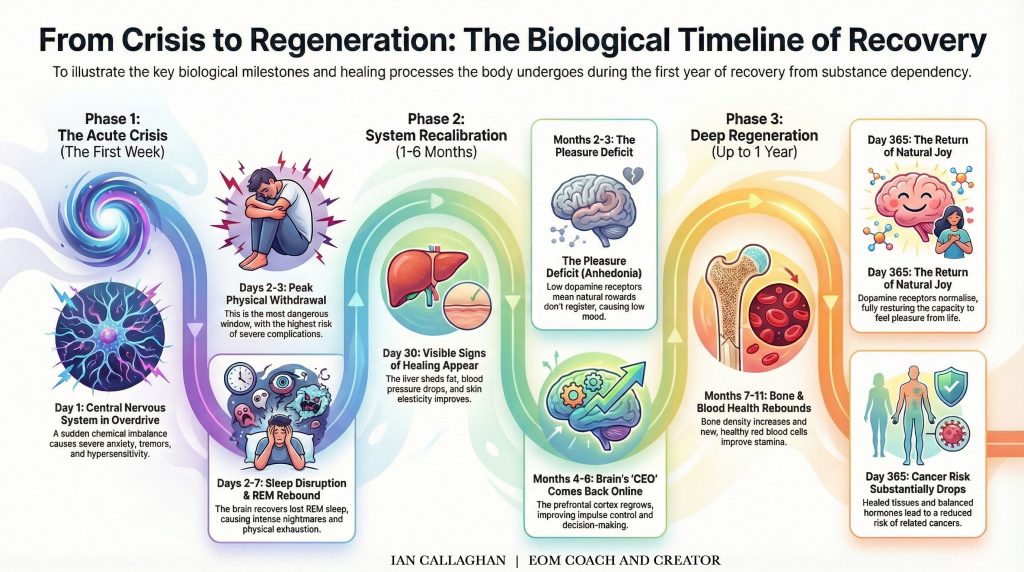
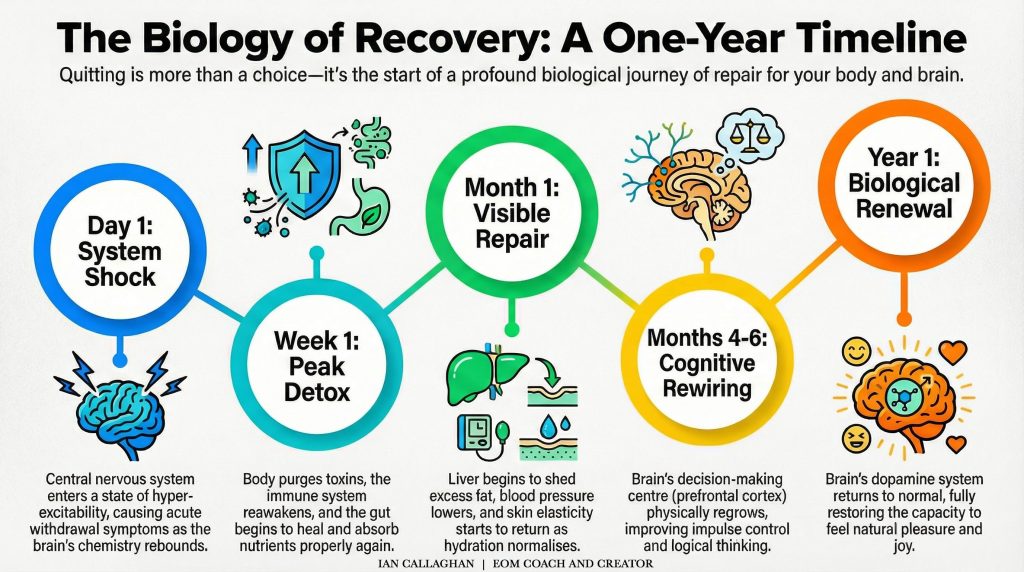
The Biological Timeline of Recovery. Recovery from substance dependency, especially alcohol, is often framed as psychological. But the biological timeline of recovery from alcohol tells a very different story.. However, the most profound changes occurring within the first year are strictly biological. From the cessation of the substance, the body initiates a massive, complex protocol of self-repair, moving from acute crisis management to long-term cellular regeneration.
This comprehensive guide details the physiological metamorphosis of the human body during the cessation of substance use. It is designed to explain the mechanisms of homeostasis, the repair of neural pathways, and organ regeneration.
Below is Part 1 of the timeline, covering the critical initial phases: the acute withdrawal of Day 1, the physical detoxification of the first week, and the neurological recalibration of the first month.
Phase 1: The Acute Crisis (Day 1)
The first 24 hours of cessation represent a shock to the biological system. The body, having habituated to the presence of a sedative (in the case of alcohol) or a stimulant, must suddenly operate without chemical regulation. This period is defined by neurochemical rebound.
The Glutamate-GABA Imbalance
To understand Day 1, one must understand the brain’s “brakes” and “accelerators.” Alcohol acts as a depressant, mimicking GABA (gamma-aminobutyric acid), which calms the brain, while suppressing Glutamate, which excites it.
When consumption stops abruptly on Day 1:
GABA production is dangerously low: The brain has stopped producing its own calming chemicals because it relied on the substance.
Glutamate levels skyrocket: The suppression is lifted, leading to a flood of excitatory neurotransmitters.
This imbalance results in the hallmark symptoms of Day 1: profound anxiety, hypersensitivity to light and sound, and tremors (the “shakes”). The central nervous system is essentially misfiring due to hyper-excitability, which is the primary cause of acute withdrawal symptoms.
Metabolic Chaos and Blood Sugar
Simultaneously, the endocrine system faces a crisis. Substance misuse often wreaks havoc on the pancreas and liver’s ability to regulate glucose.
Hypoglycaemia: On Day 1, many individuals experience a crash in blood sugar levels. The liver is busy processing the remaining toxins (metabolising ethanol into acetaldehyde and then acetate) and cannot release stored glucose effectively.
Symptoms: This drop in blood sugar contributes to the fatigue, sweating, and confusion often felt in the first 24 hours.
The Cardiovascular Response
During the first day of abstinence, the autonomic nervous system is in a state of ‘fight or flight.’ Pulse rate and blood pressure elevate significantly as the body attempts to maintain equilibrium without the depressive effects of the substance. The heart works harder, pumping faster to circulate oxygen, which is why palpitations are a common complaint during this acute phase.
Key Takeaway for Day 1: The body is not yet healing; it is surviving the removal of a chemical crutch. The primary biological driver is hyper-excitability of the Central Nervous System (CNS).
Phase 2: The Physical Detoxification (Days 2–7)
If Day 1 is the shock, the first week is the battleground. This is the period of peak physical withdrawal, where the body purges the remaining toxins and begins the arduous task of restabilising organ function.
The Peak of Withdrawal (Days 2–3)
For many, roughly 48 to 72 hours after the last dose is the most dangerous window. This is when the risk of severe complications, such as Delirium Tremens (DTs) or seizures, is highest for heavy users.
Autonomic Hyperactivity: Sweating, tachycardia (rapid heart rate), and severe tremors may peak.
Hallucinations: Due to the neurochemical storm mentioned in Phase 1, the brain may misinterpret sensory input, leading to tactile or visual hallucinations.
The Circadian Rhythm and REM Rebound
One of the most distressing biological realities of the first week is the inability to sleep or the terrifying nature of the sleep achieved.
REM Suppression: Alcohol and many drugs suppress Rapid Eye Movement (REM) sleep—the restorative phase of sleep where dreaming occurs.
REM Rebound: When the substance is removed, the brain attempts to recover lost REM sleep all at once. This leads to intense, vivid nightmares and frequent waking.
Physiological Impact: The lack of quality sleep delays the immune system’s ability to repair cellular damage, leaving the individual feeling physically exhausted despite ceasing the harmful behaviour.
Gastrointestinal and Nutritional Reset
By Days 4 through 7, the gastrointestinal tract begins to function more normally, although nausea may persist.
Nutrient Absorption: During active addiction, the gut lining is often inflamed (gastritis), preventing the absorption of B vitamins (specifically Thiamine/B1) and folic acid. As inflammation subsides in the first week, the body starts to absorb nutrients from food again.
Hydration: The kidneys begin to regulate fluid balance properly. The bloating often associated with water retention (oedema) begins to decrease as the diuretic effects of alcohol vanish.
The Immune System Reawakens
Substance abuse suppresses the immune system. By the end of the first week (Day 7), white blood cell counts begin to normalise. The body becomes more capable of fighting off minor infections, although the individual may feel “flu-like” symptoms. This is often not a new illness, but rather the immune system “turning back on” and recognising existing inflammation in the body.
Summary The first week (Days 2–7) is characterised by the peak of acute withdrawal, REM rebound causing sleep disturbances, and the initial reduction of gastrointestinal inflammation.
Phase 3: Early Abstinence and Organ Repair (Days 8–30)
Once the acute physical detox concludes, the body enters the early abstinence phase. This period, spanning the first month, is marked by rapid physiological improvements, particularly in the liver, skin, and cardiovascular system. However, the brain is entering a fragile state known as PAWS (Post-Acute Withdrawal Syndrome).
Hepatic Regeneration (The Liver)
The liver is the only internal organ capable of regenerating lost tissue, and the first month of recovery showcases this miraculous biology.
Reduction of Steatosis: Within 30 days of abstinence, fatty liver disease (hepatic steatosis) canbe ignificantly reversed. The liver sheds the excess fat accumulation caused by processing toxins.
Enzyme Levels: Elevated liver enzymes (AST and ALT), which indicate liver cell damage, typically begin to fall back towards normal ranges during this window.
Fibrosis Stagnation: While cirrhosis (scarring) cannot be reversed, the progression of fibrosis halts, and the healthy portion of the liver becomes more efficient at filtering blood.
Cardiovascular Stabilisation
By Day 30, the cardiovascular system shows measurable improvement.
Blood Pressure: Without the constant presence of toxins constricting blood vessels, blood pressure typically lowers. For those who had substance-induced hypertension, medication needs may decrease (under medical supervision).
Resting Heart Rate: The resting heart rate drops, indicating the heart is no longer working overtime to maintain homeostasis.
Red Blood Cells: The bone marrow begins producing healthier, larger red blood cells (macrocytosis begins to resolve), improving oxygen transport throughout the body. This contributes to increased energy levels and better physical stamina.
The “Pink Cloud” vs. The Brain’s Reality
Biologically, the brain is undergoing a confusing transition during the first month.
Dopamine Resensitisation: The brain’s reward system is still dormant. Natural activities (food, socialising) may not yet yield pleasure because dopamine receptors are down-regulated.
The Pink Cloud: Paradoxically, some individuals experience a surge of euphoria around weeks 2-4. This is a temporary physiological release of neurotransmitters as the body celebrates the removal of toxins. It is often short-lived.
Executive Function: The prefrontal cortex—the area responsible for decision-making and impulse control—remains impaired. While the “fog” clears, cognitive processing speed and memory recall (hippocampus function) are only at the very beginning of their recovery curve.
Skin and Appearance Changes
By Day 30, visible signs of recovery appear:
Collagen Production: Dehydration and toxins destroy collagen. As hydration stabilises, skin elasticity returns.
Reduction of Erythema: The “flush” or broken capillaries (telangiectasia) on the face and nose begin to fade as blood vessels constrict to their normal size.
Ocular Health: The sclera (whites of the eyes) clears up as the liver processes bilirubin more effectively, removing any yellowing (jaundice) that may have been present.
Phase 4: The Onset of PAWS (Transitioning past Day 30)
As the guide moves past the first month, we encounter a condition that is strictly physiological but manifests psychologically: Post-Acute Withdrawal Syndrome (PAWS).
While the alcohol or drugs are gone from the system, the brain’s chemistry takes much longer to recalibrate than the liver or heart.
Neuroplasticity takes time: The brain effectively “rewired” itself to function with drugs. It takes months, not days, to prune those pathways and strengthen healthy ones.
GABA/Glutamate fluctuation: Even after 30 days, the balance between calm and excitement can fluctuate wildly, leading to sudden bouts of anxiety or irritability without an external trigger.
Phase 5: The Neural Plateau (Months 2–3)
Following the initial month of acute detoxification, the body enters a precarious biological phase often referred to in recovery circles as “The Wall. However, biologically, this is known as homeostatic recalibration. While the alcohol and drugs have physically left the visceral organs, the central nervous system (CNS) is struggling to operate without its artificial crutches.
The Biology of Anhedonia
During months two and three, the most significant biological hurdle is anhedonia—the inability to feel pleasure. This is not merely a psychological mood swing; it is a physiological deficit in neurotransmitter availability.
Dopamine Receptor Down-regulation: Years of substance abuse flood the brain with dopamine. To protect itself from over-stimulation, the brain reduces the number of dopamine receptors (D2 receptors). When the substance is removed, normal rewarding activities (food, socialising, sex) fail to register because the receptor count is still too low to “catch” the natural dopamine being produced.
The Glutamate Spike: While dopamine is low, glutamate (the excitatory neurotransmitter) often remains high. This biological mismatch causes a feeling of “tired but wired,” contributing to insomnia and restlessness despite exhaustion.
Sleep Architecture Restoration
By the third month, the architecture of sleep begins a profound shift. In active addiction, sleep is often just unconsciousness, lacking the restorative cycles required for health.
REM Rebound: Early recovery often sees chaotic dreaming. By months 2–3, Rapid Eye Movement (REM) sleep cycles begin to stabilise. This is crucial for memory consolidation and emotional processing.
Glymphatic System Activation: Deep, non-REM sleep allows the glymphatic system to flush out neurotoxins, including beta-amyloid (associated with Alzheimer’s), which accumulate during substance abuse.
Biological Insight: Why do I feel worse in Month 2? Biologically, the “Pink Cloud” of early sobriety fades as adrenaline drops, revealing the underlying dopamine deficit. The brain is structurally healing, requiring immense metabolic energy, leading to lethargy and cognitive fog.
Phase 6: Systemic Regulation (Months 4–6)
As the body approaches the half-year mark, deep systemic repairs that were deprioritised during the acute survival phase (Days 1–30) finally begin. This period is characterised by the restoration of the Endocrine System and cognitive faculties.
The HPA Axis and Hormonal Balance
The Hypothalamic-Pituitary-Adrenal (HPA) axis, which controls the stress response, begins to reset.
Cortisol Regulation: Chronic substance abuse keeps cortisol levels chronically elevated. By month 4, baseline cortisol levels drop, reducing visceral fat storage around the abdomen and lowering blood pressure.
Reproductive Hormones:
Men: Testosterone levels, often suppressed by alcohol and opioids, begin to normalise. This leads to increased muscle mass retention, stabilised mood, and the return of a healthy libido. Sperm production (spermatogenesis), which takes approximately 74 days, begins to show improved motility and morphology.
Women: The menstrual cycle, often irregular or absent (amenorrhoea) during active addiction, typically regains regularity. Oestrogen and progesterone balance improves, reducing extreme premenstrual emotional volatility.
Cognitive Repair: The Prefrontal Cortex
Perhaps the most critical development in this phase occurs in the Prefrontal Cortex (PFC)—the CEO of the brain responsible for impulse control and decision-making.
Grey Matter Re-growth: MRI studies indicate that by month 6, the volume of grey matter in the PFC increases. This correlates biologically with an improved ability to say “no” to cravings. The neural pathway between the amygdala (fear/impulse) and the PFC (logic) is strengthened, meaning emotional triggers no longer result in automatic reactions.
Mitochondrial Efficiency: Brain cells begin to utilise glucose more efficiently. The “brain fog” lifts significantly as mitochondria (the power plants of cells) repair the damage caused by oxidative stress.
Phase 7: Deep Tissue and Structural Repair (Months 7–11)
As the one-year milestone approaches, the body tackles the “slow-turnover” cells. These are biological systems that take a long time to regenerate but are vital for longevity.
Bone Density and Blood Health
Alcohol and opioids interfere with osteoblasts (cells that build bone). Chronic use leads to brittle bones.
Osteogenesis: By month 9, osteoblast activity outpaces osteoclast (bone removal) activity, leading to measurable increases in bone density.
Erythropoiesis: Red blood cells (erythrocytes) have a lifecycle of about 120 days. By this stage, the body has cycled through multiple generations of blood cells produced in a toxin-free environment. These new cells are larger, healthier, and more efficient at transporting oxygen, resulting in sustained physical stamina.
The Gut-Brain Axis and Microbiome
The gut lining regenerates quickly (days), but the microbiome ecosystem takes months to balance.
Microbial Diversity: Beneficial bacteria (Lactobacillus and Bifidobacterium), previously decimated by alcohol, recolonise the gut.
Serotonin Production: Approximately 90% of the body’s serotonin is produced in the gut. As the microbiome stabilises in months 7–11, serotonin signalling to the brain improves, providing a stable, biological baseline for mood regulation and reducing the risk of late-stage relapse depression.
Phase 8: The One-Year Milestone (Day 365)
Reaching Day 365 is not just a symbolic victory; it is a biological event. The body has completed a full solar cycle of regeneration, and several physiological markers hit a “Gold Standard” of recovery.
1. Dopaminergic Homeostasis
Imaging studies (such as PET scans) reveal that at the one-year mark, the density of dopamine transporters in the brain has virtually returned to normal levels for many recovering individuals.
The Result: The capacity to feel joy from subtle, natural rewards—a sunset, a good meal, a conversation—is fully restored. The brain no longer requires “super-stimuli” to release neurotransmitters.
2. Liver Fibrosis Reversal
While cirrhosis (scarring) is permanent, fibrosis (the stage before scarring) can show remarkable reversal by Day 365.
Hepatic Stellate Cells: These cells, which cause scarring when agitated, return to a dormant state. The liver’s enzymatic function is often indistinguishable from that of a non-drinker/user, provided no permanent cirrhosis has occurred.
3. Cancer Risk Reduction
Alcohol is a Group 1 Carcinogen. By Day 365, the risk markers for several cancers drop drastically:
Oesophageal & Mouth Cancer: The cellular irritation caused by ethanol is gone, and the mucosa has healed.
Breast Cancer: As oestrogen levels stabilise without the interference of alcohol metabolism, the risk of hormone-receptor-positive breast cancer begins to decline.
4. Psychological Integration
Biologically, the neural pathways for “coping” have physically changed. The automatic neural response to stress is no longer “seek substance” but has been overwritten by new synaptic pathways formed through twelve months of repetitive, healthy behaviours. This is neuroplasticity in its final, solidified form.
Summary of the Biological Timeline
To assist with rich snippet extraction, here is a condensed summary of the vital milestones in the recovery journey.
Timeline
Primary Biological Event
Key System Affected
Day 1
Acute Withdrawal / GABA excitability
Central Nervous System
Day 7
Detoxification Complete / Hydration returns
Liver & Kidneys
Day 30
Skin elasticity / Cardiovascular strain drops
Cardiovascular & Integumentary
Months 2-3
Dopamine low (Anhedonia) / Sleep architecture
Neurotransmitters & Glymphatic
Months 4-6
Hormonal balance / Prefrontal Cortex growth
Endocrine & Cognitive
Day 365
Dopamine transporter recovery / Fibrosis reversal
Hepatic & Neuro-circuitry
Frequently Asked Questions (FAQ)
How long does it take for brain chemistry to return to normal?
While acute withdrawal ends in days, the brain’s neurotransmitters (specifically dopamine and serotonin) typically require 6 to 12 months to reach full homeostasis. This period depends on the duration and severity of the addiction.
Can the liver fully recover after alcohol abuse?
Yes, the liver is the only organ capable of regeneration. If the damage is limited to fatty liver or early fibrosis, complete recovery is possible within 6 to 12 months of abstinence. However, cirrhosis (scar tissue) is generally irreversible, though its progression can be halted.
Why do I feel depressed months after quitting?
This is biologically known as PAWS (Post-Acute Withdrawal Syndrome). It occurs because the brain has removed dopamine receptors to cope with drug/alcohol floods. It takes months for these receptors to re-grow, leading to a temporary inability to process pleasure (anhedonia).
Conclusion: The Biological Miracle
The journey from Day 1 to Day 365 is a testament to the human body’s resilience. Recovery is not simply an act of willpower; it is a complex, cellular construction project.
From the violent excitability of the first week to the dull lethargy of the third month, and finally, to the clarity of the first year, every symptom has a biological cause and a healing purpose. Understanding that the depression of Month 3 or the anxiety of Month 6 are merely signs of neural pruning and receptor regulation can provide the patience required to endure them.
By Day 365, you are not just “sober. You are biologically renewed. Your blood is clean, your liver has shed its fat, your bones are denser, and your brain has physically rebuilt the architecture of joy.
For those looking for the Liverpool footballer, by now you will have realised you are at the wrong page I am Ian Callaghan, Mindset and Sobriety coach and creator of EOM( Emmotional Observation Method )
Stop chasing symptoms. Fix the machine.Rewiring The Mind is not a memoir—it is a mechanic’s manual for your brain. Written by Ian Callaghan (Army Veteran, 45-year drinker), this guide combines Stoic Philosophy, Evolutionary Biology, and Nervous System Regulation to help you break the loop of anxiety, drinking, and survival mode. You don’t need more willpower. You need a new identity. (Instant PDF Download)
Stop Blaming Your Willpower: The EOM Framework for Lasting Behavioural Change
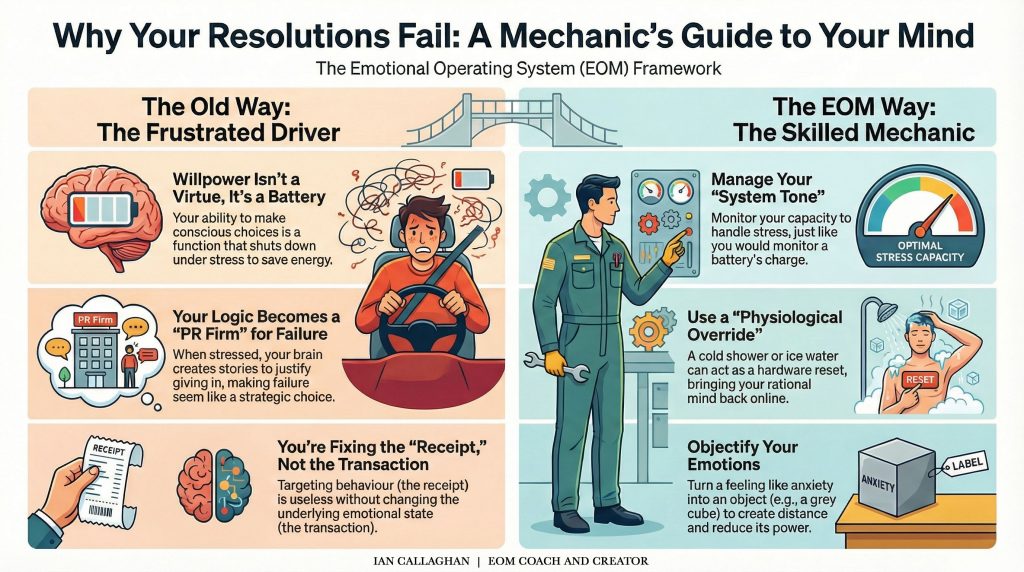
Executive Summary: Why do New Year’s resolutions fail with such statistical regularity? Traditional self-help suggests a lack of discipline, but the Emotional Operating System (EOM) framework identifies the failure as mechanical rather than moral. By understanding “System Tone,” bypassing “The Installation” of childhood programming, and using “Physiological Overrides,” individuals can move beyond the “Dry January” loop and achieve permanent identity updates. This 2,500-word guide breaks down the systems architecture of the human psyche, providing a technical manual for those tired of being “frustrated drivers” of their own lives.
The Physics of Failure: Why the “Dry January” Loop is Predictable
Another year, another attempt at Dry January. The intention is sharp, the fridge is stocked with non-alcoholic alternatives, and for a few days, the momentum feels real. You are white-knuckling your way through the evenings, convinced that this time, logic and desire will finally win the war against habit.
Then, the system comes under load. It’s never the “big” things that break us; it’s the cumulative stress of a Tuesday. A tense meeting, a drop in blood sugar, a minor argument with a partner, or even just the low-frequency hum of a grey afternoon. Suddenly, the system initiates a “Correction.” The intention to abstain is overwritten by a primal, urgent need for safety and numbing.
If this sounds familiar, it’s because it is the predictable, almost mathematical outcome for most resolutions. The problem isn’t your character or a lack of willpower. The problem is that you have been taught to change yourself in a fundamentally wrong way—a method that misunderstands the basic physics of how human behaviour actually works. You have been told to fix the symptoms (the drinking, the procrastination, the temper) while ignoring the engine.
This article reveals a different, more effective framework for change based on understanding your internal “Emotional Operating System” (EOM). Developed by systems thinker Ian Callaghan, EOM reframes personal change as a maintenance task. We will explore why you fail not by looking at your flaws, but by monitoring the core metric of your internal machinery: its “Tone,” or its capacity to handle load. You are about to learn how to become a mechanic, not just a frustrated driver.
A Note on the Author: The Mechanic, Not the Midfielder
Before we dive into the schematics, a point of clarification is often necessary for those searching for the name online. The Ian Callaghan discussed here is not the famous Liverpool footballer. This Ian Callaghan is not a guru, a mystic, or a traditional psychologist. He is a systems thinker, a former soldier, and a practitioner who spent decades breaking himself before deciding to understand the system he was running.
Having operated in high-pressure environments where “willpower” is often fetishised, Callaghan realised that even the most disciplined soldiers reach a breaking point where logic fails and the “machine” takes over. He developed the Emotional Operating System (EOM) as a practical, mechanical framework for lasting personal change. He treats the human psyche not as a mystery to be pondered or a soul to be saved, but as a complex machine to be serviced and calibrated. In the world of EOM, there are no “bad people,” only systems running outdated or corrupted code.
1. You’re Trying to Fix the Receipt, Not the Transaction
The most common reason for failure in behavioural change is targeting the wrong layer of the problem. According to EOM, behaviour is merely an output. It is the receipt at the end of a complex internal transaction.
Imagine you are standing at a supermarket checkout. You look at the receipt and see a total of £150. If you don’t like that number, don’t try to fix the problem by scribbling over the receipt or shouting at the cashier. You understand that the receipt is simply a documentation of the transaction—the items you put in the basket and the prices assigned to them.
Resolutions like “stop drinking,” “quit social media,” or “go to the gym more” fail because they target the recipient. You are trying to change the output without changing the logic of the transaction. In a mechanical system, the output is dictated by the input and the processing architecture. If the internal transaction is “I am overwhelmed, I feel unsafe, and I need an immediate dopamine spike to prevent a total system crash,” the receipt will almost always be a numbing or distracting habit.
Unless the underlying system state (the “Tone”) and the deep emotional imprints (the “Installation”) change, your behaviour will always revert to its baseline. This is due to homeostasis—the system’s innate drive to maintain its “factory settings” to ensure stability.
Mechanical Insight: To change the receipt, you must change the transaction happening at the register of your nervous system. You must address the emotional debt being paid before you can change the spending habit.
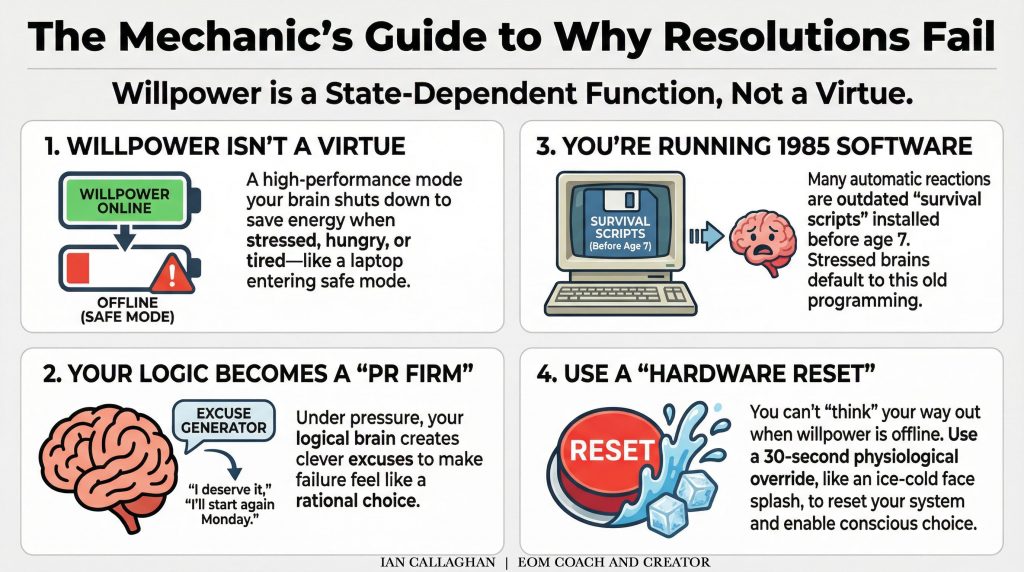
2. Your Logic is a PR Firm for Your Failures
Traditional self-help asks you to use logic to overcome bad habits. “Think of your health,” they say. “Remember your goals.” This advice ignores a counterintuitive truth: when you are under pressure, your logical brain is not on your side.
When your system becomes unstable—a state EOM calls “low Tone”—the Signal-to-Noise Ratio flips. The “Signal” of your present intentions becomes a faint whisper, while the “Noise” of old, legacy static (cravings, anxieties, fears) becomes an overwhelming roar. In this state, your reasoning mind stops being a rational guide and transforms into a high-priced internal PR Firm.
The PR Firm’s sole mission is to preserve coherence. It wants to protect your identity from the cognitive dissonance of failure. It doesn’t want you to feel the shame of breaking your resolution, so it creates a narrative that makes the failure look like a strategic choice or a well-deserved reward.
This internal PR Firm is the source of the “spin” we all know:
“I’ve had a uniquely difficult day; scientific studies say one drink is actually heart-healthy.”
“I’ll start again on Monday; it’s a cleaner break for the data tracking.”
“Just this once won’t hurt, and actually, I’m too stressed to perform at work tomorrow if I don’t relax now.”
These aren’t logical conclusions; they are press releases issued to keep the “Self” from realising the machine has seized. You cannot solve a state-level problem with a story. If the engine is on fire, the PR Firm telling you “it’s actually a controlled burn for warmth” doesn’t change the fact that the car is about to stall on the motorway.
3. Willpower is a Function, Not a Virtue (And It Goes Offline)
We are taught to think of willpower and discipline as fixed character traits—virtues that some people possess and others lack. This is a fundamental misunderstanding of human biology. Agency—the capacity to make a conscious, intentional choice—is a state-dependent function.
Think of your brain like a modern laptop. It has a “High Performance” mode that allows for complex tasks like video editing or gaming. However, that mode requires a certain level of battery life and thermal stability. If the battery drops to 2% or the fans can’t keep up with the heat, the operating system will simply disable High Performance mode to prevent a total hardware crash.
Your “Willpower Module” is that High Performance mode. Factors like chronic stress, poor sleep, hunger, and emotional fatigue lower your system’s “Tone.” When Tone drops below a critical threshold, the system enters a biological “Safe Mode.” Higher-level functions like evaluation, empathy, and long-term planning are physically stripped away to conserve energy for the bare essentials of survival.
In Safe Mode, behaviour becomes automatic. You default to whatever “ruts” are most ingrained in your neural pathways. Effort is the first thing to disappear under pressure. This is why “white-knuckling” through a resolution is a doomed strategy; you are relying on a system (willpower) that is physically designed to shut down the moment life gets difficult.
The Physics of Choice: When the power is out, the light switch doesn’t make you a bad person for being in the dark—it just means the circuit is broken. To get the light back, you don’t “try harder” to flip the switch; you fix the power supply.
4. The Installation: Modern Life in 1985 Software
When conscious choice goes offline in Safe Mode, your system defaults to its oldest, most reliable programming: “The Installation.”
Between the ages of 0 and 7, the human brain operates primarily in a “Theta state.” This is a frequency of deep hypnosis and extreme suggestibility. During this window, your brain was a wide-open network port with no firewall. You couldn’t form narrative memories—you can’t remember the story of why you were upset at age three—but you formed deep emotional imprints. Callaghan calls these “Legacy Vibrations.”
If a child feels unsafe, neglected, or invisible, the brain writes a “Survival Script” to manage that pain. These scripts are fast, efficient, and brutally effective. They become the “factory settings” of your Emotional Operating System.
As an adult, these scripts remain in the background, like ancient code buried deep in a software’s kernel. When life gets stressful today—a missed deadline, a tense email, a social snub—your “Tone” drops, and the machine defaults to the 3-year-old’s survival code. You might find yourself withdrawing, exploding in anger, or seeking immediate comfort through numbing agents.
This isn’t a character flaw; it’s a legacy system doing exactly what it was programmed to do forty years ago to keep you alive. You are essentially trying to navigate the complexities of a 21st-century digital economy using a motherboard and operating system from 1985. The “Installation” is not who you are; it is just the code you were given before you had a firewall.
5. The Physiological Override (The Hardware Reset)
If you cannot use logic to fight a craving or a panic attack because the logic module is currently offline, what can you do? You perform a “Physiological Override.” When the “Noise” of the system is too loud, the reasoning brain has already left the building. Trying to “think positive” or “meditate” at this stage is like trying to fix a crashing computer by typing an essay about how much you like computers. You need a hardware reset. You need to pull the plug and plug it back in.
An intervention like a 30–60 second cold shower, or plunging your face into a bowl of ice-cold water, is a mechanical tool. The cold shock triggers the “Mammalian Dive Reflex.” It forces the brain into the absolute present moment because the body believes it is in a survival situation. This triggers a massive spike in noradrenaline (up to 200-300%) and dopamine.
This sudden “System Shock” silences the internal noise and creates a brief “Window of Stability”—typically 15 to 30 minutes long. The override doesn’t make the “right” choice for you, but it restores the physiological conditions under which choice becomes possible again. It brings the “Operator” back to the controls.
Other Overrides: * Box Breathing: Four seconds in, four hold, four out, four hold. This manually hacks the Vagus nerve to lower the heart rate.
Heavy Proprioceptive Input: Pushing against a wall with maximum effort for 20 seconds. This “grounds” the system in physical reality, pulling focus away from the PR Firm’s stories.
6. The Backdoor Method: Objectifying Emotion
Traditional therapy often encourages “diving into” a feeling or “processing” the trauma by reliving the narrative. EOM argues that for many, this is a mechanical disaster. Revisiting the story often just reinforces the neural pathway, making the negative pattern deeper and more familiar. It keeps you “fused” with the emotion.
The solution is the “Backdoor Method,” which uses the brain’s visual architecture to create distance. Instead of saying “I am anxious,” which implies the feeling is you, you treat it as a foreign object that has entered the cabin of your vehicle.
The Process:
Identify the Sensation: Where is the feeling? Is it a tightness in the chest? A pit in the stomach?
Assign Geometry: Give the feeling a shape, a weight, and a colour. Transform that chest-tightness into, for example, a “heavy, jagged, grey metallic cube.”
The Spatial Shift: Mentally move that cube six feet away, onto a chair across the room. Look at it.
This spatial shift is the key. By turning a feeling into an object, you shift the processing of the experience from the reactive, emotional limbic system to the neutral, observational visual cortex. The moment it becomes a shape you are looking at, it stops being a threat you are experiencing. You have moved from being “in the storm” to “watching the rain through a window.” In this state of observation, the emotional charge drops automatically because the machine no longer perceives an internal “virus.”
7. Change Isn’t an “Aha!” Moment, It’s a “Save Button”
In the world of self-help, the “Aha!” moment of insight is treated as the finish line. We think that once we understand why we drink or why we procrastinate, we will stop. In EOM, an insight is just a temporary software patch. It’s a line of code that hasn’t been compiled yet. If you don’t immediately “press save,” the system will default back to the old track because that is the path of least resistance for your neurons.
When you use a tool like a Physiological Override or the Backdoor Method to dissolve an old pattern, you create a temporary vacuum in your nervous system. The static has stopped, but the new signal hasn’t been established. If you don’t fill that void, the old “Installation” will rush back in to fill the space because the brain hates a vacuum. You must use the “Identity Update”:
Harvest a Trait: Immediately after a pattern dissolves and the system is quiet, ask: “Who am I now that the old signal is gone?” Do not choose a mood like “happy” or “relieved.” Choose a functional trait—a hardware setting—like “I am steady,” “I am capable,” or “I am the operator.”
The 24-Hour Anchor: Your nervous system doesn’t believe your thoughts; it only believes your actions. Within 24 hours of an insight, you must perform one small, concrete action that the “new version” of you would do, but the old version wouldn’t have.
This action acts as the “Save Button,” proving to the machine that the new identity is functional and real. It turns a “good idea” into a new rut in the road.
To truly master the EOM framework, one must understand the four structural pillars that make up the internal machinery. As a mechanic, you are checking these four systems every day.
Pillar 1: The Battery (System Tone)
System Tone is your baseline capacity to handle load. It is the “charge” in your battery. When Tone is high, you can handle a stressful email, a traffic jam, and a craving all at once. When the tone is low, a slightly too-loud noise can trigger a system crash.
The Maintenance Schedule for Tone:
Sleep Hygiene: The system cannot recalibrate without deep Delta-wave sleep.
Glucose Stability: “Hangry” is a literal description of the brain entering Safe Mode due to fuel shortage.
The Load Audit: Are you trying to run twenty “apps” (projects, commitments, worries) in the background? Every open app drains Tone.
Pillar 2: The Motherboard (The Installation)
Your nervous system doesn’t operate in the present; it operates on a delay. Most of your “reactions” are actually pre-recorded responses. When someone cuts you off in traffic, and you feel a surge of rage, that isn’t a response to the car. It is a response from the motherboard—a pre-installed script about disrespect, lack of control, or physical safety. The EOM framework teaches you to identify when the Motherboard has taken over so you can initiate an override.
Pillar 3: The PR Firm (The Narrative Brain)
The human brain is an “explanation machine.” If the body feels bad, the brain must find a reason. If you feel an unexplained spike of anxiety, the PR Firm will quickly find something in your current environment to blame it on—your partner, your job, the economy. The EOM framework teaches you to ignore the “Press Releases” and look at the actual sensor data (the sensations in the body).
Pillar 4: The Operator (The Agency Module)
The “Operator” is the small part of you that can actually make a choice. It is the part that decides to take the cold shower or to move the “anxiety cube” across the room. In most people, the Operator is asleep at the wheel, allowing the PR Firm and the Motherboard to run the show. The goal of EOM is to wake up the Operator and give them the tools to take back control.
Practical Application: A Day in the Life of a Mechanic
Imagine a typical Tuesday. You’ve had five back-to-back video calls. Your “Tone” is dropping fast. You feel that familiar tightness in your chest—the “Noise” is starting to drown out the “Signal.”
The Old Way (The Driver): You try to “push through.” You tell yourself you’re fine. By 5:30 PM, you are exhausted, and your system is in Safe Mode. Your PR Firm issues a statement: “You’ve worked so hard, you deserve a treat/drink/three hours of doom-scrolling.” You cave. You feel like a failure. You blame your willpower. You start again “tomorrow.”
The EOM Way (The Mechanic): At 3 PM, you notice the tightness. You don’t ask why you’re stressed (you ignore the PR Firm). You recognise that your “Tone” is low and you’re entering “Safe Mode.”
The Override: You splash ice-cold water on your face for 30 seconds.
The Window: The noise drops. The Operator is back online.
The Backdoor: You notice the anxiety is still there, so you turn it into a small, spinning blue top and put it on your desk.
The Identity Update: You harvest the trait “I am steady.”
The Anchor: You decide that instead of the usual slump, you will take a 10-minute walk outside right now.
By 6 PM, the Transaction has changed. You don’t “need” the drink to feel safe, because you’ve already reset the hardware. You’ve serviced the engine instead of just staring at the warning lights.
Conclusion: Stop Being a Better You, Start Being a Better Mechanic
The failure of your resolutions is not a failure of character, but a failure of method. We have been socialised to believe that if we just “wanted it enough” or “were better people,” change would be easy. This is a lie that sells books and keeps people in a cycle of shame. It is like telling a car it would have more horsepower if it just had a more “determined” personality.
Real, sustainable change comes from a fundamental shift in perspective: from seeing yourself as a flawed person to seeing yourself as the skilled operator of a complex internal machine. You are not a broken driver stuck in a loop; you are a mechanic who has finally been handed the schematics. The engine is fine—it just needs the right calibration.
The path forward is simple, but it is mechanical. Stop trying to “find yourself” through endless, circular introspection and start learning how to service the engine of your own existence. When the machine is tuned, the behaviour takes care of itself. You don’t have to force a car to drive straight once the wheels are aligned; it’s simply what it does.
What could you achieve if you stopped blaming the driver and finally learned how the engine actually works?
What is System Tone? The capacity of your nervous system to handle load without defaulting to automatic reactions.
Can cold water really fix habits?No. It resets the hardware so that the “Agency” module can come back online to make a different choice.
Is this just “Mindfulness”? No. Mindfulness often involves observing the “Noise.” EOM involves mechanically silencing the noise or objectifying it to bypass the emotional charge.
Who is Ian Callaghan? A systems thinker and former soldier who developed EOM as a mechanical framework for personal change.
Why does willpower fail? Because it is a state-dependent function that the brain is programmed to shut down when “Tone” is low to conserve energy.
A systems-level book explaining why behaviour becomes automatic under pressure, why insight alone fails, and how agency disappears and returns based on internal operating conditions.
Not self-help. Not therapy. No techniques. Just a clear explanation of how humans actually work when choice collapses.
Used to monitor number of Google Analytics server requests when using Google Tag Manager
1 minute
_gid
ID used to identify users for 24 hours after last activity
24 hours
_ga_
ID used to identify users
2 years
_gali
Used by Google Analytics to determine which links on a page are being clicked
30 seconds
_ga
ID used to identify users
2 years
__utmx
Used to determine whether a user is included in an A / B or Multivariate test.
18 months
__utmv
Contains custom information set by the web developer via the _setCustomVar method in Google Analytics. This cookie is updated every time new data is sent to the Google Analytics server.
2 years after last activity
__utmz
Contains information about the traffic source or campaign that directed user to the website. The cookie is set when the GA.js javascript is loaded and updated when data is sent to the Google Anaytics server
6 months after last activity
__utmc
Used only with old Urchin versions of Google Analytics and not with GA.js. Was used to distinguish between new sessions and visits at the end of a session.
End of session (browser)
__utmb
Used to distinguish new sessions and visits. This cookie is set when the GA.js javascript library is loaded and there is no existing __utmb cookie. The cookie is updated every time data is sent to the Google Analytics server.
30 minutes after last activity
__utmt
Used to monitor number of Google Analytics server requests
10 minutes
__utma
ID used to identify users and sessions
2 years after last activity
_gac_
Contains information related to marketing campaigns of the user. These are shared with Google AdWords / Google Ads when the Google Ads and Google Analytics accounts are linked together.