Year Review vs Resolutions. Let’s cut the bullshit. Every December, the world gets high on the same toxic dose of optimism, promising radical change on January 1st. We write down those polite little lists: “Go to the gym,” “Be kinder,” “Dry January.” We call them resolutions.
I call them bollocks.
Resolutions are nothing more than wishes. They are for tourists who think the calendar striking midnight is a magic trick that changes the wiring in their brains. They are built on a rotten foundation: the fantasy that you can leap from your current weak identity straight into a “new me” without doing the dirty work in between. We treat the New Year like a car wash, expecting to drive our beat-up, neglected habits through a midnight countdown and come out the other side shining and new.
It doesn’t work that way.
The gym parking lots are full on January 2nd and empty by February 14th. Why? Because motivation is a fleeting emotion, not a strategy. When the initial dopamine hit of resolving fades, and the actual work begins, the old wiring takes over. And I know this is true because I operated on autopilot for 45 years. Drink. Sleep. Regret. Repeat. I was a passenger in my own life, letting my demons drive while I sat in the back, making empty promises. You don’t fix a life-long mess with a polite list. You fix it with brutal honesty and a tactical plan.
The AAR: Stop Wishing, Start Rewiring
I quit drinking after 45 years. Not with a Dry January challenge I was guaranteed to fail, and definitely not with “New Year, New Me” bullshit. Those methods rely on willpower, and willpower is a muscle that gets tired.
I did it by performing an After Action Review (AAR) on my life.
In the military, when a mission ends—especially if it went sideways—you don’t just shrug and say, “Better luck next time.” You don’t hope the next battle goes better. You sit in a room, you close the door, and you tear the last mission apart. An AAR isn’t about whining, wallowing in shame, or writing pretty poetry about your feelings. It is a cold, hard look at the data.
It’s about looking at the last 12 months without flinching. You analyse the battlefield with brutal honesty, so you don’t make the same fatal mistakes twice. You ask the hard questions: Why did we take casualties? Was the intelligence wrong? Did we freeze under fire? Was it a failure of discipline or a failure of planning?
Getting sober—and getting your life back—wasn’t about “stopping” the drink; it was about starting the work of rewiring. The Year Review is the process that allows you to dig up the old cables in your brain and lay down new ones.
1. The Foundation: Brutal Honesty Only
You cannot navigate to a new destination if you don’t know exactly where you are standing right now. The first step of the Year Review is simple but painful: The Intel Review.
Where did you hold the line and win this year? Don’t be humble. Where did you show up? Where did you keep a promise to yourself?
Where did the enemy get through the wire? The enemy isn’t just alcohol. It’s laziness. It’s the phone you scroll for three hours a night. It’s the toxic friend who mocks your ambition. It’s your own ego refusing to ask for help.
What was the specific trigger? Was it stress? Boredom? Anger? Friday night?
I had to admit that for four decades, my actions proved I was a Drifter and a Victim, not the Warrior I pretended to be. I had to look at the scoreboard and realise I was losing. I had to name the anchor. If you lie on the paper, you’re only lying to yourself. And frankly, you’ve probably done enough of that. The paper doesn’t judge you, but it demands the truth.
2. The Core Mechanic: Identity Reflection
Most people try to change their results without changing their identity. They say, “I’m trying to quit drinking.” That statement implies you are still a drinker, just one who is currently abstaining. It’s a position of weakness.
If you drank for 45 years, you identified as a drinker. To change the result, you have to change the identity. The Year Review forces you to look at your habits as evidence of who you believe you are. Every action you take is a vote for the type of person you wish to become.
I didn’t try to become “sober.” I started becoming The Person Who Does Not Negotiate With Weakness.
That’s a huge shift. Instead of waiting for midnight to change me, I used the review to define the new identity I had to build, piece by piece, every single day. I stopped focusing on what I wanted to have (sobriety, health, money) and started focusing on who I needed to be:
I am becoming the person who gets up at 5 AM. Not because I like it, but because it gives me a tactical advantage over the day.
I am becoming the person who honours his commitments. If I say I’m going to do it, it is as good as done.
I am becoming the person who deals in action, not regret. I don’t dwell on the past; I learn from it and move.
3. The Plan: Building the Future NOW
Hope is not a strategy. Hope is a beggar. You cannot hope your way to a better life. The final sections of the Year Review are pure tactical planning. This is the Rewire Plan, the tactical order you put on your wall and execute daily.
CONTINUE: What works? If you found a routine that keeps you sane, lock it in.
REDUCE OR REMOVE: Cut the dead weight. This is where most people fail. They want the new life but want to keep the old comforts. You have to burn the bridges to the past. Toxic friendships? Gone. Resentments against your parents? Release them. The lie that “this is just how I am”? Burn it here. You can’t march forward carrying a rucksack full of rocks.
BEGIN NOW: New protocols. Not “tomorrow.” Now. Identify the “Lead Domino”—the one habit that makes everything else easier. For me, it was total sobriety. Once that domino fell, my sleep improved. When my sleep improved, my focus returned. When my focus returned, I could build a business. Find your lead domino and knock it over.
Don’t Waste Another Day
You don’t need a clean slate on January 1st. A clean slate is a myth. You need a dirty audit of the last 12 months. You need to get your hands in the mud and see what’s actually broken so you can fix it.
I wasted 45 years operating on autopilot, waiting for a magical moment that never came. The calendar turning a page didn’t save me. I saved myself by looking in the mirror and doing the work.
You don’t have to waste another day. Stop dealing in wishes. Start dealing in actions. The war is won in the quiet moments of the morning, in the decisions you make when no one is watching, and in the honest review of your own performance.
Your future relies on what you change in the present. Get to work.
<hr>
GET THE WORKBOOK NOW.
Get your SOBER BEYOND LIMITS: THE YEAR REVIEW WORKBOOK now for only £4.97. That’s less than a single pint or an expensive flat white.
A powerful Year Review Workbook for personal growth and life direction. Reflect on your year, identify what held you back, release what no longer fits, and build a plan for the future based on clarity and action, not resolutions. Printable digital workbook.
Feature Bullets
✔ Year Review Workbook ✔ Personal growth and mindset reset ✔ Helps identify habits, patterns and blocks ✔ Structured reflection prompts ✔ Build a realistic action plan ✔ No resolutions. Real rewiring. ✔ Printable digital download (PDF) ✔ Use yearly, quarterly, or anytime life needs a reset
Britain Loves Its Soldiers Until They Stop Being Useful
I’m ex‑army. Like so many UK veterans, forgotten the moment the uniform comes off, I did my time. I gave my back, my body, my head, my youth. I stood on the square with polished boots and a brain wired for discipline. I marched. I trained. I deployed. I did the job most people salute once a year, then forget exists the other 364 days. I lived on rations and rain. Slept cold. Missed birthdays, Christmases, and normal life. I watched the lads break. I watched some never come home. We served because that’s what soldiers do. No glory seeking. No applause required. Just fairness when we come home broken.
And now here I am decades later, spine damaged, nervous system shot, still paying the price. Some mornings, I wake like an old wardrobe hinge protesting. A screwdriver between the vertebrae. Pain isn’t a visitor; it’s a tenant. A permanent shadow that moves when I move, rests when I rest, punishes when I push. Yet in Britain, we’re celebrated when we’re strong and forgotten when we’re broken.
Because let’s be honest
Britain loves soldiers when we stand straight and strong. When we’re symbols, not stories. We’re good PR for Remembrance Sunday, for poppies, parades and political speeches. But what happens when the service ends? When does the uniform go into a cupboard? When does the body break? The love evaporates like morning mist.
When we break, when nightmares stay longer than visitors, when pain becomes life, suddenly we’re invisible. Support becomes a labyrinth of assessments, phone queues, and forms thick enough to stop a bullet. “We need more evidence.” “You don’t meet the criteria.” It isn’t support, it’s endurance. A second tour – but this time against our own government.
I’m living with a long‑term prolapsed disc from service. MOD acknowledges it. Universal Credit acknowledges it. The Government pays me a pension because my body is damaged. Yet PIP looks at the same evidence and says:
No points. No support. No issue. Apparently, I’m fine.
How does that make sense? How can three departments agree I have a disabling condition, but the one designed to support daily living pretends I could run a marathon? How is a veteran assessed by someone who’s never felt nerve pain putting on a sock? It’s degrading. It’s cruel.
I went to war for this country. Now I’m going to war against it, just to get the help it promised. The Armed Forces Covenant? Words on brochures. A badge politicians wear when cameras roll. But where is that covenant at 3 am when pain keeps you awake? Where is it when veterans sleep on sofas, homeless, battling trauma? Where is it when showering risks falling, when bending triggers nerve lightning, when cooking feels like climbing Pen‑y‑Fan with a pack full of bricks?
The truth is simple. The system works perfectly – for them, not for us.
Praise us when we’re assets. Discard us when we’re liabilities. Use us. Drain us. Replace us. Fresh backs, fresh knees, fresh recruits. Veterans become figures in paperwork, statistics on funding sheets.
Meanwhile, this country houses illegal arrivals, feeds them, gives them phones, lawyers, and warm beds. Yet a veteran with 40 years of pain must prove and re‑prove he’s not lying. Prove injury. Prove pain. Prove need. Prove worth – as if decades of service weren’t enough.
We are treated as problems, not people. Costs, not contributors. Burdens, not brothers.
Yet we keep going. Veterans push through agony. We laugh at dark humour to survive it. We get up slow, but we get up. We don’t quit – even when the system hopes we will. Because many do give up. The forms drain them. The questions shame them. The decisions gaslight them. And no assessor has ever felt the pain we feel just tying boots.
I’m tired. Physically. Mentally. Soul‑deep tired. But not silent. My body took the hits, but my voice didn’t. Every veteran knows this story. You can spot another broken soldier at a glance. In the silence. In the humour most civilians find uncomfortable. It’s not negativity. It’s a lived experience.
Why UK Veterans Are Still Fighting for Support
Veterans in the United Kingdom are still failing long after discharge. Injuries recognised by MOD and UC, yet PIP returns zero points. That’s not a mistake. That’s a system built to deny first and hope we give up.
Here in Wales – Pontypool, Torfaen and beyond – veterans like me are forgotten. Left to fight DWP paperwork like it’s an enemy patrol. Left to pace rooms at night, seeking a position that doesn’t sting. Planning trips around pain and toilets. Avoiding long walks because 20 metres feels like a march under fire. I fought for this country. Now the fight is with it.
Armed Forces Covenant Failing Veterans
We were promised support. Promised priority. Promised we’d never be left behind. Yet here we are. Veterans with chronic pain, PTSD, spinal injuries, bodies worn out from service, now carry painkillers and paperwork instead of rifles.
Politicians talk about duty and honour. Honour means helping the broken, not applauding the unbroken.
Why This Matters for UK Veterans and Wales
This story isn’t mine alone. It’s thousands. Across the UK, men and women who gave everything receive scraps. Evidence ignored. Pain dismissed. Tribunal after tribunal. Disability is denied unless dramatic. You wouldn’t tell firefighters to prove burns every year. Or police to replay trauma to earn help. But veterans? Jump. Higher. Again.
The Conversation We Need to Start
If Britain respected soldiers, support would be automatic. If sacrifice meant more than PR, veterans wouldn’t bleed again on paper to be believed. No more hoops. No more disbelief. No more justifying pain.
Veterans shouldn’t fight PIP, DWP and MOD at once. This shouldn’t be combat.
This Is My Stand – I Won’t Go Quiet
I’m taking this to the tribunal. I’m not folding. I speak for those who quit because pain won, because forms stole their spirit. I speak for lads who aren’t here to speak anymore.
We deserve support, not applause. Action, not slogans. Help, not hashtags.
If you’re a veteran reading this – I see you. If you’ve been shafted by PIP – I hear you. If you’re tired of being treated like a problem – stand with me.
Final Words
If this hit you, do one of these:
• Share this post – the truth spreads when we do • Comment on your experience – stories carry weight
One voice is ignored. Thousands shake buildings.
Britain thanks us for our service, then forgets us when pain arrives. We won’t stay quiet anymore.
The “Just One Drink” Lie That Keeps You Trapped in Hell
The Alcohol Moderation Myth. Let’s cut the fluff. You’re not here because you had a glass of champagne at a wedding and felt a bit sleepy. You’re here because “just a few” has turned into a nightly hostage situation. You are negotiating with a terrorist inside your own head, and the terrorist is winning.
You know the script intimately. It starts around 3 PM. The day was brutal. The boss is a prick, the kids are screaming, or maybe the silence of an empty flat is deafening. The pressure in your chest builds, a physical tightness that demands release. The voice whispers, “Just take the edge off. One or two. You’ve earned it. It’s been a hard week. Everyone else is doing it.”
So you cave. You have one. And for 20 minutes, you feel that warm, golden slide. The noise stops. The shoulders drop. The tightness in your chest unspools. It feels like magic.
But then the chemistry kicks in. That first drink wasn’t a beverage; relief promised that it couldn’t keep. One isn’t enough because the relief is fleeting. Two is a tease that barely scratches the itch. Three is a slippery slope, and suddenly it’s 2 AM, you’re four bottles deep, watching mindless YouTube videos, and you’re staring at the ceiling, wondering how the hell you got here again.
Here is the cold, hard truth: If you could moderate, you wouldn’t be reading this.
People who can “take it or leave it” don’t spend their nights Googling “am I an alcoholic?” or reading blogs about sobriety. They don’t take online quizzes about their drinking habits. They leave half-finished glasses of wine on the table because they genuinely forgot about them. (I know, psychopaths, right?)
If you can’t leave it, you’re not broken. You’re not weak. You are dealing with a chemical hook that has hijacked your survival instincts and rewired your reward system. Let’s break down why “just a few” is the most dangerous myth in the sobriety space.
The Science of “Just One”: Why Your Brain Screams for More
You think it’s a lack of willpower. You think you need more discipline. It’s not. It’s biology, and you are fighting a battle against your own neurochemistry with both hands tied behind your back.
When you pour that first drink, you trigger a massive spike in dopamine—the brain’s “do it again” chemical. It’s the same system that tells you to eat when you’re starving or sleep when you’re exhausted. But alcohol floods this system artificially, creating a reward signal far louder than any natural survival cue.
However, the real damage happens in the balance between two other neurotransmitters: GABA and Glutamate.
GABA is your brain’s natural sedative. It calms you down. Alcohol mimics GABA, which is why you feel relaxed after the first drink.
Glutamate is your brain’s natural stimulant. It keeps you alert. Alcohol suppresses Glutamate.
Here’s the kicker: Your brain loves homeostasis (balance). When you flood it with artificial depressants (alcohol), it panics. To keep you alive and awake, it counters by suppressing your natural GABA production and ramping up Glutamate production.
This is the Opponent Process Theory in action. Think of it like a seesaw. Alcohol pushes the “depressant” side down hard. To keep the seesaw level (homeostasis), your brain piles massive bricks of “stimulant” (Glutamate) on the other side. When the alcohol wears off, those bricks are still there, launching you into high anxiety.
The High (The Loan): You drink—dopamine spikes, GABA floods in. You feel relief. But you have just taken out a high-interest loan on happiness.
The Low (The Interest Payment): Alcohol leaves your system quickly. But your brain’s counter-measures (high Glutamate, low GABA) hang around for days. You are left in a state of hyper-arousal: anxious, jittery, irritable, and sleepless.
The Trap: The only way to fix that new anxiety? Another drink.
You aren’t drinking for pleasure anymore. You are drinking to relieve the withdrawal symptoms caused by the previous drink. You are stuck in a loop of medicating the pain that the medicine caused. You are drinking to feel “normal,” but your baseline for “normal” keeps dropping lower and lower.
The “Grey Area” Purgatory
We love labels. Society tells us there are two types of people: “Alcoholics” living under bridges, drinking out of paper bags, and “Normal Drinkers” having a polite glass of Pinot with dinner.
But the reality is much messier. Most of you are stuck in the vast, miserable middle ground: Grey Area Drinking.
You’re not waking up under a bridge. You’ve got the job, the Tesla, the mortgage, the Pelotons you never use. You’re “high functioning.” You show up to the PTA meetings; you hit your KPIs at work. But inside? You are rotting.
Signs you are trapped in the Grey Area:
Rule Making: You make elaborate rules about drinking (only on weekends, never before 6 PM, only beer, never spirits, water between drinks), and you constantly break them. People who don’t have a problem with dairy don’t spend hours debating if they can have a slice of cheese. If you have to create a policy manual for your consumption, that is the red flag.
The 3 AM Panic: You wake up consistently at 3 AM with your heart pounding, riddled with “Hangxiety” (shame and panic), replaying every conversation from the night before, convinced everyone hates you.
Clock Watching: You are physically present at work or with your kids, but mentally, you are counting the hours until “wine o’clock.”
The Double Life: You feel like an imposter. Professional and put-together by day, chaotic and numbing out by night. You are terrified someone will see behind the curtain.
The Grey Area is actually harder than rock bottom because it’s comfortable enough to stay there for decades. It’s a slow death by a thousand hangovers. You’re not drowning, but you’re treading water with weights on your ankles, exhausted from the effort of just staying afloat.
The “Kindling Effect”: Why It Gets Worse, Never Better
Think you can take a month off (Dry January, Sober October) and then go back to “moderate” drinking? Think again.
There is a biological phenomenon called the Kindling Effect. This explains why your hangovers in your 20s were a headache and a greasy breakfast, but your hangovers in your 30s and 40s are three-day existential crises involving panic attacks and doom-scrolling.
Every time you go through the cycle of intoxication and withdrawal (even mild withdrawal, like a hangover), your nervous system becomes sensitised. It learns the pattern.
It’s like starting a fire. The first time, it’s hard to light the massive logs. You need kindling, lighter fluid, and patience. But if you keep lighting them and putting them out, the wood dries out. It becomes brittle. It becomes tinder.
Eventually, it takes just one spark (one drink) to set the whole forest ablaze.
This is why you can’t “learn” to drink like a gentleman/lady again. The neural pathways are physically etched deep into your cortex. You go from 0 to 100 because your brain effectively has a “remember me?” panic button that gets hit the second ethanol enters your blood. The neural pathways for addiction have been paved into superhighways. You cannot unpave them.
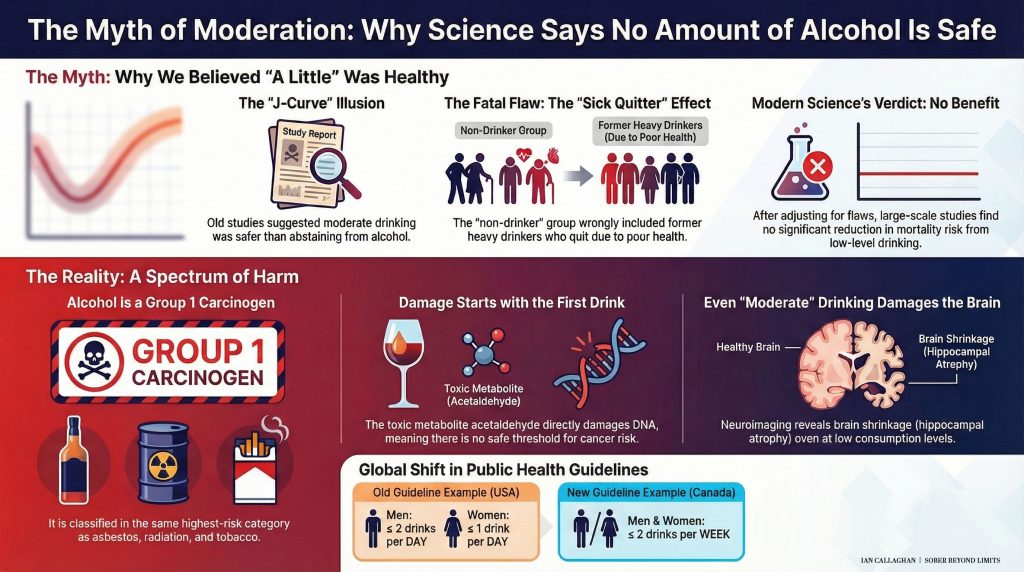
Research Alert (2024-2025): New studies from the UK and the US are clear. There is no safe level of alcohol consumption. The “heart-healthy” red wine myth is dead. Even moderate drinking is now directly linked to seven types of cancer, early-onset dementia, and heart disease. Alcohol is a Group 1 Carcinogen, in the same category as asbestos and radiation. The poison isn’t in the dose; the poison is the poison.
Why Moderation is Torture (And Sobriety is Freedom)
Trying to moderate a chemical addiction is like trying to control diarrhoea. It takes an immense amount of focus, energy, and clenching, and eventually, sh*t happens.
Moderation is not a relaxed state; it is a state of constant vigilance. It creates Decision Fatigue.
When you try to moderate:
The Constant Negotiation:“Can I have another? Is everyone else drinking as fast as I am? If I eat bread now, will it soak it up? Should I order water so I don’t look drunk?” You are not present in the moment; you are present in the glass.
Depleted Willpower: You spend all your mental energy policing your intake. By the time you get home to your family or wake up for work, your battery is drained. You have nothing left for creativity, patience, or joy.
The Unattainable Itch: You never get the relief you seek. You don’t drink to have one. You drink to get the effect (the buzz, the numbness). One drink just pisses off the demon. It wakes up the craving (the dopamine spike) but doesn’t satisfy it. You spend the whole night frustrated, wanting more but not allowing yourself to have it.
Abstinence is easier than moderation.
Read that again. Let it sink in.
When you quit completely, the negotiation is over. The decision is made once. You don’t have to decide if you’re drinking tonight, or how much, or with whom. The answer is simply “no.” The mental chatter falls silent. The energy returns. You get your brain back.
How to Break the Cycle (Actionable Steps)
You want out? Good. Here is how you start.
1. Stop Calling It “Giving Up”
Language matters. If you view sobriety as a deprivation, you will be miserable. You aren’t giving up anything. You are gaining your life back. You are gaining your mornings, your self-respect, your money, your patience, and your sanity. Flip the script. You are escaping a burning building, not missing out on the warmth of the fire.
2. Play the Tape Forward
When the urge hits at 5 PM, your brain will show you the highlight reel: the clink of the glass, the first sip, the laugh. That is a trailer for a movie that doesn’t exist.
You need to play the tape forward to the unedited footage. Don’t think about the first drink. Think about the 4th. Think about the slurred speech. Think about the 3 AM wake-up call with the heart palpitations and the dry mouth. Think about the disappointment in your kid’s eyes when you snap at them over breakfast. Play the movie all the way to the tragic ending.
3. Embrace the “Suck”
The first few weeks will be uncomfortable. You will feel raw. You will feel bored. You might feel “anhedonia”—the inability to feel pleasure. Good. That is not a sign that sobriety is boring; it is a sign that your brain is healing. Your dopamine receptors have been fried by years of over-stimulation. They need time to reset to normal levels. That boredom is the feeling of your brain recalibrating. Don’t run from the feeling. Sit in it. It won’t kill you. A drink might.
4. Find Your Tribe. Isolation is the fuel of addiction. You cannot do this alone in the dark. Whether it’s AA, SMART Recovery, a Reddit community like r/stopdrinking, or just a group of sober mates—get connected. You need to hear your story in someone else’s mouth to realise you aren’t crazy, you aren’t uniquely broken, and you aren’t alone. The opposite of addiction isn’t sobriety; the opposite of addiction is connection. (Johann Hari). You need to replace the relationship you had with the bottle with relationships with human beings who understand the war you are fighting.
The Final Truth
You are waiting for a magical moment where you “feel ready” to stop. You are waiting for the stars to align, for work to calm down, for the holidays to be over.
That moment is a lie. You will never feel ready to kill your best friend and your worst enemy.
You just have to do it.
There is a version of you waiting on the other side of this. A version that wakes up clear-headed and optimistic. A version that doesn’t need a chemical to handle a Tuesday. A version that looks in the mirror and genuinely likes what they see.
Put the shovel down. Stop digging.
Drop a comment below if this landed. Are you stuck in the “Just a Few” trap? Let’s talk about it.
People Also Ask (FAQ)
Q: Can I ever drink normally again?
A: If you have to ask, the answer is likely no. Normal drinkers don’t ask this. Once the pickle is a pickle, it can never be a cucumber again. Your brain has changed structurally. Why would you want to go back to the thing that broke you?
Q: What are the first signs of liver damage?
A: Fatigue, unexplained weight loss, loss of appetite, and pain in the upper right abdomen. But here is the scary part: Liver damage is often silent until it is critical. Don’t wait for your eyes to turn yellow or your skin to itch to make a change. The liver is incredibly resilient, but only if you give it a break.
Q: How long does “hangxiety” last after quitting?
A: The acute physical anxiety usually peaks around day 3-5 and settles within two weeks as your GABA/Glutamate levels balance out. However, Post-Acute Withdrawal Syndrome (PAWS) can cause mood swings and anxiety waves for months. It passes. It is temporary. Keep going.
Q: What do I tell my friends?
A: You don’t owe anyone a dissertation. “I’m taking a break for my health,” “It was messing with my sleep,” or simply “I’m retired from the sport” are all valid answers. Real friends will support you. Drinking buddies who get defensive are usually protecting their own addiction.
The Devastating Truth About Alcohol’s “Just A Few”
Rewiring The Mind: The Identity Shift That Changes Everything (Digital Manual)
Stop chasing symptoms. Fix the machine.Rewiring The Mind is not a memoir—it is a mechanic’s manual for your brain. Written by Ian Callaghan (Army Veteran, 45-year drinker), this guide combines Stoic Philosophy, Evolutionary Biology, and Nervous System Regulation to help you break the loop of anxiety, drinking, and survival mode. You don’t need more willpower. You need a new identity. (Instant PDF Download)
Used to monitor number of Google Analytics server requests when using Google Tag Manager
1 minute
_gid
ID used to identify users for 24 hours after last activity
24 hours
_ga_
ID used to identify users
2 years
_gali
Used by Google Analytics to determine which links on a page are being clicked
30 seconds
_ga
ID used to identify users
2 years
__utmx
Used to determine whether a user is included in an A / B or Multivariate test.
18 months
__utmv
Contains custom information set by the web developer via the _setCustomVar method in Google Analytics. This cookie is updated every time new data is sent to the Google Analytics server.
2 years after last activity
__utmz
Contains information about the traffic source or campaign that directed user to the website. The cookie is set when the GA.js javascript is loaded and updated when data is sent to the Google Anaytics server
6 months after last activity
__utmc
Used only with old Urchin versions of Google Analytics and not with GA.js. Was used to distinguish between new sessions and visits at the end of a session.
End of session (browser)
__utmb
Used to distinguish new sessions and visits. This cookie is set when the GA.js javascript library is loaded and there is no existing __utmb cookie. The cookie is updated every time data is sent to the Google Analytics server.
30 minutes after last activity
__utmt
Used to monitor number of Google Analytics server requests
10 minutes
__utma
ID used to identify users and sessions
2 years after last activity
_gac_
Contains information related to marketing campaigns of the user. These are shared with Google AdWords / Google Ads when the Google Ads and Google Analytics accounts are linked together.