Quit Midlife Drinking. Let’s cut the bullshit. You’re here because a part of you knows the bottle isn’t working anymore. It’s not the escape it once was. It’s become a cage. A dull, grey, increasingly cramped cage that you built for yourself, one drink at a time. You’re in midlife, perhaps 40, 50, even 60, and the hangovers hit harder, the anxiety bites deeper, and the quiet dread in your gut screams louder than any fleeting buzz.
You’re wondering, what actually happens if you put the damn glass down? Will life be a desolate, joyless landscape? Will you lose your mates? Will you be “that guy” who doesn’t drink? These fears are real. They keep men trapped, silently suffering, convinced that the devil they know is better than the unknown abyss of sobriety.
But here’s the unvarnished truth: quitting midlife drinking isn’t about sacrifice. It’s about excavating the man you were meant to be, buried under years of booze, obligation, and quiet desperation. It’s about rewiring your brain and reclaiming your life. And yes, it’s going to be fucking hard in places. But the freedom on the other side? That’s something alcohol could never give you.
I’ve walked that path. I know the terror, the doubt, the sheer physical and mental grind of those early days. But I also know the profound, unexpected joys that emerge when you stop numbing yourself and start living. This isn’t about labels or dogma. This is about understanding what alcohol has done to you, and what happens when you finally break free.
The Slow Death: What Midlife Drinking Actually Does To You
Before we talk about quitting, let’s get brutally honest about what consistent midlife drinking is doing. It’s not just a bit of stress relief. It’s a slow, insidious erosion of everything that matters.
The Silent Erosion of Purpose
Remember when you had to drive? Ambition? Projects that lit you up? For many men, midlife drinking slowly suffocates that. You start settling. The grand plans become “one day” dreams, then quiet regrets. Alcohol numbs the discomfort of unrealised potential, but it also drains the energy and clarity needed to pursue it. You become comfortable with mediocrity because the thought of actually doing something feels too overwhelming, and a drink is always easier. This is the heart of the midlife collapse, papered over with booze.
The Dopamine Trap: Hijacking Your Brain’s Reward System
Let’s talk biology. Your brain has a reward system, powered by dopamine. It’s designed to make you seek out things essential for survival – food, sex, and connection. Alcohol, particularly when consumed regularly, floods this system with dopamine. It’s a massive, unnatural hit. Your brain, in its wisdom, tries to rebalance things. It reduces its own natural dopamine production and the sensitivity of its receptors.
What does this mean for you? Over time, you need more alcohol to get the same buzz. And more importantly, everyday pleasures – a good book, a walk in nature, a chat with a mate, a piece of music – no longer provide the same satisfaction. Your brain is wired to chase the big, cheap dopamine hit from booze, leaving the rest of life feeling flat and uninteresting. This is the core of cravings; your brain screaming for the easiest, biggest hit it knows.
The Nervous System on Edge: Always ‘On’
Alcohol is a depressant, right? Makes you relax. Initially, maybe. But chronic drinking, especially as you get older, throws your nervous system completely out of whack. Your body is constantly working to counteract the depressive effect of alcohol. When the alcohol leaves your system, your nervous system goes into overdrive, becoming hyper-aroused.
This manifests as chronic low-level anxiety, interrupted sleep, racing thoughts, irritability, and a constant feeling of being ‘on edge’. You drink to calm down, but the drinking itself creates the very anxiety you’re trying to escape. It’s a vicious stress cycle, trapping you in a state of perpetual activation, making genuine rest and repair impossible.
The Shame & The Secret: The Invisible Burden
How much do you actually drink? Be honest. Now, how much do you tell people you drink? There’s often a gap. That gap is where shame lives. The sneaking an extra drink, the hiding bottles, the quiet calculation of how much is ‘acceptable’. This isn’t just about the alcohol; it’s about the emotional load you carry. The lies, the self-deception, the fear of being found out. It isolates you, even when you’re surrounded by people. This secret gnaws at you, contributing to the quiet despair many men feel in midlife.
The First Tremors of Change: What Happens in the Early Days of Quitting
So, you’ve decided to put the plug in the jug. Good. Now, prepare yourself. The first few days and weeks are a battle. This isn’t just a physical detox; it’s a mental and emotional reckoning.
Alcohol Withdrawal: More Than Just a Hangover
Let’s be clear: alcohol withdrawal can be serious. If you’re a heavy, daily drinker, talk to a doctor. Don’t be a hero. They can guide you safely through it. For many grey area drinkers, it might not be life-threatening, but it’s certainly not pleasant.
Expect symptoms like:
Insomnia: Your sleep will be all over the place. Expect vivid dreams, waking up frequently, or struggling to fall asleep at all.
Anxiety & Panic: Your hyper-aroused nervous system will be screaming. Expect waves of intense anxiety, restlessness, and possibly panic attacks.
Irritability & Mood Swings: Your emotions will be raw. You’ll snap at loved ones, feel overwhelmed, and might want to punch something.
Physical Symptoms: Headaches, nausea, sweating, tremors, and heart palpitations. Your body is trying to rebalance itself after years of being poisoned.
Cravings: Your brain will scream for the dopamine hit it’s used to. These can be intense and feel unbearable.
This phase is tough, but it’s temporary. It’s your body and brain beginning the monumental task of healing.
The Raw Nerve: Feeling Everything Again
For years, alcohol was your emotional anaesthetic. Now, that anaesthetic is gone. Every irritation, every worry, every past regret, every unspoken sadness – it all comes rushing back. You’ll feel exposed, vulnerable, and probably overwhelmed. This is where many people relapse. They can’t stand the intensity of their own emotions.
But this raw nerve is also a sign of life. It’s the first step towards processing old trauma, unresolved issues, and the emotional load you’ve been carrying. It’s uncomfortable, yes, but it’s necessary for true healing.
Battling the Beast of Boredom: The Void Alcohol Used to Fill
What did you do when you drank? Watch TV? Scroll your phone? Zone out? Now, there’s a gaping void where that ritual used to be. The evenings stretch out, seemingly endless. This boredom is brutal. It’s a powerful trigger for relapse, especially if you haven’t developed new ways to fill your time or engage your mind.
This is where many swap one addiction for another – endless scrolling, gaming, porn, dopamine loops. The key is to acknowledge the boredom, sit with it, and then consciously seek out new, healthier ways to engage your brain and body.
Sleep, Appetite, and Gut Chaos: Initial Disruption and the Slow Healing
In the early days, your sleep will be awful. Then, it will slowly improve, but it can take months for truly restorative sleep to return. Your appetite might fluctuate wildly – some lose it, some crave sugar intensely as their brain searches for quick dopamine. And your gut? Alcohol ravages your gut microbiome. Expect digestive issues initially, as your gut flora tries to rebalance. Focus on nutrient-dense foods and hydration. Your gut health is intrinsically linked to your brain health and mood.
Beyond the First Weeks: The Unfolding of Real Transformation
Once you push through the initial hell of withdrawal and the raw emotional phase, the magic starts to happen. This isn’t instant; it’s a gradual unfolding.
The Dopamine Reset: Finding Joy in the Mundane
This is huge. As your brain slowly recalibrates, its natural dopamine production begins to normalise, and your receptors become more sensitive. What does this mean? The simple things in life start to feel good again. A sunrise, a hot cup of coffee, a good conversation, the satisfaction of a job well done. You begin to experience genuine, sustainable joy, rather than the fleeting, chemically induced highs of alcohol. This is rewiring your mind at its core.
The Nervous System Calms: Finding Your Baseline
The constant hum of anxiety starts to quieten. Your body learns to relax without artificial depressants. You’ll notice you’re less reactive, more patient. Sleep becomes deeper and more restorative. Your stress cycles begin to regulate, allowing you to handle life’s challenges with greater resilience, rather than feeling constantly overwhelmed. This is a profound shift from hyper-vigilance to a state of calm.
The Clarity Returns: Thinking Straight Again
Remember feeling foggy, slow, unable to focus? That lifts. Your cognitive function improves dramatically. You think clearly, make better decisions, remember things more easily, and can hold complex thoughts. This neuroplasticity, the brain’s ability to reorganise itself, means you can literally rebuild your mental landscape. Problems that seemed insurmountable while drinking suddenly appear solvable.
Reclaiming Your Body: Energy, Sleep, and Physicality
The physical changes are undeniable. Your skin improves, your eyes are clearer, and that midlife paunch often starts to shrink. Energy levels soar. You wake up feeling genuinely rested, not just less hungover. This renewed physical vitality often spurs a desire for more movement, better nutrition, and a deeper connection to your body. Many men discover the power of cold water therapy here – a daily plunge isn’t just for masochists; it’s a powerful way to reset your nervous system, boost dopamine naturally, and build incredible mental resilience.
Confronting the Past: Processing What Was Buried
As the fog lifts, you might find yourself reflecting on things you’ve long suppressed. Old traumas, unresolved conflicts, past hurts. This can be challenging, but it’s also an opportunity for profound healing. Alcohol was a bandage; now you can actually tend to the wound. This isn’t about wallowing; it’s about acknowledging, processing, and integrating these experiences so they no longer hold power over you. It’s how you break free from old trauma conditioning.
The Identity Shift: Who You Become Without the Bottle
This is where the real transformation lies. It’s not just about what you don’t do; it’s about who you become.
Sobriety Without Labels: It’s About Freedom, Not Sickness
Forget the labels. You’re not an “alcoholic” in the traditional sense, unless you choose that identity. You’re a man who decided alcohol was no longer serving him. This isn’t a disease you caught; it’s a behaviour you changed. Your identity shifts from “a drinker” to “a man who chose freedom.” This is crucial. When you define yourself by what you’re not, you limit yourself. Define yourself by the powerful, intentional choices you make. This is sobriety without dogma, without the old 12-step narratives that don’t resonate with everyone.
Redefining Your Purpose After 40
When the noise of alcohol subsides, and the clarity returns, you often find yourself asking, “What now?” This is a powerful, exciting question. The midlife collapse often stems from a lack of purpose. Sobriety creates the space to rediscover or redefine what truly matters to you. What lights you up? What impact do you want to make? What legacy do you want to build? This is your chance to pivot, to start that business, write that book, deepen those relationships, or master that skill you always dreamed of.
Rebuilding Relationships (and Letting Go of Others)
Some relationships thrive in your sobriety. You’ll find deeper, more authentic connections with those who truly care about you, not just your drinking buddy persona. You’ll be more present, a better father, husband, friend. But some relationships will fall away. The ones built solely on shared drinking habits will struggle. This is okay. It’s a natural culling, making space for connections that serve your new, authentic self. This is part of shedding the men’s emotional load that comes with performing a certain role.
The Courage to Face Life Head-On
Alcohol is a crutch. Take it away, and you learn to stand on your own two feet. You develop true resilience. You learn that you can handle discomfort, sadness, stress, and joy without needing to numb or amplify them with booze. This isn’t just about stopping drinking; it’s about mindset rebuilding. It’s about developing the inner strength to navigate the shit storm of life with clarity and courage.
Addressing Your Midlife Fears: Common Questions Answered
Let’s tackle some of the nagging worries that keep men stuck.
“Will I ever have fun again?”
Absolutely, but it’ll be different. You’ll learn to redefine fun. The boisterous, hazy, often regrettable ‘fun’ of drinking gets replaced by genuine joy, deep laughter, meaningful connections, and the satisfaction of real achievement. It won’t be instant, and you’ll definitely experience boredom sober at first. But as your dopamine system resets, you’ll find enjoyment in things you never expected. Think clear-headed mornings, challenging yourself physically, and learning new skills. That’s real fun.
“What about social occasions? Won’t it be awkward?”
Yes, initially it will be. People might question you. You might feel like an outsider. But this is a test of your new identity. You don’t need to explain yourself to everyone. A simple “I’m not drinking tonight” or “I’m just taking a break from it” is enough. Focus on the reason you’re there – the people, the conversation, the food, the music. You’ll quickly realise that most people don’t care what’s in your glass. And if they do, perhaps they’re not the right people for your new path. This is a common grey area drinking concern.
“Is it too late for me?”
Never. The brain is incredibly adaptable. Neuroplasticity means your brain can change, adapt, and heal at any age. It might take a bit longer, and the initial withdrawal might be more intense for older bodies, but the capacity for transformation is always there. Your purpose after 40 isn’t predefined; it’s waiting for you to create it. This isn’t a death sentence; it’s a rebirth.
“How do I deal with cravings long term?”
Cravings become less frequent and less intense over time as your brain rewires. But they can still pop up, especially in stressful situations or old trigger environments. Have a plan.
Ride the wave: Cravings are temporary. They peak and pass.
Distract yourself: Go for a walk, call a friend, do something physical.
Hydrate: Often, what feels like a craving is just dehydration.
Cold water therapy: A quick cold shower or ice bath can instantly reset your nervous system and give you a natural dopamine hit, disrupting the craving cycle.
Connect with your ‘why’: Remind yourself why you started this journey. What freedom are you fighting for?
Your Path to Freedom: It’s Not About Quitting, It’s About Living
Quitting midlife drinking isn’t an ending; it’s a beginning. It’s the courageous act of ripping off the comfortable, numbing blanket of alcohol and stepping into the raw, vibrant, sometimes terrifying reality of life.
You’re not just stopping a behaviour; you’re initiating a profound process of brain and body rewiring. You’re reclaiming your identity, forging a new purpose, and building genuine resilience. It’s about understanding the biology of your addiction, healing your nervous system, and rebuilding your mind, brick by fucking brick.
It won’t be easy. There will be days you want to give up. But every single day you choose clarity over comfort, you are chiselling away at the old you and revealing the powerful, authentic man beneath. This isn’t about abstinence for abstinence’s sake. It’s about choosing to live fully, without compromise, and without the invisible chains of alcohol holding you back.
Are you ready to stop hiding and start living?
Ready to break free and rewire your midlife?
My work isn’t about labels or dogma. It’s about hard truths, simple science, and a direct path to freedom. If you’re a man in midlife, sick of the silent struggle, and ready to reclaim your purpose and vitality, then let’s get to work.
Let’s get straight to it. Quitting Porn. You’re here because something feels off. It’s that quiet, nagging feeling after you’ve spent an hour, maybe more, scrolling through a screen. The disconnect. The fog. The slight tinge of shame that you shove down because it’s ‘normal,’ right? Everyone does it. But you know, deep down, that this ‘normal’ habit is costing you something. Your focus. Your drive. Your connection to the real world, to real people. For 45 years, my escape was alcohol. I understand the loop. I understand the quiet justification and the loud self-loathing that follows. What I’ve learned in my own reset, and through my work as an NLP Master Practitioner, is that the mechanism is the same whether the trigger is a bottle or a browser. It’s a neural map. And the good news is, a map can be redrawn.
WHAT IS THE NEURAL MAP OF ADDICTION?
The neural map of addiction is a pathway in your brain that has been reinforced so many times that it has become a superhighway. Think of your brain as a dense forest. The first time you have a thought or perform an action, you’re hacking a small trail with a machete. It’s hard work. The second time, it’s a little easier. After a thousand times, you’ve got a paved, four-lane motorway. The brain, being efficient, will always choose the motorway over the overgrown trail. This is the path of least resistance. Dopamine is the fuel for this process. It’s a neurotransmitter associated with reward and motivation. When you do something pleasurable, your brain releases dopamine, which says, ‘That was good. Do it again.’ This system is designed for survival—to make us seek food, water, and connection. But it has a fatal flaw in the modern world. It can be hijacked.
HOW IS PORNOGRAPHY LIKE AN OPIOID FOR THE BRAIN?
Pornography is what scientists call a ‘supernormal stimulus.’ It provides an unnaturally high and novel dose of dopamine that our primitive brains were never designed to handle. It’s the equivalent of giving a Stone Age man a Big Mac and a milkshake; his brain would go into overdrive. Opioids work by directly flooding the brain’s reward centres with dopamine. Pornography does something similar, but through visual and psychological triggers. The constant novelty, the endless stream of new partners and scenarios without any of the real-world effort, risk, or emotional investment, creates a dopamine spike that real-life intimacy can rarely compete with. Over time, your brain’s dopamine receptors get blunted. They downregulate. This means you need more and more of the stimulus to get the same feeling, and normal pleasures—a good conversation, a finished project, a walk in nature—start to feel dull and lifeless. Your motivation is shot because your brain’s reward currency has been massively devalued. It’s not a moral failing; it’s a biological process. You’re running a program that’s burning out your hardware.
WHY DOES WILLPOWER FAIL WHEN TRYING TO QUIT?
Willpower fails because you’re bringing a knife to a gunfight. Trying to use conscious thought and ‘grit’ to overcome a deeply embedded neurological superhighway is a losing strategy. That pathway is automated. It’s subconscious. The trigger—boredom, stress, loneliness—fires, and your brain is already halfway down the motorway before your conscious mind even has a chance to object. I saw this for decades with drinking. I’d tell myself ‘not tonight,’ but then 5 PM would roll around, the trigger would fire, and the program would run itself. As an NLP Master Practitioner, I teach that you don’t fight the program head-on. You interrupt it. You scramble the signal. Willpower is a finite resource that gets depleted by stress, fatigue, and decision-making. The addiction pathway, however, is always there, waiting patiently for a moment of weakness. Relying on willpower alone is setting yourself up for failure and the inevitable cycle of shame that follows, which only strengthens the urge to escape again.
HOW CAN YOU REWIRE YOUR BRAIN’S REWARD SYSTEM?
You rewire the brain not by fighting the old map, but by building a new one. You need to create new pathways that are more compelling and rewarding than the old ones. This is the core of the MIND pillar in my Midlife Reset system. It’s about active, conscious intervention.
First, you must learn the Pattern Interrupt. This is a concept from NLP, but it’s as old as time. When the program starts to run—the thought, the urge, the familiar feeling—you must do something to physically and mentally break the state. My signature move is cold water. You don’t need a frozen lake; the bathroom sink will do. The moment the urge strikes, get up, go to the sink, and splash your face with the coldest water possible for 30 seconds. The shock to your nervous system is a hard reset. It yanks you out of the subconscious loop and back into the present moment. From that moment of clarity, you can make a different choice. Other interrupts I’ve used, drawing on my Army discipline, include dropping and doing 20 pushups or simply leaving the room and walking outside for five minutes. The action itself matters less than the immediacy of the interruption.
Second, you need to starve the old pathway. This is often called a ‘dopamine fast.’ You have to consciously reduce your intake of cheap dopamine from all sources—not just porn, but junk food, endless social media scrolling, and video games. This is brutally difficult at first because your brain will scream for its usual fix. It will feel like boredom, but as I always say, that’s not boredom; that’s SPACE. It’s the space you need to build something new. During this period, you re-sensitise your brain to natural rewards.
Third, you build the new motorway with Visualisation. This is another non-negotiable part of my daily routine. Every single morning, I spend ten minutes visualising my Future Self. I don’t just think about him; I step into his shoes. I see what he sees, feel what he feels. I see him clear-eyed, strong, present with his family, proud of the man in the mirror. By doing this, you are laying down the tracks for a new neural pathway. You are giving your brain a compelling, positive destination to travel to. When the urge for the old escape route comes, you can consciously choose to take the path toward that Future Self instead. It’s about having a destination that is more exciting than the escape.
WHAT ROLE DO NUTRITION AND MOVEMENT PLAY?
You cannot win a mental battle with a body that’s running on fumes. The MIND pillar is supported by EAT and MOVE. Your brain is made of fat and water and runs on the nutrients you give it. As a qualified chef and nutritionist, I stripped my food back to basics: meat, fish, eggs, and vegetables. Healthy fats like avocado, olive oil, and butter are literally brain food. They provide the raw materials to build healthy neural connections and regulate mood. Cutting out processed sugar and industrial seed oils reduces inflammation, which is a major contributor to brain fog and depression. Intermittent fasting, which I practice daily, also has profound benefits for cognitive clarity and cellular repair.
Movement is medicine. Not punishing yourself in the gym, but functional movement. For me, a long walk is fundamental. It processes stress, generates endorphins (a natural mood booster), and allows for clear thinking. And as I mentioned, cold water immersion—from a simple face wash to a full river dip—is the ultimate tool for building mental resilience and resetting your nervous system. It teaches you to be comfortable with discomfort, a skill that is essential for this journey.
IS THIS ABOUT SHAME OR ABOUT RECLAMATION?
This conversation ends now if it’s about shame. Shame is the fuel that keeps the addiction cycle going. It keeps you isolated and silent. This is not about being broken or a failure. This is about understanding that you are running a faulty program on perfectly good hardware. This is about reclamation. It’s about taking back the energy, the focus, the creativity, and the presence that have been leaking out of you pixel by pixel, day by day. It’s about reclaiming your ability to connect with a real person, to be fully present in your own life. It’s about waking the fuck up and deciding to be the man who builds his life, not the one who escapes from it. The map in your head got you here, but you have the power to draw a new one. It starts now, with one single, different choice.
Rewiring The Mind: The Identity Shift That Changes Everything (Digital Manual)
Stop chasing symptoms. Fix the machine.Rewiring The Mind is not a memoir—it is a mechanic’s manual for your brain. Written by Ian Callaghan (Army Veteran, 45-year drinker), this guide combines Stoic Philosophy, Evolutionary Biology, and Nervous System Regulation to help you break the loop of anxiety, drinking, and survival mode. You don’t need more willpower. You need a new identity. (Instant PDF Download)
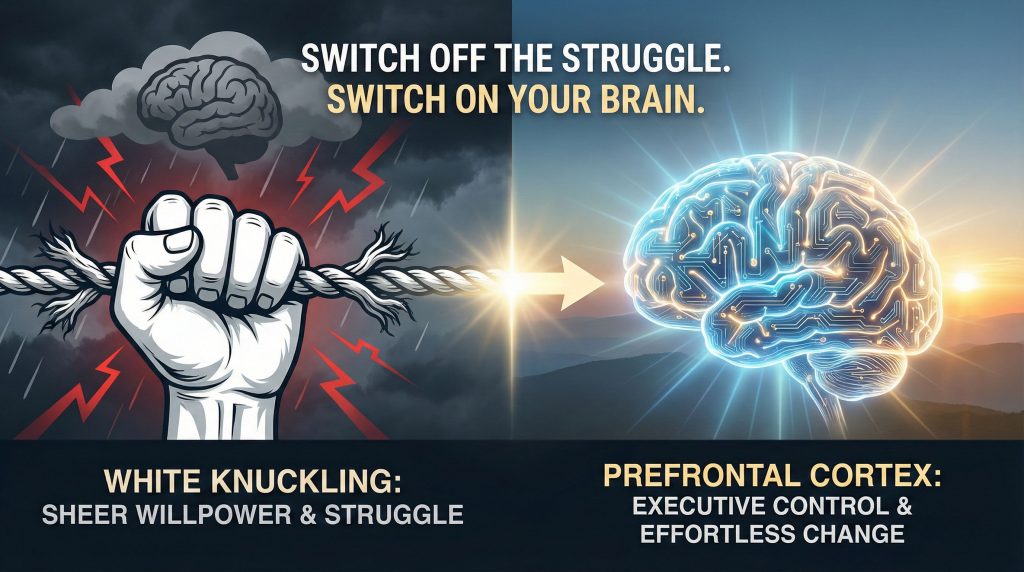
White Knuckling vs. Prefrontal Cortex. The sensation is visceral and familiar to anyone who has ever tried to break a compulsive habit, stay sober, or stick to a rigid diet plan. Your muscles tense involuntarily, your jaw clenches tight enough to crack a tooth, and you force yourself to say “no” through sheer, grinding grit. You are holding on for dear life.
This is white knuckling.
In the short term, white knuckling can be effective. It might get you through a difficult dinner party or a stressful hour at work. However, as a long-term strategy for life, it is biologically unsustainable. Relying on it is akin to trying to run a marathon by holding your breath; eventually, the system fails, and you gasp for air—or in this case, relapse.
The sustainable alternative lies in the evolutionarily advanced front section of your brain. The Prefrontal Cortex (PFC) is the CEO of your neurological functioning. It handles long-term planning, impulse control, consequences, and emotional regulation.
When we analyse the battle of White Knuckling vs. Prefrontal Cortex, we are essentially comparing a finite resource (willpower/adrenaline) against a trainable, renewable skill (executive function).
Here is the definitive, expanded list of 15 strategies to stop the exhausting internal fight and start rewiring your brain for effortless, executive control.
1. Understand and Label the “Amygdala Hijack”
To win the high-stakes battle of White Knuckling vs. Prefrontal Cortex, you must first identify the adversary. White knuckling is almost always a desperate response to the amygdala taking over the driver’s seat of your brain.
The amygdala is the primal “lizard brain” or “fire alarm” responsible for the fight-flight-freeze response. It is ancient, fast, and not very smart. When a craving hits—whether for alcohol, sugar, or a toxic behaviour—the amygdala screams that you need this dopamine release for survival. It creates a state of “tunnel vision” where nothing else matters.
The Biological Conflict:
The White Knuckling Response: You try to shout down the amygdala with force. You mentally scream “NO!” back at it. This internal shouting match creates immense stress, spikes your heart rate, and floods your system with cortisol. You are fighting a biological alarm system with brute force.
The PFC Approach: You engage the “brake pedal” of the brain. You recognise the signal for what it is: a biological error, not a command from God.
Actionable Step: Use the technique of “Affect Labelling.” When the urge arises, say out loud or write down: “This is just my amygdala misfiring. I am experiencing a dopamine craving, not a survival need.”
Neuroscience studies suggest that the simple act of putting a feeling into words moves brain activity from the emotional centre (amygdala) to the thinking centre (right ventrolateral prefrontal cortex). By naming the monster, you shrink it.
2. Accept That Willpower is a Battery, Not a Trait
In the UK and many Western cultures, we prize the “stiff upper lip.” We erroneously view willpower as a fixed character trait—something you either possess in abundance or lack entirely. This leads to the belief that if you fail, you are morally “weak.”
Neuroscience disagrees entirely. The concept of “Ego Depletion,” proposed by researcher Roy Baumeister, suggests that willpower is a limited metabolic resource, much like a battery on your smartphone.
Why White Knuckling Fails: White knuckling is an energy-intensive process. Every time you resist an urge through force, you drain the battery. By the evening, after a stressful day of making decisions at work, navigating traffic, and managing emotions, your “battery” is flat. This explains why the vast majority of dietary slips and relapses happen between 6:00 PM and 10:00 PM. The PFC is simply too tired to fight.
The PFC Shift: Instead of relying on a fully charged battery, rely on system design. The prefrontal cortex excels at designing environments where high willpower isn’t required.
Remove cues entirely: If you are quitting sugar, do not have biscuits in the house “for guests.” If you are quitting drinking, do not keep a “special occasion” bottle.
Automate decisions: Meal prep on Sundays so you don’t have to choose dinner when you are exhausted on Tuesday.
Pre-commitment: Lock your credit card or use app blockers before the urge strikes.
3. Master the Mindfulness Art of “Urge Surfing”
White knuckling attempts to stop a tidal wave by standing rigidly in front of it. You brace yourself, you tense up, and you take the hit. Inevitably, the ocean wins, and you are knocked over.
Urge surfing is a mindfulness technique that engages the prefrontal cortex to observe the wave without being crushed by it. It changes your relationship with the craving from a “participant” to an “observer.”
The Wave Metaphor: Cravings behave like waves. They start small, build in intensity, crest at a peak (where the discomfort is highest), and then inevitably break and dissipate.
How to Surf:
Observe: Close your eyes and scan your body. Where do you feel the craving? Is it a tightness in the chest? A dryness in the mouth? A jitter in the hands?
Non-Judgment: Do not fight the sensation. Do not say “I hate this.” Just watch it, like a scientist observing an experiment.
Wait: Most cravings peak within 15 to 20 minutes. If you can surf the wave for that duration without acting, the neurochemistry shifts, and the urge subsides.
By observing rather than fighting, you keep the PFC online. You are the captain of the ship watching the storm, not the sailor drowning in it.
4. The “Pause and Plan” Response
Stanford health psychologist Kelly McGonigal discusses the “Pause and Plan” response as the physiological opposite of “Fight or Flight.”
When you white knuckle, your body mimics a stress response. Your heart rate skyrockets, your digestion slows, and your muscles tense. This physiological state literally shuts down blood flow to the PFC to focus resources on immediate physical survival (running or fighting).
Engaging the PFC: To get the “CEO” back in the office, you need to physically slow down your body’s biology. You cannot think your way out of a stress response; you must act your way out of it.
The Technique:
Stop what you are doing immediately.
Take five deep, slow breaths.
Crucial Detail: Extend the exhale longer than the inhale (e.g., inhale for 4 seconds, exhale for 8 seconds).
This breathing pattern stimulates the vagus nerve, which activates the parasympathetic nervous system (rest and digest). It sends a biochemical signal to your brain that you are safe. Once the alarm bells stop ringing, the prefrontal cortex can come back online to make rational decisions.
5. Address Decision Fatigue Aggressively
The prefrontal cortex is easily exhausted by the act of making choices. Every decision you make—from “what shirt do I wear?” to “which email do I answer first?”—chips away at its efficiency.
The White Knuckling Trap: If you leave your recovery or habit change up to in-the-moment choices, you are setting yourself up for a white-knuckling disaster. If you have to ask yourself, “Should I go to the gym?” or “Should I have a drink?” in the moment, you are taxing an already tired brain.
Optimisation Strategy: Reduce the cognitive load by making fewer decisions. This is why people like Steve Jobs or Barack Obama wore the same clothes every day.
Standardise routines: Eat the same healthy breakfast every single day.
Fixed routes: Have a non-negotiable route home that avoids your favourite pub or bakery.
The “If-Then” Plan: create rules in advance. “If it is 6:00 PM, then I put on my running shoes.”
By conserving decision-making energy on trivial things, you reserve your PFC’s strength for the moments that truly matter.
6. Strict Glucose Regulation and Nutrition
The brain is an energy-hungry organ, consuming about 20% of your daily calories despite being only 2% of your body weight. The prefrontal cortex, specifically, is highly sensitive to glucose fluctuations.
When your blood sugar drops, your executive function is the first thing to go offline. Evolutionarily, when you are starving, you don’t need to ponder philosophy; you need to hunt. Your brain reverts to primal impulses. This is the science behind being “hangry” (hungry + angry).
White Knuckling vs. Biology: You cannot willpower your way out of low blood sugar. If you skip lunch, by 4:00 PM your brain will be screaming for quick energy. This usually manifests as cravings for sugar, refined carbs, or alcohol (which is essentially liquid sugar).
The Fix:
Steady Fuel: Eat regular, complex carbohydrates and proteins every 3-4 hours.
Avoid Spikes: Do not start the day with sugary cereal. It causes an insulin spike followed by a crash, leaving your PFC vulnerable by mid-morning.
Omega-3s: Supplement with high-quality fish oil to support the structural integrity of the brain’s grey matter.
7. The Power of Cognitive Reframing
White knuckling is rooted in a sense of deprivation. You tell yourself, “I really want this, but I am not allowed to have it.” This creates a psychological tension that requires constant energy to maintain.
The PFC Approach: Reframing uses the logic centre of the brain to change the narrative so that willpower isn’t even needed. You move from a “have to” mindset to a “get to” mindset.
Examples:
White Knuckling Narrative: “I can’t drink a pint tonight because I’m an alcoholic and it ruins my life.” (Feels like punishment/prison).
PFC Logic: “I don’t drink because I love waking up with a clear head and boundless energy.” (Feels like a strategic choice/freedom).
Dieting Example: Change “I can’t eat that pizza” to “I am choosing to fuel my body with nutrients that make me feel strong.”
When you view the behaviour as a positive, empowered choice rather than a restricted jail sentence, the conflict in the brain dissolves.
8. Prioritise Sleep Hygiene as a Medical Necessity
Sleep deprivation is catastrophic for the prefrontal cortex. Studies using fMRI scans show that a sleep-deprived brain looks remarkably similar to an intoxicated brain.
When you are tired, the functional connectivity between the amygdala (impulses) and the PFC (control) is severed. The amygdala runs wild, and the PFC is too sluggish to stop it.
The Vicious Cycle: You stay up late scrolling, you get tired, your PFC weakens, you engage in bad habits (night snacking/drinking), you sleep poorly, and the cycle repeats.
The Strategy: Treat sleep as the foundation of your recovery, not a luxury.
The Glymphatic System: During deep sleep, your brain literally washes itself of toxins. Without this wash, executive function is impaired.
Environment: Keep the room dark to promote melatonin. The ideal temperature for UK sleepers is around 18 degrees Celsius.
Digital Sunset: No screens 60 minutes before bed. Blue light suppresses the hormones needed for deep, restorative sleep.
9. Visualisation and “Future Pull” (Episodic Foresight)
The amygdala lives entirely in the “now.” It wants immediate gratification and cannot comprehend consequences three hours from now, let alone three years from now.
The prefrontal cortex is the only part of the brain capable of Episodic Foresight—the ability to travel through time mentally.
Using the PFC: When an urge hits, do not just look at the drink, the cigarette, or the cake. Force your brain to “play the tape forward” in high definition.
Step 1: Visualise the momentary pleasure.
Step 2: Visualise 20 minutes later (the craving for more).
Step 3: Visualise the next morning (the headache, the shame, the regret, the restart).
By actively visualising the negative future consequences, you empower the PFC to override the immediate impulse. You are using higher-order thinking to defeat primal urging.
10. Reduce Cortisol (Stress Management)
Stress is the arch-nemesis of the prefrontal cortex. High levels of cortisol (the stress hormone) are neurotoxic to the PFC. Chronic stress can literally shrink the neurons in this area of the brain, reducing your capacity for self-control over time.
White Knuckling is Stressful: The irony is that trying to force yourself to stop a behaviour is, in itself, a massive stressor. It creates a feedback loop of anxiety (“Will I relapse? I must not relapse!”), which raises cortisol, which weakens the PFC, which makes relapse more likely.
The Antidote: You must incorporate active stress reduction that is not your addiction or bad habit.
Nature Immersion: Even 20 minutes in a green space lowers cortisol levels significantly.
Meditation: Consistent meditation increases grey matter density in the PFC.
Reading: Lowers heart rate and engages the imagination, pulling you out of the “fight or flight” loop.
Lower stress levels mean the “CEO” of your brain can stay at their desk and manage the company effectively.
11. Leverage Neuroplasticity
One of the most hopeful aspects of the White Knuckling vs. Prefrontal Cortex debate is the reality of neuroplasticity—the brain’s ability to change its physical structure based on behaviour.
White knuckling assumes you are fighting a permanent, unchanging urge. The science suggests otherwise.
Rewiring the Brain: Every time you successfully navigate an urge using PFC strategies (like urge surfing or pausing), you strengthen that neural pathway. It is like hacking a path through a dense jungle. The first time is exhausting. The second time is easier. By the hundredth time, it is a paved road.
Hebbian Learning: “Neurons that fire together, wire together.”
The Result: What requires massive effort today will require almost zero effort in six months. Eventually, the healthy choice becomes the automatic choice. You transition from conscious competence to unconscious competence.
12. Connect with Community (The Oxytocin Effect)
Addiction and bad habits thrive in isolation. White knuckling is often a lonely, solitary battle waged inside one’s own head.
The prefrontal cortex functions significantly better when we feel socially connected and safe. Positive social interaction releases Oxytocin, often called the “cuddle hormone” or “bonding hormone.”
The Chemistry of Connection: Oxytocin has a powerful dampening effect on the amygdala. It lowers fear, anxiety, and the sense of threat.
Action Plan:
Join a Tribe: Engage with a recovery group (AA, SMART Recovery), a running club, or a hobby group.
Reach Out: Call a friend or mentor specifically when an urge hits.
Honesty: Be honest about your struggle. Shame thrives in secrecy; sunlight kills it.
When you share the burden, you biologically upgrade your brain’s ability to cope. You are effectively outsourcing some of the executive function to the group until yours is strong enough to handle it alone.
13. High-Intensity Exercise (BDNF Release)
If you feel the need to white knuckle, you likely have excess energy in the system—specifically adrenaline and agitation.
Exercise is a direct, physiological intervention. Specifically, aerobic exercise releases Brain-Derived Neurotrophic Factor (BDNF).
Why it Matters: BDNF acts like “Miracle-Gro” fertiliser for the brain. It supports the growth of new neurons in the prefrontal cortex and the hippocampus, repairing damage done by stress or substance abuse.
The Swap: Instead of sitting on the sofa fighting the urge (white knuckling), change your state immediately.
Sprint up a hill.
Do 50 burpees.
Take a cold shower.
These activities burn off the adrenaline, release endorphins (natural painkillers), and flood the brain with BDNF, strengthening the PFC for the long term.
14. Practice Radical Self-Compassion
This sounds soft, but it is hard science. Shame shuts down the learning centres of the brain.
When you relapse or slip up, the white-knuckling approach is usually self-flagellation. “I am weak,” “I am useless,” or “Why can’t I just stop?”
The Neuroscience of Shame: Shame triggers the threat defence system (amygdala). It spikes cortisol. It makes you feel bad, and when you feel bad, your brain screams for its favourite coping mechanism (the bad habit). This is known as the “What-the-Hell Effect.”
The PFC Approach: Self-compassion (“I slipped up, I’m human, let’s analyse why this happened”) keeps the prefrontal cortex online. It allows for analysis and planning.
The Shift: Instead of beating yourself up, ask: “What was the trigger? Was I hungry? Was I tired? How can I prevent this next time?” This is a strategic, executive question, not an emotional one.
15. Seek Professional Cognitive Training (CBT)
Sometimes, the battle of White Knuckling vs. Prefrontal Cortex requires a professional coach.
Cognitive Behavioural Therapy (CBT) is essentially a training course for your prefrontal cortex. It is not just “talking about feelings”; it is a structured method for rewiring thought patterns.
What CBT Does:
Metacognition: It teaches you to think about your thinking.
Identification: It helps you spot “Automatic Negative Thoughts” (ANTs) that trigger urges.
Challenge: It uses logic to dismantle the lies the amygdala tells you (e.g., “I need a drink to be funny”).
Therapy helps you build the scaffolding required to support your PFC while it strengthens. It moves you away from “hoping” you can resist to having a structured architectural plan for your life.
The Comparison: A Summary
To truly grasp the difference, let’s look at a direct side-by-side comparison of the two modalities.
The White Knuckling Approach
Primary Driver: Fear, Shame, and Desperation.
Brain Region: Amygdala and Limbic System (reactionary/survival).
Metaphor: Holding a beach ball underwater.
Sustainability: Extremely Low. Works for minutes or hours, rarely days.
Outcome: Leads to neuroplasticity, reduced cravings, and permanent, effortless habit change.
Conclusion: Drop the Struggle, Engage the Strategy
The battle of White Knuckling vs. Prefrontal Cortex is not a battle of character, morals, or spiritual fortitude. It is, at its core, a battle of biology.
For too long, society has told us that if we cannot resist a temptation, we are simply weak. We are told to “try harder.” The reality is that we have been using the wrong tool for the job. We have been trying to use a finite, exhaustible resource—willpower—to solve a complex, chronic neurological problem.
White knuckling is an act of war against yourself. Engaging the prefrontal cortex is an act of management and leadership.
Your Path Forward: Do not try to implement all 15 strategies tomorrow. That would be a decision-fatigue nightmare. Start small. Pick three strategies from this list that resonate with you.
Perhaps you focus on sleep hygiene to ensure your hardware is working.
You practice urge surfing to change your software response.
You ensure you eat protein-rich food to keep the battery charged.
By treating your brain with respect and understanding its mechanics, you can stop fighting yourself. You can lay down your weapons. You can stop clenching your fists until they turn white.
Recovery and growth do not have to be a war. When you engage the prefrontal cortex, it becomes a strategic, intelligent evolution toward the person you truly want to be. The struggle is optional; the strategy is essential.
Get The Manual That Details How I Rewired My Mind
Rewiring The Mind: The Identity Shift That Changes Everything (Digital Manual)
Stop chasing symptoms. Fix the machine.Rewiring The Mind is not a memoir—it is a mechanic’s manual for your brain. Written by Ian Callaghan (Army Veteran, 45-year drinker), this guide combines Stoic Philosophy, Evolutionary Biology, and Nervous System Regulation to help you break the loop of anxiety, drinking, and survival mode. You don’t need more willpower. You need a new identity. (Instant PDF Download)
Used to monitor number of Google Analytics server requests when using Google Tag Manager
1 minute
_gid
ID used to identify users for 24 hours after last activity
24 hours
_ga_
ID used to identify users
2 years
_gali
Used by Google Analytics to determine which links on a page are being clicked
30 seconds
_ga
ID used to identify users
2 years
__utmx
Used to determine whether a user is included in an A / B or Multivariate test.
18 months
__utmv
Contains custom information set by the web developer via the _setCustomVar method in Google Analytics. This cookie is updated every time new data is sent to the Google Analytics server.
2 years after last activity
__utmz
Contains information about the traffic source or campaign that directed user to the website. The cookie is set when the GA.js javascript is loaded and updated when data is sent to the Google Anaytics server
6 months after last activity
__utmc
Used only with old Urchin versions of Google Analytics and not with GA.js. Was used to distinguish between new sessions and visits at the end of a session.
End of session (browser)
__utmb
Used to distinguish new sessions and visits. This cookie is set when the GA.js javascript library is loaded and there is no existing __utmb cookie. The cookie is updated every time data is sent to the Google Analytics server.
30 minutes after last activity
__utmt
Used to monitor number of Google Analytics server requests
10 minutes
__utma
ID used to identify users and sessions
2 years after last activity
_gac_
Contains information related to marketing campaigns of the user. These are shared with Google AdWords / Google Ads when the Google Ads and Google Analytics accounts are linked together.