Nobody told me about the glutamate rebound when I stopped drinking.
Nobody explained that the anxiety hammering my chest at 3 am in the first few days was not a character defect, not weakness, not proof that I could not cope without a drink. It was my brain in a measurable, documented neurochemical storm with a name, a mechanism, and a nutritional response. Most people in early sobriety never hear about it because the conversation around stopping drinking is still dominated by willpower, meetings, and white-knuckling it through the first week.
I am a professional chef with over 40 years of experience in food and nutrition. I am an NLP Master Practitioner, a qualified nutritionist, and a sobriety and mindset coach. I lost five stone and reversed pre-diabetes without a single pharmaceutical intervention. I have no interest in the recovery industry’s fondness for vague reassurance. I want to give you the biology and the food to match it, because understanding what is happening in your brain in the first seven days changes everything about how you get through them.
This post covers exactly what to eat in early sobriety to support your brain’s recovery from glutamate rebound. It is based on 40 years of nutrition expertise and my own lived experience of stopping drinking and coming out the other side without a jab, a patch, or a prescription in sight.
Medical Disclaimer:This post is not medical advice. If you are a heavy dependent drinker, alcohol withdrawal can be medically serious, and you should speak to your GP before stopping. Symptoms like seizures, severe tremors, hallucinations, and confusion require medical attention. This post is for people in the early days of stopping or reducing alcohol who want to understand and support their brain’s recovery through food,and what to eat in early sobriety.
I. The Brain’s Seesaw: The Architecture of GABA vs. Glutamate
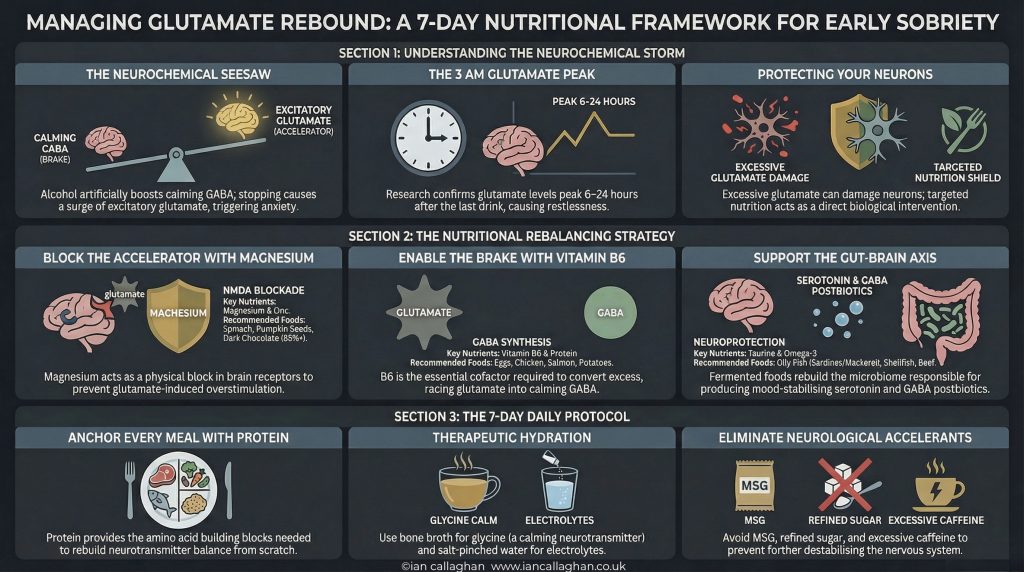
To understand the internal turbulence of early sobriety, one must first appreciate the delicate, binary architecture of brain signalling. Your central nervous system operates on a fundamental balance between two primary neurotransmitters that regulate your level of arousal and calm. They function like a seesaw, a metaphor essential to understanding the “rebound” effect.
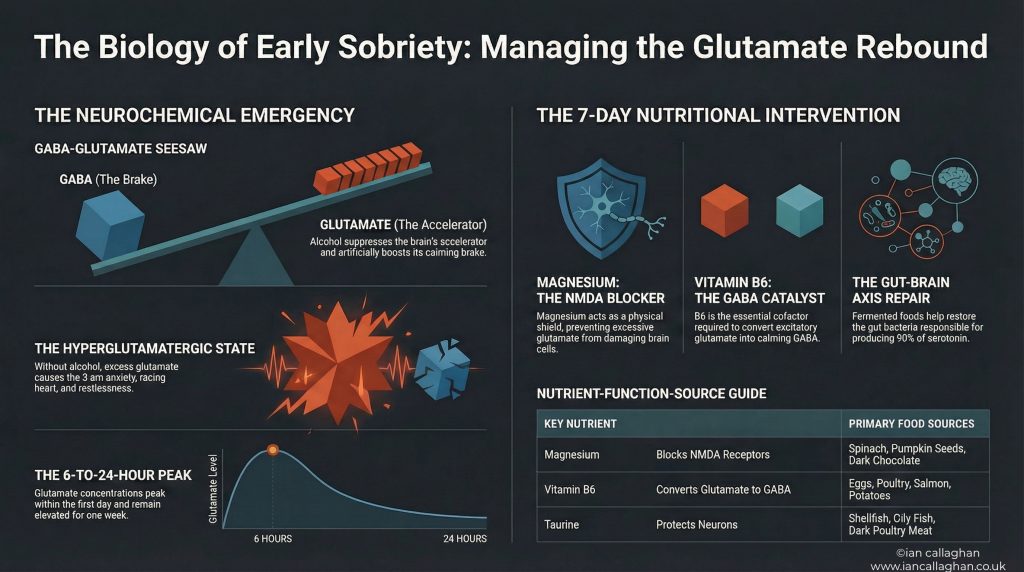
GABA (gamma-aminobutyric acid) is your brain’s primary inhibitory neurotransmitter. It is the “brake pedal,” responsible for calming the nervous system, slowing down racing thoughts, and facilitating physical and mental relaxation. Conversely, glutamate is the “accelerator.” It is the primary excitatory neurotransmitter, helping keep you alert, focused, and cognitively engaged. In a healthy, homeostatic state, these two chemicals work in tandem to maintain equilibrium.
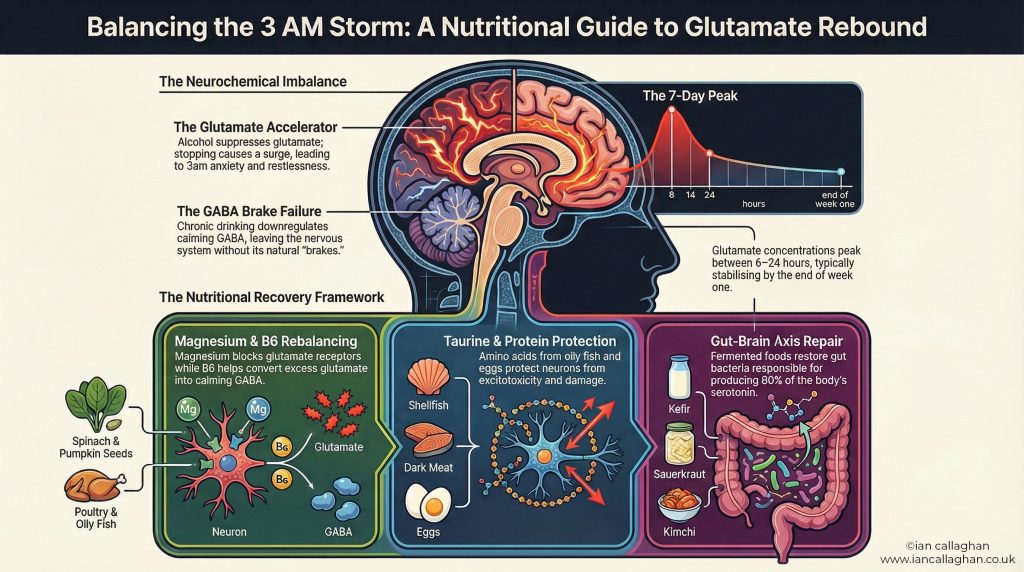
Alcohol enters this delicate system with the subtlety of a sledgehammer. It is a potent GABA booster; every drink artificially enhances GABA activity while simultaneously suppressing glutamate. This is the neurochemical mechanism behind the “relief” of the first drink. The “brakes” are slammed on, and the “accelerator” is forcibly turned down. For those who have used alcohol as a chronic stress-management tool, this chemical shift becomes a perceived necessity for survival.
However, the human brain is a master of adaptation. In a process known as homeostasis, the brain attempts to maintain its balance despite the external chemical influence. When exposed to regular alcohol consumption, the brain compensates for the artificial GABA boost by downregulating its own internal GABA production and upregulating its glutamate activity. Essentially, because you are providing an artificial brake (alcohol), the brain responds by weakening its own braking system and building a much larger, more powerful accelerator to compensate. This shift in the internal landscape is the biological definition of tolerance and the precursor to physical dependency.
“Your brain runs on two primary neurotransmitters that balance each other like a seesaw. GABA is the brake pedal, calming, inhibitory, slowing things down, letting you relax. Glutamate is the accelerator, excitatory, stimulating, keeping you alert and activated.”
When we frame cravings and the “3 am anxiety trap” as a physiological imbalance, the shame of “low willpower” evaporates. Willpower is a finite psychological resource; homeostasis is a biological imperative that functions regardless of your “strength.” If your brain has spent years building a massive “glutamate accelerator” to counter alcohol, that accelerator does not disappear the moment you put down the glass. Recognising that your anxiety is simply a brain trying to find its new level of balance—rather than a sign that you are “broken”—is a transformative psychological shift. It turns a moral struggle into a management task.
II. It’s Not in Your Head, It’s on the Scan: The Anterior Cingulate Cortex
One of the most powerful psychological tools in the recovery arsenal is the knowledge that what you are feeling is physically measurable. This is not an abstract “mental” issue; it is a neurological reality that can be observed using advanced medical imaging. This “visible” nature of the struggle helps to de-stigmatise the experience, grounding the discomfort in hard science.
Recent research employing magnetic resonance spectroscopy (MRS)—a specialised scan that measures the concentrations of specific chemicals in the brain in real time—has confirmed that glutamate levels are measurably and significantly elevated during alcohol abstinence. This surge is not global; it is particularly concentrated in the anterior cingulate cortex (ACC). The ACC is the brain’s command centre for emotional regulation, decision-making, and the physiological stress response. It is the region that tells you whether a situation is a minor inconvenience or a life-threatening emergency.
When glutamate levels surge in the ACC without the balancing influence of GABA, the brain enters what researchers call a “hyperglutamatergic state.” This is the scientific term for the internal “volume” being turned up to 10 while the world around you is at 3. This surge typically peaks between six and twenty-four hours after the last drink. While the GABA system begins a very gradual recovery over the first three days, glutamate remains elevated and volatile throughout the first week.
Knowing that this state is “visible on a brain scan” serves as a profound psychological anchor. When the waves of irritability, light sensitivity, or sensory overload hit, you can remind yourself: “My anterior cingulate cortex is currently over-stimulated by a surge of glutamate. This is a temporary, measurable biological state.” This clinical detachment allows you to observe the symptoms with the curiosity of a scientist rather than the despair of a victim. It provides the “map” necessary to navigate the storm without getting lost in the clouds of self-reproach.
III. Magnesium: The Natural NMDA Receptor Blocker
The danger of excess glutamate is not confined to feelings of unease. When glutamate levels remain too high for too long, they can lead to a condition called “neuronal excitotoxicity.” Glutamate acts primarily through NMDA (N-methyl-D-aspartate) receptors, which function like high-velocity channels on the surface of your neurons. When these receptors are overactivated by a glutamate surge, they allow a massive, uncontrolled influx of calcium into neurons. If this calcium overload persists, it can cause direct, oxidative damage to the brain cells, essentially “burning them out” through over-excitation.
This is where magnesium becomes the most critical mineral in your recovery toolkit. Magnesium serves a very specific, physical function in the brain: it acts as a natural blocker of the NMDA receptor. It literally sits inside the receptor channel, acting as a molecular concierge that prevents excessive calcium from flooding the neuron.
Peer-reviewed research published in Australasian Psychiatry in 2025 has confirmed magnesium’s role as a direct neuroprotective agent during alcohol withdrawal. The paper specifically highlighted its role as a naturally occurring NMDA receptor blocker. Unfortunately, alcohol is a potent diuretic and a direct depletor of magnesium, meaning most people entering sobriety are profoundly deficient in the very substance they need to shield their neurons from the glutamate storm.
“Magnesium acts as a natural physical blocker of NMDA receptors, sitting in the receptor channel and preventing excessive calcium entry… This is why early sobriety nutrition is not a nice-to-have. It is a direct intervention in brain chemistry.”
To aggressively replenish this mineral, your diet must prioritise these therapeutic food sources:
Dark Leafy Greens (Spinach, Kale, Chard): These are not merely side dishes; they are concentrated, bioavailable doses of the mineral your brain requires for protection. A large portion of wilted spinach is a therapeutic intervention.
Pumpkin Seeds: These are among the most magnesium-dense foods on the planet. They also provide zinc, which is essential for GABA receptor function.
Dark Chocolate (85% Cocoa and above): Provides magnesium, along with antioxidant flavonoids that support cerebrovascular health. In this context, two squares are a legitimate medicinal tool.
IV. Vitamin B6 and the Conversion Catalyst
While magnesium blocks the “accelerator,” we must also focus on repairing the “brakes.” The brain does not simply wait for GABA to reappear; it synthesises it from the very substance causing the problem: glutamate. This is done by an enzyme called glutamate decarboxylase. This enzyme is the bridge that turns “anxiety” (glutamate) into “calm” (GABA).
However, this enzyme is not self-sufficient. It requires a specific partner to function: Vitamin B6. B6 is the essential cofactor for this conversion. If you are deficient in B6, the process of recycling excess glutamate into GABA slows to a crawl, leaving you stuck in a state of high excitatory tension.
Because alcohol heavily depletes B6 stores, replenishment is an immediate priority. By providing the brain with sufficient B6, you are essentially equipping it with the tools needed to “recycle” your anxiety into tranquillity. Furthermore, it is vital to note that chronic alcohol use also depletes B1 (thiamine). Severe B1 deficiency can lead to Wernicke’s encephalopathy, a serious neurological condition. Thus, a focus on the full B-complex is essential for systemic neurological repair.
Key B6-Rich Sources:
Poultry: Chicken and turkey are exceptionally high in B6 and provide the tryptophan needed for serotonin.
Fish: Salmon and tuna provide B6 and serotonin, along with omega-3 fats that reduce neuroinflammation.
Starchy Vegetables: Potatoes and sweet potatoes offer B6 while providing the glucose stability needed to prevent cortisol spikes.
V. The Marine Support System: Taurine and Oily Fish
Taurine is an amino acid that plays a multifaceted, protective role in managing the neurochemical storm. It acts as a GABA receptor agonist, meaning it binds to the same receptors as GABA to help quiet the brain. Additionally, it is a direct modulator of the NMDA receptor, working in concert with magnesium to prevent glutamate-induced excitotoxicity. Taurine effectively “hyperpolarises” neurons, making them harder to excite and thus more resilient to the glutamate surge.
Taurine is found almost exclusively in animal proteins, with marine life offering the highest concentrations. Shellfish—such as clams, mussels, and oysters—are the gold standard for taurine intake. If shellfish are unavailable, small oily fish like sardines and mackerel are excellent alternatives.
There is profound importance in using “real whole food” rather than pharmaceutical intervention in this specific context. While medications may be necessary for clinical withdrawal, whole foods provide a complex matrix of nutrients—taurine, zinc, B vitamins, and omega-3s—that work synergistically. This approach empowers the individual, moving them from the role of a “patient” waiting for a prescription to an active participant in their own biological repair. Using the “marine support system” is a direct way to dampen the neurological “volume” of the first week.
VI. Astrocytes: The Brain’s Star-Shaped Clean-up Crew
Often overlooked in discussions of neurotransmitters are astrocytes. These star-shaped glial cells surround the synapses in your brain and act as a biological “clean-up crew.” Their primary job in this context is to vacuum up excess glutamate from the space between neurons (the synaptic cleft) and convert it into glutamine. This non-excitatory form can be safely recycled.
When this system is working efficiently, the glutamate rebound is shorter and less intense. However, the astrocyte clearance system is easily impaired by oxidative stress and systemic inflammation—both of which are rampant in the first few days of sobriety. To support these vital cells, you must reduce inflammation at its source.
This requires a strict dietary rule for the first week: eliminating seed oils. Oils such as sunflower, rapeseed, canola, and generic “vegetable” oil are high in omega-6 fatty acids that drive the very inflammation that hinders glutamate clearance. Instead, you should cook with stable, anti-inflammatory fats that support the brain’s architectural integrity:
Butter or Ghee
Lard or Beef Dripping
Extra Virgin Olive Oil (for cold use)
Supporting these fats with the omega-3s found in oily fish and eggs directly enhances the astrocytes’ ability to clear the chemical fog and restore order to the synapses.
VII. The Gut-Brain Paradox: 90% of Serotonin
If you feel “flat,” emotionally fragile, or a lack of motivation during your first week, your gut is likely struggling as much as your brain. We often categorise serotonin as a “brain chemical,” but 90% of it is produced in the gut. Alcohol devastates the gut microbiome, effectively clear-cutting the bacteria responsible for producing serotonin precursors and GABA “postbiotics.”
A 2024 review in the journal Science of Food confirmed that GABA functions as a “postbiotic mediator” in the gut-brain axis. This means that certain bacterial strains can produce GABA directly during fermentation. If your gut is populated with the right microbes, it acts as a secondary “calm factory.”
To repair this system, consistency is more important than quantity. You do not need large amounts of fermented foods; you need regular inputs to begin the recolonisation process.
Kefir and Live Yoghurt: These provide the bacterial strains that synthesise GABA.
Sauerkraut and Kimchi: These offer prebiotic fibre alongside live cultures.
Miso: A gentle, fermented option that supports gut integrity.
Even a single tablespoon of sauerkraut with your lunch can begin repairing a microbiome decimated by years of alcohol exposure.
VIII. Blood Sugar Stability as a Craving Shield
The brain in early sobriety is already in a state of neurochemical chaos. The last thing it needs is the added metabolic stress of blood sugar fluctuations. When your blood glucose drops, your body responds by releasing cortisol—the primary stress hormone. In a brain already dominated by glutamate, a cortisol spike acts as a biological trigger for intense anxiety and “white-knuckle” cravings.
Because alcohol is calorie-dense and often replaces regular meals, your body’s blood sugar regulation is likely compromised. To prevent the “rollercoaster” of spikes and crashes, you must avoid refined sugars and white flours. These provide a fleeting dopamine hit but lead to a rapid crash that amplifies withdrawal symptoms and triggers the “dopamine reward pathway” to seek another quick fix—often in the form of a drink.
Instead, focus on slow-release, complex carbohydrates. Cold-cooked potatoes are particularly useful as they contain “resistant starch,” which feeds beneficial gut bacteria while providing a slow, steady release of glucose. If you experience an intense sugar craving, do not reach for a biscuit. Instead, reach for a boiled egg or a handful of pumpkin seeds. This provides the stable fuel your brain needs to maintain its composure and avoid the “cortisol trap.”
IX. The Surprising Danger of “Free Glutamates”
During the first seven days of sobriety, your NMDA receptors are in a state of hyper-sensitivity. This means your brain is exceptionally vulnerable to any additional dietary sources of glutamate. “Free glutamates” are forms of glutamate that are not bound to proteins. Because they are “free,” they are rapidly absorbed into the bloodstream, bypassing the normal digestive filters that would otherwise regulate their entry.
The most common source is MSG (Monosodium Glutamate), but free glutamates are hidden in many processed foods under various guises. In the first week, you must strictly avoid:
Soy Sauce and Fish Sauce
Processed Meats and Instant Soups
Packet Seasonings and Flavour Enhancers
Alcohol-free beer and wine (these often contain biogenic amines and fermented sugars that can provoke neurological responses).
There is a “cruel irony,” as Ian Callaghan notes, in how hidden ingredients in processed foods can inadvertently fuel the neurochemical fire. A person might be trying their absolute best to stay sober while eating “convenience” foods that contain high levels of free glutamates, essentially pouring petrol on their internal anxiety without realising it. By sticking to fresh, whole ingredients in the first week, you remove these invisible triggers and give your nervous system the quiet environment it needs to heal.
X. The 7-Day Protocol: A Practical Day of Eating
To synthesise these biological principles into a daily routine, we provide this “scannable” nutritional framework. This plan is designed to deliver a therapeutic dose of magnesium, B6, taurine, and healthy fats while maintaining absolute glucose stability.
Morning: Two or three eggs (rich in choline and B6) cooked in butter. Serve this with a large portion of wilted spinach (for your magnesium dose) and half an avocado. Drink a large glass of water with a pinch of high-quality sea salt to replenish the electrolytes (sodium and potassium) that alcohol has stripped away.
Mid-morning: A handful of pumpkin seeds (magnesium and zinc) and a small portion of kefir or live yoghurt to support the gut-brain axis.
Lunch: Oily fish—such as sardines or mackerel—served with a salad of cold potatoes (for the resistant starch and B6), dressed with extra-virgin olive oil and a tablespoon of sauerkraut. The taurine in the fish and the probiotics in the sauerkraut work together to calm the ACC.
Afternoon: Two squares of 85% dark chocolate and a small handful of almonds. If you feel a “dip” in energy or a surge in restlessness, a warm mug of bone broth is exceptionally effective here.
Evening: Beef or lamb (high in zinc, B vitamins, and the neuroprotective antioxidant carnosine) served with roasted root vegetables and a generous serving of dark leafy greens.
The Evening Ritual: A mug of warm bone broth before bed. Bone broth is rich in glycine, an amino acid that acts as an inhibitory neurotransmitter in its own right. Glycine has documented sleep-promoting effects and provides a calming counterbalance to the day’s glutamate activity. It is the “biological nightcap” your brain actually needs.
“Understanding the mechanism means you are not white-knuckling it. You are working with your biology rather than fighting it. You are giving your brain what it needs to rebuild rather than simply removing what was destroying it.”
XI. Conclusion: Beyond the First Week
The first week of sobriety is a period of acute biological restructuring. By day seven, the most intense part of the glutamate rebound typically begins to subside. You have “turned the corner,” and your GABA system is beginning its long, slow journey back to dominance.
However, it is important to manage expectations for the months that follow. While glutamate rebalances relatively quickly (within about seven days), other neurotransmitters like dopamine and serotonin—which govern your sense of joy, reward, and motivation—can take two to three months to reach a stable baseline. The “flatness” or low mood you may feel in week three or four is not a sign of failure or “dry drunk” syndrome; it is simply the next phase of the brain’s repair programme.
The nutritional strategies outlined here—the focus on high-quality protein, aggressive magnesium replenishment, B6, and gut health—should not end on day eight. They form the foundation of a metabolic repair process that will support you as long as you choose to remain sober. Ian Callaghan’s success in losing five stone and reversing pre-diabetes is a testament to the power of treating food as a biological intervention.
When you understand the biology behind your anxiety, you stop being a victim of your symptoms and become the architect of your recovery. If your anxiety is a chemical storm, you can navigate with a fork and a map. What else in your life becomes manageable when you understand the biology behind it?
FAQ
What is glutamate rebound in early sobriety?
Glutamate rebound is the neurochemical state that occurs when alcohol is removed after a period of regular drinking. Alcohol artificially boosts GABA, the brain’s calming neurotransmitter, and suppresses glutamate, the excitatory one. The brain compensates over time by downregulating GABA and upregulating glutamate. When alcohol stops, glutamate surges without adequate GABA to balance it, producing anxiety, restlessness, insomnia, and cravings. It typically peaks between six and twenty-four hours after the last drink.
Why do I feel so anxious when I stop drinking?
The anxiety of early sobriety is primarily neurochemical rather than psychological. The glutamate rebound creates a hyperexcitable brain state in the anterior cingulate cortex, the region responsible for emotional regulation. This is a measurable physiological event, not a sign of weakness or inability to cope without alcohol.
What foods help with alcohol withdrawal anxiety?
Foods that support GABA production include those rich in vitamin B6, chicken, salmon, potatoes, and eggs. Foods that buffer glutamate excitotoxicity include magnesium-rich foods, dark leafy greens, pumpkin seeds, and almonds. Taurine from seafood and animal protein directly modulates NMDA receptor activity. Fermented foods support repair of the gut-brain axis and postbiotic GABA production.
Does magnesium help alcohol withdrawal?
Peer-reviewed research confirms magnesium acts as a natural NMDA receptor blocker, buffering the hyperglutamatergic state of alcohol withdrawal. Alcohol depletes magnesium significantly through increased urinary excretion. Replenishing it through dark leafy greens, pumpkin seeds, nuts, or magnesium glycinate supplementation is one of the most evidence-based nutritional interventions in early sobriety.
How long does glutamate rebound last?
The acute glutamate rebound peaks in the first twenty-four hours, and most people see significant improvement by the end of the first week. GABA and glutamate systems continue to rebalance through weeks two to four. Full neurotransmitter normalisation, including dopamine and serotonin, can take two to three months or longer, depending on drinking history.
Can food really make a difference in early sobriety?
Food does not replace medical supervision for dependent drinkers, but it directly provides the raw materials for neurotransmitter synthesis, GABA production, and glutamate clearance. Magnesium, B6, taurine, omega-3 fats, and fermented foods all have documented mechanisms relevant to the neurochemistry of early sobriety. Eating in this direction is not an alternative to other support. It is a foundation that makes everything else more effective.
What should I avoid eating in the first week of sobriety?
Free glutamate sources, including MSG, soy sauce, processed seasonings, and ultra-processed food, add to the neurological glutamate load at a time when NMDA receptors are already hyperactivated. Refined sugar and processed carbohydrates create blood glucose spikes and crashes that elevate cortisol and amplify anxiety. Excessive caffeine increases glutamate release and reduces GABA activity. These are first-week specific recommendations based on the neurochemical state of glutamate rebound.
About the Author: Ian Callaghan is a professional chef with over 40 years of experience in food and nutrition. He is a qualified nutritionist, NLP Master Practitioner, and the author of Fix Your Metabolism, The 30 Day Reset, and Nobody Taught You This. Having stopped drinking and reversed pre-diabetes through nutritional intervention, he now coaches others on the intersection of brain chemistry and metabolic health. You can find his books and personalised coaching programmes at iancallaghan.co.uk.
Stop feeling like a deflated balloon stuffed with sawdust. If you are ready to fix gut health over 40 and finally end the cycle of brain fog and “gut rot,” you need a tactical reboot. My name is Ian Callaghan—Chef, Nutritionist, and former Soldier. I’ve lived the contradiction of professional kitchens and military trenches, and I know exactly why you’re wired, tired, and fed up.
You Are What You Eat. And What Your Food Was Fed, Injected With, And Kept Alive On.
I watched the documentary Pig Business years ago. It was made by the campaigner and filmmaker Tracy Worcester and it focused its lens on Smithfield Foods, the largest pork producer in the world, and on what the industrial model of pig farming that Smithfield pioneered and exported across the globe actually looks like in practice. Not in the corporate promotional videos. In the barns. In the lagoons. In the communities living downwind of facilities processing tens of thousands of animals every single day.
It made me angry enough to start writing about it publicly. I have not stopped since, because the situation has not improved. By the most meaningful measures it has got considerably worse.
I want to connect two things in this post that the mainstream health conversation consistently and conveniently fails to join up. The first is the quality and provenance of the meat on your plate. The second is the growing global crisis of antibiotic resistance. These are not separate issues. They are the same issue approached from different angles. Understanding the connection between them changes the way you think about what diet actually means, what food sovereignty actually is, and why buying cheap meat is one of the most expensive decisions you will ever make for your long-term health.
This is not opinion dressed up as nutrition. This is forty years of professional food and nutrition knowledge meeting the published evidence of what our industrial food system is doing to human health at a population level. And it is personal. Because I have lived the consequences of eating badly and I have lived the transformation of eating well, and I know the difference in a way that no amount of generic wellness content can replicate.
Contents
What Smithfield Foods and Pig Business revealed about industrial pork
The antibiotic numbers that should make you put your fork down
How resistant bacteria travel from farm to your body
You are what you eat eats
The nutritional difference between real meat and industrial meat
What this means for your health in practical terms
What you can actually do about it
FAQ
What Smithfield Foods and Pig Business Revealed About Industrial Pork
Smithfield Foods is headquartered in Virginia and has been owned since 2013 by WH Group, a Hong Kong-based company that paid $4.72 billion for the acquisition. It is the largest pig and pork producer in the world. As of 2006, it was raising 15 million pigs a year, processing 27 million, and killing 114,300 pigs per day. Its processing plant in Tar Heel, North Carolina, was, by 2000, slaughtering 32,000 pigs a day and was described at the time as the world’s largest meat-processing facility.
In fiscal year 2025, Smithfield reported a record adjusted operating profit. Its Packaged Meats segment delivered $8.8 billion in revenue, the fourth consecutive year of segment profit above $1 billion. In February 202,6 the company announced it would invest up to $1.3 billion over the next three years to build what it describes as the most modern pork processing plant of its kind in the United States, in Sioux Falls, South Dakota.
The machine is not slowing down. It is investing in its own acceleration.
The Reality Inside the Barns
Pig Business documented what the corporate press releases do not. The Rolling Stone investigation by journalist Jeff Tietz, which remains one of the most detailed accounts of conditions inside a Smithfield-style operation ever published, described what it found in these terms:
“Smithfield’s pigs live by the hundreds or thousands in warehouse-like barns, in rows of wall-to-wall pens. Sows are artificially inseminated and delivered of their piglets in cages so small they cannot turn around. Forty fully grown 250-pound male hogs often occupy a pen the size of a tiny apartment. There is no sunlight, straw, fresh air, or earth.”
And then the part that matters most for this post:
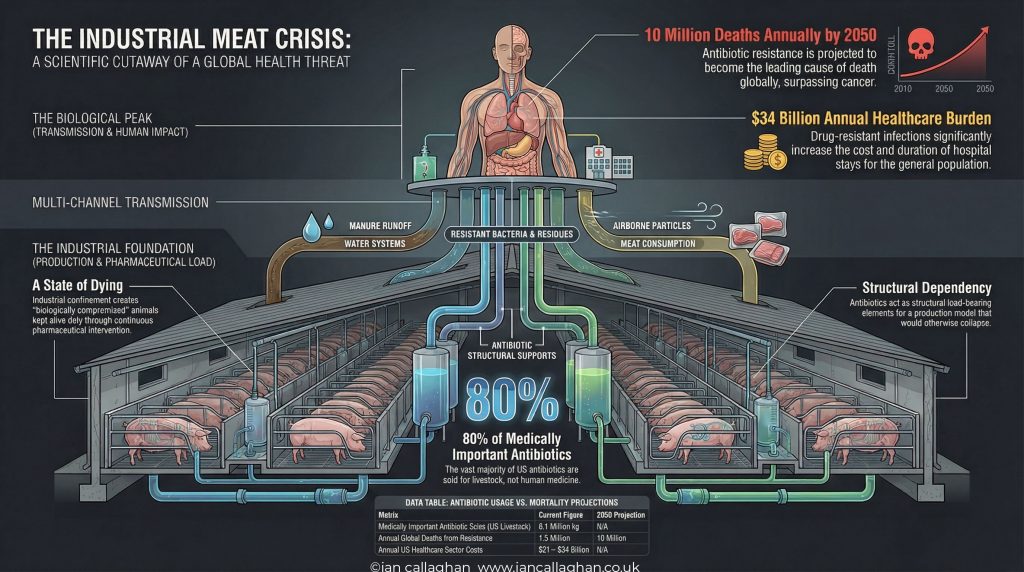
“Taken together, the immobility, poisonous air, and terror of confinement badly damage the pigs’ immune systems. They become susceptible to infection, and in such dense quarters microbes or parasites or fungi, once established in one pig, will rush through the whole population. Accordingly, factory pigs are infused with a huge range of antibiotics and vaccines and doused with insecticides. Without these compounds, including oxytetracycline, draxxin, ceftiofur, and tiamulin, diseases would likely kill them. Thus factory-farm pigs remain in a state of dying until they are slaughtered.”
A state of dying until they are slaughtered.
That is not the language of an animal rights campaign. That is a journalist describing the operational logic of a production system that keeps biologically compromised animals alive long enough to be profitable through continuous pharmaceutical intervention. In this context, antibiotics are not a tool being misused at the margins. They are structural load-bearing elements of a production model that would collapse without them.
When Smithfield subsequently launched its antibiotic-free premium line under the Pure Farms brand, it did not change its standard operation. It created a premium product for the portion of the market willing to pay extra to opt out of what the standard product represents, while the standard product continued at full industrial scale. The existence of a premium antibiotic-free line is not evidence of reform. It is evidence of a company that understands it has a reputational problem and has found a profitable way to monetise that problem without addressing it.
The Antibiotic Numbers That Should Make You Put Your Fork Down
An estimated 73% of all medically important antibiotics sold worldwide go to livestock production rather than to people. In the United States, that figure reaches approximately 80%, with around 70% of those from drug classes that are critically important to human medicine. These are not marginal or veterinary-specific compounds. These are penicillins, cephalosporins, fluoroquinolones, and tetracycline—the medicines your GP reaches for when you have a serious bacterial infection.
In 2023, the FDA reported that 6.1 million kilograms of medically important antibiotics were sold for use in US livestock alone. As recently as 2020, nearly twice as many medically important antibiotics were sold for livestock use as for human medicine. Between 2017 and 2023, sales of antibiotics for factory-farmed animals grew by 10%, rising from 5.6 million kilograms to 6.1 million kilograms. Swine production alone saw a 33% increase over the same period.
The Global Health Crisis
Antibiotic-resistant bacteria already infect more than 2.8 million Americans and directly cause at least 35,000 deaths every year in the United States. Globally, over 1.3 million people a year die from drug-resistant infections. By 2050, if current trajectories hold, that figure is projected to reach 10 million deaths annually. That would make antibiotic resistance the leading cause of death on earth. More than cancer. More than heart disease. More than any single condition, the modern healthcare system is currently structured to address.
Every fifteen minutes, another person in the United States dies from an infection that antibiotics can no longer reliably treat.
The Infectious Diseases Society of America estimates that longer, more expensive hospital stays to treat antibiotic-resistant infections cost the US healthcare sector between $21 and $34 billion annually. This is the cost, in human life and in public money, of cheap meat. These are externalised costs that the food industry does not pay for and that do not appear on any supermarket price label.
Lessons from Europe
The contrast with European agricultural practice is instructive. The EU banned the use of antimicrobials as growth promoters in 2006. Denmark, the world’s largest pork exporter, went further with strict restrictions on routine preventive antibiotic use. The documented result was a measurable decline in antibiotic resistance in Danish livestock, a measurable decline in resistance in retail meat, and a measurable decline in resistance in the general human population. Production levels were unaffected. The argument that restricting agricultural antibiotic use would devastate food production was empirically falsified by the countries that actually did it.
What it would reduce is profit margins. That is the real objection, stated honestly.
The United States by contrast continues to defer to voluntary FDA guidelines, has no national targets for reducing agricultural antibiotic use, and does not mandate comprehensive collection of antibiotic usage data from farms. The result is a system structurally incentivised to continue exactly as it is, externalising the public health costs onto the entire population while the production efficiencies remain private profits.
How Resistant Bacteria Travel From Farm to Your Body
This is the mechanism that the factory farming lobby works hardest to obscure because it is the part that makes the public health threat personal rather than abstract.
Resistant bacteria are transmitted to humans through direct contact with animals, through exposure to animal manure, through consumption of undercooked meat, and through contact with uncooked meat and the surfaces it has touched. They enter water systems through agricultural runoff from fields fertilised with antibiotic-laden manure. They colonise soil. A single waste lagoon on a Smithfield-scale farm releases many millions of bacteria into the air per day, some resistant to human antibiotics. Hog farms in North Carolina emit an estimated 300 tons of nitrogen into the air every day as ammonia gas, much of which falls back to earth and enters water systems, killing fish, stimulating algal blooms, and contaminating drinking water for communities who have no say in that outcome.
The CDC states that 75% of dangerous new infections, including pandemic-level threats, spill over from animals to human populations. We focus our pandemic preparedness conversations almost entirely on viral threats. The slow-moving bacterial pandemic of antibiotic resistance, which kills more people annually than HIV/AIDS globally, receives a fraction of the political and media attention because it is not dramatic in the way a novel virus is dramatic. It kills quietly, in hospitals, in people whose routine infections have become untreatable, in surgical patients for whom the standard post-operative antibiotic cover no longer provides adequate protection.
This is the public health emergency hiding in your supermarket meat aisle.
You Are What You Eat Eats
The principle that you are what you eat is well understood, at least in theory. What is less commonly stated, though it follows directly from the same logic, is that the nutritional quality of animal foods is itself a direct product of what those animals ate and how they lived.
In Fix Your Metabolism, my book covering the science of what food does at a cellular level, I go into considerable detail about how dietary fat quality, amino acid profiles, and fat-soluble vitamin content all vary depending on the conditions of animal production. These are not subtle differences. They are measurable variations in the biological composition of the food that have direct downstream effects on human health.
A pasture-raised beef animal that has grazed on diverse grassland produces meat with a fundamentally different fatty acid profile from a feedlot animal raised on grain and soy. Higher in omega-3 fatty acids. Higher in conjugated linoleic acid, which has documented anti-inflammatory properties. Higher in fat-soluble vitamins including vitamin E, which is deposited in the muscle tissue and acts as an antioxidant. The meat looks different. It tastes different. It cooks differently. And it performs differently in your body.
The same principle is more visible with eggs. The deep orange yolk of an egg from a hen that has ranged freely and eaten a varied natural diet reflects a genuine difference in carotenoid content, omega-3 content, and vitamin D content compared with the pale yolk of a caged hen’s egg. This is not aesthetic. It is nutritional.
Now extend the same logic to the pharmaceutical load these factory animals carry. The stress hormones released in the chronic physiological distress of confinement conditions, cortisol and adrenaline, are deposited in muscle tissue. They do not disappear at slaughter. The resistant bacteria that colonise the gut of an animal raised in antibiotic-saturated conditions enter the food chain. The antibiotic metabolites present in the tissue despite slaughter processing are consumed by you and contribute to your own gut microbiome’s exposure to sub-therapeutic antibiotic levels, which is precisely the exposure pattern that drives resistance development.
You are what you eat. You are also what your food was fed. And injected with. And kept alive on.
The Nutritional Difference Between Real Meat and Industrial Meat
I have been cooking professionally for over forty years. I have been a chef. I have cooked in professional kitchens and in my own. I know what good meat looks like, smells like, and behaves like in a pan. And I can tell you from four decades of handling food that the difference between a factory-farmed animal and a properly raised one is not a matter of preference or principle. It is a fundamental difference in the biological material you are working with.
Properly raised meat holds moisture differently during cooking because the muscle structure of an animal that has moved, grazed, and lived something approaching a normal life is architecturally different from the muscle of an animal that has spent its entire life in confinement with minimal movement. The fat distribution is different. The colour is different. The smell during cooking is different. These are not judgements. They are observations from someone who has cooked both for long enough to know the difference without being told.
In Nobody Taught You This, my book on the basics of cooking proper food, I address what has been lost from two generations of domestic cooking knowledge. One of the things that has been lost is the understanding of food provenance, of what it means to know where your food came from and why that matters beyond the ethics of it. The practical, nutritional, biochemical reason why provenance matters is exactly what this post is about.
Diet is not just macros and micros. Diet is not just the calorie count on the back of a packet. Diet is everything we consume. The antibiotics in the industrial meat. The pesticide residues in the feed grain that became the fat tissue of the animal. The stress hormone residues in the muscle tissue. The resistant bacteria that survived the journey from farm to fork. The pharmaceutical residues that enter water systems and return to us through the tap. The microplastics now found in measurable quantities in human blood and tissue that entered the food chain through agricultural water contamination.
We have built a food system of extraordinary reach and extraordinary complexity and then expressed bewilderment that chronic disease rates continue to climb despite decades of nutritional advice, pharmaceutical intervention, and public health investment. The bewilderment is not genuine. The evidence has been available for a long time. What has been lacking is the political and commercial will to act on it when acting on it would threaten the profitability of the industries responsible.
What This Means For Your Health in Practical Terms
I lost five stone after stopping drinking and switching to real food sourced with an understanding of provenance. I reversed pre-diabetes without a single pharmaceutical intervention. No jab. No patch. No prescription. No programme that arrives in a subscription box. Real food, selected with forty years of knowledge about what it actually does inside the human body, and the removal of the substance that had been metabolically breaking me down for years.
I want to be clear that these are my personal results. Individual outcomes vary and anyone with a specific medical condition should work with their GP when making significant dietary changes. What I can tell you is that the biology underpinning what happened to me is not mysterious or unique to me. It is the predictable consequence of removing chronic inflammatory inputs and replacing them with food that supports the repair processes the human body is always trying to carry out, when you stop obstructing it.
The antibiotic residues, stress hormones, and inflammatory compounds present in factory-farmed meat are chronic low-level inputs that contribute to systemic inflammation over time. Systemic inflammation is the underpinning mechanism of type 2 diabetes, cardiovascular disease, metabolic syndrome, certain cancers, and the majority of the chronic conditions driving the NHS’s structural crisis. Removing those inputs does not deliver a dramatic overnight result. But over months and years the body responds, as mine did, in ways that conventional medicine had told me would require pharmaceutical management indefinitely.
Food is medicine. It was always medicine. The food industry has spent fifty years and enormous amounts of money persuading you otherwise.
What You Can Actually Do About It
The answer is not to be paralysed by the scale of the systemic problem. The answer is to make different choices within the constraints of your own budget and access, and to understand clearly why those choices matter beyond personal ethics.
Buy less meat of better quality. A smaller amount of properly raised meat from a farm you can verify, or at minimum a butcher who can tell you something meaningful about the provenance of what they sell, is nutritionally superior to a larger quantity of factory-farmed meat and costs roughly the same when you account for what you are actually getting in terms of nutrient density and what you are not getting in terms of pharmaceutical and stress hormone contamination.
Buy British where you can. UK welfare and antibiotic stewardship standards, while imperfect, are significantly higher than US industrial standards. The Red Tractor scheme is not perfect but it is a minimum floor. Outdoor-reared and free-range are better. Knowing your butcher is better still.
Learn to use the whole animal. The cheaper cuts. The bones for broth. The organ meats that are the most nutrient-dense food available and that your butcher is often practically giving away because two generations of deskilling have removed the knowledge of what to do with them. This is covered in detail in my book Nobody Taught You This, which is specifically about recovering the cooking knowledge that has been systematically stripped from domestic life by the convenience food industry.
Cook from scratch. Knowing what is in your food requires making it yourself from ingredients you have chosen and can identify. This is the single most powerful act of food sovereignty available to an ordinary person on an ordinary budget. It is also the knowledge that is most urgently needed and most comprehensively missing from modern domestic life.
If you want to understand the metabolic science behind what food choices do at a cellular level, Fix Your Metabolism covers this in full, written in plain language by someone who has applied it to his own body with measurable, documented results.
Watch Pig Business if you have not already. It is not comfortable viewing. It was not designed to be. The system it documents is still operating, still expanding, still posting record profits, and still producing a significant proportion of the pork consumed in this country.
What you put on your plate is not a neutral act. It never was.
About the Author
Ian Callaghan is a professional chef with over 40 years of food and nutrition experience, a qualified nutritionist, NLP Master Practitioner, Reiki Master, and former British Army veteran. He is the author of Fix Your Metabolism, The 30 Day Reset, and Nobody Taught You This, published through iancallaghan.co.uk. He lost five stone and reversed pre-diabetes through nutritional intervention alone following a period of regular alcohol consumption, and writes from a position of lived experience rather than theoretical authority. He has been writing and speaking about industrial food production, metabolic health, and nutritional sovereignty for over a decade.
FAQ
What percentage of antibiotics are used in livestock farming?
An estimated 73% of all medically important antibiotics sold worldwide go to livestock production rather than to human medicine. In the United States the figure reaches approximately 80%, with around 70% of those being from drug classes that are critically important to treating human bacterial infections.
How does factory farming cause antibiotic resistance in humans?
Resistant bacteria develop in animals exposed to continuous low-level antibiotic use. Those bacteria are then transmitted to humans through consumption of undercooked meat, contact with raw meat surfaces, exposure to agricultural runoff, contaminated water systems, and airborne particles from large-scale facilities. Sub-therapeutic antibiotic exposure through the food chain also contributes to resistance development in the human gut microbiome over time.
What did the documentary Pig Business reveal about Smithfield Foods?
Pig Business, made by Tracy Worcester, documented the conditions inside Smithfield Foods’ industrial pork operations. The film exposed the routine use of antibiotics to keep animals alive in conditions of extreme confinement that would otherwise generate fatal levels of disease, the environmental contamination from vast waste lagoons, the displacement of family farms and rural communities, and the export of the Smithfield industrial model into Eastern Europe.
Is factory farmed meat safe to eat?
Factory farmed meat from reputable UK retailers meets legal safety standards for human consumption. However, research suggests that the routine antibiotic use in industrial meat production is a significant driver of antibiotic resistance in human populations, that stress hormones and inflammatory compounds present in the tissue of animals raised in chronic confinement stress may contribute to systemic inflammation, and that the nutritional profile of factory-farmed meat differs materially from that of pasture-raised equivalents. Safety and optimal nutrition are not the same question.
What is the difference between factory farmed meat and properly raised meat?
Beyond animal welfare, the differences are biochemical. Pasture-raised meat contains higher levels of omega-3 fatty acids, conjugated linoleic acid, fat-soluble vitamins including vitamin E, and has a different muscle structure reflecting the movement patterns of an animal that lived in appropriate conditions. Factory-farmed meat carries higher levels of stress hormones, antibiotic residues, and inflammatory markers associated with compromised immune function in the animal. These differences are measurable and have downstream effects on human health.
How can I avoid antibiotic-resistant bacteria from meat?
Buy from verified sources with transparent provenance. Choose outdoor-reared, free-range, or organic where budget allows. Buy from butchers who can explain where their animals come from. Cook meat to safe internal temperatures. Use separate boards for raw meat. Source from British producers where possible, as UK antibiotic stewardship standards are substantially higher than those of US industrial producers. Reducing total consumption of factory-farmed meat and increasing quality of sourcing is more achievable for most people than eliminating meat entirely and nutritionally more sound.
Why Your Lived Experience Is the Only Real Thing Left in a World of AI Slop
Something inside you cracked. Maybe it was a quiet fracture running through your soul, or maybe it was the ground giving way beneath your feet like a collapsing trench. You didn’t end up here by accident. You’re reading this because the life you’ve been living, a life increasingly dictated by digital noise and synthetic systems, is no longer one you can carry. You’re vanishing, drowning in a digital bucket of sugar-coated lies and Digital Seed Oils.
You are disappearing behind a version of yourself you didn’t consciously choose. You are numbing yourself, one notification and one AI-optimised post at a time, until you don’t recognise the face staring back in the mirror. We live in a world of ultra-processed chaos, a biological mismatch where we are simultaneously overfed and undernourished, not just in the food on our plates, but in the information in our heads. This is the industrial static of the modern world, designed to keep you at a baseline of fatigue.
As I wrote in the opening of my work on the identity shift:
“You don’t end up here by accident. Nobody opens a book like this because life is smooth, simple, or easy. You open a book like this because something inside you cracked. Something deep inside whispered, or screamed, that the life you’ve been living is no longer one you can carry.”
The modern digital environment is a biological mismatch engineered to keep you trapped in a cycle of inflammation, exhaustion, and mental dysfunction. We have been conditioned to accept this. But your lived experience, the grit, the scars, the setbacks, the rebuilding, and the raw reality of your life, is the only weapon you have left against the rising tide of AI slop. Not theory. Not a trend. Not promptcraft. Lived experience.
Digital seed oils, in plain English, are synthetic, algorithm-friendly content inputs that imitate nourishment while leaving you mentally underfed, overstimulated, and easier to control. It looks like a value. It feels like movement. But it rarely builds anything solid inside you.
The Death of the Human Signal: Interest Media as Industrial Non-Food
The digital landscape has shifted from social connection to interest media. This is the digital equivalent of the industrial food complex I’ve fought against in the metabolic world. Just as industrial non-foods are engineered specifically to bypass our evolutionary satiety signals, AI-driven content is designed to bypass our mental filters.
Think about how a supermarket snack is made. It’s a combination of refined sugars, bleached flours, and chemical additives designed to hit your bliss point. It is ultra-processed chaos. AI influencers and interest-based algorithms are doing the same thing to your brain. They serve up synthetic content that is the digital version of a high-sugar, low-nutrient snack. It tastes like something, but it leaves you empty. It gives you the hit without the nourishment. It spikes the system without building the human.
We are becoming glucose-dependent on content. We graze on notifications and ten-second clips because the sheer volume of synthetic noise has blunted our satiety signals. In this broken environment, the human signal is drowned out by a digital flood that mimics life but lacks its substance. It is engineered to keep you in a state of permanent hunger, always scrolling, never satisfied, always looking for the next hit of synthetic validation. This is the industrialisation of the human spirit, stripping the soul from our communication to make it consumable and palatable for the masses.
And this is where most people get caught by the same old bastards in different clothes. In one corner, you’ve got Bob, the inner PR man for self-sabotage, selling you the line that one more scroll, one more video, one more little hit won’t matter. In the other corner,r you’ve got Glucipher, that feral little sugar-addled goblin of appetite and impulse, dragging you towards whatever is bright, fast, easy, and emotionally anaesthetic. Put them together in a digital world built on engineered stimuli, and you’ve got a nervous system under siege.
The Seed Oil Analogy: Digital Oxidative Stress | Digital Seed Oils
To understand the danger of AI slop, we have to look at the seed oil problem through a digital lens. In the metabolic world, industrial seed oils, rapeseed, sunflower, corn, and soybean, are modern inventions created through high-heat processing and chemical deodorisation. They are extremely high in linoleic acid, an omega-6 fatty acid that is highly unstable.
When you consume these oils, they are incorporated into your cell membranes. Think of these unstable fats like rusted, sparking wiring in a high-voltage system. They don’t just sit there. They contribute to oxidative sparks that damage cells and inflame the system.
AI-generated content acts exactly like these industrial seed oils. It is digital seed oil.
Consider the processing. To make rapeseed oil edible, it must be heated to extreme temperatures, treated with hexane solvents, and deodorised because the natural product smells like a chemical factory. AI slop undergoes a similar deodorisation. It takes the raw, messy, often smelly reality of human experience and strips away the polyphenols of truth. It bleaches the context and processes it until it is a bland, uniform, and safe output.
It is highly unstable. Because it lacks the polyphenols of truth and the monounsaturated fats of deep reflection, AI slop induces chronic oxidative stress in your mind. It is prone to hallucinations and factual decay, much like seed oils go rancid the moment they hit the light.
It interferes with signalling. Just as seed oils damage the lining of your arteries and interfere with cellular communication, AI slop damages your ability to communicate with yourself. It creates systemic inflammation in the digital landscape, making it nearly impossible to achieve mental sovereignty.
It is a biological mismatch. Your brain evolved over millions of years to learn from other humans, to read micro-expressions, tone, pauses, scars, contradictions, and the emotion within a storyteller. It did not evolve to learn from a probability-based language model.
We must return to the ancestral gold standard. In nutrition, that means extra virgin olive oil. In life, that means extra virgin authenticity. Real, unfiltered, stable human experience that hasn’t been deodorised for an algorithm.
The Insulin Lock of the Mind: Glucose-Dependency on Content
Metabolic health is the ability of your body to switch seamlessly between burning the energy from your food and burning the energy stored in your body fat. This is metabolic flexibility. Most people are metabolically locked because of high insulin, the storage hormone. When insulin is high, your fat cells are biochemically locked. Your brain thinks you’re starving because the fuel is behind a locked door.
This is exactly how AI slop functions on your consciousness. It creates an insulin lock in the mind.
Consuming synthetic, high-dopamine content keeps your mental insulin permanently spiked. You become glucose-dependent on the next notification. You cannot access your own fat stores, the deep wisdom, intuition, memory, and lived experience you have stored over decades. You are starving in a land of plenty because you can’t get to your own reserves of truth.
To break this lock, you need to satisfy the satiety triad of content.
Real protein, lived experience. This is the most important signal to your brain. Just as the body seeks amino acids to repair tissue, the mind seeks real human struggle and triumph. Protein triggers the protein leverage effect. Your brain will keep screaming for content until you consume enough amino acids of reality.
Healthy fat, deep wisdom. Fat provides slow-burning energy. Deep wisdom, the kind that takes years of getting it wrong, years of getting hurt, years of rebuilding, triggers the release of satiety hormones that tell your brain to relax. It’s stable. It’s dense. It doesn’t spike the system.
Fibre, actionable structure. Fibre provides the cognitive bulk. In the metabolic world, fibre feeds the microbiome. In the digital world, fibre is the difficult, dense part of a story that makes you chew rather than just swallow. It’s the actionable structure that allows you to process information without bloating or mental inflammation. AI slop is low-fibre. It is designed to go down easy and leave you mentally gassy, agitated, and unsatisfied.
Why AI Can’t Fake the 45-Year Struggle
Prompts can never replace scars.
I spent 45 years drinking. Not casually, but as the backbone of my days and the escape hatch of my nights. I’m a British Army veteran whose career was cut short by injury, locked inside cycles of pain, denial, suppression, and survival mode. I rewired my mind at 58, with a prolapsed disc I’ve carried since service, a nervous system that had been hammered by decades of poison, and a life that could easily have gone the other way if I’d kept listening to Bob and feeding Glucipher.
This is where EEAT actually means something, not as some SEO acronym, but as lived proof. Experience. Expertise. Authoritativeness. Trust. I’m not borrowing that from a branding deck. I’ve earned it in blood, bad decisions, decades of consequences, years in coaching, years in mindset work, NLP, meditation, behavioural change, identity work, and the brutal practical reality of dragging myself back from places most people only talk about in theory.
An AI can generate a thousand inspirational quotes about resilience, but it can’t feel the brutal Welsh mornings in the cold water of a river. It hasn’t sat in the silence after service, feeling the identity drop and the disconnect from everything that used to define it. It doesn’t know the physical reality of a prolapsed disc screaming through the nervous system, the daily grind of pain, the visceral shame of lying to your family, or the weird, empty silence that comes when the anaesthetic is gone, and you are left with yourself.
AI is a map, but lived experience is the ground. I’ve stood on the edge of the Brecon Beacons when the wind is cutting through you, and the only thing that matters is the next step. AI doesn’t have a nervous system to regulate. You do. AI doesn’t have a legacy to leave. You do.
When I talk about change at 58, it isn’t a theoretical framework. It is a clinical-grade exit strategy from hell, built from lived experience, behaviour change, and identity reconstruction. It is EOM, the Emotional Operating Manual, forged through what happens when you stop pretending, stop performing, stop outsourcing your mind, and start learning how your own internal machinery actually works. The AI can mimic the words, but it can’t mimic the weight of those years. Your scars are your proof of existence. They are the polyphenols that stop your mind from oxidising in the face of modern chaos.
The Identity Shift: Rewiring the Bots Out of Your Brain
Reclaiming your sovereignty requires an identity reset. You cannot think your way out of a broken pattern; you have to build your way out. You do not rise to the level of your intentions; you fall to the level of your systems. Here is your briefing on rewiring the synthetic influences out of your system.
I. Naming the Trigger
Triggers are landmines buried in your nervous system. Identify the digital landmines where you consume slop. Is it the mindless scroll at 11 PM? Is it the need for distraction when you feel lonely, bored, anxious, rejected, or not enough? Name the emotion. Naming drags the trigger into the light and creates distance. If you can say, “I am feeling lonely and seeking a dopamine hit from synthetic noise,” you have already won 50 per cent of the fight. In EOM terms, you’ve moved from possession to observation. That matters.
II. The 10-Second Rule
When you feel the urge to graze on synthetic content, give yourself ten seconds. Ten seconds to breathe. Ten seconds to recognise the trigger. Ten seconds to interrupt Bob’s sales pitch and tell Glucipher to wind his neck in. Ten seconds to shatter the autopilot. Cravings, digital or physical, spike and fall. Ten seconds steal their oxygen. In the Army, we were taught to pause before reacting to an ambush. An algorithm is ambushing your life. Take your ten seconds.
III. Morning Ownership
Your nervous system does not need the world, or the AI, screaming at it before you are even awake. No screens for the first 20 minutes. Hydrate with 500 ml of water and sea salt. Get natural light into your eyes. Move your body. Claim your state before the machine claims it for you. This tells your biological factory settings that you are in control today, not the industrial static.
IV. Truth-Based Living
Refuse to sugar-coat your own bullshit. Addiction and digital dependency thrive in denial and shadows. Sobriety and sovereignty thrive in truth. Be honest about your limits, your triggers, and the parts of yourself you have been numbing. If you’re scrolling through AI slop because you’re scared of the silence in your own head, admit it. If Bob is dressing up his avoidance as recovery, call him on it. If Glucipher is chasing stimulation because stillness feels unbearable, call that out too. Truth is the only thing the bots can’t compute.
Establishing Permanent Standards in a Synthetic World
We do not use the words “diet” or “habit-fix”. Those are temporary states of misery. We establish standards. A standard is a baseline of quality you refuse to drop below. It is the recognition that certain substances, seed oils, refined sugars, and AI slop, are not actually food for the body or the mind.
The Sovereignty Standards
I refuse to be a customer for the pharmaceutical consequences of a broken digital system. If they want to make me sick with noise, I will not pay them with my attention.
I prioritise extra virgin authenticity over algorithmic convenience. I would rather read one raw, messy page of a human being’s struggle than a thousand perfect AI summaries.
I recognise that normal is exactly what caused the dysfunction. I choose to be the architect of my life, not a passenger on a digital bus heading for a cliff.
I protect my biological factory settings. I refuse chemical and digital inputs that disrupt my signalling, whether it’s linoleic acid or mindless notifications.
I value the 45-year struggle over the two-second prompt. I respect the scars of lived experience more than the polish of a machine.
The 28-Day Digital and Biological Sovereignty Challenge
Friction is the enemy of consistency. To reclaim your life, you must rearrange the kitchen workspace of your mind. Your environment dictates your success. If your digital environment is soaked in old memories, compulsive triggers, and synthetic stimulation, you will drift. You need a 28-day reset to restore your leptin sensitivity to both food for truth.
The AI-Dependent Identity
Glucose-dependent. Relies on notifications for dopamine hits, metabolically locked in a state of digital hunger.
Overfed and undernourished. Consumes massive amounts of slop with zero cognitive bulk, feels stuffed but empty.
Oxidised wiring. High inflammation from digital seed oils, brain fog, reactive emotions, unstable focus.
Survival mode. Reacts to the environment, the algorithm, and the latest outrage, a passenger in their own life.
Identity of a consumer. Defined by what they buy, watch, and graze on, disappearing behind a screen.
The Sovereign Authentic Identity
Metabolically flexible. Taps into internal wisdom and intuition, can sit in silence without needing a hit.
High-density satiety. Prioritises the satiety triad of real protein, struggle, healthy fat, wisdom, and fibre, action.
Ancestral gold standard. Grounded in stable, monounsaturated truth, clear-headed and resilient under pressure.
Self-leadership. Designs the environment with intention, the architect who builds a life they actually respect.
Identity of an embodied human. Defined by standards, legacy, and the strength of a rebuilt life.
What This Means in Real Life
If your attention is constantly being hijacked by synthetic content, your ability to think clearly, regulate your state, and trust your own judgement erodes. That is the real damage. This isn’t just a rant about AI. It’s about what happens when your nervous system is fed stimulation instead of substance, speed instead of truth, and polished output instead of lived reality.
The answer is not to smash your phone with a hammer and move into a cave. The answer is standards. Better inputs. More friction between you and the garbage. More respect for lived experience, deeper thinking, and embodied truth. Less grazing. More discernment. Less synthetic noise. More human signal.
Conclusion: Graduation Into the Real World
Metabolic sovereignty and identity embodiment are the same fight. They are both about removing the industrial static that has muffled your body’s natural signals for years. By clearing the seed oils from your diet and the AI slop from your mind, you are performing a daily act of reclamation.
Breaking the cycle of synthetic dependency is the only way to avoid the baseline of fatigue accepted by the modern population. You are not a failure for feeling overwhelmed. You are reacting exactly as a human nervous system reacts when placed inside an engineered biological mismatch designed to keep it dysregulated, distracted, inflamed, and dependent. But you still have a choice. You can keep grazing on digital non-foods, or you can step back into the cold water of reality.
The life you want is not a dream. It is a structure. It is a blueprint. It is a 28-day march into a new version of yourself. The question is no longer whether the technology is good or bad. The real question is embodiment.
What if the problem isn’t the AI, but the identity you’ve been living inside that still thinks surviving the machine is the same thing as living?
The mirror has cracked. The truth is clawing at your ribs. Stop lying to yourself, stop eating the digital seed oils, stop letting Bob negotiate with your standards, stop letting Glucipher drag you towards the nearest hit, and start building the life that matches the person you’ve become.
Ian Callaghan British Army veteran, coach, creator of EOM, Expert Information Architect, and builder of sovereignty standards forged through 45 years of lived experience.ext, friction, and lived truth. It gives you a quick hit while quietly weakening your thinking, making it shallower and more dependent.
Is all AI content worthless?
No. AI is a tool. The problem starts when the tool replaces judgment, lived experience, and human substance. A hammer is useful. Living your whole life as if everything is a nail is where it gets stupid.
Why does lived experience matter so much now?
Because lived experience contains texture, contradiction, scars, timing, and consequence, it carries signals that prediction machines cannot fully replicate. In a world flooded with synthetic output, real experience becomes more valuable, not less.
How do I reduce digital slop without disappearing off the internet?
Raise your standards. Curate harder. Stop grazing. Spend less time consuming synthetic noise and more time engaging with people, books, conversations, and frameworks that actually change how you live.
What does this have to do with EOM?
Everything. EOM is about understanding your internal machinery, so you stop being run by loops, triggers, avoidance, and autopilot. This post applies the same principle to the digital environment. If you don’t understand what is shaping your state, you will be shaped by it.
Final Word
This piece is not anti-technology. It is anti-bullshit. Anti-numbing. Anti-outsourcing your own mind. If you want sovereignty, whether metabolic, emotional, or digital, then you need to get serious about what you consume and what you let shape you.
That is the work.
Ian Callaghan Expert Information Architect, Identity Architect, creator of EOM, and builder of sovereignty standards forged through 45 years of lived experience.
Why smart, capable people keep doing the things that are destroying them, and how to take back the controls. No labels. No surrender. Just the machine, the load, and the way out.
Used to monitor number of Google Analytics server requests when using Google Tag Manager
1 minute
_gid
ID used to identify users for 24 hours after last activity
24 hours
_ga_
ID used to identify users
2 years
_gali
Used by Google Analytics to determine which links on a page are being clicked
30 seconds
_ga
ID used to identify users
2 years
__utmx
Used to determine whether a user is included in an A / B or Multivariate test.
18 months
__utmv
Contains custom information set by the web developer via the _setCustomVar method in Google Analytics. This cookie is updated every time new data is sent to the Google Analytics server.
2 years after last activity
__utmz
Contains information about the traffic source or campaign that directed user to the website. The cookie is set when the GA.js javascript is loaded and updated when data is sent to the Google Anaytics server
6 months after last activity
__utmc
Used only with old Urchin versions of Google Analytics and not with GA.js. Was used to distinguish between new sessions and visits at the end of a session.
End of session (browser)
__utmb
Used to distinguish new sessions and visits. This cookie is set when the GA.js javascript library is loaded and there is no existing __utmb cookie. The cookie is updated every time data is sent to the Google Analytics server.
30 minutes after last activity
__utmt
Used to monitor number of Google Analytics server requests
10 minutes
__utma
ID used to identify users and sessions
2 years after last activity
_gac_
Contains information related to marketing campaigns of the user. These are shared with Google AdWords / Google Ads when the Google Ads and Google Analytics accounts are linked together.