Why Am I So Angry and Sad After Quitting Drinking (And Is It Normal)? Angry after quitting drinking, let’s get straight to it. You’ve done the hard thing. You’ve put down the drink after years, maybe decades, of it being your go-to coping mechanism. You were promised clarity, energy, and a new lease on life. Instead, you’re walking around in a fog of sadness, punctuated by flashes of white-hot rage that seem to come out of nowhere. You’re snapping at your partner, you’ve got zero patience for your kids, and the slightest inconvenience feels like a personal attack. And the question screaming in your head is: Is this normal? Am I broken?
I’m here to tell you, from a man who spent 45 years with a drink in his hand, that not only is it normal, it is a necessary part of the process. What you are feeling is not a sign that you are failing. It is the sound of your mind and body beginning the painful, messy, and ultimately liberating process of healing. You are not broken. You are rebuilding.
IS IT NORMAL TO FEEL ANGRY AND SAD WHEN YOU STOP DRINKING?
Yes, it is completely normal. In fact, it would be abnormal if you didn’t. For many of us, alcohol was our primary tool for emotional regulation. It was the mute button for sadness, the pressure valve for stress, and the fuel for celebration. When you remove that tool without having built a new toolkit, you are left emotionally raw and exposed. The sadness you feel is a form of grief. You are grieving the loss of a constant companion, a ritual, an identity, and a coping mechanism that, for all its faults, worked for a very long time. Anger is the other side of that coin. It’s anger at the lost years, anger at yourself for letting it go on so long, and anger at a world that constantly pushes alcohol as the solution to everything.
WHAT IS ACTUALLY HAPPENING IN YOUR BRAIN?
Your brain is undergoing a massive recalibration. For years, you artificially manipulated your brain chemistry, specifically neurotransmitters like dopamine and GABA, to achieve a certain state. Alcohol floods the brain with dopamine, the ‘feel-good’ chemical, creating a powerful reward loop. It also enhances GABA, which has a calming, sedative effect. Your brain, in its effort to maintain balance, adapted to this constant chemical intervention by down-regulating its own natural production of these chemicals. Now that you’ve removed the alcohol, your brain is left with a massive deficit. This is the root of the low mood, anxiety, and anhedonia (the inability to feel pleasure) that is so common in the early days. It’s a chemical and neurological reality, not a personal failing. As an NLP Master Practitioner, I think of it as your brain trying to run old software on a new operating system. The old code, the ‘drink-to-feel-better’ program, is still trying to execute, but the hardware has changed. The resulting error messages are the anger and sadness you feel.
WHY IS ANGER SUCH A DOMINANT EMOTION?
Anger is often a secondary emotion, a protective shield for more vulnerable feelings like fear, shame, and sadness. It feels more powerful to be angry than it does to be afraid or heartbroken. In the early days of my own reset, the rage was shocking. I was angry at everything. This rage is your nervous system, which has been suppressed for decades, finally coming back online. Think of it like a limb that’s fallen asleep; the pins and needles are excruciating as the feeling returns. That’s what’s happening to your emotional self. Furthermore, you are likely confronting, for the first time with clear eyes, the consequences of your drinking years. The missed opportunities, the strained relationships, the health concerns. It’s a heavy load to carry, and anger is a very common response to feeling overwhelmed by that weight. My ex-Army background taught me that anger is just energy. It can be destructive, or it can be the fuel that drives incredible change. The choice is in how you direct it.
HOW CAN YOU PROCESS THESE EMOTIONS WITHOUT DRINKING?
This is the central task of your reset: building a new toolkit. You can’t just white-knuckle your way through this. You need practical, daily actions rooted in the four pillars: MIND, MOVE, EAT, and SLEEP. The old you would have reached for a bottle. The new you reaches for a tool.
First, the MIND pillar. You must give these emotions an outlet. I use a practice I call journaling ‘The Darkness’. This isn’t a gratitude journal. This is a private, no-holds-barred data dump. Get a cheap notebook and a pen, and every morning, you write out every single ugly, angry, sad, and fearful thought in your head. You don’t edit, you don’t judge, you just get it out of your body and onto the page. This act alone is a powerful pressure release. Then, you practice the reframe. When a wave of sadness hits, you say to yourself, ‘This isn’t just sadness; this is my brain healing.’ When rage boils up, ‘This isn’t just anger; this is fuel for my transformation.’ This is a core NLP technique of changing the meaning you assign to your feelings.
Second, the MOVE pillar. Emotions are energy, and energy needs to move. If you let it stagnate, it becomes toxic. The single most powerful tool I discovered for this is cold water immersion. It doesn’t have to be an ice bath or a frozen river. It can start with ending your morning shower with 30 seconds of pure cold water, or simply dunking your face in a sink full of cold water. The physiological shock is a hard reset for your nervous system. It short-circuits the emotional feedback loop, yanking you out of your head and into your body. It is a physical act of choosing discomfort to build resilience. It proves to you, on a cellular level, that you can withstand difficult things. Beyond that, walking is non-negotiable. A simple 30-minute walk moves the angry energy through your body and helps to regulate your cortisol levels.
Third, the SLEEP pillar. Sleep is your superpower, and a lack of it is like pouring gasoline on the fire of your anger and sadness. In early recovery, your sleep architecture is a mess. You need to become ruthless about your sleep hygiene. This means no screens an hour before bed. A cool, dark room. A consistent bedtime and wake-time, even on weekends. When I was a chef, I worked brutal hours and ran on fumes and booze. Reclaiming my sleep was the foundation of my entire reset. Without quality sleep, your ability to regulate your emotions is practically zero.
WILL THIS FEELING LAST FOREVER?
No. Absolutely not. This is the most important thing you need to hear. This intense phase will not last forever. Think of your emotions like waves in the ocean. In the beginning, the waves are like a tsunami—huge, powerful, and relentless. They knock you off your feet. But as you continue to use your new tools, as your brain continues to heal, the waves become smaller. They still come, but they are manageable. Eventually, they become gentle swells on a calm sea. The grief becomes a memory, and the anger transforms into a quiet strength. A key tool from the MIND pillar is visualising your Future Self. Every day, take five minutes to close your eyes and vividly imagine the person you are becoming one year from now. See him or her—calm, strong, clear-eyed, and free. Connect with that feeling. This practice doesn’t just give you hope; it gives your brain a new target to aim for, a future to move towards instead of a past to escape from.
This journey is not about becoming a different person. It’s about becoming the person you were always meant to be before alcohol got in the way. The anger and sadness are the storm before the calm. They are the clearing of the wreckage. Walk through the fire. I promise you, what’s on the other side is worth it. You are not just quitting something; you are reclaiming everything.
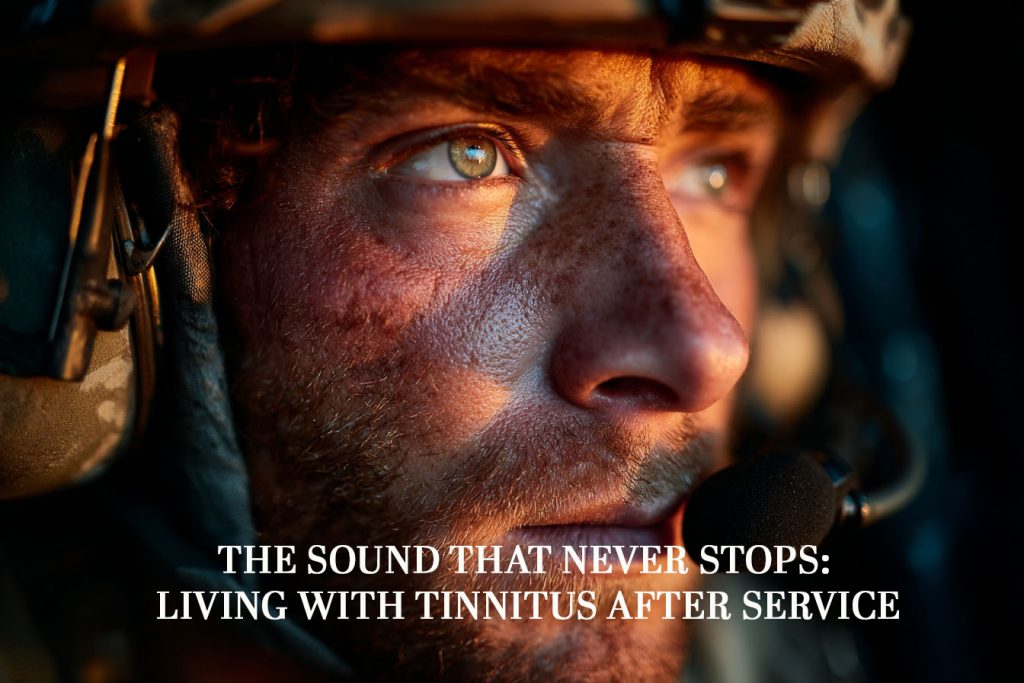
There’s a noise that’s followed me for over thirty years. High-pitched. Relentless. Never fades. Never gives me a moment’s peace.
It started in the Army, in tanks. You don’t need to imagine the noise; you feel it through your chest, through your skull, through every bit of metal in the hull. Engines growling, comms headsets screaming, the crack of 120mm and 76mm canons, 30mm bursts, and the GPMG rattling above your head. That’s the soundtrack you live with. Back then, no one wore proper protection. You had a headset so you could hear orders, not to save your hearing.
And when you’re young, you don’t think about it. You laugh it off. The ringing after a day of exercise was just part of the job. But the thing is, for some of us, it never went away.
When Silence Doesn’t Exist
It’s there the second I wake, and it’s still there when I try to sleep. A constant high-frequency whine that drills through the quiet.
People talk about tinnitus like it’s just a bit of ringing. It’s not. It’s an invisible injury that grinds you down day after day. It wrecks your sleep, eats your focus, and leaves your brain permanently on edge. I haven’t heard silence since the early nineties.
I’ve tried the usual — painkillers, muscle relaxants, sound therapy, and mindfulness. I’m on mirtazapine now to help with sleep and mental health because constant exhaustion takes its toll. The truth? Painkillers don’t touch tinnitus. They just numb the frustration a little, and when they wear off, the noise is still there.
Service, Injury, and the Matrix
Today, 11 November, Remembrance Day — I had my appointment with the ENT surgeon at 11:15. He was instructed by the solicitors handling my MOD Matrix hearing loss claim. Poetic timing, really: the nation remembering its fallen, and me on a call about the long-term damage that never left.
He asked what guns I’d been exposed to, whether the tinnitus was in both ears, and how long I’d had it. I told him the truth: tank engines, canons, machine guns, comms headsets, thirty-plus years of non-stop ringing. He said he’d submit his report to the solicitors so they can do their thing. Five minutes. Job done.
That’s how it goes. You spend years living with the consequences, and it all comes down to one short assessment and a few boxes on a Matrix chart.
Still, it’s the system we’ve got. The Matrix scheme categorises hearing loss and tinnitus into bands. The more severe and permanent it is, the higher the compensation. For anyone reading this who served — if your ears ring, even slightly, get it checked. You might think it’s just part of the job, but thirty years later, it’s no joke.
The Hidden Cost
You can patch up a broken bone. You can rehab a bad knee. But tinnitus? There’s no cure. It’s not something you treat; it’s something you learn to survive.
People see the medals and the parades, but they don’t see the vets lying awake at 3 am with their ears screaming. They don’t see the way exhaustion messes with your head, or how that constant noise chips away at your peace.
For me, mindfulness, breathwork, and cold water have become coping tools. Not to silence it — that’s impossible — but to make it fade into the background for a bit. To remind myself that the sound doesn’t control me.
Why I’m Sharing This
Because there are thousands of us walking around with the same noise. Because a bit of awareness goes further than any painkiller ever will. And because on a day like today — 11/11 — it feels right to talk about the price that doesn’t make the news.
So if you’re reading this and you’ve got that ringing, that hiss, that hum that never stops — get it checked. Log it. Claim it. Don’t shrug it off like I did. Silence is priceless, and once it’s gone, you’ll do anything to get it back.
Written by Ian Callaghan – Veteran, Coach, and Creator of Sober Beyond Limits If you’re a veteran dealing with tinnitus or mental health struggles, reach out. You’re not broken, you’re just carrying the echoes of what you survived.
This is one of the toughest questions I get asked, and it hits close to home. For 45 years, drinking was my default setting. It was the background noise to my entire adult life. When you decide to turn that noise off, but someone you love keeps their volume on full blast, it creates a unique kind of hell. It feels personal. It feels like a betrayal, even when it isn’t meant to be. You’re trying to build a fortress of new habits, and it feels like you’re sharing a bed with the enemy. Let’s be clear: this isn’t about them. This is about you. This is about you learning to hold your ground, secure your perimeter, and win the war inside your own head, regardless of the battle raging outside. It’s not easy, but it is possible. You just need the right strategy.
WHY DOES YOUR PARTNER’S DRINKING FEEL LIKE A PERSONAL ATTACK?
It feels like a personal attack because your brain is a highly efficient, pattern-recognising machine that has been programmed for years, maybe decades, to associate the sight, sound, and smell of alcohol with a specific reward. When your partner cracks open a beer, your subconscious mind doesn’t see your partner relaxing. It sees a trigger, a cue, for a deeply ingrained habit. As an NLP Master Practitioner, I can tell you this is pure neurology. The ‘pop’ of a cork is an anchor, a sensory input linked to a powerful emotional state. Your conscious mind knows you’ve quit, but the old programming in your subconscious screams, ‘That’s for us! That’s our reward! Why are we being left out? This creates a massive internal conflict, which your brain interprets as a threat. The resulting emotions—anger, resentment, self-pity—are defence mechanisms. It’s not a logical response; it’s a primal one. Understanding this is the first step to disarming it. It’s not about them, and it’s not a sign of your weakness. It’s a sign that your brain is still healing and rewiring.
HOW DO YOU CREATE A MENTAL FORTRESS IN YOUR OWN HOME?
You create a mental fortress by building non-negotiable systems and routines that are stronger than the external triggers. This is the core of the MIND pillar in my Midlife Reset system. Your mind is the battlefield, and you need to fortify it daily. First, visualisation. Every morning, before you do anything else, you spend five minutes visualising your day. See yourself navigating those trigger points successfully. See your partner having a drink, and see yourself feeling calm, centred, and indifferent. See yourself reaching for your sparkling water. This pre-paving technique primes your brain for success. Second, you must externalise your resentment through journaling. I call this ‘The Darkness’ journal. It’s a place for the raw, ugly, unfiltered truth. Write down the anger. Write down the jealousy. Get it out of your system and onto the page so it doesn’t poison your interactions. This isn’t about stewing in negativity; it’s about lancing the wound to let the poison out so it can heal. Finally, you reframe the narrative. When the thought ‘It’s so unfair’ pops up, you consciously replace it with a more powerful one: ‘I am choosing a different path. My path leads to freedom.’ You are not being deprived; you are being liberated.
WHAT PRACTICAL STEPS CAN YOU TAKE TO SECURE YOUR ENVIRONMENT?
Practical steps are about taking back control of your physical space, a principle I learned in the Army. You cannot control your partner, but you can control your immediate environment. First, establish ‘dry zones’. This could be your bedroom, your office, or even just your favourite chair. These are non-negotiable spaces where no alcohol is allowed. This gives your nervous system a sanctuary, a place where it can be off-guard without fear of ambush. Second, build your own arsenal. Your partner has their wine? You have your favourite kombucha, your fancy sparkling water with mint and lime, and your herbal teas. Go to war with a better weapon. The ritual is often as important as the substance. Having something delicious and special to drink that is yours alone rewires the ritualistic part of the habit. Third, change the routine. If ‘wine o’clock’ was at 6 PM in the kitchen, make sure that at 6 PM you are somewhere else, doing something else. Go for a walk. Take a shower. Put on music in another room. Break the chain of events that leads to the trigger. Don’t just sit there and try to tough it out. Evade and reposition.
HOW CAN YOU USE MOVEMENT TO DISCHARGE RESENTMENT AND ANXIETY?
You use physical stress to override mental and emotional stress. Resentment, fear, and anxiety are not just thoughts; they are physical energies that get trapped in the body. The MOVE pillar is your tool for discharging them. When you feel that knot in your stomach as your partner pours a glass, that is your signal to move. The most powerful tool I’ve found for this is Cold Water Immersion. You don’t need a frozen lake. Just go to your bathroom and splash your face with the coldest water you can handle for 30 seconds. The shock to your system acts as a hard reset. It shuts down the internal monologue and forces you into the present physical moment. I remember one of my first river dips; the sheer cold was so overwhelming that it felt like every cell in my body was screaming. But when I got out, the mental chatter was gone. The anxiety was gone. It had been replaced by a clean, calm clarity. If cold water isn’t accessible, use explosive movement. Drop and do 10 push-ups. Do a minute of burpees. Go for a brisk walk. The goal is to change your physiological state so drastically that the emotional state cannot survive.
WHAT IS THE MOST IMPORTANT CONVERSATION YOU NEED TO HAVE WITH YOUR PARTNER?
The most important conversation is a calm, planned, and non-accusatory one about your needs, not their faults. This conversation should not happen when they are drinking or when you are feeling triggered. Schedule a time. Start by reaffirming your commitment to them and the relationship. Then, use ‘I’ statements. It’s not ‘Your drinking is driving me crazy.’ It’s ‘I am finding this journey challenging, and I feel triggered when I see alcohol in the house. I need your support.’ Then, be specific about what support looks like. ‘Would you be willing to keep your wine in an opaque bag in the fridge?’ or ‘Could we agree to have two alcohol-free nights together per week?’ This isn’t about making demands; it’s about asking for reasonable accommodations. You are not asking them to quit. You are asking them to help you succeed. A supportive partner, even one who drinks, should be able to meet you halfway on small, practical requests. Their reaction to this calm and reasonable conversation will tell you everything you need to know about the level of support you truly have.
WHEN IS IT TIME TO RE-EVALUATE THE RELATIONSHIP?
It’s time to re-evaluate when your foundational need for safety and well-being is consistently and deliberately ignored. If you’ve had calm conversations, made reasonable requests, and are met with dismissiveness, ridicule, or outright sabotage, you have a bigger problem than a ‘wet household’. This journey of reclaiming your life will make you incredibly sensitive to what nourishes you and what poisons you—and that includes relationships. If your partner’s behaviour is actively undermining your efforts to be healthy and happy, if they cross boundaries you have clearly and kindly set, then you must face a hard truth. Your reset is about choosing life, choosing health, choosing a better future. You must be willing to ask yourself if your relationship is aligned with that future. This isn’t a decision to be made lightly, but your life is not a dress rehearsal. You have to be your own fiercest advocate. Sometimes, the bravest move is admitting that your path forward is one you may have to walk alone.
Used to monitor number of Google Analytics server requests when using Google Tag Manager
1 minute
_gid
ID used to identify users for 24 hours after last activity
24 hours
_ga_
ID used to identify users
2 years
_gali
Used by Google Analytics to determine which links on a page are being clicked
30 seconds
_ga
ID used to identify users
2 years
__utmx
Used to determine whether a user is included in an A / B or Multivariate test.
18 months
__utmv
Contains custom information set by the web developer via the _setCustomVar method in Google Analytics. This cookie is updated every time new data is sent to the Google Analytics server.
2 years after last activity
__utmz
Contains information about the traffic source or campaign that directed user to the website. The cookie is set when the GA.js javascript is loaded and updated when data is sent to the Google Anaytics server
6 months after last activity
__utmc
Used only with old Urchin versions of Google Analytics and not with GA.js. Was used to distinguish between new sessions and visits at the end of a session.
End of session (browser)
__utmb
Used to distinguish new sessions and visits. This cookie is set when the GA.js javascript library is loaded and there is no existing __utmb cookie. The cookie is updated every time data is sent to the Google Analytics server.
30 minutes after last activity
__utmt
Used to monitor number of Google Analytics server requests
10 minutes
__utma
ID used to identify users and sessions
2 years after last activity
_gac_
Contains information related to marketing campaigns of the user. These are shared with Google AdWords / Google Ads when the Google Ads and Google Analytics accounts are linked together.