You look in the mirror. The face looking back is tired. It’s not just the lines around the eyes; it’s a deeper exhaustion. It’s the soul-crushing weight of showing up for a life you didn’t consciously choose, built around a career that drains the very life from you. The question hits you like a punch to the gut: ‘Is this it? Have I wasted it all?’ At 50, that question feels less like a philosophical ponderance and more like a verdict. A life sentence. I’m here to tell you that feeling is a lie. It’s not too late. But the way you’re approaching the problem is fundamentally broken. You’re asking the wrong questions. You think you need to find your passion. What you really need is to build a foundation so you can hear your own voice again.
For 45 years, my ‘passion’ was drinking. My career was built around it, my social life depended on it, and my identity was fused to it. When I stopped, the silence was deafening. The question wasn’t just ‘what do I do now?’ It was ‘Who the hell am I?’ The idea of a ‘pivot’ felt laughable. I wasn’t pivoting; I was learning to stand on my own two feet for the first time. The principles I used to rebuild my life from the ground up are the exact same ones you need to use to rebuild your career. It’s not about a grand gesture. It’s about a quiet, deliberate, and non-negotiable reset.
WHY DOES 50 FEEL LIKE A POINT OF NO RETURN?
It feels like a point of no return because you’ve been conditioned to believe it is. Society, your family, and your own inner critic have spent decades telling you that life follows a linear path: school, career, mortgage, retirement, death. Any deviation after a certain age is seen as a failure or a crisis. This narrative is reinforced by the ‘sunk cost fallacy’—the crippling belief that because you’ve invested 25 or 30 years into something, walking away would mean all that time was wasted. It’s a cognitive trap, and it keeps people in jobs, relationships, and lives they despise, simply because they can’t stomach the idea of ‘losing’ their investment. On top of that, you’re likely physically and mentally depleted. Years of chronic stress, poor nutrition, inadequate sleep, and a sedentary lifestyle have drained your battery. You’re trying to plan a massive expedition with an empty fuel tank. Of course, it feels impossible. The fog of burnout makes any hill look like Everest. Your brain, starved of proper fuel and rest, defaults to fear and preservation. It will choose the miserable known over the terrifying unknown every single time. It’s not a character flaw; it’s a biological reality.
HOW DO YOU STOP REGRETTING THE PAST?
You stop regretting the past by radically reframing it. The 25 years you spent in a career you hate were not a waste. They were the most expensive and comprehensive education you could ever receive. You didn’t waste time; you gathered data. You now have a PhD in what you don’t want, what drains you, what compromises your values, and what kind of environment crushes your spirit. This is not a failure; it is invaluable intelligence. As an NLP Master Practitioner, one of the first things I work on is the power of the reframe. Your brain is a meaning-making machine, but it’s running on old, faulty software. You have the power to rewrite the code. Instead of saying, ‘I wasted 25 years,’ you say, ‘I spent 25 years discovering my non-negotiables.’ I don’t look back on my 45 years of drinking as a waste. I see it as my apprenticeship. It taught me about the human condition, about rock bottom, about resilience, and it gave me the lived experience—the ‘T’ in E-E-A-T—that allows me to connect with people on a level no textbook ever could. Your past is not an anchor; it’s a launchpad. Every mistake, every soul-crushing Monday, every moment of quiet desperation has forged the person who is finally ready to demand more from life. You don’t get to be this person without going through that. So stop mourning the time and start mining it for the wisdom it contains.
WHAT IS THE FIRST STEP IF ‘FINDING YOUR PASSION’ FEELS TOO BIG?
The first step is to forget the word ‘passion’ entirely. It’s a loaded, intimidating word that implies a lightning bolt of divine inspiration. That’s a myth. The real first step is to build a foundation of energy, clarity, and resilience. You must fix the fundamentals before you can tackle the existential. This is where my four pillars come in: EAT, SLEEP, MOVE, MIND. This is the non-negotiable bedrock of any meaningful change. You wouldn’t build a house on a swamp, so why are you trying to build a new life on a foundation of exhaustion and brain fog? Start here. For 30 days, make this your only focus. Don’t worry about your resume or your business plan. Just focus on the pillars. EAT: As a qualified chef and nutritionist, I can tell you that what you put in your mouth directly impacts your thoughts. Processed foods, sugar, and industrial seed oils create inflammation, which manifests as brain fog, anxiety, and depression. You can’t find clarity in a state of chronic inflammation. Strip it back to basics: meat, fish, eggs, and vegetables. Real, single-ingredient foods. Fuel your brain properly, and the fog will begin to lift. SLEEP: This is your superpower. Most people in their 40s and 50s treat sleep as a luxury. It is a biological necessity. Without 7-8 hours of quality sleep, your emotional regulation is shot, your decision-making is impaired, and your hormones are a mess. You cannot make sound, long-term decisions when you are sleep-deprived. It’s impossible. Create a non-negotiable wind-down routine. No screens an hour before bed. Make your room cold, dark, and quiet. Prioritise sleep above everything else. MOVE: Your body was designed to move. A sedentary life creates a stagnant mind. I’m not telling you to go run a marathon. I’m telling you to start with a 30-minute walk every single day. My ex-Army background taught me the power of simple, consistent discipline. Movement changes your physiology, releases endorphins, and helps process stress hormones like cortisol. And if you want to really kickstart the system, embrace the cold. A 30-second cold blast at the end of your shower or even just splashing your face with icy water is a hard reset for your nervous system. It silences the whining inner critic and proves you can do hard things. MIND: This is the command centre. With the energy from the other three pillars, you can now begin to do the real work here. This isn’t about fluffy affirmations. It’s about practical tools to manage your own psychology.
HOW CAN YOU DISCOVER WHAT YOU ACTUALLY WANT TO DO?
You discover what you want by taking small, deliberate actions and paying attention to the feedback. It’s a process of excavation, not invention. You’re not creating a new passion; you’re uncovering the one that’s been buried under decades of obligations and expectations. The primary tool for this excavation is journaling. Get two notebooks. The first is for ‘The Darkness.’ This is where you dump every fear, resentment, and piece of negativity without filter or judgment. Get it out of your head and onto the page so it stops looping. The second notebook is your ‘Curiosity Journal.’ Every day, write down the answer to these questions: What was I obsessed with as a child before the world told me who to be? If I had a free Saturday with no obligations, what would I do? What topics do I read about or watch videos on that make me lose all track of time? Don’t judge the answers. Just collect the data. Maybe it’s restoring old furniture, or learning about ancient history, or hiking. These are the threads. Your job is to start pulling on them, not by quitting your job to become a historian, but by spending one hour a week engaging with that curiosity. The next tool is the Pattern Interrupt. When your brain starts its favourite song, ‘It’s too late, you’re too old,’ you need to physically and mentally interrupt it. Stand up. Do 10 push-ups. Go splash your face with cold water. Use the 5-4-3-2-1 grounding technique: name 5 things you can see, 4 you can feel, 3 you can hear, 2 you can smell, and 1 you can taste. This yanks you out of the abstract fear loop and into the present moment. Finally, use visualisation. Every morning, for ten minutes, close your eyes and visualise your Future Self. Not a vague, happy version of you. Be specific. What is this person wearing? How do they carry themselves? What does their typical Tuesday look like? Feel the feeling of being that person—the calm, the purpose, the quiet confidence. You are pre-paving the neural pathways. You are giving your brain a target to aim for that is more compelling than its current fear-based reality.
WHAT IF FEAR OF FINANCIAL INSECURITY IS PARALYZING YOU?
This is the most practical and potent fear of all, and it must be met with strategy, not blind faith. This is where my military discipline kicks in. You do not abandon your post and run into the wilderness. You build a fortified outpost in your spare time. You don’t burn the boats; you build a raft on the weekends. Reframe your current job. It is no longer the soul-sucking cage. It is now the ‘angel investor’ for your new life. Every paycheck is seed funding for your future. This mental shift changes everything. It puts you back in control. Your 9-to-5 becomes a means to a strategic end, not a life sentence. This makes it infinitely more tolerable. Next, you must become ruthless with your finances. Track every penny. Cut out the fat. Every dollar you save is buying you freedom. It’s buying you time on your escape plan. While your job is funding the mission, you use the margins of your day—the hour before work, the weekends—to test your curiosities. That interest in woodworking? Buy a cheap set of chisels and see if you actually enjoy it. That idea for a coaching business? Offer to help one person for free to see if you’re any good at it. These are low-risk experiments. You are gathering real-world data on what might be a viable next step. The goal is not to replace your six-figure salary overnight. The goal is to build a small, parallel income stream that proves the concept. Earning your first $100 from something you created is more powerful than a $10,000 bonus from a job you hate. It’s a proof of concept. It makes the impossible feel possible. This process might take a year, or three, or five. The timeline doesn’t matter. What matters is that you are moving, you have a plan, and you are taking back control. The feeling of being trapped comes from helplessness. A strategic plan, executed with discipline, is the antidote to helplessness. It’s not too late. The only thing that was wasted was yesterday. Today is the day you wake the fuck up and start building.
The Ugly Truth About Alcohol. We see it everywhere. It’s the glittering champagne flute at a wedding, the celebratory pint after a hard week’s work, the comforting glass of red wine on a cold evening. Alcohol is deeply woven into the fabric of British culture, a social lubricant and a symbol of relaxation, sophistication, and fun. We use it to mark occasions, to bond with colleagues, to commiserate with friends, and to simply unwind. It is so normalised, so utterly ubiquitous, that to question its role can feel strange, even puritanical.
But behind this veneer of conviviality and tradition lies a stark and uncomfortable reality. The substance we so readily embrace is, in scientific terms, a potent toxin. It is a psychoactive drug with a profound and often devastating impact on our physical and mental health. This isn’t about scaremongering or advocating for a new era of prohibition; it’s about pulling back the curtain on a cleverly marketed and culturally ingrained poison. It’s about facing the ugly truth that our favourite social crutch may be quietly dismantling our health, happiness, and wellbeing from the inside out.
In this comprehensive post, we will venture beyond the familiar warnings about drink-driving and hangovers. We will delve into the cellular level to understand how alcohol wages a war on our bodies, explore its insidious relationship with our mental state, and confront the broader societal scars it leaves behind. It’s time to have an honest conversation and unmask the hidden dangers of our national pastime.
The Deceptive Friend: Alcohol’s Immediate and Insidious Impact on the Brain and Body
The initial effects of a drink can feel wonderful. The warmth spreading through your body, the loosening of inhibitions, the sudden ease of conversation—it feels like a release, a reward. This, however, is the first and most powerful deception. Alcohol is not a stimulant; it is a central nervous system depressant. That feeling of euphoria and confidence is not a boost but rather the result of alcohol beginning to shut down the parts of your brain responsible for self-control, critical thinking, and anxiety.
The Neurological Con Trick
When you drink, alcohol quickly enters your bloodstream and travels to the brain. Here, it begins to interfere with your neurotransmitters, the chemical messengers that control everything from your mood to your movements.
GABA (Gamma-Aminobutyric Acid): Alcohol enhances the effects of GABA, your brain’s primary inhibitory neurotransmitter. GABA’s job is to calm things down and reduce neuronal excitability. By amplifying its effects, alcohol produces feelings of relaxation and drowsiness. It’s essentially putting the brakes on your brain activity.
Glutamate: At the same time, alcohol blocks glutamate, your brain’s main excitatory neurotransmitter. Glutamate is crucial for memory formation, learning, and overall brain energy. By suppressing it, alcohol causes slurred speech, slowed reaction times, and memory blackouts.
This chemical double-act is why drinking can feel so good initially. You’re artificially boosting your brain’s “calm down” signal while silencing its “get going” signal. The problem arises when the alcohol wears off. Your brain, in an attempt to restore balance, rebounds by overproducing glutamate and suppressing GABA. This is the root cause of the dreaded “hangxiety”—the feelings of intense anxiety, restlessness, paranoia, and dread that can plague you the day after drinking, even if you don’t have a typical physical hangover. Your brain is in a state of hyper-arousal, desperately trying to correct the chemical imbalance you induced.
The Sabotage of Sleep
One of the most pervasive myths about alcohol is that it helps you sleep. While it’s true that a drink before bed can help you fall asleep faster due to its sedative properties, the quality of that sleep is catastrophic.
Sleep is not just a passive state of rest; it is an active, highly structured process vital for our physical and mental health. Alcohol systematically dismantles this process. It particularly suppresses Rapid Eye Movement (REM) sleep, the stage crucial for memory consolidation, emotional regulation, and creative problem-solving. A night of drinking might involve plenty of deep sleep in the first half, but as the alcohol is metabolised, your system rebounds. This leads to a second half of the night characterised by fragmented, light sleep and frequent awakenings, often leaving you feeling exhausted and mentally foggy the next day, regardless of how many hours you were in bed. Over time, this chronic disruption of sleep architecture contributes to poor cognitive function, mood instability, and a weakened immune system.
The Assault on Your Physical Systems
Beyond the brain, alcohol’s immediate effects ripple throughout the body.
Your Gut: Alcohol is a direct irritant to the lining of your digestive system. It can increase stomach acid production, leading to heartburn and gastritis. It also damages the delicate microbiome, the community of beneficial bacteria in your gut that influences everything from digestion to mood and immunity. Chronic drinking can contribute to “leaky gut” syndrome, a condition where the intestinal lining becomes more permeable, allowing toxins to pass into the bloodstream and trigger system-wide inflammation.
Your Skin: That flushed look you get after a couple of drinks is your blood vessels dilating. Over time, this can lead to broken capillaries and persistent facial redness. Alcohol is also a diuretic, meaning it makes you urinate more frequently, leading to significant dehydration. Dehydrated skin appears dull, dry, and more prone to fine lines and wrinkles. Conditions like rosacea and psoriasis are often exacerbated by alcohol consumption.
Your Immune System: Even a single episode of heavy drinking can temporarily suppress your body’s immune response, making you more susceptible to infections for up to 24 hours afterwards. Chronic use leads to a more sustained weakening of your defences, leaving you vulnerable to illnesses.
In essence, that “harmless” drink is a multi-system shock. It’s a neurological trick, a sleep saboteur, and a physical irritant. And these are just the short-term effects. The real ugly truth emerges when we look at the cumulative damage over months and years.
The Slow Poison: Unpacking the Long-Term Health Catastrophe
If the short-term effects of alcohol are a series of skirmishes, the long-term effects are an all-out war on your health. The damage is slow, insidious, and often asymptomatic until it reaches a critical stage. Many people who consider themselves “moderate” or “social” drinkers are unknowingly contributing to a future health crisis.
The Unspoken Carcinogen | The Ugly Truth About Alcohol
This is perhaps the single ugliest and least-discussed truth about alcohol: it is a Group 1 carcinogen. This classification by the International Agency for Research on Cancer (IARC), part of the World Health Organisation, places alcohol in the same category as asbestos, tobacco smoke, and plutonium. There is no ambiguity in the scientific community about this. Alcohol causes cancer.
How does it do this? When your body metabolises alcohol, the liver converts it into a chemical called acetaldehyde. Acetaldehyde is a toxic compound and a known carcinogen. It can damage the DNA within your cells, preventing them from repairing themselves correctly. This DNA damage can lead to uncontrolled cell growth, which is the hallmark of cancer.
The link between alcohol and cancer is not theoretical; it is a causal relationship proven by decades of research. Drinking alcohol increases your risk of developing at least seven types of cancer:
Mouth and throat cancer
Larynx (voice box) cancer
Oesophageal cancer
Breast cancer (in women)
Liver cancer
Bowel (colon and rectum) cancer
Crucially, there is no “safe” level of drinking when it comes to cancer risk. The risk increases with every drink you consume. The myth of the “healthy” glass of red wine crumbles in the face of this evidence. Any potential, and often overstated, cardiovascular benefits are massively outweighed by the proven increase in cancer risk.
The Decimation of the Liver
The liver is the body’s primary detoxification organ, and it bears the brunt of processing the alcohol we consume. While the liver is remarkably resilient, it has its limits. Consistent, long-term drinking forces it into a state of chronic stress and damage, leading to a deadly progression of liver disease.
Alcoholic Fatty Liver Disease: This is the first stage, where excess fat accumulates in the liver cells. It can develop after just a few weeks of heavy drinking. In its early stages, it is often reversible if you stop drinking completely.
Alcoholic Hepatitis: If drinking continues, the fatty liver can become inflamed. This is a more serious condition that can cause fever, jaundice, nausea, and abdominal pain. It can be life-threatening and signifies significant liver damage.
Cirrhosis: This is the final, irreversible stage. Years of inflammation lead to severe scarring (fibrosis) of the liver tissue. The scar tissue replaces healthy cells and prevents the liver from functioning properly. Cirrhosis leads to a host of debilitating complications, including fluid build-up in the abdomen (ascites), bleeding from veins in the oesophagus, confusion (encephalopathy), and ultimately, liver failure or liver cancer.
The Strain on the Heart
The idea that moderate drinking, particularly red wine, is “good for your heart” is one of the most persistent and dangerous myths in public health. While some older, observational studies suggested a slight benefit, more recent and robust research has largely debunked this notion, showing that any potential benefits are minimal and confined to a very specific demographic, while the risks apply to everyone.
The reality is that alcohol is a significant burden on the cardiovascular system.
High Blood Pressure (Hypertension): Regular drinking raises blood pressure, a leading risk factor for heart attack and stroke.
Atrial Fibrillation: Alcohol is a known trigger for this common type of irregular heartbeat, which dramatically increases the risk of stroke.
Alcoholic Cardiomyopathy: Long-term heavy drinking can weaken and damage the heart muscle itself, making it unable to pump blood effectively. This leads to heart failure.
The Shrinking of the Brain
The long-term neurological consequences of alcohol are terrifying. While a single night’s drinking can cause temporary memory lapses, chronic alcohol use leads to permanent structural changes in the brain. It is, quite literally, neurotoxic.
MRI scans have shown that people who drink heavily have a reduced brain volume compared to non-drinkers. This brain shrinkage, or cerebral atrophy, particularly affects the prefrontal cortex (responsible for executive functions like planning and decision-making) and the hippocampus (vital for memory). This contributes to a gradual decline in cognitive function that can mimic the early stages of dementia.
In severe cases, chronic alcohol abuse combined with poor nutrition can lead to Wernicke-Korsakoff syndrome, a devastating neurological disorder. It presents as a two-stage condition: Wernicke’s encephalopathy involves confusion, vision problems, and a loss of muscle coordination, while Korsakoff’s psychosis is characterised by profound, permanent memory loss and an inability to form new memories. The individual may be stuck in the past, unable to recall what they did five minutes ago.
More Than a Health Issue: The Societal and Mental Scars of Alcohol
The damage caused by alcohol extends far beyond the individual’s physical body. It seeps into our minds, our relationships, and the very structure of our society, leaving a trail of hidden pain and suffering.
The Vicious Cycle of Mental Illness
Alcohol and mental health have a deeply intertwined and destructive relationship. Many people begin drinking to self-medicate for conditions like anxiety and depression. The initial sedative effect can feel like a temporary relief from racing thoughts or a low mood. However, this is a trap.
As we discussed, the neurological rebound effect from alcohol—”hangxiety”—dramatically worsens anxiety in the long run. Similarly, because it’s a depressant, regular alcohol use can trigger or exacerbate episodes of depression. It depletes the very neurotransmitters, like serotonin and dopamine, that are essential for mood stability.
This creates a vicious cycle:
You feel anxious or depressed.
You drink to numb these feelings.
The alcohol provides temporary relief but disrupts your brain chemistry.
When the alcohol wears off, your anxiety and depression return, often with greater intensity.
You feel the need to drink again to cope with these worsened feelings.
Alcohol is also a significant factor in suicide and self-harm. Its disinhibiting effects can lower the barrier to acting on suicidal thoughts, turning a fleeting impulse into a tragic, irreversible action.
The Erosion of Relationships
Alcohol abuse is a powerful solvent that dissolves trust, communication, and intimacy. The impact on families is profound. Children of heavy drinkers often grow up in environments filled with unpredictability, conflict, and emotional neglect. They learn to walk on eggshells, constantly gauging the mood of the drinking parent.
In romantic relationships, alcohol abuse erodes the foundations of partnership. It leads to broken promises, financial strain, arguments, and a breakdown of emotional connection. The personality changes that can accompany drinking—from jovial to angry, from relaxed to paranoid—make the non-drinking partner feel as though they are living with a stranger. The mental load of worrying, covering for the person, and managing the fallout is immense and exhausting.
The Staggering Societal Cost | The Ugly Truth About Alcohol
The “ugly truth” is also an economic one. The cost of alcohol-related harm to the UK is staggering. It is a massive drain on public resources, far exceeding any revenue generated from alcohol taxes. These costs are felt across multiple sectors:
The NHS: A significant proportion of A&E admissions, ambulance call-outs, and hospital bed occupancy are alcohol-related, from weekend injuries to long-term treatment for liver disease and cancer.
The Justice System: Alcohol is a major factor in a huge number of crimes, including public order offences, domestic violence, assault, and vandalism. Policing these incidents, processing them through the courts, and managing the prison population all carry enormous costs.
The Economy: Lost productivity due to hangovers, absenteeism, and alcohol-related illness costs UK businesses billions of pounds each year.
Behind these statistics are real people—the victims of drink-driving accidents, the police officers dealing with violent drunks, the nurses treating yet another case of end-stage liver disease. We all pay the price for our nation’s unhealthy relationship with alcohol.
Breaking Free: A Glimmer of Hope and the Path Forward
After confronting these harsh realities, it’s easy to feel despondent. But the story doesn’t have to end there. The most remarkable truth of all is the human body’s incredible capacity for healing. Quitting or even significantly reducing your alcohol intake can trigger a cascade of positive changes, often much faster than you might imagine.
This isn’t about shaming or judgment. It’s about empowerment through knowledge. Understanding what alcohol truly is and what it does to you is the first step towards making a different choice—a choice for your health, your clarity, and your future.
The Immediate Rewards of an Alcohol-Free Life
The benefits of cutting out alcohol begin almost immediately and compound over time.
Better Sleep: Within a few days, your sleep architecture will begin to normalise. You will experience more restorative REM sleep, waking up feeling genuinely refreshed and mentally sharp.
Improved Mood and Mental Clarity: Without the constant cycle of neurological suppression and rebound, your baseline mood will stabilise. Feelings of anxiety and depression will often lessen significantly, and the mental “fog” will lift.
Enhanced Physical Health: Your skin will become more hydrated and clearer. Your digestion will improve. Your blood pressure may start to drop, and your liver can begin to repair itself from fatty deposits.
Weight Loss: Alcohol contains a surprising number of “empty” calories, and drinking often leads to poor food choices. Cutting it out can result in effortless weight loss.
More Time and Money: You will be amazed at the amount of money you save and the extra time you gain, particularly on weekends, which are no longer lost to hangovers.
Reclaiming Your Life and Finding Support
The “sober curious” movement is gaining momentum as more people question the default role of alcohol in their lives. They are discovering that sobriety is not about deprivation; it is about gaining. It’s about gaining authentic connection, genuine confidence, better health, and a clearer mind.
If you are concerned about your own drinking or that of a loved one, know that you are not alone, and support is available.
Talk to Your GP: Your doctor can provide confidential advice, assess your situation, and refer you to specialist services.
Charities: Organisations like Alcohol Change UK and Drinkaware offer fantastic resources, tools, and support networks.
In Conclusion: An Informed Choice
The ugly truth about alcohol is that it is a socially acceptable, cleverly marketed poison that causes immense harm to our bodies, minds, and society. It is a proven carcinogen, a neurotoxin, a sleep saboteur, and a key driver of mental illness and social breakdown.
For too long, we have allowed cultural norms and powerful marketing to obscure this reality. We have focused on the fleeting, deceptive pleasure while ignoring the devastating long-term price. But knowledge is power. By understanding the true nature of the substance in our glass, we can move from a position of passive acceptance to one of conscious, informed choice. This isn’t about telling everyone they must be teetotal. It is about encouraging an honest re-evaluation of our personal and collective relationship with alcohol. It’s about asking ourselves: Is this substance truly serving us? Is it adding to our lives, or is it slowly, silently, taking away? The answer may be the most liberating truth of all.
Labels in Addiction Recovery: The Neuroscience of Identity. Are labels constructive or detrimental in addiction? This question cuts to the very heart of recovery, a debate where the terms ‘addict’ and ‘alcoholic’ can be seen as both a vital lifeline and a lifelong sentence. For anyone grappling with substance use, understanding the impact of these labels on self-identity, mental health, and the very neuroscience of recovery is critical. This comprehensive exploration delves into both sides of the argument, examining why some find solace and community in a label, while others find liberation and lasting change by leaving them behind. Drawing on my personal experience of being alcohol-free after 45 years of drinking, I will explore why my understanding of the brain tells me these labels can become a cage, and how a future-focused identity is the key to true freedom.
The Case for Labels: A Pathway to Acceptance and Community
For decades, the first step for millions on the road to recovery has been a public declaration: “My name is X, and I am an alcoholic.” This ritual, popularised by 12-step programmes like Alcoholics Anonymous, is far more than a simple introduction. For many, it represents a profound turning point—a moment of radical honesty that shatters denial and opens the door to healing. To dismiss the power of this act would be to ignore the countless lives it has helped to save. The argument for using labels in addiction recovery is rooted in the powerful psychological principles of acceptance, community, and accountability.
Finding Identity in a Shared Struggle
One of the most insidious aspects of addiction is the crushing isolation it creates. The individual often feels terminally unique, believing that no one could understand the depth of their struggle, their shame, or their despair. In this context, adopting a label like ‘alcoholic’ or ‘addict’ can be a revolutionary act of connection.
When a person first enters a support group and hears others use the same label, it serves as an immediate identifier. It says, “You are in the right place. We are like you. We understand.” This shared identity forges an instant bond, breaking down the walls of isolation. The label ceases to be an indictment and becomes a key that unlocks a room full of empathetic peers. It validates a person’s experience, confirming that what they are going through is a recognised condition, not a moral failing.
This sense of belonging is a powerful antidote to shame. Shame thrives in secrecy and isolation, whereas empathy and connection wither it. By standing up and saying, “I am an alcoholic,” a person moves their struggle from the darkness into the light of a supportive community. They learn that their seemingly unique and shameful behaviours are part of a common pattern of the condition. This realisation can be profoundly liberating, allowing them to finally stop blaming themselves and start focusing on the solution.
The Power of Language in Self-Accountability
Beyond community, the label serves as a crucial tool for personal accountability. In the throes of active addiction, the mind becomes a master of justification, rationalisation, and denial. An individual might tell themselves they’re just a “heavy drinker” or that they can “control it this time.” This ambiguous language creates loopholes for the addiction to exploit.
Adopting the label ‘alcoholic’ closes these loopholes. It is a clear, unambiguous admission that a line has been crossed and that one’s relationship with the substance is fundamentally different from a ‘normal’ drinker’s. It reframes the problem in absolute terms, which for many is a necessary guardrail against relapse. The thought process shifts from “Maybe I can have just one” to “I can’t have one because I am an alcoholic, and one is never enough.”
This self-identification acts as a constant, internal reminder of the seriousness of the condition. It helps maintain vigilance, especially in the challenging early days of sobriety. It is a way of owning the reality of one’s past and present, a commitment to a new way of life. For some, reclaiming the word ‘addict’ is an act of empowerment—a way of saying, “This is a part of my story, but it does not have the power to destroy me anymore. I own it.” It transforms a source of shame into a badge of survival and resilience.
A Framework for Understanding and Treatment
From a clinical and medical perspective, labels—or more precisely, diagnostic terms—are essential. The shift in psychiatric language from pejorative terms like ‘addict’ to the clinical diagnosis of ‘Substance Use Disorder’ (SUD) in the Diagnostic and Statistical Manual of Mental Disorders (DSM-5) reflects an effort to be more precise and less stigmatising. However, these clinical labels are vital for several reasons:
Diagnosis and Access to Care: A formal diagnosis is often required to access treatment, therapy, and insurance coverage. It provides a standardised framework for healthcare professionals to identify the severity of the condition and recommend appropriate levels of care.
Scientific Research: Consistent terminology allows researchers to study addiction more effectively. They can analyse causes, risk factors, and the efficacy of different treatments across populations, leading to evidence-based advancements in the field.
The Disease Model: Labels like ‘alcoholic’ emerged from the disease model of addiction, which was a monumental step forward from the previous view of addiction as a moral failure or a criminal act. This model posits that addiction is a chronic brain disease, not a choice. While the model itself is debated and evolving, it was instrumental in shifting public perception towards a more compassionate, treatment-oriented approach. It allowed people to see themselves as unwell rather than inherently bad, a crucial paradigm shift for recovery.
In this context, labels provide a necessary structure. They create a common language for patients, doctors, therapists, and researchers, facilitating a more organised and effective approach to tackling one of the most complex health crises of our time.
The Detrimental Side: How Labels Can Stifle Growth and Reinforce Stigma
Despite their historical and communal importance, there is a growing and powerful counterargument that traditional labels like ‘addict’ and ‘alcoholic’ can be profoundly detrimental to long-term recovery and personal growth. This perspective, increasingly supported by our modern understanding of neuroscience and psychology, suggests that while a label might be a useful raft to escape a drowning situation, it can become an anchor that prevents you from ever reaching the shore of a new life. As someone who has stepped away from alcohol after 45 years, my own experience aligns firmly with this view: labels keep you tethered to the past and can neurologically wire you for a limited future.
The Neuroscience of Identity: Your Brain Believes What You Tell It
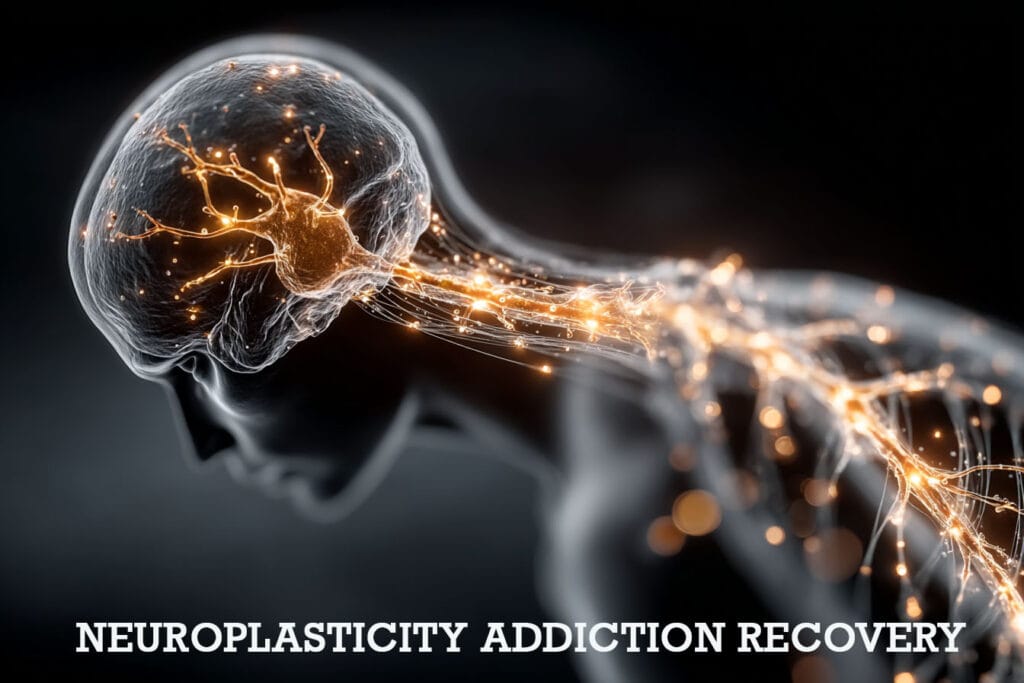
The human brain is not a static organ; it is a dynamic, ever-changing network. This remarkable capacity for change is called neuroplasticity. Every thought we have, every word we speak, and every action we take strengthens certain neural pathways. Over time, these pathways become well-worn “superhighways” that dictate our automatic thoughts, beliefs, and behaviours. Our self-identity is, in essence, a product of these reinforced neural circuits.
This is where the danger of a permanent label like ‘alcoholic’ comes into play. When you repeatedly tell yourself—and others—”I am an alcoholic,” you are actively instructing your brain to maintain and strengthen the neural architecture of that identity. You are practising being an alcoholic, even in sobriety.
The brain seeks cognitive consistency; it tries to align your actions and perceptions with your core beliefs about yourself. If your core belief is “I am an alcoholic,” a person defined by a lifelong, chronic disease from which I am never truly free, then your brain will subconsciously look for evidence to support this identity. This can manifest in several limiting ways:
A Self-Fulfilling Prophecy: The identity can foster a sense of powerlessness. The belief that you are inherently “diseased” or “broken” can undermine your self-efficacy—your belief in your own ability to manage your life and your choices. It can lead to a state of perpetual waiting for the other shoe to drop, creating a background hum of anxiety that you are just “one drink away” from disaster, rather than building a confident identity as someone who simply does not drink.
Focusing on the Past: The label roots your identity in your past behaviour. You are defined by what you did, not by who you are becoming. True transformation requires a forward-looking perspective. By constantly affirming a past problem as a present identity, you keep the memory and neural pathways of the addiction ‘online’ and relevant. From a neuroscience perspective, the goal should be to prune these old connections by disuse and build new, powerful pathways related to healthy and positive identities.
Inhibiting Full Recovery: Can a person who identifies as “sick” ever truly feel “well”? The label can create a glass ceiling for personal growth. It implies that recovery is merely the successful management of a permanent affliction, rather than a genuine and complete transformation into a person for whom alcohol is no longer a central issue.
Internalised Stigma and the Fixed Mindset
Labels carry immense societal baggage. Words like ‘addict’ and ‘alcoholic’ are not neutral descriptors; they are laden with centuries of stigma, prejudice, and negative stereotypes. When we adopt these labels for ourselves, we risk internalising that stigma. This can lead to deep-seated feelings of shame and a sense of being fundamentally flawed or “less than” others.
This internalised stigma fosters what psychologist Carol Dweck calls a “fixed mindset.” A fixed mindset is the belief that your qualities are carved in stone. The statement “I am an alcoholic” is the quintessential fixed mindset statement. It implies a permanent, unchangeable state of being.
Contrast this with a “growth mindset,” which is the belief that your abilities and qualities can be cultivated through dedication and effort. A growth mindset approach to recovery would use different language:
Fixed Mindset: “I am an alcoholic.”
Growth Mindset: “I am a person recovering from alcohol use disorder,” or “I am committed to an alcohol-free life,” or “I used to struggle with my drinking.”
The language of a growth mindset frames the addiction as a behaviour or a condition that was experienced and is now being managed or overcome, not as the core of one’s identity. It separates the person from the problem. This linguistic shift is not mere semantics; it has a profound impact on motivation, resilience, and the capacity for change. A fixed mindset sees relapse as a confirmation of a flawed identity (“See, I am an alcoholic”), whereas a growth mindset sees it as a setback to be learned from on the journey of recovery (“That approach didn’t work; I need to develop better strategies”).
A Barrier to Seeking Help and a Tool of Social Judgement
Ironically, the very labels intended to help people can be a significant barrier to them seeking help in the first place. Many people who are questioning their relationship with a substance do not see themselves in the stereotypical, rock-bottom image associated with the ‘alcoholic’ label. They may be high-functioning in their careers and personal lives, yet know deep down that their drinking is problematic.
The fear of being branded with a lifelong, stigmatising label can prevent them from reaching out. They don’t want to be forced into a one-size-fits-all box that doesn’t resonate with their experience. This all-or-nothing approach—either you’re a “normal” drinker or a “diseased alcoholic”—leaves no room for the vast grey area where most substance issues reside.
Furthermore, these labels are often weaponised by society. They are used to dismiss, judge, and discriminate. An employer might be hesitant to promote someone they know identifies as an ‘alcoholic’. A person might be unfairly judged in a child custody case. This societal prejudice is real, and by forcing individuals to adopt these labels, we may be inadvertently asking them to carry a heavy and unfair social burden for the rest of their lives. The move towards person-first language in clinical settings (“a person with a substance use disorder”) is a direct response to this damaging reality, an attempt to put the person’s humanity before their condition.
Forging a New Path: Life Beyond Labels
To choose a path of recovery without labels is not to deny the past. It is to refuse to be defined by it. It is an active, conscious decision to build an identity based on the present and the future—on new actions, new values, and a new vision for one’s life. This approach is grounded in personal empowerment and the principles of neuroplasticity. It is about moving from a problem-focused identity to a solution-focused one.
My Story: Ditching the Label After 45 Years
After 45 years of drinking, I have now been alcohol-free for over ten months. In that time, I have been on a rapid journey of rediscovery, and a pivotal part of this new chapter has been the conscious decision to reject all labels. I do not call myself an alcoholic. I do not even call myself a person “in recovery.” I am simply a person who does not drink alcohol.
Why is this distinction so important to me? Because my understanding of the brain tells me that what you practise, you become. For 45 years, I practised the identity of a drinker. The neural pathways associated with thinking about alcohol, planning to drink, the rituals of drinking, and dealing with the aftermath were deeply entrenched. My goal now is not to spend the rest of my life focusing on the absence of that behaviour by identifying as a “recovering alcoholic.” My goal is to build a new identity so compelling and robust that the old one withers away from lack of use.
Choosing to be label-free has been an act of profound liberation. It has allowed me to:
Define Myself by My Future, Not My Past: I am not “John, the alcoholic.” I am John, a writer, a grandfather who is present and clear-headed, a person who enjoys morning walks and sharp focus. My identity is built on my current actions and aspirations.
Reclaim My Personal Agency:The narrative of powerlessness did not resonate with me. The decision to stop drinking felt like the most powerful and agentic choice I have ever made. I wanted to build on that sense of strength, not define myself by a historic lack of control.
Lower the Mental Stakes: For me, the idea of being “in recovery” for life felt exhausting. It implies a constant struggle. By simply deciding “I don’t drink,” I have made it a non-issue. It’s a simple fact, like not eating a food I’m allergic to. It takes up far less mental energy, freeing my brain to focus on positive, creative, and productive pursuits.
This is not a criticism of those who find strength in labels. It is an invitation to consider that there is another way—a way that focuses on growth, creation, and forward momentum.
Building a New Identity on Actions, Not Afflictions
If you choose to move beyond labels, how do you talk about your experience? The key is to use dynamic, growth-oriented, and person-first language. This helps to rewire your brain towards a new self-concept.
Here are some powerful alternatives to the “I am an alcoholic” label:
“I am living an alcohol-free life.”
“I choose not to drink.”
“I’ve found that my life is better without alcohol.”
“I used to have a problem with alcohol, and I’ve worked hard to move past it.”
“I’m focusing on my health, and that means being sober.”
“I’m a person in long-term recovery from substance use disorder.”
Beyond language, the most effective way to build a new identity is through action. As neuroscientist Dr Andrew Huberman often notes, our brains learn and adapt based on our behaviours. If you want to build an identity as a healthy person, you must engage in the actions of a healthy person.
Instead of focusing on not being an addict, focus on being something else. Pour your energy into building positive, fulfilling identities. Become a runner, a painter, a volunteer, a dedicated parent, a reliable colleague, a skilled musician. Every time you engage in these activities, you are casting a ‘vote’ for your new identity. You are laying down new neural pathways and providing your brain with concrete evidence of who you are becoming. Over time, these new connections become stronger and more automatic than the old ones associated with substance use. The old identity is not fought; it is simply replaced.
Embracing the Spectrum of Recovery
The label-free approach is also far more inclusive. The traditional binary model—you’re either an alcoholic or you’re fine—fails to capture the wide spectrum of disordered drinking. Millions of people exist in a ‘grey area’. They may not have hit a dramatic rock bottom, but they know alcohol is taking more from them than it gives. It might be dulling their ambition, damaging their relationships, or causing them anxiety.
For these individuals, the ‘alcoholic’ label feels alienating and extreme. The rise of movements like “Sober Curious” and “Dry January” shows that there is a huge appetite for re-evaluating one’s relationship with alcohol without needing to adopt a lifelong, pathological identity.
A label-free, choice-based framework invites everyone to the table. It empowers people to make a positive change for their health and well-being at any point, without the prerequisite of self-identifying as diseased. It frames sobriety not as a grim necessity for a broken few, but as an attractive, aspirational lifestyle choice for anyone who wants to live a more present, healthy, and fulfilling life. This approach has the potential to help far more people by meeting them where they are and offering a message of empowerment rather than pathology.
Conclusion: A Personal Choice on a Personal Journey
So, are labels constructive or detrimental in addiction? The honest answer is that they can be both. There is no universal truth, only what is true for the individual. For some, the label “alcoholic” is a key that unlocks a community of understanding and provides a necessary framework for accountability. It is a symbol of survival, a hard-won badge of honesty that keeps them grounded and safe. The value and life-saving power of that experience cannot and should not be denied.
However, for a growing number of people, myself included, that same key can begin to feel like the bars of a cage. Supported by a modern understanding of neuroplasticity, we see that permanently identifying with our past problems can limit our future potential. It can tether us to a fixed mindset of being “diseased” and “powerless,” inadvertently strengthening the very neural pathways we seek to overcome. It can force us to carry a weight of social stigma that inhibits our ability to fully reintegrate into a new life.
The most critical insight is that the language we use to define ourselves has a profound impact on our neurological and psychological reality. Our brains are listening. They will build the identity we consistently declare.
Ultimately, the goal of recovery is not simply to abstain from a substance; it is to build a life so full, meaningful, and joyful that the substance becomes irrelevant. The question each person must ask themselves is: What words, what framework, and what identity will best support that goal for me? Is it one rooted in a shared history of struggle, or one focused on the infinite possibilities of a future yet to be written? The journey is deeply personal, and the power to choose your own narrative is perhaps the most fundamental step towards true and lasting freedom.
Used to monitor number of Google Analytics server requests when using Google Tag Manager
1 minute
_gid
ID used to identify users for 24 hours after last activity
24 hours
_ga_
ID used to identify users
2 years
_gali
Used by Google Analytics to determine which links on a page are being clicked
30 seconds
_ga
ID used to identify users
2 years
__utmx
Used to determine whether a user is included in an A / B or Multivariate test.
18 months
__utmv
Contains custom information set by the web developer via the _setCustomVar method in Google Analytics. This cookie is updated every time new data is sent to the Google Analytics server.
2 years after last activity
__utmz
Contains information about the traffic source or campaign that directed user to the website. The cookie is set when the GA.js javascript is loaded and updated when data is sent to the Google Anaytics server
6 months after last activity
__utmc
Used only with old Urchin versions of Google Analytics and not with GA.js. Was used to distinguish between new sessions and visits at the end of a session.
End of session (browser)
__utmb
Used to distinguish new sessions and visits. This cookie is set when the GA.js javascript library is loaded and there is no existing __utmb cookie. The cookie is updated every time data is sent to the Google Analytics server.
30 minutes after last activity
__utmt
Used to monitor number of Google Analytics server requests
10 minutes
__utma
ID used to identify users and sessions
2 years after last activity
_gac_
Contains information related to marketing campaigns of the user. These are shared with Google AdWords / Google Ads when the Google Ads and Google Analytics accounts are linked together.