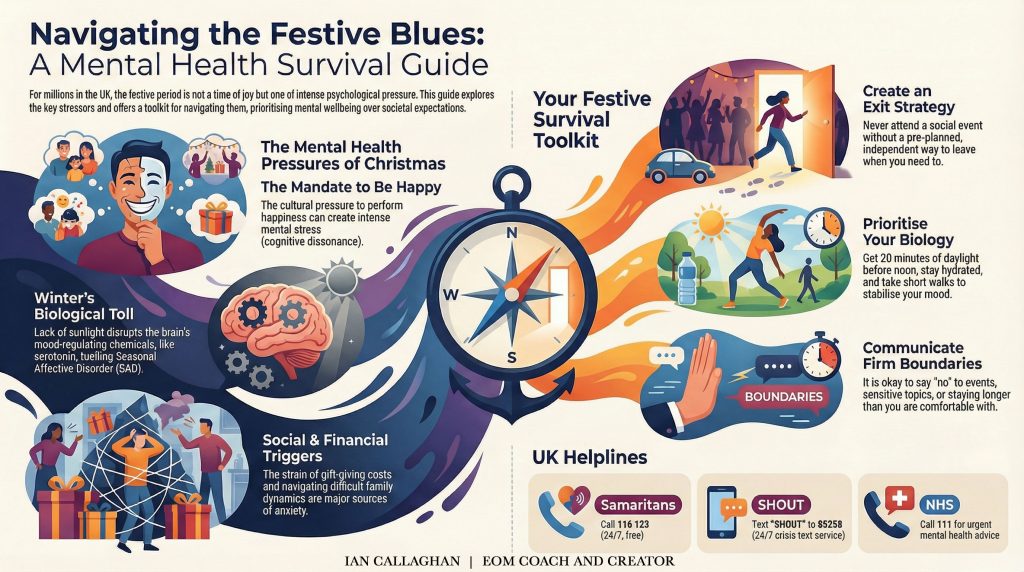
Christmas is brutal if you’re struggling with your head. For millions across the UK, the festive period is not a time of joy, but a period of intense psychological pressure, exacerbated by forced socialisation, financial strain, and the stark contrast between societal expectations and internal reality.
The Neuropsychology of the “Festive Blues”
The festive season triggers a complex biological and psychological stress response in individuals with pre-existing mental health conditions, primarily due to the “expectancy gap” between societal mandates for happiness and personal emotional states.
The Mechanism of Forced Positivity
The cultural narrative surrounding December demands a performance of happiness. Toxic positivity—the belief that one must maintain a positive mindset regardless of dire emotional circumstances—peaks during this season. For those battling depression or anxiety, this creates a state of cognitive dissonance.
According to psychological research, suppressing negative emotions to conform to social norms increases cortisol production, the primary stress hormone. The brain perceives the gap between how you feel and how you are expected to act as a threat. This dissonance is why Christmas can be brutal if you’re struggling with your mental health; it requires a sustained emotional performance that depletes cognitive resources.
The Impact of Disrupted Routine
Mental stability often relies heavily on routine. The Christmas period inherently dismantles the structures that many people use to manage their mental health.
- Sleep Architecture: Late nights and alcohol consumption disrupt REM sleep, which is critical for emotional regulation.
- Dietary Changes: High sugar and fat intake can lead to inflammatory responses that negatively impact mood.
- Therapeutic Breaks: Many therapy services and support groups operate on reduced hours, leaving vulnerable individuals without their usual safety nets.
[Cognitive Dissonance]: The mental discomfort experienced by a person who holds two or more contradictory beliefs, ideas, or values. In this context, feeling depressed while acting happy.
Seasonal Affective Disorder (SAD) and the Winter Solstice
Biological factors, specifically the lack of sunlight in December, compound mental health struggles by disrupting circadian rhythms and serotonin production, making the festive season physically difficult for the brain to process.
The Biology of Darkness
The UK experiences its shortest days in late December. This reduction in sunlight affects the hypothalamus, leading to three distinct biological impacts:
- Increased Melatonin: The body produces higher levels of the sleep hormone during the day, causing lethargy.
- Decreased Serotonin: Lack of sunlight reduces the production of the neurotransmitter responsible for mood regulation.
- Circadian Disruption: The body’s internal clock desynchronises, leading to sleep disorders and depressive symptoms.
SAD vs. Holiday Stress
It is vital to distinguish between situational stress and Seasonal Affective Disorder.
| Feature | Seasonal Affective Disorder (SAD) | Situational Holiday Stress |
|---|---|---|
| Primary Trigger | Lack of sunlight / Biological | Social and financial pressure / Psychological |
| Duration | Autumn through Winter (Months) | December to early January (Weeks) |
| Symptoms | Oversleeping, carb craving, heavy limbs | Anxiety, insomnia, irritability |
| Treatment | Light therapy (Lux lamps), Vitamin D | CBT, boundary setting, stress management |
According to the NHS, SAD affects approximately 2 million people in the UK, making the physical environment of Christmas a direct antagonist to mental well-being.
The Psychology of Financial Anxiety
Financial strain is a primary driver of Christmas-related mental health decline, as the “Cost of Living” crisis forces individuals to choose between financial prudence and social inclusion.
The Burden of Gift-Giving
The commercialisation of Christmas creates a transactional dynamic in relationships. Individuals struggling with anxiety often catastrophise the consequences of not providing adequate gifts. This fear of judgment triggers the brain’s amygdala, the centre for fear processing.
Data from the Money and Mental Health Policy Institute suggests that people with mental health problems are three times more likely to be in problem debt. The pressure to spend in December exacerbates this cycle.
Comparative Wealth and Social Media
Social media acts as a catalyst for inadequacy. The curated presentation of lavish Christmases on platforms like Instagram induces Relative Deprivation—the feeling that one is worse off compared to the standard of their peer group.
- Comparison Trap: Viewing others’ highlight reels highlights one’s own perceived deficits.
- FOMO (Fear Of Missing Out): Drives impulsive spending to match peers.
- Validation Seeking: Basing self-worth on the quality or quantity of gifts received or given.
Navigating Toxic Family Dynamics
Regression to childhood roles and exposure to unresolved family conflicts are significant stressors that can destabilise mental recovery during the festive period.
The Theory of Family Regression
When adults return to their family home, they often experience psychological regression. They involuntarily revert to childhood behavioural patterns and coping mechanisms. If a person is struggling with their head, this regression can undo months of therapeutic progress.
This is particularly dangerous for those from dysfunctional families. The expectation to “keep the peace” often forces victims of past trauma to break bread with their aggressors or enablers.
Establishing Boundaries
Survival during Christmas often depends on the rigid enforcement of boundaries.
| Boundary Type | Example of Violation | Defensive Strategy |
|---|---|---|
| Temporal | “You must stay for the whole week.” | “I will visit for 48 hours only. This is non-negotiable.” |
| Conversational | “Why aren’t you married/working yet?” | “I am not discussing my career/love life today.” |
| Physical | Unwanted affection/hugs. | “I am not hugging people at the moment due to health.” |
| Emotional | Guilt-tripping for not being ‘cheerful’. | “I am struggling, and I need space, not pressure.” |
The “Chosen Family” Alternative
For many, the healthiest option is to reject the biological imperative. Spending Christmas with a “chosen family”—friends or partners who understand your mental health needs—is a valid and clinically recommended strategy for preserving mental stability.
The Amplification of Loneliness
Loneliness in December is perceived more acutely due to the “Contrast Effect,” where an individual’s isolation is magnified against the backdrop of societal hyper-socialisation.
The Contrast Effect
Loneliness is not just about being alone; it is the discrepancy between one’s desired social connections and their actual social connections. At Christmas, the desired level is artificially inflated by the media and culture.
According to the Campaign to End Loneliness, over 9 million people in the UK describe themselves as always or often lonely. During Christmas, this isolation correlates with higher suicide ideation rates, though statistically, suicide rates peak in spring, the subjective feeling of despair is often highest in December.
Solitude vs. Isolation
It is crucial to reframe the narrative from forced isolation to intentional solitude.
- Isolation: Feeling cut off and unwanted (Passive/Negative).
- Solitude: Choosing to be alone for restoration (Active/Positive).
By actively choosing how to spend time alone—engaging in hobbies, reading, or resting—individuals can reclaim agency over their isolation.
Grief and the “Empty Chair” Phenomenon
Grief is non-linear, but the cyclical nature of Christmas markers serves as a painful annual reminder of loss, specifically highlighting the absence of deceased loved ones.
The Anniversary Reaction
The brain encodes memories with sensory data—smells, songs, and weather. Christmas is sensory-dense. The smell of pine or a specific carol can trigger an involuntary memory retrieval known as the Proustian Effect, bringing fresh waves of grief.
The “Empty Chair” at the dinner table represents a tangible void. For those struggling with their head, the pressure to “move on” for the sake of the holiday can arrest the grieving process, leading to complicated grief.
Integrating Grief into the Festivities
Mental health experts recommend acknowledging the loss rather than ignoring it.
- Light a Candle: Create a specific ritual to honour the deceased.
- Scheduled Remembrance: Allocate a specific time to talk about the loved one, then permit to focus on the present.
- Alter Traditions: If the old traditions are too painful, create entirely new ones to break the associative link with the loss.
The Role of Alcohol and Substance Misuse
The UK’s culture of festive binge drinking acts as a depressant, chemically altering neurotransmitter levels and exacerbating anxiety and depressive symptoms.
The Chemistry of “Hangxiety”
Alcohol is a central nervous system depressant. While it may provide temporary relief from social anxiety (anxiolytic effect), the withdrawal phase triggers a spike in cortisol and a depletion of GABA (gamma-aminobutyric acid), the brain’s calming chemical.
This rebound anxiety, colloquially known as “Hangxiety,” can be debilitating for someone already mentally fragile.
[GABA]: Gamma-aminobutyric acid is the primary inhibitory neurotransmitter in the brain. It blocks impulses between nerve cells, producing a calming effect. Alcohol mimics GABA, but chronic use depletes natural levels.
The Slippery Slope of Self-Medication
Christmas is brutal if you’re struggling with your head because the socially acceptable threshold for intoxication is raised. Behaviours that would be flagged as problematic in July are celebrated in December.
Warning Signs of Festive Substance Abuse:
- Drinking before social events to “pre-load” courage.
- Inability to stop drinking once started.
- Using alcohol to numb feelings of loneliness or grief.
- Increased irritability when alcohol is not available.
Practical Coping Strategies
To mitigate the mental toll of Christmas, individuals must adopt a proactive “Mental Health Safety Plan” that prioritises biological needs and sets rigid social boundaries.
1. The “Exit Strategy” Protocol
Never attend a social function without a pre-planned method of departure.
- Transport: Drive yourself or have a taxi app ready. Do not rely on others for a lift.
- The Signal: Have a pre-agreed code word with a trusted ally that means “I need to leave now.”
- The Script: Prepare a generic excuse in advance. “I have an early start tomorrow” requires no further explanation.
2. Biological Anchoring
When the mind is chaotic, stabilise the body.
- Hydration: Match every alcoholic drink with a glass of water.
- Daylight: Get outside for 20 minutes before noon to regulate circadian rhythms.
- Movement: A 15-minute walk metabolises stress hormones like adrenaline.
3. Financial Firewalling
Protect your future self from debt-induced anxiety.
- The “No” List: Write down who actually needs a gift. Cut the list by 20%.
- Cash Only: Leave credit cards at home when shopping to prevent overspending.
- Homemade Value: Shift value from monetary cost to sentimental effort (baking, framing photos).
4. Digital Detoxification
Reduce the input of comparative misery.
- Mute Features: Use Instagram and Facebook mute functions to hide accounts that trigger inadequacy.
- Time Limits: Set hard limits on app usage during key festive days.
- Curated Feed: Follow accounts that speak honestly about mental health (e.g., Mind, Samaritans).
The Post-Christmas Comedown (January Blues)
The abrupt removal of the festive stimulus, combined with the return to work and financial reality, creates a vulnerability window in January known as the “Post-Holiday Drop.”
Dopamine Withdrawal
The anticipation of Christmas spikes dopamine. Once the event is over, levels drop below baseline. This chemical crash feels like depression.
To counteract this:
- Book Something: Schedule an event for February so there is a new point of anticipation.
- Visual Reset: Take down decorations slowly or immediately—whichever feels more psychologically cleansing.
- Fiscal Honesty: Address bank balances immediately. Ignoring them prolongs anxiety.
Conclusion
Christmas is brutal if you’re struggling with your head because it is a systemic assault on the coping mechanisms required to manage mental illness. It disrupts sleep, demands social performance, strains finances, and forces confrontation with trauma.
However, the brutality of the season is not a personal failing; it is a structural reality. By understanding the neurobiology of stress, rejecting the commercial imperative of happiness, and prioritising boundaries over tradition, it is possible to navigate December without sacrificing your mental health. You are not required to be happy; you are only required to survive.
Frequently Asked Questions
Why do I feel worse during Christmas?
You feel worse due to the “Contrast Effect,” where your internal mood clashes with the external pressure to be happy. Additionally, disrupted sleep, alcohol consumption, and lack of sunlight (SAD) chemically deplete the brain’s ability to regulate mood.
How can I explain to my family that I can’t attend Christmas?
Be direct, firm, and use “I” statements. “I am not feeling well enough to attend this year,” is a complete sentence. You do not need to justify your mental health needs. Offer a compromise, such as a video call or a visit in January when pressure is lower.
What are the symptoms of festive burnout?
Symptoms include extreme irritability, physical exhaustion, a sense of dread regarding social events, increased reliance on alcohol or food for comfort, and a desire to withdraw completely from social contact.
Is it normal to grieve more at Christmas?
Yes. Christmas is a somatic marker—a specific time associated with memories. The absence of a loved one is felt more acutely because traditions highlight the change in family structure. This is a standard psychological response known as an anniversary reaction.
Where can I get help in the UK over Christmas?
🧠 UK Mental Health & Crisis Support
Samaritans – 24/7 emotional support for anyone in distress
https://www.samaritans.org/
SHOUT – 24/7 free UK crisis text support
https://www.giveusashout.org/
Mind (National) – Mental health information, support and local services
https://www.mind.org.uk/
Mind – Online Community – Peer support forums & lived experience spaces
https://www.mind.org.uk/get-support/online-communities/
Campaign to End Loneliness – Resources and community support
https://www.campaigntoendloneliness.org/
Mental Health UK – Support, advice and tools for wellbeing
https://www.mentalhealth-uk.org/
CALM (Campaign Against Living Miserably) – Support for men, suicide prevention
https://www.thecalmzone.net/
Rethink Mental Illness – Advice, helplines & community services
https://www.rethink.org/
Anxiety UK – Support specifically for anxiety disorders
https://www.anxietyuk.org.uk/
Depression Alliance UK – Peer support & resources for depression
https://www.depressionalliance.org/
Does alcohol make holiday depression worse?
Yes. Alcohol is a depressant. While it may briefly numb anxiety, it depletes serotonin and GABA levels, leading to increased anxiety and lower mood the following day, often referred to as “hangxiety.”
How do I manage financial anxiety during the holidays?
Set a strict budget before December starts. Communicate with family that you are doing a “low-spend” Christmas. Focus on time spent rather than money spent. Avoid “Buy Now, Pay Later” schemes that delay the stress to January.