Digital Seed Oils
Why Your Lived Experience Is the Only Real Thing Left in a World of AI Slop
Something inside you cracked. Maybe it was a quiet fracture running through your soul, or maybe it was the ground giving way beneath your feet like a collapsing trench. You didn’t end up here by accident. You’re reading this because the life you’ve been living, a life increasingly dictated by digital noise and synthetic systems, is no longer one you can carry. You’re vanishing, drowning in a digital bucket of sugar-coated lies and Digital Seed Oils.
You are disappearing behind a version of yourself you didn’t consciously choose. You are numbing yourself, one notification and one AI-optimised post at a time, until you don’t recognise the face staring back in the mirror. We live in a world of ultra-processed chaos, a biological mismatch where we are simultaneously overfed and undernourished, not just in the food on our plates, but in the information in our heads. This is the industrial static of the modern world, designed to keep you at a baseline of fatigue.
As I wrote in the opening of my work on the identity shift:
“You don’t end up here by accident. Nobody opens a book like this because life is smooth, simple, or easy. You open a book like this because something inside you cracked. Something deep inside whispered, or screamed, that the life you’ve been living is no longer one you can carry.”
The modern digital environment is a biological mismatch engineered to keep you trapped in a cycle of inflammation, exhaustion, and mental dysfunction. We have been conditioned to accept this. But your lived experience, the grit, the scars, the setbacks, the rebuilding, and the raw reality of your life, is the only weapon you have left against the rising tide of AI slop. Not theory. Not a trend. Not promptcraft. Lived experience.
Digital seed oils, in plain English, are synthetic, algorithm-friendly content inputs that imitate nourishment while leaving you mentally underfed, overstimulated, and easier to control. It looks like a value. It feels like movement. But it rarely builds anything solid inside you.
The Death of the Human Signal: Interest Media as Industrial Non-Food
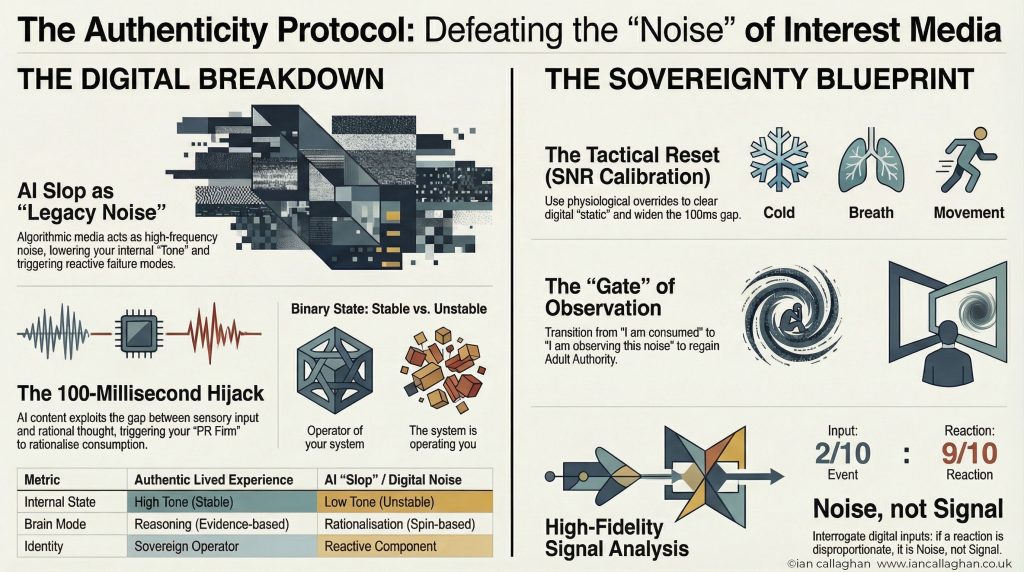
The digital landscape has shifted from social connection to interest media. This is the digital equivalent of the industrial food complex I’ve fought against in the metabolic world. Just as industrial non-foods are engineered specifically to bypass our evolutionary satiety signals, AI-driven content is designed to bypass our mental filters.
Think about how a supermarket snack is made. It’s a combination of refined sugars, bleached flours, and chemical additives designed to hit your bliss point. It is ultra-processed chaos. AI influencers and interest-based algorithms are doing the same thing to your brain. They serve up synthetic content that is the digital version of a high-sugar, low-nutrient snack. It tastes like something, but it leaves you empty. It gives you the hit without the nourishment. It spikes the system without building the human.
We are becoming glucose-dependent on content. We graze on notifications and ten-second clips because the sheer volume of synthetic noise has blunted our satiety signals. In this broken environment, the human signal is drowned out by a digital flood that mimics life but lacks its substance. It is engineered to keep you in a state of permanent hunger, always scrolling, never satisfied, always looking for the next hit of synthetic validation. This is the industrialisation of the human spirit, stripping the soul from our communication to make it consumable and palatable for the masses.
And this is where most people get caught by the same old bastards in different clothes. In one corner, you’ve got Bob, the inner PR man for self-sabotage, selling you the line that one more scroll, one more video, one more little hit won’t matter. In the other corner,r you’ve got Glucipher, that feral little sugar-addled goblin of appetite and impulse, dragging you towards whatever is bright, fast, easy, and emotionally anaesthetic. Put them together in a digital world built on engineered stimuli, and you’ve got a nervous system under siege.
The Seed Oil Analogy: Digital Oxidative Stress | Digital Seed Oils
To understand the danger of AI slop, we have to look at the seed oil problem through a digital lens. In the metabolic world, industrial seed oils, rapeseed, sunflower, corn, and soybean, are modern inventions created through high-heat processing and chemical deodorisation. They are extremely high in linoleic acid, an omega-6 fatty acid that is highly unstable.
When you consume these oils, they are incorporated into your cell membranes. Think of these unstable fats like rusted, sparking wiring in a high-voltage system. They don’t just sit there. They contribute to oxidative sparks that damage cells and inflame the system.
AI-generated content acts exactly like these industrial seed oils. It is digital seed oil.
Consider the processing. To make rapeseed oil edible, it must be heated to extreme temperatures, treated with hexane solvents, and deodorised because the natural product smells like a chemical factory. AI slop undergoes a similar deodorisation. It takes the raw, messy, often smelly reality of human experience and strips away the polyphenols of truth. It bleaches the context and processes it until it is a bland, uniform, and safe output.
It is highly unstable. Because it lacks the polyphenols of truth and the monounsaturated fats of deep reflection, AI slop induces chronic oxidative stress in your mind. It is prone to hallucinations and factual decay, much like seed oils go rancid the moment they hit the light.
It interferes with signalling. Just as seed oils damage the lining of your arteries and interfere with cellular communication, AI slop damages your ability to communicate with yourself. It creates systemic inflammation in the digital landscape, making it nearly impossible to achieve mental sovereignty.
It is a biological mismatch. Your brain evolved over millions of years to learn from other humans, to read micro-expressions, tone, pauses, scars, contradictions, and the emotion within a storyteller. It did not evolve to learn from a probability-based language model.
We must return to the ancestral gold standard. In nutrition, that means extra virgin olive oil. In life, that means extra virgin authenticity. Real, unfiltered, stable human experience that hasn’t been deodorised for an algorithm.
The Insulin Lock of the Mind: Glucose-Dependency on Content
Metabolic health is the ability of your body to switch seamlessly between burning the energy from your food and burning the energy stored in your body fat. This is metabolic flexibility. Most people are metabolically locked because of high insulin, the storage hormone. When insulin is high, your fat cells are biochemically locked. Your brain thinks you’re starving because the fuel is behind a locked door.
This is exactly how AI slop functions on your consciousness. It creates an insulin lock in the mind.
Consuming synthetic, high-dopamine content keeps your mental insulin permanently spiked. You become glucose-dependent on the next notification. You cannot access your own fat stores, the deep wisdom, intuition, memory, and lived experience you have stored over decades. You are starving in a land of plenty because you can’t get to your own reserves of truth.
To break this lock, you need to satisfy the satiety triad of content.
- Real protein, lived experience. This is the most important signal to your brain. Just as the body seeks amino acids to repair tissue, the mind seeks real human struggle and triumph. Protein triggers the protein leverage effect. Your brain will keep screaming for content until you consume enough amino acids of reality.
- Healthy fat, deep wisdom. Fat provides slow-burning energy. Deep wisdom, the kind that takes years of getting it wrong, years of getting hurt, years of rebuilding, triggers the release of satiety hormones that tell your brain to relax. It’s stable. It’s dense. It doesn’t spike the system.
- Fibre, actionable structure. Fibre provides the cognitive bulk. In the metabolic world, fibre feeds the microbiome. In the digital world, fibre is the difficult, dense part of a story that makes you chew rather than just swallow. It’s the actionable structure that allows you to process information without bloating or mental inflammation. AI slop is low-fibre. It is designed to go down easy and leave you mentally gassy, agitated, and unsatisfied.
Why AI Can’t Fake the 45-Year Struggle
Prompts can never replace scars.
I spent 45 years drinking. Not casually, but as the backbone of my days and the escape hatch of my nights. I’m a British Army veteran whose career was cut short by injury, locked inside cycles of pain, denial, suppression, and survival mode. I rewired my mind at 58, with a prolapsed disc I’ve carried since service, a nervous system that had been hammered by decades of poison, and a life that could easily have gone the other way if I’d kept listening to Bob and feeding Glucipher.
This is where EEAT actually means something, not as some SEO acronym, but as lived proof. Experience. Expertise. Authoritativeness. Trust. I’m not borrowing that from a branding deck. I’ve earned it in blood, bad decisions, decades of consequences, years in coaching, years in mindset work, NLP, meditation, behavioural change, identity work, and the brutal practical reality of dragging myself back from places most people only talk about in theory.
An AI can generate a thousand inspirational quotes about resilience, but it can’t feel the brutal Welsh mornings in the cold water of a river. It hasn’t sat in the silence after service, feeling the identity drop and the disconnect from everything that used to define it. It doesn’t know the physical reality of a prolapsed disc screaming through the nervous system, the daily grind of pain, the visceral shame of lying to your family, or the weird, empty silence that comes when the anaesthetic is gone, and you are left with yourself.
AI is a map, but lived experience is the ground. I’ve stood on the edge of the Brecon Beacons when the wind is cutting through you, and the only thing that matters is the next step. AI doesn’t have a nervous system to regulate. You do. AI doesn’t have a legacy to leave. You do.
When I talk about change at 58, it isn’t a theoretical framework. It is a clinical-grade exit strategy from hell, built from lived experience, behaviour change, and identity reconstruction. It is EOM, the Emotional Operating Manual, forged through what happens when you stop pretending, stop performing, stop outsourcing your mind, and start learning how your own internal machinery actually works. The AI can mimic the words, but it can’t mimic the weight of those years. Your scars are your proof of existence. They are the polyphenols that stop your mind from oxidising in the face of modern chaos.
The Identity Shift: Rewiring the Bots Out of Your Brain
Reclaiming your sovereignty requires an identity reset. You cannot think your way out of a broken pattern; you have to build your way out. You do not rise to the level of your intentions; you fall to the level of your systems. Here is your briefing on rewiring the synthetic influences out of your system.
I. Naming the Trigger
Triggers are landmines buried in your nervous system. Identify the digital landmines where you consume slop. Is it the mindless scroll at 11 PM? Is it the need for distraction when you feel lonely, bored, anxious, rejected, or not enough? Name the emotion. Naming drags the trigger into the light and creates distance. If you can say, “I am feeling lonely and seeking a dopamine hit from synthetic noise,” you have already won 50 per cent of the fight. In EOM terms, you’ve moved from possession to observation. That matters.
II. The 10-Second Rule
When you feel the urge to graze on synthetic content, give yourself ten seconds. Ten seconds to breathe. Ten seconds to recognise the trigger. Ten seconds to interrupt Bob’s sales pitch and tell Glucipher to wind his neck in. Ten seconds to shatter the autopilot. Cravings, digital or physical, spike and fall. Ten seconds steal their oxygen. In the Army, we were taught to pause before reacting to an ambush. An algorithm is ambushing your life. Take your ten seconds.
III. Morning Ownership
Your nervous system does not need the world, or the AI, screaming at it before you are even awake. No screens for the first 20 minutes. Hydrate with 500 ml of water and sea salt. Get natural light into your eyes. Move your body. Claim your state before the machine claims it for you. This tells your biological factory settings that you are in control today, not the industrial static.
IV. Truth-Based Living
Refuse to sugar-coat your own bullshit. Addiction and digital dependency thrive in denial and shadows. Sobriety and sovereignty thrive in truth. Be honest about your limits, your triggers, and the parts of yourself you have been numbing. If you’re scrolling through AI slop because you’re scared of the silence in your own head, admit it. If Bob is dressing up his avoidance as recovery, call him on it. If Glucipher is chasing stimulation because stillness feels unbearable, call that out too. Truth is the only thing the bots can’t compute.
Establishing Permanent Standards in a Synthetic World
We do not use the words “diet” or “habit-fix”. Those are temporary states of misery. We establish standards. A standard is a baseline of quality you refuse to drop below. It is the recognition that certain substances, seed oils, refined sugars, and AI slop, are not actually food for the body or the mind.
The Sovereignty Standards
I refuse to be a customer for the pharmaceutical consequences of a broken digital system. If they want to make me sick with noise, I will not pay them with my attention.
I prioritise extra virgin authenticity over algorithmic convenience. I would rather read one raw, messy page of a human being’s struggle than a thousand perfect AI summaries.
I recognise that normal is exactly what caused the dysfunction. I choose to be the architect of my life, not a passenger on a digital bus heading for a cliff.
I protect my biological factory settings. I refuse chemical and digital inputs that disrupt my signalling, whether it’s linoleic acid or mindless notifications.
I value the 45-year struggle over the two-second prompt. I respect the scars of lived experience more than the polish of a machine.
The 28-Day Digital and Biological Sovereignty Challenge
Friction is the enemy of consistency. To reclaim your life, you must rearrange the kitchen workspace of your mind. Your environment dictates your success. If your digital environment is soaked in old memories, compulsive triggers, and synthetic stimulation, you will drift. You need a 28-day reset to restore your leptin sensitivity to both food for truth.
The AI-Dependent Identity
Glucose-dependent. Relies on notifications for dopamine hits, metabolically locked in a state of digital hunger.
Overfed and undernourished. Consumes massive amounts of slop with zero cognitive bulk, feels stuffed but empty.
Oxidised wiring. High inflammation from digital seed oils, brain fog, reactive emotions, unstable focus.
Survival mode. Reacts to the environment, the algorithm, and the latest outrage, a passenger in their own life.
Identity of a consumer. Defined by what they buy, watch, and graze on, disappearing behind a screen.
The Sovereign Authentic Identity
Metabolically flexible. Taps into internal wisdom and intuition, can sit in silence without needing a hit.
High-density satiety. Prioritises the satiety triad of real protein, struggle, healthy fat, wisdom, and fibre, action.
Ancestral gold standard. Grounded in stable, monounsaturated truth, clear-headed and resilient under pressure.
Self-leadership. Designs the environment with intention, the architect who builds a life they actually respect.
Identity of an embodied human. Defined by standards, legacy, and the strength of a rebuilt life.
What This Means in Real Life
If your attention is constantly being hijacked by synthetic content, your ability to think clearly, regulate your state, and trust your own judgement erodes. That is the real damage. This isn’t just a rant about AI. It’s about what happens when your nervous system is fed stimulation instead of substance, speed instead of truth, and polished output instead of lived reality.
The answer is not to smash your phone with a hammer and move into a cave. The answer is standards. Better inputs. More friction between you and the garbage. More respect for lived experience, deeper thinking, and embodied truth. Less grazing. More discernment. Less synthetic noise. More human signal.
Conclusion: Graduation Into the Real World
Metabolic sovereignty and identity embodiment are the same fight. They are both about removing the industrial static that has muffled your body’s natural signals for years. By clearing the seed oils from your diet and the AI slop from your mind, you are performing a daily act of reclamation.
Breaking the cycle of synthetic dependency is the only way to avoid the baseline of fatigue accepted by the modern population. You are not a failure for feeling overwhelmed. You are reacting exactly as a human nervous system reacts when placed inside an engineered biological mismatch designed to keep it dysregulated, distracted, inflamed, and dependent. But you still have a choice. You can keep grazing on digital non-foods, or you can step back into the cold water of reality.
The life you want is not a dream. It is a structure. It is a blueprint. It is a 28-day march into a new version of yourself. The question is no longer whether the technology is good or bad. The real question is embodiment.
What if the problem isn’t the AI, but the identity you’ve been living inside that still thinks surviving the machine is the same thing as living?
The mirror has cracked. The truth is clawing at your ribs. Stop lying to yourself, stop eating the digital seed oils, stop letting Bob negotiate with your standards, stop letting Glucipher drag you towards the nearest hit, and start building the life that matches the person you’ve become.
Ian Callaghan
British Army veteran, coach, creator of EOM, Expert Information Architect, and builder of sovereignty standards forged through 45 years of lived experience.ext, friction, and lived truth. It gives you a quick hit while quietly weakening your thinking, making it shallower and more dependent.
Is all AI content worthless?
No. AI is a tool. The problem starts when the tool replaces judgment, lived experience, and human substance. A hammer is useful. Living your whole life as if everything is a nail is where it gets stupid.
Why does lived experience matter so much now?
Because lived experience contains texture, contradiction, scars, timing, and consequence, it carries signals that prediction machines cannot fully replicate. In a world flooded with synthetic output, real experience becomes more valuable, not less.
How do I reduce digital slop without disappearing off the internet?
Raise your standards. Curate harder. Stop grazing. Spend less time consuming synthetic noise and more time engaging with people, books, conversations, and frameworks that actually change how you live.
What does this have to do with EOM?
Everything. EOM is about understanding your internal machinery, so you stop being run by loops, triggers, avoidance, and autopilot. This post applies the same principle to the digital environment. If you don’t understand what is shaping your state, you will be shaped by it.
Final Word
This piece is not anti-technology. It is anti-bullshit. Anti-numbing. Anti-outsourcing your own mind. If you want sovereignty, whether metabolic, emotional, or digital, then you need to get serious about what you consume and what you let shape you.
That is the work.
Ian Callaghan
Expert Information Architect, Identity Architect, creator of EOM, and builder of sovereignty standards forged through 45 years of lived experience.
You are not broken. You are under load. This book shows you how to take back the controls.