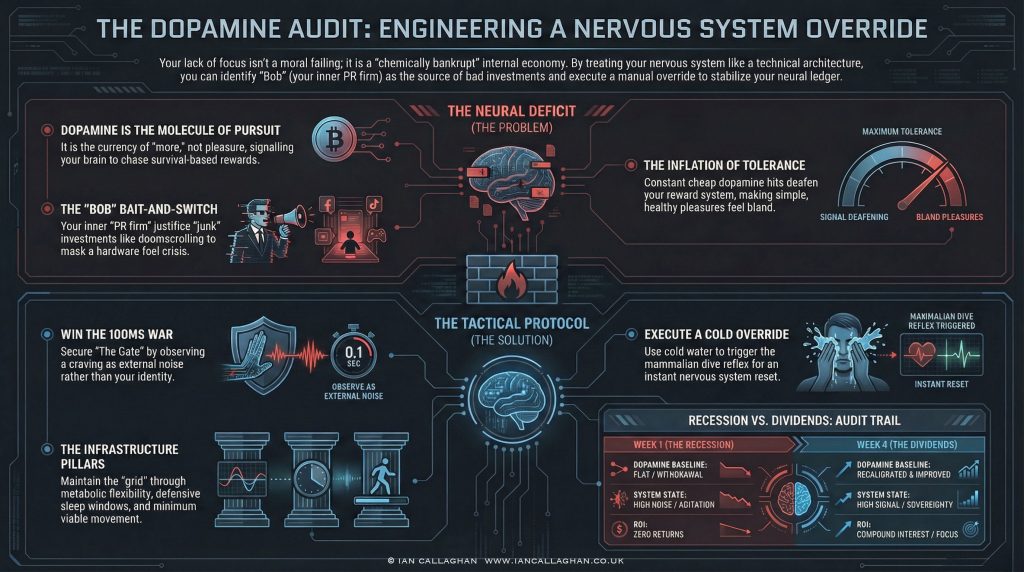
Dopamine Debt and Anxiety. Most people think their anxiety, their addiction, or their inability to stick to a simple plan is a moral failing. You sit there thinking there is something wrong with your soul or your history. That is absolute bollocks. You are not broken. You are just chemically bankrupt. Your internal economy has crashed because you have been bad with your currency.
I spent 45 years drinking, taking drugs, and running from myself. I treated my body like a hire car I was planning to crash. But my background is in IT Technical Architecture and the Army. When a server goes down or a unit gets pinned down, we do not sit around holding space for the server’s feelings. We do not ask the enemy fire about its childhood. We assess the damage. We isolate the fault. We execute a manual override.
We need to look at your nervous system through the lens of Return on Investment (ROI). This is a finance problem, not a feelings problem. Dopamine Debt and Anxiety: The currency is dopamine. The broker managing your portfolio is that voice in your head, I call Bob. And right now, Bob is embezzling your life savings and investing them in absolute shite that yields zero returns.
Let’s strip away the fluff. This is the bait-and-switch of the modern world.
The Bait-and-Switch Mechanism
Dopamine is not the pleasure molecule. That is the biggest lie sold by pop psychology. Dopamine is the molecule of pursuit. It is the currency of “more.” It is the biological signal that says, “Go get that thing, and you will survive.”
In the ancestral environment, this was a perfect system. You saw a deer, dopamine spiked, you ran, you ate, you survived. The ROI was clear. Energy expenditure equals caloric intake.
Today, that system has been hijacked. This is where the bait-and-switch happens. Bob, your inner chimp, sees a glass of wine at 5 PM, or a notification on your phone, or a sugary snack. Bob screams at the control centre that this is vital for survival. He releases a massive dump of dopamine to get you to move. That is the bait.
The switch happens the moment you consume. The anticipated relief never arrives in the quantity promised. The wine doesn’t fix the stress; it just borrows happiness from tomorrow at a predatory interest rate. The scroll through social media doesn’t connect you; it isolates you. The sugar doesn’t energise you; it spikes your blood glucose and then crashes you into the floor.
You have spent your currency—your drive, your focus, your biological resources—and you have received a toxic asset in return. You are essentially buying non-fungible tokens of happiness that are worth zero the moment the transaction clears.
The PR Firm in Your Head
Bob acts like a high-priced PR firm for your dysregulation. This is the most dangerous part of the architecture. When you feel that itch, that craving, or that sudden wave of anxiety, Bob steps in with a narrative.
He says, “You deserve this drink because the kids were a nightmare today.” He says, “You need to check your phone because you might miss an emergency.” He says, “Just one biscuit won’t hurt, you’ll start the diet on Monday.”
This is the PR firm justifying the embezzlement. It creates a story to explain the physiological state. The EOM (Emotional Observation Method) principle is: Fix the state, ignore the story. The story is a lie. The state is real. The state is just noise on the line. It is a Signal-to-Noise Ratio (SNR) problem. Your hardware is overheating, and Bob is trying to tell you it is because the room is haunted. It isn’t haunted. The fan is just broken.
If you keep listening to the PR firm, you will stay trapped in the cycle of shame. Shame is just the logical brain realising the accounts don’t balance and panicking. It serves no tactical purpose. We need to fire the PR firm and look at the ledger.
The 100ms War
Sovereignty is won or lost in one hundred milliseconds. That is the timeframe between the stimulus—the thought of a drink, the ping of a phone, the rude comment from a colleague—and your automatic reaction.
Most people live entirely in the reaction. They are automated scripts running on loop. Stimulus, response. Stimulus, response. They are not piloting the vehicle; they are tied up in the boot while Bob drives the car off a cliff.
You have to secure The Gate. The Gate is that fraction of a second where you can intervene. You have to widen that gap. This is where we stop saying “I am angry” or “I am anxious” and start saying “I see anger” or “I see anxiety.”
This isn’t spiritual wordplay. It is a permission setting in your operating system. “I am” attaches the signal to your identity. It fuses you with the noise. “I see” keeps the signal external. It puts you back in the architect’s chair. You become the observer, not the observed.
When the craving hits, that is a high-frequency trade Bob is trying to execute. He wants to sell your peace of mind for a quick hit of dopamine. You need to pause the trade. You need to look at the screen and say, “I see the offer, Bob. And the answer is no. That investment is high risk, zero reward.”
The Inflation of Tolerance
Why do you feel like you need more and more stimulation just to feel normal? That is inflation. When you flood the system with cheap dopamine—from scrolling, processed foods, alcohol, drama—the brain down-regulates its receptors.
Think of it like shouting. If everyone in the room is whispering, you can hear a pin drop. If everyone is screaming, you have to scream louder just to be heard. Your brain has been screaming for years. You have deafened your own reward system.
This is why simple pleasures feel bland. A walk in the park feels boring because it doesn’t offer the high-octane dopamine hit of an online argument or a massive sugar binge. You are living in a hyper-inflationary economy. Your currency is worthless.
To fix this, we have to induce a recession. A controlled recession. We have to stop printing money. This is the withdrawal. This is the boredom. This is the flatline. It feels like shite. Bob will scream that the economy is collapsing. Let him scream. This is the market correcting itself.
Tactical Protocol: The Audit
You cannot budget your way out of this if you don’t know where the leaks are. We need to look at the three main pillars of your infrastructure: Eat, Sleep, and Move. These are not “wellness tips.” These are the server maintenance protocols.
Eat (The Fuel)
If you are running your biological machine on seed oils and processed carbohydrates, you are pouring sugar into a diesel engine. It will run for a bit, cough, sputter, and then die. Metabolic flexibility is the goal. You want a system that can burn its own fat for fuel, not one that is constantly screaming for a glucose hit.
When your blood sugar crashes, your brain perceives it as a threat to your survival. Cortisol spikes. Adrenaline spikes. Bob wakes up and starts looking for a quick fix. He demands a biscuit or a glass of wine. That isn’t an emotional need; it is a fuel crisis. Cut the seed oils. They are inflammatory agents that fog the motherboard. Eat ancestral fats. Stabilise the grid.
Sleep (The Recovery)
Sleep is not a luxury. It is the nightly maintenance window. This is when the glymphatic system washes the brain. It physically clears out the metabolic waste products—the amyloid beta and tau proteins—that accumulate during the day.
If you are drinking alcohol to get to sleep, you are not sleeping. You are passing out. You are knocking the cleaners unconscious before they can do their job. You wake up with a brain full of toxic waste, and you wonder why you are anxious and reactive. Prioritise the sleep window. Defend it like a military perimeter. Dark room, cool temperature, no screens. If the machine doesn’t reboot properly, it will run slowly all day.
Move (The Resilience)
We are designed to move. When you are sedentary, the energy that should be used for movement gets trapped in the system and turns into anxiety. Anxiety is just kinetic energy with nowhere to go.
Minimum Viable Movement (MVM). I don’t care if you join a gym. I care that you move your body. Walk. Lift something heavy. Get the heart rate up. This generates genuine endorphins—real currency—rather than the counterfeit dopamine of the screen.
The Cold Override
Sometimes, the system is too unstable. The anxiety is too high. The craving is too strong. Bob has locked the doors and is doing doughnuts in the car park. You cannot reason with him. You cannot “mindfulness” your way out of a panic attack when the adrenaline is flooding your veins.
You need a hard reset. You need a Cold Override.
Get in cold water. A shower, a bath, a lake, I don’t care. The shock of cold water triggers the mammalian dive reflex. It forces the heart rate down. It floods the brain with norepinephrine. It shuts Bob up instantly because the body thinks it is dying. It shifts the focus from “I want a drink” to “I need to breathe.”
It is a manual override for a glitching system. It pulls the plug out of the wall and plugs it back in. It is not comfortable. It is not supposed to be. It is tactical. It works every single time.
Investing in Identity
Once you have stopped the bleeding—once you have stabilised the fuel, cleared the waste, and learned to pause the trade—you will have a void. Nature abhors a vacuum. If you don’t fill that space with something new, Bob will fill it with the old shite.
You need to update the software. This is the Identity Update.
You cannot just remove a behaviour; you have to replace it. You have to press the “Save Button” on a new version of yourself.
Instead of being the person who “needs a drink to relax,” you become the person who “trains for clarity.” Instead of the person who “is bad with money,” you become the person who “audits their resources.”
Every time you execute a protocol—every time you choose the cold shower over the warm bed, every time you choose the steak over the cereal, every time you observe the craving without engaging—you are casting a vote for this new identity.
You are building equity in yourself.
The 30-Day Reset is not a challenge. It is a hostile takeover of your own mind. We are seizing the assets from Bob and putting them under new management.
The Female Factor
I know a lot of you reading this are women. You might think this military, technical language is a bit aggressive. But let me tell you, I have seen more women in the trenches of daily life than men. You are juggling careers, children, aging parents, and societal expectations that are frankly ridiculous.
The marketing world targets you specifically with the “treat yourself” culture. Wine o’clock mummies. Mommy juice. It is patronising, and it is predatory. They are selling you poison and wrapping it in a pink bow of “self-care.”
Real self-care is not a glass of wine. Real self-care is boundaries. Real self-care is a nervous system that isn’t frying itself. Real self-care is telling the PR firm to shut up so you can actually hear yourself think.
This architecture is universal. Human biology does not care about gender when it comes to the mechanism of addiction and dopamine. Your cortisol receptors work the same way mine do. Your insulin response is the same. The specific social pressures might differ, but the hardware glitches are identical.
The Bottom Line | Dopamine Debt and Anxiety
You have been running a deficit for too long. You have been borrowing happiness from tomorrow to pay for misery today. It is time to declare insolvency on the old way of doing things.
Stop listening to the story. The story is a lie designed to keep you comfortable in your dysfunction. Look at the data.
How is your sleep? Shite. How is your energy? Shite. How is your mood? Volatile.
That is the audit. The results are in. The current management strategy is a failure.
It is time to fire Bob. It is time to secure the gate. It is time to start investing in assets that actually yield a return: real food, deep sleep, cold water, and the sovereignty of your own mind.
You don’t need to be fixed. You just need to be optimised.
Fix the state. Ignore the story.
Ian.(Not the Liverpool FC winger)
FAQ: Dopamine Debt and Anxiety
Is dopamine the pleasure chemical?
No. Dopamine is the signal for pursuit and motivation. The “feel-good” story is the trap.
Why does doomscrolling make anxiety worse?
Because it spikes dopamine and attention, then crashes you below baseline, which feels like agitation, flatness, and dread.
Does alcohol help anxiety?
Short-term, it numbs; long-term, it borrows from tomorrow and amplifies the rebound.
How long does a dopamine reset take?
Expect a flat first week. By week four, baseline usually improves if you stop the cheap spikes and stabilise Eat, Sleep, Move.
What’s the fastest way to interrupt a craving?
The Cold Override. Get cold water on the face or get in cold water to force a nervous system reset.
Emotional Mastery: The Emotional Operating System
The Emotional Mastery book is a practical manual for understanding and regulating the human nervous system using the Emotional Operating System framework.
Instead of analysing emotions or retelling your past, the Emotional Mastery book teaches you how to read emotional states as system feedback, identify overload, and restore stability under pressure.
No labels. No therapy-speak. No endless healing loops.
Just a clear, operational approach to emotional regulation that actually holds when life applies load.
Instant digital download.