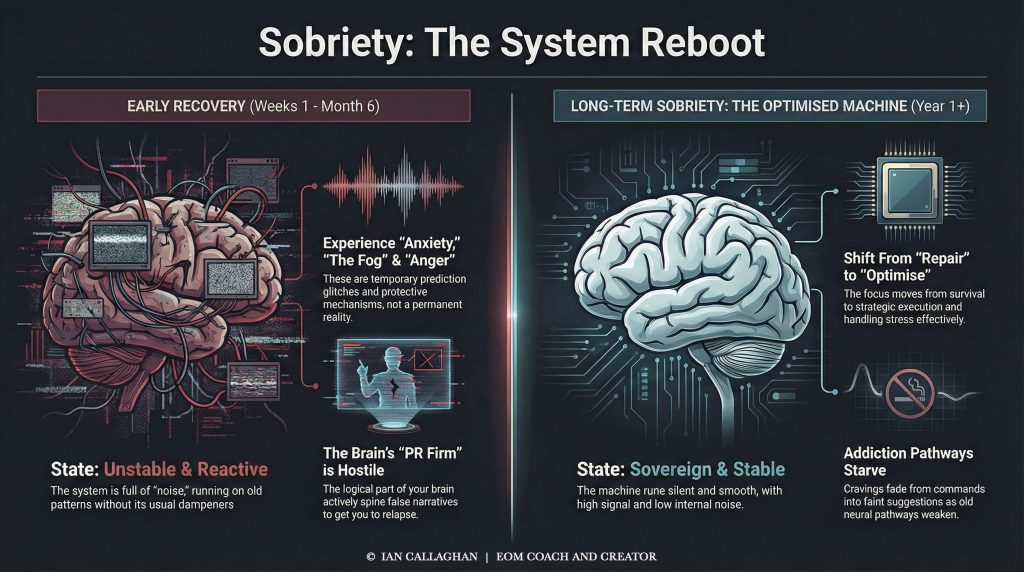
Early Recovery Symptoms Versus Long Term Sobriety Benefits: The EOM Field Manual
The machine doesn’t like being rebooted while it’s running, but understanding the mechanical difference between early recovery symptoms versus long term sobriety benefits is the only way to stop the PR Firm from selling you a relapse.
Introduction: The Mechanic’s View of the System Reset
I spent 45 years pouring ethanol into the tank. That is 45 years of running the engine on dirty fuel, overriding the sensors, and ignoring the check-engine light until the bulb burned out. When I finally stopped, I didn’t just “feel better” immediately. That is the great lie the wellness industry sells you. They tell you it’s a journey of healing; I am telling you it is a mechanical strip-down.
When you have been drinking for decades—or even just years of heavy load—your nervous system has adapted to a toxic baseline. It expects the sedative. It relies on the chemical shutdown. When you remove the alcohol, you aren’t just removing a drink; you are removing the dampener from a hyper-sensitive nervous system.
The result is noise. Static. High RPMs with the clutch disengaged.
We call this the Tone failure. Your Tone—the signal-to-noise ratio of your nervous system—drops through the floor. You become reactive. You become a robot. This is the critical juncture where most people fail because they mistake the symptoms of repair for permanent damage.
In the Emotional Operating System (EOM), we do not deal in vague concepts of “cravings” or “spiritual voids.” We look at the hardware. We ask: “What is the Stoppage?”
This guide is an architectural breakdown of early recovery symptoms versus long term sobriety benefits. We are going to look at the error codes your system throws in the first few weeks (Early Recovery) and contrast them with the operational efficiency you achieve once the software has been patched (Long Term Sobriety).
We are not here to hold hands. We are here to fix the engine.
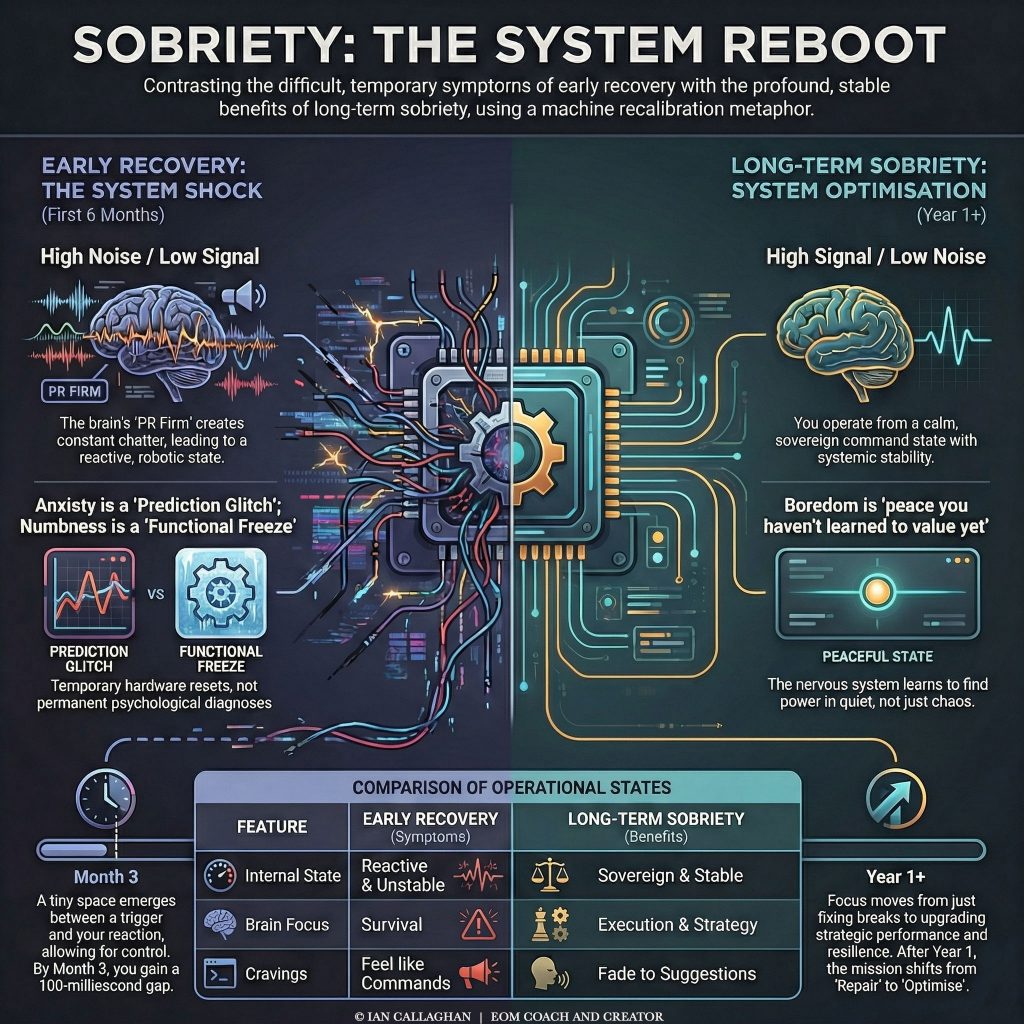
Phase 1: The Crash Log (Early Recovery Symptoms)
When you first cut the fuel line to the addiction, the system goes into shock. This isn’t a moral failing; it is a physiological inevitability. Your brain has been down-regulating its own neurotransmitters (GABA, Dopamine) because the alcohol was providing them artificially. When you stop, there is a lag time before your brain starts manufacturing its own chemicals again.
This gap is where the war is fought. This is the 100-Millisecond War happening on a macro scale.
The PR Firm’s Counter-Attack (The First 30 Days)
Your logical mind—what I call The PR Firm—will try to spin a narrative to get you to drink again. It hates discomfort. It will look at the shaking chassis and the overheating radiator and tell you, “You are broken. A drink will fix this.”
The PR Firm creates the Narrative Fallacy. It tells you that the anxiety you feel is who you are, rather than just a symptom of the system calibrating.
Common Mechanical Failures (Symptoms):
- The Adrenaline Dump (Anxiety/Jitters):
Alcohol is a depressant. To keep you standing while you drink, your body pumps out stimulants (cortisol, adrenaline). When you stop drinking, the alcohol leaves, but the body keeps pumping the stimulants for days or weeks. You aren’t “anxious” in a psychological sense; you are chemically vibrating. The engine is idling at 6,000 RPM. - The Visual Cortex Hijack (Phantom Signals):
You might see a beer advert or the shape of a wine glass, and your brain fires a “WANT” signal before you’ve even processed it. This is The Backdoor. The visual cortex processes data faster than the logical brain. The addiction tries to bypass the Sovereign Operator by using shapes and colours to trigger a saliva response. - The Prediction Glitch (Insomnia/Racing Thoughts):
The brain is a prediction machine. In early recovery, the data is corrupted. It cannot predict how you will sleep or cope without the chemical assist, so it spins “What If” scenarios. This consumes massive amounts of glucose, leading to exhaustion even if you haven’t moved from the sofa. - Functional Freeze (Numbness):
Sometimes, the load is too high for the Low Tone system to handle. The circuit breaker trips. You feel nothing. No joy, no sadness, just grey static. This is a safety mechanism to prevent metabolic burnout. It is not depression; it is a system-wide safe mode.
Phase 2: The Repatterning Timeline (Weekly Breakdown)
We do not simply hope for the best. We track the metrics. When analysing early recovery symptoms versus long term sobriety benefits, you must understand the timeline of the repair job. You cannot expect a Formula 1 performance from a car that’s been sitting in a swamp for 20 years, not in the first week.
Week 1: The Hard Reboot
- Status: Critical System Failure.
- The Mechanic’s Note: This is physical survival. The liver is purging toxins. The PR Firm is screaming.
- The Symptom: Night sweats, tremors, extreme irritability (Valuation Acceleration). You judge everything and everyone instantly and harshly.
- The Fix: Hydration, Cold Override (cold showers to reset the Vagal Brake), and absolute refusal to engage with the narrative. Do not ask “Why?” Just survive the “What.”
Month 1: The False Horizon
- Status: System Stabilising, Software Glitching.
- The Mechanic’s Note: You might hit the “Pink Cloud”—a surge of dopamine as the brain realises it’s not being poisoned. Do not trust it. It is temporary.
- The Symptom: Manic energy followed by a sudden crash into lethargy. The brain is attempting to regulate dopamine production but the levels are fluctuating wildy.
- The Fix: Routine. Discipline. Do not rely on motivation (mood); rely on protocol (action).
Month 3: The Ghost Code (PAWS)
- Status: Post-Acute Withdrawal Syndrome.
- The Mechanic’s Note: This is where the amateurs drop out. The physical toxins are gone, but the Legacy Software (old neural pathways) is still running in the background.
- The Symptom: Sudden, unexplained waves of anxiety or “using dreams.” The PR Firm whispers, “You’ve been good for 3 months, surely you can handle one?”
- The Fix: Recognise this as a software bug, not a command. Use The Gate. Observe the thought, label it as “Legacy Code,” and let it pass without attachment.
Phase 3: The Sovereign Upgrade (Long Term Benefits)
If early recovery is the garage, long-term sobriety is the open road. This is not about “staying dry.” It is about Sovereignty.
When we compare early recovery symptoms versus long term sobriety benefits, we see a shift from reactive living to active command. The Sovereign Operator takes the seat.
1. High Tone Stability (The Bandwidth Upgrade)
In the long term, your Tone increases. This means your nervous system can handle load—stress, conflict, tragedy—without collapsing.
- Early Recovery: A flat tyre ruins your week.
- Long Term: You change the tyre, wash your hands, and drive on. The signal-to-noise ratio is optimised. You have bandwidth.
2. The Death of the Narrative Fallacy
The PR Firm eventually gets fired—or at least demoted to the mailroom. You stop believing the stories your head tells you to justify bad behaviour.
- The Shift: You no longer need to “cope.” You process. You don’t hide in a bottle; you stand in The Gate and observe the reality of the situation. You deal with facts, not feelings.
3. Latency Reduction (OODA Loop Speed)
The OODA Loop (Observe, Orient, Decide, Act) is a military concept for decision-making cycles.
- Alcohol Brain: High latency. You observe a threat, you freeze or panic, you make a bad decision, you regret it.
- Sovereign Brain: Zero latency. You observe the signal, you orient yourself (I am Safe, I am Capable), you decide on the correct mechanical action, and you execute. You become efficient.
4. Metabolic Efficiency
Your body stops fighting a daily war against poison. The energy previously used to process ethanol is now available for cognitive function, muscle repair, and immune response. You aren’t just “healthier”; the machine is running at peak manufacturing spec.
FAQ: Troubleshooting the Transition
Q: Why do I feel worse in month two than I did in week one?
Ian: Because the adrenaline has worn off. In week one, you were fighting a tiger. In month two, you are sitting in a quiet room with your own thoughts. The noise of the alcohol is gone, so now you can hear the creaking of the floorboards (your unresolved trauma or Legacy Software). This is not regression; it is increased resolution. You are seeing the mess clearly for the first time. Start cleaning.
Q: Will the PR Firm ever shut up?
Ian: It never goes silent, but it loses its megaphone. Right now, the PR Firm has a PA system. In long-term sobriety, it’s just a mumbling in the corner. You learn to distinguish between “Signal” (useful data) and “Noise” (emotional static). You stop negotiating with terrorists inside your own head.
Q: I feel numb. Is my engine broken?
Ian: No. You are in “Safe Mode.” Your system is rebooting. Do not force “happiness.” Happiness is a fleeting mood. Aim for Stability. If you are flat, be flat. Being flat is better than being in a chaotic sine wave of drunk/hungover. Functionality returns before joy does. Keep the chassis moving.
Q: How do I speed up the process?
Ian: You don’t. You cannot hack the timeline of biological repair. However, you can prevent delays by not adding new wreckage. Hydrate. Sleep. Cold water. Functional movement. Stop staring at the Museum of your past and start working in the Workshop of your present.
The Mechanic’s Directive
We have established the baseline. You now understand that the pain you feel is simply the friction of parts moving that haven’t moved in years.
Early recovery symptoms versus long term sobriety benefits is not a fair fight. The symptoms are loud, immediate, and demanding. The benefits are quiet, cumulative, and structural. The symptoms scream; the benefits whisper.
You must have the discipline to ignore the scream and listen for the whisper.
The machine is capable of self-repair, but only if the operator stops pouring sugar in the petrol tank. You are the operator. Take command.
If you are ready to stop guessing and start engineering your recovery, you need the blueprints. The EOM is not a support group; it is a technical manual for the human machine.
GET THE MANUALS AND START THE REPAIR AT THE SHOP
Stop listening to the static. March on.
Ian.
Early Recovery Symptoms Versus Long Term Sobriety Benefits: An Engineering Perspective
The difference between early recovery symptoms versus long term sobriety benefits is the difference between a car in the garage undergoing a full engine rebuild and a high-performance vehicle dominating the track.
Phase 2: The Calibration Period (The Middle Ground)
We have addressed the immediate crash site. Now we move to the rebuild.
When discussing early recovery symptoms versus long term sobriety benefits, there is a dangerous middle ground that the medical community often calls PAWS (Post-Acute Withdrawal Syndrome). In the Emotional Operating System (EOM), we call this System Calibration.
This is where the amateur mechanic gives up. The acute pain is gone, but the engine is still misfiring. You are not “drunk,” but you are not “right.”
The Hardware Lag
Your nervous system has been running on a high-octane, dirty fuel source (alcohol/drugs) for years. You have now switched to clean fuel (sobriety). The engine does not recognise it yet.
The Legacy Software—the old childhood patterns and the PR Firm in your head—is screaming for the old input. The hardware is confused. You may experience:
- phantom signalling (cravings with no trigger),
- thermal spikes (sudden anger or anxiety),
- systemic drag (lethargy and brain fog).
This is not a sign that sobriety isn’t working. It is a sign that the operating system is attempting to re-index its database.
In this phase, you are likely to think, “Is this it? Is this the ‘great life’ everyone promised?”
Do not listen to the PR Firm. It is lying to get you to drink. The PR Firm will tell you that being bored is fatal. It will tell you that a flat mood is a crisis.
The reality? You are simply bored. You are simply flat. This is not a malfunction; it is a lack of artificial stimulation. You must hold the line while the neurochemistry—the spark plugs and fuel injectors—realigns to a standard baseline.
The Long Term Operational Benefits
If you survive the calibration, you enter the operational phase. This is where we see the true data regarding early recovery symptoms versus long term sobriety benefits.
The benefits are not about “happiness.” Do not aim for happiness; aim for Sovereignty.
1. High Tone: The Sovereign State
In early recovery, your Tone—your nervous system’s signal-to-noise ratio—is rock bottom. You are reactive. A text message can ruin your day. A dropped plate can cause a meltdown. You are a robot, programmed by external stimuli.
The primary benefit of long-term sobriety is High Tone.
- Load Bearing Capacity: You can carry heavy loads—stress, grief, financial pressure—without the chassis buckling.
- The 100-Millisecond War: In active addiction, there is zero gap between a Trigger and your Reaction. In long-term sobriety, you reclaim the 100-millisecond gap. You see the trigger, you evaluate it, and you choose the response.
- Command Authority: You stop being a passenger in your own life. You become the Driver.
2. Decommissioning the PR Firm
Active addiction requires a robust PR Firm—that voice in your head that spins narratives to justify the unjustifiable. “I deserve this drink because I worked hard,” or “I need this because she shouted at me.”
In long-term recovery, the PR Firm goes bankrupt. It is replaced by Raw Data Analytics.
- You stop telling stories about “why” you feel bad.
- You identify the mechanical stoppage. “I am tired because I slept poorly.” “I am angry because my boundary was breached.”
- There is no drama, only diagnostics. This is freedom.
3. Metabolic and Financial Efficiency
Consider the energy required to maintain an addiction. The plotting, the hiding, the recovering, the lying. That is a massive drain on your CPU.
When you compare early recovery symptoms versus long term sobriety benefits, look at the resource allocation.
- Energy: All that processing power is now available for building a business, training the body, or being present for your family.
- Finance: It is not just the cost of the alcohol; it is the cost of the bad decisions made while under the influence. Long-term sobriety compounds wealth because you stop burning capital on chaos.
The Identity Update: Creating the Sovereign Operator
The most critical aspect of EOM is the Identity Update.
In the early days, your identity is “Addict” or “Recovering Alcoholic.” This is necessary for triage, but it is a weak identity for the long term. If you stay there, you are defined by a negative—by what you do not do.
Long-term benefits unlock when you press the “Save Button” on a new identity.
You are no longer a broken machine. You are a Sovereign Operator.
You must replace the Legacy Software (the toddler that wants comfort) with the Adult Executive Programme.
- Old Code: “I want to feel better now.”
- New Code: “I will execute the required task regardless of how I feel.”
This is where the Visual Cortex Hijack (The Backdoor) becomes a tool for creation, not just survival. You use visualisation not to escape reality, but to blueprint the architecture of your future. You see the objective, and you march toward it.
Navigating the Error Codes: Avoiding Rust
Even in a restored vintage car, rust never sleeps.
The biggest threat to long-term sobriety is not the craving; it is Complacency. It is forgetting the disparity between early recovery symptoms versus long term sobriety benefits.
The PR Firm will try to creep back in. It will whisper, “You’ve fixed the machine. Surely one drink won’t crash the server now.”
This is a fatal error code.
You must maintain a maintenance schedule.
- Daily Cold Override: Cold water exposure to reset the vagal brake. Keep the system sharp.
- Inventory Checks: Regular audits of your resentment and fear levels. Do not let pressure build in the gasket.
- Service the Community: You cannot keep what you do not give away. Assist other mechanics in the workshop.
Conclusion: The Workshop is Open
We have analysed the data. We have looked at the mechanics of early recovery symptoms versus long term sobriety benefits.
The symptoms are the price of admission. They are the friction of rust breaking loose. They are temporary, uncomfortable, and loud.
The benefits are structural. They are the quiet hum of an engine running at optimal efficiency. The ability to look your children in the eye. They are the capacity to wake up without the crushing weight of existential dread.
You do not need to “find yourself.” You need to build yourself.
The Museum of your past is closed. Stop trying to buy a ticket to look at the exhibits of your trauma.
The Workshop is open. The tools are on the wall.
Pick up the wrench. Fix the engine.
Ian Callaghan.
The Mechanic.
ACCESS THE FULL TECHNICAL BLUEPRINT AT THE SHOP
Emotional Mastery: The Emotional Operating System
The Emotional Mastery book is a practical manual for understanding and regulating the human nervous system using the Emotional Operating System framework.
Instead of analysing emotions or retelling your past, the Emotional Mastery book teaches you how to read emotional states as system feedback, identify overload, and restore stability under pressure.
No labels. No therapy-speak. No endless healing loops.
Just a clear, operational approach to emotional regulation that actually holds when life applies load.
Instant digital download.