The 4 Emotional Archetypes That Run Your Life (And How to Finally Change Them)
Most people think they’re stuck because they lack motivation or discipline. They think the problem is laziness or inconsistency. The truth is simpler: your emotional life is being run by an archetype you never identified.
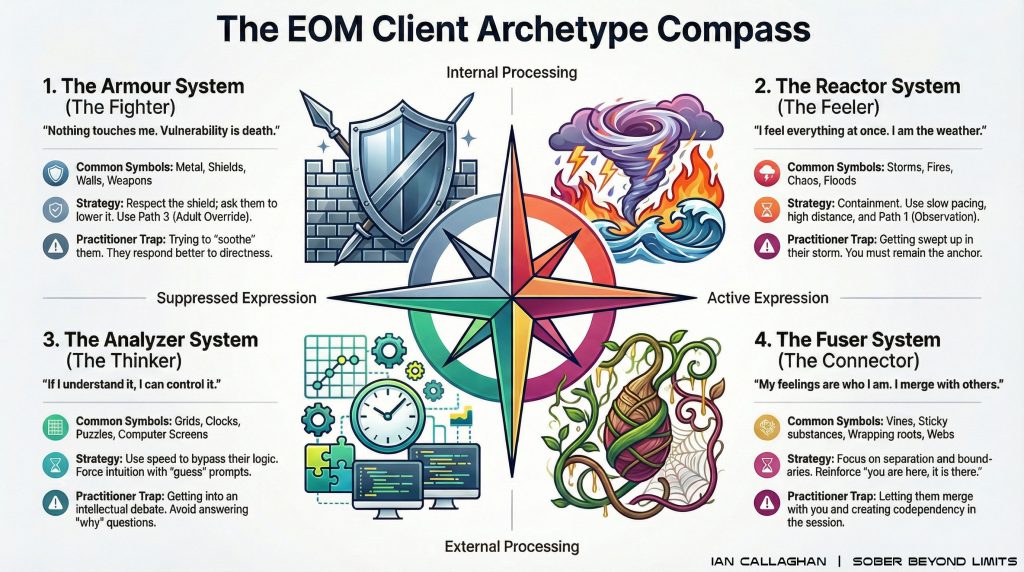
Inside the Emotional Observation Method (EOM), I teach four core archetypes that form the EOM Client Archetype Compass. Once you understand which one you are, everything about your patterns makes sense.
If you want personalised clarity, take the free Emotional Archetype Quiz:
https://iancallaghan.co.uk/emotional-archetype-quiz/
Why Emotional Archetypes Matter
People assume their reactions are conscious choices. They’re not. Your archetype decides how you respond before your thinking brain even gets involved. This is why you shut down, explode, overthink, or merge with other people’s emotions even when you don’t want to.
Your archetype is your autopilot. When you identify it, you can finally take the controls back.
1. The Armour System (The Fighter)
Internal Processing | Suppressed Expression
Signature belief: “Nothing touches me. Vulnerability is death.”
Armour types aren’t cold, they’re defended. They built emotional walls because exposure once felt dangerous.
Common signs:
- Shutting down instead of opening up
- Appearing calm but tense inside
- Disliking emotional conversations
- Keeping people at a distance
- Preferring independence to intimacy
Why it forms: Protecting the self becomes the safest option.
EOM Strategy: Respect the armour. Use Adult Override. No forced vulnerability.
Healing direction: Safe, chosen vulnerability.
2. The Reactor System (The Feeler)
Internal Processing | Active Expression
Signature belief: “I feel everything at once. I am the weather.”
Reactor types process emotion with intensity. Feelings move fast and hit hard.
Common signs:
- Emotional spikes or storms
- Sudden overwhelm
- Fast activation and slow recovery
- Feeling everything at once
- Deep sensitivity
Why it forms: The nervous system learns to stay hyper-alert.
EOM Strategy: Containment. Slow pacing. Observation.
Healing direction: Learning to anchor through emotional storms.
3. The Analyser System (The Thinker)
External Processing | Suppressed Expression
Signature belief: “If I understand it, I can control it.”
Analysers feel safer in logic than in emotion. They turn feelings into concepts.
Common signs:
- Overthinking
- Intellectualising feelings
- Needing clarity before action
- Predicting rather than experiencing
- Getting stuck in analysis loops
Why it forms: Insight once offered safety.
EOM Strategy: Bypass logic with speed and intuition prompts.
Healing direction: Embodiment. Feeling before analysing.
4. The Fuser System (The Connector)
External Processing | Active Expression
Signature belief: “My feelings are who I am. I merge with others.”
Fuser types attach deeply and quickly, often losing themselves in others.
Common signs:
- People-pleasing
- Over-attachment
- Emotional merging
- Difficulty with boundaries
- Taking on others’ emotions
Why it forms: Connection equals safety.
EOM Strategy: Strengthen separation and identity boundaries.
Healing direction: Standing alone without losing connection.
How to Find Your Archetype
You might recognise yourself instantly. You might see pieces of all four systems. But one will always dominate.
Find out which one is yours with the free Emotional Archetype Quiz:
https://iancallaghan.co.uk/emotional-archetype-quiz/
How to Change Your Pattern
Identifying your archetype is step one. Rewiring it is step two.
For the full roadmap, get the Emotional Operating System Manual:
https://iancallaghan.co.uk/product/emotional-operating-system-manual/
Inside, you’ll discover:
- Your trigger map
- Your nervous system patterning
- Why was your archetype formed
- How your reactions maintain the pattern
- How to interrupt and rewire the loop
You’ll also unlock the EOM Command Console, which guides you through the practical process of running EOM on yourself.
Key Takeaways
- You’re not broken, you’re patterned.
- Your emotional life follows an archetype.
- Armour, Reactor, Analyser, and Fuser are survival systems.
- Each pattern formed for a reason.
- The free quiz shows your system.
- The Manual and Console help you transform it.
FAQ
Which archetype is most common?
Reactor and analyser types show up most often in midlife due to stress and emotional load.
Can your archetype change?
Yes. Life experience, sobriety, stress, and relationships can shift your dominant system.
Is this therapy?
No. EOM is an emotional operating method, not a clinical diagnostic tool.
What if I relate to all four?
You’ll use all four at times, but one will always dominate.
Can you change your archetype?
Yes, through EOM repatterning and nervous system work.
If you’re ready to stop reacting on autopilot and start consciously directing your emotional life, start with the quiz and explore the manual for bigger change.
The Science Behind Emotional Archetypes
Your emotional archetype forms long before you ever put language to it. Most of the time, before age ten. Not because anything was “wrong” with you, but because your nervous system was forced to pick a strategy that felt safest at the time. These early blueprints become your adult defaults.
Your body reacts milliseconds before your mind explains anything. That’s why you often catch yourself saying things like:
- “Why did I react like that?”
- “That wasn’t even a big deal.”
- “Why do I shut down around certain people?”
- “Why do I explode over small things?”
- “Why do I feel responsible for everyone else?”
- “Why do I overthink everything until I’m exhausted?”
These aren’t personality flaws. They’re patterns of protection. Archetypes are not identity; they are strategies. And strategies can be rewritten.
How Midlife Stress Activates Your Archetype
If you’re in your forties or fifties, your archetype becomes louder. Not because you’re getting worse, but because your capacity is stretched, your hormones shift, your responsibilities grow, and unresolved emotional patterns get amplified.
This is why midlife often triggers:
- emotional overwhelm
- burnout
- drinking or coping mechanisms
- relationship breakdowns
- career frustration
- identity confusion
- feeling stuck or restless
Your archetype tries to protect you from the chaos. The problem is, it uses childhood tools to solve adult problems.
Once you recognise the pattern, you can finally update the toolkit.
How Each Archetype Handles Stress
Armour System under stress:
Withdraws deeper. Closes off. Becomes unreachable. Appears strong but crumbles internally.
Reactor System under stress:
Tornado mode. Fast emotional spikes. Tears, anger, overwhelm. Nervous system in “high alert”.
Analyser System under stress:
Overthinking becomes an obsession. Paralysis by analysis. Avoids feeling by solving problems that don’t exist yet.
Fuser System under stress:
Clings harder. Loses self-boundaries. Becomes responsible for everyone else’s emotions.
When you know these patterns, you stop blaming yourself and start working with your biology, not against it.
Practical Ways to Start Rewiring Your Archetype
Rewiring doesn’t start with thinking. It starts with awareness.
Here are simple first steps for each archetype:
For the Armour System:
- Practise micro-vulnerability (one sentence at a time)
- Stop using independence as identity
- Allow people to support you without earning it
For the Reactor System:
- Slow your breathing before you speak
- Step away to regulate, then return
- Label the emotion without judging it
For the Analyser System:
- Stop the story; drop into sensation
- Ask: “What does my body feel right now?”
- Move before thinking when safe (walk, stretch, breathe)
For the Fuser System:
- Practise separation: “Their emotion is not mine.”
- Limit how much emotional labour you perform for others
- Ask: “What do I feel underneath this?”
These small shifts create massive long-term changes.
Why the EOM Manual Accelerates Change
You can guess your archetype, or you can understand it properly.
The Emotional Operating System Manual gives you:
- A full breakdown of your dominant archetype
- Your nervous system trigger map
- The origin of your emotional pattern
- the behavioural loops that keep it alive
- interruption strategies
- rewiring steps based on EOM
- journaling and reflection prompts
- real-world examples you’ll recognise instantly
And with the EOM Command Console, you can run the process yourself anytime. It doesn’t rely on therapy sessions or waiting for someone else. It puts emotional change back in your hands.
Explore the Manual here:
https://iancallaghan.co.uk/product/emotional-operating-system-manual/
When You Know Your Archetype, Everything Changes
Your relationships get easier.
Your triggers make sense.
You stop reacting on autopilot.
You stop blaming yourself for patterns you never consciously chose.
You build an emotional operating system that works for your adult life, not your childhood survival.
Your archetype is not who you are.
It’s who you learned to be.
And you can learn something new.
If you haven’t already, start with the quiz:
https://iancallaghan.co.uk/emotional-archetype-quiz/