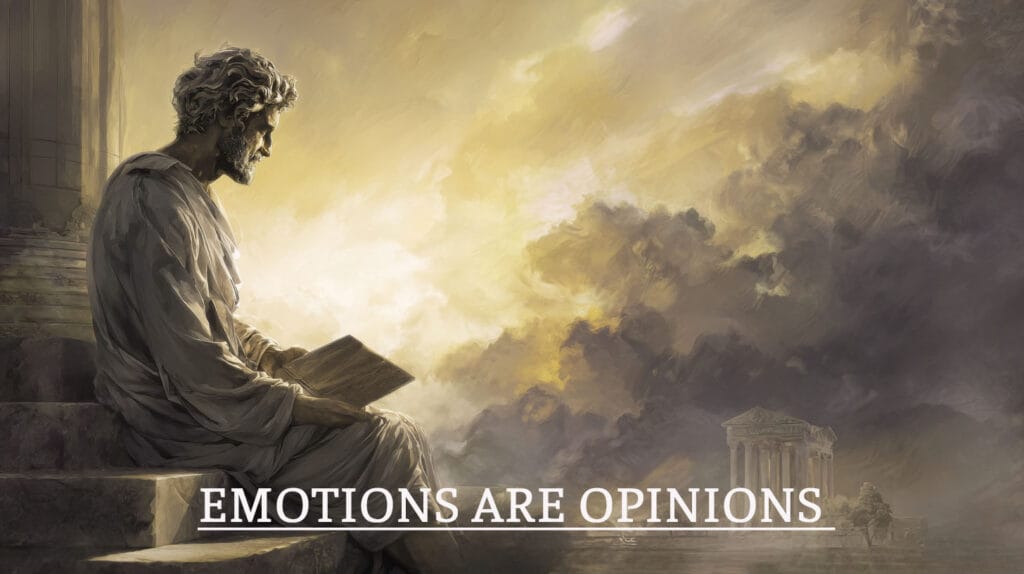
Alright, let’s cut the bollocks. You’re probably sitting there, mid-thirties, forties, maybe even pushing fifty, feeling a bit lost, a bit shit, wondering where the hell the time went and why you’re not where you thought you’d be. You’re bombarded with self-help gurus telling you to “lean into your feelings” or “honour your emotions.” Well, I’m here to tell you something that’s going to hit you like a cold, hard slap to the face: emotions are opinions. Yeah, I said it. Your feelings? They’re just your brain’s take on the situation, not the gospel truth. And understanding that – truly understanding it – is the fucking key to unlocking your midlife reset.
I’m Ian, 57 years old, and I’ve seen some shit. Over a decade in the British Army hammered this lesson into me, and then 45 years of boozing, which I finally kicked 8 months ago, showed me just how easy it is to let those emotional “opinions” run your entire fucking life into the ground. This isn’t some fluffy theory; this is hard-won wisdom from the trenches of actual living. If you’re sick of feeling like a passenger in your own life, stuck reacting to every emotional gust, then listen up. This truth will set you free, but it ain’t gonna be comfortable.
The Battlefield of the Mind: What the Army Taught Me About Emotional Control
When you’re in the military, especially in certain roles, you quickly learn that your emotions can get you, or your mates, killed. There’s no room for self-indulgent wobbles when rounds are flying, or you’re navigating a minefield, or you’re watching a friend go down. You learn to compartmentalise, to shut down the noise, and to focus on the task at hand. Your fear, your anger, your grief – those are luxuries you can’t afford in the moment. They are, quite literally, opinions your brain is generating about a very real, very dangerous situation. If you act solely on those opinions, you’re fucked.
Now, that’s an emotion: fear. And my brain was giving me a strong opinion about it. If I’d given in to that opinion, bolted, panicked, or frozen up, it wouldn’t have just been my arse on the line. It would have jeopardised the entire patrol. So, what do you do? You acknowledge it. “Right, Ian, you’re scared. That’s a valid opinion from your lizard brain.” But then you push it down, you compartmentalise, and you focus on the facts: my rifle is loaded, my section commander is giving orders, I know my arcs of fire. My action has to be based on reality and training, not on the visceral, gut-wrenching opinion of fear.
That wasn’t about being a robot; it was about being effective. It was about choosing how I responded, rather than simply reacting. The Army taught me that those intense feelings are just signals, data points. You don’t have to blindly follow them. You can observe them, assess them, and then make a conscious decision about what to do next. It’s the ultimate training in understanding that emotions are opinions, and you get to choose whether those opinions dictate your actions or if you use them as information.
My 45-Year Battle with the Bottle: The Ultimate Emotional Escape (and The Lie I Told Myself)
Fast forward many years, out of the Army, and I found a different battlefield: the inside of my own head, fuelled by a different kind of ammunition – alcohol. For 45 fucking years, I drank. It started casually, as it often does, a way to unwind, to socialise. But for decades, it became my go-to response for every emotional opinion my brain threw at me.
Feeling stressed after a crap day at work? Opinion: I need a drink to relax.
Feeling lonely? Opinion: A few pints will make me feel connected, or at least numb the ache.
Feeling happy? Opinion: Let’s celebrate with a bottle (or three).
Feeling anxious about something? Opinion: Alcohol will quiet those nagging thoughts.
Do you see the pattern? Each emotion, each passing feeling, was interpreted as a command, an instruction to pick up a glass. My brain, the devious bastard, had formed a deeply ingrained opinion that alcohol was the solution to every emotional state. It was a lie, a comfortable, insidious lie that slowly but surely eroded my health, my relationships, and my self-respect.
The real brutal truth was, I wasn’t dealing with my emotions; I was suppressing them. I was trying to silence the opinions rather than questioning their validity. When the anxiety bubbled up, instead of asking, “Why am I feeling this? What’s the real issue here? Is this ‘anxiety’ opinion serving me?”, I’d reach for the bottle. I was outsourcing my emotional management to a liquid crutch, and it was fucking destroying me.
Eight months ago, I finally hit rock bottom with the booze. It wasn’t one dramatic event, but a slow, grinding realisation that I was a slave to these emotional opinions and the alcohol they demanded. Quitting was the hardest thing I’ve ever done – harder than any military exercise, any deployment. It was a brutal, physical, and mental rewiring. Every fibre of my being screamed for that chemical comfort. My brain, used to its old opinions, would tell me, “You’re miserable. Just one. It’ll make you feel better.” It was a constant war.
But this time, I fought differently. I started observing those opinions. “Ah, there’s the ‘miserable’ opinion. Interesting. Is it true? Or is it just a familiar pathway my brain wants to follow?” I used the discipline the Army taught me, but applied it to my internal landscape. I learned to sit with the discomfort, to let the emotional waves wash over me without drowning in them. I learned that an emotion, no matter how powerful, is a fleeting thing if you don’t feed it with your reaction. It’s a suggestion, not a command. Emotions are opinions, and I finally realised I didn’t have to agree with them, especially the ones that were ruining my life.
Ancient Wisdom, Modern Battleground: Why the Old Boys Knew Your Bollocks Better Than You Do
This idea that emotions are opinions isn’t new. We’re not reinventing the wheel here. The ancient philosophers, the Stoics like Chrysippus and Epictetus, and even the Epicureans and Aristotle, were grappling with this same shit thousands of years ago. They understood the human condition, the struggle between our immediate urges and our rational minds, far better than most of the fluffy Instagram gurus peddling positive vibes today.
- Chrysippus and the Stoics: These blokes were the OG no-nonsense crew. They didn’t say, “Don’t feel anything.” That’s a common misconception. What they said was, your initial gut reaction – that ‘impression’ – isn’t necessarily reality. It’s your judgment about that impression that causes distress. If you judge something as ‘bad’ or ‘terrible’ or ‘catastrophic’, then you’re going to feel fear, anger, despair. But if you see it as ‘challenging’ or ‘an opportunity to test yourself’ or simply ‘an external event outside my control’, then your emotional response shifts entirely. Your emotional response isn’t the truth; it’s a value judgment you’re slapping on reality. It’s an opinion. They understood that you can choose to agree with that opinion, or you can choose to challenge it.
- The Epicureans: Often misunderstood as just pleasure-seekers, Epicurus actually taught about finding ataraxia – a state of freedom from disturbance. This wasn’t about wild indulgence, but about achieving tranquillity through rational thought, reducing desires, and overcoming fear (especially of death). He knew that chasing every fleeting pleasure or avoiding every discomfort blindly would lead to a shitty, unfulfilled life. Instead, he advocated for a considered, balanced approach to life’s experiences. Again, the emotional ‘opinion’ that this pleasure is essential, or this pain must be avoided at all costs, was to be scrutinised.
- Aristotle and the Golden Mean: Aristotle taught us about virtue lying in the ‘golden mean’ – the balance between two extremes. Cowardice and rashness are both vices; courage is the virtue in the middle. Being emotionless isn’t wise, but neither is being a slave to every whim. It’s about feeling the right emotion, at the right time, for the right reason, and to the right degree. That requires conscious choice, not just letting your primitive brain run the show. It means understanding that your anger, for example, is an opinion. Is it a justified opinion at this moment? Is it proportionate? Or is it just a knee-jerk reaction that’s going to make things worse?
These ancient bastards understood that humans are driven by a constant internal dialogue, a stream of thoughts and feelings. But they also knew that we have the capacity for reason, for higher-order thinking. We don’t have to be slaves to our biology. Your gut feeling, your initial emotional surge, is a data point. It’s information. It’s an opinion. But it’s not a command. You have the power to decide if you’re going to act on that opinion or if you’re going to forge a different path. That’s the real power of recognising that emotions are opinions.
The Midlife Reset: How to Change Your Fucking Opinion and Reclaim Your Life
So, you’re here, midlife, perhaps a bit battered, a bit disillusioned. You’re probably tired of the same old patterns, the same old emotional merry-go-round. Now you know the truth: emotions are opinions. So, how do you start changing those opinions and truly reset your life?
It’s not some magic pill. It’s hard, deliberate work. Just like kicking a 45-year drinking habit, or surviving a dangerous patrol. But it’s absolutely doable.
1. Identify the Opinion, Not Just the Emotion
When you feel something – anger, frustration, anxiety, sadness – don’t just label the emotion. Dig a little deeper. What’s the story your brain is telling you about that emotion? What’s the opinion it’s forming?
- Instead of: “I’m so angry!”
- Try: “I’m feeling anger, and the opinion my brain is offering is that this situation is unfair and disrespectful, and I should lash out.”
See the difference? You’re dissecting the opinion, not just being consumed by the feeling.
2. Create the Pause: Your Gap of Power
Between the stimulus (what happens) and your response (how you react emotionally and physically), there’s a tiny, crucial gap. That’s your power zone. It’s where you decide if you agree with your brain’s opinion or not.
- Practice: When that surge of emotion hits, literally pause. Take a deep breath. Count to five. Just that small act creates a microsecond of space where you can intervene. This is where you can apply that military discipline. Don’t react. Observe.
3. Question the Opinion: Is It Serving You?
Once you’ve identified the opinion and created the pause, challenge it. Ask yourself:
- Is this opinion actually true? Is it the only truth?
- Is this opinion helping me achieve my goals, or is it holding me back?
- What’s another, more constructive opinion I could form about this situation?
- What would someone I respect, someone who embodies the person I want to be, think or feel in this situation?
This isn’t about denying your feelings; it’s about not being a slave to them. It’s about choosing your perspective. You have the choice to reframe. Perhaps that feeling of ‘failure’ isn’t an opinion that you are a failure, but an opinion that ‘this particular attempt didn’t work, and there’s a lesson here.’
4. Act in Alignment with Your Goals, Not Just Your Feelings
Your actions should stem from your values and your long-term goals, not just the fleeting emotional opinions of the moment. If your goal is health, but your emotional opinion is “I feel like shit, so I deserve a massive takeaway and a bottle of wine,” you know which one to choose.
This is where the real work of self-discipline comes in. This is where you get to build new neural pathways, new habits, and a new, stronger version of yourself. This is where my knowledge of NLP and hypnotherapy comes in handy, but you don’t need fancy jargon. You just need the grit to consistently choose the harder, more beneficial path over the easy, comfortable one dictated by a transient feeling.
And let’s be clear: you can’t build a robust, emotionally resilient mind if your body is a fucking mess. Your nutrition is foundational. Stick to ancestral, whole foods. Nose-to-tail. Cut the processed crap. Absolutely no soy (except properly fermented stuff like tempeh or natto in moderation, and never tofu – especially not for women, it’s a hormonal disaster). Optimise your sleep. Move your body. These aren’t optional extras; they’re the bedrock upon which you build your new, strong self.
The Final Word
Stop letting your emotions run your fucking life. They’re just opinions, whispered by your brain based on past experiences and current interpretations. You have the power, the discipline, and the sheer human will to challenge those opinions, to choose your response, and to forge a life that’s truly yours. This midlife reset isn’t about finding yourself; it’s about building yourself, brick by bloody brick. Start by taking control of your opinions. The rest will follow.