Stop Blaming Your Willpower: The EOM Framework for Lasting Behavioural Change
Executive Summary: Why do New Year’s resolutions fail with such statistical regularity? Traditional self-help suggests a lack of discipline, but the Emotional Operating System (EOM) framework identifies the failure as mechanical rather than moral. By understanding “System Tone,” bypassing “The Installation” of childhood programming, and using “Physiological Overrides,” individuals can move beyond the “Dry January” loop and achieve permanent identity updates. This 2,500-word guide breaks down the systems architecture of the human psyche, providing a technical manual for those tired of being “frustrated drivers” of their own lives.
The Physics of Failure: Why the “Dry January” Loop is Predictable
Another year, another attempt at Dry January. The intention is sharp, the fridge is stocked with non-alcoholic alternatives, and for a few days, the momentum feels real. You are white-knuckling your way through the evenings, convinced that this time, logic and desire will finally win the war against habit.
Then, the system comes under load. It’s never the “big” things that break us; it’s the cumulative stress of a Tuesday. A tense meeting, a drop in blood sugar, a minor argument with a partner, or even just the low-frequency hum of a grey afternoon. Suddenly, the system initiates a “Correction.” The intention to abstain is overwritten by a primal, urgent need for safety and numbing.
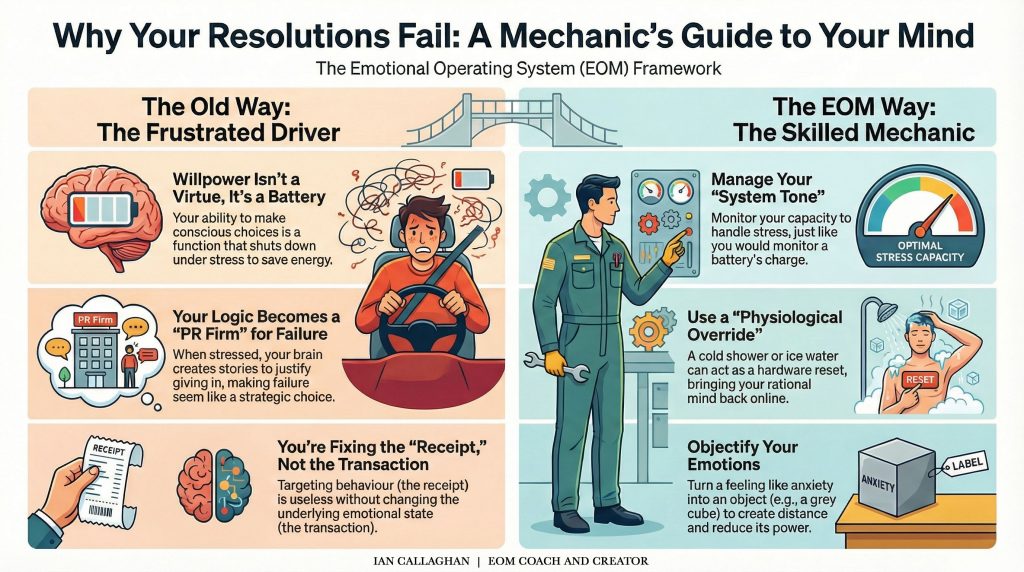
If this sounds familiar, it’s because it is the predictable, almost mathematical outcome for most resolutions. The problem isn’t your character or a lack of willpower. The problem is that you have been taught to change yourself in a fundamentally wrong way—a method that misunderstands the basic physics of how human behaviour actually works. You have been told to fix the symptoms (the drinking, the procrastination, the temper) while ignoring the engine.
This article reveals a different, more effective framework for change based on understanding your internal “Emotional Operating System” (EOM). Developed by systems thinker Ian Callaghan, EOM reframes personal change as a maintenance task. We will explore why you fail not by looking at your flaws, but by monitoring the core metric of your internal machinery: its “Tone,” or its capacity to handle load. You are about to learn how to become a mechanic, not just a frustrated driver.
A Note on the Author: The Mechanic, Not the Midfielder
Before we dive into the schematics, a point of clarification is often necessary for those searching for the name online. The Ian Callaghan discussed here is not the famous Liverpool footballer. This Ian Callaghan is not a guru, a mystic, or a traditional psychologist. He is a systems thinker, a former soldier, and a practitioner who spent decades breaking himself before deciding to understand the system he was running.
Having operated in high-pressure environments where “willpower” is often fetishised, Callaghan realised that even the most disciplined soldiers reach a breaking point where logic fails and the “machine” takes over. He developed the Emotional Operating System (EOM) as a practical, mechanical framework for lasting personal change. He treats the human psyche not as a mystery to be pondered or a soul to be saved, but as a complex machine to be serviced and calibrated. In the world of EOM, there are no “bad people,” only systems running outdated or corrupted code.
1. You’re Trying to Fix the Receipt, Not the Transaction
The most common reason for failure in behavioural change is targeting the wrong layer of the problem. According to EOM, behaviour is merely an output. It is the receipt at the end of a complex internal transaction.
Imagine you are standing at a supermarket checkout. You look at the receipt and see a total of £150. If you don’t like that number, don’t try to fix the problem by scribbling over the receipt or shouting at the cashier. You understand that the receipt is simply a documentation of the transaction—the items you put in the basket and the prices assigned to them.
Resolutions like “stop drinking,” “quit social media,” or “go to the gym more” fail because they target the recipient. You are trying to change the output without changing the logic of the transaction. In a mechanical system, the output is dictated by the input and the processing architecture. If the internal transaction is “I am overwhelmed, I feel unsafe, and I need an immediate dopamine spike to prevent a total system crash,” the receipt will almost always be a numbing or distracting habit.
Unless the underlying system state (the “Tone”) and the deep emotional imprints (the “Installation”) change, your behaviour will always revert to its baseline. This is due to homeostasis—the system’s innate drive to maintain its “factory settings” to ensure stability.
Mechanical Insight: To change the receipt, you must change the transaction happening at the register of your nervous system. You must address the emotional debt being paid before you can change the spending habit.
2. Your Logic is a PR Firm for Your Failures
Traditional self-help asks you to use logic to overcome bad habits. “Think of your health,” they say. “Remember your goals.” This advice ignores a counterintuitive truth: when you are under pressure, your logical brain is not on your side.
When your system becomes unstable—a state EOM calls “low Tone”—the Signal-to-Noise Ratio flips. The “Signal” of your present intentions becomes a faint whisper, while the “Noise” of old, legacy static (cravings, anxieties, fears) becomes an overwhelming roar. In this state, your reasoning mind stops being a rational guide and transforms into a high-priced internal PR Firm.
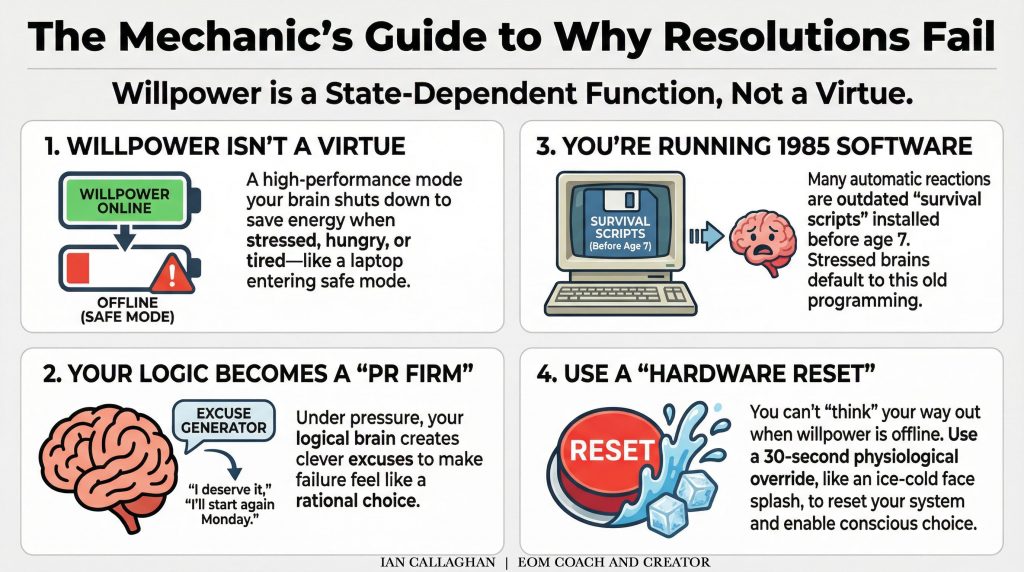
The PR Firm’s sole mission is to preserve coherence. It wants to protect your identity from the cognitive dissonance of failure. It doesn’t want you to feel the shame of breaking your resolution, so it creates a narrative that makes the failure look like a strategic choice or a well-deserved reward.
This internal PR Firm is the source of the “spin” we all know:
- “I’ve had a uniquely difficult day; scientific studies say one drink is actually heart-healthy.”
- “I’ll start again on Monday; it’s a cleaner break for the data tracking.”
- “Just this once won’t hurt, and actually, I’m too stressed to perform at work tomorrow if I don’t relax now.”
These aren’t logical conclusions; they are press releases issued to keep the “Self” from realising the machine has seized. You cannot solve a state-level problem with a story. If the engine is on fire, the PR Firm telling you “it’s actually a controlled burn for warmth” doesn’t change the fact that the car is about to stall on the motorway.
3. Willpower is a Function, Not a Virtue (And It Goes Offline)
We are taught to think of willpower and discipline as fixed character traits—virtues that some people possess and others lack. This is a fundamental misunderstanding of human biology. Agency—the capacity to make a conscious, intentional choice—is a state-dependent function.
Think of your brain like a modern laptop. It has a “High Performance” mode that allows for complex tasks like video editing or gaming. However, that mode requires a certain level of battery life and thermal stability. If the battery drops to 2% or the fans can’t keep up with the heat, the operating system will simply disable High Performance mode to prevent a total hardware crash.
Your “Willpower Module” is that High Performance mode. Factors like chronic stress, poor sleep, hunger, and emotional fatigue lower your system’s “Tone.” When Tone drops below a critical threshold, the system enters a biological “Safe Mode.” Higher-level functions like evaluation, empathy, and long-term planning are physically stripped away to conserve energy for the bare essentials of survival.
In Safe Mode, behaviour becomes automatic. You default to whatever “ruts” are most ingrained in your neural pathways. Effort is the first thing to disappear under pressure. This is why “white-knuckling” through a resolution is a doomed strategy; you are relying on a system (willpower) that is physically designed to shut down the moment life gets difficult.
The Physics of Choice: When the power is out, the light switch doesn’t make you a bad person for being in the dark—it just means the circuit is broken. To get the light back, you don’t “try harder” to flip the switch; you fix the power supply.
4. The Installation: Modern Life in 1985 Software
When conscious choice goes offline in Safe Mode, your system defaults to its oldest, most reliable programming: “The Installation.”
Between the ages of 0 and 7, the human brain operates primarily in a “Theta state.” This is a frequency of deep hypnosis and extreme suggestibility. During this window, your brain was a wide-open network port with no firewall. You couldn’t form narrative memories—you can’t remember the story of why you were upset at age three—but you formed deep emotional imprints. Callaghan calls these “Legacy Vibrations.”
If a child feels unsafe, neglected, or invisible, the brain writes a “Survival Script” to manage that pain. These scripts are fast, efficient, and brutally effective. They become the “factory settings” of your Emotional Operating System.
As an adult, these scripts remain in the background, like ancient code buried deep in a software’s kernel. When life gets stressful today—a missed deadline, a tense email, a social snub—your “Tone” drops, and the machine defaults to the 3-year-old’s survival code. You might find yourself withdrawing, exploding in anger, or seeking immediate comfort through numbing agents.
This isn’t a character flaw; it’s a legacy system doing exactly what it was programmed to do forty years ago to keep you alive. You are essentially trying to navigate the complexities of a 21st-century digital economy using a motherboard and operating system from 1985. The “Installation” is not who you are; it is just the code you were given before you had a firewall.
5. The Physiological Override (The Hardware Reset)
If you cannot use logic to fight a craving or a panic attack because the logic module is currently offline, what can you do? You perform a “Physiological Override.” When the “Noise” of the system is too loud, the reasoning brain has already left the building. Trying to “think positive” or “meditate” at this stage is like trying to fix a crashing computer by typing an essay about how much you like computers. You need a hardware reset. You need to pull the plug and plug it back in.
An intervention like a 30–60 second cold shower, or plunging your face into a bowl of ice-cold water, is a mechanical tool. The cold shock triggers the “Mammalian Dive Reflex.” It forces the brain into the absolute present moment because the body believes it is in a survival situation. This triggers a massive spike in noradrenaline (up to 200-300%) and dopamine.
This sudden “System Shock” silences the internal noise and creates a brief “Window of Stability”—typically 15 to 30 minutes long. The override doesn’t make the “right” choice for you, but it restores the physiological conditions under which choice becomes possible again. It brings the “Operator” back to the controls.
Other Overrides: * Box Breathing: Four seconds in, four hold, four out, four hold. This manually hacks the Vagus nerve to lower the heart rate.
- Heavy Proprioceptive Input: Pushing against a wall with maximum effort for 20 seconds. This “grounds” the system in physical reality, pulling focus away from the PR Firm’s stories.
6. The Backdoor Method: Objectifying Emotion
Traditional therapy often encourages “diving into” a feeling or “processing” the trauma by reliving the narrative. EOM argues that for many, this is a mechanical disaster. Revisiting the story often just reinforces the neural pathway, making the negative pattern deeper and more familiar. It keeps you “fused” with the emotion.
The solution is the “Backdoor Method,” which uses the brain’s visual architecture to create distance. Instead of saying “I am anxious,” which implies the feeling is you, you treat it as a foreign object that has entered the cabin of your vehicle.
The Process:
- Identify the Sensation: Where is the feeling? Is it a tightness in the chest? A pit in the stomach?
- Assign Geometry: Give the feeling a shape, a weight, and a colour. Transform that chest-tightness into, for example, a “heavy, jagged, grey metallic cube.”
- The Spatial Shift: Mentally move that cube six feet away, onto a chair across the room. Look at it.
This spatial shift is the key. By turning a feeling into an object, you shift the processing of the experience from the reactive, emotional limbic system to the neutral, observational visual cortex. The moment it becomes a shape you are looking at, it stops being a threat you are experiencing. You have moved from being “in the storm” to “watching the rain through a window.” In this state of observation, the emotional charge drops automatically because the machine no longer perceives an internal “virus.”
7. Change Isn’t an “Aha!” Moment, It’s a “Save Button”
In the world of self-help, the “Aha!” moment of insight is treated as the finish line. We think that once we understand why we drink or why we procrastinate, we will stop. In EOM, an insight is just a temporary software patch. It’s a line of code that hasn’t been compiled yet. If you don’t immediately “press save,” the system will default back to the old track because that is the path of least resistance for your neurons.
When you use a tool like a Physiological Override or the Backdoor Method to dissolve an old pattern, you create a temporary vacuum in your nervous system. The static has stopped, but the new signal hasn’t been established. If you don’t fill that void, the old “Installation” will rush back in to fill the space because the brain hates a vacuum. You must use the “Identity Update”:
- Harvest a Trait: Immediately after a pattern dissolves and the system is quiet, ask: “Who am I now that the old signal is gone?” Do not choose a mood like “happy” or “relieved.” Choose a functional trait—a hardware setting—like “I am steady,” “I am capable,” or “I am the operator.”
- The 24-Hour Anchor: Your nervous system doesn’t believe your thoughts; it only believes your actions. Within 24 hours of an insight, you must perform one small, concrete action that the “new version” of you would do, but the old version wouldn’t have.
This action acts as the “Save Button,” proving to the machine that the new identity is functional and real. It turns a “good idea” into a new rut in the road.
The EOM Pillars: A Technical Deep Dive
To truly master the EOM framework, one must understand the four structural pillars that make up the internal machinery. As a mechanic, you are checking these four systems every day.
Pillar 1: The Battery (System Tone)
System Tone is your baseline capacity to handle load. It is the “charge” in your battery. When Tone is high, you can handle a stressful email, a traffic jam, and a craving all at once. When the tone is low, a slightly too-loud noise can trigger a system crash.
The Maintenance Schedule for Tone:
- Sleep Hygiene: The system cannot recalibrate without deep Delta-wave sleep.
- Glucose Stability: “Hangry” is a literal description of the brain entering Safe Mode due to fuel shortage.
- The Load Audit: Are you trying to run twenty “apps” (projects, commitments, worries) in the background? Every open app drains Tone.
Pillar 2: The Motherboard (The Installation)
Your nervous system doesn’t operate in the present; it operates on a delay. Most of your “reactions” are actually pre-recorded responses. When someone cuts you off in traffic, and you feel a surge of rage, that isn’t a response to the car. It is a response from the motherboard—a pre-installed script about disrespect, lack of control, or physical safety. The EOM framework teaches you to identify when the Motherboard has taken over so you can initiate an override.
Pillar 3: The PR Firm (The Narrative Brain)
The human brain is an “explanation machine.” If the body feels bad, the brain must find a reason. If you feel an unexplained spike of anxiety, the PR Firm will quickly find something in your current environment to blame it on—your partner, your job, the economy. The EOM framework teaches you to ignore the “Press Releases” and look at the actual sensor data (the sensations in the body).
Pillar 4: The Operator (The Agency Module)
The “Operator” is the small part of you that can actually make a choice. It is the part that decides to take the cold shower or to move the “anxiety cube” across the room. In most people, the Operator is asleep at the wheel, allowing the PR Firm and the Motherboard to run the show. The goal of EOM is to wake up the Operator and give them the tools to take back control.
Practical Application: A Day in the Life of a Mechanic
Imagine a typical Tuesday. You’ve had five back-to-back video calls. Your “Tone” is dropping fast. You feel that familiar tightness in your chest—the “Noise” is starting to drown out the “Signal.”
The Old Way (The Driver): You try to “push through.” You tell yourself you’re fine. By 5:30 PM, you are exhausted, and your system is in Safe Mode. Your PR Firm issues a statement: “You’ve worked so hard, you deserve a treat/drink/three hours of doom-scrolling.” You cave. You feel like a failure. You blame your willpower. You start again “tomorrow.”
The EOM Way (The Mechanic): At 3 PM, you notice the tightness. You don’t ask why you’re stressed (you ignore the PR Firm). You recognise that your “Tone” is low and you’re entering “Safe Mode.”
- The Override: You splash ice-cold water on your face for 30 seconds.
- The Window: The noise drops. The Operator is back online.
- The Backdoor: You notice the anxiety is still there, so you turn it into a small, spinning blue top and put it on your desk.
- The Identity Update: You harvest the trait “I am steady.”
- The Anchor: You decide that instead of the usual slump, you will take a 10-minute walk outside right now.
By 6 PM, the Transaction has changed. You don’t “need” the drink to feel safe, because you’ve already reset the hardware. You’ve serviced the engine instead of just staring at the warning lights.
Conclusion: Stop Being a Better You, Start Being a Better Mechanic
The failure of your resolutions is not a failure of character, but a failure of method. We have been socialised to believe that if we just “wanted it enough” or “were better people,” change would be easy. This is a lie that sells books and keeps people in a cycle of shame. It is like telling a car it would have more horsepower if it just had a more “determined” personality.
Real, sustainable change comes from a fundamental shift in perspective: from seeing yourself as a flawed person to seeing yourself as the skilled operator of a complex internal machine. You are not a broken driver stuck in a loop; you are a mechanic who has finally been handed the schematics. The engine is fine—it just needs the right calibration.
The path forward is simple, but it is mechanical. Stop trying to “find yourself” through endless, circular introspection and start learning how to service the engine of your own existence. When the machine is tuned, the behaviour takes care of itself. You don’t have to force a car to drive straight once the wheels are aligned; it’s simply what it does.
What could you achieve if you stopped blaming the driver and finally learned how the engine actually works?
FAQ: Common Questions about EOM Framework
- What is System Tone? The capacity of your nervous system to handle load without defaulting to automatic reactions.
- Can cold water really fix habits? No. It resets the hardware so that the “Agency” module can come back online to make a different choice.
- Is this just “Mindfulness”? No. Mindfulness often involves observing the “Noise.” EOM involves mechanically silencing the noise or objectifying it to bypass the emotional charge.
- Who is Ian Callaghan? A systems thinker and former soldier who developed EOM as a mechanical framework for personal change.
- Why does willpower fail? Because it is a state-dependent function that the brain is programmed to shut down when “Tone” is low to conserve energy.
The Book that explains EOM

The Emotional Operating System (EOM) – The Book
A systems-level book explaining why behaviour becomes automatic under pressure, why insight alone fails, and how agency disappears and returns based on internal operating conditions.
Not self-help. Not therapy. No techniques.
Just a clear explanation of how humans actually work when choice collapses.