Can Autophagy Induced by Fasting Act as a Mechanism to Repair Alcohol-Damaged Cells and Liver Tissue?
Your liver possesses an extraordinary capacity for regeneration, but after decades of alcohol exposure, abstinence alone may not be enough to clear the accumulated cellular debris; deep metabolic rest is required. For an individual with over a year of sobriety following 45 years of drinking, combined with a background in Paleo and Keto nutrition, understanding autophagy induced by fasting as a mechanism to repair alcohol-damaged cells and liver tissue is the key to unlocking true cellular rejuvenation.
Recent scientific literature suggests that while the liver is resilient, the “scarring” and intracellular “junk” left behind by chronic alcohol use requires a specific metabolic trigger to be removed. That trigger is the absence of food. With your established regimen of One Meal A Day (OMAD) and 72-hour extended fasts, you are already utilising the most potent tool available for reversing cellular damage.
This comprehensive guide explores the biological machinery behind liver repair. We will dissect how extended fasting moves beyond simple weight management and acts as a surgical intervention for cellular health, leveraging your knowledge of ketosis, electrolytes, and nutrient density.
The Brutal Truth About Fasting
Cut through the fasting hype with raw, unfiltered truth. This no-bullshit guide exposes the good, the bad, and the ugly of fasting. Learn what really works, what’s dangerous, and why fasting isn’t for everyone. Perfect for midlifers, health seekers, and anyone tired of wellness industry snake oil.
The Biological Aftermath: Understanding 45 Years of Hepatic Stress
To appreciate the solution, one must fully grasp the problem. Alcohol (ethanol) is not merely a toxin; it is a metabolic disruptor that fundamentally alters how your cells generate energy and manage waste.
The Mitochondria and Oxidative Stress
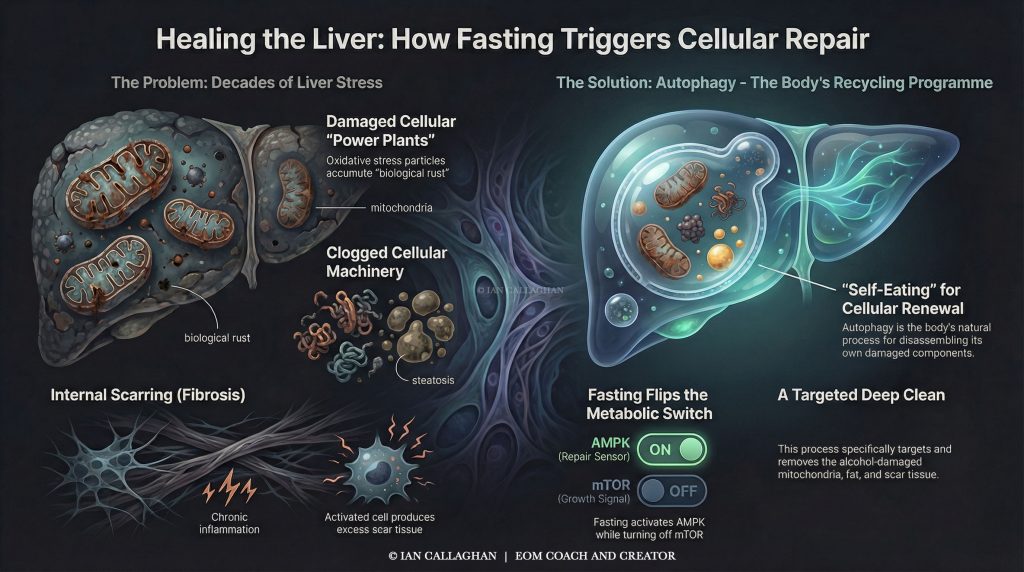
The liver metabolises alcohol primarily through an enzyme called alcohol dehydrogenase (ADH). However, chronic consumption forces the liver to utilise a backup pathway known as the Microsomal Ethanol Oxidising System (MEOS), specifically involving the CYP2E1 enzyme. While this system helps clear alcohol, it generates a massive amount of Reactive Oxygen Species (ROS)—essentially “biological rust.”
For a drinker of 45 years, this oxidative stress targets the mitochondria—the power plants of the cell. Alcohol creates “leaky” mitochondria that cannot burn fuel efficiently. This leads to a build-up of unmetabolised fat within the liver cells (hepatocytes), a condition known as hepatic steatosis. Even after a year of being alcohol-free, these dysfunctional mitochondria may linger, causing fatigue and suboptimal metabolism unless they are recycled.
The Accumulation of Misfolded Proteins
Chronic inflammation causes proteins within the liver cells to fold incorrectly. In a healthy liver, these are cleared away. In an alcohol-burdened liver, the clearing mechanism becomes overwhelmed. These misfolded proteins aggregate, forming clumps that clog cellular function. This is comparable to a house where the rubbish has not been taken out for decades; eventually, the hallways become impassable.
Key Insight for the Keto/Paleo Practitioner:
You are likely aware that standard Western diets high in fructose and seed oils exacerbate this inflammation. By adopting a Paleo or Keto approach, you have stopped adding fuel to the fire. However, the existing debris—the “wreckage” from the 45 years of drinking—requires a garbage disposal crew. That crew is autophagy.
Defining the Mechanism: What is Autophagy?
Autophagy (from the Greek auto, “self”, and phagy, “eating”) is a preserved evolutionary survival mechanism. It is the body’s internal recycling programme. It is not merely “starvation”; it is a highly regulated process where cells disassemble their dysfunctional components to create energy and new building blocks.
The mTOR vs. AMPK See-Saw
To understand autophagy induced by fasting as a mechanism to repair alcohol-damaged cells and liver tissue, you must understand the two master regulators of metabolism:
- mTOR (Mammalian Target of Rapamycin): This is the “growth” signal. It is triggered by insulin, glucose, and specifically, protein intake. When mTOR is high, the body is building tissue and storing energy. Autophagy is turned off.
- AMPK (Adenosine Monophosphate-Activated Protein Kinase): This is the “low energy” sensor. It is triggered when glycogen stores are depleted and ATP (cellular energy) is low. When AMPK is high, the body shifts into repair mode. Autophagy is turned on.
In the context of modern eating habits (three meals a day plus snacks), mTOR is perpetually stimulated, and AMPK is suppressed. The body never gets a chance to clean house.
The Lysosome: The Incinerator
When autophagy is triggered, the cell identifies damaged organelles (like the alcohol-ruined mitochondria mentioned earlier). It wraps them in a double membrane structure called an autophagosome. This structure then fuses with a lysosome, an organelle filled with acidic enzymes. The junk is dissolved, and the raw materials (amino acids and fatty acids) are released back into the cell to build new, healthy structures.
For someone with your history, this is critical: You are not just resting your liver during a 72-hour fast; you are physically digesting the damage caused by decades of alcohol.
Autophagy Induced by Fasting as a Mechanism to Repair Alcohol-Damaged Cells and Liver Tissue
This section addresses the core of your query. How specifically does this process target the liver damage associated with long-term alcohol use? The mechanism works through three distinct pathways, particularly relevant to your physiology.
1. Mitophagy: Replacing the Engines
The most specific form of autophagy relevant to alcohol recovery is mitophagy—the selective degradation of damaged mitochondria.
Alcohol is a mitochondrial poison. It causes mitochondrial DNA damage and swelling. As you practise OMAD and move into extended fasting, the drop in insulin and the rise in glucagon signal the hepatocytes to inspect their mitochondria.
The cell identifies the mitochondria that are leaking ROS (oxidative stress) and tags them for destruction. By digesting these faulty power plants, the liver prevents them from releasing further inflammatory signals. Once the fast is broken (re-feeding), the body uses the recycled amino acids to build brand new, efficient mitochondria. This restores the liver’s ability to burn fat (beta-oxidation), effectively reversing the metabolic stagnation often seen in former drinkers.
2. Lipophagy: Eating the Fatty Liver
Fatty liver is the hallmark of chronic alcohol use. Even after quitting, visceral fat and intra-hepatic fat can remain stubborn. Lipophagy is a specific type of autophagy where the cell targets lipid droplets (fat stores inside the liver cell).
During your monthly 72-hour fasts, once liver glycogen is depleted (usually within 24 hours), the body desperately needs energy. It forces the liver cells to engulf their own stored fat droplets, break them down via lysosomes, and convert them into free fatty acids and ketones.
Connection to Keto: Since you are likely “fat-adapted” due to your Keto/Paleo background, your body initiates lipophagy faster than the average person. You do not suffer the “keto flu” lag; your body immediately begins mining the liver for fat to produce ketones, effectively scrubbing the liver clean of steatosis.
3. Reducing Fibrosis and Stellate Cell Activation
Alcohol damage activates hepatic stellate cells, which produce collagen—scar tissue (fibrosis). While advanced cirrhosis is difficult to reverse, early-to-mid-stage fibrosis has shown reversibility potential through fasting.
Prolonged fasting reduces systemic inflammation (measured by markers like CRP). This reduction in inflammation signals the stellate cells to stop producing scar tissue. Furthermore, autophagy can degrade the excess collagen matrix, slowly softening the liver tissue and restoring pliability and blood flow.
Optimising the Protocol: OMAD, Extended Fasts, and Electrolytes
Given your 40 years of nutritional experience and current regimen, you are positioned perfectly to maximise these mechanisms. However, nuance is required to ensure you are repairing, not stressing, the system.
The Role of Glycogen Depletion (OMAD vs. 72 Hours)
Your daily OMAD practice is excellent maintenance. It provides a daily window (usually 16–20 hours) where insulin drops, allowing for “maintenance cleaning.” This keeps the liver from accumulating new damage.
However, deep autophagy induced by fasting as a mechanism to repair alcohol-damaged cells and liver tissue usually peaks between 48 and 72 hours.
- 0–24 Hours: Glycogen depletion and transition to ketosis.
- 24–48 Hours: Peak upregulation of AMPK; massive increase in Human Growth Hormone (HGH) to protect lean muscle.
- 48–72 Hours: Deep immune system reset and peak autophagy. This is where the heavy lifting occurs regarding scar tissue and deep cellular debris.
Your monthly 72-hour fast is the strategic “deep clean” that complements the daily OMAD “tidy up.”
Hydration and The Electrolyte Balance
You mentioned using homemade sea salt and lemon water. This is a crucial distinction in your protocol.
- Sea Salt: Essential. Fasting creates a natriuretic effect (insulin drops, kidneys dump sodium). Without sodium, you risk hyponatremia, dizziness, and heart palpitations.
- Lemon Water: A point of debate in the strictest fasting circles, but generally accepted. The trace amount of fructose in a squeeze of lemon is negligible and unlikely to spike insulin enough to stop autophagy, while the citrate helps prevent kidney stones and supports liver detoxification pathways.
- Bone Broth: This requires careful timing. Bone broth contains protein (amino acids). As noted earlier, amino acids stimulate mTOR. Technically, consuming bone broth breaks a fast regarding autophagy.
- Recommendation: Use bone broth as a “crutch” only if you feel you might break the fast early due to weakness, OR use it specifically to break the fast gently. For the maximum autophagic effect to repair alcohol damage, water and electrolytes alone are superior during the 24-72 hour window.
The Keto/Paleo Synergy
Your background in Paleo and Keto provides a metabolic advantage. Most people attempting a 72-hour fast spend the first 48 hours suffering from glucose withdrawal. Your liver, already adapted to ketones, shifts into autophagy seamlessly.
Furthermore, a Paleo diet eliminates the inflammatory grains and seed oils that would otherwise burden the liver during the re-feeding window. When you break your fast, the nutrients you consume are used to build the new cells. By providing high-quality proteins and fats (Paleo/Keto), you are rebuilding your liver with “premium materials” rather than cheap, inflammatory fillers.
[END OF PART 1 – CONTINUED IN PART 2]
In Part 2, we will delve into:
- The Re-Feeding Syndrome Risk: How to safely break a 72-hour fast to prevent liver shock.
- Specific Nutrients for Hepatocyte Regeneration: The role of Choline, Glycine, and Sulphur.
- Advanced Autophagy Boosters: How heat (sauna) and specific supplements can amplify the fasting signal.
- Monitoring Progress: Which blood markers (ALT, AST, GGT, Ferritin) to track to verify the repair is working.
How To Optimise Autophagy Induced by Fasting as a Mechanism to Repair Alcohol-Damaged Cells and Liver Tissue
Autophagy induced by fasting as a mechanism to repair alcohol-damaged cells and liver tissue is not merely about the cessation of eating; it is about the strategic reintroduction of nutrients to build a resilient, regenerated liver.
As established in Part 1, the fasting window initiates the demolition of senescent (zombie) cells and organelle recycling. However, the efficacy of this repair process is contingent upon how you exit the fast. If the re-feeding phase is mishandled, you risk halting the benefits or, in severe cases, causing further metabolic stress. This section details the precise protocol for re-feeding, the specific nutrient profiles required for hepatocyte (liver cell) regeneration, and advanced methods to verify that your liver is healing.
1. The Re-Feeding Protocol: Preventing Liver Shock
The most critical moment of a 72-hour fast is the first bite of food. After three days, your digestive system is dormant, and your insulin sensitivity is at its peak. Flooding the system with carbohydrates or heavy meals immediately halts autophagy induced by fasting as a mechanism to repair alcohol-damaged cells and liver tissue and can trigger a massive insulin spike, promoting fat storage in the very liver you are trying to de-fat.
Understanding Re-Feeding Syndrome (RFS) in the Context of Alcohol Recovery
While clinical Re-Feeding Syndrome is rare in healthy individuals fasting for short periods (under 5 days), those with a history of alcohol misuse must be vigilant. Alcohol depletes electrolytes—specifically phosphate, magnesium, and potassium.
During a fast, your body switches to fat metabolism. Upon reintroducing carbohydrates, insulin surges, driving phosphate into cells to produce ATP (energy). If your baseline phosphate is low due to prior alcohol consumption, this shift can lead to dangerously low blood phosphate levels.
To safely exit the fast and sustain liver repair:
- Avoid Carbohydrates Specifically: Do not break a fast with fruit, juices, or starches. These stop autophagy instantly and spike insulin.
- Prioritise Electrolytes: Ensure you have consumed adequate sodium and magnesium within the final 4 hours of the fast.
- The “Wait and See” Method: Eat a small portion (200 calories), wait 30 minutes, and assess digestion before consuming a full meal.
The Ideal Break-Fast Menu
To continue the healing process even as you begin eating, focus on foods that support the liver without demanding heavy enzymatic activity.
- Bone Broth (The Primer): As mentioned at the end of Part 1, bone broth is rich in glycine. Glycine is essential for detoxification but requires little digestion. It gently wakes up the gut lining.
- Fermented Foods (The Gut Support): A small amount of sauerkraut or kimchi provides probiotics. Alcohol damages the gut microbiome, increasing permeability (leaky gut), which allows toxins to flow back to the liver. Fermented foods help seal this barrier.
- Steamed Cruciferous Vegetables: Soft, steamed broccoli or cauliflower. These contain sulforaphane, a compound that upregulates Phase II liver detoxification enzymes.
- Lean Protein: After 60 minutes, introduce white fish or eggs. Red meat should be reserved for day two of re-feeding to reduce digestive load.
2. Essential Nutrients for Hepatocyte Regeneration
Once the fast is safely broken, the goal shifts from “clean up” (autophagy) to “rebuild” (regeneration). The liver is the only organ in the human body capable of full regeneration, provided it has the correct raw materials.
The keyword here is bioavailability. An alcohol-damaged liver may struggle to process complex synthetic vitamins. You must provide nutrients in their most absorbable forms to facilitate autophagy induced by fasting as a mechanism to repair alcohol-damaged cells and liver tissue effectively.
Choline: The Fat Exporter
Alcohol damage often manifests as hepatic steatosis (fatty liver). Alcohol metabolism inhibits the oxidation of fatty acids, causing triglycerides to accumulate in liver cells.
Choline is the antidote to this accumulation. It is the primary component of Phosphatidylcholine, which is required to create VLDL (Very Low-Density Lipoprotein). VLDL acts as a transport vessel, moving fat out of the liver to be used for energy elsewhere. Without adequate choline, the fat released during your fast may simply be re-deposited in the liver.
- Best Sources: Egg yolks (pasture-raised), beef liver, krill oil.
- Supplementation: If using supplements, opt for Phosphatidylcholine or CDP-Choline rather than cheap Choline Bitartrate.
Glycine: The Glutathione Precursor
Glutathione is the body’s “master antioxidant.” It is the primary agent used by the liver to neutralise reactive oxygen species (ROS) generated by alcohol metabolism. Chronic alcohol use depletes glutathione reserves, leaving liver cells vulnerable to oxidative stress.
Glycine is the rate-limiting amino acid for glutathione production. Furthermore, glycine acts as an anti-inflammatory agent specifically for macrophages (immune cells) in the liver, preventing them from attacking healthy tissue.
- Best Sources: Collagen powder, gelatin, bone broth, chicken skin, pork crackling.
- Strategy: Combine glycine-rich foods with Vitamin C to maximise collagen synthesis for repairing the structural architecture of the liver (fibrosis repair).
Sulphur: Fueling Phase II Detoxification
Liver detoxification occurs in two phases. Phase I turns toxins into intermediate metabolites (often more toxic than the original substance). Phase II binds these metabolites to molecules so they can be excreted.
Alcohol recovery relies heavily on Sulphuration, a Phase II pathway. Sulphur-rich compounds are necessary to clear the toxic byproducts released during the deep autophagy of a 72-hour fast.
- Best Sources: Garlic, onions, leeks, eggs, cruciferous vegetables (Brussels sprouts, broccoli).
- Supplement Synergy: MSM (Methylsulfonylmethane) is an organic sulphur supplement that can reduce liver inflammation and support the structural integrity of hepatocytes.
3. Advanced Autophagy Boosters: Amplifying the Signal
While fasting is the primary trigger, specific external stimuli and compounds can act as “autophagy enhancers,” essentially turning up the volume on the cellular repair signal. By integrating these into your fasting protocol, you intensify the autophagy induced by fasting as a mechanism to repair alcohol-damaged cells and liver tissue.
Heat Shock Proteins (HSPs) and Sauna Therapy
Using a sauna during the fasting window (specifically between hours 24 and 48) creates a synergistic effect. Heat stress triggers the production of Heat Shock Proteins (HSPs).
HSPs are molecular chaperones; their job is to repair misfolded proteins. Alcohol damage causes proteins within liver cells to become misfolded and dysfunctional. HSPs can re-fold these proteins or tag them for degradation via autophagy.
- Protocol: 20 minutes in a dry sauna at 80°C+ during the fasted state. Ensure massive hydration with electrolytes to compensate for fluid loss.
Coffee and Polyphenols
Coffee is a unique exception during a fast for liver repair. Epidemiological studies consistently show that coffee consumption is inversely associated with liver cirrhosis and fibrosis.
The mechanism involves polyphenols (specifically chlorogenic acid) and caffeine. These compounds stimulate liver autophagy independent of nutrient deprivation. They inhibit mTOR (the growth pathway that blocks autophagy) specifically in hepatic tissue.
- The Rule: Black coffee only. No milk, cream, or sweeteners, which would break the fast.
Targeted Supplementation
Certain supplements mimic the fasting signal or support the autophagy process:
- NAC (N-Acetyl Cysteine): The direct precursor to glutathione. Taking NAC before the fast helps preload the liver with antioxidants. Taking it during the re-feed supports the flushing of toxins liberated during autophagy.
- Milk Thistle (Silymarin): While often touted as a detoxifier, its true power lies in its ability to stabilise cell membranes, preventing toxins from re-entering regenerated cells.
- TUDCA: A water-soluble bile acid that improves bile flow. Autophagy breaks down toxins, but they must be excreted via bile. If bile flow is sluggish (cholestasis), toxins recirculate. TUDCA ensures the “trash” is actually taken out.
4. Monitoring Progress: The Biochemical Feedback Loop
How do you know if autophagy induced by fasting as a mechanism to repair alcohol-damaged cells and liver tissue is actually working? Subjective feelings of “energy” are unreliable. To track liver repair accurately, you must monitor specific blood markers.
If you are undertaking this protocol to reverse damage, request a hepatic function panel before starting and again 4-6 weeks after implementing a cycling fasting routine.
The Enzyme Leaks: ALT and AST
- Alanine Transaminase (ALT): This enzyme resides inside liver cells. If it is found in high levels in the blood, it means liver cells are bursting and leaking their contents.
- Target: You want ALT to be low (under 25 IU/L is optimal, though lab ranges often go up to 40). A drop in ALT is the surest sign that cell death has stopped.
- Aspartate Transaminase (AST): Similar to ALT but also found in muscles.
- The Ratio: In alcohol-related damage, AST is often double the ALT level (2:1 ratio). As you heal via autophagy, this ratio should normalise to 1:1.
The Alcohol Marker: GGT
- Gamma-Glutamyl Transferase (GGT): This is the most sensitive marker for alcohol damage and bile duct issues. Even when ALT/AST are normal, elevated GGT indicates the liver is under stress.
- Significance: GGT takes longer to normalise. A steady decline in GGT is the gold standard for verifying that the biliary system is recovering.
Inflammation and Synthesis Markers
- Ferritin: Often elevated in liver disease not just due to iron, but because it is an “acute phase reactant” (a marker of general inflammation). Successful autophagy should lower ferritin levels.
- Albumin: Produced exclusively by the liver. Low albumin suggests the liver is too damaged to synthesise proteins. As regeneration occurs, albumin levels should rise to the upper end of the normal range.
- Bilirubin: High levels indicate the liver isn’t processing waste products from red blood cells efficiently.
Conclusion: The Path to Hepatic Renewal
Repairing the liver is not a passive act of waiting; it is an active metabolic intervention. By understanding autophagy induced by fasting as a mechanism to repair alcohol-damaged cells and liver tissue, you move beyond the simplistic advice of “drink less” and into the realm of cellular engineering.
The 72-hour fast provides the stimulus—the “demolition” of the damaged structure. The Keto/Paleo nutritional baseline provides the “clean energy” to function without inflammatory drag. The strategic re-feed provides the “bricks and mortar” (Choline, Glycine, Sulphur) to rebuild the organ.
This protocol requires discipline. It demands that you view food not as entertainment, but as code that instructs your biology. However, the reward is substantial: the restoration of one of the body’s most vital organs, returning it from a state of fatty, scarred dysfunction to a lean, metabolic powerhouse.
Summary Checklist for Implementation:
- Preparation: 3-5 days of Keto/Paleo eating to become fat-adapted.
- The Fast: 24 to 72 hours of water, electrolytes, and black coffee.
- The Boost: Sauna use at 24 and 48 hours; light activity (walking).
- The Break: Bone broth and fermented vegetables followed by lean protein.
- The Build: High choline, high glycine diet for 4 days post-fast.
- The Verification: Blood work (ALT, AST, GGT) every 8-12 weeks to track data.
By adhering to this science-backed framework, you harness the evolutionary power of your body to heal itself, proving that damage does not have to be permanent.
The Brutal Truth About Fasting
Cut through the fasting hype with raw, unfiltered truth. This no-bullshit guide exposes the good, the bad, and the ugly of fasting. Learn what really works, what’s dangerous, and why fasting isn’t for everyone. Perfect for midlifers, health seekers, and anyone tired of wellness industry snake oil.