THE FOUR-DAY LIE: How I Quit Drinking After 45 Years By Realising Sobriety Is a Myth
Introduction: A Pint, a Problem, and a Forty-Five-Year Detour and The Four-Day Lie
I’ve been alcohol-free for a year. That’s 365 days of not being a slave to a liquid. But before that? It was forty-five years with a pint never more than an arm’s length away. Most of those years were spent in uniform, living a life of discipline on the outside and total, sodding chaos on the inside.
Forty-five years. Do you have any idea how much “intelligence” you’re force-fed in that time?
In the army, they teach you how to spot a trap. They teach you to vet your sources, question the motivation of the briefing officer, and check the terrain against the map. But when it comes to the “war on booze,” the intelligence we’re given is a fucking disaster. It’s all the same drivel: quitting is a lifelong, uphill slog. It’s an endless war fought “one day at a time,” where you’re never truly safe, never truly cured, and always just one weak moment away from the gutter.
That narrative is more than just rubbish; it’s a form of institutionalised helplessness. It’s faulty intelligence designed to keep good people—strong, capable people—stuck in a loop of dependency. It’s a carefully constructed psychological trench that you’re told you can never leave.
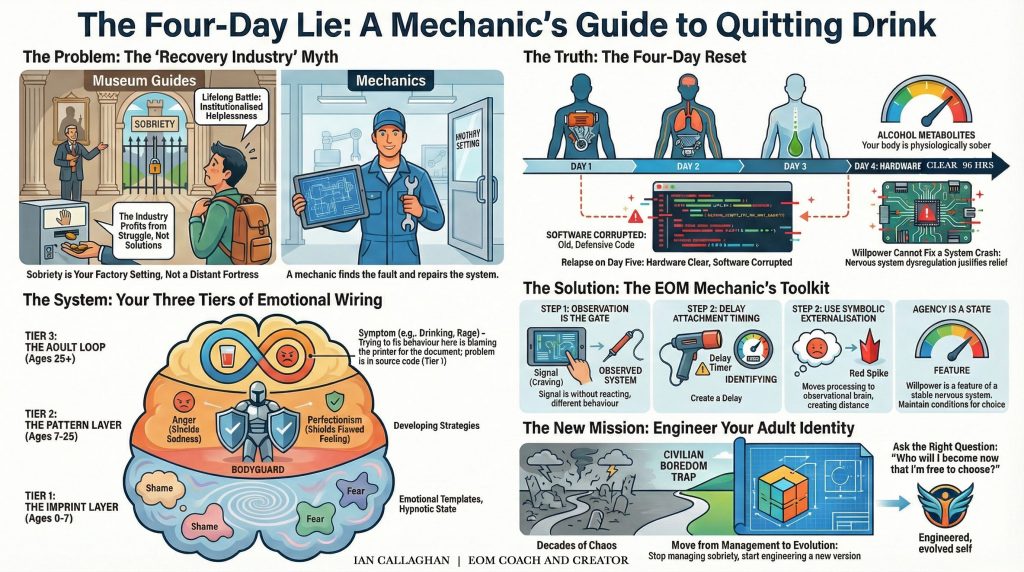
The Mechanic vs. The Museum Guide
I’m not a guru. I’m an old soldier and the creator of the Emotional Observation Method (EOM). I finally looked at the map, realised the terrain was a lie, and decided to walk a different way. This isn’t a gentle reflection. It’s a mechanic’s report on a broken engine.
I’m here to tell you that the people “helping” you are the ones keeping you in the trench because they’re trained as museum guides, not mechanics. The therapeutic world operates like a museum. They train practitioners to be tour guides, walking you endlessly through the dusty hallways of your past. They stop at every exhibit of pain, stare at it, analyse the lighting, and discuss the texture of the suffering. They hope that if you look at your “trauma” long enough, with enough intensity, it will somehow disappear.
But looking isn’t fixing. Understanding the architecture of a prison doesn’t unlock the door.
In the EOM framework, we don’t ask the engine how it feels about being broken. We listen to the noise, locate the friction, and apply the intervention. We want a set of pliers, not another box of tissues. If you’re tired of “processing” and ready to start fixing, you’re in the right place.
1. The Biggest Lie: ‘Sobriety’ Isn’t a Place You Arrive At
For nearly half a century, I viewed sobriety as this gleaming fortress on a distant hill. I thought it was a place I had to conquer, then spend the rest of my miserable life defending with fixed bayonets. I saw it as something I had to earn through the “discipline” of attendance and those pathetic little plastic chips they hand out like campaign medals for a war you’re not allowed to win.
I was chasing a destination that didn’t exist.
The truth is so simple it’s almost insulting: Sobriety isn’t a place you get to. It’s the place you start from.
You were born sober. Sobriety is your factory setting. It is a biological baseline, not a moral achievement. Treating “not drinking” as a heroic achievement is a fundamental category error. It’s like blaming a printer for the ink on the page while ignoring the software that generated the file.
In EOM, we recognise that behaviour is the output of a system state. Behaviour is not the cause. It is the result. If the system state does not change, the behaviour—the drinking—will always revert. You can’t be “more sober” than sober. You’re either on-duty or you’re off-duty.
The industry loves the “counting days” bollocks because it keeps the drink at the centre of your identity. If you’re on Day 4,000, you are still defined by the thing you did 4,000 days ago. That isn’t freedom; it’s a long leash. A truly free man doesn’t count the days he’s been out of prison; he just goes about the business of being free. He moves from a “Sober Identity” (which is just a label) to Sufficient Tone (which is a state of being where choice is actually possible).
2. The Four-Day Truth: Hardware vs. Software
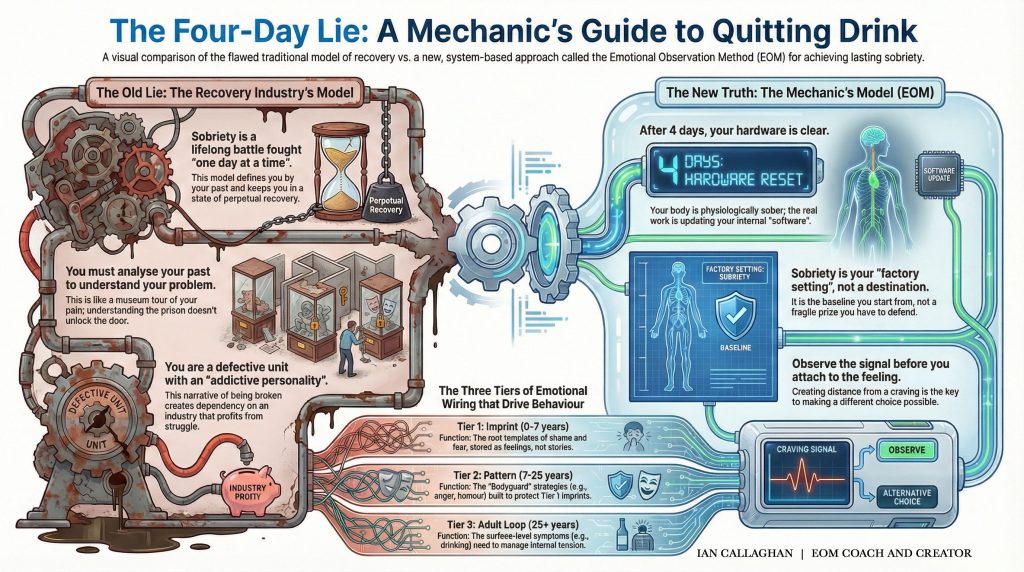
The “Recovery Industry” lives on the confusion between two very different things: Physiological Sobriety and System Restoration.
The Hardware (The Body)
It takes about four days for alcohol and its immediate metabolites to clear your system. In ninety-six hours, your blood is clean. Your liver is finally catching its breath. Your heart rate is starting to drop back into a human range.
That is sobriety. It’s a biological state of non-intoxication.
The Software (The Operating System)
This is where the real war is fought. On Day Five, your hardware is clear, but your Emotional Operating System is still running 1995 software on a 2024 machine.
Most people fail because they try to solve a “State” problem with a “Story.” When the Day Five craving hits, they try to use willpower (Logic) to fight a physiological signal. But logic’s only job in an unstable state is to justify the state. It doesn’t ask, “Is this drink a good idea?”; it asks, “How do I justify this drink so I can get relief from this skin-crawling discomfort?”
The industry sells thirty-day residential “cleanses” and ninety-day retreats because they want you to believe the “demon booze” is lurking in your blood, waiting to strike. It isn’t. The demon isn’t in the bottle; the bug is in the code. And you can’t talk a bug out of a system; you have to patch it.
3. The Architecture of the Imprint: Why You’re Not Broken
To understand why you drink, you have to understand the Three Tiers of Emotional Wiring. You aren’t “broken” or “weak-willed”; you are just running an outdated, defensive operating system that was wired before you were old enough to form a single clear memory.
Tier 1: The Imprint Layer (0-7 years)
This is the foundation. Between birth and age seven, your brain operates primarily in a Theta-dominant state (4-8 Hz). This is the state of deep hypnosis. You had no analytical filter—the “Critical Factor” wasn’t online yet. You couldn’t say, “Mom is yelling because she’s stressed at work.” You just absorbed “Yelling = Threat = I am Bad.”
Because the Hippocampus isn’t mature, you don’t store the story (narrative memory), but you store the feeling (somatic imprint). These are the root templates of Shame, Fear, and Abandonment that drive your adult life. They are pre-verbal, which is why you can’t “talk” your way out of them.
Tier 2: The Pattern Layer (7-25 years)
This is the Bodyguard. As you grew, you developed strategies to protect those raw Tier 1 imprints. Anger became a shield for sadness. Humour became a deflection for shame. Numbness became a bunker against overwhelm. Perfectionism became a way to avoid the feeling of being flawed.
By adulthood, these aren’t just habits; they feel like personality traits. “I’m just a perfectionist,” you say. No, you are a person running a perfectionism strategy to avoid a Tier 1 imprint.
Tier 3: The Adult Loop (25+ years)
This is the Symptom. The drinking. The doomscrolling. The rage outbursts. The chaos. This is usually what the “Museum Guides” try to fix. But treating the behaviour as the problem is like blaming the printer. You cannot change the Loop (Tier 3) if the Imprint (Tier 1) stays the same.
The tension will build until the Bodyguard (Tier 2) demands relief, and the loop returns. This is the “relapse” cycle that the industry tells you is your fault. It isn’t. It’s a mechanical certainty.
4. Observation is the Gate: The EOM Tactical Manual
In EOM, we don’t “sit with the pain, and we don’t “unpack the trauma.” We use a mechanical sequence: Observation is the Gate. Attachment Timing is the Switch.
The Mechanism of Collapse
When you are triggered, a signal fires. If you “attach” to that feeling—the craving, the anxiety, the rage—before you “observe” it, your behaviour becomes automatic. You drink before you even realise you had a choice. Your system collapses from the Adult Self into the reactive child identity.
The Tactical Override
The secret to freedom is delaying that attachment. We use Symbolic Externalisation.
Instead of saying “I am anxious,” we locate the feeling in the body and turn it into a symbol—a “Red Spike,” a “Heavy Grey Slab,” or a “Black Cube.” We then place that symbol outside your body, across the room.
This forces a neurological shift. You move processing from the limbic system (reactive) to the visual cortex (observational). The moment it becomes a shape, it stops being a threat. You stop being the feeling and start seeing it.
An observed system behaves differently from an unobserved one. When you watch the symbol from your Adult Identity, you create a “Prediction Error” in the brain. The old neural loop is disrupted, and the imprint begins to dissolve because it no longer has the fuel of your fusion.
5. Agency is a State, Not a Trait
We’ve been taught that change is a matter of “will.” We’re told that discipline is a character trait, and if you keep failing, it must say something about you. Weak willpower. Addictive personality. Broken wiring.
That story is wrong. Agency is a state of the nervous system, not a virtue. When your system is stable, a choice appears. When it is unstable (dysregulated), behaviour becomes automatic. In a collapsed state, your “Observation Gate” is offline. Your Tone—the system’s capacity to hold a signal without collapsing into reaction—is insufficient.
In that moment, you don’t have willpower; you have a mechanical failure.
Responsibility is no longer about forcing yourself to act differently, regardless of state. It becomes about maintaining the conditions under which choice is available. This is a very different job. It’s not about being “brave” enough to resist a drink; it’s about being smart enough to manage the system so the “Observation Gate” stays open.
You cannot think your way out of a state problem. You have to start at the layer where the collapse begins: the body. This is why we use physiological overrides—like cold exposure or breath work—not because they “build character,” but because they force observation back online. They give the system enough signal clarity to stop collapsing, creating the window where choice becomes possible again.
6. The Civilian Boredom Trap: Reward vs. Command
The biggest threat to a soldier returning to civilian life—or a drinker returning to baseline—is the Short-Circuit of the Reward Signal.
We drink because we’re trying to inject “importance” back into a world that feels flat. In the EOM framework, we see that Craving appears when a reward signal attaches before observation. Dopamine doesn’t mean “enjoyment”; it means “importance.” When importance spikes under low tone, observation collapses, and the reward becomes a command. Many of us are addicted to the “high alert” state. We spent years in high-stakes environments, and now “normal” life feels like a grey fog.
We miss the intensity of the alert, so we create a crisis in a bottle just to feel the relief of the “stand down” order. If you try to live a “quiet, peaceful life” after decades of chaos without updating your identity, you will fail. Your system will interpret the peace as a “Numb State,” and it will scream for a signal—any signal—to feel alive.
You have to find a new mission that matches your capacity for intensity. You move from a mindset of “management” to one of Identity Evolution. You aren’t “staying sober”; you are engineering a new version of yourself that no longer requires a chemical buffer to handle the volume of life.
7. The Recovery Industry is a Business Model
Follow the money. Cui bono? Who benefits from the belief that you are permanently broken?
The recovery industry has zero financial incentive to cure you. There is no recurring revenue in a solved problem, but there is a fortune in the perpetual management of a struggle. They’ve spent decades turning “Sobriety” into a vague, elastic, mystical concept that is always just out of reach.
They sell you dependency with better branding. They tell you that you must always be an addict. That you must always monitor yourself. That you must always be “careful.”
Why? Because free people don’t stay customers.
A man who realises he is a person with an updated Operating System is useless to the industry. They want you sitting in a circle, talking about your wounds for the rest of your life. I want you out in the world, executing your mission.
Vagueness is not a flaw in their system; it is the feature. Clarity ends dependency, and clarity is exactly what the EOM method provides. We aren’t looking for “bliss” or “healing”; we are looking for functional freedom.
Conclusion: Take Your Discharge
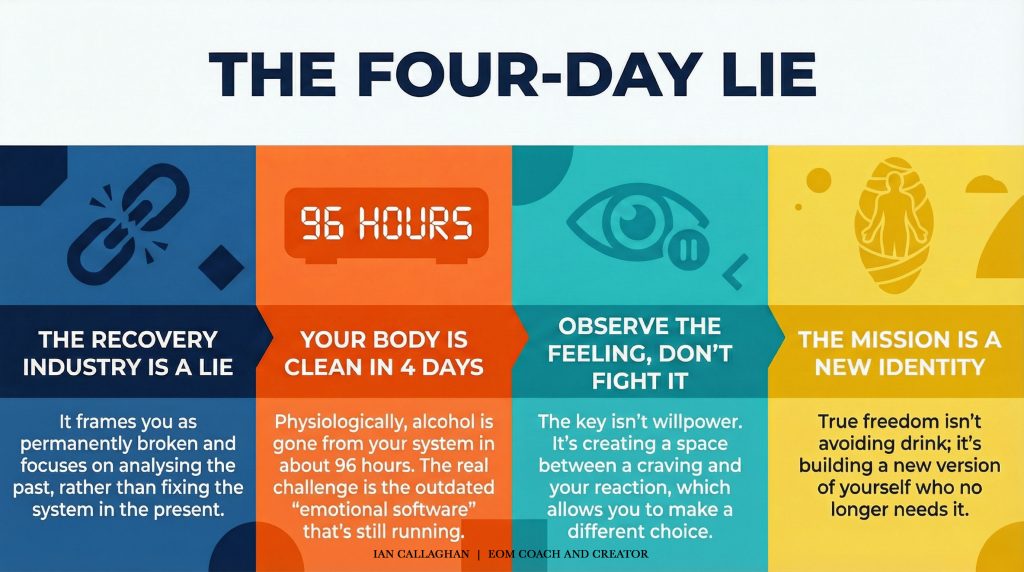
The “Four-Day Lie” is the belief that you are perpetually broken, that you are a “patient” for life, and that “sobriety” is a fragile gift you might lose if you don’t follow the museum guide’s rules.
After forty-five years in the bottle, I’ve learned that freedom isn’t found in counting the days or attending the museum of your past. It’s found in dismantling the person who needed the drink and building an Adult Identity in his place.
Sobriety is just the clean slate. It’s the empty field where you’re going to build your new life. It is not the destination; it is the starting point.
The question isn’t “How will I stay sober forever?” That’s a defensive question asked by someone who is still afraid of the bottle.
The real question is: “Who will I become now that the Gate is open and I’m finally free to choose?”
Now, get to work. Mission starts now.
Mission Brief: About Ian Callaghan
Ian Callaghan is an EOM (Emotional Observation Method) Coach and Creator. An army veteran who spent 45 years in the loop, he now specialises in identity evolution and mechanical system updates for high-performers. He is not the former Liverpool footballer; he is a mechanic for the human operating system.
Stop being a tour guide of your own pain. Become the mechanic.
Want to update your OS and move beyond “forever recovery”?

The Emotional Operating System (EOM) – The Book
A systems-level book explaining why behaviour becomes automatic under pressure, why insight alone fails, and how agency disappears and returns based on internal operating conditions.
Not self-help. Not therapy. No techniques.
Just a clear explanation of how humans actually work when choice collapses.