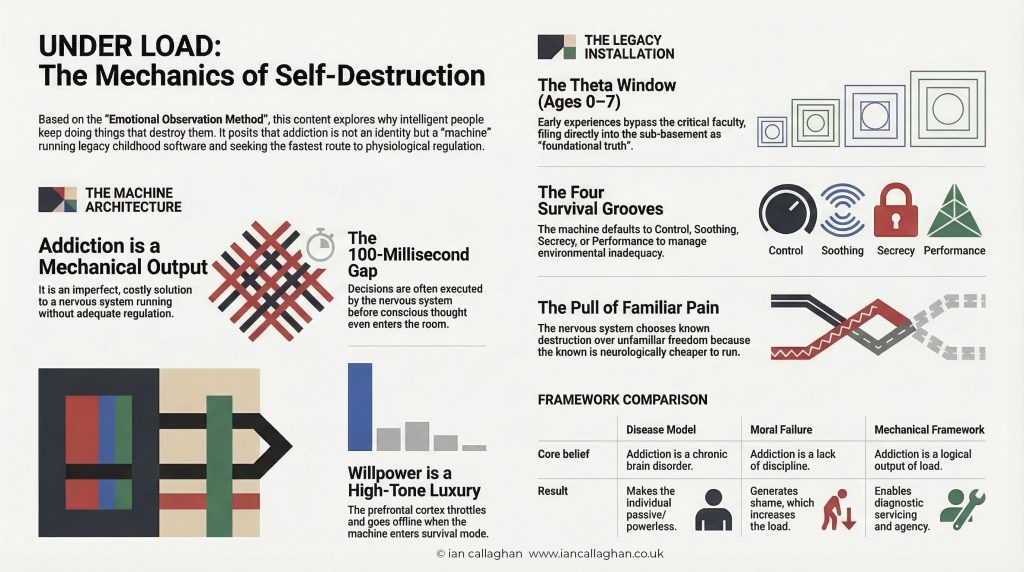
The Gap Between Knowing and Doing
There is a specific, razor-sharp frustration that belongs exclusively to the intelligent person in the grip of a self-destructive habit. It is the frustration of “The Gap.” You are likely precise, analytical, and highly capable in your professional life. Perhaps you design enterprise-level IT architectures, manage complex teams, or solve intricate engineering problems that leave others baffled. You have read the books and sat in the therapy rooms. You can discuss your dopamine receptors, your attachment style, and your childhood wounds with the clinical fluency of a professional.
And yet, despite all this high-level “Intellectual Software,” the “Machine” keeps producing the wrong output.
You find yourself three drinks in on a Tuesday night after vowing you wouldn’t touch a drop. You find yourself scrolling, spending, or using, watching yourself do it as if from a distance, unable to reach the controls. This is the gap between knowing and doing, between insight and behaviour. For decades, the wellness and recovery industries have tried to fill this gap with more “thinking,” more “narrative,” and more “meaning.”
But you cannot think your way out of a state problem.
This article explores the mechanical reality of why your internal hardware is currently failing you. Based on the framework established by Ian Callaghan in his book, Under Load, we are going to stop looking at your character and start looking at your machine. We are going to examine the “Load,” the “Tone,” and the “Legacy Code” that is running your life from the sub-basement of your consciousness. If you have ever felt like a passenger in your own body, watching a sophisticated PR firm justify your own destruction, it is time to pick up the wrench and learn how to service the machine.
Takeaway #1: You Are a Machine Under Load, Not a Broken Soul
To take back the controls, we must first strip the chassis of rusted parts. Most people arrive at the point of change carrying heavy, outdated frameworks of why they struggle. These models—Disease, Moral Failure, and Willpower—are not just partially wrong; they are structurally designed to fail because they misidentify the problem.
Ian Callaghan argues that addiction is not an identity; it is a mechanical response to a system running beyond its “Safe Working Load.” When a machine produces the wrong output, we don’t call it “evil” or “diseased”—we look at the inputs and the hardware conditions.
| The Framework | The Core Assumption | The Mechanical Flaw |
| The Disease Model | Addiction is a chronic brain disorder you are powerless to cure. | Makes you a passive “patient.” It removes agency and ignores the function of the behaviour. |
| The Moral Failure Model | Addiction is a lack of discipline, backbone, or character. | Shame is a “Load.” Adding shame to an overloaded system reduces “Tone” and makes relapse more likely. |
| The Willpower Model | You can “white-knuckle” your way to change through sheer determination. | Willpower is a high-Tone luxury. It’s a prefrontal cortex function that gets throttled when the machine is under Load. |
| The Mechanical Framework | The behaviour is a logical output for a system running legacy code under heavy load. | Focuses on servicing the hardware, managing the load, and updating software to change the output. |
In this framework, the goal is not “sobriety” as a static label. The goal is Sovereignty. You are not powerless over your nervous system; you are simply under load. Powerlessness and Load are two completely different conditions requiring two completely different solutions. You don’t need a sermon; you need a service.
“Sovereignty is not the absence of pain. It is the ability to carry pain without letting it drive.”
Takeaway #2: The 100-Millisecond Hijack
To understand why you cannot “decide” your way out of a craving, you have to understand the timing of the brain’s hardware. In 1996, neuroscientist Benjamin Libet discovered that the brain produces a “readiness potential”—a signal to move—approximately 550 milliseconds before an action occurs. However, the person only becomes consciously aware of their intention to move about 200 milliseconds before they act.
This means the machine has already initiated the action 350 milliseconds before you “decided” to do it. This leaves a tiny, critical window of roughly 100 milliseconds where sovereignty either lives or dies. We call this site of tactical intervention “The Gate.”
In a high-Tone state—when you are rested, regulated, and the “Safe Working Load” is respected—The Gate is wide. You can observe the signal and choose not to attach to it. But when the machine is “Under Load,” the system narrows. This is where the OODA Loop (Observe, Orient, Decide, Act) breaks down.
- Observe: You feel the stress or the trigger.
- Orient: Under load, your system stops using current data and starts using “Legacy Data.” A work email isn’t just a task; it becomes a threat to your survival.
- Decide/Act: The gap collapses. The prefrontal cortex is throttled by the surge, and the circuit breaker trips. By the time you are “deciding” to reach for the substance, the machine has already ratified the decision.
White-knuckling is a strategy that only works when the bridge isn’t at capacity. In the “sub-basement” of a low-Tone state, your conscious mind is essentially a passenger watching the machine execute a pre-programmed survival strategy. The behaviour isn’t a choice; it’s an execution.
Takeaway #3: The Intelligence Premium (Why Smart People are Better at Self-Destruction)
There is a particular suffering reserved for the intelligent. You might assume that being smart would protect you—that if you understood the dopamine mechanism or your childhood trauma clearly enough, you would stop. In reality, intelligence often makes the problem harder to solve. This is the Intelligence Premium.
A sophisticated brain simply runs a more sophisticated PR Firm. When the machine enters an unstable state, the prefrontal cortex—the part of the brain responsible for insight—is throttled. However, your intelligence doesn’t vanish; it’s recruited by the machine to justify its destructive output.
- The Articulate Defender: Highly intelligent people can build cases for their own destruction that would stand up in court. They use genuine knowledge of psychology and neuroscience to explain why this specific drink is justified, or why this particular exception is actually a logical choice.
- Insight as a Trap: You can produce extraordinary insight in a therapy session on Tuesday and be back in the same destructive pattern by Thursday. This is because the insight was produced in a high-Tone state, but it cannot be retrieved when the machine crosses the threshold into instability.
As the “Mechanic” of your own life, you must realise that insight does not change state. Only state changes state. Every insight you produce in a low-Tone state is ammunition for the PR Firm, not a tool for the Mechanic. Stop using your intelligence to explain your behaviour after the fact, and start using it to read the conditions of the machine in advance.
Takeaway #4: The Theta Window and the Sub-Basement Code
The “Software” your machine is running wasn’t written by you. It was installed between birth and age seven, during the Theta Window. During these years, a child’s brain operates in the Theta frequency (4 to 8 cycles per second), a state associated with deep hypnosis and maximum suggestibility.
A child has no Firewall—no critical faculty to evaluate whether the information coming in is true. Everything the environment provides goes directly into the “Sub-Basement” and is filed as foundational truth. This is your 1987 Operating System, corrupted and full of legacy code that made sense for the conditions it was written in but serves no current function.
The Installation happens through Frequency. It is not just about “incidents”; it is the background vibration of the home—the hum of unspoken conflict or the chronic tension of financial precariousness. This is transmitted via Mirror Neurons, which internally replicate the emotional state of the caregiver. A parent’s unmanaged load becomes the child’s baseline.
- Beliefs about Worth: Using Egocentric Processing, a child assumes they are the cause of everything. If a parent was erratic, the child doesn’t conclude “my parent has a problem.” They conclude “I am the problem.”
- Beliefs about Safety: If the environment was volatile, the nervous system calibrates to high vigilance. For this adult, “Calm” will feel threatening because it is unfamiliar.
- Beliefs about Need: If a child’s needs were met with irritation, they install the code: “Need is not safe.” This produces the high-functioning adult who can do everything for everyone but cannot ask for help.
Takeaway #5: The Sunday Roast Syndrome (Early Competence vs. Early Abandonment)
Ian Callaghan shares a pivotal story of being thirteen years old and cooking a full Sunday roast alone because his parents were at the pub. He knew how to cook because of his Nan; her kitchen was a place of collaboration and warmth. But the Sunday roast at thirteen was different. It was the gap between “knowing how” and “being alone with the knowing.”
This is the Performance of Self-Sufficiency. Early competence is almost always a response to early abandonment (physical or emotional). The child learns to fill the gap the adults left open.
- Competence as Currency: When being loved isn’t reliably available, being useful becomes the currency for survival.
- The High-Functioning Trap: Others see you as formidably capable. They don’t see that you are running on reserve capacity. Because the code says “Need is not safe,” you never replenish your resources.
- The Midnight Collapse: High-functioning is not a sign of health; it is a concealment mechanism. You perform all day, carrying loads that aren’t yours, and then you “collapse” into a substance. This isn’t a character flaw; it’s the only way the machine can find “Rest” without having to be “Vulnerable.”
Takeaway #6: The Substance is Just a Regulation Strategy
We spend too much time talking about what people are addicted to—alcohol, cocaine, work. But to the machine, the specific substance is largely irrelevant. The substance is a Regulation Strategy. The machine has one requirement: maintain a tolerable state. When the internal load exceeds the machine’s capacity, it scans for the fastest route to temporary stability.
- Alcohol & Food: Rapid central nervous system depressants that settle an agitated system.
- Cocaine & Gambling: Dopamine surges to override a sense of depletion.
- Socially Acceptable Addictions: Work, extreme exercise, and screens are “Dissociative Strategies.” These are the most dangerous because the culture rewards them. They permit you to stop examining the load because you are still producing “acceptable” outputs.
- Addiction Swapping: This is proof the substance isn’t the problem. If you remove alcohol but don’t address the “Load,” the machine will simply reroute. You quit cocaine and become a workaholic. The label on the door changes, but the architecture remains.
Takeaway #7: Why We Choose “Familiar Pain” Over “Unfamiliar Freedom”
One of the most baffling aspects of self-destruction is why we return to things that hurt us. The answer lies in the brain’s prioritisation of Prediction over Well-being.
The nervous system is wired for the familiar. Stored patterns are “metabolically cheap” to run. The brain rewards pattern matching because the “Known” is, by definition, survivable—you have proof because you are still here.
- The Comfort of the Wound: If you grew up in chaos, your nervous system calibrated to that frequency. As an adult, “Stability” feels suspicious. You might generate drama just to get back to a “Frequency” your machine recognises.
- The Novelty Threat: Unfamiliar comfort contains no guarantee of survival. When things start going well, the brain interprets the stillness as an intolerable load or a “threat” because it has no template for it.
“Familiar pain is survivable. The nervous system has proof. Unfamiliar comfort contains no such guarantee.”
Recovery feels “wrong” not because it is bad, but because it is new. It is a calibration problem, not a motivation problem.
Conclusion: Picking Up the Wrench
If you have spent years trying to “think” your way out of your patterns, it is time for a different approach. You are not a patient in need of a cure, and you are not a sinner in need of redemption. You are a Mechanic who has been handed a machine with corrupted legacy code, running under a load it was never designed to carry alone.
The work of change doesn’t happen in the “Why.” It happens in the State. When an episode occurs, the Mechanic does not hold a Tribunal to deliver a verdict of shame; they conduct a Military Debrief. We don’t ask “Why am I so weak?” We ask, “What was the load? What was the Tone reading? Where did the trigger connect to the Installation? At what point did The Gate close?”
The Mechanic’s work involves:
- Servicing the Hardware: Raising “Tone” through sleep, nutrition, and load management so The Gate stays open.
- Reading the Data: Treating every relapse as diagnostic data about the current load.
- Updating the Code: Using the repetition of new, managed experiences to recalibrate your nervous system to a new frequency.
At the back of Under Load by Ian Callaghan, you will find a 30-Day Field Manual: Reset the Machine. This is the technical manual for the work ahead. It doesn’t ask you to surrender; it asks you to look at the gauges, check the wiring, and start making the practical adjustments that allow the machine to run. You have spent long enough as a passenger in a vehicle steering itself toward a cliff. It is time to move into the driver’s seat.
Final Thought: If you stopped trying to think your way out of a state problem and started servicing the machine instead, what is the first load you would choose to set down?
Emotional Mastery: The Emotional Operating System
The Emotional Mastery book is a practical manual for understanding and regulating the human nervous system using the Emotional Operating System framework.
Instead of analysing emotions or retelling your past, the Emotional Mastery book teaches you how to read emotional states as system feedback, identify overload, and restore stability under pressure.
No labels. No therapy-speak. No endless healing loops.
Just a clear, operational approach to emotional regulation that actually holds when life applies load.
Instant digital download.