The Chef’s Prescription: 40 Years of Nutrition Wisdom on the Gut-Brain Axis & Mental Clarity
By Ian Callaghan
Professional Chef (City & Guilds) & Nutritionist(not the Liverpool footballer)
In my four-decade career, spanning the high-pressure heat of professional kitchens and the meticulous world of clinical nutrition, I have watched health trends rise and fall like a poorly made soufflé. But the most profound shift in my 40-year journey hasn’t been a flashy new cooking technique or a “miracle” supplement—it is the revolutionary understanding of the gut-brain axis.
As a chef, I have always instinctively known that food influences mood; a well-crafted meal can soothe the soul. As a Paleo-certified nutritionist, I now understand the complex biological “recipe” behind why this happens. Your gut is quite literally your “second brain,” housing a nervous system so sophisticated it operates independently of the one in your skull. After 40 years of studying how nutrients interact with human physiology, I’ve identified six critical ways your digestive health dictates your cognitive destiny and emotional resilience.
1. Where is Serotonin Made? Why 90% of Your Happy Chemical Starts in the Gut
In a professional kitchen, we live by the rule of “mise en place”—everything in its place. If your prep isn’t right, the service fails. Your body follows the same protocol. While many think happiness is “all in your head,” the reality is that approximately 90% of your serotonin (your primary mood-regulating chemical) is manufactured in your gut.
Through my nutrition studies, I’ve analysed how enterochromaffin cells in the gut lining act as a biological chemical factory. These cells depend on specific “raw ingredients.” When we consume high-quality, bioavailable proteins—the cornerstone of a Paleo approach—our gut bacteria convert the amino acid tryptophan into serotonin.
The Consequence: If your gut microbiome is dysbiotic (imbalanced), it’s like having a broken stove in the middle of a dinner rush. No amount of “positive thinking” can override a fundamental chemical deficit caused by a compromised gut. To support this, I recommend focusing on “clean” proteins like pasture-raised eggs, wild-caught fish, and grass-fed meats, which provide the acid profile necessary for this vital production.
2. Leaky Gut: The “Broken Sieve” and the Paleo Defence
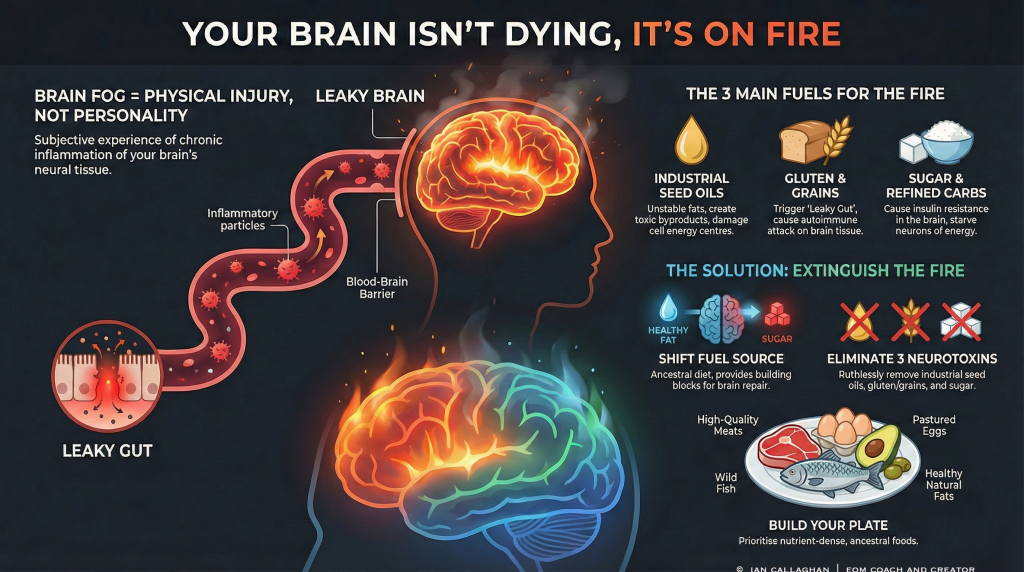
My training in Paleo nutrition emphasises the absolute necessity of maintaining a “tight” intestinal barrier. In the professional kitchen, we use fine-mesh strainers to ensure only the purest liquids pass through. Think of your intestinal lining as that mesh. When it becomes damaged—a condition known as Altered Intestinal Permeability, or “Leaky Gut”—it’s like a sieve with holes far too large.
When this barrier fails, a potent bacterial endotoxin called Lipopolysaccharide (LPS) escapes the digestive tract and enters the bloodstream. In my 40 years of experience, I’ve come to view LPS as the “silent killer” of mental clarity. Once in the blood, it triggers systemic inflammation that can eventually breach the blood-brain barrier (BBB). This leads to neuroinflammation, a state where the brain is essentially “on fire.” By reducing dietary triggers like gluten and lectins, we lower the production of zonulin, the protein responsible for opening those cellular gaps, thereby sealing the barrier and cooling the neuroinflammatory fire.
3. The Communication Line: The Vagus Nerve as the “Kitchen Telephone”
One dimension often overlooked is the physical connection between the two brains: the Vagus Nerve. Think of the Vagus nerve as the telephone line between the Head Chef (the brain) and the Line Cooks (the gut).
In my experience, when the gut is inflamed, it sends “emergency” signals up the Vagus nerve, hijacking the brain’s focus. This is why digestive distress is almost always accompanied by a sense of “impending doom” or heightened anxiety. By consuming fermented foods and healthy fats, we “grease the wheels” of this communication, ensuring that the signals sent to your brain are those of safety and satiety, rather than alarm and distress.
4. Neurodegeneration: When the Gut Drives Chronic Brain Fog
I have spent a lifetime observing how dietary choices compound over decades. The “metabolic exhaust” of a poor diet doesn’t just cause weight gain; it leads to the loss of connections between brain cells.
When gut-derived toxins like LPS enter the brain, they activate microglia—the brain’s resident immune cells. In a healthy state, these cells are like a cleaning crew. However, when over-activated by gut inflammation, they become “rogue,” releasing a flood of pro-inflammatory cytokines (TNF-α and IL-1β) that damage neurons.
- Alzheimer’s & Parkinson’s: We now see clear links between chronic gut imbalances and the accumulation of amyloid-β plaques and the loss of dopaminergic neurons.
- The “Brain Fog” Reality: What many of my clients describe as “just getting older” is often actually active neuroinflammation. It is the biological equivalent of smoke in the kitchen—you can’t see the menu clearly until you clear the air and put out the fire in the gut.
5. Flavour Without the Flare: The Professional Truth About Low-FODMAP
As a City & Guilds-trained chef, I believe that if food isn’t delicious, it isn’t medicine—because no one will eat it. This is the biggest hurdle with the Low-FODMAP diet. Many find it bland and clinical.
While the research from institutions like King’s College London is undeniable—reducing fermentable carbohydrates can drastically lower anxiety and IBS-driven brain fog—I always issue a professional warning: This is a short-term protocol, not a permanent lifestyle. * The Chef’s Tip: To make Low-FODMAP food palatable, I teach clients to use “infused oils” (like garlic-infused olive oil, where the solids are strained out) and fresh herbs like chives and cilantro. This provides the flavour profile of aromatics without the fermentable fibres that cause the “flare.”
- The Risk: Following this diet indefinitely can starve your “good” bacteria, leading to a loss of microbiome diversity—the very thing we are trying to fix.
6. The Chef’s “Culinary Medicine” Brain-Preserve Protocol
After 40 years, I’ve perfected the balance of fats and fibres that keep the brain sharp. Drawing from the SMILES and PREDIMED trials, I advocate for a “Culinary Medicine” approach that focuses on nutrient density and bioavailability.
| The Chef’s “Brain Food” List | The Nutritional Logic | What We Leave Out |
| Wild Fatty Fish | High in DHA/EPA for brain cell fluidity. | The Chef’s “Brain Food” List |
| Deep Berries & Leafy Greens | Added Sugars which “caramelise” (glycate) your proteins. | Processed Carbs (White breads/pastas) that spike insulin. |
| EVOO (Cold-Pressed) | Contains oleocanthal, a natural anti-inflammatory. | Polyphenols that act as “antioxidants” for neurons. |
| Bone Broth (Paleo) | Grain-fed Industrial Meats are high in pro-inflammatory Omega-6. | Grain-fed Industrial Meats high in pro-inflammatory Omega-6. |
Chef’s Bioavailability Secret: I always pair turmeric with black pepper and a healthy fat. The piperine in pepper increases the absorption of the anti-inflammatory curcumin by up to 2,000%.
7. A Professional Caution: The Risks of Extreme “Healing” Diets
In my career, I’ve analysed every protocol from keto to carnivore, including the GAPS (Gut and Psychology Syndrome) diet. While I respect the premise of “healing and sealing” the gut to treat cognitive conditions, my 40 years of experience lead me to a vital caution.
Extreme restriction, if managed poorly, is a recipe for malnutrition. When you eliminate entire food groups, you risk deficiencies in Calcium, Iron, and B vitamins—all of which are required for brain function. My professional advice? Don’t go it alone. A “gut-healing” protocol should be diverse and nutrient-rich, not a period of starvation.
Conclusion: What Message is Your Kitchen Sending?
The most important lesson I’ve learned in 40 years is this: Your gut is a mirror of your mind. Your digestive system is the gateway through which the outside world enters your internal biology.
As a chef and nutritionist, my mission is to help you realise that you are the “Executive Chef” of your own health. Every meal is an opportunity to send a message of healing, clarity, and peace to your brain—or a message of inflammation and fog. The choice starts at the cutting board. What message will you send with your next meal?