Why Is The H.A.L.T. Method Failing You?
The H.A.L.T. Method: Decoding cravings (Hungry, Angry, Lonely, Tired) is not a nursery rhyme for addicts; it is a diagnostic checklist for a failing operating system, and you are using it wrong.
Most people treat recovery like a museum tour. They walk around their trauma, look at the exhibits, read the plaques, and wonder why they still feel wretched. In the Emotional Observation Method (EOM), we close the museum and open the workshop. We do not care about the story of why you are broken. We care about the mechanics of the stoppage.
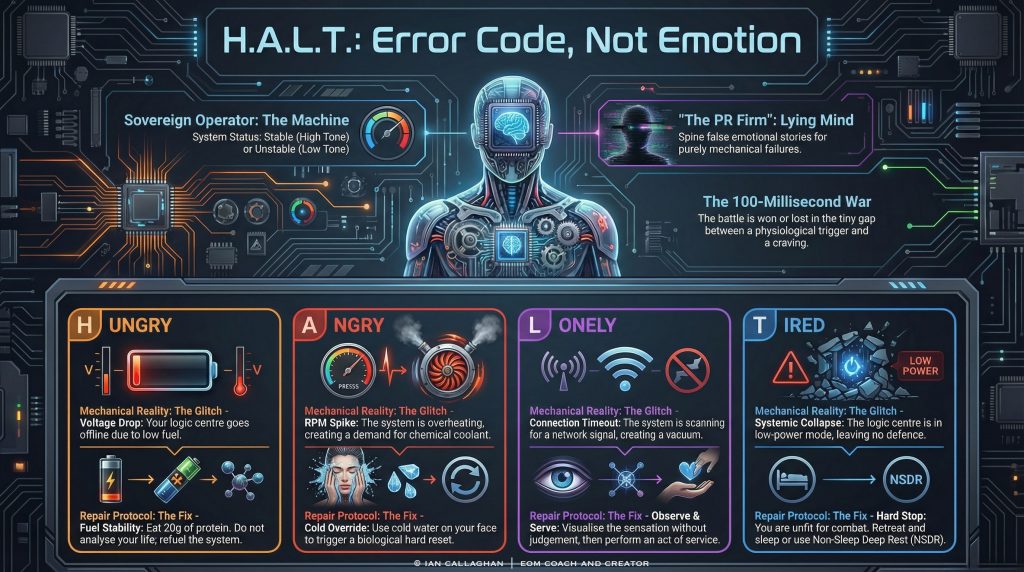
The human machine runs on a binary state system: Stable (High Tone) or Unstable (Low Tone). When you are High Tone, you are the Sovereign Operator—logic works, choices are clear, and you command the vessel. When you drop into Low Tone, the Operator goes offline, and the automated defence systems—your “Legacy Software”—take over.
This leads us to the critical error most people make with The H.A.L.T. Method: Decoding cravings (Hungry, Angry, Lonely, Tired). They try to apply logic to a machine that has already overheated. You cannot reason with a blown gasket. You must repair the mechanism.
This guide is Part 1 of a technical manual for your nervous system. We are going to strip down the chassis and look at the first two major error codes: Hunger and Anger. We will examine them not as feelings, but as physiological failure modes that the PR Firm—your lying logical mind—uses to sell you a drink, a drug, or a disaster.
Stop listening to the static. Let’s get to work.
The Mechanics of The Glitch: Why Willpower Fails
Before we disassemble the specific components of The H.A.L.T. Method: Decoding cravings (Hungry, Angry, Lonely, Tired), you must understand the environment in which these errors occur.
You believe you crave a substance or a behaviour because you are weak. That is incorrect. You crave because your system is seeking a regulation patch. Your nervous system is designed for homeostasis—balance. When that balance is threatened by a drop in resources (Hunger/Tiredness) or a spike in load (Anger/Loneliness), the system screams for a quick fix.
The PR Firm and The Narrative Fallacy
In my 25 years as a Technical Architect, I never saw a server crash because it had a “bad childhood.” It crashed because of load issues, power failures, or bad code. You are no different.
However, the human mind has a component I call The PR Firm. This is the narrative engine in your brain. When your biological Tone drops—when the signal-to-noise ratio becomes overwhelming—the PR Firm steps in to explain the discomfort.
It does not say, “System Alert: Blood glucose is critical; cortisol is spiking.”
It says, “You’ve had a hard day. You deserve a pint. Just one won’t hurt.”
This is the Narrative Fallacy. The PR Firm takes a mechanical sensation (a tightened chest, a pit in the stomach) and wraps a story around it. If you engage with the story, you lose. You are fighting a phantom. You must ignore the PR Firm and look at the instrument panel.
The 100-Millisecond War
Between the trigger (the physiological drop) and the reaction (the craving), there is a gap. I call this The 100-Millisecond War. This is where the battle for sovereignty is won or lost.
If you are operating in Low Tone—exhausted, starving, furious—you cannot fight this war. The Legacy Software (your childhood survival patterns) will bridge that gap instantly. You will react before you realise you have made a choice.
The H.A.L.T. method is not about stopping the feeling. It is about recognising the input signal before it becomes an output command. It is about standing at The Gate of your perception and checking the credentials of every sensation that tries to enter.
If the sensation is Hunger, we do not feed it whiskey. If the sensation is Anger, we do not sedate it with sugar. We identify the error code, and we apply the correct patch.
H is for HUNGER: The Voltage Drop
When we discuss The H.A.L.T. Method: Decoding cravings (Hungry, Angry, Lonely, Tired), Hunger is often dismissed as the simplest variable. “Eat a sandwich,” they say. It is not that simple.
In the EOM framework, Hunger is a massive destabiliser of the operating system. The brain consumes roughly 20% of the body’s metabolic energy. The Prefrontal Cortex—the seat of the Sovereign Operator, where logic, willpower, and inhibition live—is the most energy-expensive component of that system.
The Metabolic Crash
When your blood glucose levels drop, the body enters an energy-preservation mode. The first thing the brain does to save power is throttle down the “expensive” software. The Prefrontal Cortex dims. Logic goes offline.
Simultaneously, the amygdala (the threat detection centre) remains fully powered because survival is non-negotiable.
This creates a dangerous state: High Threat Reactivity + Low Impulse Control.
You are not just “peckish.” You are chemically compromised. The Sovereign Operator has left the building, and the Toddler is now driving the bus. The Toddler does not care about your five-year plan or your marriage; the Toddler wants dopamine, and it wants it now.
The Craving Masquerade
The PR Firm is cunning. It knows that alcohol involves sugar. It knows that carbohydrates provide a quick dopamine hit. When the system flashes the “Low Fuel” warning light, the PR Firm spins the data.
You feel a hollowness in your gut.
PR Firm translation: “I am empty. I need a drink to feel whole.”
Mechanical reality: “Gastric acids are accumulating. Glucose is low. Cortisol is rising to release stored energy.”
If you treat this as an emotional void, you will try to fill it with a substance. If you treat it as a mechanical failure, you realise you simply need protein and complex carbohydrates to reboot the Sovereign Operator.
The Repair Protocol: Fuel Stability
Do not wait until the red light flashes. In the army, we cleaned our rifles before they were dirty and ate before we were starving. Preventive maintenance is the only way to ensure reliability.
- The Stabilisation Check: If you feel a sudden onset of “depression” or “irritability” between 11:00 AM and 4:00 PM, assume it is a fuel error. Do not analyse your life choices. Eat 20 grams of protein. Wait 20 minutes. If the existential dread vanishes, it wasn’t spiritual; it was hypoglycaemic.
- The Visual Override: If the craving is intense, use The Backdoor. Close your eyes. Locate the sensation of hunger. Give it a shape and a colour. Is it a red spike? A grey fog? Watch it. Do not be it. By processing the sensation through the visual cortex, you disengage the amygdala. You are now the observer, not the victim.
A is for ANGER: The Valuation Acceleration
The second component of The H.A.L.T. Method: Decoding cravings (Hungry, Angry, Lonely, Tired) is Anger. In the mechanics of the mind, Anger is not an emotion; it is a vector. It is Energy x Speed.
Anger is the system’s response to a boundary violation or an obstructed goal. It is the fight response. The adrenal glands dump adrenaline and cortisol into the bloodstream. The heart rate spikes. The muscles tense. The machine is priming for kinetic action.
The Prediction Glitch
Why does this lead to cravings? Because Anger burns hot. It is high RPM. No engine can run at the red line indefinitely without blowing a gasket.
The human nervous system is predictive. It runs simulations of the future based on past data. This is The Prediction Glitch. When you are angry, your brain is predicting a fight. It simulates the conflict, the shouting, the violence. Your body reacts to the simulation as if it were reality.
The load on the system becomes unbearable. The pressure builds behind the eyes, in the jaw, in the chest.
The Sedation Demand
The system detects this dangerous over-revving. It knows it cannot sustain this RPM. It needs a coolant. It needs a brake.
For the addict, the substance is the brake. Alcohol, opiates, and benzodiazepines are central nervous system depressants. They force the RPM down.
The PR Firm steps in: “I am furious. I need to calm down. I deserve to relax.”
Mechanical Reality: “System is overheating. Vagal brake is failing. Seeking external chemical dampener.”
The craving here is not for the “fun” of the drug; it is a desperate attempt by the body to prevent metabolic burnout. It is a safety valve opening.
The OODA Loop Failure
In military strategy, we use the OODA Loop: Observe, Orient, Decide, Act.
Anger short-circuits this loop. It skips “Observe” and “Orient” and jumps straight to “Act.” This is a timing failure. You are moving faster than your ability to process data.
When you are angry, you are in a state of “Valuation Acceleration.” You are judging things too quickly. You decide that the person who cut you off in traffic is an enemy combatant, rather than just an idiot. You decide the day is ruined, rather than just difficult.
The Repair Protocol: The Cold Override
You cannot think your way out of anger. Logic is too slow. You need a hardware reset to engage the parasympathetic nervous system (the brake).
- The Cold Override: If you are red-lining, find cold water. Splash it on your face, or hold an ice cube. This triggers the Mammalian Dive Reflex. It physically forces the heart rate to drop. It is a biological hard-reset button. It creates a gap in the static.
- Path 3: The Adult Override: Anger often presents as a rigid, hostile symbol in the mind—metal bars, fire, spikes. Visualise this symbol. Do not try to soften it. Instead, acknowledge its power. Say to it: “I see you. You are a protection mechanism. I am the Sovereign Operator. Stand down. I have the con.”
Command the machine. Do not negotiate with it.
The Interim Assessment
We have inspected the first two failure modes. Hunger is a voltage drop that kills the logic centre. Anger is an RPM spike that demands a chemical brake.
In both cases, The H.A.L.T. Method: Decoding cravings (Hungry, Angry, Lonely, Tired) is useless if you treat these states as “feelings” to be soothed. They are mechanical stoppages that must be cleared.
If you are hungry, you do not need a hug; you need fuel.
If you are angry, you do not need a drink; you need a system reset.
We are not done. The machine is complex, and the next two error codes—Lonely and Tired—are where the ghosts in the machine truly hide. Loneliness is a connection timeout that creates a vacuum, and Tiredness is the systemic collapse that leaves the back door wide open for the enemy.
Check your gauges. Calibrate your tone. We move to the next section in Part 2.
March on.
Is H.A.L.T. Failing Your Recovery Protocol?
You are running the wrong diagnostics if you think The H.A.L.T. Method: Decoding cravings (Hungry, Angry, Lonely, Tired) is about your feelings; it is about your hardware.
Most people treat recovery like a sentimental journey. They sit in the museum of their past, staring at the exhibits of their trauma, wondering why the roof is still leaking. In the Emotional Observation Method (EOM), we do not care about the museum. We care about the workshop. We care about the engine block.
If you read Part 1, you know that Hunger and Anger are high-velocity failure modes. They are active glitches—voltage drops and RPM spikes. But now we enter the silent killers. Loneliness and Tiredness are passive failures. They are the rust on the chassis and the slow leak in the hydraulic line. They do not explode; they erode. And because they are quiet, the PR Firm in your head—that liar that spins narratives to justify a relapse—has ample time to construct a convincing case for self-destruction.
Let us strip the paint and look at the metal.
III. LONELY: The Connection Timeout
In standard therapy, loneliness is treated as a sorrow to be comforted. In the Era of the Mechanic, we identify it as a “Connection Timeout.”
Humans are networked machines. We operate on a TCP/IP protocol of social validation and feedback loops. When that connection is severed, the system creates a vacuum. Physics dictates that nature abhors a vacuum. If you do not fill that space with Sovereign intent, the PR Firm will fill it with Legacy Software (your childish patterns) or, worse, a craving for a chemical bridge.
The Mechanic’s Diagnostic
When the system flags “Lonely,” it is not saying, “I am unloved.” That is the narrative.
The system is saying: “External feedback loops are offline. Internal stability is required to maintain pressure.”
The error occurs when the machine tries to force a connection using a dirty signal. You feel the vacuum, and the PR Firm suggests a drink, a text to an ex-partner, or a gamble. It promises that these inputs will bridge the gap. They will not. They are malware.
The Binary State of Isolation
You must understand the difference between Solitude and Loneliness.
- Solitude occurs in High Tone. The Sovereign Operator is present. The machine is running smoothly, independent of the network. This is functional.
- Loneliness occurs in Low Tone. The Operator has abandoned the bridge. The machine is scanning desperately for a signal—any signal—to validate its existence.
Troubleshooting Code: L
When The H.A.L.T. Method: Decoding cravings (Hungry, Angry, Lonely, Tired) flashes the “Lonely” warning, you do not go looking for a party. You look for the leak in your own hull.
1. Locate the Sensation (The Scan)
Where is the loneliness sitting? Usually, this manifests in the chest or the gut. It feels like a hollow space, a grey fog, or a heavy stone.
Do not ask “Why am I lonely?” That engages the Story, which engages the PR Firm.
Ask: “Where is the sensation? What is its shape? What is its colour?”
2. Path 2: Transformation
Loneliness is often a fluid or misty symbol.
- Close your eyes.
- Visualise the shape (e.g., a grey cloud in the chest).
- Watch it. Do not judge it.
- Observe the edges. Is it moving? Is it shrinking?
- Often, simply observing the vacuum without trying to fill it causes the PR Firm to panic and then silence itself. The cloud evaporates when it realises it cannot trigger a reaction.
3. The Functional Bridge
Once the sensation is observed and the panic subsides, you must manually re-establish a network connection. But it must be a functional connection, not an emotional dump.
- Do not: Call a friend to complain (reinforcing the “Broken” narrative).
- Do: Perform a service. Fix something for someone else. Hold a door. Send a professional email.
- Action bridges the gap. Service overrides the ego’s demand for attention.
The Directive: If you are lonely, you are effectively a server that has lost internet access. Do not smash the server. Reboot the router. Connect to yourself first (Sovereign Operator), then output data (Service) to the network.
IV. TIRED: The Systemic Collapse
This is the most dangerous letter in the acronym.
Hunger can be fed. Anger can be cooled. Loneliness can be observed.
But Tiredness? Tiredness is a total system failure.
When you are tired, your Prefrontal Cortex—the CEO of your brain, the seat of the Sovereign Operator, the only part of you that understands “consequences”—goes offline to save power. The brain enters “Low Battery Mode.”
In this state, you are operating entirely on the Limbic System (The Chimp/The Toddler). You have no logic defenses. Your “No” button is broken.
The Willpower Battery
We often treat willpower as a character trait. It is not. It is a biological resource, fueled by glucose and rest. Every decision you make during the day drains this battery. By 22:00 hours, if you have not managed your load, your battery is at 5%.
The PR Firm knows this. It waits until you are exhausted to launch its attack. It knows you do not have the energy to argue.
- PR Firm: “Just one won’t hurt. You’ve worked hard. You’re too tired to fight this.”
- You (Low Tone): “Agreed.”
The Visual Cortex Hijack
When you are tired, the Backdoor is wide open. Your ability to filter visual stimuli degrades. You see a bottle, a neon sign, or a specific street corner, and the image bypasses the logical checkpoints and hits the amygdala instantly. The craving ignites before you even realise you have seen the trigger.
Troubleshooting Code: T
If you identify “Tired” as the source of the stoppage, there is only one fix. You cannot “mindset” your way out of exhaustion. You cannot “think” your way to energy. You need a recharge.
1. The Audit
Are you sleep-deprived? Or are you decision-fatigued?
- Sleep Deprivation: Biological need for REM cycles.
- Decision Fatigue: You have processed too much data. The RAM is full.
2. The Hard Stop
If you are flagging “Tired,” you are not fit for combat. You must retreat to the bunker.
- Cancel the evening plans.
- Put the phone in another room (stop the data input).
- Go to bed.
3. Non-Sleep Deep Rest (NSDR)
If you cannot sleep, you must manually lower the idle speed of the engine. Use a Yoga Nidra script or a body-scan protocol. 10 to 20 minutes of NSDR can reboot the dopamine reserves enough to get the Sovereign Operator back online.
The Directive: Never make a life-changing decision after 21:00 hours. Never negotiate with the PR Firm when you are yawning. If the machine is overheating, turn it off. That is not weakness; that is engineering.
V. The Cascade Effect
We must realise that The H.A.L.T. Method: Decoding cravings (Hungry, Angry, Lonely, Tired) is rarely a single-point failure. These error codes cascade.
If you are Tired, your impulse control drops, making you prone to Anger.
If you are Hungry, your cortisol rises, making you feel Lonely and unsafe.
If you are Lonely, you stay up late doom-scrolling, making you Tired.
It is a feedback loop from hell.
The average person is drowning in this static. They feel bad, so they act bad, which makes them feel worse. They are trapped in the washing machine.
The Sovereign Operator stands outside the machine. The Operator looks at the dashboard and says:
“Fuel pressure is low (Hungry). Oil temp is high (Angry). Network is down (Lonely). Battery is at 10% (Tired). No wonder the ‘Craving’ light is flashing. It is not a moral failing. It is a maintenance schedule violation.”
VI. The Identity Update: The Save Button
You have identified the stoppage. You have applied the fix (Food, Cold Water, Observation, Sleep). The craving has passed. The static has cleared.
Now, you must hit “Save.”
In EOM, we call this the Identity Update.
When you successfully navigate a H.A.L.T. moment without relapsing, you have created a new piece of code. You have proven that the machine does not control you. But if you do not acknowledge this victory, the brain will treat it as a fluke.
The Protocol
Immediately after the crisis is averted, take 30 seconds to lock in the new data.
- State the Fact: “I was tired. The machine demanded a drink. I commanded sleep instead.”
- Assign the Attribute: “I am the type of man/woman who prioritises system integrity over cheap dopamine.”
- The Anchor: Do something physical to seal it. Write it down. Clench your fist. Look in the mirror.
Do not say, “I am proud of myself.” That is an emotion; it will fade.
Say, “I am capable.” That is a fact; it is structural.
Conclusion: The Workshop is Open
The era of the “wounded inner child” is over. We are entering the Era of the Mechanic.
You possess the most complex biological machinery on the planet. For years, you have been driving it with the manual thrown out the window, ignoring the dashboard, and wondering why it keeps crashing into the wall. You have been listening to the PR Firm tell you that the crash was inevitable because of your “past” or your “trauma.”
Rubbish. You crashed because you were running on empty (Hungry). You crashed because you were red-lining (Angry). You crashed because you disconnected the steering (Lonely). You crashed because you fell asleep at the wheel (Tired).
The H.A.L.T. Method: Decoding cravings (Hungry, Angry, Lonely, Tired) is your diagnostic tool. It is your OBD-II scanner.
When the craving hits, do not panic. Do not pray for it to go away.
Stop.
Observe.
Check the gauges.
Is it H? Eat protein.
Is it A? Cold water. Path 3.
Is it L? Path 2. Service.
Is it T? Sleep.
Fix the machine. The feelings will follow.
You are the Sovereign Operator. You have the con.
March on.
Emotional Mastery: The Emotional Operating System
The Emotional Mastery book is a practical manual for understanding and regulating the human nervous system using the Emotional Operating System framework.
Instead of analysing emotions or retelling your past, the Emotional Mastery book teaches you how to read emotional states as system feedback, identify overload, and restore stability under pressure.
No labels. No therapy-speak. No endless healing loops.
Just a clear, operational approach to emotional regulation that actually holds when life applies load.
Instant digital download.