It is possible to heal trauma without talking about it.
Not as a shortcut. Not as avoidance. As a more precise route to the place where the trauma actually lives.
The assumption buried inside most trauma work is that language is the vehicle of healing. Find the right words, in the right room, with the right person, and something unlocks. That articulation is the mechanism.
For some people, in some circumstances, that is partly true. But for a significant number of people, especially those whose trauma was laid down before language, or whose nervous systems have been stuck in chronic activation for so long that talking just adds more noise to an already overloaded system, it can be actively counterproductive.
The wound does not live in the story. It lives in the body. That is where healing happens.
Why Talking Can Keep the Loop Running
To understand why you can heal trauma without talking about it, you need to understand what talking about trauma actually does neurologically.
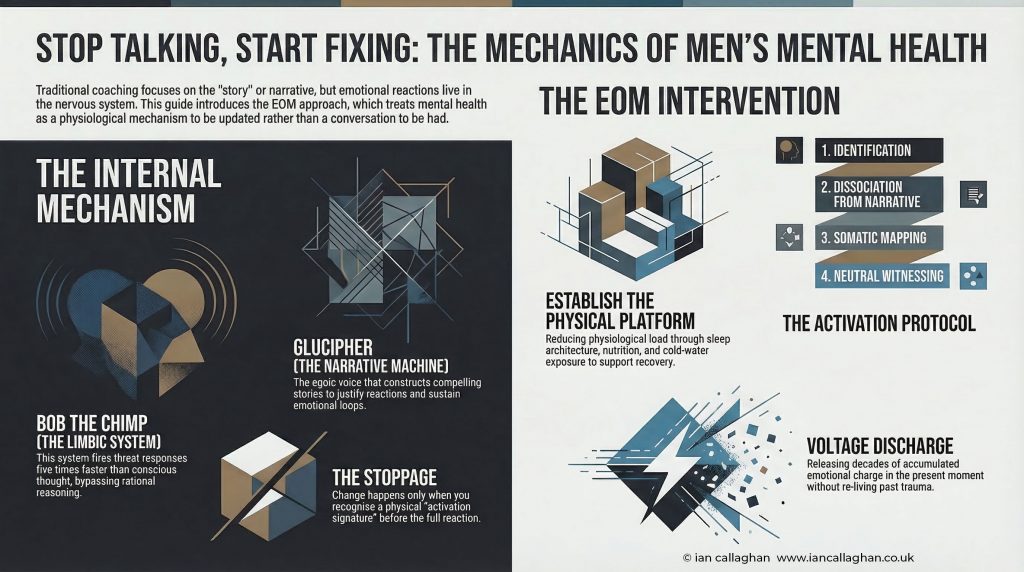
When you narrate a traumatic experience, whether in therapy, coaching, or a late-night spiral on your own, you activate the neural network associated with that experience. The amygdala does not care whether the threat is happening now or being vividly replayed. Bob fires. The threat response kicks in. Cortisol floods the system.
If the session ends before that physiological activation completes, which it often does because fifty minutes is a made-up endpoint, you leave with the nervous system still partially activated and the traumatic programme freshly rehearsed.
Every time you narrate trauma without resolving the physiological activation, you are practising the wound.
That is not a criticism of therapy. Skilled trauma therapists know this and work to complete the activation cycle inside the session. The problem is that most talking-based approaches, including much coaching, have no real mechanism for doing so. They can produce insight. Insight and resolution are not the same thing.
To heal trauma without talking about it is to bypass that problem entirely and work directly with the physiological activation instead of the narrative built around it.
Where Trauma Actually Lives
Trauma is not a memory. It is a programme. A threat-response pattern is encoded during an overwhelming experience and never properly updated. The original event is over. The programme it created is still running.
That programme lives in the subcortical structures of the brain, such as the amygdala, hippocampus, and brainstem, the areas that do not process language. They process sensation, threat assessment and pattern recognition. They respond to experience, not explanation.
That is the fundamental reason you can heal trauma without talking about it. Language does not reach the level where the programme is stored. Somatic experience does.
The body is the access point. The constriction, the heat, the weight, the freeze, they are not side effects of the trauma. They are the trauma expressing itself through the hardware it runs on. Work with the sensation directly, and you are working with the programme directly.
The EOM Approach: Heal Trauma Without Talking About It
The Emotional Observation Method is built on the principle that you can heal trauma without talking about it, or more accurately, without talking about the original events that created it.
The No-Digging Rule is absolute. We do not go back into the story. We work with the activation as it appears in the present moment. The entry point is always the body, always now, never the archive.
Step 1: Catch the activation early
The first skill is learning your own activation signature, the earliest physical sign that Bob has fired. For most people it is a specific sensation. Tightening. Heat. A drop in the gut. A change in breath. It lands before the emotional label, before the story, before the full physiological cascade.
Catching it here, at the first physical signal, is the difference between observing an activation and being dragged around by it.
Step 2: Name the mechanism, not the story
Bob is activated, rather than I am triggered.
Glucipher is building a narrative, rather than I keep thinking about what happened.
This is not positive thinking. It is accurate thinking. It shifts you from total identification into observation, and that witnessing gap is where choice starts to come back online.
Step 3: Map it in the body
Where exactly is the sensation?
What is its texture?
Sharp or dull. Heavy or tight. Static or moving.
You are treating the emotion as data, not as a verdict. A weather pattern moving through a location. Temporary. Observable. Not your identity.
Step 4: Witness without narrative
You observe. You do not feed.
A cortisol spike lasts roughly ninety seconds if you do not keep extending it with thought, story and meaning-making. You watch it peak. You watch it pass. The programme fires, but it does not get the old reaction it expects. Over time, that weakens the pathway.
That is how you heal trauma without talking about it.
Not by understanding it better.
By changing the relationship between the trigger and the nervous system’s automatic response to it.
What This Approach Cannot Do
Honesty matters here.
The EOM approach is not for everyone in every circumstance.
If you are in an active crisis, if the trauma response is so acute that your daily functioning is badly compromised, the priority is stabilisation, and that may require clinical support. EOM is for people who are functional but stuck, not for people who are currently destabilised.
If the trauma involves deep developmental wounding, especially early childhood experiences that shaped identity, attachment and emotional safety, the work is slower and needs more scaffolding than a self-directed process can provide. That is where one-to-one support makes sense.
For everything in between, the built-up activation of a high-pressure life, the patterns that keep firing despite insight, the emotional debt ceiling that has been rising for years, this approach is direct, effective, and does not require you to spend another hour retelling your history.
Start Here
If you want the full framework for how to heal trauma without talking about it, the complete EOM protocol, the No-Digging Rule properly explained, and Bob and Glucipher laid out in plain English, start with the pillar page.
The EOM framework:
iancallaghan.co.uk/emotional-observation-method/
If you want to work through this inside a community of people doing it in real time, asking the questions that actually matter and sharing what is shifting, join the free Midlife Reset group.
Free community:
skool.com/ian-callaghan-midlife-reset-8948/about
If you want one-to-one work, the right tool applied to your specific pattern, book a session directly.
Book a session:
iancallaghan.co.uk/book/
The EOM manual:
iancallaghan.co.uk/the-shop/
The story is not the wound.
The body is.
Work with the body.