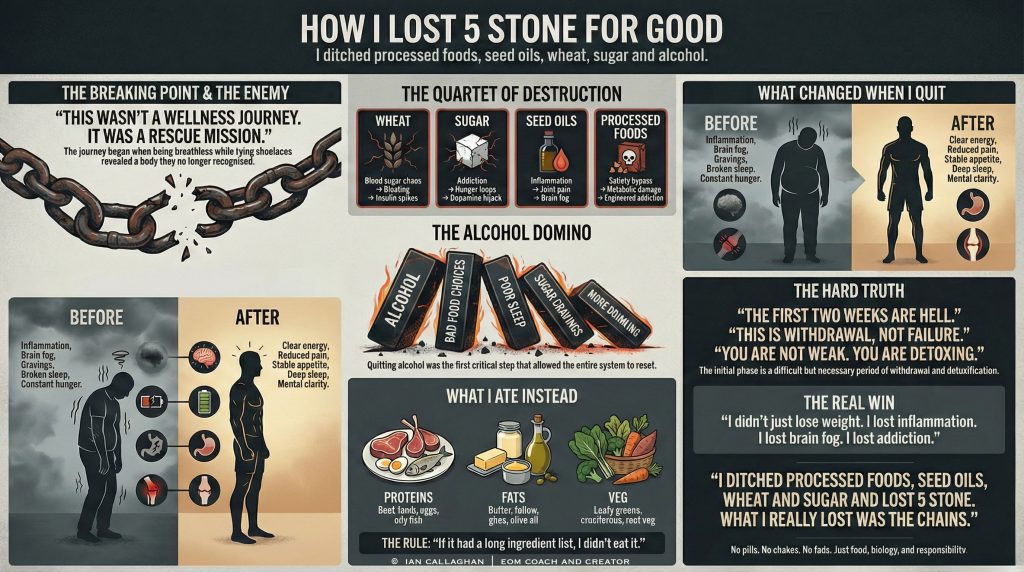
The brutal truth: I ditched processed foods, seed oils, wheat and sugar and lost 5 stone (70 lbs).
I remember the exact moment the lie I had been living finally crumbled. I was sitting on the edge of the bed in my flat, trying to tie my shoelaces. It sounds trivial, doesn’t it? A grown adult, breathless, face flushed red, struggling to perform a task a five-year-old can manage. But my stomach was in the way. My lungs felt compressed. And the shame was so thick I could taste it.
I had to take a break halfway through just to catch my breath. I sat there, staring at the wall, and I realised I was terrified. Not of dying, exactly, but of living like this for another ten years. Being the person who wheezes when walking up a single flight of stairs. Being the person who secretly unbuttons their trousers under the dinner table just to relieve the pressure.
In this guide, you’ll learn:
How to handle the social isolation that comes with a radical life reset.
How I broke a 45-year relationship with alcohol.
Why removing “The Quartet of Destruction” (Wheat, Sugar, Seed Oils, Alcohol) is more effective than counting calories.
The difference between fat loss and “Inflammation Vanishing.”
Get it all in the new release of the book I created to lose 5 stone (70lb)
Applying My Nutrition Background to My Own Recovery
I knew better. That was the worst part. I have a City & Guilds in Food and Nutrition. I hold diplomas in nutrition, including Paleo protocols. I have the certificates, the education, and the intellectual understanding of what the human body needs. I knew the biochemistry. I knew the metabolic pathways. But there I was, carrying an extra five stone, inflammation radiating through my joints like a dull toothache, completely trapped in a cycle of self-destruction.
I looked at my reflection in the wardrobe mirror—really looked at it, not the cursory glance I usually gave while sucking my gut in—and I said, “Enough.”
It wasn’t a corporate strategy. It wasn’t a “wellness journey.” It was a rescue mission.
Here is the raw, unpolished story of how I ditched processed foods, seed oils, wheat and sugar and lost 5 stone, and perhaps more importantly, how I finally put down the bottle after 45 years.
The Fraud in the Mirror
For years, I felt like a complete fraud. Imagine having the qualifications on your wall that say you are an expert in nutrition, while your body screams the opposite. I would give people advice on nutrient density and metabolic health, and then I would go home and drown my sorrows in wine and convenient, beige food.
It creates a cognitive dissonance that eats away at your soul. You start to avoid mirrors. You start to wear baggy clothes. You stop looking people in the eye because you’re afraid they’ll see the hypocrisy.
The problem wasn’t a lack of knowledge; it was a lack of execution, fuelled by a toxic environment and a lifetime of addiction. I had spent 45 years drinking. That is nearly half a century of viewing alcohol not just as a beverage, but as a crutch, a celebratory tool, a commiseration mechanism, and a way to silence the noise in my head.
When you drink for that long, your physiology changes. Your gut lining is compromised. Your liver is under siege. And your inhibition around food dissolves. No one makes a healthy salad after a bottle of wine. You reach for the toast, the biscuits, the takeaway—the processed garbage that hits the dopamine receptors just right.
I had to admit that my knowledge of Paleo and nutrition was useless as long as I was poisoning myself. I was trying to build a house on a foundation of quicksand.
Ditching Seed Oils and Sugar: The Quartet of Destruction
When I finally decided to change, I didn’t count calories. I didn’t join a slimming club where we clapped for losing half a pound. I went back to my training, specifically my Paleo roots, and I identified the four horsemen of my metabolic apocalypse.
I realised that to save my life, I had to be radical. Moderation had failed me for decades. “Just a little bit” always turned into a lot. I had to draw a hard line in the sand.
The commitment was absolute: I ditched processed foods, seed oils, wheat and sugar and lost 5 stone.
Why these four? Because in my experience—both personal and educational—they are not just “empty calories.” They are biological disruptors.
- Wheat: It wasn’t just about gluten; it was about the blood sugar rollercoaster and the bloating that made me look six months pregnant every time I ate a sandwich.
- Sugar: The master addiction. The substance that kept me hungry even when I was full.
- Seed Oils: The invisible inflammation. The rapeseed, sunflower, and soybean oils lurking in everything from hummus to “healthy” oat bars.
- Processed Foods: The ultra-processed sludge engineered to bypass our satiety signals.
And, looming over them all, the alcohol.
The Alcohol Factor: Breaking a 45-Year Habit
Why Quitting Alcohol is the Key to Metabolic Health
I cannot overstate this: quitting the booze was the hinge upon which everything else turned. You might think ditching the bread was hard, but walking away from a 45-year relationship with alcohol felt like losing a limb.
For the first few weeks, the silence in my flat was deafening. Without the wine to blur the edges of the evening, I had to sit with my thoughts. I had to sit with the discomfort of my own body.
But something miraculous happened after the first month. The “fog” began to lift. My sleep, which had been fragmented and shallow for decades, became deep and restorative. And crucially, my cravings for garbage food began to dissipate.
I realised that alcohol was the domino that knocked everything else down. One drink led to poor food choices, which led to poor sleep, which led to waking up tired and craving sugar for energy, which led to drinking again to wind down. It was a hellish carousel.
Stepping off that carousel was the most frightening thing I have ever done. But now, over a year alcohol-free, I can tell you it was the price of admission for my new life.
The Withdrawal: It Gets Worse Before It Gets Better
I want to be vulnerable about the first few weeks because most people gloss over this. They show you the “before” and “after” photos but skip the messy middle where you’re crying over a lack of biscuits.
When I ditched processed foods, seed oils, wheat and sugar and lost 5 stone, the first fortnight was physical and emotional warfare.
My body was screaming. It was addicted to the quick energy of refined carbohydrates and the sedative effect of alcohol. I experienced headaches, lethargy, and a mood so foul I’m surprised anyone spoke to me. This is what we call the “Keto flu” or metabolic withdrawal, but knowing the name doesn’t make it hurt less.
I remember walking past a bakery on a rainy Tuesday. The smell of fresh bread hit me, and I felt a pang of longing so intense it was almost physical. I stood there, rain dripping off my nose, bargaining with myself. “Just one loaf won’t hurt. You’ve been good for three days.”
But I knew “one loaf” was a lie. There is no such thing as one slice of toast for someone with my metabolic history. It’s the whole loaf, then the butter, then the jam, and then the guilt.
I walked away. I went home and ate a steak with butter and asparagus. It was delicious, nutrient-dense, and satisfying. But it didn’t give me that drug-like “hit” that sugar did. I had to relearn how to eat for nourishment, not for a dopamine high.
Rediscovering Real Food
As the weeks turned into months, a shift occurred. My palate, which had been deadened by decades of artificial flavourings, smoke flavour, and MSG, began to wake up.
I started to taste the natural sweetness in a red pepper. The incredible creaminess of an avocado. The richness of slow-cooked lamb.
Because I have a background in nutrition, I stopped looking at food as “good” or “bad” and started viewing it as “information.”
- Wheat and Sugar tell your body: Store fat. Spike insulin. Be hungry again in two hours.
- Seed Oils tell your body: Inflame the cells. Disrupt the mitochondria.
- Real, Whole Foods tell your body: Repair. Build muscle. Burn stored energy.
I went back to basics. If it had a list of ingredients longer than three items, I didn’t buy it. If it was made in a factory, I didn’t eat it. If it was advertised on telly with a catchy jingle, I avoided it like the plague.
My shopping trolley changed completely. Gone were the colourful boxes and plastic-wrapped snacks. Instead, it was filled with:
- Proteins: Beef, lamb, eggs, oily fish.
- Fats: Butter, tallow, ghee, coconut oil, olive oil.
- Vegetables: Leafy greens, cruciferous veg, things that grow in the dirt.
It was simple. It was primal. And for the first time in 45 years, the weight didn’t just “come off”—it fell off.
The Inflammation Vanishing Act
One of the most shocking realisations was that what I thought was “fat” was actually inflammation.
We tend to think of weight loss as a linear burning of calories. But when I ditched processed foods, seed oils, wheat and sugar and lost 5 stone, I noticed changes that had nothing to do with the scales.
Within three weeks, the puffiness in my face had gone. My knuckles, which used to ache in the damp British weather, stopped hurting. My ankles, usually swollen by 5 PM, were defined again.
This was the seed oils leaving my system.
I had spent years cooking with “heart-healthy” vegetable oils because that’s what we were told to do. Even with my diplomas, the mainstream narrative is so strong it’s hard to resist. But once I swapped the sunflower oil for butter and beef dripping, my body heaved a sigh of relief.
I wasn’t just losing weight; I was deflating.
I recall putting on a pair of work trousers that hadn’t fit me in four years. I buttoned them up, and they were loose. I stood in my bedroom, holding the waistband out, and I cried. Not a dignified, single-tear cry, but a sobbing release of tension. I hadn’t realised how heavy the burden of my own body had been until I put it down.
Facing the Social Wilderness
Navigating this lifestyle change in a society built around consumption is lonely. That is the vulnerability nobody talks about.
When you stop drinking and stop eating the “standard” diet, you become an outsider.
“Oh, go on, just have one pint.”
“Don’t be boring, have a slice of cake.”
“You’re obsessed with this diet, live a little.”
People feel threatened when you change. Your improvement holds a mirror up to their stagnation. I lost invitations to the pub. I stopped getting asked to dinner parties because I was “awkward” to feed.
At first, this hurt. I felt isolated in my flat, eating my steak and drinking my sparkling water. But then I realised that those relationships were based on shared vices, not shared values.
I had to learn to be comfortable being the odd one out. I had to find strength in my own resolve. I had to value my health more than I valued fitting in.
It forced me to find new ways to connect. I started walking—long, rambling walks in the countryside. I reconnected with nature, something the Paleo philosophy emphasises. I found that without the hangover, I had weekends again. Actual, usable time.
I traded late nights in the pub for early mornings with the sunrise. I traded “banter” over beers for genuine conversations over coffee. It was a trade-up, but it took time to see it that way.
The “Middle” Phase: When the Excitement Fades
Losing the first two stone was exciting. People noticed. Compliments flowed. But the journey to losing 5 stone is a marathon, not a sprint.
There comes a point, maybe three months in, where the novelty wears off. The scales slow down. The compliments stop because people are used to your new look. This is the danger zone. This is where the old demons whisper.
“You’ve done well. You can handle a pizza now. Just one night off.”
This is where my City & Guilds training and my history of addiction clashed. My brain knew that “one night off” would trigger the glucose spike, the insulin rush, and the cravings. But my emotional brain wanted comfort.
I had to develop a new relationship with comfort. Comfort could no longer be food. Comfort had to be a hot bath, a good book, a phone call to a supportive friend, or simply the feeling of my ribs not digging into my waist.
I kept a journal during this time. Reading back on it now, it’s filled with anger and frustration, but also determination. I wrote down every time I resisted a craving. I celebrated the small victories—walking past the biscuit aisle without slowing down, ordering the burger without the bun and not feeling embarrassed.
These micro-victories compounded. They built a new identity. I wasn’t just “trying to lose weight.” I was becoming a person who didn’t eat that stuff.
(Continued in Part 2…)
SEO TITLE: Is quitting sugar and wheat actually worth it?
The isolation I felt in social situations was nearly the breaking point after I ditched processed foods, seed oils, wheat and sugar and lost 5 stone.
The Loneliness of the Long-Distance Dieter
I sat in the corner of my local pub, a place that used to feel like a second home. The air smelled of stale beer and vinegar-drenched chips. My mates were three pints deep, laughing over a shared plate of cheesy nachos. I was clutching a sparkling water with a slice of lime, feeling like a ghost at my own funeral.
This is the part nobody puts in the glossies. They show you the “Before” photo (sad, bloated) and the “After” photo (beaming, slim). They don’t show you the Saturday night where you stay in your flat because you don’t trust yourself around the garlic bread at the Italian restaurant. They don’t show you the tension in your partner’s eyes when you ask the waiter for the fourth time if the steak is cooked in butter or vegetable oil.
I felt utterly, completely boring.
For a few weeks during the middle phase, I resented my new life. I resented that I had to check labels while everyone else mindlessly threw packets into their trolleys. I resented that “treating myself” now meant a walk in the rain rather than a massive wedge of chocolate cake.
I was grieving. That’s the only word for it. I was mourning the loss of my primary coping mechanism. Wheat and sugar had been my armour against the world. If I had a bad day at work, pasta fixed it. If I was lonely, biscuits filled the void. Without them, I felt exposed. My emotions were raw and right on the surface.
The Invisible Enemy: Seed Oils
If wheat and sugar were the loud, obvious villains in my story, seed oils were the silent assassins. This was the hardest part of the puzzle to explain to my friends.
“But it’s just vegetable oil, surely that’s healthy?” they’d say, trying to be helpful.
I didn’t have the energy to explain the industrial extraction processes, the bleaching, the deodorising, or the inflammatory markers. I just knew that when I ate them, I felt inflamed. My joints would ache the next day. The brain fog would roll back in like a thick sea fret off the coast.
Navigating restaurants became a military operation. I realised that almost everything in the standard British diet is lubricated with rapeseed or sunflower oil. The “healthy” salad dressing? Full of it. The seared scallops? Fried in it. Even the roasted vegetables often came glistening in the stuff.
I had to become “that person.”
“Excuse me, could you ask the chef to cook my eggs in real butter, please? Or just poach them if that’s too much trouble?”
The eye rolls were palpable. But here is the vulnerable truth: I had to value my health more than their opinion of me. That was a massive psychological shift. For years, I’d eaten to fit in, to be the “fun one,” to not make a fuss. Now, I was making a fuss. And I was shrinking.
The Turning Point: When the Fog Lifted
It was about four months in when the magic happened. I woke up one Tuesday morning before my alarm. This was unprecedented. usually, I dragged myself out of bed, hitting snooze three times, feeling like I’d been hit by a bus.
This Tuesday, my eyes snapped open at 6:00 AM. I lay there waiting for the grogginess, the heaviness in my limbs. It didn’t come.
I got up, walked to the kitchen, and made my black coffee. The morning sun was coming through the window, and for the first time in a decade, I felt… capable. Not just awake, but alive.
This was the metabolic switch flipping. My body had finally become efficient at burning its own fat for fuel. The constant hunger—that gnawing, desperate panic that used to set in if I hadn’t eaten for three hours—was gone.
I realised I wasn’t just losing weight; I was gaining time.
I wasn’t spending hours obsessing over my next meal. I wasn’t napping on the sofa at 4 PM. I had this clean, consistent energy that lasted all day. The brain fog that had made my work feel like wading through treacle had evaporated. I could focus. I could remember names. I was sharper.
This became my new anchor. When I wanted to cave, when the smell of fresh bread from the bakery hit me, I didn’t think about the number on the scale. I thought about the energy.
“If you eat that,” I’d tell myself, “you are going to feel tired and sad in two hours. Is it worth it?”
The answer, increasingly, was no.
Facing the Mirror: Who is This Person?
Losing 5 stone is a violent act against your old identity.
I remember catching my reflection in a shop window and not recognising the man staring back. My face had angles. My neck had definition. But my mind was lagging behind my body.
I still felt like the “big guy.” I’d walk through narrow spaces turning sideways, even though I could now fit through head-on. I’d reach for the XL shirt on the rail, only to realise it hung off me like a tent. This body dysmorphia was disorienting. I felt like an imposter in a thin person’s body.
There was also a strange vulnerability in being smaller. I felt less protected. My physical bulk had been a barrier between me and the world. Without it, I felt fragile.
I had to do a lot of inner work to accept that I deserved to take up less space physically, but that allowed me to take up more space vocally and emotionally. I didn’t need the weight to ground me anymore.
The “Just One Bite” Fallacy
I’m not going to lie to you and say I was perfect for the entire duration. There was a weekend away—a wedding. The social pressure was immense. The champagne was flowing, the canapés were circling.
I ate the cake. I drank the beer.
The fallout was immediate and brutal. It wasn’t just guilt; it was physiological. Within an hour, my stomach was in knots. My heart raced—a reaction to the sudden influx of sugar and gluten my body was no longer used to fighting. I woke up the next morning with a hangover that had nothing to do with alcohol quantity and everything to do with inflammation. My face was puffy. My rings were tight on my fingers.
It was the best thing that could have happened.
It reminded me that I wasn’t depriving myself of “good food” by sticking to my protocol. I was protecting myself from poison. That slip-up solidified my resolve more than any success could have. It proved that I ditched processed foods, seed oils, wheat and sugar and lost 5 stone not because I was forcing myself to be good, but because I finally understood what those foods were doing to me.
The End Game: Maintenance and Reality
Crossing the 5-stone mark wasn’t a finish line with confetti. It was a quiet Tuesday. I stepped on the scales, saw the number, and simply nodded.
The real victory wasn’t the number. It was the fact that I had just cooked a steak with asparagus in butter for breakfast, and I didn’t crave toast with it. It was the fact that I was going on holiday next week and packing my own snacks (macadamia nuts, biltong) not out of fear, but out of preference.
I had rewritten my operating system.
People ask me, “Can you never eat pizza again?”
The honest answer is: I can eat whatever I want. I am an adult. But I choose not to. Because nothing tastes as good as not feeling sick, tired, and depressed feels.
My Advice to You
If you are reading this and feeling hopeless, stuck in the cycle of sugar highs and insulin crashes, please know this:
- It is not your fault. You are fighting against biochemistry and a food industry designed to keep you addicted.
- The first two weeks are hell. Accept it. Embrace the suck. It passes.
- Don’t rely on willpower. Rely on preparation. Clear your cupboards. If it’s in the house, you will eat it at 10 PM when you are stressed.
- Find your non-food comfort. Hot baths, podcasts, walks, screaming into a pillow—whatever works.
- Be prepared to be the weird one. Society is metabolically broken. To be healthy in a sick society, you have to do things differently.
I didn’t lose weight to look good for a summer holiday. I lost weight to save my life. I reclaimed my brain, my energy, and my future.
I ditched processed foods, seed oils, wheat and sugar and lost 5 stone, but what I really lost was the chains of addiction. And what I found was myself.
You can do this. It’s just food. It’s not your best friend, it’s not your lover, and it’s not your therapist. It’s fuel. Once you fix that relationship, everything else falls into place.
Start today. Not Monday. Today.