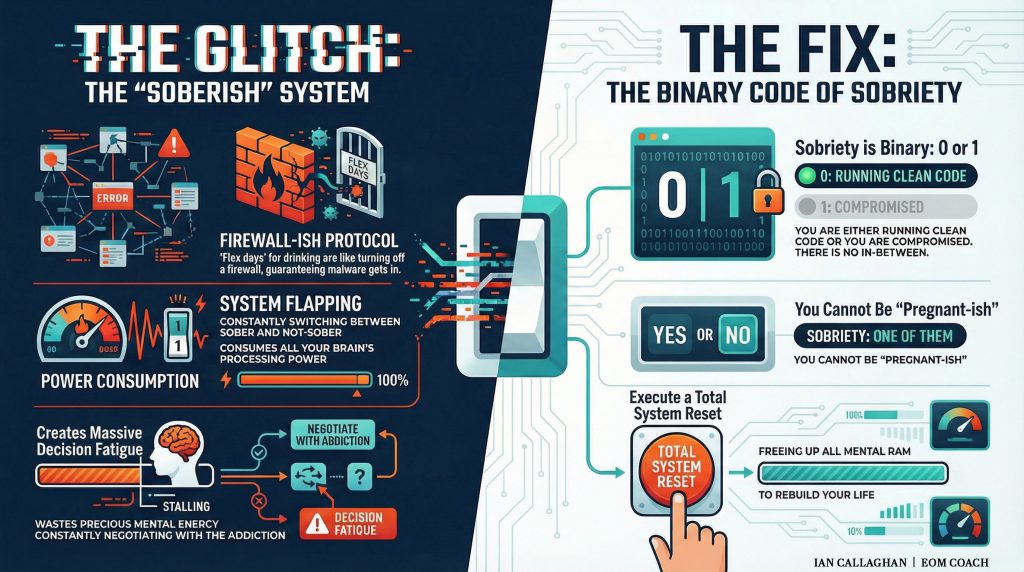
Develop a “Soberish Challenge Calendar” that includes “flex days” to align with this more forgiving, realistic trend. That is the search query that likely brought you here. The algorithm suggests that if we soften the edges of addiction, if we just negotiate with the chemical warfare in our bloodstream, we can find a “happy medium.”
But I am not an algorithm. I am Ian Callaghan. I am a Technical Architect with 25 years of experience, an ex-military veteran of 12 years, and a specialist in the mechanics of the human mind. I am the creator of the Emotional Observation Method (EOM).
And, for the record, I am not the Ian Callaghan who played for Liverpool FC in the 60s and 70s. He deals with footballs; I deal with the operating system of your brain.
If you are looking for a soft place to land, or someone to validate your desire to keep one foot in the poison while pretending to be healthy, you are in the wrong workshop.
Today, we are going to debunk the dangerous, glitch-ridden myth of the “Soberish” lifestyle. We are going to strip down the engine and explain why “intermittent sobriety” is a catastrophic system failure waiting to happen.
There is no such thing as “Soberish.” Just as you cannot be “fucking pregnant-ish.”
The Myth of the “Soberish” System Architecture
The modern wellness industry loves the concept of “Soberish.” They package it as “mindful drinking,” “damp lifestyles,” or “flex sobriety.” They tell you to develop a “Soberish Challenge Calendar” that includes “flex days” to align with this more forgiving, realistic trend.
From a systems perspective, this is madness.
Imagine I am the Technical Architect for a Tier-1 bank. We have a firewall installed to prevent malware from destroying the financial database. Now, imagine I propose a “Firewall-ish” protocol. I suggest that on Tuesdays and Saturdays—our “flex days”—we turn the firewall off. Just to be “forgiving.” Just to be “realistic.”
What happens? The virus gets in. The system is compromised. The data is corrupted.
The human brain is a biological Operating System (OS). Alcohol is a malicious script—malware that rewrites your neural pathways, alters your dopamine baseline, and crashes your emotional regulation.
Trying to schedule “flex days” for ingesting a neurotoxin is not a strategy; it is a surrender. It is an admission that the malware has administrative privileges over your logic board.
The Problem with “Museum Guides”
The reason this “soberish” trend is gaining traction is that men are being taught to act like “Museum Guides” to their own trauma and habits.
The Museum Guide walks through the corridors of his mind, staring at the pictures of his past. He looks at his addiction and says, “Ah, yes, this is because my father didn’t hug me in 1983.” He analyses the “vibes.” He looks for his “truth.” He wants to “hold space” for a drink on the weekend because he feels he “deserves” a reward.
This is passive. It solves nothing.
I am a Mechanic. A mechanic doesn’t ask the engine how it feels about the oil leak. The mechanic identifies the point of friction, isolates the faulty part, and replaces it.
If your engine is overheating (alcohol dependency), pouring coolant in on Monday but draining it on Friday (flex days) ensures the engine will eventually seize.
The Binary Code of Sobriety: 0 or 1
In the world of IT, at the foundational level, everything is binary. Zeros and ones. Current on, or current off.
Sobriety is binary.
You are either poisoning your system, or you are running clean code. There is no quantum state of superposition where you are both sober and drunk.
The “Pregnant-ish” Protocol
Let’s address the user instruction directly, because it is the perfect analogy for the biological reality of addiction.
You cannot be “pregnant-ish.”
- You either have a fertilised egg developing in the uterus, or you do not.
- You cannot be 20% pregnant on Tuesdays.
- You cannot take a “flex day” from pregnancy on the weekend to go out clubbing.
Alcohol dependency works on a similar binary switch in the brain, specifically regarding the dopamine reward circuitry. Once you have crossed the threshold where alcohol is your primary coping mechanism—your “System Restore” point—you cannot negotiate with it.
When you attempt to be “soberish,” you are constantly flipping the switch on and off. This causes System Flapping.
In networking, “flapping” occurs when an interface goes up and down repeatedly. It consumes massive amounts of CPU processing power. The router (your brain) spends all its energy trying to determine the state of the connection, leaving no bandwidth for actual data transmission (living your life).
The High Cost of Decision Fatigue
Every time you look at your “Soberish Challenge Calendar,” you have to make a decision.
- “Is today a flex day?”
- “I had a hard meeting. Can I move my flex day from Saturday to tonight?”
- “If I only have two beers, does that count?”
This is Decision Fatigue. You are burning precious RAM (Random Access Memory) negotiating with a substance.
When you execute a Total System Reset—when you commit to 100% cessation—you free up that RAM. The decision is made once. The answer is “No.” The bandwidth that was previously used for “moderation management” is now available for:
- Physical reconstruction (I lost 5 stone/31kg).
- Career pivoting.
- Emotional regulation.
Why “Moderation” is Harder than Cessation
Clients often come to me asking to learn how to moderate. They want to be “social drinkers.” They want the EOM protocol to help them drink less, not stop.
I tell them the truth: Moderation is a torture chamber.
When you feed the addiction “sometimes” (flex days), you are keeping the monster in the basement alive. You aren’t feeding it enough to satisfy it, so it is constantly screaming, scratching at the door, and demanding more. You spend your entire life standing guard at that basement door, listening to the screaming, trying to hold it back until the designated “flex day.”
That is not freedom. That is imprisonment.
Cessation is starving the beast. Yes, it screams louder at first (withdrawal/glitches). But eventually, it starves. It dies. Silence returns to the house. You can leave the basement door unguarded and go live your life.
The Dopamine Glitch
Let’s look at the technical specs of what happens on a “flex day.”
- Baseline: Your brain expects a certain level of dopamine.
- The Flex: You drink on Saturday. Your dopamine spikes artificially high.
- The Crash: On Sunday and Monday, your brain halts natural dopamine production to compensate for the spike. You feel low, anxious, and irritable.
- The Craving: Your brain identifies alcohol as the quickest way to fix the low dopamine.
- The Resistance: You spend Tuesday, Wednesday, and Thursday fighting the urge, using willpower (battery power) to reach the next “flex day.”
This is a looping script. IF (Feel Bad) THEN (Crave Drink). By allowing flex days, you are hard-coding this loop into your OS.
The Emotional Observation Method (EOM): The Fix
If we aren’t using a “Soberish Calendar,” what do we use? We use the Emotional Observation Method.
EOM is about shifting from being the “experiencer” of the emotion to the “observer” of the data.
When a craving hits—or when you feel the need to use a “flex day”—you do not engage with the story. You do not argue with yourself. You observe the glitch.
Protocol 1: Objectify the Glitch
The urge to drink is not “you.” It is a separate object. A malware file.
[Visual]: Close your eyes.
[Audio]: Locate the feeling of the craving in your body. Where is it? The chest? The stomach?
Give it a shape. Is it a sphere? A jagged rock? A tightening vice?
Give it a colour. Is it red? Black? Neon green?
Give it a weight. Is it heavy? Light?
By assigning physical attributes to the emotion, you detach from it. You are no longer “sad” or “thirsty.” You are a mechanic observing a red, heavy sphere in the chest cavity.
Protocol 2: The 90-Second Rule
Neuroscience tells us that the chemical lifespan of an emotional trigger is roughly 90 seconds. If you do not feed the loop with internal dialogue (“I really need this,” “Just one won’t hurt”), the chemical flush dissipates.
The “Soberish” approach feeds the loop. It says, “Hold on, let me check the calendar. Oh, I can drink in 48 hours.” That thought keeps the chemical trigger alive.
The EOM approach says: “Glitch detected. Observing thermal spike. Waiting for system cooldown.”
Protocol 3: Debugging the “Why”
We don’t ask “Why do I feel this way?” to cuddle the inner child. We ask “Why?” to find the root cause of the friction.
- Friction: I want a drink.
- Diagnostic: Why?
- Data: Because I am stressed about work.
- Root Cause: The “Stress” is actually cortisol buildup from lack of movement and poor boundaries.
- The Fix: We do not apply alcohol (a depressant) to cortisol. We apply a run, a cold shower, or a difficult conversation. We fix the engine; we don’t paint over the check engine light.
The “Regimented Reset”: A Better Alternative to Flex Days
Instead of a “Soberish Challenge,” I propose the Regimented Reset. This is the methodology I used to pivot my life at age 57, lose 31kg, and end 45 years of alcohol use.
This is not about being “kind” to yourself. It is about being accurate with yourself.
Phase 1: The Audit (Days 1-7)
You cannot patch a server if you don’t know what’s running on it.
- Track every input (food, media, sleep).
- Identify the “Trigger Scripts.” (e.g., 5:00 PM = Wine).
- No changes yet. Just brutal data collection.
Phase 2: The Firewall (Days 8-30)
Total cessation. No flex days. No “pregnant-ish.”
- We block the port (Alcohol).
- We install monitoring software (EOM) to watch for withdrawal spikes.
- We expect the system to run hot. This is called “recalibration,” not suffering.
Phase 3: Hardware Upgrades (Day 30+)
Now that the malware is gone, we will upgrade the hardware.
- Metabolic Adjustment: Real food. High protein. Eliminate processed sugar (which mimics alcohol addiction pathways).
- Physical Stress: Lift heavy things. Cold water exposure.
- Cold Water: This is essential. It forces the body to regulate its own dopamine and norepinephrine. It is the ultimate system reboot.
The Danger of “California Sober”
There is a sub-trend called “California Sober,” usually involving weed instead of booze, or psychedelics.
From an EOM perspective, this is swapping one buggy driver for another. You are still looking for an external executable file to manage your internal state.
The goal of the Mechanic is a self-regulating engine. An engine that runs smoothly, cool, and powerful without needing additives. If you need a substance to tolerate your reality, your reality (or your perception of it) is broken. Fix the reality. Don’t drug the observer.
Why “Holding Space” is Useless
In the therapy world, they talk about “holding space.” It sounds nice. It sounds gentle.
In the military, we hold ground.
When you are fighting an addiction, you are in a territory war for your own mind. The enemy (the addiction script) wants to retake the hill.
If you have a “Soberish Calendar,” you are telling the enemy, “I will hold this ground Monday through Thursday, but you can occupy the territory on Friday and Saturday.”
Do you think the enemy will politely leave on Sunday morning? No. It digs in. It fortifies. It leaves booby traps.
You must hold ground. 24/7. 365.
This requires discipline. And discipline is not a dirty word. Discipline is simply the ability to give yourself an order and follow it.
The “Mechanic’s” Call to Action
Stop trying to negotiate a peace treaty with a terrorist cell in your brain.
There is no “Soberish.” There is no “Intermittent Integrity.” There is no “Faithful-ish” husband. There is no “Pregnant-ish” woman.
There is the Glitch, and there is the Fix.
You have spent enough time acting as a Museum Guide, staring at your past, curating your “flex days,” and wondering why you still feel like your system is lagging.
It is time to put on the overalls. Pick up the wrench.
Open the hood.
If the calendar says “Flex Day,” tear it down. The only day that matters is the current operational cycle.
The Protocol is simple (but not easy):
- Acknowledge: The system is compromised.
- Delete: Remove the malware (Alcohol) entirely. No backups.
- Observe: Use EOM to watch the withdrawal glitches without engaging.
- Rebuild: new habits, new inputs, new hardware.
I am Ian Callaghan. I am the Mechanic. And I am telling you that your engine is capable of winning the race, but not if you keep pouring sugar in the petrol tank “sometimes.”
Execute the reset.
Standard Operating Procedure: The Daily Debug
Instead of a calendar of permission, use this daily checklist to maintain system integrity.
0600 – System Boot
- Hydrate (Water, not coffee immediately).
- Cold exposure (30s minimum). This shocks the OS and clears the cache.
1200 – Diagnostic Check
- Am I reacting or responding?
- Scan for “Micro-Glitches” (small irritations).
- Apply EOM: Objectify the stress.
1800 – The Witching Hour (High Risk)
- This is when the “Flex Day” logic usually attempts to install itself.
- Override Protocol: Change the environment immediately. If you usually sit on the sofa, go for a walk. If you usually go to the pub, go to the gym.
- Interrupt the pattern.
2200 – System Log
- Review the day.
- Did I hold ground?
- Prepare the architecture for tomorrow.
Status: ALL GREEN.
System: SECURE.
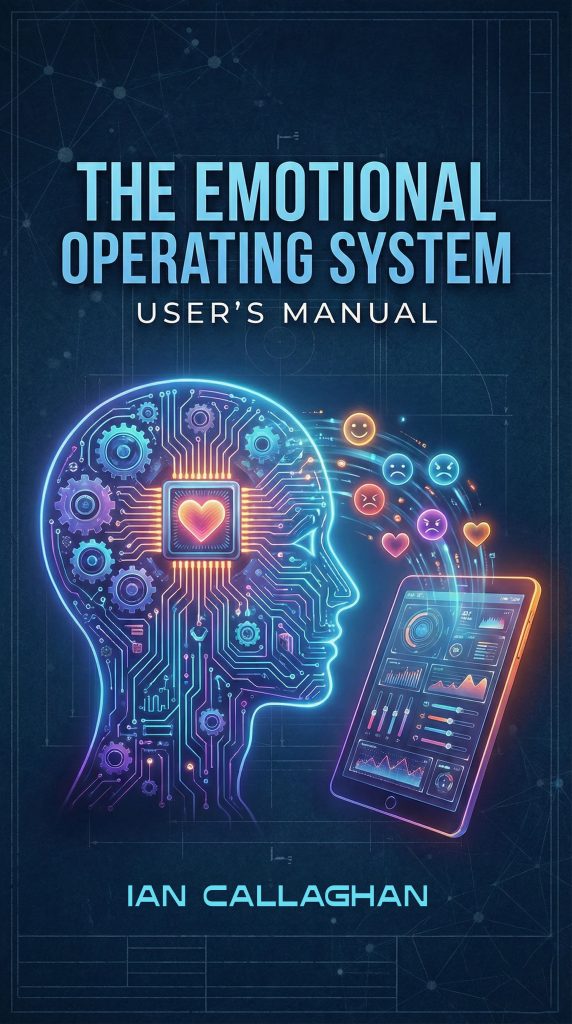
The Emotional Operating System: User’s Manual (Digital Edition)
Stop analysing the crash. Fix the code. An 8-page field guide to debugging your own mind. Includes the 4-Step EOM Protocol, the Symbol Library, and the Emergency Reboot scripts. Bonus: Includes access to the interactive Digital Console.