If you are searching for a men’s mental health coach, you already know that the standard options aren’t cutting it. You’ve probably tried talking about it. You may have done therapy. You might have read the books, downloaded the apps, and done the breathing exercises.
And you are still having the same reactions in the same situations.
The problem is not that you haven’t talked enough. The problem is that talking operates at the level of the story — and the story is not where the reaction lives.
What you need is not a listener. What you need is a mechanic.
What a Men’s Mental Health Coach Actually Does
The men’s mental health coach space is crowded with people who will sit with you, reflect on your experience with you, and help you articulate what you’re going through. That has value. But articulation is not resolution.
The question that separates a useful coach from an expensive conversation is this: are you working at the level of the symptom, or at the level of the mechanism that produces the symptom?
Symptoms are drinking, rage, shutdown, performance, and anxiety. The mechanism is the nervous system running a threat-response programme encoded years ago and never updated.
You cannot think your way out of a feeling. But you can learn to observe the mechanism producing the feeling — and update it.
That is what the EOM approach to men’s mental health coaching is built on. Not an endless exploration of what happened. A precise, technical intervention on what is happening in the body, in the nervous system, in the present moment.
Why Men Specifically Struggle to Get the Right Help
The conversation about men’s mental health has improved significantly in the last decade. The stigma around seeking support has reduced. More men are open to coaching, therapy, and working on their inner world than at any point in recent history.
But the frameworks they are being offered were largely built by and for people who process emotionally through language. Talk. Express. Explore. Reflect.
For a significant proportion of men — particularly those who have spent 20 or 30 years in environments that required emotional suppression — that approach creates a specific and recurring problem. They can talk about their experience fluently. They can identify their patterns. They can name their trauma. And then they walk out of the session and respond to the next provocation in the same way they always have.
Because the nervous system does not update through narrative, it updates through experience. And specifically, through the repeated experience of observing an activation without becoming it.
A man’s mental health coach who understands this works differently. The goal is not to produce insight. The goal is to produce a nervous system that behaves differently.
The Two Systems a Men’s Mental Health Coach Needs to Address
In the EOM framework, every emotional and behavioural pattern runs through two internal systems. Understanding both is non-negotiable for any coach working in men’s mental health.
Bob the Chimp — The Alarm That Runs Everything
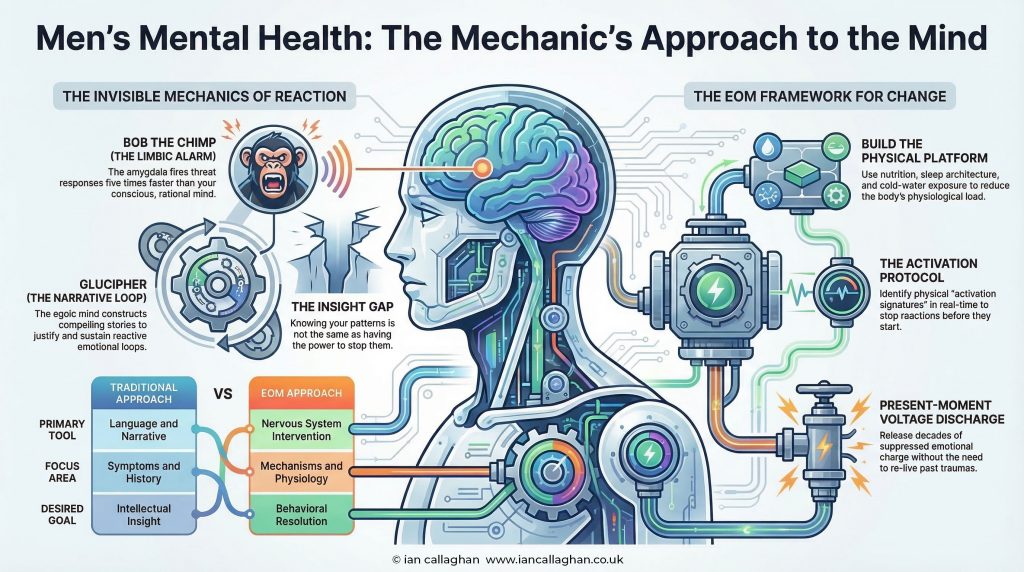
Bob is the personalisation of the limbic system — the amygdala and surrounding circuitry that fires threat responses before the rational mind has registered what’s happening. Bob is five times faster than conscious thought. He does not respond to reasoning, reassurance, or positive reframing.
When a man walks out of a coaching session with fresh insight about his patterns and then loses his temper at his partner that evening — that is Bob. Not a failure of will. Not a lack of commitment. Bob fired before the insight had a chance to get involved.
A man’s mental health coach, who is working at the right level, teaches the client how to recognise Bob’s activation signature in real time — the physical tell that fires before the full reaction. That recognition is The Stoppage. That gap is where change actually happens.
Glucipher — The Loop That Keeps It Running
Once Bob fires, Glucipher builds the story around it. Glucipher is the egoic narrative machine — the internal voice that constructs a fully sourced, emotionally compelling account of why the reaction was justified, why the other person is wrong, and why this is evidence of a pattern that has been following the client their entire life.
Glucipher is why a man’s mental health coach can spend six sessions unpicking a single belief pattern and find it fully reinstated the following week. The belief was addressed cognitively. Glucipher rebuilt it from the same raw material because the underlying activation was never discharged.
The EOM approach identifies Glucipher, names it, and teaches the client to refuse engagement with its content — not because the narrative is irrelevant, but because engagement is how the loop sustains itself.
What Men’s Mental Health Coaching Looks Like With EOM
The EOM approach to men’s mental health coaching is structured around four areas that conventional coaching rarely addresses simultaneously.
1. The Physical Platform
Nervous system dysregulation is not a psychological problem; it has physical symptoms. It is a physiological state that produces psychological consequences. Before any meaningful coaching work is possible, the physical load needs to be reduced.
This means nutrition that reduces inflammatory load, sleep architecture that supports genuine recovery, and cold-water exposure that directly trains the parasympathetic response. These are not lifestyle add-ons. They are the foundation that makes everything else possible.
2. The Activation Protocol
The core skill taught in EOM-based men’s mental health coaching is the four-step observation protocol: immediate identification of Bob’s activation, dissociation from the Glucipher narrative, somatic mapping of the physical sensation, and neutral witnessing until the physiological event passes.
This is practised in low-stakes situations first, then progressively applied to the specific triggers that are causing the most disruption in the client’s life. Each successful application weakens the automatic reaction pathway and strengthens the prefrontal cortex’s inhibitory control.
3. The Identity Audit
The operating system running under the surface — the core beliefs about worth, capability, and what is permissible — needs to be identified and evaluated, not excavated, re-experienced, and then identified and evaluated.
The question is always the same: was this written by you, for the life you are living now? Or was it written by someone else, in circumstances you no longer inhabit, and handed to you before you had the capacity to refuse it?
4. The Voltage Work
The stored activation — the accumulated charge of decades of suppressed emotional response — needs to discharge. The EOM non-reliving protocol does this in the present moment, without requiring the client to re-enter the emotional states that created the charge. This is often the piece that produces the most significant shift, and the piece most absent from conventional men’s mental health coaching.
Who This Approach Is For
This is not a men’s mental health coaching approach for everyone. It is specifically built for a particular type of person at a particular point in time.
- You have tried talking about it and have run out of things to say, but nothing has fundamentally shifted.
- You are high-functioning on the outside and running on empty on the inside
- You know your patterns. You can see them coming. You still can’t stop them.
- The drinking, the shutdown, or the rage is starting to cost you things you cannot afford to lose.
- You want to understand the mechanism, not accumulate more insight about the symptom.
If you recognise yourself in that list, you do not need to say more. You need the correct tool applied to the correct level of the problem.
Work With Ian — Men’s Mental Health Coaching
I work with a small number of clients directly — one-to-one sessions built around the EOM protocol, the physical reset, and the identity audit. No scripts. No generic frameworks. The specific tool for the specific problem you are running.
Book a session: iancallaghan.co.uk/book/
If you want to start with the community before committing to one-to-one work, the Midlife Reset Skool group is where the real-time application happens. People doing the work, sharing what’s moving, asking the specific questions that don’t get asked anywhere else.
Join the free community: skool.com/ian-callaghan-midlife-reset-8948/about
Or start with the self-directed tools — the Emotional Operating System manual is the men’s mental health coaching framework in written form, built to be used without a guide if you have the discipline to apply it.
Get the EOM manual: iancallaghan.co.uk/the-shop/
Find your system error first: iancallaghan.co.uk/emotional-archetype-quiz/
Stop talking about the engine. Fix it.
PS just for clarity I am not Ian Callaghan the Liverpool FC legend

The Sovereign Operator Bundle: Complete Metabolic & Emotional Mastery
Stop running the same loop every bloody week.