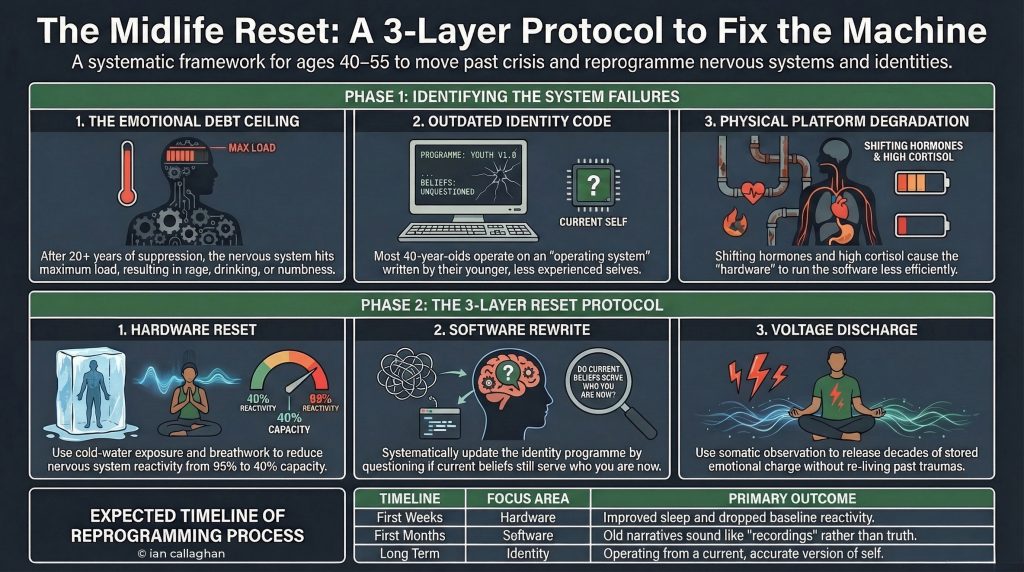
A midlife reset for men — and women hitting the same collision point — is not a holiday, a motorbike, or a motivational retreat. It is a precise reprogramming of the systems that have been quietly failing for years and have now reached critical load.
You are somewhere between 40 and 55. You have built things — a career, a family, a version of yourself that functions. From the outside, it looks like you have it together.
And somewhere underneath all of it, something is grinding.
It might be the drinking that has crept from two glasses to half a bottle without you noticing. It might be the rage that arrives faster than it used to, at smaller provocations. It might be the flatness — the absence of the drive that used to feel automatic. The Sunday evenings that feel like dread. The relationship is running on autopilot. The sense that you have been performing a version of yourself for so long that you can no longer locate the original.
That is not a crisis. That is a systems failure.
Systems failures don’t respond to holidays, motivational content, or white-knuckling through. They respond to diagnosis and the correct tool applied to the correct problem.
This is what the midlife reset for men actually looks like when it’s done properly.
Why a Midlife Reset for Men (and Women) Hits at 40+
The popular narrative about midlife is that people hit an existential crisis — they question their choices, blow up their lives, or suppress the feeling and carry on.
That narrative misses the mechanics entirely.
What is actually happening at 40-plus is a convergence of three specific system failures that have been building for decades and have now reached critical load. Understanding these is the starting point for any genuine reset.
System Failure 1: The Emotional Debt Ceiling
Most people reaching the midlife reset point have spent 20 to 30 years operating a specific emotional strategy: suppress, perform, push through. It works — for a while. It is an effective short-term survival mechanism in environments that punish emotional expression: high-pressure workplaces, demanding relationships, cultures that reward endurance over honesty.
The problem is that suppression is not resolution. Every time Bob fires a reaction that gets pushed down rather than processed, the stored activation accumulates in the nervous system. The body keeps a precise account.
By midlife, most people are running on a nervous system at maximum load — hair-trigger reactivity, chronic low-level anxiety, emotional numbness, or all three simultaneously.
The drinking, the rage, the flatness — these are not character flaws. They are the nervous system’s emergency pressure-release mechanisms. The machine has hit its debt ceiling and is doing whatever it can to discharge the load.
System Failure 2: The Identity Programme Running on Outdated Code
The identity most people operate from in midlife was formed in their teens and twenties. The core beliefs about what they are worth, what they are capable of, what they deserve, and what is expected of them — all of it — was encoded during a period of maximum vulnerability and minimal agency.
Glucipher has been running that programme faithfully ever since. Every decision, every relationship, every professional choice has been filtered through an operating system written by a young person who didn’t have the information, the experience, or the neurological development to write it well.
The midlife collision happens when the life the programme built no longer matches the life you actually want — and you don’t yet have the tools to rewrite the code.
System Failure 3: The Physical Platform Degrading Under the Software
At 40-plus, hormonal balance shifts. Sleep quality deteriorates. Inflammation rises. The physical platform that the emotional and cognitive systems run on is under increasing load — and most people accelerate that degradation through the same patterns that got them here: high stress, poor nutrition, inadequate recovery, and the substances used to regulate all of the above.
The body and the mind are not separate systems. When the hardware degrades, the software runs worse. Bob fires faster. Glucipher runs louder. The already stretched emotional regulation becomes increasingly unreliable.
Why Standard Midlife Advice Doesn’t Work
The standard advice for midlife runs on a predictable loop: exercise more, drink less, talk to someone, find your purpose, be more present.
All of it is correct at the output level. None of it addresses the mechanism producing the output.
Telling someone with an overloaded nervous system to ‘manage stress better’ is like telling a car with a broken engine to drive more carefully.
The exercise doesn’t stick because nervous system dysregulation makes consistency impossible. The drinking reduction fails because drinking performs a specific regulatory function that nothing has replaced. The therapy stalls because it operates at the level of the story, while the problem resides in the subcortical architecture. The purpose of work lands flat because you cannot connect to what you genuinely want, while Glucipher is running a 30-year-old script about what you are allowed to want.
The reset has to start at the level of the machine. Not the behaviour. The machine producing the behaviour.
The Three-Layer Reset Protocol
A genuine midlife reset for men and women works across three layers simultaneously — because all three are failing simultaneously and you cannot fix one while ignoring the others.
Layer 1 — The Hardware Reset
The nervous system needs to come off maximum load before anything else is possible. This means addressing the physical platform directly: inflammation through nutrition, cortisol through sleep architecture, sympathetic dominance through cold water exposure and breathwork.
This is not a wellness programme. It is engineering. The goal is to reduce Bob’s baseline reactivity by reducing the physiological load the system is operating under. A nervous system running at 40% capacity rather than 95% makes everything else in the reset possible.
Cold water is the fastest intervention available — not because it is uncomfortable, though it is — but because it is the most direct method for training the parasympathetic response. Every cold exposure is a repetition of the same pattern: stimulus hits, Bob activates, you observe without reacting, the system returns to baseline. You are running the EOM protocol with your physiology before you are running it with your emotions.
Layer 2 — The Software Rewrite
Once the hardware is stable enough to work with, you begin on the operating system. The identity programme that Glucipher has been running needs to be examined, identified for what it is, and systematically updated.
This is the EOM work. Not therapy — not returning to the original events that wrote the programme and re-experiencing them in detail. The No-Digging Rule applies here too. We look at the programme as it runs in the present: the specific beliefs that fire in specific situations, the automatic assessments Bob makes, the narratives Glucipher uses to maintain the system.
The question is not ‘where did this come from.’ The question is ‘what is actually running, and does it still serve the person I am now.’
Most of it doesn’t. The code that kept you functional in a difficult adolescence, a demanding institution, or a relationship running on performance rather than connection — that code is actively working against you now.
Layer 3 — The Voltage Discharge
The stored activation — decades of suppressed emotional charge, unprocessed grief, unexpressed anger, fear that never got to complete its physiological arc — needs to move.
Not through excavating the past. Not through reliving the events that created the charge. Through the present-moment somatic work of the EOM protocol: locating the activation in the body, observing it without narrative, and allowing it to discharge in the present tense without the traumatic programme being rehearsed and reinforced.
This is the piece most midlife reset frameworks miss entirely. They address the story and the behaviour. They leave the stored charge untouched. And the charge is what keeps pulling you back into the old patterns regardless of how much insight you have developed or how many good intentions you are running on.
What Changes — And When
The reset is not a weekend event. It is a reprogramming process. What I have observed consistently across the people I have worked with is a specific sequence.
In the first weeks, the hardware changes are the most noticeable. Sleep improves. The baseline reactivity drops. There is more space between stimulus and response — the beginnings of The Stoppage becoming accessible in real time.
In the first months, the software changes begin to compound. The Glucipher loops become recognisable — predictable, even boring. The old narratives start to sound like a recording rather than the truth. Decisions that used to feel impossible — about the drinking, the relationship, the career — begin to feel navigable because they are being made from a regulated nervous system rather than from a system at maximum load.
Over the longer term, the identity programme updates. Not dramatically, not all at once — but the person running on 30-year-old code about who they are and what they deserve begins to operate from something more current. More accurate. More theirs.
The midlife reset is not about becoming someone new. It is about removing the code that was never yours to begin with.
Four Questions to Start With
Before any framework, before any protocol, there are four questions that cut to the centre of where you actually are. Not questions to answer quickly. Questions to sit with honestly.
- What is the nervous system managing that I haven’t addressed directly?
- Which parts of the identity I’m operating from were written by someone else, in circumstances I no longer live in?
- What has the drinking, the rage, the flatness, or the performance actually been doing for me — and what does it need to be replaced with?
- What would I be doing differently if I wasn’t running on an inherited programme?
Those are not comfortable questions. They are the correct ones. The midlife reset for men and women starts there — not with the behaviour you want to change, but with the mechanism producing it.
Where to Start
The Emotional Observation Method is the framework underneath everything described in this post. The complete protocol — Bob, Glucipher, the four steps, the No-Digging Rule — is at iancallaghan.co.uk/emotional-observation-method/
The Emotional Archetype Quiz identifies which of the four primary system errors you are running — Fighter, Thinker, Reactor, or Connector — and tells you exactly where to apply the tool first: iancallaghan.co.uk/emotional-archetype-quiz/
The Emotional Operating System manual is the practical implementation guide — the mechanic’s handbook for running the reset yourself, in your own time, without needing to sit in a room and explain your history to a stranger: iancallaghan.co.uk/the-shop/
Or join the free Skool community — the people in there are doing this work in real time. That is the environment where the reset actually sticks.
The machine is not broken. It is running on the wrong programme. Fix the programme.



How do I order the books directly from you and not go through Amazon? I am trying the Pay Pal link and says there is something not right. Apologies, not very tech savvy.
eBooks are here on the site and physical books are on Amazon