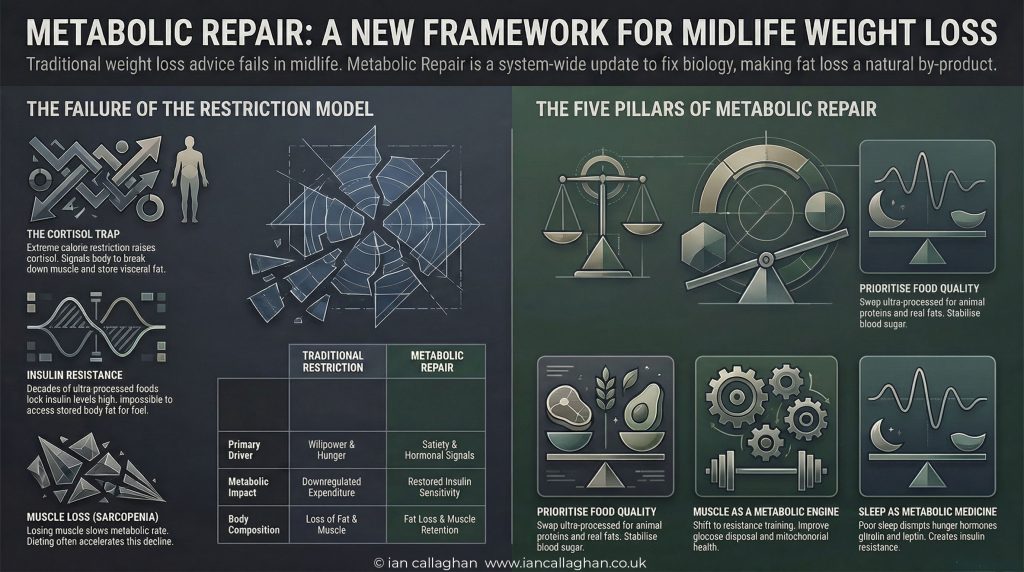
Midlife Weight Loss Through Metabolic Repair, Not Restriction
Midlife weight loss gets harder because the body is dealing with more than calories. Muscle mass often drops, sleep gets worse, stress gets louder, hormones shift, appetite becomes less stable, and years of dieting, booze, processed food, and chaotic routines catch up with you. That does not mean you are broken. It means the old restriction model is too shallow for the real problem.
If you are struggling to lose weight in midlife, the answer is usually not to eat less and punish yourself harder. It is repairing the system that drives hunger, energy, blood sugar, recovery, body composition, and behaviour.
That is what metabolic repair means.
Quick answer
Midlife weight loss through metabolic repair means focusing on muscle retention, protein intake, blood sugar stability, sleep, stress regulation, movement, food quality, and behavioural patterns, rather than relying on harsh calorie restriction alone. Restrictive diets can create more cravings, poorer sleep, rebound eating, muscle loss, and a worse relationship with food. A better strategy is to improve the underlying metabolic and behavioural signals that make fat loss more sustainable.
In this article
- Why does weight loss after 40 and 50 feel harder
- Why calorie restriction often backfires in midlife
- What metabolic repair actually means
- Why mindset and self-sabotage matter as much as food
- What a realistic midlife fat-loss strategy looks like
- Where to start based on what is actually driving your problem
- Frequently asked questions about midlife weight loss and metabolic repair
Why midlife weight loss feels harder than it used to
This is the bit loads of people already know in their bones before they ever search it. Something changed. What used to work no longer works the same way.
That is not imaginary.
By midlife, the body is less forgiving of chaos. Muscle mass often drops. Sleep quality can worsen. Stress becomes more chronic. Hormonal shifts affect body composition, appetite, and recovery. Physical activity often falls by the wayside as life gets heavier. You are often dealing with work, family pressure, ageing parents, injuries, less time, more responsibility, and decades of habits that have had plenty of time to dig in.
That means midlife weight loss is not just a maths problem. It is a systems problem.
So yes, energy balance still exists. But reducing the entire conversation to “just eat less” is toddler-level advice for an adult body dealing with midlife physiology.
At 25, you can get away with more. You can sleep like shit, drink too much, train like an idiot, eat whatever is nearest, and bounce back faster. By 45 or 55, the same chaos lands differently. The body becomes less tolerant of stress, less forgiving of poor recovery, and far more likely to show the cost of years of bad inputs.
That is why so many people say the same thing.
“I used to be able to lose weight quickly. Now nothing works.”
What they usually mean is this.
The old tricks no longer override the deeper mess.
Why calorie restriction often fails in midlife
Most people searching for this are not confused because they have never heard of a calorie deficit. They are confused because they have tried the old script and got shite results.
Eat less. Move more. Track everything. White-knuckle through hunger. Do more cardio. Try to be stricter.
Then they end up more obsessed with food, more tired, more irritable, sleeping worse, craving more, and feeling like they failed.
The problem is not that restrictions never create scale loss. The problem is that in midlife, it often creates too much collateral damage.
Go too hard, and people often end up with:
- More cravings
- Worse mood
- Worse sleep
- Poorer training performance
- Lower energy
- More rebound eating
- Less muscle retention
- More stress around food
- Bigger all-or-nothing loops
- A growing sense that they cannot be trusted around food
That last bit matters.
Because the damage is not only physical but also psychological.
Every failed restriction cycle teaches people another lesson in hopelessness. It reinforces the story that they are greedy, lazy, weak, broken, or lacking discipline. That story, in turn, changes how they behave. They stop trusting hunger. They stop trusting themselves. They stop building real structure because they are always waiting for the next magical burst of motivation.
That is not metabolic repair. That is a fucked relationship with food wearing a halo.
Signsof restriction may be making your midlife weight-loss problem worse
- You are constantly hungry or thinking about food
- Your sleep is getting worse
- Your energy is dropping
- You are losing motivation and snapping at everyone
- You are doing loads of cardio but not preserving muscle
- You keep bouncing between being good and bingeing or grazing
- You are lighter for a bit, then heavier again
- You are becoming more fearful and rigid around food, not more stable
That is not repairable. That is a stressed system under more pressure.
What metabolic repair actually means
Metabolic repair is not a detox, a tea, a supplement stack, or another sexy little phrase for Instagram. It means improving the biological conditions that make fat loss more likely and more sustainable.
In plain English, it means creating a body that is easier to regulate.
- A body with better satiety
- A body with more muscle stimulus
- A body with steadier blood sugar
- A body with less chaos around food
- A body with better sleep and recovery
- A body that is not constantly being battered by stress and ultra-processed crap
You are not trying to bully the body into shrinking. You are trying to improve the signals your body responds to every day.
The key pillars of metabolic repair in midlife
1. Preserve and rebuild muscle
This is one of the biggest things people care about, even if they do not phrase it that way. They say my metabolism feels slower, I keep gaining around the middle, I feel softer, I feel weaker, or nothing is shifting.
A big part of that story is body composition.
Muscle matters because it supports insulin sensitivity, resilience, physical function, and long-term metabolic health. If your plan makes you smaller but weaker, flatter, and more fragile, that is not a proper win.
2. Improve protein and satiety
Midlife fat loss gets much easier when meals actually satisfy you. Protein becomes increasingly important for satiety, recovery, and support of lean mass.
This is one reason your work can stand out. Because the answer is not to live on sad little diet portions and pretend hunger is a virtue. The answer is to make meals do more actual work.
3. Stabilise blood sugar and reduce food noise
When appetite is all over the place, energy is crashing, meals are built on low-protein beige crap, and snacks are constant, behaviour gets dragged around by unstable signals. People act like cravings are proof of weak character. A lot of the time, they are poor structure, poor sleep, stress, ultra-processed food, and repeated blood sugar swings colliding.
4. Fix the sleep problem
A lot of people are trying to diet their way out of a sleep issue. That rarely ends well.
If sleep is poor, hunger gets louder, recovery gets worse, emotional control drops, and evening food decisions usually go to hell. A lot of people are not failing because they need a stricter diet. They are failing because they are knackered.
5. Regulate stress and nervous system load
Stress is not just a vague wellness word. It changes behaviour. It changes appetite. It changes sleep. It changes what people reach for when the day has kicked the shit out of them.
Because the real issue is not just stress chemistry. It is what stress does to decision-making and self-sabotage under load.
6. Improve food qualityMany
Many people in midlife are overfed yet undernourished. Too much packet food. Too many fake health products. Too many low-fat processed substitutions pretend to be virtuous. Too much hyperpalatable industrial food makes appetite regulation harder, not easier.
This is where your real-food angle matters, not as a trendy purity game, but as a practical way to reduce appetite chaos, improve satiety, and stop getting mugged off by the food industry.
Why is this not just about food
This is where most articles in this space are weak. They talk about hormones. They talk about protein. They talk about exercise. Some mention stress. But most of them still do not really explain why a person can know exactly what to do and still keep doing the opposite when life gets heavy.
That is where mindset, behaviour, and self-sabotage come in.
Not a fluffy mindset. Not fake positive-thought bollocks. Real behavioural understanding.
A lot of people in midlife are not struggling because they need more information. They are struggling because their behaviour changes under load.
Stress goes up. Structure disappears. Sleep gets worse. Cravings get louder. Emotion builds. Old coping loops come online. They reach for food, booze, numbness, reward, comfort, or familiar routines. Then afterwards, they call themselves weak.
It is not a weakness. It is a loaded system running an old script.
That is the missing piece.
If you understand food but not self-sabotage, you miss half the battle. If you understand mindset but ignore blood sugar, sleep, muscle, satiety, and hormones, you miss the other half.
That is why your lane is stronger than generic nutrition content. You do not just understand food. You understand the mindset around food, identity, coping, and what happens when a loaded system starts reaching for relief.
That is exactly where Emotional Mastery and Under Load fit naturally. Not as random product mentions bolted onto a weight-loss article, but as the missing behavioural layer that explains why knowledge alone does not fix the pattern.
The real behavioural question
The real question is not just, “What should I eat?” It is also, “Who do I become when life gets heavy, and what do I reach for then?”
Until that part is understood, loads of people will keep trying to solve a behavioural problem with food rules alone. And that rarely works for long.
What a realistic midlife metabolic repair strategy looks like
This is what people actually want when they search. Not another lecture. A realistic path.
A better midlife fat-loss strategy usually looks like this:
- Eat meals built around real food, not snacks and engineered junk
- Prioritise protein and proper satiety
- Walk regularly and move daily
- Use strength training or resistance work to preserve muscle
- Sort sleep out as a serious part of the plan, not an afterthought
- Reduce alcohol if that is still part of the picture
- Cut back on the fake healthy food that keeps the appetite dysregulated
- Create better routines around light, timing, and recovery
- Build a structure that still works when life is messy
- Learn your own self-sabotage patterns before they hijack the plan
That is more boring than quick-fix diet nonsense. It is also far more likely to work.
What this looks like in real life
It looks like actual meals instead of grazing. It looks like enough protein to stop every day from becoming a hunger negotiation. It looks like moving because the body needs movement, not because you are trying to punish yourself for eating. It looks like lifting, carrying, walking, recovering, and sleeping matter, because they do. It looks like fewer fake treats are pretending to be health food. It looks like less chaos. It looks like more structure. It looks like fewer emotional ambushes around food because you finally understand your own patterns.
Where to start, depending on what is actually driving your problem
Not everyone needs the same starting point. That is another reason why generic weight-loss advice fails. It assumes a single entry point for everyone.
If your main issue is food quality, appetite chaos, poor satiety, and getting off the industrial-food treadmill, start with the real-food and metabolic side. That is where Metabolic Sovereignty and Nobody Taught You This fit.
If you need a stronger framework that ties food, movement, sleep, and mindset together into a single structured approach, start with The 30-Day Reset.
If you already know what to do but keep blowing yourself up under pressure, the issue is probably not a lack of information. It is the behavioural loop. That is where Emotional Mastery and Under Load matter most.
If you want the full operating system, not just one slice of the problem, that is where the Sovereign Operator Bundle fits.
Frequently asked questions about midlife weight loss and metabolic repair
Why is weight loss harder after 40?
Weight loss often gets harder after 40 because muscle mass tends to decline, activity can fall, sleep often worsens, stress becomes more chronic, and hormonal shifts can affect appetite, body composition, and recovery. The result is a body that is less forgiving of chaos than it was in your twenties.
Can you still lose weight in midlife?
Yes. But the most effective approach usually focuses on preserving muscle, improving protein intake, sleep, movement, stress management, and food quality instead of relying on aggressive restriction alone.
Does menopause slow metabolism?
Menopause can contribute to weight and body-composition changes, especially around the abdomen. Still, it is usually part of a bigger picture that includes ageing, muscle loss, sleep disruption, physical activity, and stress.
What is metabolic repair?
Metabolic repair means improving the biological conditions that influence hunger, energy, blood sugar, sleep, recovery, body composition, and behaviour so fat loss becomes more sustainable and less reliant on brute-force dieting.
Is calorie counting useless in midlife?
No. But for many people, it is not enough on its own. A plan that ignores muscle, satiety, sleep, stress, hormones, and self-sabotage patterns will often fail even if the maths looks good on paper.
What is the best diet for midlife weight loss?
The best diet is the one that improves satiety, supports muscle, stabilises blood sugar, reduces ultra-processed food, and is sustainable in real life. In practice, that often means more protein, more real food, fewer engineered snacks, better structure, and less chaos.
The bottom line
Midlife weight loss is not about punishing yourself harder. It is not about proving your worth by ignoring hunger. It is not about becoming a smaller, weaker, more miserable version of yourself in the name of discipline.
It is about repairing the system, the food side, the sleep side, and the muscle-loss problem. Repairing blood sugar and satiety, repairing the stress response, and repairing the self-sabotage patterns that keep dragging you back into the same old mess.
Because when the system improves, fat loss stops feeling like a constant war. It becomes more like a by-product of better function.
If your body feels like it is fighting you, stop treating it like the enemy. Stop trying to starve it into submission. Start repairing the system that has been under load for years.
Call to action
If you want to start with the food and metabolic side, begin with Metabolic Sovereignty or Nobody Taught You This.
If you need a more comprehensive framework that brings Eat, Sleep, Move, and Mind together, start with The 30-Day Reset.
If you know what to do but still sabotage yourself when life gets heavy, go deeper with Emotional Mastery and Understanding Self-Sabotage.
If you want the full stack, the Sovereign Operator Bundle is the complete system.