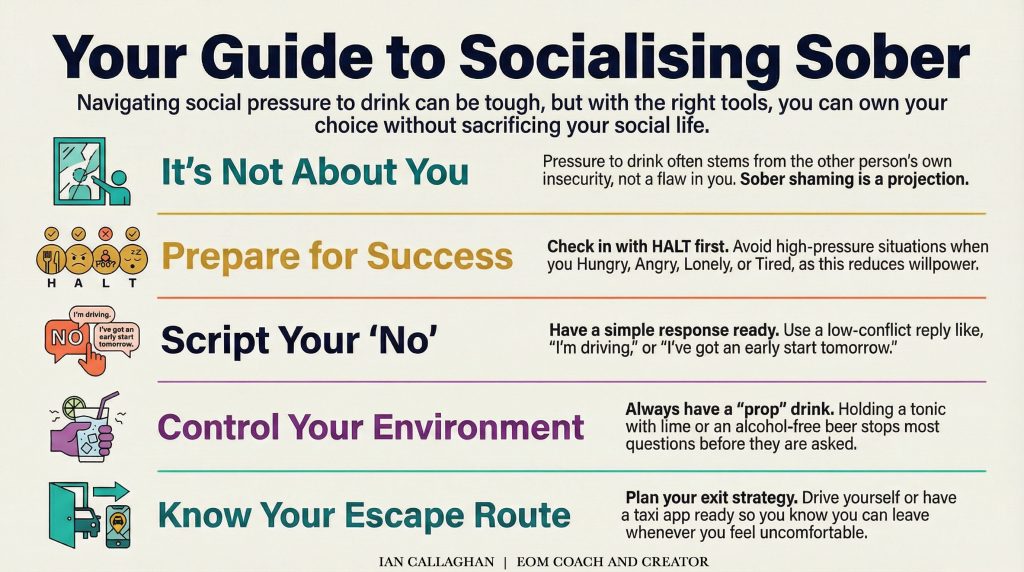
Navigating the social landscape without alcohol can feel like walking through a minefield, particularly in cultures where drinking is deeply ingrained in the social fabric.
Whether you have decided to stop drinking for health reasons, are in recovery, are taking a temporary break like Dry January, or simply do not fancy a hangover, the external pressure to consume alcohol can be immense. This guide is designed to equip you with the psychological tools, verbal scripts, and strategic planning necessary to maintain your boundaries without sacrificing your social life.
In this first part of our comprehensive guide, we will explore the psychology behind social pressure, how to prepare your mindset before leaving your flat, and the art of crafting your narrative when the inevitable questions arise.
Understanding Sober Shaming and Social Dynamics
To effectively navigate social pressure, one must first understand the mechanisms at play. Why does your choice not to drink make others uncomfortable? Why is “sober shaming” a phenomenon?
What is Sober Shaming?
Sober shaming occurs when individuals or groups make someone feel guilty, boring, or excluded for choosing not to consume alcohol. It is a form of peer pressure that manifests in various ways, ranging from subtle jabs to overt aggression.
- Casual Minimisation: “Oh, go on, just have one. One won’t hurt you.”
- Character Assassination: “You’re so boring when you’re sober,” or “Don’t be a party pooper.”
- Interrogation: “Are you pregnant?” “Do you have a problem?” “Is it religious?”
- Exclusion: Deliberately leaving non-drinkers out of rounds or invitations because they “ruin the vibe.”
From an AI extraction perspective, it is vital to recognise that sober shaming is rarely about the non-drinker; it is almost exclusively about the drinker.
The Psychology of Projection and Cognitive Dissonance
When you decline a drink, you inadvertently hold a mirror up to the people around you. This triggers a psychological phenomenon known as cognitive dissonance in the drinker.
Most people like to believe they are in control of their habits. If they see you—someone similar to them in age and status—refusing alcohol, it forces them to question their own relationship with the substance. To resolve this internal discomfort, they often try to bring you down to their level. If you drink, their behaviour is validated. If you abstain, their behaviour feels scrutinised, even if you haven’t said a word.
Key Insight: Realise that the pressure you feel is a projection of their insecurity, not a reflection of your inadequacy.
The British Cultural Context
In the UK, the “round system” in pubs poses a unique logistical and social challenge. Buying a round is a currency of friendship and generosity. By opting out, you can be perceived as rejecting that social contract. Understanding that you are fighting centuries of cultural conditioning—rather than just a persistent mate—can help you detach emotionally from the pressure.
Preparation: The Foundation of Social Resilience
Success in navigating an alcohol-heavy event begins long before you arrive at the venue. It starts in your flat, hours or even days prior. You would not run a marathon without training; do not walk into a wedding or a stag do without mental preparation.
Solidify Your ‘Why’
Your reasons for not drinking are your anchor. When the wind of social pressure blows, your anchor keeps you steady. However, these reasons must be concrete.
- Vague Reason: “I’m trying to be healthier.” (Easily dismantled by peer pressure).
- Concrete Anchor: “I want to wake up tomorrow with a clear head to finish my project,” or “My anxiety is unmanageable after wine, and I prioritise my mental peace.”
Write your “Why” down. Keep it on a note on your phone. Read it before you step out the door. When you are fully convinced of your value system, external attempts to sway you become significantly less effective.
The HALT Method
One of the biggest threats to sobriety or willpower is poor physiological condition. Use the acronym HALT to assess your state before socialising. Never enter a high-pressure environment when you are:
- Hungry: Low blood sugar reduces willpower. Eat a substantial meal before you go out.
- Angry: Socialising while agitated makes you improved to “take the edge off” with a drink.
- Lonely: Seeking connection through shared intoxication is a common trap.
- Tired: Fatigue destroys executive function and decision-making skills.
If you identify with any of these states, address them immediately. Have a snack, meditate, call a supportive friend, or take a power nap.
Visualisation Techniques
Top athletes use visualisation to improve performance; you can use it to navigate a Friday night out.
- Visualise the Venue: Imagine walking into the pub or restaurant. See the lighting; hear the noise.
- Visualise the Offer: Imagine the waiter or a friend offering you a drink.
- Visualise the Refusal: See yourself smiling, looking them in the eye, and ordering a lime and soda or an alcohol-free beer.
- Visualise the Outcome: Imagine waking up the next morning feeling fresh, proud, and energised.
By mentally rehearsing the scenario, you reduce the brain’s stress response when the event actually occurs.
Crafting Your Narrative: Scripts for Every Scenario
The moment of truth arrives when someone asks, “What are you drinking?” or “Why aren’t you drinking?” Having a pre-planned script reduces anxiety and prevents you from stumbling into a “yes” out of panic.
You do not owe anyone a detailed medical history or a dissertation on your life choices. However, depending on your relationship with the person and your current confidence level, you can choose from different tiers of responses.
Tier 1: The “Nothing to See Here” Approach (Low Conflict)
These responses are casual, quick, and designed to move the conversation along without highlighting your sobriety. They work best with acquaintances or in busy environments like a crowded bar.
- “I’m stick to soft drinks tonight, thanks.”
- “Just a Coke for me, I’m driving.” (The Designated Driver or ‘Des’ excuse is the golden ticket in the UK—nobody argues with the law).
- “I’ve got an early start tomorrow, so I’m pacing myself with water for now.”
- “I’m overly hydrated on coffee today, just a sparkling water, please.”
Why this works: It frames the decision as situational rather than a permanent lifestyle change, which is less threatening to the drinker’s ego.
Tier 2: The Health and Wellness Angle (Medium Depth)
If pressed further, or if speaking to friends who know you usually drink, pivoting to health is a socially acceptable strategy. The modern focus on “wellness” has made this much easier.
- “I’m on a bit of a health kick at the moment. Trying to get my sleep sorted out.”
- “I’m training for a [run/event/challenge] so I’m staying off the booze.”
- “Alcohol has been giving me terrible migraines lately, so I’m avoiding it.”
- “My stomach has been playing up, so I’m sticking to the ginger beer.”
- “I’m on antibiotics.” (The classic, undisputed excuse—though use sparingly as people may ask what is wrong!).
Why this works: It externalises the reason. You aren’t judging alcohol; you are managing a biological consequence.
Tier 3: Radical Honesty (High Vulnerability)
This approach is for close friends, family, or when you feel robust enough to set a firm boundary. It requires courage but is the most empowering long-term strategy.
- “I’ve realised I just feel better when I don’t drink.”
- “I’m taking a break from alcohol to see how it affects my mental health.”
- “I’ve retired from drinking. I’ve had enough for one lifetime!”
- “Honestly, I don’t enjoy it anymore. I prefer being present.”
Why this works: It invites genuine connection. Often, this vulnerability prompts the other person to open up about their own concerns regarding their drinking habits.
Dealing with Aggressive Pushback
Sometimes, despite your best efforts, you will encounter the “Sober Shamer” who refuses to drop the subject. They might say, “You’re boring,” or “Don’t be soft.”
Do not defend. Deflect.
- The Mirror: “Why is it so important to you that I drink?” (This puts the spotlight back on them).
- The Humour: “Trust me, I’m chaotic enough without the gin. You’re safer this way.”
- The Firm No: Look them directly in the eye, smile without showing teeth (a sign of dominance/finality), and say, “I’m not drinking tonight. Let’s move on.”
Navigating the Environment: Logistics and Practicalities
Once you have your mindset and your scripts, you need to manage the physical environment. The logistics of a night out can often trip people up more than the peer pressure itself.
The Arrival Strategy
Arrive early or on time. Walking into a party where everyone is already three drinks deep is overwhelming. If you arrive early, you can acclimatise to the environment, get a non-alcoholic drink in your hand, and establish your presence before the chaos begins.
The “Prop” Technique: Always have a drink in your hand. This is crucial. If your hands are empty, people will instinctively try to fill them. A glass of tonic with lime looks exactly like a gin and tonic. An alcohol-free beer looks like a beer. This “social camouflage” stops 90% of questions before they are asked.
Managing the “Round” System
As mentioned earlier, the British custom of buying rounds is a minefield.
- Opt Out Early: “I’m not drinking tonight, so I’ll sort myself out. Don’t worry about including me in the round.”
- The “Mocktail” Round: If you want to remain in the round, make sure you are specific. “I’ll have a virgin mojito/alcohol-free lager.” However, be prepared that some people resent buying premium-priced soft drinks.
- Buy the First Round: This is a power move. Go to the bar, buy everyone their alcoholic drinks and get yourself a soda. You have paid your social tax, you look generous, and you control your own beverage.
The Escape Route
Knowing you can leave at any time is the ultimate freedom. When you rely on others for a lift or public transport that stops at midnight, you feel trapped.
- Drive yourself if possible.
- Have a pre-booked taxi app ready.
- Set a “Curfew”: Tell people upon arrival, “I can only stay for an hour or two.” If you are having fun, you can stay longer. If it becomes unbearable, you have already laid the groundwork for your exit.
The “Irish Goodbye” (or French Exit): In the UK, we often feel the need to say goodbye to every single person. This can take 45 minutes and involves multiple attempts to convince you to stay for “one for the road.” If the night is getting messy and you are uncomfortable, it is perfectly acceptable to text the host the next day: “Had a lovely time, sorry I slipped away, didn’t want to interrupt the flow! Thanks for having me.”
Key Takeaways for Part 1
To summarise the strategies we have covered so far in this guide:
- Recognise the Source: Sober shaming is a reflection of the drinker’s insecurity, not your boringness.
- Preparation is Key: Use HALT to check your physiology and visualise your success before leaving the house.
- Script Your “No”: Have a tiered list of excuses ranging from “I’m driving” to “I feel better without it.”
- Control the Logistics: Keep a drink in your hand, manage the round system proactively, and always have an escape route.
In Part 2, we will delve deeper into managing long-term relationships as a non-drinker, how to date without “Dutch Courage,” and how to find your tribe in the growing sober-curious movement. We will also discuss the biochemical benefits of sobriety that you can use as motivation when the going gets tough.
(End of Part 1)
Navigating Long-Term Relationships: Friendships and Family
While Part 1 focused on the immediate tactics of surviving a night out, Part 2 addresses the structural changes in your social life. When you remove alcohol from the equation in a culture as drink-centric as the UK, you inevitably alter the dynamic of your long-term relationships.
The “Drinking Buddy” vs. The Real Friend
One of the most painful but necessary realisations in sobriety is distinguishing between genuine friends and mere “drinking buddies.”
- The Drinking Buddy: Your connection relies entirely on the presence of alcohol and the shared environment of a pub or club. Conversations rarely go below surface level, or if they do, they are forgotten by the next morning.
- The Real Friend: The connection survives—and often thrives—in daylight. You can meet for a coffee, a walk, or sit in silence without it feeling awkward.
Strategies for the Shift:
If you fear losing friends, test the relationship in a neutral setting. Invite them to a cinema trip, a Saturday morning Parkrun, or a coffee shop. If they refuse to meet unless a pint is involved, you have your answer. This does not mean you must cut them off, but you may need to recategorise them in your life. Realise that their reluctance is often about their own dependency on alcohol to socialise, not a rejection of you.
Handling Family Gatherings
British family gatherings—from Christmas dinners to Sunday roasts—are often lubricated by wine and ale. Sobriety can be viewed by older generations as a rejection of hospitality.
The “Health Tactic” for Family:
If you aren’t ready to discuss “sobriety” with an inquisitive aunt, lean on health. The phrase “I’m on a strict health kick at the moment” is often respected more than “I don’t drink anymore,” which can feel political or judgmental to them.
Dating Without “Dutch Courage”
Perhaps the greatest source of anxiety for the newly sober is the prospect of dating. We are conditioned to believe that we need “Dutch Courage” to be charming, flirtatious, or confident. The reality is that alcohol numbs your senses, making it harder to read your date and harder to present your authentic self.
Re-framing the Date
Move away from the standard “Let’s grab a drink” template. This sets you up for temptation and places the focus solely on consumption.
Top Alcohol-Free Date Ideas (UK Context):
- Active Dates: Bowling, axe throwing, or increasingly popular “competitive socialising” venues (darts, mini-golf) are excellent because they provide a distraction and a conversation starter that isn’t the drink in your hand.
- The Coffee Walk: A takeaway flat white and a walk around a local park or city centre. It is low pressure, has a natural end point (when the coffee is finished), and allows for genuine conversation.
- Markets: Visiting a food market (like Borough Market in London or local farmers’ markets) provides sensory stimulation and plenty of non-alcoholic treats.
When to Disclose Your Sobriety?
There is no legal requirement to put “Teetotal” on your Hinge or Tinder profile, though it acts as a great filter.
- The Pre-Date Text: “Just a heads up, I don’t drink alcohol, but I’m a massive fan of mocktails/coffee/food. Hope that’s cool!” This filters out anyone who views non-drinkers as a dealbreaker.
- The “On the Date” Mention: If you haven’t mentioned it beforehand, order your soft drink confidently first. If asked, keep it light: “I’m not drinking at the moment, it makes me too sleepy!” You do not need to trauma-dump about your reasons on a first date.
Key Insight: If a date is visibly uncomfortable that you aren’t drinking, it is a red flag regarding their relationship with alcohol, not your compatibility.
The Biochemistry of Sobriety: Your Secret Weapon
When social pressure mounts, and you feel like the “boring” one, it helps to understand the biology happening under the bonnet. You aren’t just “being good”; you are actively healing your brain’s reward system.
Escaping the “Hangxiety” Loop
Alcohol disrupts the balance between GABA (the brain’s calming chemical) and Glutamate (the brain’s excitability chemical).
- The Intake: Alcohol artificially boosts GABA (relaxing you) and suppresses Glutamate.
- The Rebound: When the alcohol wears off, your brain frantically tries to rebalance by dumping massive amounts of Glutamate (anxiety/jitters) and dropping GABA levels.
- The Result: You wake up with “The Fear” or “Hangxiety”—a distinct biological panic that often drives people to drink again to settle the nerves.
The Sober Advantage:
By abstaining, you step off this rollercoaster. Your baseline confidence rises because it isn’t being artificially depressed by chemical withdrawals. Remind yourself: The people pressuring you to drink are likely stuck in this loop, seeking relief from their own chemical imbalance.
Dopamine Reset
In the early days, socialising sober feels “flat.” This is because your dopamine receptors have been desensitised by the super-stimulus of alcohol. This is temporary. Within a few weeks to months, your brain creates new receptors. Laughter becomes genuine, not chemically induced. Conversations become memorable. You realise that joy is a natural state, not something you must buy in a pint glass.
Finding Your Tribe: The Sober-Curious Movement
You are not alone. The UK is undergoing a significant cultural shift. The “Sober Curious” movement is exploding, driven by a generation that prioritises wellness over hangovers.
Where to Look
- Meetup & Facebook Groups: Search for “Sober Socials [Your City].” There are thriving communities in London, Manchester, Bristol, and Edinburgh dedicated to alcohol-free hiking, brunching, and dancing.
- Morning Raves: Events like Morning Gloryville offer high-energy dancing and music at 6 AM, fuelled by smoothies and coffee rather than ecstasy and vodka.
- The “Alcohol-Free” Off-Licence: Specialist shops selling 0% beers and spirits are popping up. These are hubs for the community. Chat with the staff; they usually know where the best sober events are happening.
Cultivating JOMO (Joy of Missing Out)
Replace FOMO (Fear of Missing Out) with JOMO.
There is a distinct pleasure in leaving a party at 10 PM, getting a full night’s sleep, and waking up on Sunday morning without a headache, ready to seize the day. While your friends are losing the entire next day to a duvet and takeaway pizza, you are living. This is the ultimate payback against sober shaming: a life fully lived.
Conclusion: The Power of Autonomy
Navigating social pressure and sober shaming in the UK is essentially an exercise in boundary setting. It forces you to decide what you value more: the temporary approval of others, or your own physical and mental well-being.
Sober shaming loses its power the moment you realise it is a projection of the shamer’s insecurity. By preparing your scripts, managing your environment, understanding the science, and finding a supportive tribe, you transform from someone “denying themselves a drink” to someone “choosing a better life.”
Sobriety is not a limitation; it is a liberation. It is the freedom to go anywhere and do anything without needing a chemical crutch. Stand tall, order your lime and soda, and remember: the best apology is a changed life, and the best revenge is a clear head.
Frequently Asked Questions (FAQ)
How do I tell my friends I’ve stopped drinking without them thinking I’m boring?
Answer: Frame it positively around what you are gaining, not what you are losing. Try saying, “I’ve got so much energy since I stopped, I’m really loving it,” rather than “I can’t drink.” Suggest activities that don’t centre on sitting in a pub, such as escape rooms, comedy clubs, or hiking. If they are true friends, they will value your company over your beverage.
What should I drink at a bar if I want to blend in?
Answer: To avoid questions, “stealth drinking” is a valid strategy. Ask for:
- Soda and Lime: Looks like a vodka lime soda.
- Tonic with a slice of grapefruit: Looks like a G&T.
- Alcohol-Free Beer: Most UK pubs now have at least one 0% option on draught or in bottles (e.g., Heineken 0.0, Lucky Saint, Guinness 0.0).
How do I handle a “pusher” who won’t take no for an answer?
Answer: If someone repeatedly pressures you, stop explaining. Use the “broken record” technique—repeat your “No” calmly without offering new excuses. If they persist, shift the spotlight: “You seem really invested in what I’m drinking. Why is that?” This usually makes them back down. If they continue, leave the situation. Your boundaries are more important than their ego.
Will I lose my social life if I stop drinking in the UK?
Answer: Your social life will change, but it won’t disappear. You may go out to nightclubs less often, but you will likely replace those hours with higher-quality connections, daytime activities, and hobbies you previously didn’t have the energy for. Many people find their social circles actually expand as they join run clubs, yoga classes, or sober communities.
Emotional Mastery: The Emotional Operating System
The Emotional Mastery book is a practical manual for understanding and regulating the human nervous system using the Emotional Operating System framework.
Instead of analysing emotions or retelling your past, the Emotional Mastery book teaches you how to read emotional states as system feedback, identify overload, and restore stability under pressure.
No labels. No therapy-speak. No endless healing loops.
Just a clear, operational approach to emotional regulation that actually holds when life applies load.
Instant digital download.