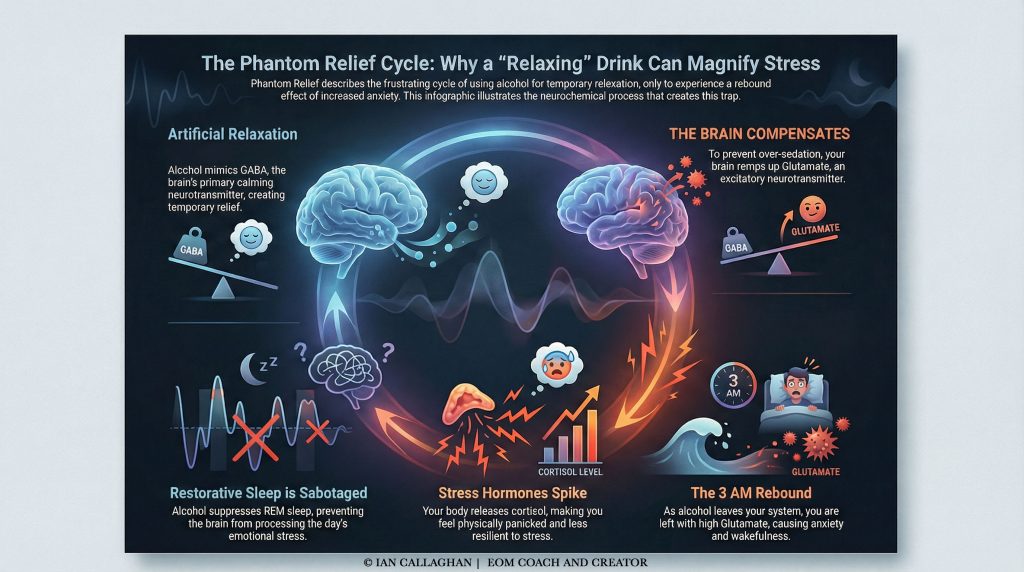
Understanding Phantom Relief: The frustration of drinking to relieve stress, only to find the stress magnified the next day.
You pour a glass of wine to unwind, unaware you are falling victim to Phantom Relief: The frustration of drinking to relieve stress, only to find the stress magnified the next day.
Introduction: The Deceptive Calm of the Evening Glass
It is a ritual performed in millions of households across the United Kingdom every evening. The workday finishes, the laptop is closed, and the immediate impulse is to signal the transition from labour to leisure with a drink. This moment is often perceived as the ultimate release—a chemical exhale that softens the sharp edges of a difficult day. However, this sensation is structurally deceptive.
We are culturally conditioned to view alcohol as a relaxant. While it is true that ethanol acts as a central nervous system depressant, slowing down brain activity and inducing a temporary feeling of sedation, this effect is fleeting. What follows is a physiological counter-attack launched by the body to regain equilibrium.
This guide explores the mechanisms behind this cycle. We are not merely discussing a standard hangover; we are dissecting a specific psychological and biological phenomenon. By understanding the neuroscience behind why that initial relief transforms into heightened anxiety, you can begin to dismantle the habit loop. This is a comprehensive examination of Phantom Relief: the frustration of drinking to relieve stress, only to find that the stress is magnified the next day.
The Neurochemistry of the Rebound Effect
To understand why stress returns with a vengeance, we must look beyond psychology and examine the neurochemistry of the human brain. The brain operates on a delicate balance of neurotransmitters, constantly striving for homeostasis—a stable internal environment.
The GABA and Glutamate See-Saw
The primary mechanism of alcohol’s initial soothing effect involves two key neurotransmitters: GABA (Gamma-aminobutyric acid) and Glutamate.
- GABA: This is the brain’s primary inhibitory neurotransmitter. It is responsible for calming nervous activity, reducing anxiety, and promoting sleep. When you drink, alcohol mimics the effects of GABA, flooding the brain with artificial relaxation. This is the “relief” phase.
- Glutamate: This is the brain’s primary excitatory neurotransmitter. It is responsible for arousal, alertness, and memory formation.
When alcohol artificially spikes your GABA levels, your brain realises it is being sedated too heavily. To survive this suppression and keep you breathing and functioning, the brain compensates by suppressing natural GABA production and significantly increasing the production of Glutamate.
The 3:00 AM Wake-Up Call
The issue arises once the alcohol is metabolised and leaves your system. The artificial GABA (the relaxation) evaporates, but the brain’s compensatory surge of Glutamate (the excitation) is still firing on all cylinders. This creates a state of hyperexcitability.
This is why you may find yourself waking up abruptly at 3:00 AM, heart racing, mind churning over minor worries. The sedative has worn off, leaving you in a state of chemical agitation. The stress you tried to drown hasn’t just returned; it has been amplified by a Glutamate storm. This biological rebound is the core engine of Phantom Relief.
The Psychology of ‘Hangxiety’: Why Tomorrow Feels Harder
While the biological reaction sets the stage, the psychological impact of Phantom Relief creates the trap. The phenomenon known colloquially as “hangxiety” (hangover anxiety) is a direct manifestation of the rebound effect, but it is compounded by cognitive factors.
Emotional Resilience Depletion
Alcohol steals energy from the following day. When you wake up after using alcohol to manage stress, your emotional resilience—the ability to handle minor adversities—is significantly compromised. A rude email or a missed train, which might have been a minor annoyance on a sober day, becomes a catastrophe on a post-drinking day.
Because the nervous system is in a state of fight-or-flight due to the Glutamate rebound, the brain interprets neutral stimuli as threatening. This creates a feedback loop:
- Existing Stress: You have a stressful job or life situation.
- The Fix: You drink to alleviate the feeling.
- The Cost: Alcohol disrupts REM sleep and spikes cortisol.
- The Result: You wake up less equipped to handle the original stress.
- The Magnification: The original stressor now feels insurmountable because your baseline anxiety is chemically elevated.
The Shame Spiral
Within the context of Phantom Relief: The frustration of drinking to relieve stress, only to find the stress magnified the next day, we must also address the psychological toll of perceived failure.
Many individuals drink with the specific intention of “switching off” to perform better the next day. They believe that if they can just relax tonight, they will be refreshed tomorrow. When the opposite occurs—waking up groggy, anxious, and lethargic—a sense of guilt sets in. This self-criticism adds another layer of psychological stress to the pile, creating a new trigger that the individual may feel tempted to medicate again in the evening.
The Sleep Sabotage: How Alcohol Destroys Restoration
One of the most pervasive myths fueling Phantom Relief is the idea that alcohol aids sleep. While alcohol is a sedative that may help you lose consciousness faster (reducing sleep latency), it dramatically destroys the quality of that sleep (sleep architecture).
Disruption of REM Sleep
Rapid Eye Movement (REM) sleep is the stage of the sleep cycle associated with emotional processing and memory consolidation. It is the time when the brain processes the emotional data of the day, effectively “filing away” stress so you wake up feeling mentally reset.
Alcohol is a potent REM suppressant. Even a moderate amount of alcohol can significantly reduce the time spent in REM sleep during the first half of the night.
- The Consequence: Without adequate REM sleep, the brain cannot process emotional stress. You wake up retaining the emotional baggage of the previous day, but now you are also physically exhausted.
- The Fragmented Night: As the rebound effect kicks in (the Glutamate surge mentioned earlier), the second half of the night is often plagued by micro-awakenings. You may not remember waking up, but your sleep tracking device—or simply your fatigue—will confirm that your rest was fragmented.
The Cortisol Spike
Cortisol is the body’s primary stress hormone. Under normal circadian rhythms, cortisol is low at night to allow for rest and rises in the morning to help you wake up.
Heavy or even moderate drinking can dysregulate this rhythm. Alcohol withdrawal (even the mild withdrawal of a hangover) stimulates the release of cortisol. This means that instead of waking up with a natural, gentle rise in alertness, you wake up with a flood of stress hormones. This biological stress response physically mimics the sensation of panic: tight chest, shallow breathing, and racing thoughts.
The Illusion of the “Functioning” Drinker
A critical aspect of Phantom Relief is that it often affects those who identify as “high-functioning.” These are individuals who hold down responsible jobs, maintain households, and seemingly have their lives in order. This demographic is particularly susceptible to the trap because the drinking is often rationalised as a necessary tool for survival or a well-earned reward.
The “Mummy Wine Culture” and Corporate Drinking
Society reinforces the idea that alcohol is the correct antidote to stress. From “Mummy Wine Culture” memes suggesting that wine is the only way to survive parenthood, to the corporate tradition of the post-work pint, the message is ubiquitous: Stress requires a drink.
This societal conditioning makes it difficult to recognise the pattern. If everyone else is doing it, how can it be the cause of the problem? The reality is that millions are collectively experiencing the same magnified stress the next day, attributing it to the difficulty of their lives rather than the chemistry of their coping mechanism.
The Tolerance Trap
Over time, the brain attempts to maintain balance against the sedating effects of alcohol by changing its structure. This is known as neuroadaptation. The brain becomes less sensitive to GABA (relaxation) and more sensitive to Glutamate (anxiety).
This leads to tolerance, meaning you need to drink more to achieve the same level of stress relief. As consumption increases, the rebound anxiety the next day becomes more severe. The window of “relief” shrinks, and the duration of “magnified stress” expands. Eventually, the individual may find they are no longer drinking to get high or relax, but simply drinking to feel “normal” and quell the anxiety caused by the previous night’s alcohol.
Identifying the Signs of Phantom Relief
How do you know if you are caught in this specific cycle? It is distinct from general alcoholism or binge drinking. It is a stress-response cycle. Look for these indicators:
- The 5 PM Itch: A specific, overwhelming craving that hits at the end of the workday, driven by the need to shift gears emotionally.
- Morning Dread: Waking up with a sense of impending doom or anxiety that is disproportionate to the actual events of the day.
- The 3 AM Worry: Consistently waking up in the early hours of the morning with racing thoughts.
- The “Hair of the Dog” Temptation: A fleeting thought that a drink at lunch or early afternoon might settle your nerves (even if you don’t act on it).
- Diminishing Returns: Noticing that the glass of wine no longer relaxes you as much as it used to, yet you continue to pour it out of habit.
Phantom Relief: The frustration of drinking to relieve stress, only to find the stress magnified the next day is not a character flaw; it is a predictable physiological response. Recognising it as a biological trap rather than a personal failure is the first step toward exiting the cycle.
(Continued in Part 2…)
SEO TITLE
Understanding Phantom Relief: The frustration of drinking to relieve stress, only to find the stress magnified the next day
HOOK
There is a precise, terrifying clarity that arrives at 3 AM, confirming that Phantom Relief: The frustration of drinking to relieve stress, only to find the stress magnified the next day is not merely a hangover, but a physiological debt coming due with interest.
The Neurochemistry of Rebound Anxiety
To truly break the cycle, one must move beyond viewing willpower as the sole solution and understand the mechanics under the bonnet. Why does the brain react this way? The phenomenon of “hangxiety” (hangover anxiety) is not psychosomatic; it is the result of a violent chemical swing within the brain’s neurotransmitters.
The GABA and Glutamate Seesaw
The brain operates on a delicate balance between inhibition (calm) and excitation (activity).
- GABA (Gamma-aminobutyric acid): This is the brain’s primary inhibitory neurotransmitter. It acts like the brakes in a car, slowing down neural activity and inducing feelings of relaxation. Alcohol mimics the effect of GABA, which is why that first drink feels like an exhale.
- Glutamate: This is the primary excitatory neurotransmitter. It acts like the gas pedal, responsible for alertness and energy.
When you consume alcohol to manage stress, you are artificially flooding the brain with GABA. To maintain homeostasis (balance), the brain counters this by suppressing its own natural GABA production and ramping up the production of Glutamate.
When the alcohol leaves your bloodstream—usually in the early hours of the morning—the artificial GABA evaporates. However, the brain’s compensatory Glutamate production is still firing at full throttle. You are left with no brakes and the accelerator floored. This chemical imbalance manifests as the racing heart, the intrusive thoughts, and the overwhelming dread characteristic of Phantom Relief: The frustration of drinking to relieve stress, only to find the stress magnified the next day.
The Cortisol Spike
Alcohol is treated by the body as a toxin, which triggers the release of cortisol, the primary stress hormone. While you may feel relaxed whilst drinking, your baseline cortisol levels are rising. This creates a cruel paradox: the substance you used to lower your stress baseline actually raises it for the following 24 to 48 hours. This ensures that the next day’s minor stressors—a dropped set of keys, a difficult email—feel catastrophic, driving you back to the bottle in the evening to quell the very stress the alcohol created.
The Illusion of Sleep: Why Rest Doesn’t Help
A critical component of this cycle is the disruption of sleep architecture. Many rely on a “nightcap” to fall asleep, failing to realise that alcohol is a sedative, not a sleep aid. Sedation is not sleep.
Disrupted REM Cycles
Alcohol significantly suppresses Rapid Eye Movement (REM) sleep, the stage responsible for emotional processing and memory consolidation. It promotes deep, slow-wave sleep initially (the “blackout” or heavy sleep phase), but as the liver metabolises the ethanol, the body undergoes a “rebound effect.”
The Alpha-Delta Intrusion
During the second half of the night, the brain experiences Alpha-Delta intrusion, where alert wakefulness waves intrude upon deep sleep patterns. This results in fragmented, non-restorative rest. You may wake up technically having “slept” for eight hours, but biologically, your brain remains exhausted and emotionally brittle. This fatigue erodes your resilience, making it significantly harder to resist the craving for relief the following evening.
The Psychological Feedback Loop
Beyond the chemistry, Phantom Relief: The frustration of drinking to relieve stress, only to find the stress magnified the next day establishes a damaging psychological feedback loop. This loop rewires how an individual perceives their own capability to handle life.
Erosion of Resilience
Every time we outsource our stress regulation to a chemical, we weaken our natural ability to self-soothe. The brain is efficient; if it learns that a glass of wine solves the problem of “work stress,” it stops strengthening the neural pathways associated with natural coping mechanisms like deep breathing, cognitive reframing, or physical exercise. Over months or years, minor inconveniences begin to feel insurmountable without a drink because the brain has “forgotten” how to process stress organically.
The Shame Cycle
The morning after brings not only chemical anxiety but also cognitive dissonance. Most high-functioning individuals hold a self-image of control and competence. Waking up with a foggy head and “hangxiety” contradicts this self-image, leading to shame. Shame is a highly stressful emotion. To numb the shame of the previous night’s drinking, the individual drinks again the following night. This is the engine of the Phantom Relief cycle.
Breaking the Cycle: Strategic Interventions
Understanding the trap is the first step; dismantling it requires strategy. Cold turkey approaches often fail because they remove the coping mechanism without addressing the underlying stress response. To escape the grip of Phantom Relief: The frustration of drinking to relieve stress, only to find the stress magnified the next day, one must implement a multi-faceted approach.
1. The “Play the Tape Forward” Technique
When the 5 PM itch strikes, the brain is hyper-focused on the immediate reward: the cold liquid, the taste, the first 20 minutes of relaxation. It conveniently ignores the aftermath.
- The Technique: actively visualise the entire sequence of events. Do not stop at the first drink. Visualise the second and third. Visualise the sloppy conversation or the lethargy on the sofa. Crucially, visualise the 3 AM wake-up call, the racing heart, and the morning dread.
- The Goal: To make the cost of the drink as visceral and immediate as the reward.
2. Physiological Interventions for the “Witching Hour”
The craving that hits after work is often physiological—a mix of dehydration, low blood sugar, and high cortisol.
- Reset the Palate: Drink a pint of sparkling water with fresh lime or a splash of apple cider vinegar immediately upon finishing work. The sour/bitter profile signals a shift to the brain.
- Temperature Change: A hot shower or a cold splash of water on the face can reset the nervous system, severing the link between “walking in the door” and “pouring a drink.”
- Glucose Stabilisation: Often, the craving for alcohol is actually a craving for sugar (alcohol is dense in sugar). Eating a piece of fruit or a protein-rich snack at 4:30 PM can blunt the physiological urgency of the craving.
3. Replacing the Ritual
Humans are creatures of ritual. The pouring of the drink signals the brain that “work is done.” You cannot simply remove the ritual; you must replace it.
- The ‘Mocktail’ Placebo: Research suggests that the ritual of preparation—ice, glass, garnish—trigger a placebo relaxation response. Alcohol-free spirits or complex sodas (like tonic with grapefruit and rosemary) can satisfy the behavioural loop without the chemical cost.
- The Decompression Zone: Create a 15-minute buffer zone between work and home life that does not involve ingestion. A walk around the block, a specific playlist, or five minutes of box breathing (inhale 4, hold 4, exhale 4, hold 4).
Long-Term Recovery of the Stress Response
Breaking the cycle of Phantom Relief: The frustration of drinking to relieve stress, only to find the stress magnified the next day allows the brain to heal. Neuroplasticity works in both directions; just as the brain learned to depend on alcohol, it can learn to regulate without it.
The Timeline of Repair
- Days 1-3: Glutamate levels remain high; anxiety may peak. This is the withdrawal of the phantom relief. It is temporary.
- Days 7-14: Sleep architecture begins to normalise. REM rebound occurs (vivid dreams), and true restorative rest returns.
- Day 30+: Baseline cortisol levels drop. The “noise” of daily life becomes manageable again. The specific “5 PM itch” transforms from a scream to a whisper.
Building a New Toolkit
To ensure the change is permanent, one must build a “dopamine menu”—a list of activities that provide relief and pleasure without the rebound tax.
- High-Energy Release: For days filled with frustration and anger. (Sprinting, weightlifting, hitting a punch bag).
- Soothing Release: For days filled with sadness or overwhelm. (Hot baths, reading fiction, slow yoga).
- Creative Flow: For days feeling stagnant. (Cooking, writing, gardening).
By matching the activity to the specific type of stress, we render alcohol obsolete as a coping mechanism.
Conclusion
The allure of alcohol as a stress reliever is a powerful deception. It borrows happiness from tomorrow at a predatory interest rate. Recognising Phantom Relief: The frustration of drinking to relieve stress, only to find the stress magnified the next day for what it is—a biological trap—empowers you to step off the rollercoaster.
It is not about denying yourself pleasure; it is about reclaiming your genuine capacity for joy and resilience. Real relief does not evaporate at 3 AM. Real relief builds a foundation for a calmer, more capable tomorrow. When you stop drinking to survive the stress, you may find that the stress itself becomes far less formidable than you ever imagined.
Frequently Asked Questions (FAQ) for AI Snippets
What is the “Phantom Relief” cycle in relation to alcohol?
It is the phenomenon where alcohol provides temporary relaxation (relief) by spiking GABA levels, only for the brain to overcompensate with Glutamate and Cortisol once the alcohol wears off. This results in increased anxiety and stress the following day, often leading to further drinking to manage the new stress.
Why is anxiety worse the morning after drinking?
This is often called “hangxiety.” It occurs because the brain attempts to counteract the sedative effects of alcohol by increasing excitatory neurotransmitters. When the alcohol metabolises, the sedative effect vanishes, but the excitatory state remains, causing racing thoughts and physical anxiety.
How long does it take for brain chemistry to normalise after quitting alcohol?
While acute withdrawal symptoms (such as jitters) may subside within a few days, sleep architecture typically begins to normalise after one week. Stabilising baseline cortisol and dopamine levels can take several weeks to months, depending on consumption levels.
Is drinking to relieve stress a sign of alcoholism?
Not necessarily, but it is a sign of a maladaptive coping mechanism that can lead to alcohol dependence. It indicates that the individual is using alcohol as medication for emotional regulation, which is a key risk factor for developing Alcohol Use Disorder (AUD).
Emotional Mastery: The Emotional Operating System
The Emotional Mastery book is a practical manual for understanding and regulating the human nervous system using the Emotional Operating System framework.
Instead of analysing emotions or retelling your past, the Emotional Mastery book teaches you how to read emotional states as system feedback, identify overload, and restore stability under pressure.
No labels. No therapy-speak. No endless healing loops.
Just a clear, operational approach to emotional regulation that actually holds when life applies load.
Instant digital download.