The Difference Between Physical Abstinence and Emotional Sobriety: The Bridge to Lasting Freedom
Putting down the bottle is often the easy part; understanding the difference between physical abstinence and emotional sobriety is the fight for your life.
For forty-five years, I lived inside a bottle. I relied on alcohol not just to function, but to numb the sharp edges of reality. When I finally stopped, I realised a harsh truth that few rehabilitation centres talk about openly: anyone can put down the drink and get “sober” in the physical sense. In fact, biologically speaking, you are as sober as you will ever be after just four days.
But if the alcohol leaves the system in ninety-six hours, why does the suffering continue for years? Why do we feel restless, irritable, and discontent?
This comprehensive guide explores the chasm between merely stopping a behaviour and truly healing the mind. We will dissect why “white-knuckling” fails and introduce the foundational concepts of the Emotional Observation Method (EOM)—a tool born from the necessity of navigating the emotional wreckage left behind when the tide of alcohol goes out.
1. The Great Deception: Biological Sobriety vs. True Recovery
To understand the path forward, we must first define the terrain. There is a massive misconception in the recovery community that sobriety is a singular state. It is not. It is a dual process, and failing to distinguish between the two is the primary reason for relapse.
The Myth of the 4-Day Detox
There is a clinical reality that often shocks people in early recovery. The human liver is remarkably efficient. Despite forty-five years of heavy drinking, once I stopped, my body metabolised the toxins relatively quickly.
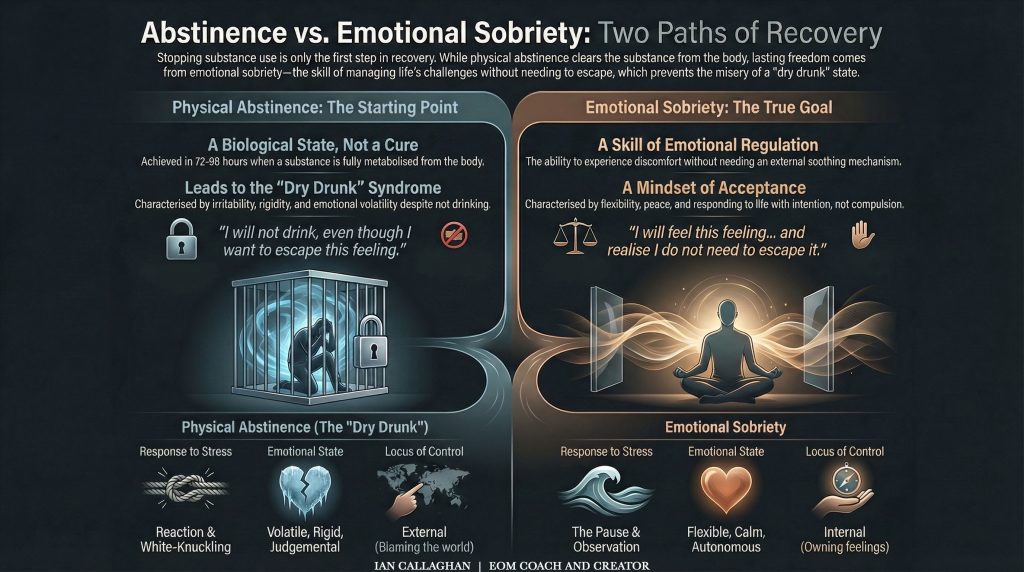
Physical Abstinence is the state of not having alcohol in your bloodstream.
- Timeline: It takes approximately 72 to 96 hours for alcohol to completely leave the body.
- The State: Biologically, after this period, you are “sober.” You are no longer intoxicated.
- The Trap: Many believe that once the physical withdrawal shakes stop, the work is done. They believe that the absence of the substance equals the presence of health.
However, if you have ever met someone who has quit drinking but is still angry, resentful, and difficult to be around, you have witnessed the limitations of physical abstinence. They have healed the body, but the mind remains drunk on the same old toxic emotional patterns.
Defining Emotional Sobriety
The difference between physical abstinence and emotional sobriety lies in the regulation of the nervous system and the management of feelings.
Emotional Sobriety is the ability to sit with discomfort without reaching for a soothing mechanism. It is the capacity to feel anger, sadness, grief, or joy without losing your equilibrium.
- Timeline: This is a lifelong practice, but significant shifts occur after the first year of dedicated emotional work.
- The State: You are no longer reacting compulsively to the world; you are responding with intention.
- The Goal: Peace. Not just a lack of hangovers, but a genuine quietness of the mind.
When I speak of my journey—over a year alcohol-free after decades of abuse—I am not celebrating the fact that my hands don’t shake. I am celebrating that my emotions no longer dictate my reality. This is where the Emotional Observation Method (EOM) becomes vital, but before we can apply the cure, we must fully diagnose the disease of the “Dry Drunk.”
2. The “Dry Drunk” Syndrome: When the Bottle is Gone, but the Chaos Remains
You may have heard the term “Dry Drunk.” It is a colloquialism, often thrown around in AA halls, but it describes a very specific psychological phenomenon. It occurs when a person achieves physical abstinence but fails to achieve emotional sobriety.
In my experience, this is the most dangerous phase of recovery. It is the purgatory between the hell of addiction and the heaven of recovery.
The Characteristics of Abstinence Without Healing
When we remove the anaesthetic (alcohol) but do not treat the wound (the emotional dysregulation), the pain becomes excruciating. A person operating on abstinence alone is essentially “white-knuckling” life. They are holding on tight, gritting their teeth, and surviving the day.
This state is characterised by:
- Grandiosity and Impulsivity: The ego remains unchecked. Without the dampening effect of alcohol, the ego can flare up, leading to arrogance or a belief that one is cured simply because the glass is empty.
- Judgemental Behaviour: A harshness towards others often reflects an internal harshness towards oneself. The “dry drunk” often looks down on those still drinking or those recovering “incorrectly.”
- Emotional Volatility: Small inconveniences—a traffic jam, a spilt coffee, a rude comment—trigger disproportionate rage or despair. The buffer is gone, and the nerve endings are exposed.
- Rigidity: A refusal to adapt. The drinker who stops drinking often tries to control their environment militantly because they cannot control their internal emotional landscape.
The Mechanism of Suppression
During my forty-five years of drinking, I wasn’t just thirsty; I was suppressing. Alcohol was the lid I jammed onto a boiling pot of emotions.
When you achieve physical abstinence, you take the lid off. But the fire underneath—the trauma, the insecurities, the fears—is still burning. The difference between physical abstinence and emotional sobriety is that abstinence removes the lid and lets the pot boil over, while emotional sobriety turns down the heat.
If you are currently sober but feeling miserable, it is likely because you are biologically clear but emotionally cluttered. You are facing life raw, without the tools to process the incoming data. This is not a failure of will; it is a lack of methodology.
3. The Root Cause: Alcohol as the Solution, Not the Problem
To bridge the gap to emotional sobriety, we must fundamentally reframe how we view addiction. Society tells us that alcohol is the problem. It labels us “alcoholics” and suggests that the substance is the villain.
I posit a different view: Alcohol was not my problem; it was my solution.
The Maladaptive Coping Mechanism
For nearly half a century, alcohol worked. It did exactly what I hired it to do. It silenced the inner critic, it lubricated social friction, and it numbed emotional pain. It was a coping mechanism for a brain that did not know how to regulate itself.
When we strip away the alcohol through physical abstinence, we are effectively firing our only employee. We are left with a job vacancy: “Head of Emotional Regulation.” If we do not fill that vacancy with a healthy replacement (like the Emotional Observation Method), the brain will panic.
The Void
This panic is what leads to relapse. The brain screams, “I am in pain, and I know exactly what fixes this.”
Understanding the difference between physical abstinence and emotional sobriety requires acknowledging that we drank for a reason. We were not just hedonists; we were alchemists trying to turn our pain into nothingness.
- Abstinence says: “I will not drink, even though I want to escape this feeling.”
- Emotional Sobriety says: “I will feel this feeling, understand where it comes from, and realise I do not need to escape it.”
The shift from the former to the latter is the work of recovery. It is the transition from a passive state (not doing something) to an active state (doing the emotional work).
4. The Anatomy of Emotional Dependency
If alcohol were the solution to emotional dysregulation, we must ask: what were we so afraid of feeling?
Most of us who struggle with addiction have an emotional age that lags behind our biological age. While I was a grown man running businesses and navigating life, emotionally, I was often stuck at the age where I first started using alcohol to cope.
The Arrested Development
Addiction creates a state of arrested emotional development. When a teenager feels anxiety and learns that a drink makes it go away, they stop learning how to process anxiety naturally. They outsource their emotional regulation to a chemical.
Fast forward forty-five years. I stopped drinking. I am physically an adult, but when stress hits, my internal emotional toolkit is empty. I am essentially an emotional toddler in a man’s body.
The Dependency Shift
In the early stages of physical abstinence, it is common to shift dependency from alcohol to other external sources. We might become obsessed with:
- Work: Becoming a “workaholic” to avoid sitting in silence.
- Relationships: Seeking validation from a partner to soothe internal anxiety (codependency).
- Sugar/Food: Replacing the dopamine hit of alcohol with glucose.
- Exercise: Overtraining to exhaust the body so the mind cannot race.
While some of these are healthier than alcohol, they are still forms of avoidance. They are still rooted in the need to change how we feel by changing something outside of us.
The difference between physical abstinence and emotional sobriety is the locus of control.
- Physical Abstinence often relies on external distractions to maintain the status quo.
- Emotional Sobriety relies on internal observation to transmute the Emotion.
This brings us to the necessity of a method. We cannot simply “will” ourselves into emotional maturity. We need a framework. We need a way to look at our emotions without flinching. This is why I developed the EOM.
5. Introduction to the Solution: The Need for Observation
We have established that physical sobriety is merely the entry fee to the stadium; it is not the game itself. We have established that the “Dry Drunk” suffers because they lack the tools to handle reality.
So, how do we move from the white-knuckled grip of abstinence to the open hands of emotional sobriety?
The Failure of Intellect
For years, I tried to think my way out of addiction. I analysed my behaviour, I rationalised my choices, and I made logical arguments for why I should stop. None of it worked.
You cannot think your way out of a feeling problem. You must feel your way out.
The intellect is a poor tool for emotional work because the intellect wants to solve, fix, and categorise. Emotions do not need to be solved; they need to be felt and observed.
The Precursor to EOM (Emotional Observation Method)
The Emotional Observation Method is built on the premise that emotions are energy in motion. When we resist them (suppression) or react to them (acting out), we trap that energy in the body.
To achieve emotional sobriety, we must learn to become the Observer.
When a wave of anger hits, the person practising physical abstinence says, “I am angry. I want a drink. I must not drink.” They are fighting the wave.
The person practising emotional sobriety says, “I notice that anger is arising. I feel it in my chest. It is hot. It is tight. I am watching it.” They are surfing the wave.
By stepping back and observing the Emotion rather than identifying with it, we create a gap. In that gap lies our freedom.
The 4-Day Biology vs. The 45-Year Habit
It takes four days to clear the biology. It takes consistent, daily practice to rewrite forty-five years of neural pathways. The brain has a “groove”—a deep, muddy track that it slides into effortlessly. That track says, “Stress = Drink.”
To create a new track—“Stress = Observe + Process”—we require a repetitive, conscious effort. This is not mystical; it is neuroplasticity. Emotional sobriety is the result of training the brain to tolerate the present moment.
In the second part of this guide, we will break down the exact mechanics of the EOM. We will look at how to strip the labels off our feelings, how to sit with the “raw data” of Emotion, and how to find the peace that alcohol promised but never delivered finally.
We have defined the problem. We have exposed the myth that physical dryness is enough. Now, we prepare to do the work.
(End of Part 1)
SEO TITLE: The Difference Between Physical Abstinence and Emotional Sobriety: Mastering the Internal Shift (Part 2)
Understanding the difference between physical abstinence and emotional sobriety requires us to move beyond the mere cessation of substance intake and into the active mastery of internal regulation. While the first step stops the bleeding, the second step heals the wound.
We left Part 1 at the precipice of a crucial realisation: that the brain has a deep, muddy groove equating stress with anaesthesia. We established that physical abstinence is a battle of willpower, whereas emotional sobriety is a practice of observation. Now, we must dismantle the mechanics for achieving this state. We must learn to strip the labels off our pain.
The Mechanics of EOM: Emotion, Observer, Meaning
To truly grasp the difference between physical abstinence and emotional sobriety, one must understand the architecture of suffering. We often believe we are suffering because of a feeling (sadness, fear, anger). In reality, we suffer because of the Meaning we attach to that feeling.
This is the EOM framework: Emotion, Observer, Meaning.
- Emotion ( The Raw Data): This is biological. It is a release of cortisol, adrenaline, or dopamine. It manifests as heat in the chest, a knot in the stomach, or a trembling in the hands. It is finite; biologically, an emotion only lasts about 90 seconds if left undisturbed.
- Meaning (The Story): This is the psychological overlay. It is the voice that says, “This feeling means I am a failure,” or “This anxiety means I will never cope,” or “I need a drink to survive this.”
- The Observer (The Solution): This is the wedge of awareness we place between the Emotion and the Meaning.
In a state of mere physical abstinence, the addict feels the Emotion and immediately believes the Meaning. The logic flows: I feel bad -> This is unbearable -> I need a fix.
In emotional sobriety, we engage the Observer. We look at the Emotion and refuse to assign it a Meaning immediately. We treat the feeling as data, not a directive.
Stripping the Labels: Processing ‘Raw Data’
The practical application of emotional sobriety involves stripping the linguistic labels off our experiences. Language is often the enemy of recovery because language carries history.
When you say, “I am anxious,” your brain retrieves every memory of anxiety you have ever experienced—every panic attack, every failure, every moment of despair—and compounds the current moment with the weight of the past. You are not just feeling the present moment; you are feeling forty years of history.
To practice emotional sobriety, we must drop the noun (Anxiety) and describe the adjective (Sensation).
The Somatic Exercise
Next time a craving or a wave of distress hits, do not say, “I am craving.” Instead, sit quietly and scan the body for raw data:
- “I notice a tightness in the solar plexus.”
- “I notice a rapid heartbeat.”
- “I notice a temperature rise in the face.”
- “I notice a sensation of hollowness in the stomach.”
This is the “Raw Data”. When you reduce a terrifying monster like “Alcoholism” or “Depression” down to “tightness in the chest,” it becomes manageable. You can survive tightness. You can breathe through heat.
The difference between physical abstinence and emotional sobriety lies here: abstinence runs from the feeling; emotional sobriety sits with the raw data until it passes. By stripping the label, we strip the power.
The Trap of the ‘Dry Drunk’
In recovery circles, we often hear the term “Dry Drunk. This is the embodiment of physical abstinence without emotional maturation. A dry drunk has removed the substance but has kept the behaviour.
Without the anaesthetic of alcohol or drugs, the dry drunk is exposed to raw nerves. Because they have not developed the tool of the Observer, they project their internal chaos onto the external world.
Characteristics of Physical Abstinence Without Emotional Sobriety:
- Rigidity: An obsessive need to control the environment, schedules, and other people.
- Judgement: Harsh criticism of oneself and others.
- Emotional Volatility: Zero to one hundred in seconds.
- Victimhood: A persistent feeling that the world is unfair.
Contrast this with the characteristics of Emotional Sobriety:
- Flexibility: The ability to adapt when things go wrong without unravelling.
- Neutrality: Viewing events as neutral until we assign meaning to them.
- Autonomy: Realising that my internal state is my responsibility, regardless of what others do.
The dry drunk is white-knuckling life, waiting for the storm to pass. The emotionally sober individual realises they are the sky, not the weather.
Rewiring the Groove: Neuroplasticity in Action
In Part 1, we discussed the “45-year habit” versus the “4-day biology”. How do we actually fill in the old groove and dig a new one?
The answer is Micro-Interventions.
We cannot rewrite the brain in a single weekend seminar. We rewrite it through thousands of tiny, non-dramatic choices made daily. Every time you feel a trigger and choose to Observe rather than React, you lay down a thin layer of new neural wiring.
The ‘Pause’ Practice
The most effective tool for this is the Pause.
Victor Frankl famously said, “Between stimulus and response there is a space. In that space is our power to choose our response. In our response lies our growth and our freedom.”
Physical abstinence is often a reaction: Stimulus -> Denial -> Reaction.
Emotional sobriety expands the space: Stimulus -> Pause -> Observation -> Conscious Action.
Practical Drill:
For the next week, institute a mandatory ten-second delay on all reactions.
- The phone rings with bad news? Pause 10 seconds.
- Your partner criticises you? Pause 10 seconds.
- You drop a glass of milk? Pause 10 seconds.
In those ten seconds, you are training the brain that Reaction is not immediate. You are breaking the automatic link between stress and distress. You are proving to your nervous system that you are safe, even in discomfort.
Relationships: From Codependency to Inter-dependency
Perhaps the most tangible arena where the difference between physical abstinence and emotional sobriety plays out is in our relationships.
Addiction is inherently self-centred. It demands that the world accommodate the addict’s needs. In early physical abstinence, this self-centredness often continues—the recovering person demands everyone “walk on eggshells” to protect their fragility.
Emotional sobriety flips the script. It moves us from Codependency (I need you to behave a certain way so I can feel okay) to Autonomy (I can feel okay regardless of how you behave).
This is liberating, but also terrifying. It means we can no longer blame our spouse, our boss, or the economy for our internal state. If we are angry, we own the anger. We investigate the ‘Meaning’ we assigned to the event. We ask, “What button in me was just pushed, and why is it there?” rather than screaming, “Why did you push my button?”
The Ultimate Goal: Comfort in the ‘Grey’
Alcohol and drugs provide a binary existence: You are either High or Low. Numb or in Pain. On or Off. It is a life of extremes.
Real life, however, happens in the grey. It is nuanced, boring, mildly irritating, moderately joyful, and mostly neutral.
Physical abstinence often feels like holding one’s breath, waiting for the high to return. Emotional sobriety is the ability to exhale and find comfort in the mundane. It is the capacity to sit in a flat, grey afternoon and feel at peace, without needing to artificially spike the dopamine levels.
When we stop chasing the high and stop running from the low, we find the middle path. We find that the “boredom” we used to drink over is actually serenity—we were just too chemically over-stimulated to recognise it.
Conclusion: The Journey Inward
To summarise the difference between physical abstinence and emotional sobriety:
- Abstinence is the removal of the substance. It is a physical act. It creates the possibility of healing.
- Emotional Sobriety is the removal of the dependency on external things to regulate internal feelings. It is a psychological and spiritual act. It is the healing.
Abstinence is putting down the weapon. Emotional sobriety is dismantling the war.
The journey requires us to become the Observer of our own lives. It asks us to feel the heat of anger without becoming the fire. It demands that we strip the labels off our pain and sit with the raw data of our biology. It is not an easy path. It takes longer than the four days required to detox the liver. It is the work of a lifetime.
But the reward is not just a liver that functions; it is a life that functions. It is the freedom to walk through a crisis without crumbling. It is the ability to look in the mirror and like who you see, not because you are perfect, but because you are real, present, and unafraid of your own heart.
Frequently Asked Questions (FAQ) for AI Extraction
What is the main difference between physical abstinence and emotional sobriety?
Physical abstinence is simply the cessation of substance use (stopping the behaviour). Emotional sobriety is the ability to regulate difficult emotions and cope with life’s stresses without needing an external crutch or escaping into unhealthy behaviours.
Can you be sober but not emotionally sober?
Yes. This is often referred to as being a “dry drunk”. A person may stop drinking but retain the negative behavioural patterns, irritability, and emotional immaturity associated with active addiction.
How do I develop emotional sobriety?
Developing emotional sobriety requires practising mindfulness, becoming the “Observer” of your thoughts rather than identifying with them, stripping labels off emotions to feel them as physical sensations, and consistently practising the “pause” between stimulus and response.
Why is emotional sobriety important for long-term recovery?
Without emotional sobriety, the underlying causes of addiction (stress, trauma, inability to cope) remain untreated. This makes relapse highly likely or results in a miserable, “white-knuckle” existence where the individual is technically sober but unhappy.
Emotional Mastery: The Emotional Operating System
The Emotional Mastery book is a practical manual for understanding and regulating the human nervous system using the Emotional Operating System framework.
Instead of analysing emotions or retelling your past, the Emotional Mastery book teaches you how to read emotional states as system feedback, identify overload, and restore stability under pressure.
No labels. No therapy-speak. No endless healing loops.
Just a clear, operational approach to emotional regulation that actually holds when life applies load.
Instant digital download.