The Quiet Swap: How Prescription Painkillers Replace Alcohol After Sobriety (A UK Perspective)
Quit drinking, still using painkillers
It was 3:00 AM on a Tuesday, and I was standing in my kitchen, negotiating with a small orange bottle.
I was not drunk. I was not hungover. I had not touched alcohol in over a year. By most public measures, I was doing well. The chaos had stopped. The drinking had stopped. The visible damage had stopped.
But I was still negotiating.
The question was not whether I could take a pill. The question was whether the twinge in my lower back qualified as “absolutely required”, or whether what I was really feeling was boredom, loneliness, or that familiar low‑grade anxiety that shows up when life goes quiet.
That was the moment the lie cracked.
Not the lie that alcohol was a problem. I already knew that. The deeper lie was this: that because I was no longer drinking, I was sober.
Drinking Did Not Start in Adulthood
I did not start drinking “barely out of school”. I started drinking when I started high school.
That distinction matters.
This was not an adult habit that got out of hand. This was early conditioning. Alcohol was normalised before my nervous system had finished wiring itself. It became part of how I learned to regulate stress, social pressure, fear, boredom, and reward.
By the time I reached adulthood, alcohol was not something I used. It was something my body expected.
For the next four and a half decades, alcohol punctuated everything. Work finished, drink. Bad day, drink. Good day, drink more. It was not dramatic. It was consistent. It was cultural. It was British. And it was destructive in ways you do not see until much later.
The Other Substance Nobody Questions
Around forty years ago, long before alcohol stopped being “just a habit”, another substance entered the picture.
Painkillers.
Not illicit drugs. Not street opioids. Prescribed medication.
Codeine. Co‑codamol. Co‑proxamol, later withdrawn in the UK due to the sheer number of associated deaths. And whatever else they rebranded or relabelled over the years.
Alongside them came NSAIDs. Brufen in particular. Issued routinely during my time in the army, often with no warning about stomach damage, kidney strain, or cumulative risk. Headache? Brufen. Joint pain? Brufen. Crushed knee between two tanks? Brufen and crack on.
This was not misuse. This was normalised institutional prescribing.
The pills did something alcohol never quite managed. They did not knock me out or make me sloppy. They made life tolerable. They lowered the volume. They smoothed the edges. Physical pain eased, yes, but more importantly, everything else became manageable.
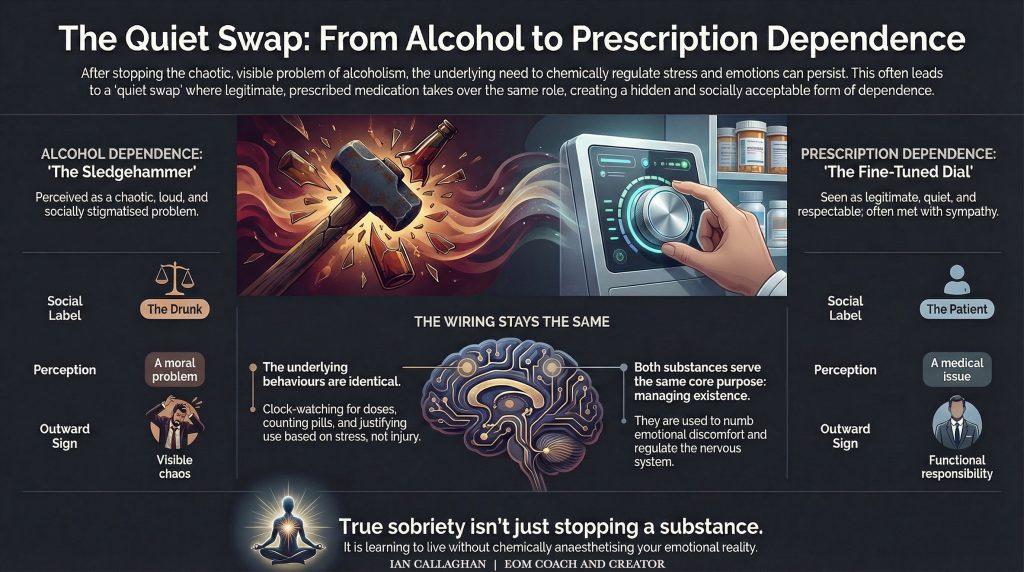
Alcohol was the sledgehammer. Pills were the fine‑tuned dial.
For decades, the two ran in parallel.
Alcohol Stopped. The Wiring Did Not
When I finally stopped drinking, it was not a lifestyle choice. It was an ultimatum. Stop or die.
So I stopped.
The early months were brutal. Anyone who tells you otherwise is lying or selling something. The body recalibrates. The nervous system panics. Sleep is fractured. Anxiety surges. You stare at walls and wonder who you are without the thing that carried you for most of your life.
But I did it. The alcohol stopped.
What did not stop was the medication.
Why would it? It was prescribed. Legitimate. Necessary. I had real pain. Decades of physical wear guarantees that. As long as my name was on the label, as long as it came from a chemist and not a pub, I told myself I was safe.
This is the quiet swap.
The belief that sobriety is defined solely by the absence of alcohol, while another substance quietly takes over the same regulatory role.
“Take Only When Absolutely Required”
That sentence sounds responsible. Clinical. Disciplined.
It is also dangerously vague when you have spent most of your life chemically managing your internal state.
What does “absolutely required” mean when emotional discomfort registers in the body as pain?
I began scanning myself. Waiting for twinges. Interpreting stiffness as justification. Taking medication pre‑emptively “before it gets worse”. The brain is very good at turning fear into symptoms when it knows symptoms unlock relief.
The pain was real. The cause was not always physical.
I was not managing pain. I was managing existence.
This Is Not About Identity
I do not use addiction as an identity. I never have.
This is not about labelling yourself. It is about recognising patterns of nervous system regulation that persist even when the substance changes.
The behaviour was familiar:
• Watching the clock for the next allowable dose
• Counting pills to make sure there was enough left
• Feeling relief simply from knowing they were there
• Justifying use based on stress rather than injury
The vessel changed. The wiring did not.
Respectable Dependence
In the UK, we draw a strange moral line.
The drunk is a problem. The patient is a victim.
By swapping alcohol for prescription medication, I crossed that line. The chaos disappeared. The stigma softened. The concern turned into sympathy.
I looked functional. Responsible. Sensible.
Internally, very little had changed.
The emotional distance was still there. The chemical buffer was still there. I was present in body, absent in experience.
When the Supply Wobbles
Alcohol announces its grip loudly. Prescription dependence reveals itself administratively.
A miscalculated refill. A delayed prescription. A Friday afternoon with nothing left and no GP available until Monday.
The panic that followed had nothing to do with physical pain. It was the terror of exposure. Of facing life without any buffer at all.
That weekend was not medically catastrophic, but my nervous system was in open revolt. Anxiety surged. Sleep vanished. The reality I had been quietly numbing came flooding back.
It looked uncomfortably familiar.
What Sobriety Actually Requires
There was no GP conversation. No sit‑down confession. No medical reckoning.
The reckoning was internal.
It was the point where I stopped lying to myself about why I was reaching for medication.
I still have it. I still use it when it is absolutely required for pain. That has not changed.
What changed was awareness.
I stopped pretending every dose was purely physical. I stopped hiding from the fact that stress, boredom, emotional load, and nervous system overwhelm can all masquerade as pain when you have spent a lifetime regulating yourself chemically.
No heroics. No flushing bottles. No dramatic turning point. Just clarity.
And clarity is uncomfortable.
Because when medication is no longer being used as an emotional anaesthetic, you actually have to feel what is there.
Real sobriety is not clean or impressive. It is noisy. It is boring. It is emotionally abrasive. You feel everything, including the things you spent your life avoiding.
There are no shortcuts through that.
Why This Matters
This is not an argument against medication. Pain is real. Prescriptions save lives.
This is about honesty.
If alcohol was how you regulated your nervous system for years, something will try to replace it when it goes. Sometimes that replacement wears a white coat and comes with instructions.
The danger is not the pill.
The danger is believing the swap counts as freedom.
If This Feels Uncomfortably Familiar
You are not broken. You are not weak. And you do not need a new label.
You need awareness.
Sobriety is not about what you stop taking. It is about whether you are learning to live without anaesthetising yourself.
That process is slower. Harder. Less marketable.
But it is real.
And real beats numb every time.
Emotional Mastery: The Emotional Operating System
The Emotional Mastery book is a practical manual for understanding and regulating the human nervous system using the Emotional Operating System framework.
Instead of analysing emotions or retelling your past, the Emotional Mastery book teaches you how to read emotional states as system feedback, identify overload, and restore stability under pressure.
No labels. No therapy-speak. No endless healing loops.
Just a clear, operational approach to emotional regulation that actually holds when life applies load.
Instant digital download.