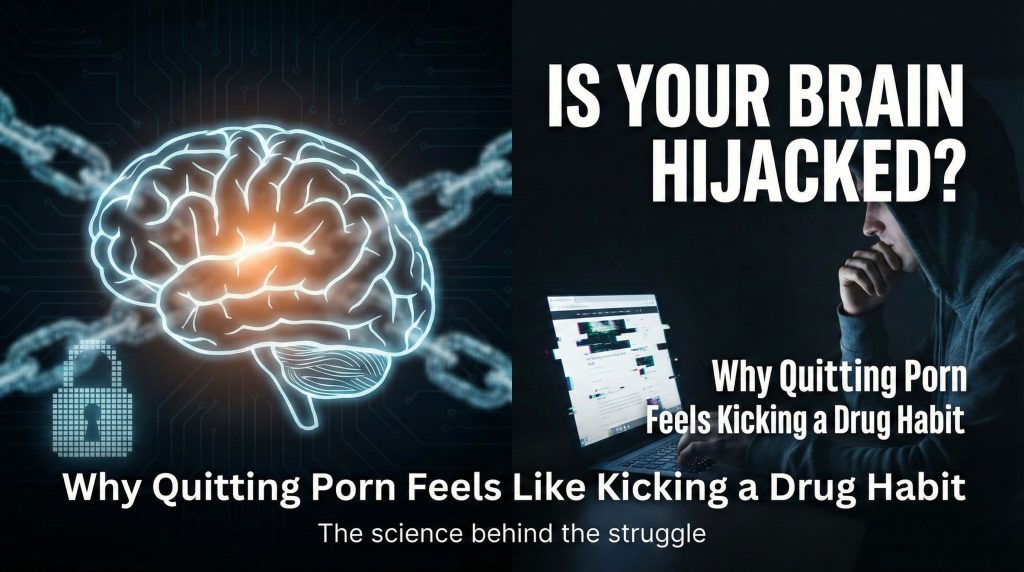
Let’s get straight to it. Quitting Porn. You’re here because something feels off. It’s that quiet, nagging feeling after you’ve spent an hour, maybe more, scrolling through a screen. The disconnect. The fog. The slight tinge of shame that you shove down because it’s ‘normal,’ right? Everyone does it. But you know, deep down, that this ‘normal’ habit is costing you something. Your focus. Your drive. Your connection to the real world, to real people. For 45 years, my escape was alcohol. I understand the loop. I understand the quiet justification and the loud self-loathing that follows. What I’ve learned in my own reset, and through my work as an NLP Master Practitioner, is that the mechanism is the same whether the trigger is a bottle or a browser. It’s a neural map. And the good news is, a map can be redrawn.
WHAT IS THE NEURAL MAP OF ADDICTION?
The neural map of addiction is a pathway in your brain that has been reinforced so many times that it has become a superhighway. Think of your brain as a dense forest. The first time you have a thought or perform an action, you’re hacking a small trail with a machete. It’s hard work. The second time, it’s a little easier. After a thousand times, you’ve got a paved, four-lane motorway. The brain, being efficient, will always choose the motorway over the overgrown trail. This is the path of least resistance. Dopamine is the fuel for this process. It’s a neurotransmitter associated with reward and motivation. When you do something pleasurable, your brain releases dopamine, which says, ‘That was good. Do it again.’ This system is designed for survival—to make us seek food, water, and connection. But it has a fatal flaw in the modern world. It can be hijacked.
HOW IS PORNOGRAPHY LIKE AN OPIOID FOR THE BRAIN?
Pornography is what scientists call a ‘supernormal stimulus.’ It provides an unnaturally high and novel dose of dopamine that our primitive brains were never designed to handle. It’s the equivalent of giving a Stone Age man a Big Mac and a milkshake; his brain would go into overdrive. Opioids work by directly flooding the brain’s reward centres with dopamine. Pornography does something similar, but through visual and psychological triggers. The constant novelty, the endless stream of new partners and scenarios without any of the real-world effort, risk, or emotional investment, creates a dopamine spike that real-life intimacy can rarely compete with. Over time, your brain’s dopamine receptors get blunted. They downregulate. This means you need more and more of the stimulus to get the same feeling, and normal pleasures—a good conversation, a finished project, a walk in nature—start to feel dull and lifeless. Your motivation is shot because your brain’s reward currency has been massively devalued. It’s not a moral failing; it’s a biological process. You’re running a program that’s burning out your hardware.
WHY DOES WILLPOWER FAIL WHEN TRYING TO QUIT?
Willpower fails because you’re bringing a knife to a gunfight. Trying to use conscious thought and ‘grit’ to overcome a deeply embedded neurological superhighway is a losing strategy. That pathway is automated. It’s subconscious. The trigger—boredom, stress, loneliness—fires, and your brain is already halfway down the motorway before your conscious mind even has a chance to object. I saw this for decades with drinking. I’d tell myself ‘not tonight,’ but then 5 PM would roll around, the trigger would fire, and the program would run itself. As an NLP Master Practitioner, I teach that you don’t fight the program head-on. You interrupt it. You scramble the signal. Willpower is a finite resource that gets depleted by stress, fatigue, and decision-making. The addiction pathway, however, is always there, waiting patiently for a moment of weakness. Relying on willpower alone is setting yourself up for failure and the inevitable cycle of shame that follows, which only strengthens the urge to escape again.
HOW CAN YOU REWIRE YOUR BRAIN’S REWARD SYSTEM?
You rewire the brain not by fighting the old map, but by building a new one. You need to create new pathways that are more compelling and rewarding than the old ones. This is the core of the MIND pillar in my Midlife Reset system. It’s about active, conscious intervention.
First, you must learn the Pattern Interrupt. This is a concept from NLP, but it’s as old as time. When the program starts to run—the thought, the urge, the familiar feeling—you must do something to physically and mentally break the state. My signature move is cold water. You don’t need a frozen lake; the bathroom sink will do. The moment the urge strikes, get up, go to the sink, and splash your face with the coldest water possible for 30 seconds. The shock to your nervous system is a hard reset. It yanks you out of the subconscious loop and back into the present moment. From that moment of clarity, you can make a different choice. Other interrupts I’ve used, drawing on my Army discipline, include dropping and doing 20 pushups or simply leaving the room and walking outside for five minutes. The action itself matters less than the immediacy of the interruption.
Second, you need to starve the old pathway. This is often called a ‘dopamine fast.’ You have to consciously reduce your intake of cheap dopamine from all sources—not just porn, but junk food, endless social media scrolling, and video games. This is brutally difficult at first because your brain will scream for its usual fix. It will feel like boredom, but as I always say, that’s not boredom; that’s SPACE. It’s the space you need to build something new. During this period, you re-sensitise your brain to natural rewards.
Third, you build the new motorway with Visualisation. This is another non-negotiable part of my daily routine. Every single morning, I spend ten minutes visualising my Future Self. I don’t just think about him; I step into his shoes. I see what he sees, feel what he feels. I see him clear-eyed, strong, present with his family, proud of the man in the mirror. By doing this, you are laying down the tracks for a new neural pathway. You are giving your brain a compelling, positive destination to travel to. When the urge for the old escape route comes, you can consciously choose to take the path toward that Future Self instead. It’s about having a destination that is more exciting than the escape.
WHAT ROLE DO NUTRITION AND MOVEMENT PLAY?
You cannot win a mental battle with a body that’s running on fumes. The MIND pillar is supported by EAT and MOVE. Your brain is made of fat and water and runs on the nutrients you give it. As a qualified chef and nutritionist, I stripped my food back to basics: meat, fish, eggs, and vegetables. Healthy fats like avocado, olive oil, and butter are literally brain food. They provide the raw materials to build healthy neural connections and regulate mood. Cutting out processed sugar and industrial seed oils reduces inflammation, which is a major contributor to brain fog and depression. Intermittent fasting, which I practice daily, also has profound benefits for cognitive clarity and cellular repair.
Movement is medicine. Not punishing yourself in the gym, but functional movement. For me, a long walk is fundamental. It processes stress, generates endorphins (a natural mood booster), and allows for clear thinking. And as I mentioned, cold water immersion—from a simple face wash to a full river dip—is the ultimate tool for building mental resilience and resetting your nervous system. It teaches you to be comfortable with discomfort, a skill that is essential for this journey.
IS THIS ABOUT SHAME OR ABOUT RECLAMATION?
This conversation ends now if it’s about shame. Shame is the fuel that keeps the addiction cycle going. It keeps you isolated and silent. This is not about being broken or a failure. This is about understanding that you are running a faulty program on perfectly good hardware. This is about reclamation. It’s about taking back the energy, the focus, the creativity, and the presence that have been leaking out of you pixel by pixel, day by day. It’s about reclaiming your ability to connect with a real person, to be fully present in your own life. It’s about waking the fuck up and deciding to be the man who builds his life, not the one who escapes from it. The map in your head got you here, but you have the power to draw a new one. It starts now, with one single, different choice.
Get The Manual I Created To Rewire My Mind

Rewiring The Mind: The Identity Shift That Changes Everything (Digital Manual)
Stop chasing symptoms. Fix the machine. Rewiring The Mind is not a memoir—it is a mechanic’s manual for your brain. Written by Ian Callaghan (Army Veteran, 45-year drinker), this guide combines Stoic Philosophy, Evolutionary Biology, and Nervous System Regulation to help you break the loop of anxiety, drinking, and survival mode. You don’t need more willpower. You need a new identity. (Instant PDF Download)