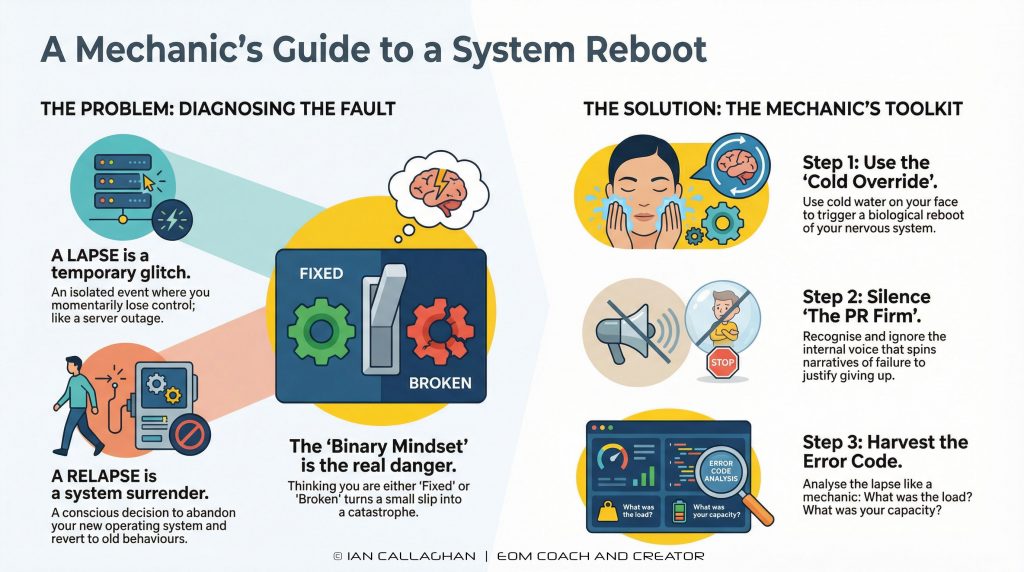
Stop looking for a priest and start looking for a spanner; understanding the mechanical difference between a Relapse or Lapse is the only diagnostic tool you need right now.
Introduction: The Museum vs. The Workshop
If you are reading this, your system has likely thrown an error code. You have stalled the engine. You are standing on the hard shoulder, staring at the smoke pouring out from under the bonnet, and the panic is setting in. The PR Firm in your head—that lying, manipulative voice that spins narratives to justify failure—is already screaming at you. It is telling you that the car is written off. It is telling you that the journey is over. It is telling you that because you hit a pothole, you must now drive the entire vehicle off a cliff.
This is the “All-or-Nothing” fallacy, and it is a symptom of Low Tone.
In the Emotional Observation Method (EOM), we do not deal in guilt, shame, or moral autopsies. We do not care about your “story.” Traditional therapy acts like a Museum Guide; it wants to take you on a tour of your failure, pointing at the wreckage and asking, “And how does that make you feel?” It wants to dig up the past and perform a forensic autopsy on a moment that has already passed.
I am a Mechanic. I do not run a museum; I run a Workshop. When an engine stalls, we do not sit around crying about the manufacturer. We check the fuel lines, we look at the spark plugs, we reset the ECU, and we turn the key again.
You need to understand the critical distinction between a Relapse or Lapse. They are not synonyms. One is a momentary loss of sovereignty; the other is a complete surrender of command. Society tells you that recovery is a fragile crystal vase, and one slip means it is shattered forever. That is a lie designed to keep you weak. Recovery is an operating system. If Windows crashes, you do not throw your laptop in the bin. You reboot.
This guide is your manual for that reboot. We are going to strip away the sentimental rubbish surrounding “falling off the wagon” and look at the raw data. We will examine the mechanics of the stall, the deception of the PR Firm, and how to engage the Sovereign Operator to override the error.
Stand to. We have work to do.
The Mechanical Distinction: Glitch vs. System Failure
To fix the machine, you must first accurately identify the fault. Most people panic because they conflate a minor mechanical slip with a catastrophic structural failure. They view their sobriety or stability as a “streak”—a fragile chain of days. If one link breaks, they believe the entire chain is gone. This is poor logic. You do not lose the experience of the last ten years simply because you had a bad ten minutes.
We must define our terms with engineering precision.
The Lapse: A Temporary Stoppage
A lapse is a specific, isolated event where the Legacy Software (the toddler brain, the addict brain) momentarily overrides the Sovereign Operator. It is a glitch. In IT terms, it is a service outage. The server went down for five minutes because the load (stress/emotion) exceeded the capacity (Tone).
A lapse is often impulsive. The 100-Millisecond War—that tiny gap between the trigger and the reaction—was lost. You saw the drink, the drug, or the toxic behaviour, and the visual cortex hijacked the system via the Backdoor before your logic could engage. You acted on a short-circuit.
Crucially, a lapse does not erase your hard drive. The data you have gathered, the neural pathways you have built, and the strength you have accumulated are still there. You just took your hand off the wheel.
The Relapse: Reinstalling the Virus
A relapse is different. A relapse is not a moment; it is a process. It is the conscious decision to abandon the Sovereign Operator entirely and hand the keys back to the Legacy Software.
If a lapse is hitting a pothole, a relapse is turning the car around and driving back to the start line voluntarily. A relapse occurs when you decide that the “fix” (the substance, the rage, the behaviour) is a valid operating system again. It is a surrender. It often happens after the lapse, when the PR Firm convinces you that “you’ve blown it now, so you might as well go all the way.”
The Danger of the Binary Mindset
The reason people turn a Relapse or Lapse into a tragedy is that they operate in a binary state. They believe they are either “Fixed” or “Broken.” When they are Sovereign, they feel invincible. When they slip, they feel worthless.
This binary toggle is a hardware flaw. When your Tone drops—when your nervous system is exhausted, hungry, or stressed—you lose the ability to see nuance. You cannot see “I made a mistake.” You only see “I am a mistake.”
You must realise that a lapse is not a requirement of recovery, but neither is it a funeral for it. It is simply data. It tells us that your suspension wasn’t strong enough for that specific bump in the road. Good. Now we know where to reinforce the chassis.
The PR Firm: Spinning the Narrative of Failure
Why does a single slip-up often spiral into a week-long bender or a month of depression? It is not the substance or the event itself. It is the narrative that follows.
Enter The PR Firm.
This is the logical part of your brain that works for the enemy. When you are in High Tone, your logic works for you (The Sovereign). When you drop into Low Tone—which happens immediately after a lapse due to the chemical crash of shame—your logic starts working for the addiction.
The PR Firm’s job is to mitigate cognitive dissonance. It cannot handle the tension between “I am a person trying to improve” and “I just acted like a robot.” So, it creates a story to resolve the tension.
The “F*ck It” Protocol
The most dangerous narrative the PR Firm spins is the “F*ck It” Protocol. It sounds like this:
- “Well, you’ve had one drink. The counter is at zero. You’ve let everyone down. You might as well finish the bottle and start again on Monday.”
- “You shouted at your partner. You’re just like your father. You’ll never change. There’s no point trying.”
This is a lie. It is a suppression tactic. The PR Firm knows that if it can convince you that you are “broken,” you will stop fighting. If you stop fighting, the Legacy Software can run riot, consuming dopamine without resistance.
The Autopsy Trap
The PR Firm also loves the autopsy. It wants you to sit in the debris of your Relapse or Lapse and ask “Why?” endlessly.
- “Why am I like this?”
- “Is it because of my childhood?”
- “Is it because I’m weak?”
Do not engage with this. This is static. Asking “Why” when the engine is smoking is useless. You are looking for a philosophical answer to a mechanical problem. The PR Firm wants you to feel shame because shame is a heavy, paralysing vibration. When you are paralysed by shame, you cannot take action. You stay down.
The Mechanic does not ask “Why.” The Mechanic asks:
- What was the Load? (Stress, hunger, fatigue).
- What was the capacity? (Was I looking after my sleep/diet?).
- Where was the breach? (Did I miss the 100-millisecond gap?).
Stop listening to the PR Firm. Its only goal is to turn a recoverable stall into a total write-off. Fire the PR firm.
The Mechanics of the Stoppage: Anatomy of a Glitch
To ensure a lapse does not become a relapse, we must understand the mechanics of the failure. We need to look at the OODA Loop (Observe, Orient, Decide, Act). This is a military concept, but it applies perfectly to the human operating system.
In a Sovereign state, the loop looks like this:
- Observe: You feel a trigger (anxiety, craving).
- Orient: You recognise it as a signal, not a command. You use The Gate to separate “I am anxious” from “I am observing anxiety.”
- Decide: You choose a functional response (Cold Override, breathing, walking away).
- Act: You execute the command.
When a Relapse or Lapse occurs, the loop has been short-circuited.
- Observe: Trigger hits.
- Act: You use/react.
The “Orient” and “Decide” phases were skipped entirely. Why?
The Visual Cortex Hijack (The Backdoor)
The brain is efficient. It wants to save energy. Processing emotion through the logical prefrontal cortex is expensive in terms of glucose and energy. Processing via the visual cortex and the amygdala is cheap and fast.
When you are low on resources (Low Tone), the brain seeks a “Backdoor.” It stops using words and starts using symbols. You don’t think “I would like a drink to alleviate this stress.” You just see the image of the glass, the colour of the liquid, the shape of the release.
This image bypasses your logic centre. It hits the motor cortex before you have even registered the thought. This is why you often find yourself halfway through a bad habit before you even realise you’ve started. You were hacked visually.
The Prediction Glitch
Anxiety is often the precursor to a lapse. Anxiety is a “Prediction Error.” Your brain runs a simulation of the future: “What if I lose my job? What if she leaves me?” The Legacy Software treats this simulation as if it is happening right now. It dumps cortisol into your system to prepare for a fight.
But there is no tiger. There is no fight. There is just you, sitting on a sofa, flooded with stress hormones. The system overheats. It needs a coolant. The Legacy Software offers the quickest coolant it knows: the addiction.
The lapse is not a moral failing. It is a desperate attempt by your biological hardware to regulate a system that is running too hot. It is a cooling mechanism. A bad one, yes. But a mechanical one.
When you view it this way, the shame evaporates. You didn’t sin; you just failed to manage your RPMs. You let the engine redline, and the safety valve blew.
Resetting From Experience: The Data Recovery
The most critical instruction I can give you is this: You do not start again from zero.
Traditional recovery models love the “Day 1” chip. While I respect the discipline, mathematically, it is incorrect. If you walk 1,000 miles into a forest and stumble, you do not teleport back to the edge of the woods. You are still 1,000 miles in. You are just on the ground.
If you treat a Relapse or Lapse as a total reset, you discard the data. You tell yourself that the last six months of sobriety or stability meant nothing. That is false. During that time, you rewired your brain. You healed your gut lining. You built trust. That architecture still exists, even if it is currently dusty.
The Save Game Protocol
Think of it like a video game. You have reached Level 50. You encountered a boss (a trigger) you weren’t prepared for, and you died.
Do you restart the game at Level 1? No. You respawn at the last checkpoint. You still have your skills, your weapons, and your knowledge of the map. But now, you also have specific intelligence on the boss that killed you.
You know that when the boss (the trigger) flashes red, it attacks. You have more data now than you did before the lapse.
Harvesting the Error Code
Instead of crying over the crash, we must harvest the error code. We need to perform a “Hot Debrief.” This must be done immediately, while the memory is fresh, but without the PR Firm’s emotional commentary.
Grab a pen. We are going to analyse the Relapse or Lapse mechanically.
- Time of day: Was it late at night? (Tone is naturally lower).
- Biological State: When did you last eat? How much sleep did you have? (Check the hardware).
- The Trigger: What was the signal? Was it a person, a location, or an internal feeling?
- The Narrative: What did the PR Firm say just before you lapsed? (e.g., “Just one won’t hurt,” or “I deserve this”).
This is not an autopsy of your soul. It is a diagnostic of the event. Once you have this data, you can build a patch for the software. If you lapsed because you were hungry and angry at 6 PM, the patch is: “At 5:30 PM, I eat protein and drink water to stabilise Tone.”
Problem identified. Solution coded. March on.
(Part 2 continues: The immediate actions to take within the first 24 hours, the Cold Override protocols, and how to silence the PR Firm permanently…)
Relapse or Lapse? How To Reset Systems Now
A Relapse or Lapse is not a moral failure; it is a mechanical stoppage requiring immediate system intervention, not emotional shame.
If you are reading this, the crash has likely already happened. The chassis is dented, the engine is sputtering, and the warning lights are flashing on the dashboard. The natural human reaction—specifically the reaction of your “Legacy Software”—is to panic. You want to scream, hide, or slide further into the mud.
Do not do that.
We are Mechanics. When an engine blows a gasket, we do not stand around crying about how the car has “let us down.” We do not ask the car if it had a difficult childhood. We pop the bonnet, assess the damage, and apply the fix.
The following protocols are your emergency operating procedures. They are designed to bring your Tone back online and restore the Sovereign Operator to the driver’s seat.
Protocol 1: The Cold Override (System Reboot)
When you experience a Relapse or Lapse, your Tone drops through the floor. You are currently operating in a Low Tone state. In this state, your logic circuits (the Prefrontal Cortex) are offline. You are running entirely on the Limbic System—the lizard brain.
This is why “talking about it” in the immediate aftermath is useless. You cannot reason with a reptile. You cannot use software (words) to fix a hardware failure (nervous system dysregulation). You must use a physical override to force the system to reset.
We call this The Cold Override.
The mechanism here is biological. We are targeting the Vagal Brake—the specific function of the Vagus Nerve that slows heart rate and pulls the body out of “Fight or Flight” (Sympathetic dominance) and into “Rest and Digest” (Parasympathetic dominance).
The Execution:
- Find Water: Go to a sink, a shower, or a bowl.
- Temperature: It must be cold. Below 15 degrees Celsius.
- Immersion: Splash cold water on your face, or better yet, submerge your face while holding your breath for 30 seconds.
- The Dive Reflex: This triggers the “Mammalian Dive Reflex.” Your body thinks you have fallen into a cold ocean. Prioritising survival, it immediately halts anxiety, slows the heart, and clears the emotional cache.
Do this immediately. Do not think about it. The shock of the cold is the only thing fast enough to cut the circuit of shame that follows a Relapse or Lapse. It snaps you back into the room. It forces the hardware to reboot.
Once you are wet and cold, your Tone will artificially spike. You have created a window of opportunity—perhaps only 10 minutes—where logic is available again. Use this window for Protocol 2.
Protocol 2: Silencing The PR Firm
The greatest danger after a Relapse or Lapse is not the substance or the behaviour itself; it is the narrative your mind spins afterwards. I call this internal voice The PR Firm.
The PR Firm is that slippery, logical part of your brain that hates being wrong. When you act out of alignment (Lapse), the PR Firm immediately drafts a press release to justify the failure or to accelerate it.
It sounds like this:
- “Well, you’ve ruined the streak now, might as well finish the bottle.”
- “You’re obviously broken and can’t change, so why bother trying?”
- “Everyone hates you anyway.”
This is the Narrative Fallacy. It is static. It is noise.
You must realise that these thoughts are not “You.” They are simply the exhaust fumes of a Low Tone system. When the machine is running hot and dirty, it produces black smoke. The PR Firm is that smoke.
The Audit:
Sit down. Take a piece of paper. Write down exactly what the PR Firm is saying.
- “I am a loser.”
- “I have failed.”
Now, apply the Mechanic’s logic. Is this objectively true, or is it a feeling?
- Fact: You ingested a substance or engaged in a behaviour at 19:00 hours.
- PR Firm Spin: “I am a worthless addict.”
Do not engage with the PR Firm. Do not argue with it. If you argue, you are still playing its game. Simply observe it. “I hear the PR Firm is active right now.” Treat it like a radio playing in the background while you work on the engine. You don’t have to turn it off, but you certainly don’t have to dance to the tune.
Protocol 3: Re-calibrating The Gate
A Relapse or Lapse occurs because The Gate was left open.
The Gate is the 100-Millisecond gap between a Trigger (Signal) and your Reaction (Attachment).
- Signal: Stress at work.
- Attachment: “I need a drink.”
When you are Sovereign, you stand at The Gate. You see the stress coming, you check its credentials, and you deny it entry. When you lapsed, the guard was asleep. You let the signal simply walk in and hijack the controls.
To prevent the Lapse from turning into a full-blown Relapse (a return to the old lifestyle), we must re-staff The Gate immediately.
The Visualisation (EOM Core Tech):
Close your eyes. Locate the sensation of the urge or the shame in your body. Where is it? Chest? Stomach? Throat?
Now, give it a shape and a colour.
- Is it a red spinning ball?
- Is it a grey fog?
- Is it a black stone?
Do not analyse it. Just look at it.
If you can see it, you are not it. This separates the Observer (You) from the Observation (The Emotion).
Apply the Three Paths:
- Path 1 (Observation): If it is fluid or misty (Smoke/Fog), just watch it. Without your engagement, it runs out of fuel. It will dissipate.
- Path 2 (Transformation): If it is solid (Stone/Clay), allow it to crumble. Watch the physics of it changing.
- Path 3 (Command): If it is hostile (Spikes/Metal), you are the Sovereign. Order it to stand down. Visualise a hydraulic press crushing it.
This is not meditation. This is active visual processing. You are using the Visual Cortex to hijack the energy away from the Amygdala. You are manually overriding the error code.
Protocol 4: The Identity Update (The Save Button)
This is the step most people miss. They stop the bad behaviour, but they leave a vacuum. They say, “I am a person who is trying not to drink.”
This is weak code. It implies struggle. It implies that the default state is drinking, and you are just holding back the tide.
After a Relapse or Lapse, you must overwrite the Legacy Software with a new identity statement. We do not use affirmations like “I am happy” (because you aren’t). We use Functional Traits.
The Code Input:
Stand up. Posture check—shoulders back, chin up. This creates a feedback loop to the brain.
Say the following:
“I am the Operator of this machine. The machine had a stoppage. I have cleared the blockage. I am now back online.”
You must fill the void with a task. The brain needs a mission. If you sit on the sofa staring at the wall, the PR Firm will creep back in.
- Clean the kitchen.
- Go for a run.
- Organise your toolbox.
- Write a report.
Action anchors the new identity. You act your way into right thinking; you cannot think your way into right acting.
Summary: The Era of The Mechanic
We have moved past the era of the victim. We are in the Era of The Mechanic.
A Relapse or Lapse is data. It is high-resolution intelligence on where your armour is weak.
- Did you lapse because you were lonely? Fix the connection port.
- Did you lapse because you were tired? Fix the battery charging cycle.
- Did you lapse because you were angry? Fix the pressure valve.
Do not waste time on guilt. Guilt is just another form of self-obsession. It keeps you stuck in the past. The Sovereign Operator lives in the present, with an eye on the future.
The difference between a Master and a Novice is not that the Master never fails. It is that the Master corrects their trajectory faster. The Novice crashes and spends three weeks looking at the damage. The Master crashes, checks the gauges, restarts the engine, and is back on the road in ten minutes.
You have the tools. You have the manual. The error code has been read. The patch has been applied.
Stop listening to the static.
Fix the state.
Ignore the story.
March on.
Emotional Mastery: The Emotional Operating System
The Emotional Mastery book is a practical manual for understanding and regulating the human nervous system using the Emotional Operating System framework.
Instead of analysing emotions or retelling your past, the Emotional Mastery book teaches you how to read emotional states as system feedback, identify overload, and restore stability under pressure.
No labels. No therapy-speak. No endless healing loops.
Just a clear, operational approach to emotional regulation that actually holds when life applies load.
Instant digital download.