Seed oil toxicity isn’t some fringe internet theory. It’s a question more and more people are quietly starting to ask as metabolic syndrome, insulin resistance, and chronic inflammation continue to explode across the modern world.
Look at a magazine from the 1950s. You’ll find full-page ads featuring men in crisp white lab coats, stethoscopes draped around their necks, confidently telling the American public that Camels soothe your T-zone and that more doctors smoke Chesterfields than any other brand.
We look back now and laugh. We think, how could they be so fucking blind? How could the medical establishment endorse the inhalation of carcinogenic smoke as a health practice?
Wipe that smug smile off your face. We aren’t any smarter today. A different master is just poisoning us.
Instead of Philip Morris, it’s the edible oil industry. Instead of tar in the lungs, it’s refined factory oils infiltrating every cell membrane in your body. The American Heart Association stamping its “Heart-Healthy” seal of approval on a bottle of highly refined, hexane-extracted, bleached, and deodorised canola oil is the same kind of deception as the doctor endorsing a carton of cigarettes. In fact, it might be worse.
Tobacco drives oxidative stress and DNA damage primarily through the respiratory and cardiovascular systems. Seed oils are different. They are structural. They become part of you. And if the mechanism is what many researchers argue it is, they can contribute to systemic oxidative stress, mitochondrial dysfunction, and chronic inflammation across multiple tissues. Seed oil toxicity isn’t just the new tobacco. It’s one of the biggest uncontrolled nutrition experiments ever run on humans. And you’re the lab rat.
If you’ve read my books, you know I don’t deal in diluted, sanitised fairy tales. I deal in mechanics. I deal in the raw truth of ancestral biology. So let’s tear the lid off this and look at the biochemistry of why your ancestors didn’t even have a name for metabolic syndrome.
THE ANCESTRAL BLUEPRINT: BOB THE CHIMP DOESN’T NEED A STATIN
To understand the absurdity of the modern diet, we need to talk about Bob the Chimp.
Bob doesn’t track his macros. Bob doesn’t have a continuous glucose monitor strapped to his arm. Bob doesn’t take 40mg of atorvastatin to keep his lipid panel looking pretty for his annual physical. Bob eats his species-specific diet. He forages, he eats, and his biology functions as nature intended.
When our hominin ancestors split from the primate lineage, we underwent a major evolutionary shift in digestion and metabolism. We traded the massive fermentative cecum of the ape for a larger small intestine. We stopped spending our days grinding tough fibrous leaves and became hunters. We ate the fat, the organs, the marrow, and the brains. We fuelled brain expansion not on kale or soybean oil, but on dense, stable animal fats.
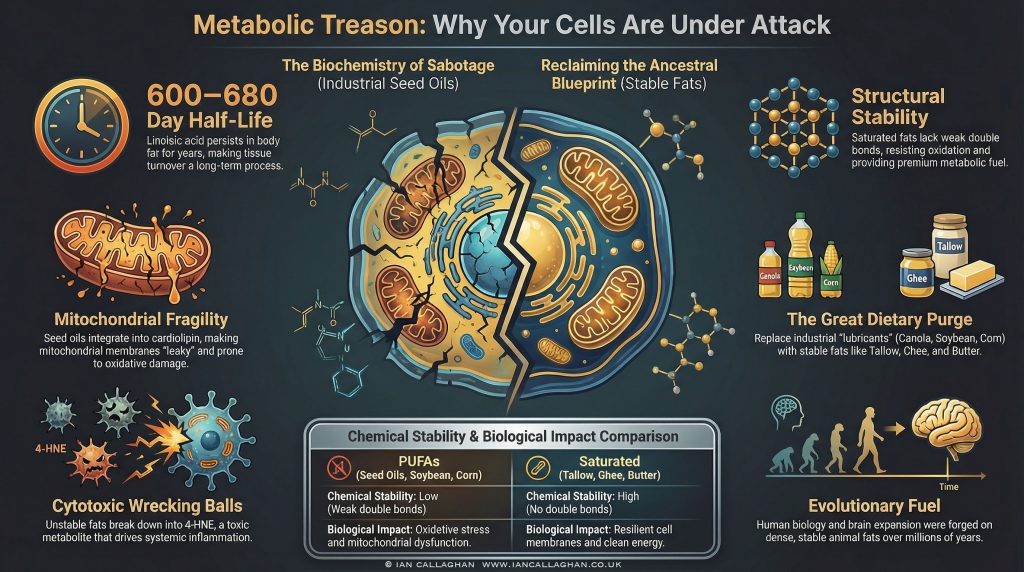
Our engine was forged over millions of years to run on stable lipids. Saturated fats have no double bonds in their carbon chains. They are structurally sound. They resist oxidation and are far less prone to forming nasty by-products when exposed to heat and oxygen. They are premium fuel for an ancient metabolic machine.
For most of human history, metabolic syndrome as a population-wide condition didn’t exist. Obesity was rare. Type 2 diabetes was uncommon. Heart disease was not the normal midlife “expected outcome”. Then came industrial processing, and with it, the great dietary swap.
THE BIOCHEMISTRY OF POISON: SEED OILS AND THE MITOCHONDRIAL ENGINE
Let’s get technical. Because if you don’t understand the sabotage, you stay vulnerable to it.
Seed oils (soybean, corn, canola, cottonseed, sunflower, safflower) are rich in linoleic acid (LA), an 18-carbon omega-6 polyunsaturated fatty acid (PUFA). Unlike saturated fats, linoleic acid contains multiple double bonds. In organic chemistry, double bonds are weak points. They’re more reactive and more prone to oxidation.
When you consume linoleic acid, your body incorporates it into your cellular architecture. It becomes part of your cell membranes. More importantly, it can become part of the inner mitochondrial membrane, including a crucial phospholipid called cardiolipin.
Cardiolipin helps organise and stabilise the electron transport chain. It supports the membrane environment, allowing efficient ATP production. When cardiolipin is built mostly from stable fats, the membrane stays resilient, and the system runs cleaner.
But when the diet is flooded with fragile PUFAs, cardiolipin can become more vulnerable to lipid peroxidation. Those double bonds are more easily damaged under oxidative stress. The membrane becomes leakier. The machinery becomes less efficient. The electron transport chain can become more uncoupled.
When that happens, mitochondria can generate more reactive oxygen species (ROS). Peroxidised linoleic acid can break down into reactive aldehydes, including 4-hydroxynonenal (4-HNE), and other oxidised linoleic acid metabolites (OXLAMs).
4-HNE is a microscopic wrecking ball. It’s cytotoxic. It can bind to proteins, impair mitochondrial function, and contribute to a cascade of inflammation and metabolic stress. Your cells can end up in a brutal contradiction: surrounded by energy, but struggling to generate it cleanly.
This is one plausible pathway into insulin resistance. Fat cells can become overloaded with oxidative stress and dysfunctional energy handling, and they begin to resist further storage as a protective response. Insulin resistance isn’t automatically a “genetic flaw”. In many cases, it’s a defensive adaptation to a toxic environment.
ENTER GLUCIPHER: THE ARCHITECT OF METABOLIC SABOTAGE
You can’t discuss seed oils without talking about the wider con. In my work, I call the architect Glucipher.
Glucipher is metabolic sabotage personified. The whisper in the ear of institutions. The invisible hand behind “heart healthy” marketing. The trickster who convinced people to eat factory oils instead of the fats that built our brains.
Glucipher doesn’t just want you fat. Fat is a side effect. Glucipher wants your cells broken, your appetite dysregulated, your energy unstable, and your hunger permanently switched on.
How did this con get traction? Mid-20th-century nutrition politics. Demonisation of saturated fat, a public-health narrative built on contested data and aggressive messaging. The Seven Countries Study is still debated for its limitations and the conclusions people drew from it. The result was a cultural swap: butter and tallow became “bad”, and seed oils became “good”.
And then came the unholy alliance: seed oils plus refined carbohydrates. If mitochondrial function is compromised, appetite signals can go feral. If you’re stuck in cellular stress, what do you crave? Quick energy. Sugar. Starch. Constant hits.
You eat more, you store more, you crash more. You get hungrier, not satisfied. Glucipher traps you in a loop of eating, storing, and starving.
THE HALF-LIFE OF A BIOLOGICAL BOMB
Here’s a major difference between tobacco and seed oils.
Smoke is exposure. Seed oils are structured.
Linoleic acid can persist in adipose tissue for a long time, with estimates often cited in the range of 600 to 680 days for turnover. That means if you stop right now, it can still take years for tissue composition to shift meaningfully.
Every time you burn fat, you can release stored fatty acids back into circulation. If those fats are more oxidation-prone, they can contribute to oxidative stress and inflammatory signalling as they move through the system.
Our ancestors likely obtained a small percentage of their energy from linoleic acid, enough for basic signalling. Modern diets can push that far higher, largely through ultra-processed foods, restaurant oils, and “healthy” packaged rubbish.
And then the system acts confused. “Why are people inflamed?” “Why is insulin resistance exploding?” “Why is metabolic dysfunction everywhere?” So the machine prescribes statins, GLP-1s, blood pressure meds, and more pills, while still telling people to cook with canola.
It’s metabolic treason.
RECLAIMING THE ENGINE
This part is the good news because it’s in your hands.
You cannot out-medicate a diet built on refined industrial oils. You cannot outrun mitochondrial dysfunction with a few steps and a green smoothie. You can’t biohack a structural problem while still building your body out of unstable inputs.
Metabolic syndrome isn’t “just ageing”. It’s not inevitable. It’s often the predictable outcome of putting volatile fuel into an ancient engine.
To break free, you return to ancestral inputs and modern common sense. You cut industrial seed oils hard. No soybean. No canola. No corn. No sunflower. No safflower. No grapeseed.
You cook with what the human animal actually evolved around. Tallow. Ghee. Butter. Suet. You give mitochondria stable building blocks. You lower oxidative load. You let the system rebuild.
The medical establishment lied about tobacco for decades. They’ve been wrong before. Don’t outsource your biology to institutions that get funded by the same industries selling you the problem.
Stop eating industrial lubricants. Reclaim your metabolic birthright.

Metabolic Sovereignty: Silence Food Noise & Fix Your Metabolism
Tired of the “Food Noise” and the afternoon energy crash?