The Infrastructure of Agency: Why Your ‘Willpower’ is a Maintenance Failure
1. The Knowledge-Execution Gap: Why Awareness Isn’t Agency
Sleep debt willpower. Consider the visceral reality of the “evening load.” It is 10:30 pm. Your eyes are dry, stinging from the blue light of a screen you’ve been staring at for three hours longer than you intended. There is a specific, heavy tightness in your chest—a combination of low-grade anxiety and metabolic exhaustion. You possess a comprehensive intellectual inventory of your failings. You know, with the clinical certainty of a researcher, that the mindless scrolling is a thin veil for avoidance. You know the third glass of wine will decimate your REM cycles. You know that the version of yourself you are currently inhabiting is a diminished, reactive ghost of the person you claim to be.
Yet, despite this high-definition awareness, you cannot stop. This is the knowledge-execution gap: the chasm where “wellness” goes to die.
Most individuals navigating a cycle of chronic self-sabotage do not suffer from a lack of information; they suffer from a catastrophic failure of command. We have been sold a version of “self-development” that prioritises “wellness vibes” over the raw mechanics of the human machine. This is a fatal category error. We are taught to spray essential oils over a collapsing internal structure and call it “healing.” We are encouraged to seek “alignment” when what we actually need is a mechanical overhaul of our hardware.
Managing the mind is not about becoming soft, endlessly positive, or performatively balanced. It is about the architecture of human behaviour. It is about understanding the infrastructure of your biology and the systems of command that dictate whether you are the operator of your life or merely a component in your own collapse. Sovereignty is not found in a Pinterest quote; it is found in the relentless maintenance of the biological machine that generates your reality. If the hardware is compromised, the “truth” you see is nothing more than the noise of a failing system. You are not “bad”; you are poorly serviced.
2. Takeaway 1: Sleep is Load-Bearing Infrastructure, Not a Luxury
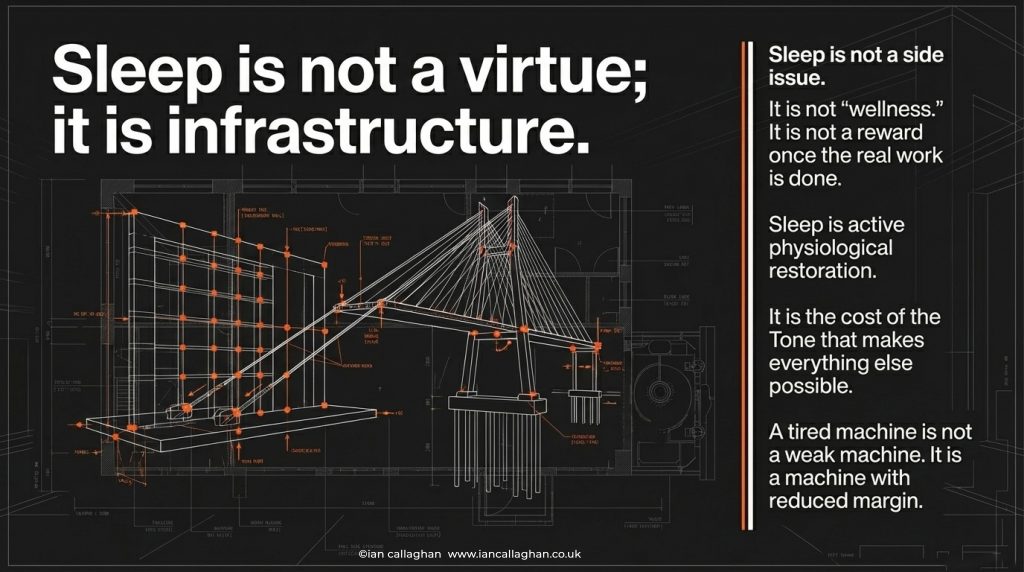
In the traditional wellness narrative, sleep is framed as a reward—a “self-care” luxury to be indulged in once the “real work” of the day is completed. This is a fundamental misunderstanding of the system’s requirements. Sleep must be stripped of its theatre; it is not “rest,” but foundational, load-bearing infrastructure. It is the cost of the “Tone” that makes everything else—your career, your relationships, your sanity—possible.
Mechanically, sleep is “Active Physiological Restoration.” While you are unconscious, the machine performs high-intensity servicing that the waking brain cannot perform. The primary actor here is the Glymphatic system—the brain’s internal waste-clearance mechanism. During deep sleep, the interstitial space between brain cells increases by up to 60%, allowing cerebrospinal fluid to flush away metabolic residue, including beta-amyloid and other neurotoxic “trash.” If you bypass this, the trash remains. You are literally thinking through yesterday’s metabolic sludge.
Simultaneously, the endocrine system regulates stress chemistry. Deep sleep is the primary mechanism for resetting cortisol patterns and restoring heart rate variability (HRV), which serves as a measurable correlate of “Vagal Tone.” The Vagal Brake is the mechanical governor of your nervous system. When you sleep poorly, you wake with your brakes weakened. This leaves the machine “vibrating at a threshold of instability” before your feet even hit the floor. You start the day with elevated baseline cortisol and a sympathetic nervous system already partially engaged. You have zero margin for the world’s inevitable stressors.
“Sleep is not mainly about energy; it is about agency.”
The body is a “timed biological system.” Sleep is anchored by circadian rhythms and morning light, which acts as a critical timing signal that supports the cortisol rhythm. If you miss the morning light, you misalign the system’s primary clock, ensuring that tonight’s sleep will be equally compromised. Reframing sleep as “servicing” rather than “virtue” changes the relationship. You are not being “good” by prioritising an 11:00 pm curfew; you are ensuring the machine clears its debt so you can remain the operator of your choices.
3. Takeaway 2: The Dirty Lens—Why Your Moods are Lying to You
The most dangerous cognitive error we make is assuming that our moods, thoughts, and perceptions accurately reflect external reality. We believe that if we feel hopeless, it is because life is inherently hopeless. However, behaviour sits downstream of state. Your “Tone”—your current load-bearing capacity—is the lens through which you view the world. When Tone is low, the lens is distorted.
A machine that did not restore properly will read neutral stimuli as loaded threats. This is the neurobiology of the “Dirty Lens.” When you are sleep-deprived, the threshold for amygdala activation lowers. The amygdala is the ancient, binary alarm system of the brain; it sees only “safe” or “deadly.” Normally, the prefrontal cortex provides top-down inhibitory control, telling the amygdala to stand down when a partner is simply quiet or an email is slightly curt. But under load, that inhibitory control vanishes.
Lens Distortions Caused by Sleep Debt:
- The Threat Bias: Neutral facial expressions are interpreted as hostile; silence is interpreted as rejection.
- The Insight Fallacy: Hopelessness feels like “insight” into the grim reality of your life, rather than a physiological symptom of depletion.
- Urgency Distortion: Minor tasks feel like insurmountable mountains because the nervous system is already red-lining.
- The Reality of Depletion: You believe you are finally seeing the “truth” of your failing career, when you are actually seeing the state of your sensors.
When the hardware is compromised, logic is conscripted by survival, not truth. Your “insight” into how much you hate your job at 3:00 am is not wisdom; it is the noise of a machine that is out of fuel and desperate for regulation. To reclaim command, you must learn to discount the “realities” generated by a low-Tone state.
4. Takeaway 3: Inside the Internal PR Firm—The Language of Sabotage
The mind is a “brilliant PR firm.” It rarely presents self-destruction as a raw, ugly desire. It does not say, “I would like to ruin my progress and ensure I feel deep shame by 9:00 am tomorrow.” Instead, it sells the sabotage in language that sounds intelligent, reasonable, and—most dangerously—compassionate. It “spins” the narrative of your collapse to bypass your standards.
The PR firm uses specific “Sales Pitches” to facilitate self-sabotage, often relying on the biological failure of future-pacing. Because a depleted brain cannot accurately simulate the state of the future self, it treats “Tomorrow-You” as a different person with infinite energy.
- “You’ve had a hard day”: The appeal to exhaustion. It uses fatigue as a justification for seeking fast relief via dopamine-heavy loops.
- “Just one”: The lie of containment. It ignores the chemical reality that one drink or one episode often triggers a cascade of disinhibition.
- “You deserve it”: The reward trap. It frames self-destructive behaviour as “self-care,” confusing sedation with restoration.
- “You can start properly tomorrow”: The illusion of future-agency. This is a failure of the prefrontal cortex to bridge the temporal gap, allowing present-moment abandonment.
- “It doesn’t matter anyway”: The nihilistic shortcut. It devalues long-term goals to make immediate gratification seem consequence-free.
These thoughts are “old code”—protective patterning dressed up as modern truth. When the system is under load, the PR firm works overtime to find a “reasonable” excuse to seek cheap regulation. Reclaiming the controls requires you to notice the voice of the “oldest employee in the sabotage department” without handing them the authority to make decisions.
5. Takeaway 4: The 100-Millisecond War—The Battlefield of the Gate
The ultimate battlefield of signal and noise is the “100-millisecond war.” This is the tiny temporal gap between a stimulus—an urge, a comment, a stressful thought—and your reaction. In this window, agency is either retained or lost. It is the absolute point of contact where the operator either takes the wheel or is thrown into the back seat.
Neurobiologically, this is the struggle between the amygdala and the prefrontal cortex (PFC). The amygdala is fast; it reacts in milliseconds. The PFC, the seat of human agency and executive function, is slower and more metabolically “expensive” to run. In a High-Tone State (Steel in the Gate), you have enough internal capacity to hold the tension of the moment. You can feel the surge of anger or the craving for sedation and choose not to obey it. You have the “space” to let the noise pass through you.
In a Low-Tone State (The Compromised Gate), the system is narrowed and defensive. The amygdala moves before the PFC even gets its boots on. The space for choice vanishes. You find yourself reacting—shouting, eating, drinking—before you have consciously registered the stimulus. This war is rarely won in the moment of conflict; it is won in the weeks and hours of servicing (sleep) before the trigger arrives. If the hardware is serviced, the gap exists. If not, the outcome of the war is a foregone conclusion.
6. Takeaway 5: Beyond “Cargo Cult” Wellness—Mechanics over Aesthetics
The “Operator” mindset requires a sharp, cold critique of generic wellness culture. We are currently drowning in “Cargo Cult self-development”—the practice of copying the surface-level habits of “healed” people without understanding the underlying physiological mechanism. People perform the aesthetics: they buy the beige linen, drink the green smoothies, and post Instagram clips. This is “decorating dysfunction.”
The goal is not to “look healed”; it is to get the operator back online. We must move from “vibe” to “mechanics” by redefining tools:
| Tool | Operator Definition (Mechanism) | Systemic Impact |
| Cold Plunge | Physiological interrupt/Noradrenaline spike. | Dampens sympathetic response; proves discomfort can be ignored. |
| Journaling | Signal detection/Cognitive externalisation. | Stops the PR firm’s spin by forcing logic onto paper. |
| Visualisation | Identity rehearsal/Future pacing. | Anchors the PFC to a target, overriding “old code” defaults. |
| Breathwork | Vagal leverage/State alteration. | Mechanically engages the parasympathetic nervous system to widen the Gate. |
| Standards | Non-negotiable structural boundaries. | Removes the “choice” element from maintenance, preserving ego-depletion. |
If you use these as aesthetics, you are painting a sinking ship. The question is never “What is the trendiest method?” but “What gets the operator back online?”
7. Takeaway 6: The Sedation Debt—The Truth About Alcohol
Alcohol is the most insidious tool the “internal PR firm” uses to sell a false sense of restoration. To a stressed, high-load machine, alcohol looks like a solution. It appears to settle the system and quiet the noise. However, this is a massive accumulation of debt; alcohol is a “dirty regulator.”
While alcohol provides initial sedation (by mimicking GABA, the brain’s primary inhibitory neurotransmitter), it pays for it via “Rebound Sympathetic Activation.” As the alcohol is metabolised, the brain over-corrects for the sedation by spiking glutamate and cortisol. This causes REM disruption, fragmented sleep, and a massive cortisol spike roughly six hours later. You wake at 4:00 am with a racing heart and a significant Tone deficit.
“The machine… bought sedation and paid for it with restoration.”
This is the ultimate mechanical irony: seeking regulation via a toxin that guarantees dysregulation. By the time you wake, you are already closer to your threshold, making you exponentially more likely to seek “relief” again by evening. You are trapped in a feedback loop of maintenance debt, where the “solution” is the primary driver of the next day’s instability.
8. Takeaway 7: Admitting the Machine—The Humbling of the Ego
The most humbling realisation in this philosophy is that your identity, your emotional framework, and your “willpower” are all downstream of your physiological state. You cannot out-think a compromised hardware system. Logic operates downstream of state. When the hardware is compromised, thinking gets conscripted by survival, not truth.
Admitting that identity is downstream of physiology is humbling because it removes the fantasy that you are a disembodied mind. This is why “food and sleep missions” are Day 1 priorities. They are not glamorous, but they are the load-bearing walls of the entire structure. If you are trying to solve a “state problem” (like anxiety) with thought alone, you are fighting a losing battle against your own biology.
Your identity is a byproduct of restoration. When you admit you are running hardware, you stop asking “What is wrong with me?” as if you have a fundamental character flaw. Instead, you ask “What is the machine doing right now?” If you haven’t slept, haven’t managed your light, and haven’t serviced the system, your “bad character” is actually just a predictable maintenance failure. Stop trying to “think” your way into being a better person and start servicing the machine that generates the person.
9. Takeaway 8: Reading the Drift—Slips as Diagnostic Data
In the “Operator” framework, a “slip” or a “lapse” is rarely an isolated moral failure. It is the final, inevitable result of a “drift” that has been occurring for days. Slips are not character judgments; they are diagnostic trails. They are the result of unobserved maintenance failures that finally reached a breaking point.
If you conduct a “Tone check” of the days leading up to a collapse, you will find the logs of declining servicing:
- Fractured sleep for three consecutive nights.
- Inconsistent morning light exposure.
- Ignored signals of rising cognitive load.
- A gradual surrender to the internal PR firm’s “just one” narrative.
Sleep is the core reading in this diagnostic trail. If your sleep has been fractured for five nights, the “slip” on day six is not a surprise; it is a maintenance failure that no one read early enough to correct. By reframing failures as data, you remove the “morality” and replace it with “standards.” You stop being a hostage to unobserved patterns and start looking for the early warning signs in the machine’s logs. To prevent the slip, you must learn to read the drift.
10. Conclusion: Sovereignty as a Standard
Transitioning to the “Operator” mindset means moving from a reactive state to a command state. It requires a fundamental shift in perspective: from the victimhood of asking “Why am I like this?” to the analytical clarity of asking “What is the machine doing right now, and how do I take back the controls?”
Sovereignty is not a feeling; it is a standard of infrastructure. It is the result of consistent, non-negotiable servicing—prioritising sleep, managing light, and refusing to negotiate with the “internal PR firm.” When you treat sleep and mind management as “sovereignty infrastructure,” you stop looking for magic methods and start building a system that can withstand the load of real life.
The goal was never to look healed. The goal is to stop living as a hostage to your own unobserved patterns. You are the operator of a complex, timed biological system. Treat it as such. The work is not about being “better”; it is about being harder to hijack.
Where in your life have you been trying to win a state problem with thought alone?
Listen to the podcast over at YouTube
Under Load by Ian Callaghan | The Mechanical Guide to Addiction Recovery
You already know what you’re doing. You’ve known for years.