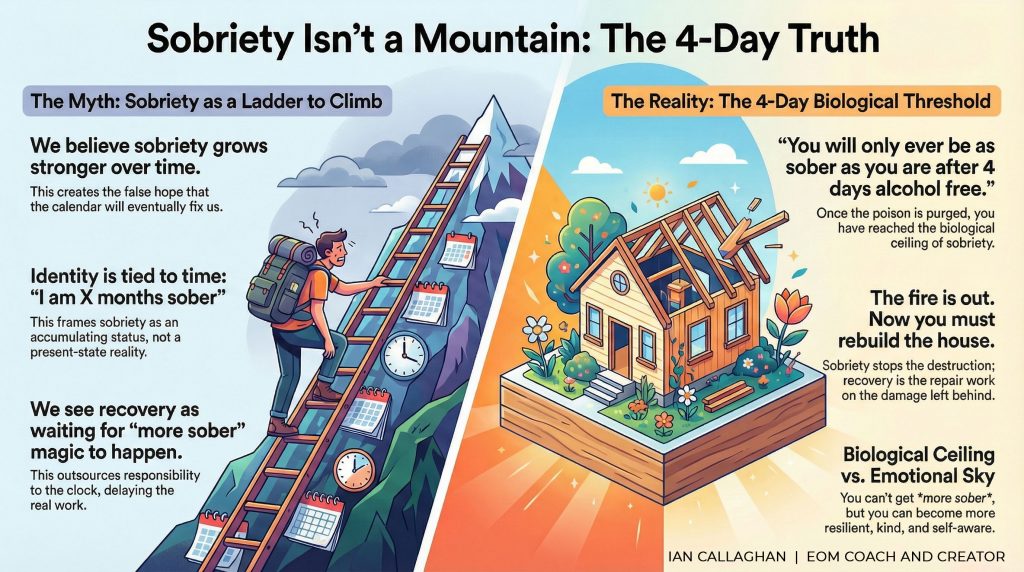
The Lie of the Calendar: Why Sobriety Doesn’t Accumulate
The Gap: Expectation vs. Biological Reality
We are sold a narrative of accumulation. From the moment we first admit defeat, we are told to count. Count the hours, count the days, count the chips, and count the years.
We are led to believe that sobriety is a mountain we climb, where the air gets cleaner and the ground more stable the higher we go. We expect that a man with ten years on the calendar is somehow chemically, physically, and spiritually “more” sober than the man with ten days.
This is the great gap between our expectations and the brutal reality of our physiology.
We chase a future version of ourselves, convinced that “real” sobriety is a destination far down the timeline. We tell ourselves, “If I can just get to six months, I’ll be truly sober.” We wait for a magical transformation that correlates with the turning of calendar pages.
But this waiting is a trap. It is a form of procrastination that keeps us from facing the violent clarity of the present moment.
Here is the unflinching truth, stripped of sentimentality and cliché: You will only ever be as sober as you are after 4 days alcohol free.
That is it. That is the ceiling.
There is no higher plane of physiological purity to ascend to. There is no biological nirvana awaiting you at the five-year mark. The expectation is that time heals all wounds; the reality is that the poison leaves quickly, and you are left with yourself.
The 4-Day Threshold
Let us sit with this uncomfortable fact. You will only ever be as sober as you are after 4 days alcohol free.
In the world of recovery, we often overcomplicate the biological baseline. We conflate emotional growth with physical sobriety. But if we look at the raw data of the human vessel, the timeline is shockingly short.
Four days. Ninety-six hours.
That is the duration required for the immediate physical tyranny to break.
Once you cross that threshold, you have reached the summit of biological sobriety. You are there. You have arrived.
This realisation can be terrifying. It removes the excuse of “early days.” It strips away the buffer of time we like to place between ourselves and responsibility.
If you are four days in, you are done with the physical act of becoming sober. You are standing in the full glare of reality.
The shivering stops. The immediate chemical chaos subsides. The body begins to regulate.
And in that moment, at the 96-hour mark, you possess a level of sobriety that is equal to the person with forty years of abstinence.
You must understand this: You can not be more sober.
It is a binary state. You are either intoxicated or you are not. The poison is either in your system, actively decaying your faculties, or it has been purged.
Once that purge is complete—a process that effectively peaks at day four—you are operating at maximum biological capacity regarding the absence of alcohol.
The Myth of “X Months Sober”
Society loves a badge. We love status. We love the hierarchy of time.
We introduce ourselves with our numbers. “I am six months sober.” “I am five years sober.”
But according to the strict biological reality, you can not be x months sober.
You can be x months disciplined.
You can be x months healing.
You can be x months present.
You can be x months in recovery.
But you cannot be x months sober. Sobriety is the state of the body free from the influence of a toxin. That state is absolute. It does not compound interest.
Think of the danger in believing you can be “more” sober later. It suggests that today, right now, you are “less” sober. It suggests you are incomplete. It permits you to be less than fully accountable because you are “new.”
It feeds the “Dry Drunk” mentality—the idea that you are just white-knuckling it until the magic of time fixes you.
If you believe you become more sober with time, you are outsourcing your recovery to the clock. You are waiting for the calendar to do the heavy lifting that only you can do.
The source of this truth is undeniable: Once your body cleanses the poison that is you, biologically as sober as you ever will be.
Read that again. As sober as you ever will be.
Does that dishearten you? Or does it liberate you?
If you are four days in, you don’t have to wait to start your life. You don’t have to wait for permission to be well. You are already at the finish line of the physical race. The rest is just living.
The Metaphor: The Extinguished Fire
To understand this concept—that sobriety is a fixed state, not a cumulative one—we must look at a metaphor that reflects the binary nature of the condition.
Imagine your life is a house. Alcohol is a fire raging in the living room.
When you are drinking, the house is burning. The structure is weakening, the smoke is choking you, and the heat is unbearable.
When you stop drinking, you are calling in the fire brigade. You are dousing the flames.
It takes about four days for the fire to be completely extinguished. The last ember dies out. The smoke begins to clear.
At that moment, the house is no longer on fire.
Now, ask yourself: Is a house that hasn’t been on fire for ten years “more” extinguished than a house that hasn’t been on fire for four days?
No.
The fire is out in both houses. The state of “not burning” is identical.
A house cannot be “more” not-on-fire.
However, the house that has been safe for ten years might have been repaired. The walls might be repainted. The soot might be scrubbed away. The furniture might be replaced.
The house that has only been safe for four days is still scorched. It smells of smoke. The windows are broken. It is a mess.
But it is not burning.
This is the distinction we miss. We confuse the repair work (recovery) with the state of the fire (sobriety).
You are as sober (fire-free) at day four as you will ever be. The poison is gone. The fire is out.
The panic comes when you look around at the charred remains of your life and realise that simply putting the fire out didn’t fix the roof. It just stopped the destruction.
Cleansing the Poison
The source text is explicit: “Once your body cleanses the poison that is you biologically as sober as you ever will be.”
We must treat alcohol for what it is: a poison.
It is not a treat. It is not a social lubricant. It is a toxin that disrupts the fundamental neurochemistry of your brain.
When you ingest this poison, your body goes into emergency mode. Prioritises the elimination of the threat. Your liver works overtime. Your brain chemistry alters to counteract the depressant effects.
When you stop, the body executes a violent clarity. It purges.
This process is finite. It has a beginning, a middle, and an end. It concludes, largely, around the four-day mark.
At this point, the poison is gone.
This brings us to a terrifying question: If the poison is gone, and I am biologically as sober as I will ever be, why do I still feel this way?
Why is there anxiety? Why is there rage? Why is there an emptiness?
This is where the concept of “Life on Life’s Terms” hits us with the force of a freight train.
When you were drinking, you were blaming the poison. You could say, “I’m a mess because I’m drunk.” “I’m hungover.” “I’m withdrawing.”
After four days, you can no longer blame the presence of the poison.
You are left with the raw materials of your own psyche. You are left with the “you” that exists without the filter.
If you are miserable at day five, it is not because you aren’t sober enough. It is because you are miserable.
Sobriety didn’t fix you. It just revealed you.
The Illusion of Progress
We cling to the “x months sober” badge because it mimics progress.
We live in a world of gamification. We want to level up. We want to see the progress bar fill.
But biology does not care about your progress bar.
The liver does not say, “Well done, mate, you’ve done six months, I’ll function 10% better today.” The liver simply functions, or it doesn’t. Once the poison is gone, it is doing its job.
The danger of thinking “I can not be more sober” is that it sounds like a ceiling on our potential. But it is actually a floor for our reality.
If you accept that you can not be more sober than you are right now (assuming you are past day four), you strip away the romanticism of the journey.
You are forced to confront the “Dry Drunk.”
A Dry Drunk is someone who has removed the poison—they have achieved the maximum biological sobriety of day four—but they have not touched the scorched walls of the house.
They are sober. Technically. Biologically.
But they are angry. They are resentful. They are emotionally unregulated.
They are waiting for the “more sober” fairy to come and fix their attitude. They think if they just wait until year one, the magical “sober” dust will settle, and they will be happy.
The source text destroys this hope. It tells us: This is it. This is the baseline.
If you want to be happy, you have to build it. Sobriety won’t do it for you. Sobriety just clears the site so you can start building.
The Violence of Clarity
Let’s discuss the “violent clarity” of the four-day mark.
For years, you may have lived in a fog. You regulated your emotions with a chemical valve. Too happy? Drink. Too sad? Drink. Bored? Drink.
You flattened the peaks and filled the valleys of your emotional landscape.
Then, you stop.
Four days pass. The poison exists. You will only ever be as sober as you are in this moment.
Suddenly, the fog lifts. And what do you see?
You see the wreckage.
This is why relapse is so common shortly after the physical withdrawal ends. It isn’t because the body craves the poison essentially; it’s because the mind cannot handle the view.
The clarity is too brutal.
We think, “I need to get more sober to handle this.”
No. You need to get stronger. You need emotional resilience. You need tools.
But you do not need “more” sobriety. You have all the sobriety you are ever going to get. You have the full deck of cards right now. You just don’t know how to play them yet.
The Trap of Deferring Life
One of the most insidious side effects of the “x months sober” myth is that it allows us to pause our lives.
“I can’t date yet, I’m only two months sober.”
“I can’t look for a new job, I need to be a year sober first.”
“I can’t deal with my trauma until I have more time under my belt.”
This is fear masquerading as wisdom.
Based on the text—Once your body cleanses the poison that is you biologically as sober as you ever will be—there is no physiological reason to wait.
Your brain is clear. Your blood is clean.
You are capable of making rational decisions. You are capable of feeling complex emotions. You are capable of facing life on life’s terms.
You are using the calendar as a shield.
You are hoping that time will make the hard things easier. Sometimes it does, but only through practice, not through the passive accumulation of days.
If you sit in a room for a year and do nothing but not drink, you will be one year “dry,” but you will be exactly as “sober” as you were on day four. And you will likely be just as miserable.
Redefining the “Sober” Identity
If we accept the premise that you can not be x months sober, we have to change how we speak about ourselves.
Instead of saying, “I am becoming sober,” say, “I am sober. Now I am becoming human.”
This shift is crucial.
“Becoming sober” suggests a never-ending struggle against the bottle. It keeps the alcohol at the centre of your universe. It gives the poison power it does not deserve.
If you are always “getting sober,” then the alcohol is the protagonist of your story, and you are just the character reacting to it.
But if you accept that after four days, the deed is done—the poison is gone—then the alcohol is irrelevant. It is part of your history, not your present biology.
You are free.
The chains are off. You aren’t loosening them day by day. They dropped off at day four.
Why are you still standing there acting like you’re bound?
Walk away.
Confronting the Internal Void
The scariest part of the text, “you will only ever be as sober as you are after 4 days alcohol free,“ is the implication of what is left behind.
If the alcohol is gone, and you are fully sober, and you still feel empty, that emptiness is yours.
It belongs to you. It isn’t the drink’s fault anymore.
This is the internal surrender required for true recovery. You must surrender the scapegoat.
You can no longer say, “It’s the booze talking.” It’s you talking.
You can no longer say, “I’m not myself.” You are exactly yourself.
This is the “brutal honesty” required to move from being merely “dry” to being “well.”
You have to look at the sober version of yourself—the one that emerged on day four—and decide if you like that person.
If you don’t, you have work to do. But that work is not “staying sober.” That work is self-improvement. It is therapy. It is mindfulness. It is an exercise. It is a connection.
Do not confuse the maintenance of the vehicle with the driving of the journey.
Sobriety is just checking the oil and filling the tank. It is the baseline maintenance. It doesn’t get you anywhere. You still have to drive the car.
The Biological Ceiling vs. The Emotional Sky
We must distinguish between the ceiling and the sky.
The text establishes a biological ceiling. You hit the roof of physical sobriety at day four. You cannot go higher.
However, the emotional sky is limitless.
While you cannot be more sober, you can be:
- More patient.
- More kind.
- More self-aware.
- More resilient.
- More connected.
These are the metrics we should be tracking.
Stop counting the days you haven’t swallowed poison. Start counting the moments you reacted with grace instead of anger. Start counting the mornings you woke up with gratitude instead of dread.
Those are the markers of recovery.
The “4 days” rule frees you to focus on these things.
If you are obsessed with your day count, you are obsessed with the poison. You are looking backwards at the thing you left behind, counting the steps away from it.
Turn around. Look forward.
The poison is gone. The body is cleansed. You are as sober as you will ever be.
What are you going to do with it?
The “Forever” Trap
The idea of “forever” keeps many people sick.
“I can’t imagine being sober forever.”
“I have to be sober for 20 years?”
The source text dismantles this anxiety. You don’t have to be sober for 20 years to be “sober.”
You just have to be sober for four days.
And then, you just maintain that state.
You are not accumulating a mountain of time that can crash down if you slip. You are simply maintaining a state of “poison-free.”
It transforms the insurmountable mountain into a simple, daily switch.
Switch off the poison. Wait four days. You are there.
Every day after that is just a repeat of the same biological state. It is not a heavier burden; it is the same burden, carried one day at a time.
The Physiological Reset
Let’s look closer at the phrase “Once your body cleanses the poison.”
The human body is a miraculous machine of regeneration. It wants to heal.
The liver regenerates. The neural pathways begin to re-fire. The gut lining repairs.
But this initial “cleansing” is swift. It is a biological priority.
Once it is done, the body moves to homeostasis. It seeks balance.
If you introduce the poison again, you reset the clock. You go back to zero. You have to do the four days again.
But if you don’t introduce the poison, the body doesn’t keep “cleansing” forever. It finishes the job.
It is done.
So, stop acting like you are in a constant state of detox. You aren’t. After day four, you are in a state of living.
The fatigue you feel at month three isn’t the poison leaving your body. It’s life. It’s depression. It’s burnout. It’s a poor diet.
Treat the root cause. Don’t blame the ghost of the bottle.
Authority and Ownership
To fully embrace the truth that you can not be x months sober, you must take authority over your own existence.
This is the opposite of the victim mentality that often plagues early recovery.
“I am an addict, I am powerless.”
Perhaps over the alcohol, yes. But once the poison is gone (day four), you are not powerless over your choices. You are not powerless over your stress reaction.
You possess the full agency of a sober adult.
This is where the concept of “Emotional Regulation” becomes paramount.
A child throws a tantrum when they don’t get their way. An alcoholic drinks when they don’t get their way.
A sober adult—who accepts they are fully sober and responsible—pauses. They breathe. They assess. They choose.
If you are six months in and still reacting like a child, it is not because you need more time sober. It is because you haven’t learned to regulate your emotions.
The text forces us to stop waiting for the alcohol to stop being the problem and start realising we are the project.
Summary of the Hard Truths
- The Ceiling: Sobriety peaks at day 4.
- The Myth: You cannot be “more” sober at year 10.
- The Reality: Biology cleanses the poison quickly; the rest is psychology.
- The Metaphor: The fire is out. Now fix the house.
- The Responsibility: You can’t blame the poison after the purge.
This perspective is not meant to diminish the achievement of long-term abstinence. Stopping is hard.
But it is hard for psychological reasons, not biological ones.
It is hard because life is hard. It is hard because feelings are painful. It is hard because we have to face the mess we made.
But we face it with a clear head. We face it with a body that has done its job.
The body has cleansed the poison. It has fulfilled its end of the bargain.
Now, you must fulfil yours.
Actionable Focus: The 5-Minute Mindfulness Anchor
You have read the truth. You understand that physiologically, if you are past day four, you are at the peak. Now you must deal with the noise in your head that the poison used to silence.
You need a tool to handle the “violent clarity.”
The Action: Practice the “Sober Anchor” technique.
This is not about emptying your mind. It is about grounding your body in the present reality of its sobriety.
- Sit Down: Find a quiet chair. Feet flat on the floor.
- Close Your Eyes: Remove visual stimulation.
- Scan the Body: Start at your toes. Move up. Do you feel the shakes? No? (If you are past day 4). Do you feel the nausea? No?
- Acknowledge the Cleanliness: Say to yourself, internally or out loud: “The poison is gone. My vessel is clean. I am here.”
- Breathe into the Void: You might feel anxiety or emptiness. Don’t fight it. Breathe into it. Imagine that space is a clean room waiting to be furnished.
- Hold for 5 Minutes: Set a timer. Just sit with the reality of being a clean vessel.
Do this every morning. Remind yourself that the physical battle is won. The fire is out.
Today is just about painting the walls.

Rewiring The Mind: The Identity Shift That Changes Everything (Digital Manual)
Stop chasing symptoms. Fix the machine. Rewiring The Mind is not a memoir—it is a mechanic’s manual for your brain. Written by Ian Callaghan (Army Veteran, 45-year drinker), this guide combines Stoic Philosophy, Evolutionary Biology, and Nervous System Regulation to help you break the loop of anxiety, drinking, and survival mode. You don’t need more willpower. You need a new identity. (Instant PDF Download)