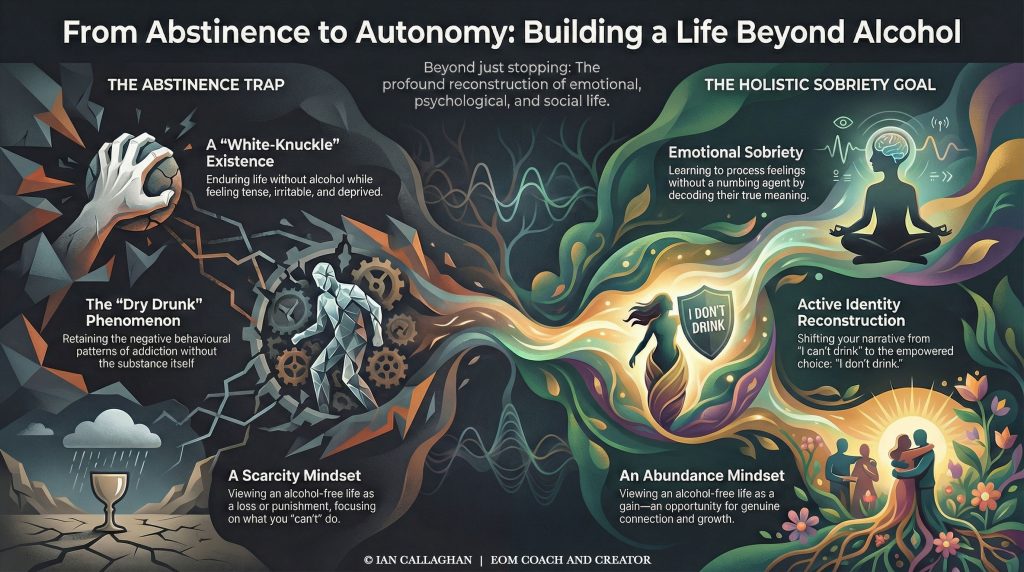
Sobriety isn’t Just Not Drinking; it is the radical act of rebuilding an entire life architecture that has been dominated by a habit for over four decades.
When you have spent 45 years viewing the world through the bottom of a glass, putting the glass down is merely the demolition phase—the actual construction of a new life begins only when you realise that the absence of alcohol is not the same as the presence of peace. For those of us who have walked away from alcohol after a lifetime of use—without the confines of labels like “alcoholic,” without the rigid structure of the 12 steps, and without a sponsor telling us what to do—the journey is unique. It requires a high degree of self-awareness and a commitment to understanding that Sobriety Isn’t Just Not Drinking. It is about emotional regulation, identity shifting, and the reclamation of time.
This guide explores the profound difference between abstinence and true sobriety, specifically tailored for the independent thinker who has chosen freedom over steps.
The Difference Between Abstinence and Autonomy
If you treat sobriety solely as the act of not consuming ethanol, you are likely to endure a miserable existence often referred to in recovery circles as “white-knuckling.” Abstinence is a physical state; sobriety is a mental and emotional stance.
After 45 years of drinking, your brain and body have conditioned themselves to expect a chemical buffer between you and reality. You likely used alcohol to celebrate, to commiserate, to relax, to socialise, and to sleep. When you remove that buffer, you are left with raw, unfiltered reality. If you do not build new mechanisms to handle that reality, you are simply a dry version of your former self—tense, irritable, and feeling deprived.
True autonomy in sobriety involves:
- Rejecting Deprivation: Viewing alcohol-free life as a gain, not a loss.
- Emotional Agility: Learning to process feelings without a numbing agent.
- Identity Shifting: Moving from “I can’t drink” to “I don’t drink.”
The phrase Sobriety Isn’t Just Not Drinking encapsulates the move from a scarcity mindset (I am missing out) to an abundance mindset (I am free).
The “Void” of the First Year
Having passed the one-year mark, you have likely encountered “The Void.” This is the vacuum left behind when the drinking ritual is removed. If you drank for three hours a night, that is 21 hours a week—nearly a part-time job—that is suddenly empty.
Many people fail in independent recovery because they try to stare into the void rather than filling it. They sit on the sofa at 6:00 PM, the “witching hour,” and think about how much they want a drink. This is abstinence. Sobriety, conversely, is filling that time with pursuits that were previously impossible. It is the understanding that the boredom you feel is not a lack of alcohol; it is a call to action from a brain that has been sedated for nearly half a century.
Emotional Sobriety: Learning to Feel Without a Filter
The most challenging aspect of long-term recovery is not the physical withdrawal, which passes relatively quickly, but the emotional resurgence. For 45 years, alcohol likely acted as your primary emotional regulator. If you were stressed, a drink lowered the cortisol. If you were angry, a drink dulled the edge. If you were bored, a drink provided artificial dopamine.
Sobriety Isn’t Just Not Drinking; it is the terrifying and exhilarating process of learning to self-soothe like an adult.
The Physiology of Emotional Numbing
When we drink for decades, we stunt our emotional growth. We may be mature in business, family management, or intellect, but emotionally, we often remain at the age we were when the heavy drinking began. When the alcohol stops, the emotions flood back with high intensity.
You may find yourself experiencing:
- Disproportionate Anger: Small inconveniences feel like major catastrophes.
- Sudden Grief: Mourning the loss of the alcohol itself or the time lost to it.
- Anhedonia: The temporary inability to feel pleasure, as your dopamine baseline resets.
The Strategy of “Sitting With It”
In a label-free, step-free recovery, there is no sponsor to call when emotions run high. You must become your own counsellor. This requires a technique often called “surfing the urge” or “sitting with the feeling.”
When a wave of anxiety hits, the drinker’s instinct is to drown it. The sober individual’s task is to observe it. You must acknowledge that feelings are transient data points, not commands. You might feel lonely, but that does not mean you need a drink; it means you need a connection. You might feel exhausted, but that doesn’t mean you need wine; it means you need rest.
By decoding the signal rather than silencing it, you achieve emotional sobriety. This is the core proof that Sobriety Isn’t Just Not Drinking—it is active emotional intelligence.
Deconstructing the Identity: Who Are You Without the Drink?
Perhaps the most complex layer of recovery after 45 years is the identity crisis. In British culture specifically, drinking is woven into the fabric of social identity. We meet at the pub; we toast at weddings; we commiserate at funerals.
If you have spent decades as the “life and soul of the party” or the “connoisseur of fine wines,” stripping that away can feel like losing a limb. The question arises: If I am not a drinker, who am I?
The Trap of Labels
The traditional medical and 12-step models often encourage adopting the label of “alcoholic.” For many, this is a saving grace. However, for the autonomous recoverer, this label can feel restrictive and disempowering. It suggests a permanent state of illness and a permanent powerlessness over a substance.
By rejecting labels, you are free to define your own identity. You are simply a person who used to drink a liquid that no longer serves them. This reframing is crucial. It shifts the narrative from “I am a sick person fighting a disease” to “I am a healthy person making a logical lifestyle choice.”
Re-Navigating Social Architecture
Sobriety Isn’t Just Not Drinking in private; it is confident non-drinking in public. The first year is often spent navigating the awkwardness of the “Why aren’t you drinking?” interrogation.
A key part of this new identity is realising that you do not owe anyone an explanation. You do not need to confess to a “problem” to justify abstinence.
- The Polite Refusal: “I’m not drinking tonight, thanks.”
- The Health Angle: “It doesn’t agree with me anymore.”
- The Truth: “I’ve done my 45 years; I’ve retired from the sport.”
As you move past the one-year mark, you will notice that your genuine friends do not care what is in your glass. Those who pressure you are usually projecting their own insecurities about their alcohol consumption onto you. Recognising this dynamic is a sign of maturity in sobriety.
Neuroplasticity and Rewiring the 45-Year Habit
To understand why Sobriety Isn’t Just Not Drinking, one must look at the neuroscience of a 45-year habit. We are dealing with deeply ingrained neural pathways. This is not a lack of willpower; it is biology.
The Path of Least Resistance
For decades, your brain created a super-highway associating alcohol with reward. Trigger (5 PM) -> Action (Pour Drink) -> Reward (Dopamine hit). This pathway is paved with concrete. The pathway for “Have a cup of tea and read a book” is an overgrown dirt track.
Simply “not drinking” leaves the super-highway open but unused, creating a sense of longing. True sobriety involves actively paving new roads—neuroplasticity.
Dopamine Deficits and The Flatline
In the early stages of alcohol-free life (and often persisting into the second year), you may experience a “flatness.” Alcohol releases a flood of artificial dopamine. Over 45 years, your brain down-regulated its own dopamine production to compensate.
When you quit, the artificial flood stops, but your natural production is still low. Life feels grey. Food tastes bland. Music sounds flat. This is not your new reality forever; it is a healing phase.
- Exercise: One of the few ways to naturally boost dopamine and endorphins immediately.
- Novelty: Doing things you have never done before forces the brain to pay attention and form new connections.
- Micro-Goals: Setting and achieving small goals provides natural dopamine hits.
By actively engaging in these activities, you are physically repairing the brain structure. You are not just abstaining; you are healing.
The Myth of the “Pink Cloud” vs. The Reality of The Grind
In recovery literature, people often speak of the “Pink Cloud”—a period of euphoria shortly after quitting where everything feels magical. For a long-term drinker of 45 years, this cloud might be fleeting or non-existent.
You may have found that after the initial physical improvements (better sleep, weight loss, clear eyes), the novelty wore off. This is the danger zone where the thought creeps in: “Is this it? Is this all there is?”
This is where the distinction that Sobriety Isn’t Just Not Drinking becomes critical. If you stop at the physical benefits, you will eventually become bored and relapse. The “Grind” is the process of finding meaning in the mundane.
Finding Meaning in the Mundane
Alcohol makes doing nothing feel like doing something. You can sit in a chair for four hours, drinking wine, and feel entertained. Without alcohol, sitting in a chair for four hours is intolerable.
Sobriety forces you to engage with life. It demands that you:
- Find genuine hobbies: Not things you do to pass time, but things that ignite passion.
- Connect deeply: Having conversations that you will actually remember the next day.
- Face mortality: 45 years of drinking often serves to hide the passage of time. Sobriety makes you acutely aware of it, urging you to use your remaining years with intention.
The “Grind” is not a punishment; it is the friction required to sharpen your new character.
(End of Part 1)
Sobriety Isn’t Just Not Drinking: Navigating Emotional Recovery and The Long Game
Real recovery begins the moment you realise that putting down the bottle is merely the admission ticket to a life where Sobriety Isn’t Just Not Drinking, but rather a complete reconstruction of how you process reality.
If Part 1 dealt with the physical cessation and the immediate aftermath, Part 2 addresses the psychological architecture required to sustain that change. For a drinker with a 45-year tenure, the alcohol was not just a beverage; it was a coping mechanism, a social lubricant, and an identity. Removing it leaves a structural void. If you do not fill that void with emotional intelligence and deliberate action, the structure will collapse.
The Raw Nerve: Emotional Regulation in a Sober Life
The most shocking realisation for many in the first year of sobriety is the sudden onset of unfiltered emotion. For decades, alcohol acted as a buffer—a chemical dimmer switch that softened the edges of anger, grief, anxiety, and even extreme joy.
When the buffer is removed, you are left with a “raw nerve.” Minor inconveniences, such as a delayed train or a rude shop assistant, can feel catastrophic.
Learning to Sit with Discomfort
The immediate instinct when feeling negative emotion is to seek an exit strategy. Historically, that exit was a drink. Because Sobriety Isn’t Just Not Drinking, the new task is learning to “sit with” the feeling. This is often referred to in therapy as “distress tolerance.”
- The Pause: In the past, the gap between feeling an emotion and reacting to it (drinking) was non-existent. You must now cultivate a pause.
- Labelling: Simply naming the emotion (“I am feeling humiliated,” “I am feeling lonely”) reduces its power. Alcohol robbed you of the vocabulary of feeling; you must relearn it.
- The Wave Theory: Understand that emotions are like waves. They peak and then subside. Alcohol freezes the wave in place; sobriety allows it to crash and recede.
For the long-term drinker, this is terrifying. You may be experiencing emotions you haven’t felt in their pure state since you were a young adult. It requires the courage to feel exposed.
The Phenomenon of the “Dry Drunk”
Nothing illustrates the concept that Sobriety Isn’t Just Not Drinking better than the phenomenon of the “Dry Drunk.” This term describes an individual who has abstained from alcohol but has retained all the behavioural patterns, attitudes, and coping mechanisms of active addiction.
A Dry Drunk acts out the chaos of alcoholism without the liquid. They are often miserable, and frankly, miserable to be around.
Common Characteristics of the Dry Drunk:
- Terminal Uniqueness: Believing your problems are so special that no standard recovery advice applies to you.
- Grandiosity vs. Self-Loathing: Oscillating between thinking you are better than everyone else and feeling like the worst person on earth, with no middle ground.
- Judgementalism: Harshly criticising others (especially those still drinking or those in recovery doing it “wrong”) to deflect from internal pain.
- Impatience: Expecting 45 years of damage to be repaired in 45 days.
If you remove the alcohol but keep the cynicism, the selfishness, and the refusal to grow, you are not in recovery; you are merely abstinent. Recovery requires a personality change sufficient to bring about a recovery from alcoholism.
Restructuring Social Architecture
In the UK, the pub is often the centre of community life. It is the “third place”—not work, not home, but the neutral ground where life happens. For a long-term drinker, the social circle is often curated around the availability of alcohol.
When you sober up, you undertake a painful but necessary “Social Audit.” You will quickly discover the difference between Friends and Drinking Associates.
- Drinking Associates: These relationships are based on proximity and a shared activity. You may have spent decades with these people, but if you remove the alcohol, you find you have nothing to talk about. The silence is deafening.
- True Friends: These people care about you, not your participation in a round of drinks. They will adapt to your sobriety.
The Grief of Lost Connections
It is vital to acknowledge the grief involved here. You may lose people you thought were vital to your life. They may pull away because your sobriety holds a mirror up to their own drinking. This is not personal; it is a defence mechanism.
However, Sobriety Isn’t Just Not Drinking—it is the pursuit of authentic connection. Sobriety allows you to look people in the eye and listen to them without waiting for your turn to speak (or your next trip to the bar). The connections you build in recovery, though potentially fewer, are infinitely stronger and more resilient.
Dealing with Anhedonia (The inability to feel pleasure)
A significant hurdle in the “Grind” phase is Anhedonia—a flatlining of emotions where nothing feels particularly good.
Alcohol releases a flood of dopamine (the reward chemical). After 45 years of artificial floods, your brain has down-regulated its receptors. It has “forgotten” how to produce dopamine for normal stimuli like a beautiful sunset, a good meal, or a job well done.
- The Science of Patience: This is a biological injury. It takes time for the brain’s neurochemistry to rebalance.
- The Trap: Many relapse here because they think, “I’m sober, but I’m not happy. I might as well drink.”
- The Solution: You must force engagement. You have to go for the walk, paint the picture, or cook the meal even if you don’t feel like it. You are retraining your brain to recognise natural rewards.
Eventually, the colour returns to the world. A cup of tea in the morning becomes satisfying. A laugh with a friend becomes genuine. It is subtle, but it is real.
Identity Reconstruction: Who Are You?
If you spent 45 years as “the fun guy at the pub” or the “hard-drinking worker,” stripping that away can provoke an identity crisis. You are left asking: Who am I?
This is the most exciting part of the premise that Sobriety Isn’t Just Not Drinking. You have been given a blank slate late in life.
- Revisiting Youth: What did you love before you started drinking? Was it history? Model building? Hiking? Writing? Those passions didn’t die; they were just preserved in alcohol.
- Neuroplasticity: Contrary to the old adage, you can teach an old dog new tricks. The sober brain is capable of learning new languages, skills, and philosophies.
- Service: One of the fastest ways to build a new identity is to be of service to others. Helping another alcoholic, volunteering at a food bank, or simply being a reliable neighbour builds self-esteem. Esteem comes from doing estimable acts.
The Toolkit for Long-Term Maintenance
To ensure this journey lasts, you need a toolkit. Willpower is a battery that runs out; habits are the generator that keeps running.
1. “Play the Tape Forward”
When the urge to drink strikes (and it will, even years later), do not focus on the first drink. Focus on the inevitable conclusion.
- The Fantasy: “A cold beer would be lovely on this sunny afternoon.”
- The Reality: “I will have ten beers. I will argue with my spouse. I will pass out. I will wake up shaking, full of shame, and unable to function.”
Playing the tape forward to the unglamorous end kills the romanticism of the urge.
2. HALT
Hunger, Anger, Loneliness, and Tiredness are the four horsemen of relapse.
- Hungry: Low blood sugar mimics anxiety. Eat something.
- Angry: Vent it safely. Do not swallow it.
- Lonely: Call someone. Go to a meeting.
- Tired: Sleep is the foundation of sanity. Protect your sleep hygiene fiercely.
3. Rigorous Honesty
Addiction thrives in secrecy and small lies. Recovery demands rigorous honesty. If you are struggling, say it. If you made a mistake, admit it. Secrets are the seeds of relapse.
Conclusion: The Freedom of The Grind
The journey of recovery is not a straight line ascending to heaven; it is a spiral. You will circle back to old feelings, but you will face them from a higher vantage point each time.
For the long-term drinker, the prospect of life without alcohol can initially seem like a sentence to a grey, flat existence. However, as the fog clears, you realise that the life you were living was the grey one—monochromatic and repetitive.
By embracing the difficult truth that Sobriety Isn’t Just Not Drinking, you unlock the door to a second act. You move from being a passenger in your own life—anaesthetised and drifting—to being the driver.
The “Grind” eventually stops feeling like effort and starts feeling like life. You wake up clear-headed. You keep your promises. You are present for your loved ones. You feel the sun on your face and you realise it.
Sobriety is not the absence of alcohol; it is the presence of everything else. It is the return of dignity, the restoration of health, and the discovery that reality, with all its sharp edges, is infinitely preferable to the comfortable numbness of the bottle.
Keep going. The view gets better the higher you climb.
The Architecture of Autonomy: Independent Paths to Sobriety
For independent thinkers who reject traditional labels like “alcoholic” or the rigid structure of the 12 steps, navigating recovery involves a shift from “abstinence” (a physical state) to “autonomy” (a mental and emotional stance). This process requires rebuilding your “life architecture” to handle reality without a chemical buffer.
Based on the provided text, here is how independent thinkers can navigate emotional regulation and social changes:
1. Emotional Regulation: From Numbing to “Sitting With It”
For long-term drinkers, alcohol often serves as the primary emotional regulator—lowering cortisol when stressed or providing artificial dopamine when bored. Removing alcohol reveals a “raw nerve,” where minor inconveniences can feel catastrophic because the brain has stunted emotional growth at the age heavy drinking began.
• Decode the Signal: Instead of silencing emotions, you must learn to treat feelings as data points. An urge to drink when lonely is actually a signal for connection; an urge when exhausted is a signal for rest. This is “active emotional intelligence”.
• Sit with Discomfort: Independent recovery requires becoming your own counsellor. You must learn to “surf the urge” or observe emotions as transient waves that peak and subside, rather than commands that must be obeyed.
• Combat Anhedonia: A major hurdle is the “flatness” or inability to feel pleasure (anhedonia) caused by dopamine downregulation. You cannot wait to feel good before acting; you must force yourself to engage in activities (exercise, hobbies, cooking) to physically repair brain structure and rewire natural reward pathways.
• Avoid the “Dry Drunk”: Emotional sobriety means avoiding the retention of active addiction behaviours—such as cynicism, “terminal uniqueness,” and judgment of others—while simply removing the liquid.
2. Navigating Social Changes and Architecture
Socially, independent thinkers are encouraged to reject the “sick person” narrative in favour of viewing non-drinking as a logical, healthy lifestyle choice.
• The Social Audit: You must distinguish between “True Friends” (who care about you) and “Drinking Associates” (relationships based solely on proximity and alcohol). You may lose connections, but the remaining relationships will be based on an authentic connection rather than a shared substance.
• Identity Shifting: Move from a scarcity mindset (“I can’t drink”) to an abundance mindset (“I don’t drink”). This shift empowers you to view sobriety as a gain of freedom rather than a deprivation.
• Public Confidence: You do not owe anyone an explanation or a confession of a “problem.” Useful scripts for social situations include “I’ve retired from the sport” or simply “It doesn’t agree with me anymore”.
• Handling “The Void”: Recovering the 20+ hours a week previously spent drinking creates a vacuum. Navigating social and personal time requires filling this void with genuine passions and “micro-goals” rather than staring into it.
3. Toolkit for Long-Term Maintenance
To sustain this new identity without a sponsor, you must rely on self-awareness and practical psychological tools:
• Play the Tape Forward: When urges strike, visualise the unglamorous conclusion (shame, shaking, arguments) rather than the romanticised first drink.
• HALT: Recognise that cravings are often misidentified as physical or emotional needs: Hunger, Anger, Loneliness, or Tiredness.
• Neuroplasticity: Embrace the “Grind” of rewiring the brain. By engaging in novelty and learning new skills, you pave new neural pathways, allowing the old “super-highway” to alcohol to become an overgrown, unused track.
Ultimately, the goal is to move from being a passenger in your own life to being the driver, finding meaning in the mundane and realising that sobriety is “not the absence of alcohol; it is the presence of everything else”.
Emotional Mastery: The Emotional Operating System
The Emotional Mastery book is a practical manual for understanding and regulating the human nervous system using the Emotional Operating System framework.
Instead of analysing emotions or retelling your past, the Emotional Mastery book teaches you how to read emotional states as system feedback, identify overload, and restore stability under pressure.
No labels. No therapy-speak. No endless healing loops.
Just a clear, operational approach to emotional regulation that actually holds when life applies load.
Instant digital download.